
Key takeaways
- Compare the best door rugs for snow, from WaterHog and Gorilla Grip mats with water dams to a drainage scraper that lets meltwater run through and away fast.
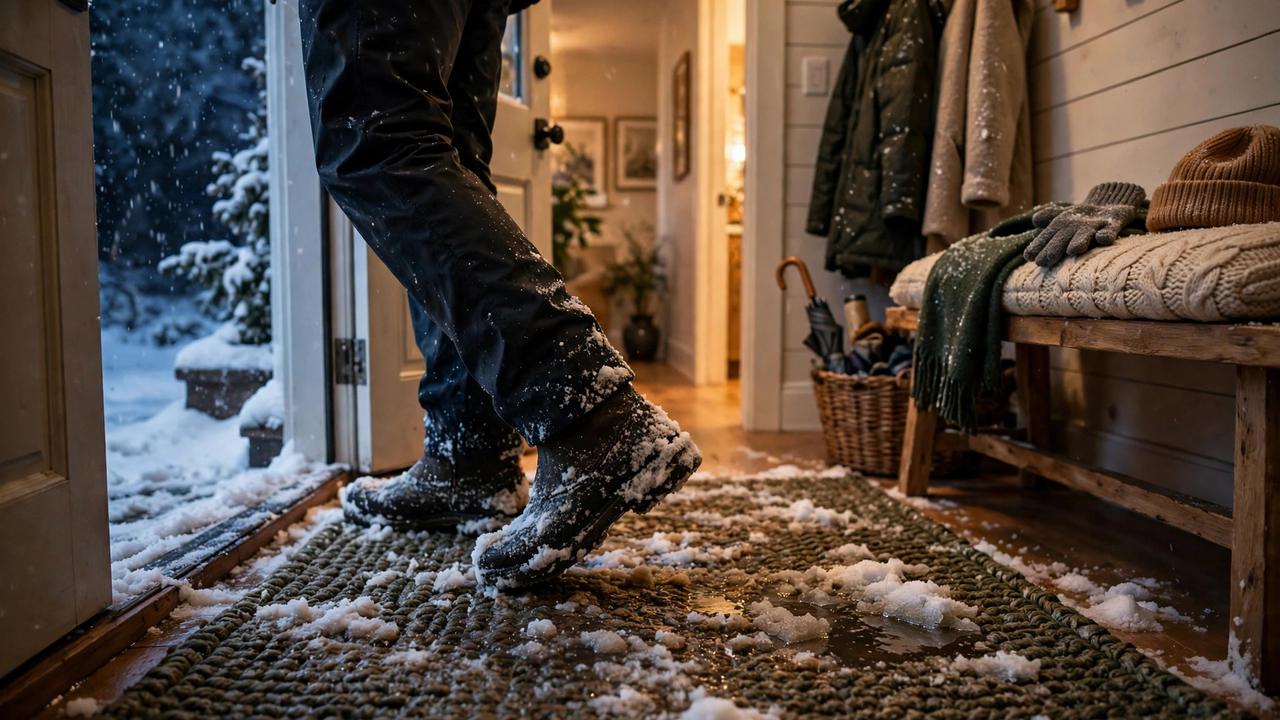
Snow changes what a door rug has to do. In dry weather a mat mostly brushes dust off soles, but in winter every pair of boots arrives carrying packed snow in the tread, grit and road salt mixed into that snow, and then, once inside a warm entry, a steady drip of meltwater that keeps coming long after the boots themselves have been taken off. A thin decorative rug that works fine in October can turn into a wet, sliding sheet in January, and the water it fails to hold does not disappear. It spreads across tile, seeps toward wood flooring, and leaves white salt marks and gritty puddles exactly where people are most likely to step in socks. Choosing the best door rugs for snow is therefore less about colour or a welcome message and more about three practical jobs done in order: scrape the boot, absorb or drain the meltwater, and hold everything the mat collects so it does not run off the edges onto the floor.
This guide looks at six door mats that approach those jobs in different ways, because snowy entries are not all the same. A covered porch outside the door calls for a different mat than the space just inside the threshold. A wide mudroom door needs more coverage than a narrow apartment entry. A home where boots are left to drip for hours needs containment, while a busy doorway where people pass straight through needs a surface that scrapes quickly and then lets water move away. Among the picks below you will find two Gorilla Grip mats that use grooved topsides and rubber borders, a WaterHog mat with a bi-level square pattern built for heavy traffic, an all-rubber Rubber-Cal drainage mat that lets water pass through holes instead of holding it, and two lower-profile woven mats from Mibao and OLANLY that suit doors with limited clearance. Each one is described only with specifications its maker lists, so you can compare size, thickness, materials and cleaning methods on a like-for-like basis.
Before the detailed picks, it helps to picture a snowy entry as a two-step system. The first step happens outside or right at the threshold, where a stiff, open or deeply grooved surface knocks the bulk of the snow out of boot treads. The second step happens inside, where an absorbent surface with a border or a rubber backing catches the meltwater that the first step missed. Some households can only fit one mat, and in that case the mat has to compromise between scraping and absorbing. Others can place a scraper outside and an absorbent mat inside, and that pairing is usually the most forgiving arrangement of all. The picks below can be used on their own, and several of them work especially well as one half of that pairing.
Quick verdict
If you want one all-round mat for a snowy front door, start with the WaterHog Squares Door Mat. Its bi-level square pattern scrapes in the raised areas and traps water and grime in the lower channels, its size gives boots room to land fully on the mat, and the maker lists simple shake, sweep, vacuum or hose cleaning. If meltwater volume is your main worry inside the door, the GORILLA GRIP HydroABSORB is the specialist: the maker lists an absorption figure in cups, a water dam border and deep grooves, and it is recommended for covered outdoor spaces or indoor use rather than an exposed step. If your door sits close to the floor, the GORILLA GRIP WeatherMAX, the Mibao Welcome mat and the OLANLY Front Door Mat all sit at the same slim thickness the makers list, so clearance is less likely to be a problem, though you should still measure your own gap. And if you would rather not store water in a mat at all, the Rubber-Cal Dura-Scraper Drainage takes the opposite approach, letting liquid drain through holes in a solid rubber surface that can be hosed down. There is no single winner for every entry, but there is a clear match for each kind of snowy doorway in the table that follows.
Comparison table
| Product | Size the maker lists | Thickness the maker lists | Surface and backing the maker lists | Best placement |
|---|---|---|---|---|
| GORILLA GRIP WeatherMAX Door Mat 29×17 Beige Quatrefoil | 29 x 17 inches | 0.3 inch | Woven topside with deep grooves, beveled rubber border and retention dam; natural rubber backing | Indoor or outdoor, high-traffic door |
| GORILLA GRIP HydroABSORB Door Mat 29×17 Black | 29 x 17 inches | 0.3 inch | Polyester topside, raised square pattern, water dam border; textured rubber backing | Indoor or covered outdoor, wettest entries |
| WaterHog Squares Door Mat 23×35.5 Camel | 23 x 35.5 inches | About 0.38 inch | Bi-level square pattern, recycled PET fabric surface; rubber backing with recycled content | Indoor or outdoor, wide or busy entry |
| Rubber-Cal Dura-Scraper Drainage Door Mat 24×36 Black | 24 x 36 inches | 0.38 inch | Natural and reclaimed rubber with drainage holes | Outside the door or wet commercial-style entry |
| Mibao Welcome Door Mat 17×30 Brown | 17 x 30 inches | 0.3 inch | Polyester surface with deep grooves; thermoplastic rubber backing | Indoor or outdoor, narrow door |
| OLANLY Front Door Mat 29.5×17 Grey | 29.5 x 17 inches | 0.3 inch | Polyester striped surface; polyvinyl chloride backing as listed | Indoor or outdoor, low-clearance door |
Read the table as a starting point rather than a ranking. The two larger mats, the WaterHog Squares and the Rubber-Cal Dura-Scraper Drainage, cover more of the landing zone in front of a door, which matters when two people arrive together or when boots are set down on the mat to drip. The four slimmer mats trade that coverage for a lower profile and a smaller footprint that fits an apartment entry, a side door or the space between a storm door and an inner door. Thickness is closely grouped across the list, so the real differences are in how each surface handles water: holding it behind a dam, absorbing it into a polyester top, trapping it in channels below foot level, or draining it straight through.
How we selected
Selection started with the snow-specific jobs described above. A mat had to offer a scraping action, through deep grooves, a raised pattern, a bi-level surface or drainage holes, because smooth mats let packed snow ride straight through the doorway on the boot. It also had to offer a stated way of dealing with meltwater, whether that was absorption the maker quantifies, a border or dam that contains water on the mat, channels that hold water below the walking surface, or holes that let it drain away. Mats that were purely decorative, with no listed scraping texture and no listed water handling, were left out even when they were widely sold.
Each product in this guide was checked on an opened product page with full details, and the specifications in its section are the specifications that page lists, phrased as the maker lists them. Where a maker gives a water capacity, that figure is reported in the maker’s own terms and only for that product, because makers measure capacity differently and the figures are not directly interchangeable. Where a maker recommends a placement, such as covered outdoor use, that recommendation is reported too, since placing an absorbent indoor mat on an exposed, freezing step is a common reason a snow mat disappoints. Sizes and colours in the product names are the exact variants checked, because door mats are sold in many size and colour combinations under one listing and the details can differ between them.
We also weighed practical ownership. Snow mats need frequent cleaning, because the grit and salt they collect will keep spreading if the mat itself is never emptied. Cleaning methods the makers list, from shaking and vacuuming to hosing and air drying, are therefore included for every pick. Door clearance was another filter: every pick here is a low-profile mat by the thickness its maker lists, but the guide still advises measuring the gap under your door, since a mat that a door drags across will bunch, wear at the edge and eventually become a trip point rather than a help. Finally, no prices, ratings or review counts are used in this guide, and nothing here is based on hands-on testing. The comparisons rest on maker-listed construction, size and care information, applied to the situations snowy entries actually present.
Top picks
GORILLA GRIP WeatherMAX Door Mat 29×17 Beige Quatrefoil
The WeatherMAX is Gorilla Grip’s all-season design, and its relevance to snow comes from the combination of a grooved woven topside and a border that is meant to keep what the grooves collect from escaping. The maker lists deep grooves, a beveled rubber border and a retention dam that help capture dirt, debris and moisture, and describes the topside as stain, weather and fade resistant, constructed to withstand conditions from snow and rain to mud and sand. For a snowy entry that means the mat can sit on either side of the door: outside as the first scraping surface on a covered porch, or inside as the mat that receives boots once the worst of the snow has been knocked off at the threshold. The Beige Quatrefoil variant checked here is the 29 by 17 inch size, a standard single-door footprint that suits a front door without overwhelming a small entry.
- Size: the maker lists 29 x 17 inches
- Thickness: the maker lists 0.3 inch, with a low profile design that allows doors to open over the mat
- Topside: the maker lists a durable woven topside with deep grooves and a Quatrefoil pattern in beige
- Border: the maker lists a beveled rubber border and retention dam to help capture dirt, debris and moisture
- Backing: the maker lists a natural rubber backing, noting that natural rubber provides higher tensile strength and higher tear resistance
- Weather resistance: the maker lists a stain, weather and fade resistant topside for indoor and outdoor use
- Care: the maker lists hand wash only
In snow terms, the retention dam is the detail to focus on. Meltwater behaves differently from rain that lands on a mat outdoors, because it arrives in a concentrated spot under a boot and then spreads slowly as more snow melts. A beveled border gives that water an edge to stop at, and the grooves give grit somewhere to settle below the next pair of soles. The natural rubber backing matters in cold entries too, because a backing that stays grippy on a cold tile or wood floor keeps the mat from travelling every time someone wipes their feet vigorously, which is exactly the motion a snowy doorway demands. The trade-off is care: the maker lists hand wash only for this mat, so if your routine is to carry a filthy mat outside and hose it down, check that instruction against your habits before choosing it, and consider one of the hose-clean picks below instead.
Buy it if: you want one mat that can work inside or outside a high-traffic front door, with a dam and grooves to hold meltwater and grit, and you are comfortable with hand washing. Skip it if: your entry is wide enough that a 29 by 17 inch mat leaves most of the landing zone uncovered, or you want a mat the maker says you can simply hose clean.
GORILLA GRIP HydroABSORB Door Mat 29×17 Black
The HydroABSORB comes from the same maker as the WeatherMAX but is built around absorption rather than all-weather toughness. The maker describes it as its most absorbent door mat and lists that it can absorb up to 1.7 cups of water, with an ultra soft polyester topside that the maker says absorbs more water than other materials. Around that topside sits a water dam border with deep grooves and a bi-level design, intended to capture water and prevent excess moisture from spilling onto the floor. The raised square pattern adds the scraping element, helping to remove dirt from shoes, boots, cleats and paws before it reaches the absorbent surface. For snow, this is the profile of an indoor mat: boots arrive already scraped, stand on the squares while snow loosens, and the meltwater is absorbed and dammed rather than left to pool on a hard floor.
- Size: the maker lists 29 x 17 inches
- Thickness: the maker lists 0.3 inch, with a low profile design that allows doors to open over the mat
- Absorption: the maker lists that the mat can absorb up to 1.7 cups of water
- Topside: the maker lists an ultra soft polyester topside with a raised square pattern and deep grooves
- Border: the maker lists a water dam border with a bi-level design to help capture water and prevent spills onto the floor
- Backing: the maker lists a textured rubber backing
- Placement: the maker lists indoor or outdoor use and recommends covered outdoor spaces
- Resistance: the maker lists stain, weather and fade resistance, and a crush proof construction for high-traffic areas
- Care: the maker lists hand wash only
The covered-space recommendation deserves emphasis in a snow guide. An absorbent mat left on an open step through a storm takes on snow faster than any household mat can hold it, and absorbed water in an unheated, exposed spot can freeze in the fibres. Used as the maker directs, inside the door or under a porch roof, the HydroABSORB’s capacity is aimed at the realistic load: the meltwater from a family’s boots across an evening, held in the mat instead of migrating across the entry floor. The black variant checked here also hides the grey-brown tint that melted road grit leaves on lighter mats, which is a practical rather than decorative consideration in midwinter. As with the WeatherMAX, care is listed as hand wash only, so plan on vacuuming and spot attention through the season rather than hosing.
Buy it if: meltwater inside the door is your main problem, you have a covered or indoor spot for the mat, and a maker-listed absorption figure matters to you. Skip it if: you need a mat for a fully exposed outdoor step, or you want the larger landing coverage of a mat wider than 29 by 17 inches.
WaterHog Squares Door Mat 23×35.5 Camel
WaterHog mats are the heavy-duty end of this list, built on a bi-level idea that suits snow particularly well. The maker lists a raised square pattern that scrapes dirt and debris from shoes while lower channels help trap water and grime below the surface, so the walking surface stays drier than a flat absorbent mat that holds water at foot level. The Camel variant checked here measures 23 by 35.5 inches, noticeably wider than the standard single-door mats above, which gives two boots room to stand side by side with space to spare and gives a household a bigger target when people come in carrying bags and not looking down. The maker positions it for muddy boots, wet shoes, messy paws, rain, snow, leaves and dirt at busy entrances, porches, mudrooms and garage entryways.
- Size: the maker lists 23 x 35.5 inches, with up to 3 percent size variance noted by the maker
- Thickness: the maker lists about 3/8 inch high
- Surface: the maker lists a bi-level square pattern, with raised squares for scraping and lower channels for trapping water and grime
- Materials: the maker lists a fabric surface containing at least 90 percent recycled polyester PET and a rubber backing containing up to 20 percent recycled rubber
- Backing: the maker lists a rubber backing certified by the National Floor Safety Institute for grip
- Placement: the maker lists indoor and outdoor use at front doors, back doors, porches, mudrooms, garage entries and pet entrances
- Origin: the maker lists the mat as made in the USA, in Dalton and LaGrange, Georgia
- Care: the maker lists shake, sweep, vacuum or hose off, then allow the mat to air dry
For snowy households, the hose-off care is a genuine advantage, because a mat that traps salt and grit in deep channels needs a cleaning method that can flush those channels, not just lift surface dirt. Shaking and vacuuming handle the dry days, and a hose handles the thaw days when the channels hold a slurry of meltwater and road grit. The size also changes how the mat can be used: at this width it can sit inside a mudroom door as a standing and boot-removal zone, not just a wipe strip, which means boots can stay on the mat while they drip instead of being carried across the room still wet. Check door clearance carefully, though, since at about 3/8 inch high this is the joint-thickest style in the guide, and measure the swing of your door over the exact spot where the mat will lie.
Buy it if: you have a wide or busy entry, want a bi-level surface that traps meltwater below foot level, and want hose-off cleaning. Skip it if: your door gap is very tight, your entry is too narrow for a mat of this width, or you prefer a softer absorbent feel underfoot indoors.
Rubber-Cal Dura-Scraper Drainage Door Mat 24×36 Black
The Dura-Scraper Drainage takes the opposite approach to meltwater from every absorbent mat in this guide: instead of holding water, it lets water leave. Rubber-Cal lists a series of holes meant for the draining of liquids and even small debris particles, in a mat made from natural and reclaimed rubber. Placed outside a door, that means snow scraped off boots falls or melts through the mat rather than sitting on its surface turning to slush, and the textured rubber surface is listed as anti-slip protection for a home or commercial entryway. The variant checked here is the 24 by 36 inch size in black, at 3/8 inch thick, a commercial-style footprint that covers the full landing in front of most single doors.
- Size: the maker lists 24 x 36 inches
- Thickness: the maker lists 3/8 inch
- Weight: the maker lists 9 pounds
- Materials: the maker lists natural rubber and reclaimed rubber
- Drainage: the maker lists holes meant for draining liquids and small debris particles
- Surface: the maker lists a textured, anti-slip surface for entryway use indoors or outdoors
- Colour: the maker lists black
- Care: the maker lists cleaning with a hose and common non-caustic cleansers
This is the pick to understand as the outdoor half of a two-mat system. On its own outside the door, it gives boots a heavy, stable scraping surface that will not absorb water, will not stay soggy, and can be hosed clean when salt and grit build up. What it does not do is absorb the meltwater that boots still carry once they step inside, because drainage and absorption are different jobs. Pair it with any absorbent pick in this guide inside the threshold and each mat does the job it is built for. Used alone indoors, it makes most sense in a garage entry, a utility space or a commercial-style doorway where water draining through to a hard, washable floor is acceptable. Its weight helps it stay put on an exposed step where lighter mats can shift, and the all-rubber construction is listed by the maker for wet climates and year-round use.
Buy it if: you want an outdoor scraper that drains meltwater through instead of storing it, with hose-down cleaning and a heavy rubber build. Skip it if: you need a single indoor mat to absorb meltwater off boots, or a softer, more decorative surface for a front hall.
Mibao Welcome Door Mat 17×30 Brown
The Mibao Welcome mat is the narrow-door option in this guide. The variant checked here measures 17 by 30 inches in brown, a longer, slimmer rectangle that fits the swing of a standard door in a compact entry, a hallway entrance or an apartment doorway where a wider mat would crowd the space. The maker lists a polyester surface with a deep groove design that scrapes dirt, mud, sand and grass from shoes and traps moisture within its fibres, keeping interior floors clean and dry in rainy or snowy weather, in the maker’s description. A textured rubber backing, listed as thermoplastic rubber in the specifications, is described as gripping various floor types and keeping the mat in place in high-traffic areas.
- Size: the maker lists 17 x 30 inches
- Thickness: the maker lists 0.3 inch, as a low-profile, snag-free design
- Surface: the maker lists a polyester surface with a deep groove design and a Welcome pattern
- Backing: the maker lists a textured thermoplastic rubber backing
- Placement: the maker lists indoor and outdoor use at entrances, porches, patios, garages and hallways
- Resistance: the maker lists waterproof, fade and stain resistant materials
- Care: the maker lists vacuum, sweep or shake outdoors, and for a deeper clean wipe with a damp cloth and mild soap or rinse with a garden hose, then air dry completely; do not use bleach
For snow, this mat’s role is the everyday wipe-and-trap mat inside or just outside a smaller door. The deep grooves give boot treads something to scrape against in a short distance, which matters in a narrow entry where nobody takes more than a step or two on the mat. Its cleaning list is the most flexible in this guide, covering quick shaking for dry snow days and a hose rinse for the gritty thaw, and the maker notes it dries quickly. What it does not list is a raised dam or border, so on the wettest days, with several pairs of boots dripping at once, meltwater has less containment than the Gorilla Grip or WaterHog designs provide. In a household where boots are removed promptly and placed on a tray, that matters less; in a household where boots stand on the mat for hours, pair this mat with a boot tray or choose a dammed design.
Buy it if: your doorway is narrow, you want a low-profile mat with flexible cleaning options, and boots are removed promptly rather than left dripping. Skip it if: you need a raised border to contain hours of meltwater, or your entry is wide enough to justify a larger mat.
OLANLY Front Door Mat 29.5×17 Grey
The OLANLY Front Door Mat is a slim, striped all-weather mat in the standard single-door size. The variant checked here is the grey 29.5 by 17 inch mat, with a vertical stripe pattern the maker describes as combining a classic look with a contemporary one. The maker lists a polyester surface that traps dirt and quickly absorbs moisture from shoes, keeping floors clean and dry, and describes the construction as handling high traffic while protecting the home from water, dust and sand. At 0.3 inch thick, the maker lists it as an ultra-slim, low-profile design for smooth door clearance, which is the first thing to check off for doors that sit close to the floor or for entries with both a storm door and an inner door competing for the same small space.
- Size: the maker lists 29.5 x 17 inches
- Thickness: the maker lists 0.3 inch, as an ultra-slim low-profile design
- Surface: the maker lists a polyester surface with a vertical stripe pattern
- Backing: the maker lists a polyvinyl chloride backing in the specifications, described as a stable non-slip base; the construction also lists recycled PVC materials
- Placement: the maker lists indoor and outdoor use at entryways, patios and porches
- Resistance: the maker lists absorbent, fade resistant, non-slip, shed resistant and waterproof features
- Weight: the maker lists 2.2 pounds
- Care: the maker lists spot clean only in the specifications, and describes vacuuming, sweeping or shaking outdoors for everyday care
In a snowy entry, this mat works as the neat, low-clearance option: it slides under doors that would catch on a thicker mat, its striped polyester surface gives soles a textured pass that takes off loose snow and absorbs the first melt, and its light weight makes the daily shake-out over a porch rail easy even when the mat is wet. The limits follow from that slim build. There is no raised dam in the maker’s description, and the listed care is spot cleaning rather than hosing, so this is a mat for households that will shake it often and keep on top of grit before it builds up, rather than a mat to leave unemptied through a long thaw. It suits a side door, a covered porch door or an indoor entry where another surface outside does the heavy scraping first.
Buy it if: door clearance is your tightest constraint, you want a light mat you can shake out daily, and your heaviest scraping happens on another surface. Skip it if: you need meltwater containment from a dam or border, or a mat the maker lists as hose-clean for heavy salt and grit.
Buying guide
Start with placement, because it decides everything else. A mat outside an uncovered door lives in the weather: it will be snowed on directly, frozen overnight and walked on with the full load of snow a boot can carry. Open or draining rubber designs, like the Rubber-Cal pick, suit that spot because they store nothing. A mat under a porch roof or inside the door lives a gentler life and can be absorbent, because its water load is only what boots bring to it. Makers’ placement guidance reflects this: the HydroABSORB is recommended for covered outdoor spaces, while the drainage mat is built for exposed wet conditions. Buying an absorbent mat for an exposed step, or a drainage mat as your only indoor mat, is the most common way to end up disappointed with an otherwise good product.
Match the water strategy to your household’s habits. There are four strategies in this guide. Absorption, listed for the HydroABSORB with a maker-stated capacity, suits entries where boots stand and drip in one place. Containment, through the retention dam on the WeatherMAX or the water dam border on the HydroABSORB, suits hard floors where any runoff is immediately visible and slippery. Trapping below the surface, the WaterHog approach, suits busy doors because the walking surface stays comparatively dry even while the mat is holding water and grit in its channels. Drainage, the Rubber-Cal approach, suits outdoor landings where water can leave through the mat and disperse. Think about where the water goes in your entry at the end of a snowy day, and choose the strategy that sends it somewhere harmless.
Measure twice: the landing and the door gap. For the landing, a mat should be wide enough that both boots land on it without aiming, and long enough for a full step plus a wipe. The sizes here run from 17 inches wide to 35.5 inches wide, and that difference is the difference between a wipe strip and a standing zone. For the gap, measure the clearance under your door at the point where the mat will sit, remembering that floors are not always level and doors sometimes sag toward one side. Every pick here is listed at 0.3 inch or about 3/8 inch thick, but the only measurement that matters is your own door over your own floor. If a door drags, a mat will bunch and become a hazard, so treat a tight result as a reason to choose the slimmest option or place the mat just outside the swing.
Plan the cleaning routine before you buy. Snow mats collect an abrasive mix of grit and salt that shortens a mat’s life if it stays in the fibres, and a saturated mat stops absorbing. Check the care the maker lists and be honest about what you will do weekly in winter. Shaking works for dry snow and loose grit and is listed for most picks here. Vacuuming suits indoor mats between deeper cleans. Hosing, listed for the WaterHog, Rubber-Cal and Mibao picks, is the most effective reset after a thaw but needs an outdoor spot and drying time. Hand wash or spot clean only, listed for the two Gorilla Grip mats and the OLANLY respectively, asks for more patience and suits households that stay ahead of dirt rather than rescuing a neglected mat. Whichever you choose, let a wet mat dry fully when you can; a mat that never dries between storms starts each day already part full.
Think in systems for the hardest entries. If your entry defeats single mats every winter, combine roles: a drainage or heavy scraper outside, an absorbent or dammed mat inside, and a boot tray beside the door for the pairs that will drip for hours. Keep a stiff brush by the door for packed snow in deep treads, since no mat scrapes as well as a brush on a lifted boot. And in freezing weather, remember that any mat holding water in an unheated porch can freeze stiff; bringing an absorbent mat inside to dry overnight keeps it working and keeps the porch safer to step on in the morning.
FAQ
Should a snow mat go inside or outside the door?
Ideally, scraping happens outside and absorbing happens inside, because that order removes the bulk of the snow before it can melt indoors. If you can only have one mat, place it where the meltwater will do least harm and choose its type accordingly: a draining or heavily grooved mat outside, or an absorbent mat with a border inside. The makers’ own placement guidance in each pick above, such as covered outdoor use for the HydroABSORB, is a good guide to which side of the door each design prefers.
How big should a door rug for snow be?
Big enough for both boots to stand on with room to wipe. For a single door, the standard sizes in this guide, around 29 by 17 inches, work as a wipe strip, while the wider 23 by 35.5 inch and 24 by 36 inch mats work as standing zones where boots can be taken off on the mat. Measure your landing first, and leave the door’s swing clear of any bunching by checking thickness against your door gap as well as footprint against your floor.
What thickness is safe for door clearance?
Every mat in this guide is listed by its maker at 0.3 inch or about 3/8 inch thick, which makers describe as low profile designs that allow doors to open over the mat. That is a description, not a guarantee for your door. Measure the actual gap under your door, test the swing across the whole arc, and remember that a mat placed on top of an existing rug or an uneven threshold effectively becomes thicker. If the door grazes the mat, move the mat outside the swing or choose a slimmer placement.
How do I clean a mat full of salt and grit?
Start dry: shake the mat outdoors and vacuum what shaking loosens, because grit is easier to remove before it gets wet. For mats whose makers list hose cleaning, such as the WaterHog Squares, the Rubber-Cal Dura-Scraper Drainage and the Mibao Welcome mat, rinse the channels or holes through, then air dry fully before putting the mat back. For mats listed as hand wash or spot clean only, follow that instruction rather than hosing, and vacuum more often through the season so salt does not build up in the fibres.
Can an absorbent snow mat freeze?
Yes, if it is holding water in a space that drops below freezing, such as an unheated porch or garage entry. That is one reason makers recommend some absorbent mats for covered or indoor use. If your entry is unheated, favour a drainage design outside, bring absorbent mats into a heated space to dry when they are saturated, and check the mat before the first step of the morning, since a frozen mat is both ineffective and slippery.
Do I still need a boot tray with a good snow mat?
For households where boots come off and stand for hours, a tray and a mat do different jobs. The mat handles the walking zone, scraping and catching meltwater where people step. A tray handles the storage zone, containing the long, slow drip from boots that are no longer being worn. A mat with a dam or deep channels covers short drips well, but a tray beside the door is the simplest way to keep an evening’s worth of meltwater in one washable place.
Conclusion
The right door rug for snow is the one whose water strategy matches your doorway. Choose the WaterHog Squares for a wide, busy entry that needs meltwater trapped below the walking surface and hose-off cleaning. Choose the GORILLA GRIP HydroABSORB when absorption inside a covered or indoor entry is the priority, and the WeatherMAX when you want a dammed, grooved all-rounder for either side of a high-traffic door. Choose the Rubber-Cal Dura-Scraper Drainage for an exposed landing where water should drain through rather than be stored, and pair it with an absorbent mat inside for the strongest two-step system. For narrow or low-clearance doors, the Mibao Welcome and OLANLY Front Door mats keep the profile slim while still scraping and absorbing the everyday load. Measure your landing and your door gap, commit to the cleaning routine the maker lists, and any of these six will keep more snow, grit and meltwater on the mat and off your floors through the winter.
More from Amazon
Programs that pair well with the guide above. Offers and eligibility are set by Amazon and may change.
Collect the home and kitchen items you want in one registry that guests can shop from.
Create a wedding registrySet up recurring deliveries of everyday items on eligible products. Terms and savings are set by Amazon.
Explore Subscribe & SaveFree shipping on eligible items, Prime Video and more. Eligible new members can start with a free trial.
Start a Prime free trialAudiobooks and podcasts to listen to on the go. Eligible new members can start with a free trial.
Try Audible freeAs an Amazon Associate we earn from qualifying purchases.










Write Your Review
No reviews yet. Be the first to share your experience!