We independently review everything we recommend. When you buy through our links, we may earn a commission. As an Amazon Associate we earn from qualifying purchases.
Best Microfiber Towels for Vinyl Records: Top 6 Picks
Compare the six best microfiber towels for vinyl records, from large 12-inch cloths to extra-large and anti-static packs, with sizes, weaves and pack counts.
Compare the six best microfiber towels for vinyl records, from large 12-inch cloths to extra-large and anti-static packs, with sizes, weaves and pack counts.
A record is only as clean as the cloth you wipe it with. Paper towels shed fibres into the groove, old cotton T-shirts can drag grit across the surface, and a cloth that has spent a month in a kitchen drawer brings its own contamination to the job. Purpose-made microfiber is different: the split fibres lift dust and hold it inside the weave instead of pushing it around, the edges are soft enough for a playing surface, and a good cloth works dry for a quick dust-off or damp for a proper wet clean. If you are shopping for the best microfiber towels for vinyl records, the differences that matter are size, weave, pack count and whether the cloth is genuinely made for records rather than borrowed from a car-detailing kit.
This guide compares six cloth packs that are sold specifically for vinyl care. They range from a compact 7-inch square you keep beside the deck for fingerprints, to an extra-large cloth that can sit under a whole LP as a work mat while you clean it, to a mixed set that pairs absorbent pearl-weave towels with small smooth detail cloths. Every pick below is a standalone cloth pack, not a brush or a cleaning kit with a cloth thrown in, so you can compare like with like and build the cloth rotation your collection actually needs.
Quick verdict
For most listeners, the GrooveWasher pack of three 12-inch cloths is the easiest recommendation: the maker lists a dense 400 GSM split-fibre weave, the size matches an LP almost exactly, and three cloths are enough to run a clean, dry and spare rotation. If static is your main enemy, the Hudson Hi-Fi and Record-Happy five-packs are both built around anti-static handling, in larger and smaller formats respectively. Collectors who clean in batches will get more mileage from the Honeydak eight-pack, anyone who wants a cloth big enough to work on top of should look at the extra-large MayRecords pair, and wet-cleaning and record-washer users are best served by the HumminGuru set, which mixes four absorbent pearl-weave towels with two smooth detail cloths.
The products in this guide
GrooveWasher Microfiber Cleaning Cloth for Vinyl Records (Pack of 3)
The weave as 100 percent ultra-fine split-fibre microfiber at 400 GSM, which puts it at the dense, plush end of the record-cloth market
We started with a simple filter: the product had to be a microfiber cloth or towel sold for vinyl records, available on its own rather than only as an accessory inside a brush kit. That filter removed several well-known names. One famous drying cloth, for example, turned out on its own listing to be made entirely of cotton, so it does not belong in a microfiber round-up no matter how good it is at its own job. General-purpose household and auto-detailing towels were also left out, even when they are excellent cloths, because their makers do not position them for record surfaces and their edging, dyes and finishing treatments are chosen for paintwork and glass rather than for grooves.
Each surviving product was checked on its opened Amazon listing for the details that decide whether a cloth suits record care: the fibre blend or weave weight where the maker publishes it, the cloth dimensions, the pack count, and whether the maker describes dry use, wet use, or both. We favoured cloths whose makers talk about lint, static and scratching in record-specific terms, and we treated size as a first-order feature rather than a footnote, because a cloth that is too small folds into a thick pad that is hard to control, while one that is too large for the job bunches up and drags its own trailing edge across the label.
Finally, we spread the six picks across the ways people actually clean. Some listeners wipe a record for ten seconds before every play. Some sit down once a month and wet-clean a stack of second-hand finds. Some own a record washer and need cloths mainly for handling and final drying. A useful shortlist has to serve all three habits, so the picks below differ deliberately in size, count and weave instead of being six versions of the same towel.
GrooveWasher built its name on record-cleaning fluid, and this cloth is designed as the other half of that system. The maker lists the weave as 100 percent ultra-fine split-fibre microfiber at 400 GSM, which puts it at the dense, plush end of the record-cloth market. Density matters for two reasons. A heavier weave holds more fluid before it starts to smear it around, and the split fibres present far more edge surface to lift dust out of the outer grooves instead of skating over it. At 12 by 12 inches, each cloth matches the diameter of an LP, so you can lay a record on one cloth, clean the top side with a second, and keep the third dry for a final pass.
The maker describes the cloths as anti-static and suitable for use dry or wet, and that dual role is where this pack earns its place as the default choice. Used dry, it is a sensible pre-play dust-off cloth that leaves less behind than a brush alone. Used slightly damp, or with record-cleaning solution, it becomes a proper wet-cleaning towel that absorbs as it wipes. The maker also notes the cloths are machine washable and can be tumble dried on low heat, which keeps the long-term routine simple: wash them separately, skip fabric softener, and retire a cloth to turntable-dusting duty once its face starts to look tired.
Three cloths is the right count for a rotation and the wrong count for a marathon. If you wet-clean twenty second-hand LPs in one sitting, you will want a fresh section of cloth more often than three towels allow, and you will either rinse mid-session or reach for a bigger pack like the Honeydak below. The 400 GSM plushness also means the cloth is thicker in the hand than a thin lens-style microfiber, which some people love for control and others find bulky when folded into quarters. Those are the only real caveats on an otherwise complete everyday pick.
Buy it if: you want one pack that covers daily dust-offs and occasional wet cleans, you clean with a bottled solution, and you value a dense, absorbent weave sized exactly to an LP.
Skip it if: you clean large batches in one session and need more than three cloths in rotation, or you prefer a very thin cloth you can fold small for detail work around the label.
Hudson Hi-Fi sells a wide range of turntable accessories, and this five-pack is its dedicated cloth offer: anti-static microfiber cloths made for vinyl records and, notably, for record covers as well. That second job is easy to overlook and genuinely useful. Outer sleeves and jackets collect the same room dust that ends up on the vinyl, and wiping a jacket down before you slide a clean record back into it stops the sleeve from re-dusting the surface you have just cleaned. A five-pack lets you keep cloths in more than one place: a couple by the turntable, one with the cleaning supplies, and one reserved for jackets and the platter.
The anti-static positioning is the headline. Static is not just an annoyance that makes a record crackle; a charged record actively attracts airborne dust between the shelf and the platter, which is why a record can look dusty again minutes after a careful clean. An anti-static cloth addresses the wipe itself, so you are not recharging the surface while you clean it. In a dry, heated room in winter, or a carpeted listening room, that behaviour is worth more than a small difference in weave weight.
What this pack does not compete on is published technical detail. Hudson Hi-Fi keeps the specification sheet short compared with a maker like GrooveWasher, so if you shop by GSM figures and fibre percentages, you will find less to compare here. The pack is also aimed squarely at surface care: dust, fingerprints, static and cover grime. For a deep wet clean of a filthy thrift-store record, you will still want a fluid, a brush to work the grooves, and a cloth rotation behind it, rather than expecting any single cloth pack to do the whole job alone.
Buy it if: static and dust are your main problems, you want cloths stationed in several spots, and you like the idea of one pack that handles records and their covers.
Skip it if: you choose cloths by detailed weave specifications, or your main task is heavy wet cleaning, where a denser, fluid-oriented cloth is the better tool.
Record-Happy takes the opposite approach to size. The maker lists these cloths at 7 by 7 inches, closer to a large lens cloth than to a towel, and that small format is a deliberate fit for the most common record-cleaning moment of all: the record is already on the platter, you can see fingerprints and a film of dust, and you want to wipe it down without taking it off the deck. A small cloth folds into a neat pad that fits in one hand, follows the grooves with light pressure, and stays well away from the label and the spindle. It also tucks into a record crate, a DJ bag or the drawer under the turntable without any folding ritual.
The maker describes the cloth as anti-static, lint-free and safe across media, naming CDs, DVDs and screens alongside vinyl, and pitches it at DJs and working music professionals as much as home listeners. That working angle makes sense: in a booth or at a gig, cloths get lost, dropped and borrowed, and a five-pack of small cloths is easier to treat as a consumable you rotate and replace than a pair of large towels you protect. At home, the same logic suits households where a cloth that lives on top of the receiver will inevitably be borrowed for glasses and phone screens; with five in the pack, a dedicated record cloth can stay dedicated.
The trade-off is coverage. A 7-inch cloth cannot sit under an LP as a work surface, and it is a poor choice as your only wet-cleaning towel, because it saturates quickly and gives you fewer fresh sections per record. Think of this pack as the specialist for quick, dry, on-the-platter maintenance, and pair it with at least one full-size cloth for wash days. If your cleaning is mostly the deep, at-the-table kind, start with a 12-inch pack instead and add these later.
Buy it if: most of your cleaning is a quick dry wipe before play, you want a cloth that lives beside or on the deck, or you need spares that travel in a crate or bag.
Skip it if: you want a cloth that doubles as a mat under the record, or you wet-clean often and need the absorbency and coverage of a full-size towel.
Honeydak’s answer to record care is volume: eight cloths, each 12 by 12 inches, in a single pack. The maker lists the blend as 80 percent polyester and 20 percent polyamide, the classic microfiber recipe in which the polyamide fraction does much of the absorbing while the polyester gives the cloth its structure and durability. Eight full-size cloths change how you clean. Instead of nursing one towel through a whole stack of records and rinsing it between sides, you can work through a batch with a genuinely fresh cloth for each small group of records, then wash the whole set at once.
That rotation matters more than it sounds. A cloth’s worst moment is late in a session, when it is damp, loaded with the dust and film it has already lifted, and starting to redeposit as much as it removes. With eight cloths, the fix is simply to put the used one down and pick up the next. The maker describes the cloths as anti-static and suitable for wet or dry use, and also suggests them for album covers, lenses, screens and instruments, so the spares will not sit idle if your record-cleaning habit turns out to be lighter than expected.
The honest caveat is focus. This is a generalist pack from a broad home-goods brand rather than a cloth developed by a record-care specialist, and the listing’s claims are the familiar microfiber claims rather than record-specific engineering. For routine dust, fingerprints and solution-assisted wipes, that is fine; cloth hygiene and rotation do more for results than brand pedigree. But buyers who want a published weave weight or a cloth tuned to a particular cleaning system should look at the GrooveWasher or HumminGuru sets, and everyone should wash these before first use and keep them in a closed bag or box, because a spare cloth stored loose on a shelf is just a dust collector with good intentions.
Buy it if: you clean records in batches, you want a fresh cloth always within reach, and you prefer buying cloths once in quantity rather than reordering small packs.
Skip it if: you own a handful of records and would never work through eight cloths, or you want specialist published specifications rather than a standard, proven blend.
At 15.75 by 15.75 inches, the MayRecords cloths are the largest in this guide by a clear margin, and the size is the whole point. A 12-inch record on a 12-inch cloth leaves no margin: the edge of the vinyl meets the edge of the cloth, and any slip puts a groove on the table. On a 15.75-inch cloth, the record sits with a border of soft microfiber on every side, so one cloth becomes your work mat and the second becomes the wiping and drying cloth. That two-cloth layout, one under and one in hand, is exactly how careful hand-cleaning is usually taught, and this pack is built around it.
The maker describes the microfiber as ultra-soft, non-abrasive and lint-free, anti-static, and usable dry or with a record-cleaning solution, and it extends the suggested uses to turntables, album covers and CDs. The extra area also helps with a quieter job: handling. Draping a large cloth over your hands or laying it across your lap when you are inspecting a record under a light gives the vinyl a soft landing if it tilts, and gives you a clean surface to set it on while you change a sleeve. For collectors who buy used records and inspect every side before it goes near the turntable, that handling role alone can justify the pair.
Two is, however, the smallest count here, and size cuts both ways. A cloth this large is clumsy for a quick on-platter wipe, where its trailing corners want to catch the tonearm and the spindle, and with only two cloths you have no spare when one is in the wash or already loaded mid-session. Treat this pack as the foundation of a cleaning station rather than a complete rotation: add a small pack for deck-side dust-offs and you have both ends of the job covered.
Buy it if: you hand-clean at a table, you want a cloth that works as a protective mat under the record, and you handle and inspect used vinyl often.
Skip it if: you mainly wipe records on the platter, you have limited storage for bulky cloths, or you need several cloths in rotation for batch sessions.
HumminGuru is known for its ultrasonic record-cleaning machines, and this set is designed to sit alongside a wet-cleaning routine rather than replace any part of it. The pack mixes two cloth types: four large cloths in an extra-absorbent pearl weave, each 30 by 30 centimetres, and two smaller smooth cloths, each 20 by 12 centimetres, with zigzag-cut edges. The maker is explicit that the set is cloths only, with no washer, solution or records included, which keeps the comparison honest: you are buying the drying, handling and finishing stage of a wet clean.
The two weaves do different work. Pearl weave has a textured, looped face that picks up and holds moisture, which is what you want when a record comes off a washer or out of a bath and needs its surface water taken off quickly and evenly. The smooth cloths are for control: folded small, they wipe a specific area, work around a label, and handle the final pass where a textured cloth would be more than the job needs. The maker’s own guidance is refreshingly practical, too: check both the cloth and the record for grit before use, wipe with light pressure, and use a clean section of cloth. That advice applies to every cloth in this guide, and it is a good sign when a maker prints it on its own listing.
If you never wet-clean, much of this set’s design goes unused, and a simpler pack will serve you for less fuss. The large cloths are also sized in the same 12-inch class as most rivals, so the reason to choose HumminGuru is the weave pairing and the washer-oriented routine, not raw area. But for listeners whose records regularly come out of a cleaning machine or a spin washer, having dedicated absorbent cloths that are kept apart from everyday dusting cloths is exactly the kind of separation that keeps a routine safe, and this is the only pack here designed from that starting point.
Buy it if: you wet-clean or use a record washer, you want separate cloths for drying and detail work, and you keep your cleaning-stage cloths apart from daily dusting cloths.
Skip it if: you only ever dry-wipe before play, or you want one identical cloth repeated across the pack rather than two sizes and two weaves.
Buying guide
Size decides the job
Match cloth size to the cleaning you actually do. A cloth around 12 inches square is the versatile standard: it can lie under an LP, fold into a hand pad, and cover a side in a few passes. Smaller cloths, around 7 inches, are deck-side tools for fingerprints and dust on a record that is already on the platter. Extra-large cloths earn their keep as work mats and handling surfaces. Most settled routines end up with two sizes, one for the table and one for the turntable, rather than a single compromise size for both.
Weave, weight and blend
Where a maker publishes a weave weight, higher GSM generally means a plusher, more absorbent cloth that holds more fluid, which suits wet cleaning and drying. The common 80 percent polyester and 20 percent polyamide blend is a reliable all-rounder. Textured weaves such as pearl weave are built to pick up moisture; smooth weaves are built for controlled, final wipes. None of this matters if the cloth is dirty, so judge a cloth by how easy it is to keep clean as much as by its specification on day one.
Pack count and rotation
A rotation is a cleaning tool in itself. With at least three cloths you can dedicate one to wet work, one to drying and one as a clean spare, and you stop wiping records with a cloth that is already loaded with what it lifted from the last side. Bigger packs suit batch cleaners and households where cloths wander off to other jobs. Whatever the count, store cloths in a closed bag, box or drawer; a cloth stored in the open is pre-dusted before it touches a record.
Dry, damp and wet technique
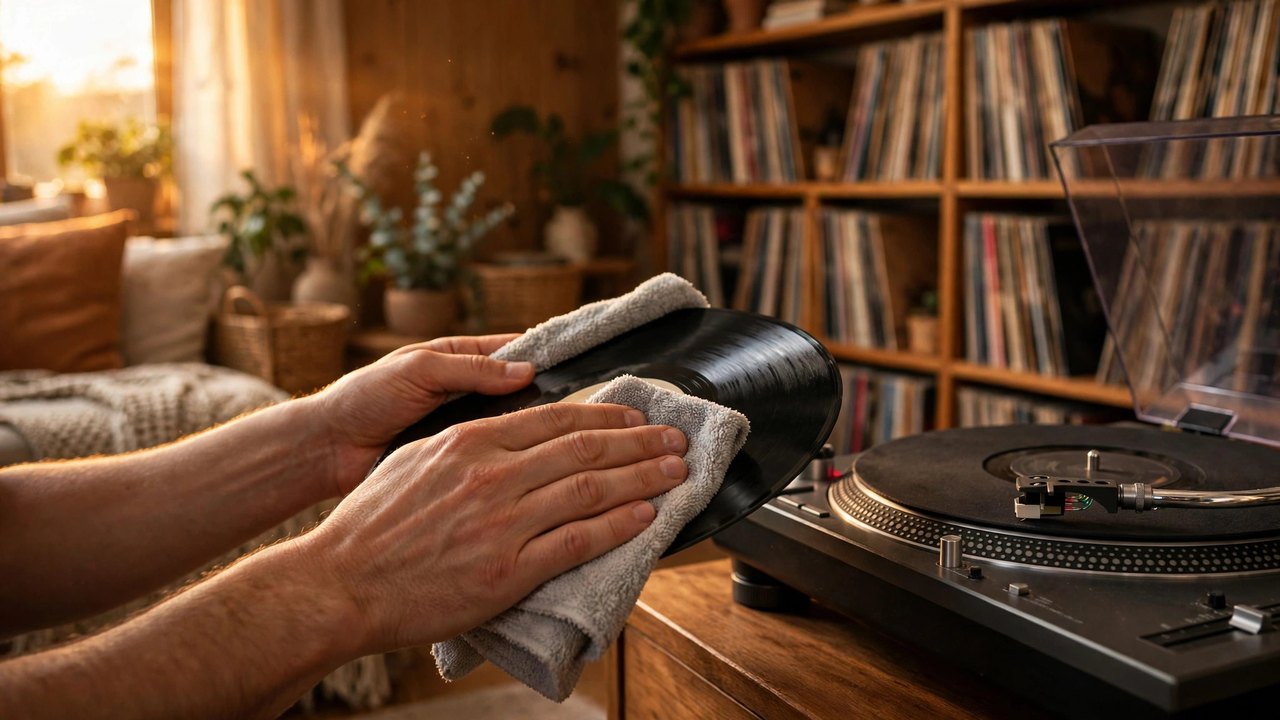
For a dry dust-off, fold the cloth into a flat pad, rest it lightly on the surface and wipe in the direction of the grooves, following the curve of the record rather than scrubbing across it. For a damp clean, moisten the cloth rather than flooding the record, keep fluid off the label, and finish with a dry cloth so no moisture sits in the groove. Always check the cloth face for grit before it touches vinyl, use light pressure throughout, and let a wet-cleaned record dry fully before it goes back into its sleeve.
Washing and retiring cloths
Machine wash microfiber separately from cotton, which sheds lint into the weave, and avoid fabric softener, which coats the fibres and dulls their ability to lift and absorb. Air drying or low heat keeps the fibres in shape. A cloth is not immortal: when the face feels flat, looks shiny or starts leaving anything behind, demote it to dusting the turntable lid and promote a fresh one. Keeping that demotion path is a good reason to buy a multi-pack in the first place.
FAQ
Can I use a household microfiber towel on my records instead?
You can, and many people do, but a record-specific cloth removes the guesswork. Household towels may have stitched or laser-cut edges, dyes and finishing treatments chosen for kitchens and cars, and they often live in drawers where they pick up grit. A cloth made for records is sold on its lint, static and surface behaviour, and keeping one set of cloths for records only is the simplest way to know exactly what is touching the groove.
How many cloths do I actually need?
Three is a workable minimum: one for wet or damp work, one for drying, and one clean spare. If you clean in batches, or you want a cloth stationed by the deck as well as at your cleaning table, five to eight cloths is more comfortable. The right number is the one that means you never have to wipe a record with a cloth you know is already dirty.
Should I wipe in circles or straight lines?
Follow the grooves. Whether the record is on the platter or on a cloth at the table, move the cloth in an arc that tracks the groove direction, with light pressure, rather than scrubbing back and forth across the grooves. Straight radial scrubbing drags particles across the groove walls instead of lifting them along the path they sit in.
Do anti-static cloths really make a difference?
An anti-static cloth addresses the charge that wiping itself can add, and a charged record attracts dust quickly and can contribute to crackle. The effect is most noticeable in dry rooms and in winter heating season. An anti-static cloth is not a substitute for clean storage and anti-static inner sleeves, but as part of that system it helps a cleaned record stay clean for longer.
Can these cloths clean a really dirty second-hand record on their own?
No cloth on its own deep-cleans a groove. A cloth lifts surface dust and fingerprints and applies and removes cleaning fluid, but a genuinely grubby record needs fluid to loosen what is in the grooves, and often a brush or a washer to work it out, with the cloth handling application, drying and finishing. Buying the right cloth still matters, because it is the only part of that system that touches every part of every side.
How do I keep the cloth itself from scratching a record?
Scratches come from grit, not from clean microfiber. Shake and inspect the cloth before use, fold it so a fresh face is presented for each side, wash it regularly, store it closed away from dust, and never use a cloth that has been dropped on the floor or used for another job until it has been washed. Light pressure does the rest; the fibres are meant to lift, not to be pushed.
Conclusion
The right microfiber towel for your records is the one that matches your routine. Choose the GrooveWasher three-pack for a dense, LP-sized all-rounder, the Hudson Hi-Fi or Record-Happy five-packs for anti-static care in full-size and compact formats, the Honeydak eight-pack for batch rotation, the MayRecords pair when you want a cloth that works as a mat as well as a wipe, and the HumminGuru set when wet cleaning and drying are the centre of your system. Whichever you pick, the habits matter as much as the cloth: keep it clean, keep it dedicated, present a fresh face to every side, and let light pressure and the weave do the work.
M
Modern Line Home Editorial Team
We compare specs, materials and verified owner reviews before a product earns a spot. Rankings are never paid.
Affiliate disclosure. As an Amazon Associate we earn from qualifying purchases at no extra cost to you. Prices accurate as of the date shown.
House cold even with the heat on? Walk this ordered checklist: thermostat and filter first, then drafts, insulation, leaky ducts and a failing heating system.
Windows fogging up in winter? Check where the fog sits: on the room side it is indoor humidity, outside it is harmless, and between panes the seal has failed.
Store the main firewood pile about 30 feet from your house, off the ground and covered only on top. Compare racks, woodsheds, garages and indoor spots safely.
Place a portable generator outdoors only, at least 20 feet from windows, doors and vents, exhaust pointed away. Exact distances, setup steps and CO rules here.
Keep houseplants in the right winter spot: match window direction to plant type, stay clear of radiators and cold glass, and fix dry air and low light at home.
Mice enter through pencil-width gaps at foundations, pipes, vents, doors and the roofline. Walk this room-by-room winter checklist to find and seal each one.
A winter outage timeline: what to do in the first hour, first night and multi-day outage, with food safety times, pipe protection, heat and CO safety steps.
Size a space heater by room area: 10 watts per square foot at 8-foot ceilings, adjusted for insulation and ceiling height, with full wattage and BTU tables.
Start dripping at about 20 degrees, sooner for exposed pipes. Set a pencil-lead stream, drip the right faucets on both lines, and know when to stop safely.
A fridge needs 800-1,200 starting watts, not just 150-400 running watts. Use the tables to total your fridge plus freezer, lights, furnace fan and more today.











Write Your Review
No reviews yet. Be the first to share your experience!