We independently review everything we recommend. When you buy through our links, we may earn a commission. As an Amazon Associate we earn from qualifying purchases.
Best Squeegee for Bathtubs: Blade, Handle and Reach Guide
Find the best squeegee for bathtubs: compare blade width, silicone or rubber edges, handle reach and storage, with a buying guide, care tips and a full FAQ.
Find the best squeegee for bathtubs: compare blade width, silicone or rubber edges, handle reach and storage, with a buying guide, care tips and a full FAQ.
Our top picks at a glance
6 products from this guide, in the order reviewed below.
1
Gutewerk High Performance Shower Squeegee
This is a slim silicone-coated squeegee that several reviewers rank near the top.
As an Amazon Associate we earn from qualifying purchases. Prices and availability can change.
Water left on tub walls, glass panels and the rim dries into spots and soap film, and a poor squeegee leaves streaks or skips along curves. This guide helps you choose the best squeegee for bathtubs by blade width, edge material, handle reach and storage, with each limit stated plainly so the trade-offs are clear before you buy.
Quick verdict on the best squeegee for bathtubs
A bathtub squeegee has two jobs: clear the tub walls and any glass panel, and fit a storage spot that stays wet. The right answer depends on whether you mostly wipe flat tile, a curved tub wall or a tall glass door, and whether bending down is the problem.
For general tub-and-shower use, a silicone blade of about the width of a hand is the safest starting point. Several published guides pick a silicone-edged tool with a stainless core, such as the Gutewerk, and the OXO stainless squeegee is named best overall on another list. Both are slim and hang up easily.
If reaching the upper tile or kneeling at the tub floor is the real problem, the telescoping and long-handled designs solve it, such as the DSV double-sided tool and the Grand Fusion telescoping squeegee. If you share a small bathroom, the folding simplehuman model and the compact Foshio save space.
The table lines up each squeegee by blade width, edge material, reach and main trade-off. Figures come from the review pages that were read, and handle length or weight is left out wherever the pages do not state it, rather than estimated. Use it to shortlist two or three tools, then read the entries below.
The picks come from published review text, not from hands-on use by the writer. A squeegee needed a page that named its blade material and width, described how it hangs or stores, and gave at least one honest limit. Models with strong complaints on those pages were left out.
Four filters shaped the shortlist. First, the blade must be silicone or rubber rather than a bare edge, since a hard edge can scratch glass and tub finishes. Second, the tool must be easy to hang, because a squeegee that lives on a wet ledge collects film. Third, the blade width must fit a tub wall. Fourth, any reach or fold feature had to be described on the page.
The review pages disagree in places. One list calls the Hiware squeegee versatile, while another says its handle gets slick and it leaves water trails, and the Command squeegee is praised on one list and criticized on another. When a tool split opinion that sharply, it was not recommended here.
Handle lengths and weights are not stated for most tools on the pages that were read, so none are listed, and any dimension that does appear is copied as published. Prices, star ratings and review counts are left out because they change quickly.
These eight tools cover the main designs a tub owner meets: a slim hand squeegee, a compact one, a long-handled design, a folding model and a telescoping one. Each entry gives the blade, the material, who it suits, its limits and a buy-if and skip-if line.
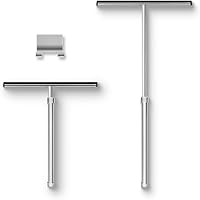
This is a slim silicone-coated squeegee that several reviewers rank near the top. The review text lists a blade width of 9 inches and describes a stainless steel core covered in high-performance, food-grade silicone with a soft silicone blade that is gentle on the surface.
It has an ergonomic handle, a suction hook and a hanger, and it hangs on a hook for storage. The review says the grip is comfortable and nonslip, the shape fits into corners, and the compact size suits apartment storage. It can also be used on a car or around the house.
The limit is water pickup. The review says it does not collect water or dirt at the bottom as well as some other options, and on mirrors or windshields a microfiber cloth may be needed afterward. Another list notes that some owners report the mount falling over time.
Pros: comfortable grip, soft blade, good in corners, compact. Cons: weaker at gathering water at the bottom edge, mount reports. Buy if you want a slim everyday tool for tub walls and glass. Skip if your tub has a wide flat wall and you want the widest blade possible.
The Foshio is the compact option for small tubs and tight spots. The review lists a blade width of 5.11 inches, a rigid beveled rubber blade and a nonslip screw-in handle, and it ships with a replacement blade so you can swap in a fresh edge when the first one wears out.
The page says it is small enough to fit in a standard car glove box, which makes it easy to keep in a tub caddy or a drawer. The blade comes in bright colors, including blue, green, turquoise and yellow. It works well on glass and polished surfaces and removes dirt and soap scum.
The trade-off is size. Because the blade is small, larger spaces take longer, and a full tub surround will take many more passes than with a wider tool. The review also notes that it was not clear how to swap out the old blade.
Pros: replacement blade included, small enough to store anywhere, rigid edge for glass. Cons: slow on big areas, unclear blade swap. Buy if you have a small tub, a narrow glass panel or a limited storage spot. Skip if you want to clear a tall tub wall in a few strokes.
DSV Long-Handled Window and Shower Squeegee
The DSV answers a problem the other tools do not: reach. The review lists a blade width of 8 inches, a soft rubber blade on one side and a nylon-netted sponge on the other, a rotating head and a telescoping handle, plus a hanging hole for storage, so one tool does both jobs.
The long handle means you can work on tub walls without kneeling, and the review says it works on tubs, sinks and other surfaces. The mesh side helps lift grime from tile and grout before the blade clears the water, so one tool does two steps.
It is described as easy to clean up and it passed the reviewer’s tests with strong scores. The limit is cost, since the review calls it pricier than other options, and a double-sided head with a rotating joint has more parts than a simple one-piece tool, so check the joint after a few weeks.
Pros: long reach, two-sided head, rotating head, good for kneeling-averse users. Cons: more parts, higher cost per the review, handle length not stated. Buy if bending over a tub is the problem. Skip if you want one slim tool that tucks into a drawer.
This tool is the one the review calls highly maneuverable. The page lists a blade width of 7.7 inches, a silicone blade and a foam grip, and notes that the two replacement blades included are each nearly 8 inches wide, so the set covers future wear for a long time.
The handle has a hole for hanging on an adhesive hook, a cabinet, a shelf or a wall hook. The review says the blade action is smooth, it needs little effort, it picks up small drops and it leaves a streak-free finish without scratching shiny surfaces.
The review lists no cons for this model, which should be read with care: it means the reviewer found nothing to criticize, not that the tool has no limits. A 7.7 inch blade is narrower than the widest options, so expect more passes on a tall tub wall.
Pros: replacement blades included, smooth action, safe on shiny surfaces per the review. Cons: no stated reach beyond the handle, mid-size blade. Buy if you want a simple silicone tool with spare edges. Skip if you need extra reach.
The Richmirth uses a flexible, rubberized silicone blade with a width of 9 inches. The review describes 100% BPA-free silicone-based construction and a design that glides over tile and handles rippled surfaces and grout lines without chatter or skipping.
It comes with a silicone hook that fits shower doors from 0.45 to 1 inch thick, which helps if your tub has a glass door. The review says it can clean an entire shower wall in about four swipes and lifts soap scum with little effort, and the page adds that it will not damage tile or tubs if dropped.
The one complaint is sound: it squeaks while cleaning, and some people will find that irritating. The page also notes that the material performs in cold weather, which is a car-cleaning point more than a bathroom one.
Pros: wide flexible blade, hook included, handles grout lines, non-scratching material. Cons: squeaking. Buy if your tub surround has tile with textured grout. Skip if noise bothers you or your glass door is thicker than the hook allows.
The OXO is the most frequently recommended general-purpose tool across the lists that were read. One page names it best overall with a flexible 10-inch blade, a slim profile, an included suction cup for hanging and a non-slip grip, and it has a stainless steel body.
It suits tub and shower use because the slim body fits a wall hook without taking much space, and the blade width covers a wide strip of wall per stroke. Another list also includes the OXO among its picks and calls its grip secure when wet.
The limits are style and cost. The review calls it more expensive than other options, and one list says its look does not suit traditional bathrooms. The maker page could not be fetched, so details beyond the review text, such as materials of the blade, are not stated here.
Pros: wide 10-inch blade, slim profile, suction hanger, non-slip grip. Cons: higher cost per the reviews, modern look. Buy if you want a dependable all-rounder. Skip if you need a longer reach or a foldable body.
This tool is meant for small bathrooms where wall and shelf space is scarce. The review lists a blade 10 inches long with a soft edge, rust-proof metal construction and a design that folds into a small package, with an included suction-cup hanger for storage on smooth tile or glass.
The fold-away feature is the real selling point for a bathroom with little room around the tub. It folds down so it does not stand out on a wall or in a drawer, and the hanger keeps it off wet surfaces so the blade can dry.
The cautions are about the listing. The review calls it expensive, and the heading on the page lists model BT1071 while the body and link list BT1035, so confirm the exact model on the product page before you buy.
Pros: folds small, suction hanger, rust-proof metal, wide blade. Cons: higher cost per the review, model number mismatch on the source. Buy if storage space is tight. Skip if you prefer a simple one-piece tool with no moving parts.
This tool is built for reach. The review lists a 10-inch blade, a reach of 14 inches when closed and 23.5 inches when fully extended, a stainless steel and silicone construction, a soft silicone blade and an extendable handle, at a weight of 209 g, which keeps it light in the hand.
The soft blade is described as gentle on surfaces and durable, and the extended handle reaches high corners, which helps on a tub surround that runs to the ceiling. When closed it is short enough to hang or lay in a drawer.
The complaint is about locking. Some reviewers say the handle does not lock in the extended position, so it can slide shut under pressure. Test the lock when it arrives, and avoid using full pressure on a handle that slips.
Pros: adjustable reach, soft silicone blade, compact when closed. Cons: lock reliability reports. Buy if you have a tall surround and no step stool. Skip if you want a rigid tool you can lean on.
Buying guide for tub squeegees
Choosing a squeegee is mostly about four questions: how wide the blade should be, what the edge is made of, how far you need to reach and where the tool will hang. These sections explain each choice in plain terms so that a shelf of similar tools becomes easy to sort.
Blade width and tub shape
One review notes that 10-inch blades are the most common and that 12 to 14 inches is available for larger showers. For a tub, a width near the middle of that range covers a wall quickly without catching on the curve where the wall meets the floor of the tub.
A narrow blade, like the 5.11-inch Foshio, trades speed for control. It turns corners and fits around fixtures, but you will make many more passes. A wide blade is quicker on flat tile and glass but can leave a gap on a curved tub rim.
If your tub has a fixed glass panel, measure its width. A blade that is a little narrower than the panel will leave a thin water line at one edge, so you may want to make two passes there.
Silicone, rubber or stainless: what the edge is made of
One review says rubber and silicone blades are generally more effective and unlikely to scratch glass. Silicone tends to stay flexible and resist cracking, and rubber can be a little firmer, which some people prefer for glass, while a stiff plastic edge can skip and streak.
Stainless steel in a squeegee is usually the body or the core, not the blade, and it resists rust. Two lists warn about different products that can rust over time, such as brass or some metal handles, so a rust-resistant finish is worth looking for.
Avoid any tool with a hard metal edge on acrylic or fiberglass. One reviewer reported that a metal-bladed model scratched walls, which is the clearest example of why the edge matters.
Reach, handle and grip
Handle length is not stated for most tools in the pages that were read, so judge reach by the design. A telescoping or long-handled model, such as the DSV or the Grand Fusion, helps if you cannot kneel or the surround is tall. A short handle gives more control for corners.
The grip matters in a wet room. The reviews describe nonslip handles on the Gutewerk and Foshio and a foam grip on the Desired Tools model, while another list complains that one metal handle gets slick when wet. Look for texture or a soft grip.
A rotating head, like the one on the DSV, helps you reach around the tub faucet and into corners, but it adds a joint that can loosen. Check it from time to time.
Storage, hooks and suction
A squeegee that hangs dries faster, and a dry blade lasts longer. Suction cups work on smooth tile and glass, adhesive strips work on flat surfaces, and a hole at the end of the handle fits a standard hook. Some owners report suction mounts that fall, so test the hold.
Check the hook against your glass door if you plan to hang the tool there. The Richmirth hook fits doors from 0.45 to 1 inch thick, so measure first. A folding model solves the problem by tucking away in a drawer.
Whatever you choose, hang it blade-down or flat so the water drains off, and do not leave it lying in a puddle at the tub edge.
How to choose the best squeegee for bathtubs by your bathroom
Match the tool to the room. A tiled tub with a tall surround favors a long or telescoping tool, a small tub with a glass panel suits a compact blade, and a shared bathroom with no wall space favors a folding model that tucks into a drawer. Weigh reach, storage and blade width together.
If you live in a rental, adhesive strips and suction mounts avoid drilling, and a tool that stores in a drawer avoids the problem entirely. If several people use the tub, pick a grip that works for hands of different sizes.
Replacement blades are worth a look. The Foshio and the Desired Tools model include spares, which is useful when the edge wears. A tool with no replacement edge is replaced as a whole when the blade finally curls.
Using and caring for a tub squeegee
A good technique matters as much as the tool itself. These steps keep the blade working, keep standing water off the tub surfaces and help limit the soap film and mineral spotting that make the next cleaning harder than it needs to be, and they take little effort.
A simple wipe-down routine
Start at the top of the wall and pull the blade down in an overlapping line, then wipe the blade on a towel every pass or two. Finish along the tub edge and the faucet base, where water pools, and use a cloth for the last drops that the blade leaves behind.
Do the glass first if you have a door, then the tile, then the tub rim, so you do not drag dirty water over clean areas. Rinse the tub before you squeegee if there is soap scum, since a gritty film can drag across the blade.
A quick squeegee after each use costs very little time, and the earlier you do it the less soap film and mineral spotting you will see.
Cleaning and replacing the blade
Rinse the blade under running water after each use and let it hang to dry in open air. If it picks up film, wipe it with a mild cleaner and rinse. Do not scrub a silicone blade with abrasives, which can roughen the edge and leave streaks on the next use.
When the edge starts to leave streaks, curl or crack, replace the blade if the tool allows it, or replace the tool. A worn blade is the most common reason a squeegee stops working, and it does not clean better with more pressure.
Check the hook or suction cup too. A slipping mount drops the tool onto the tub floor, which can chip a finish or crack a plastic body.
Frequently asked questions about tub squeegees
These short answers stay general, because tubs, glass panels and water supplies all differ from home to home. When your tub maker or glass maker gives care advice, follow that over any general guide, and test any new tool on a small, hidden area of the tub first.
Does a squeegee scratch an acrylic tub?
A soft silicone or rubber edge is unlikely to scratch, but grit trapped under the blade can. Rinse the surface first, keep the blade clean and avoid any tool with a hard metal edge on acrylic or fiberglass. If the product page lists tub surfaces, trust it over a general rule.
How wide should the blade be?
One review says 10-inch blades are the most common, with 12 to 14 inches for larger showers. For most tubs a middle width is a good fit, and a narrow blade is fine for small spaces. Wider is quicker on flat walls but harder on curves, and it needs more storage room.
Is a silicone blade better than rubber?
Both work. One review says rubber and silicone are generally more effective and unlikely to scratch glass. Silicone tends to stay flexible, and rubber can be slightly firmer. The best choice is the blade that stays clean and makes full contact with your surface.
How often should I squeegee the tub?
After each use is ideal, since drying water leaves minerals and soap film behind. If that is too much for your routine, do it after the last bath or shower of the day in your home. The goal is to get most of the water off before it dries, and a quick pass is enough to do that.
Why does my squeegee leave streaks?
The most common causes are a dirty blade, a worn or curled edge, soap film on the surface or a blade angle that is too steep. Wipe the blade between passes, clean the surface and use a light, steady angle. If streaks persist after that, replace the blade with a new one.
Can one tool work on a tub and a glass door?
Many can. Several of the tools in this guide are described for glass, tile and tubs together. If you have both a tall surround and a tub, a telescoping or long-handled model may be the most flexible, but a second small tool is useful for corners and for the faucet base.
Conclusion
The best squeegee for a bathtub is the one that fits your wall, your reach and your hook. The Gutewerk and the OXO suit everyday use, the Foshio suits small tubs, the DSV and Grand Fusion add reach, and the simplehuman folds away. Pick a soft edge, hang it to dry and replace worn blades before they leave streaks.
M
Modern Line Home Editorial Team
We compare specs, materials and verified owner reviews before a product earns a spot. Rankings are never paid.
Affiliate disclosure. As an Amazon Associate we earn from qualifying purchases at no extra cost to you. Prices accurate as of the date shown.
Compare the best inexpensive whirlpool bathtubs by listed jets, pump, size, material and limits, with electrical needs and tips for checking live listings.
Compare the best inexpensive deep bathtubs by listed water depth, capacity, size and material, with limits noted and tips for checking each live listing first.
Shopping for the best bathtubs under 600? Compare entry-level alcove, drop-in and freestanding tubs by their listed size, depth and features, with limits noted.
Searching for the best bathtubs under 250? See portable, foldable, inflatable and basic steel options ranked by listed features, with limits and what to check.
Looking for the best tape for bathtubs? Compare five self-adhesive caulk strips by width, length, material and limits, plus prep steps and when tape fails.
A practical guide to curtain rods for bathtubs: tension, curved, wall-mounted and corner designs, with listed lengths, materials, weight limits and trade-offs.
Choose the best bathtub trays by expandable range, material, book and wine glass slots and grip, with a clear buying guide, care tips and an FAQ for bath fans.
Find the best rust primer for bathtubs: compare rust converters, rust-bonding and oil or water-based primers, with prep steps, limits and an FAQ for metal tubs.
Compare the best epoxy paint for bathtubs by surfaces, curing times, odor and application, with prep steps, buying advice and a full FAQ for worn or dull tubs.
Compare the best wax for bathtubs by listed surfaces, form and limits, and learn the slip risk, prep needs and when to skip wax, with a buying guide and FAQ.















Write Your Review
No reviews yet. Be the first to share your experience!