
Key takeaways
- A practical guide to curtain rods for bathtubs: tension, curved, wall-mounted and corner designs, with listed lengths, materials, weight limits and trade-offs.
Our top picks at a glance
7 products from this guide, in the order reviewed below.




As an Amazon Associate we earn from qualifying purchases. Prices and availability can change.
A sagging or slipping rod turns a bathtub shower into a daily annoyance, and a curtain that clings to your legs is worse. This guide compares the best curtain rods for bathtubs by type, length range, material and weight limit, so you can match a rod to your tub, your walls and the weight of your curtain.
Quick verdict
For most standard alcove tubs, a stainless steel tension rod is the easiest and least invasive choice, and the Briofox Industrial rod is the one the reviews we read favor most. Curved rods add elbow room, mounted rods carry more weight, and corner or freestanding tubs need an L-shaped or hoop design.
The short version is this. If your tub sits in a standard three-wall alcove with sturdy tile or fiberglass walls, start with a tension rod. If you want more room at shoulder height, pick a curved rod such as the Zenna Home double curved model or the Moen curved tension rod. If you hang a heavy curtain and liner together, or the walls are drywall, choose a wall-mounted rod and use the right anchors. For a freestanding tub, a ceiling-supported hoop is the realistic option.
Every pick below comes from a page that lists its length range, material or capacity. Where a page does not state a fact, we say so rather than guess. Weight limits and length ranges differ between pages for a few models, and those differences are flagged in the text so you can check the current listing before you order.
Related guide: Best Luxury Bathtubs: 7 Freestanding Options and a Guide
Best curtain rods for bathtubs at a glance
The table lists each rod by type, the listed adjustment range, the main material and the weight limit where one is stated. Use it to narrow the field by tub shape first, then read the matching review for installation notes, finishes and the main trade-off of each design.
| Rod | Type | Listed length range | Material | Stated capacity | Main trade-off |
|---|---|---|---|---|---|
| Briofox Industrial | Tension, straight | 27 to 90 inches | Stainless steel | 30 pounds | Some users report slipping over time |
| Teeck Adjustable Tension | Tension, straight | 26 to 85 inches | Stainless steel | 22 pounds | Can bow at full length |
| Zenna Home NeverRust Double Curved | Tension, double curved | Fits tub spaces up to 72 inches | Aluminum | Not stated in the review | Heavy, bulky holders |
| Moen Curved Tension | Tension, curved | 57 to 60 inches | Stainless steel | Not stated | Narrow size range |
| Pottery Barn Wall-Mount Classic | Wall mounted | 54 to 90 inches | Steel | 45 pounds | Needs drilling |
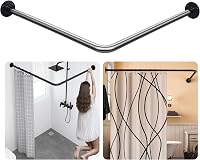
| Sikaiqi L-Shaped Corner | Wall and ceiling mounted, L-shaped | 23.6 to 69 inches per side | Stainless steel | 30 pounds with the ceiling mount | Drilling and a split curtain |
| PrettyHome Rod Hoop | Wall and ceiling mounted, hoop | Not stated | Aluminum | Not stated | Hardest to install |
| Umimile Tension | Tension, straight | 51 to 165 inches | Stainless steel | 66 pounds | Very long range, check fit |
How we selected the best curtain rods for bathtubs
We built this list from published reviews and listings, not from hands-on use. A rod earned a place when a page stated what it is, how long it adjusts, what it is made of and how it mounts. We favored designs that cover the common tub layouts: straight alcove, curved, corner and freestanding.
We read two published roundups in full, one from Bob Vila and one from Bustle, and used the product details they state. We did not rely on search snippets for any number. Where the two pages disagree, for example on the upper length of the Briofox rod, we say so and tell you to confirm the current listing.
We left out products whose pages did not state the basics, and we did not include any price, rating or review count. We also skipped plastic adhesive holders as a main pick, since they are a backup for slipping tension rods rather than a rod. If you buy, treat the stated weight limit as a ceiling for the curtain, liner and rings together, and leave a margin.

Related guide: Best Bathtubs for Kids: 7 Family Tub Options and a Guide
Curtain rod reviews for bathtub and shower spaces
Each review below covers who the rod suits, what the page states about its size and material, the limits to know about, and a plain buy-if and skip-if line. Pick by your tub layout and wall type first, then by finish, curtain weight and how much installation effort you are willing to take on.
Briofox Industrial Shower Curtain Rod
The Briofox Industrial rod is a tension rod that two published reviews name as a top pick, and it fits ordinary straight tub and shower openings where you want a tool-free setup. It is the default choice for renters and for anyone avoiding screw holes in tile.
Bob Vila lists it as a stainless steel tension rod that adjusts from 27 to 90 inches, with a manufacturer maximum of 30 pounds, up to eight finishes including chrome, gold and matte black, and tool-free installation by twisting the ends in opposite directions. Bustle lists the same brand at 27 to 73 inches with the same 30 pound limit and a large plate at each end to resist slipping, so confirm the upper size on the current listing for your tub.
Bob Vila says the rubber end caps protect walls and that the rod works on tile, fiberglass and painted drywall. It also notes that some users report slipping over time and that a slight shift appeared after heavy weights were added.
Pros: no drilling, many finishes, a stated weight limit that suits a curtain plus liner, and a wide size range. Cons: tension holds can loosen over time, and a heavy curtain on drywall adds stress to the wall. Buy if you want the simplest dependable rod for a standard alcove tub. Skip if your walls are soft drywall and your curtain is heavy.
Teeck Adjustable Tension Shower Curtain Rod
The Teeck rod is a lighter-duty stainless steel tension rod that reviewers recommend for ordinary curtains on tile or fiberglass walls. It suits a guest bath or a rental where a plain, adjustable straight rod is all you need and the curtain is a single light layer.
Bob Vila lists it at 26 to 85 inches in stainless steel, with five finishes, a 22 pound capacity, no drilling and rubber end caps that do not scratch. Bustle lists it at 26 to 85 inches in stainless steel with a limit of up to 30 pounds and five finishes including gold, black, brown, silver and white. The two pages differ on capacity, so check the current listing before you hang a heavy curtain and liner together.
Bob Vila reports that the rod bowed in the middle at its maximum length and advises buying the next longer size rather than stretching one to its limit. That is useful general advice for any tension rod: a rod used near the middle of its range holds better than one at the end of it.
Pros: wide size range, rust-resistant stainless steel, several finishes, easy setup. Cons: a lower or disputed capacity, and visible bowing risk at full extension. Buy if your tub opening is well inside the range and you hang a light curtain. Skip if you plan to hang heavy layers or need a rod near its maximum length.
Zenna Home NeverRust Double Curved Shower Rod
The Zenna Home NeverRust double curved rod is built for people who feel the curtain pressing in while they shower. Its outward bow pushes the curtain away from your body, which matters most in a narrow tub where a straight rod lets the liner cling to your legs.
Bob Vila lists it as an aluminum tension rod that fits tub spaces up to 72 inches, in chrome, nickel and black, and says it adds up to 9 extra inches of elbow room. The same review says the reviewer gained only 4 inches because the extra room depends on distance from the shower, and calls the rod heavy with bulky holders. Bustle lists a Zenna double curved rod at 50 to 72 inches in rust-proof aluminum with two curved rungs for a curtain and a liner and three finishes: chrome, bronze and nickel.
The double design is useful if you want a decorative curtain outside and a liner inside, because each hangs on its own rung and neither bunches up against the other.
Pros: extra room, separate rungs for curtain and liner, rust-proof aluminum, matches common faucet finishes. Cons: heavy, bulky holders, and the real gain is smaller than the maximum figure. Buy if your tub is narrow and your curtain keeps drifting inward. Skip if you want a slim, minimal look.
Moen Curved Tension Shower Rod
The Moen curved tension rod is the cleaner-looking curved option for a standard tub. It adds a gentle outward bow without the second rung or the bulk of a double design, and it is designed to sit neatly between both walls of a standard alcove, so the whole setup looks tidy and planned.
Bustle lists it for openings of 57 to 60 inches, in corrosion-resistant stainless steel, with decorative covers that snap over the tension mounts, two finishes and a limited lifetime warranty. The page does not state a weight capacity for it, so the manufacturer’s listing is the place to check how much curtain it can carry.
The narrow size range is the main limit. If your tub wall-to-wall distance falls outside 57 to 60 inches, this is not the rod for you, and you should look at an adjustable design with a wider range. Because the page does not give a capacity, we suggest a light curtain without a heavy liner, especially on drywall.
Pros: tidy covers over the tension mounts, corrosion-resistant steel, a curved shape for more room. Cons: tight size range, only two finishes, and no stated capacity on the page we read. Buy if you have a standard 60 inch alcove and want a curved look. Skip if your opening is wider or narrower than the listed range.
Pottery Barn Wall-Mount Classic Shower Curtain Rod
The Pottery Barn wall-mount rod is for people who want a permanent rod that does not rely on tension. It suits heavier curtains, family bathrooms where a rod gets pulled on or grabbed, and walls where a tension rod would not stay put for long. Think of it as the heavy-duty route.
Bob Vila lists it as a steel mounted rod that adjusts from 54 to 90 inches, in chrome or matte black, with wall brackets and included wall anchors and a stated capacity of 45 pounds. The review says the directions claim tool-free installation, but the reviewer recommends a drill. It calls the rod contract grade for high-traffic spaces and notes a classic look.
The trade-off is permanence. You will drill into the wall, so hitting studs or using the right anchors matters, and tile walls need the correct bit and care. If you ever move the rod, the old holes remain.
Pros: the highest stated capacity among the straight rods here apart from the Umimile, no tension to lose, a classic profile. Cons: drilling, permanent holes, more setup time. Buy if you hang a heavy curtain and liner and want a rod that stays where you put it. Skip if you rent or do not want to drill into tile.
Sikaiqi L-Shaped Corner Shower Curtain Rod
The Sikaiqi L-shaped rod is designed for corner tubs and corner shower layouts where a straight rod cannot enclose the space. It is a mounted rod with a ceiling support, so it is a weekend project rather than a quick swap, and it makes the most sense when you already plan to drill into the wall and ceiling anyway.
Bob Vila lists it as stainless steel in classic silver, adjusting from 23.6 to 69 inches on each side. The review gives a 30 pound capacity with the ceiling mount and says the rod began bowing at 20 pounds without it. It requires a drill and a stud finder, or wall anchors if no stud is available, and it says glue-on brackets are only for tile and two people are recommended for installation.
The ceiling mount means a split curtain, which some people do not want. On the plus side, the review calls the rod sturdy with the included ceiling mount and corrosion- and rust-resistant.
Pros: fits corner layouts, stated capacity with the ceiling support, rust-resistant. Cons: needs drilling, a split curtain, and two people for setup. Buy if you have a corner tub and want a rod that encloses it. Skip if you want a single full-width curtain or cannot drill into the ceiling.
PrettyHome Shower Curtain Rod Hoop
The PrettyHome hoop is aimed at freestanding tubs, where there is no wall on either side to hold a standard rod. It forms a hoop around the tub and is held by wall brackets and a ceiling support bar. It is a more involved install than any tension rod, and it only makes sense if your tub truly stands free of the walls.
Bob Vila lists it as aluminum, in a variety of finishes, with wall brackets plus a ceiling support bar drilled in with included fasteners. The page does not state an adjustable length or a weight capacity, and says the ceiling support bar is not adjustable. The reviewer rated it the hardest to install, and notes that the ceiling bar may need cutting if it is too long and that it requires a split curtain.
Because the page does not give a capacity, plan to use a lightweight curtain, and check the manufacturer’s installation notes about ceiling material before you drill. A freestanding tub means you will also need to plan the curtain so water does not run onto the floor, since the hoop alone cannot stop splashing.
Pros: rigid ceiling bar, rust-proof aluminum, a realistic solution for freestanding tubs. Cons: hardest installation, possible cutting, split curtain, and no stated capacity. Buy if you shower in a freestanding tub. Skip if you have a standard alcove tub.
Umimile Tension Curtain Rod
The Umimile tension rod stands out for sheer range and a high stated capacity, so it can cover a wide tub-and-shower opening or a long window-style run. It is a straight stainless steel rod for people who want one rod to cover unusual dimensions without hunting for a custom size.
Bustle lists it at 51 to 165 inches in rust- and corrosion-resistant stainless steel, with nonslip end caps to protect walls and tile, and a capacity of up to 66 pounds. It comes in four finishes: black, brown, white and stainless steel. Bustle calls it the widest rod in its list.
A very long tension rod gets less stiff as it extends, so the middle can sag under a heavy curtain. The 66 pound figure is the stated limit, but a rod used at the long end of its range will not behave like one used at the short end. Measure your opening, pick the size that leaves you in the middle of the range, and keep the curtain weight comfortably below the limit.
Pros: a very wide range, a high stated capacity, nonslip end caps. Cons: long spans can sag, and tension rods still depend on solid walls. Buy if your opening is wide or unusual. Skip if your tub is a standard size and a shorter, stiffer rod will do.
Buying guide for curtain rods on a bathtub
A good rod comes down to five choices: type, length, material, capacity and wall type. Settle those before you look at finishes, and most of the mistakes people make with tub curtain rods, such as slipping, bowing and rust, become easy to avoid. The sections below explain each choice in plain terms.
Tension, curved or mounted
Tension rods press against two walls with a spring or twist mechanism and need no tools, which is why they suit rentals. Curved rods bow outward to give more room at the middle. Mounted rods attach to the wall or ceiling and hold more weight but need drilling.
Think about how you shower. If the curtain hugs you, a curved rod helps. If you hang a heavy curtain and a separate liner, a mounted rod or a rod with a stated high capacity is safer than a basic tension rod. Corner tubs need an L-shaped design, and freestanding tubs usually need a ceiling-supported hoop.
Measure the opening and leave margin
Measure the distance between the two walls at the height where the rod will sit, not at the tub rim, since walls are not always parallel. Compare that number to the middle of the rod’s listed range, not its extremes, and write the figure down before you shop so you can check it against each listing.
One review in this guide reports that a rod bowed at its maximum length, and its advice was to buy the next longer size. That is sensible general advice: a rod stretched to its limit has less grip and more flex than one used in the middle of its range. For curved rods, check the listed opening range closely, since some cover only a narrow band.
Material and rust resistance
Bathrooms are damp, so look for stainless steel or aluminum, which resist rust better than plain metal. Several pages here describe their rods as rust-resistant or corrosion-resistant, but one product page in the research left the material unidentified and called it only metal.
Finish matters for looks and for wear. Chrome, nickel, matte black and gold are common. If your faucet is brushed nickel or matte black, matching the rod makes the tub area look planned. A finish does not change how much weight the rod holds, so choose it last.
Weight capacity and your curtain
Add up the curtain, the liner, the rings or hooks and any wet weight, since a fabric curtain gets heavier when soaked. A rod near its limit will sag or slip. Where a page states a capacity, treat it as a ceiling and aim well below it, because a curtain that is rubbed or tugged adds load.
Capacities in this guide range widely: one tension rod page lists a manufacturer maximum of 7 pounds for a basic model, while mounted rods list higher figures. Several pages do not state a capacity at all, in which case a light curtain is the careful choice and the maker’s listing should be checked.
Wall type and installation
Tile and fiberglass give tension rods a firm surface, while painted drywall is softer and can mark or crack under heavy tension. Mounted rods need studs or proper anchors, and tile needs the right drill bit and a slow, steady hand so the surface does not crack around the hole.
If you rent, check the lease before you drill. If you do drill, a stud finder and level save time. For a freestanding tub, check what the ceiling is made of before you install a hoop support, and follow the maker’s instructions. If you are unsure, ask a handyperson.
Keeping the rod and curtain working
Wipe the rod and end caps now and then, check that tension rods still grip, and rehang a curtain that has started to pull to one side. A little care keeps a rod from loosening or marking the wall, and it makes the whole bathtub area look better kept between full cleanings.
Rust spots usually start where water pools, such as the rod ends and ring contact points. Dry the ends if you notice water sitting there. Replace worn end caps rather than forcing a rod tighter, since over-tightening can mark tile or crack soft walls.
Frequently asked questions about curtain rods for bathtubs
These answers cover the questions people ask most often when choosing a rod for a tub, from whether tension rods are strong enough to how to handle freestanding and corner tubs. They rely only on the product pages and roundups summarized above, and where a page was silent we say so instead of guessing.
Will a tension rod hold a heavy curtain and liner?
It depends on the stated capacity and the wall. The pages we read list capacities from 7 pounds for a basic model to 66 pounds for a wide-range rod. A heavy curtain plus liner can exceed a basic rod, and drywall adds risk. If your total is heavy, use a mounted rod or a model with a higher stated limit.
Are curved rods worth it for a bathtub?
They are if the curtain tends to touch you. A curved rod bows the curtain outward and gives more elbow room. One review lists an extra 9 inches at most for a double curved model but notes the reviewer gained only 4 inches, so expect a modest gain, not a dramatic one.
What rod works for a freestanding tub?
A freestanding tub has no side walls, so a tension rod cannot span it. The PrettyHome hoop is described as suited to freestanding tubs and uses wall brackets plus a ceiling support bar. Installation is the hardest in this guide, so read the maker’s instructions and plan the curtain around the tub shape.
Can I install a rod on tile without drilling?
Tension rods work on tile and fiberglass without drilling. One review also says glue-on brackets on a corner rod are only for tile. If you need a mounted rod on tile, plan for the correct bit and anchors, or choose a tension design and keep the curtain light.
How do I stop a tension rod from slipping?
Use a rod near the middle of its range, clean the wall and end caps, and keep the load within the stated capacity. Bustle lists a plastic adhesive holder pair as backup support for slipping tension rods. If the rod keeps moving, a mounted rod is a better fit.
Conclusion
For a standard alcove tub, start with a stainless steel tension rod such as the Briofox, and move to a curved design like the Zenna Home or Moen if the curtain crowds you. Choose a mounted rod for heavy curtains, an L-shaped rod for corners and a hoop for freestanding tubs, and check each listing before buying.
More from Amazon
Programs that pair well with the guide above. Offers and eligibility are set by Amazon and may change.
Collect the home and kitchen items you want in one registry that guests can shop from.
Create a wedding registrySet up recurring deliveries of everyday items on eligible products. Terms and savings are set by Amazon.
Explore Subscribe & SaveFree shipping on eligible items, Prime Video and more. Eligible new members can start with a free trial.
Start a Prime free trialAudiobooks and podcasts to listen to on the go. Eligible new members can start with a free trial.
Try Audible freeAs an Amazon Associate we earn from qualifying purchases.










Write Your Review
No reviews yet. Be the first to share your experience!