We independently review everything we recommend. When you buy through our links, we may earn a commission. As an Amazon Associate we earn from qualifying purchases.
Best Tape for Bathtubs: Five Caulk Strips Compared Today
Looking for the best tape for bathtubs? Compare five self-adhesive caulk strips by width, length, material and limits, plus prep steps and when tape fails.
Looking for the best tape for bathtubs? Compare five self-adhesive caulk strips by width, length, material and limits, plus prep steps and when tape fails.
Gaps where the tub meets the wall collect water, soap and mold, and fresh caulk is messy to apply. Self-adhesive strips promise a cleaner fix. This guide compares the best tape for bathtubs by width, length, material and limits, and explains when a strip works and when real caulk is the better call.
Quick verdict
For a tub-to-wall seam, a self-adhesive caulk strip with a center crease is the most practical kind of tape. Of the five we compare, the Fixmend three-roll pack lists the widest gap coverage, TOUSEA and MOKANI suit corners, and ALLICAVER lists the softest, most flexible build.
The honest summary is that tape is a convenience, not a replacement for a properly sealed joint. Every maker here asks for a clean, dry surface, and most pages mention a hair dryer for curves. If water already leaks behind the tub, one listing says the area needs sealing first. Treat these strips as a tidy finish for a sound, dry seam and check them regularly.
All five picks come from one roundup page that states the width, length and material of each strip. We did not use retailer star ratings or price lists, and we leave out any claim a page did not state. Several makers do not name the adhesive or the color, and we say that plainly in each review.
The products in this guide
Fixmend Caulk Tape, three-roll pack
3 rolls, 1.5 inches wide, 10.5 feet each · Up to 5 inches
The table compares the five strips by roll size, material, the gap width each listing says it can cover and the main limit. Start with the gap you need to close, then check the surface and corner shape before you read the individual reviews below, because those two details decide most outcomes.
We looked for products that a page describes clearly enough to compare: width, length, material, stated surfaces and stated limits. Because there is no independent lab comparison of tub tape, we used a single detailed roundup and kept only what it states, without adding our own claims about durability.
We did not use hands-on language, since we have not used these products ourselves. We also left out rubberized repair tapes sold for emergency leaks, because those are a different product for a different job, and the pages we could read did not say they are meant for sealing a tub-to-wall joint.
Several retail pages for these strips could not be opened by our research tools, so we do not quote reviews or ratings from them. Where the roundup does not give a fact, such as the adhesive type or color for ALLICAVER or MOKANI, the review says it is not stated. We suggest reading the current product listing for the exact size and color you need before you order.
Best tape for bathtubs: five caulk strips reviewed
Each review below gives the listed size and material, what the page says about surfaces and gaps, the limits to know, and a plain buy-if and skip-if line. Read the limits closely, because the biggest differences between strips are gap width and how well they handle corners.
Fixmend is the pick for longer runs and wider gaps. It comes as three rolls, which covers a full tub surround without running out, and its listing gives the largest gap coverage of the five strips we compare, so it suits older tubs where the seam has opened.
The roundup lists each roll as 1.5 inches wide and 10.5 feet long, made of PVC with a strong adhesive backing described as heat-activated, in white. It lists a maximum gap fill of up to 5 inches and a full set time of 10 hours, and says the pack includes a sealing tool. The page calls the design linear, meant for straight home runs.
The limits are worth noting. The roundup says it can be difficult to apply around curved corners and that the full set time is longer than some competitors. Its tip is to warm the tape with a hair dryer so it becomes more pliable on curves and corners.
Pros: three rolls, the widest listed gap fill, white finish, sealing tool included. Cons: awkward on curves, a longer set time. Buy if you have long, straight seams or a wide gap. Skip if your tub has tight curved corners and you want the easiest fold.
Practical note: because the pack has three rolls, you can do a trial run along a hidden stretch, such as behind a door or at the end of the tub, to see how the strip behaves on your wall before committing to the visible seam. That small test costs little and shows whether your surface is clean enough for the adhesive to grab.
TOUSEA is a corner-friendly strip for narrow seams. It has a crease down the middle so the tape folds into a clean right angle, which matters where the tub meets two walls and caulk lines are hardest to keep neat. It is a good match for a standard alcove tub with smooth tile walls.
The roundup lists it at 1.5 inches wide and 10.5 feet long, 0.04 inches (1 mm) thick, made of PVC with nano double-sided tape, in white. It lists a maximum gap fill of 0.2 inches, and compatible surfaces of glass, wood, metal, plastic and tile. The page adds that it can be cut to length and cleaned with simple daily wiping.
The same page lists limits: gap fill is capped at 0.2 inches, it is unsuitable for uneven or water-permeable surfaces, it may not adhere to dusty or greasy surfaces, and areas with existing leaks need sealing first. That last point matters in a bathtub, so confirm the area is dry and sound before applying.
Pros: a center crease for corners, a thin profile, a nano double-sided adhesive, easy wiping. Cons: a small gap range and strict surface needs. Buy if your gap is narrow and the walls are smooth and clean. Skip if the seam is wide, uneven or still wet.
Practical note: a thin strip makes a neat line, but a thin film also shows any dirt or ridges beneath it. Scrape and wipe the seam thoroughly, let it dry, and press the tape down along its full length, working from the middle of a run toward each end so air does not get trapped.
ALLICAVER Caulk Tape
ALLICAVER is the soft, flexible option. It is made for seams that move a little, and it can be laid over existing caulk, which makes it useful when you want to cover an old line instead of scraping it out first, though the surface still needs to be clean and dry before the strip goes on.
The roundup lists it at 1.5 inches wide and 10.5 feet long, made of PE and viscose fiber that it describes as odorless, with a maximum gap fill of 1.5 inches. The adhesive type and color are not stated. The page says it has a middle crease for 90-degree folds, can be applied over existing caulk, is removable without residue and includes a sealing tool.
Limits from the same roundup: some users report poor adhesion to grout in places, the surface must be completely dust-free and dry, and roll length is limited. It suggests using a hair dryer for better stickiness if needed. The page also mentions a refund guarantee, but we do not repeat its terms because we could not confirm them.
Pros: flexible, can go over old caulk, removable, a middle crease. Cons: grout adhesion reports, one short roll. Buy if you want to cover an existing seam without scraping. Skip if the seam sits on rough grout.
Practical note: if your tub sits against a grouted tile edge, run a fingertip along the line first. A rough, crumbling grout surface is the situation where the roundup reports weaker adhesion, so a smooth surface or a different strip is a safer choice in that spot.
MOKANI is a two-roll pack aimed at tubs, showers and sinks, so it works when you want to do the tub and a nearby basin in one go. Like TOUSEA it has a center crease for corners, which helps in the awkward spots where the tub meets two walls, and the second roll gives you spare length for mistakes.
The roundup lists each roll at 1.5 inches wide and 10.5 feet long, made of PVC with a strong adhesive whose type is not specified. The page says the design is linear with a middle crease for 90-degree applications, is waterproof and oil-proof and includes a sealing tool. Applications named are bathtubs, showers, sinks and gas stoves. The color and a maximum gap size are not stated.
Limits listed: it may need heating in low-temperature environments, the surface must be cleaned and dried, and it may not work well on very uneven surfaces. The tip is to clean and dry first and use a hair dryer in cold conditions. Because no gap figure is given, treat it as a tool for a normal, tight seam.
Pros: two rolls, a center crease, a sealing tool. Cons: no stated gap range, needs warmth in cold rooms. Buy if you have a standard seam and a few corners. Skip if you must bridge a wide gap.
Practical note: the maker lists bathtubs, showers and sinks as uses, so one pack can cover several fixtures. Plan the cuts across both rolls before you start, so a long tub run uses one roll and corners and a basin use the other, with as few joins as possible.
XIMOXIGU Caulk Tape
XIMOXIGU lists the longest surface compatibility of the five, which makes it appealing if your seam runs between a tub and a mix of materials such as tile, stone, painted wall or metal trim. It is a single roll, so plan the length before you start and measure the full seam, including the short return along the end wall.
The roundup lists it at 1.5 inches wide and 10.5 feet long, 0.04 inches (1 mm) thick, made of PVC with nano double-sided tape, in white. It has a middle crease for custom angles and cleans with a simple wipe. The compatible surfaces listed are wall, tile, glass, metal, plastic, ceramic, marble, stainless steel, leather, paper, wood and brick.
Limits: a single roll may not be enough for larger projects, thorough surface preparation is required, and high-moisture areas need extra preparation. The page does not state a gap size. As with every strip here, do the surface prep carefully, because a long list of compatible materials does not remove the need for a clean, dry start.
Pros: broad surface list, a crease for angles, a white finish. Cons: one roll, a strict prep requirement, no stated gap range. Buy if your seam touches several materials. Skip if you need more than one roll of coverage.
Practical note: this is the strip to consider when the tub meets stone, metal trim or a painted surface. Even so, test a small hidden area first, since a long list of compatible materials still depends on the surface being clean, dry and free of soap film or wax.
Choosing a strip is mostly about the gap you are closing, the surface it will stick to and the corners you must turn. Get those three right and most of the common complaints, such as lifting edges and stuck corners, become avoidable. The sections below take each choice in turn.
Caulk strip, painter’s tape or repair tape
Self-adhesive caulk strips are made to bridge the seam between a tub and a wall. Painter’s tape is a masking aid you use while applying liquid caulk, and it comes off afterward. Rubberized repair tapes are sold for emergency patches, not as a finish for a tub joint.
If your goal is a neat, permanent seam, liquid silicone caulk is the traditional answer, and a strip is a faster alternative where the surface is sound. Use painter’s tape on either side of a caulk line if you are applying caulk yourself, then remove it before the caulk skins over.
Gap width and fit
Match the strip to the gap. The pages we read list gap coverage from 0.2 inches up to 5 inches, and that range is wide. A strip rated for a tight seam will not hide a large gap, and a wide strip on a narrow seam can look bulky and collect dirt along its edge.
Measure the gap along the whole seam, since tubs often settle unevenly and the gap is not constant. If the gap is much wider than a strip allows, fill or reseal it properly first. Tape is a finish for a sound seam, not a way to hide movement or a leak.
Material and adhesive
The strips here are PVC, PVC with a nano double-sided tape, or a PE and viscose fiber blend. PVC is a firmer plastic, while the softer blend is described as flexible and removable. None of the pages we read explain long-term mold resistance in detail, so do not assume it.
The adhesive matters as much as the film. Several pages mention heat activation or warming with a hair dryer, which helps the adhesive bond on curves. If a page does not name the adhesive, as ALLICAVER and MOKANI do not, you are relying on the general description.
Surface preparation
Every page asks for a clean, dry surface. Remove old caulk and soap scum, wipe the area, and let it dry completely. The roundup recommends a room temperature of 65-80°F for application and suggests starting in a hidden area so any seams are less visible.
Oily or dusty surfaces can stop a strip from bonding, and one listing says existing leaks need sealing first. If your tub wall is porous or the finish is flaking, a strip may not hold. Press the strip firmly with the included tool or a card to push out air bubbles.
Corners and curves
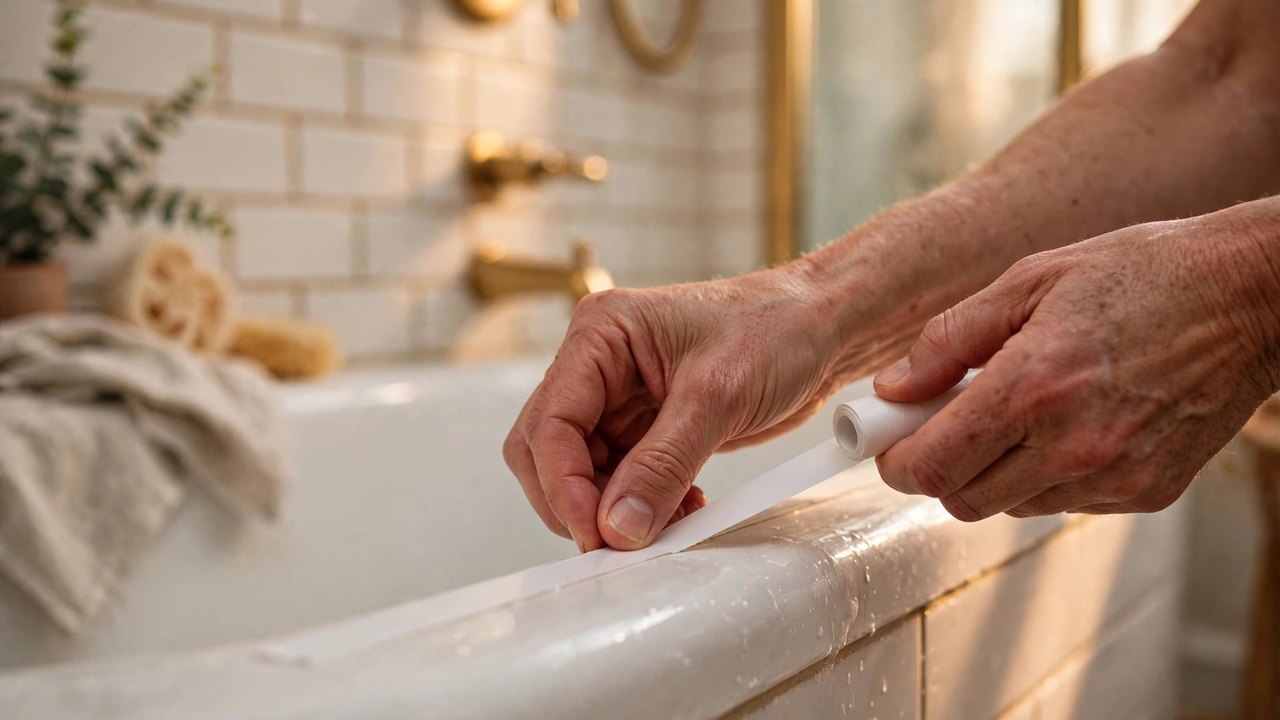
Corners are where strips fail first. Strips with a middle crease fold into a right angle, which gives a clean turn without cutting. For curves, warm the strip with a hair dryer so it bends without kinking, and work slowly around the bend, checking that the crease sits right in the corner.
Cut each length slightly longer than you need, fold it into the corner, and trim after pressing. Fixmend’s page says its linear design can be hard around curved corners, so a creased strip is the safer choice if your tub has rounded corners or a curved apron.
Lifespan and upkeep
One roundup estimates a lifespan of 1-3 years depending on moisture exposure and installation quality, and presents that as an estimate rather than a maker promise. Plan to inspect the strip now and then, especially at corners and low points where water sits.
Clean with a mild bathroom cleaner and avoid scrubbing brushes and abrasive cleaners. If an edge starts to lift, clean and dry it fully and press it down again. If lifting returns or you see moisture behind the strip, remove it, find the cause and reseal the joint properly.
Mistakes that make tape fail
Most failures trace back to preparation, not the strip. Applying tape to a damp seam, over soap scum, or in a cold room all weaken the bond. Skipping the pressing step leaves air pockets that collect water, and stretching the strip around a corner leaves it pulling back.
Another common mistake is using a strip on a seam that still has a leak behind it. One listing says areas with existing leaks need sealing first, and the logic is simple: tape covers a seam, it does not stop water that is already getting behind the tub. Fix the source, let everything dry, then apply the strip.
Finally, avoid buying one short roll for a long job. Joins between pieces are weak points, so measure the full seam first and choose a pack with enough length, or accept that you may need more than one roll.
Tools and supplies to have ready
Gather a scraper or plastic putty knife for old caulk, a mild bathroom cleaner, clean cloths, scissors, a tape measure and a hair dryer. Several packs include a small sealing tool, and the roundup says a credit card works too for pressing out air bubbles.
Having everything close means you can work while the surface is clean and dry. It also helps to plan the order of work: corners first, then the long straight runs, and a final pass of pressing along the whole length once the strip is in place.
Frequently asked questions about tape for bathtubs
These answers cover the practical questions that come up before you buy a strip for a tub: whether tape replaces caulk, how to apply it, and what to do when an old seam is already damaged. They rely only on the pages summarized above, and where a page did not state a fact the answer says so.
Is tape a good replacement for caulk around a tub?
For a sound, dry seam, a caulk strip is a reasonable and tidy alternative. For a seam with movement, a leak or mold behind the tub, caulk applied properly after cleaning is the more dependable repair. Tape is best seen as a convenient finish, not a fix for water damage.
Can I put tape over old caulk?
One roundup says ALLICAVER can be applied over existing caulk. For the other strips the pages say to remove old caulk, soap scum and residue and to dry the surface fully. When in doubt, remove the old caulk, since a strip bonds better to a clean surface than to a worn line.
How long should I wait before using the tub?
The roundup lists a full set time of 10 hours for Fixmend and says letting the tape set for several hours improves adhesion for all of them. Follow the instructions on your pack, and keep water away from the seam until the time the maker states has passed.
What if the strip lifts at the corners?
Clean and dry the edge, warm the strip gently with a hair dryer and press it down again. If it keeps lifting, the surface may be dusty, oily or damp, or the gap may be too wide for that strip. Remove it, fix the cause and reapply a fresh length, since a lifted edge that is pressed back without cleaning usually lifts again.
Is rubberized repair tape suitable for a tub seam?
The repair tape pages we reached did not describe a tub-to-wall seam as an intended use, so we do not recommend it for that job. Use a product whose maker lists tubs or bathrooms as a stated use, and follow its surface and set-time instructions closely.
Conclusion
For long straight seams or wider gaps, Fixmend is the strongest fit on paper. For tight corners, TOUSEA and MOKANI use a center crease, and ALLICAVER suits soft, flexible seams. Prepare the surface carefully, confirm the seam is dry and sound, and replace tape with proper caulk if water is getting behind the tub.
M
Modern Line Home Editorial Team
We compare specs, materials and verified owner reviews before a product earns a spot. Rankings are never paid.
Affiliate disclosure. As an Amazon Associate we earn from qualifying purchases at no extra cost to you. Prices accurate as of the date shown.
Compare the best inexpensive whirlpool bathtubs by listed jets, pump, size, material and limits, with electrical needs and tips for checking live listings.
Compare the best inexpensive deep bathtubs by listed water depth, capacity, size and material, with limits noted and tips for checking each live listing first.
Shopping for the best bathtubs under 600? Compare entry-level alcove, drop-in and freestanding tubs by their listed size, depth and features, with limits noted.
Searching for the best bathtubs under 250? See portable, foldable, inflatable and basic steel options ranked by listed features, with limits and what to check.
A practical guide to curtain rods for bathtubs: tension, curved, wall-mounted and corner designs, with listed lengths, materials, weight limits and trade-offs.
Choose the best bathtub trays by expandable range, material, book and wine glass slots and grip, with a clear buying guide, care tips and an FAQ for bath fans.
Find the best rust primer for bathtubs: compare rust converters, rust-bonding and oil or water-based primers, with prep steps, limits and an FAQ for metal tubs.
Compare the best epoxy paint for bathtubs by surfaces, curing times, odor and application, with prep steps, buying advice and a full FAQ for worn or dull tubs.
Compare the best wax for bathtubs by listed surfaces, form and limits, and learn the slip risk, prep needs and when to skip wax, with a buying guide and FAQ.
Compare the best scale remover for bathtubs by form, listed surfaces and limits, with a buying guide on acrylic, fiberglass and porcelain tubs, plus an FAQ.











Write Your Review
No reviews yet. Be the first to share your experience!