
Key takeaways
- Keep houseplants in the right winter spot: match window direction to plant type, stay clear of radiators and cold glass, and fix dry air and low light at home.
If you are asking where should you keep houseplants in winter, the short answer is: in the brightest spot you have that is not touching cold glass, not sitting over a radiator or heat vent, and not in the path of a draft from an outside door. For most foliage plants that means close to a south- or west-facing window, pulled a little back from the pane, in a room that stays steady through the day and night. Sun-loving succulents and cacti can sit closest to a bright south window, shade-tolerant plants are the only ones that should be trusted at a north window, and humidity-loving tropicals do best grouped together in a bright kitchen or bathroom rather than alone in a dry living room.
That short answer is only the starting point, because the right spot changes with two things a search snippet cannot check for you: which direction your window faces, and what kind of plant you own. A spot that kept a plant happy in July can be too dark, too cold at the glass, or too dry in December. This guide works through both checks in order. First you will read your windows using the direction table below, then you will match your plants to those windows using the plant-type table, then you will clear the danger zones — radiators, vents, cold glass, and drafty doors — and finally you will fix the rooms that are almost right with extra light and humidity. By the end you should be able to walk through your home, plant by plant, and give each one a deliberate winter address instead of leaving it wherever it happened to spend the summer.
Why the summer spot often fails in winter
Winter changes the light in a room in three ways at once. The days are shorter, so a plant receives light for fewer hours. The sun sits lower, so the angle and strength of the light coming through the same window change. And the weather is cloudier in many regions, so even the midday light is weaker. North Carolina State Extension makes the point directly: where north- and east-facing windows may have created great indirect light in the summer, they can become too shady in the winter months, and it advises considering a move to a sunnier location or supplementing with grow lights. A window that was a perfect medium-light spot in June can therefore be a low-light spot by December, without anything in the room appearing to change to your eyes.
Illinois Extension describes the warning signs to watch for. When houseplants do not get enough light, they begin to have small leaves and long, thin stems reaching for more light, older leaves may yellow and drop, and the plants in general look weak. Kansas State Extension describes the same pattern in different words: too little light can result in tall, lanky, small-leafed plants. If you see that stretching, the plant is not asking for more water or food — it is telling you its address is wrong, and the fix is a move, not a watering can.
The second winter change is dry air. Iowa State University Extension notes that many houseplants prefer a relative humidity of 40 to 50 percent, but the humidity level in many homes during the winter months may be only 10 to 20 percent. North Carolina State Extension gives a similar picture, saying indoor humidity tends to plummet, sometimes below 20 percent in winter, while most houseplants prefer 40 to 50 percent. That gap explains a lot of winter leaf damage that gets blamed on watering: Iowa State lists slow growth, dried-up flower buds, and brown leaf tips and edges as results of low humidity.
The third change is temperature swings near the edges of a room. The thermostat may read a comfortable number in the middle of the room, but the air next to a window, a door, a radiator, or a vent can be far hotter or colder. Montana State University Extension warns that an open door or a leaky window can drop the temperature significantly around a plant, while registers and radiators can raise the temperature too high. North Carolina State Extension likewise says drastic swings in environmental conditions are difficult on plants, and suggests using digital thermometers to track temperatures and make sure fluctuations are not too extreme. Placement in winter is therefore not just a light decision. It is a light, humidity, and temperature decision made at the same time, for each plant separately.
Step 1: Read your windows — the direction table
Start by naming the direction each usable window in your home faces. If you do not know, use the sun itself: a window that gets gentle sun first thing in the morning faces roughly east, one that gets strong sun in the afternoon faces roughly west, one that is bright for most of the day faces roughly south, and one that never really gets direct sun faces roughly north. Then check that window against the table below. The light figures in the table come from Illinois Extension, which lists low light at about 75 foot-candles, such as at a north window or 8 feet or more away from any other light source; medium light at about 150 foot-candles from east- or west-facing windows, which is also like being about 5 feet away from a southern window; and bright light at about 300 foot-candles at a south-facing window.
| Window direction | Winter light it gives | Best use in winter | Watch out for |
|---|---|---|---|
| South | The brightest window in the home; Illinois Extension lists a south-facing window at about 300 foot-candles | Sun-loving plants right near the glass, and most foliage plants a few feet back where the light is still strong | Cold glass at night and, for sensitive leaves, too much direct sun; pull foliage back so no leaf touches the pane |
| West | Medium light overall at about 150 foot-candles by the Illinois Extension figures, with stronger sun in the afternoon | A good winter home for many foliage plants that have outgrown an east or north spot, and for plants that need a brighter afternoon | Heat building up in the afternoon sun, especially if a radiator or vent is also on that wall |
| East | Medium light at about 150 foot-candles, arriving as gentler morning sun | The safest bright spot for plants that burn easily; Iowa State lists east-facing windows as an ideal site for moth orchids | It can become too shady in winter for plants that need more; North Carolina State Extension warns east windows that were fine in summer can turn too dark |
| North | Low light at about 75 foot-candles, with no direct sun | Only genuinely shade-tolerant plants, placed as close to the glass as cold allows | The first window to fail in winter; most plants left here will stretch, yellow, and drop leaves |
| No window / interior wall | Illinois Extension treats being 8 feet or more away from a light source as low light, and light falls further the deeper into the room you go | Short stays for very tolerant plants, or a permanent spot only with supplemental light added | Assuming a room that looks bright to you is bright to a plant; human eyes adjust, plants cannot |
Two lessons fall out of that table. The first is that distance is a light control, not just a tidiness choice. Kansas State Extension notes that most houseplants require the light that would be found within four to eight feet of a bright south window, with some tolerating a spot very near the window and others preferring less light some distance away. Moving a plant five feet closer to a south window can change its light as much as moving it to a different window altogether, because Illinois Extension equates about 5 feet away from a southern window with the medium light of an east or west window. When you rearrange, think in feet, not just in rooms.
The second lesson is that winter promotes some windows and demotes others. A north window should be your last resort, not an equal option. An east window is a good home for sensitive plants but may no longer be enough for a plant that was thriving there in summer. A south window, which may have been too strong for some foliage plants in summer, often becomes the best winter address in the house — provided you manage the cold glass on its night side, which is covered in detail below. Work through your windows in the order south, west, east, north, and fill them in that order, starting with the plants that need the most light.
How to check a spot before you commit to it
- Check at more than one time of day. A west window looks dim in the morning and strong in the afternoon; a single glance can mislead you about the total light a plant will receive.
- Look for the stretch test. If a plant already in that spot has long, thin stems and small new leaves, Illinois Extension identifies that pattern as a sign of too little light, whatever the room looks like to you.
- Open the curtains and keep them open in the day. Kansas State Extension advises that drapes should be left open during the day where houseplants are being grown — but see the cold-glass section below for what to do at night.
- Clean the leaves and the glass. Montana State University Extension notes that dust accumulated on leaves reduces the ability to photosynthesize, and suggests running plants under the shower for a minute or wiping leaves with a sponge. North Carolina State Extension also recommends dusting leaves off in winter. A dirty leaf in weak winter light is working with even less light than the window provides.
- Rotate the plant. Illinois Extension notes that natural light is best even if it is one-sided coming in from the window, and advises rotating plants to prevent one-sided growth and keep growth even. A regular quarter turn keeps a window plant from leaning permanently toward the glass.
Step 2: Match the plant to the window — the plant-type table
With your windows ranked, sort your plants. The table below groups common houseplants by what the extension sources say about their light, temperature, and humidity needs, and gives each group a winter placement. Read down the plant column, find your plant or the group it belongs to, and then read across to the window and the exact position in the room. That cross-check — plant type against window direction — is the decision the whole question turns on, and it is why two plants that sat happily side by side in summer may need to move to different rooms in winter.
| Plant type | Winter window | Exact placement | Why, from the sources |
|---|---|---|---|
| Succulents and cacti | South, as close to the light as you can manage | On or near the brightest sill, with leaves kept off the cold pane; allow the soil to dry and then stay dry a few days before watering again | Kansas State Extension notes cacti and other succulents need to be allowed to remain dry a few days before watering, even when the top of the medium is dry; these are the plants that can use the strongest window |
| Aloe vera | South or a bright kitchen window | Montana State University Extension lists a kitchen windowsill as a suitable place for aloe vera, which does well in dry conditions but needs indirect light | Dry air that stresses tropicals is far less of a problem for aloe, so it does not need to compete for the humid spots |
| Moth orchid (Phalaenopsis) | East first, north as second choice, south only behind a sheer curtain | Bright, indirect light with no direct sun on the foliage; keep it in a humid spot or on a pebble tray | Iowa State University Extension lists east- and north-facing windows as ideal sites for moth orchids, says direct sun may harm the foliage, and says plants in a south window will need shading with a sheer curtain; it lists a preferred humidity of 40 to 60 percent for this plant |
| African violet and other easily burned foliage | East, or a few feet back from south or west | Bright but out of the direct beam, close enough to use the window light without sitting in it | Kansas State Extension warns that too much light can cause leaf burn on sensitive species like African violet, even though too little light causes lanky growth in most plants |
| Most tropical foliage — monstera, philodendron, dracaena and similar leafy plants | South or west, a few feet back from the glass | Within the four-to-eight-foot band of a bright south window that Kansas State Extension describes, closer in midwinter and a step back if leaves pale | These are the plants Cornell Cooperative Extension describes as typically tropical species that prefer some humidity, and the group most likely to stretch in a dim winter corner |
| Ferns, calathea and other humidity-loving tropicals | The brightest humid room — usually a bright bathroom or kitchen | Grouped with other plants, near a humidifier or on pebble trays, but only if the room’s window gives real light | Cornell Cooperative Extension notes tropical ornamentals prefer places with certain levels of humidity such as the kitchen or bathroom; North Carolina State Extension likewise says bathrooms tend to have higher humidity, making them good places if there is adequate light and space |
| Snake plant, ZZ plant, cast iron plant, Chinese evergreen, pothos and philodendron | North or east, or the dimmer end of a brighter room | These are your north-window and second-row plants, placed close to whatever window they get | Montana State University Extension lists Chinese evergreen as able to be placed in an area of little to no light, cast iron plant as surviving in low light, pothos as withstanding low light, philodendron as liking low light, and the ZZ plant as growing in almost all conditions |
| Spider plant and Christmas cactus | East or west, or a cooler bright spot | A bright sill or stand away from heat vents, with sparing water | Montana State University Extension describes spider plant as needing only some light and as forgiving of colder winter temperatures, and Christmas cactus as living well with little water and some light |
Notice what the table does with competition. Your brightest, steadiest spot is a limited resource, and winter is when to spend it deliberately. Give the south window first to the plants that cannot do without it — succulents, cacti, and any foliage plant already stretching. Give the east window to the plants that burn, such as African violets and moth orchids. Use the north window and the second row, a few feet back from the glass, for the tolerant group that Montana State lists as surviving low light. If you reverse that order and park a tolerant snake plant in the prime south spot while a sun-hungry plant fades at the north window, both plants are in the wrong place even though only one of them will show it quickly.
Temperature refines the match further. Iowa State University Extension says most houseplants grow well with daytime temperatures of 65 to 75 degrees Fahrenheit and night temperatures of 60 to 65 degrees Fahrenheit, and warns that temperatures below 50 degrees Fahrenheit or rapid temperature fluctuations may harm some plants. Cornell Cooperative Extension gives a wider general range of generally between 60 and 80 degrees Fahrenheit during the day and 55 to 65 degrees Fahrenheit at night, and stresses keeping a constant temperature. Moth orchids are warmer still in the Iowa State guidance: daytime temperatures of 70 to 80 degrees Fahrenheit and nighttime temperatures of 60 to 70 degrees Fahrenheit, avoiding exposure below 55 degrees Fahrenheit. In practical terms, the coldest window in the house is the wrong place for an orchid even if its light is perfect, and a plant that tolerates cooler air, such as a spider plant, is a better candidate for that sill.
Step 3: Room by room — where plants usually end up
Living room
For most homes the living room holds the biggest and brightest windows, so it becomes the main winter plant room by default. That works well if you arrange it by distance rather than by decoration: sun-lovers nearest the south or west glass, the main foliage group a few feet back, and the tolerant group in the second row. The living room’s weakness is dry, heated air and the radiator that so often sits under the main window. Arrange the plants around the heat source, not over it, and group them together on one side of the room so a single humidifier can serve the group. If you are choosing equipment for that grouping, our guide to humidifiers with automatic humidity sensors for winter covers the sensor-controlled options that hold a set level instead of running unchecked.
Kitchen
The kitchen earns its place for two reasons: cooking and washing add moisture to the air, and kitchen windows are often bright. Cornell Cooperative Extension specifically names the kitchen as a place tropical ornamentals may prefer because of its humidity, and Montana State University Extension names a kitchen windowsill as suitable for aloe vera. A bright kitchen sill or counter near, but not beside, the stove is a good winter home for herbs, aloe, and smaller foliage plants. Keep plants back from the heat and steam bursts of the cooker itself, and away from a window over the sink if that window is the draftiest in the house — humidity helps only when the temperature is steady.
Bathroom
A bathroom with a real window can be the best winter room in the house for ferns, calatheas, and orchids, because showers raise the humidity those plants want. North Carolina State Extension makes the condition explicit: bathrooms tend to have higher humidity, making them good places if there is adequate light and space. That “if” does all the work. A windowless bathroom, or one with a small frosted window that gives only low light, trades a humidity problem for a light problem, and light is the factor Illinois Extension puts first. Test the bathroom by the stretch test and the direction table before moving humidity-lovers in, and if the light is only medium, choose the plants that need humidity and medium light rather than the ones that need humidity and bright light. For a bathroom or bedroom grouping, a compact unit from our roundup of top-fill humidifiers for bedrooms that are easy to clean can top up the moisture without taking over the room.
Bedroom
Bedrooms are often cooler at night and have one good window, which makes them useful overflow space for plants that prefer the cooler end of the range and for the tolerant group. They are also the room where a plant is most likely to be pushed into a corner far from the window because the sill is narrow. Use a stand or shelf to hold the plant at window height within a few feet of the glass rather than on the floor across the room, remembering that Illinois Extension treats 8 feet or more from a light source as low light. A bedroom is a poor choice for a plant that needs warm nights if you turn the heating down hard overnight.
Home office and spare room
An office with an east or south window is often the quietest, steadiest room in the house — no cooking heat, few door openings, and consistent daytime temperatures — which suits orchids and foliage plants that dislike fluctuations. The risk is neglect: plants in a room you do not enter daily get watered late and checked rarely. If you use a spare room as a plant room, keep the whole collection there rather than scattering single plants in rooms you forget, and put the watering check on a routine tied to a day of the week rather than to noticing a plant wilt. Montana State University Extension notes that houseplants do not transpire or photosynthesize as much in winter and need much less water, and calls overwatering the number one reason for houseplant death in winter — so a weekly check that often ends in “not yet” is exactly the right rhythm.
Rooms and spots to avoid altogether
- Hallways and landings with no window. With no direct light source they sit at or below the low-light level Illinois Extension describes, and hallways also collect every draft from the front door.
- Next to an outside door. Cornell Cooperative Extension advises placing plants away from open doors and windows where very cold breezes constantly enter; Kansas State Extension says almost no plant likes being placed near a door where cold drafts enter; Montana State University Extension says to place plants especially away from outside doors.
- On top of, or directly in front of, a radiator, vent, register, or heating stove. Every source in this guide agrees on this one, detailed in the next section.
- An unheated room, enclosed porch, or garage for tropical plants. With Iowa State warning that temperatures below 50 degrees Fahrenheit may harm some plants, a room that drops toward that level on cold nights is not a safe winter address for tropical foliage, however bright it is by day.
- Directly on a cold floor. Cold floors chill the root ball even when the air at leaf height is fine; raising the pot on a stand also lifts the plant into better light, so the fix helps twice.
- Behind heavy curtains on a sill. A plant left behind a closed curtain at night is trapped in the coldest pocket of air in the room, against the glass. Either move the plant inside the curtain line at night or leave it off that sill.
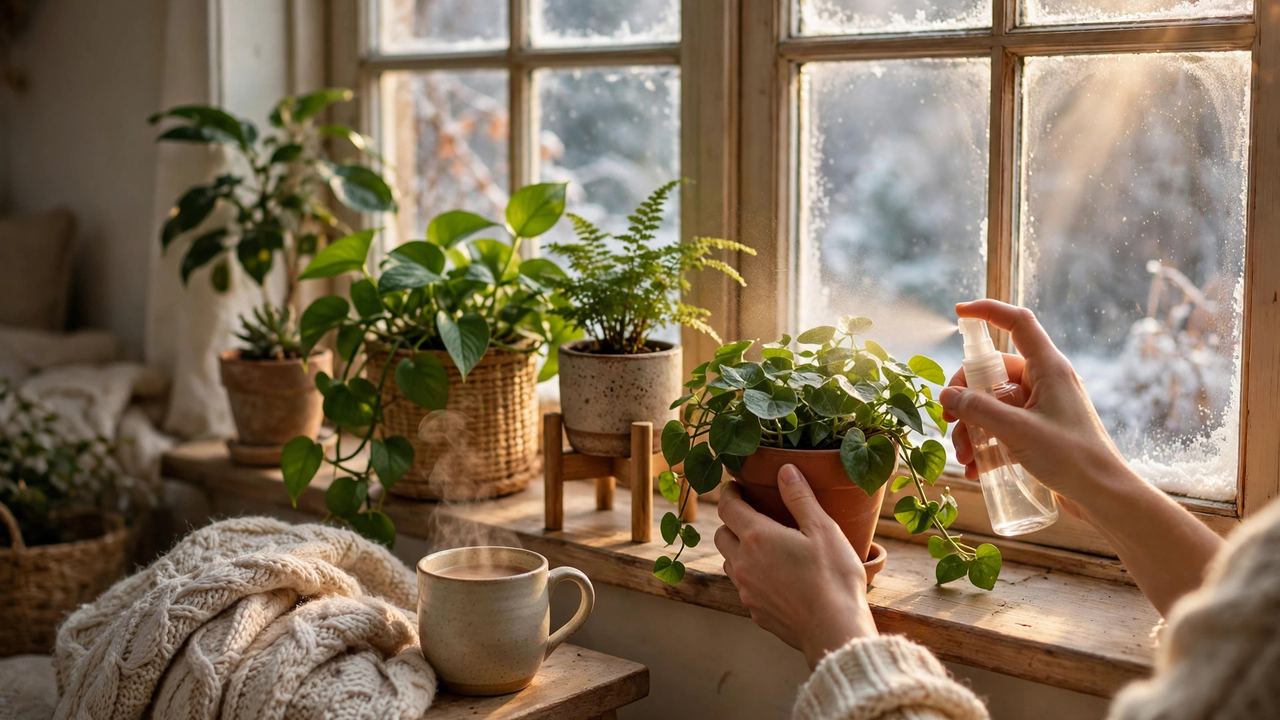
How far from heat sources and cold glass?
Readers often ask for a single safe distance in inches, and the honest answer from the extension sources is that they do not publish one universal number — they publish a rule, and the rule is consistent across all of them: keep the plant out of the hot, dry airflow and keep its foliage off the cold pane. Iowa State University Extension puts it plainly: keep houseplants away from cold drafts, radiators, and hot air vents, and make sure houseplant foliage does not touch cold windows. Kansas State Extension says almost none will survive the hot, dry air from a furnace vent. Cornell Cooperative Extension says to find a place away from heating, since heaters tend to overheat the environment and reduce the little humidity that exists in the air. Montana State University Extension says to keep plants away from vents, registers, heating stoves, and radiators, and not to let foliage touch the glass of a window because it is way too cold for a houseplant.
Turn that rule into distances you can act on in your own rooms. For cold glass, the working distance is a foliage gap, not a pot gap: position the plant so no leaf rests against or leans onto the pane, and so the pot is not pressed to the glass either. On a deep sill that may mean the front half of the sill only; on a narrow sill it means the plant does not belong on the sill at all and should sit on a stand just inside the room, still within a few feet of the window for light. Kansas State Extension gives the same instruction from the light side: drapes should be left open during the day where houseplants are being grown, but be careful not to allow the plants’ leaves to touch the glass of the window. If your windows are the drafty kind, fixing the window helps the plant as much as moving it — our guide to how to seal drafty windows for winter compares the main methods, and window insulation film kits for drafty old windows are the renter-friendly option that adds a still-air layer between the plant and the cold.
For heat, the working distance is “out of the rising air.” A windowsill directly above a radiator puts a plant in the worst of both worlds: hot, dry air rising past it all day and cold glass behind it all night. Move that plant sideways along the window if you can, so it keeps the light but leaves the column of hot air, or move it to a stand beside the window at sill height. A plant on the floor beside a vent or register should be moved far enough that you cannot feel the warm airflow on your hand at the plant’s position when the heating is running — that hand test is a practical way to apply the extension rule without a published inch count. The same logic applies to thermal curtains for sliding glass doors in winter: they can cut the cold coming off a large glazed door, but only if the plant sits inside the curtain, on the warm side, rather than between the curtain and the glass.
One more placement trap appears when you raise humidity near cold windows: moist air meeting a cold pane produces condensation, which can drip onto sills and plants below. If you group plants under a window and run a humidifier there, check the glass in the morning. Our guide to how to stop condensation on windows in winter explains the ventilation and insulation fixes; for the plants, the immediate step is simply to move the group a little further into the room, where the air at the glass is less humid and the light is only slightly lower.
Fixing a room that is almost right: light and humidity
Adding light where no window is good enough
Sometimes every window in a home is north-facing, shaded, or already full. That is the case supplemental light exists for. Illinois Extension notes that if you want to supplement light or use non-natural light, LED is now an option alongside fluorescent, that fluorescent tubes are available as grow bulbs fitting a standard 48-inch fixture, and that LEDs designed for plant growth can satisfy the quality and intensity issue without the heat factor that fluorescent fixtures generate. Cornell Cooperative Extension likewise suggests giving plants a little help on cloudy, dark days with artificial light, naming fluorescent or LED growing lights as good options.
Distance and duration are where the one specific, sourced example in this guide applies. For moth orchids, Iowa State University Extension says fluorescent lighting can be used to supplement natural lighting in poorly lit areas, to place the fluorescent fixture 6 to 8 inches above the plants, and to keep the lights on for 12 to 16 hours each day. Treat that as an orchid-specific instruction from that source, not as a universal setting for every plant and every lamp — but it shows the pattern that matters: a supplement works when it is close to the foliage and on for a long, regular part of the day, not when a ceiling light is left on in the same room. Put supplemented plants together in one lit station rather than scattering them, keep the station away from radiators and cold glass just as you would a window spot, and remember that a lit shelf in a steady interior room can be a better winter address than a drafty sill.
Raising humidity around the plants you placed
Once plants are grouped in their winter spots, raise the humidity around the group rather than trying to humidify the whole house for one fern. Iowa State University Extension calls humidifiers an excellent way to increase relative humidity, and North Carolina State Extension advises using a humidifier near your plants — near matters, because humidity falls off with distance just as light does. Iowa State also lists the simpler cultural methods: grouping plants together, because water evaporating from the potting soil plus water lost through the foliage increases humidity in the vicinity of the plants; placing plants on pebble trays that raise the pot above a saucer of water, keeping the bottoms of the pots above the water line; and growing smaller plants in a terrarium, where the enclosed glass traps moisture. Kansas State Extension gives the same pebble-tray method in the form of a tray of moist gravel or pebbles, with the warning not to allow the water to touch the bottom of the pot, because water would then be wicked into the potting medium and keep the plant too wet.
What not to rely on is misting. Iowa State University Extension states directly that misting houseplants is not an effective way to raise relative humidity, because humidity levels are only elevated for a few minutes after misting. North Carolina State Extension debunks the same myth, saying the benefits of misting are minor and only have a short-term effect of a few minutes. A mister can stay in the cupboard; a grouped arrangement, a pebble tray kept topped up, or a humidifier near the group are the fixes the sources actually support. Aim for the range the sources give — 40 to 50 percent for many houseplants, per Iowa State, and 40 to 60 percent for moth orchids — rather than chasing tropical greenhouse air in a heated home.
Watering and feeding change with the new spot
A move changes how fast a plant dries, so re-learn each plant in its new place instead of keeping its summer schedule. A plant promoted to a bright south window will dry faster than one demoted to a cool east room. The checks the sources recommend are physical, not calendar-based. Cornell Cooperative Extension advises putting about 2 inches of your finger into the soil: if the first inch is dry but the second inch is still wet, do not water; when the first 2 inches of soil are dry, it is time to add water. North Carolina State Extension offers the same finger check on the upper 2 inches, judging the weight of the pot wet versus dry, and a wooden skewer pulled from the pot to show how dry the medium is at depth. Montana State University Extension uses the lift test too — if the pot is light it is too dry, if heavy, wait — and warns never to leave a plant sitting in pooled saucer water.
Feeding, by contrast, should mostly stop wherever the plant sits. Cornell Cooperative Extension explains that plants take the cold months as an opportunity to rest, do not need additional food while growth is paused, and are best fertilized in the times of greatest sun, from spring to fall; fertilizing in cold, low-sun conditions stimulates new tissue without enough energy to develop it well. North Carolina State Extension agrees that fertilization is generally not necessary during winter months and advises resuming in March or April as conditions become more favorable. Montana State University Extension says fertilization is rarely recommended in winter and, if you do fertilize, to use only one-half the recommended amount and restart properly when new growth appears in spring. A plant that is not growing in winter is usually resting, not starving.
Mistakes to avoid
- Leaving every plant where it spent the summer. North Carolina State Extension warns that north and east windows that gave great indirect light in summer can become too shady in winter. The summer arrangement is a starting point, not a winter plan.
- Using the sill above the radiator as the main plant shelf. It combines the two hazards every source names: hot, dry air from heating and foliage against cold glass. Keep the light, lose the position — move the plant sideways or onto a stand.
- Letting leaves touch the glass. Iowa State, Kansas State, and Montana State extensions all warn against foliage touching cold windows. Check after every move and after growth, not just on the day you place the plant.
- Parking plants by the front door for the light. A bright spot in a draft is still a draft. Cornell, Kansas State, and Montana State extensions all advise keeping plants away from doors where cold breezes enter.
- Trying to fix a dark spot with water or fertilizer. Illinois Extension identifies small leaves, long thin stems, and yellowing older leaves as light problems. More water in low light risks the overwatering that Montana State calls the number one winter killer of houseplants.
- Misting instead of humidifying. Iowa State and North Carolina State extensions both say misting raises humidity for only a few minutes. Group plants, use pebble trays with pots above the water line, or run a humidifier near the group.
- Watering on the summer schedule after a move. Growth and water uptake fall in winter, per North Carolina State Extension. Check the top 2 inches of soil, the weight of the pot, or a skewer before every watering.
- Fertilizing a resting plant into weak growth. Cornell Cooperative Extension warns that feeding in cold, low-sun conditions produces tissue the plant cannot support. Hold feed until spring, as North Carolina State advises.
- Hiding a plant behind closed curtains overnight. The pocket between curtain and glass is the coldest air in the room. Bring the plant inside the curtain line or choose a different spot.
- Forgetting to rotate. One-sided window light produces one-sided growth; Illinois Extension advises rotating plants to keep growth even.
Frequently asked questions
Can houseplants stay on a windowsill all winter?
Some can, if three conditions hold: no leaf touches the cold glass, there is no radiator or vent directly below sending hot, dry air up past the plant, and the window is not a drafty one. Iowa State University Extension warns to keep foliage off cold windows and plants away from radiators and hot air vents, and Montana State University Extension makes the same points. If any condition fails, keep the window but change the position — a stand just inside the room, at sill height and within a few feet of the glass, preserves most of the light without the two hazards.
Which window is best if I only have north-facing windows?
Use the north window anyway, but use it deliberately: put only shade-tolerant plants there, as close to the glass as the cold allows, and expect slower growth. Illinois Extension puts a north window at low light, about 75 foot-candles. Montana State University Extension lists good candidates for that spot, including Chinese evergreen, cast iron plant, pothos, and philodendron. For anything that needs more, North Carolina State Extension advises supplementing with grow lights when a sunny location is not available, rather than hoping a light-hungry plant will adjust.
Is a bathroom really a good place for houseplants in winter?
Yes, if it has adequate light and space — that is the condition North Carolina State Extension attaches to its advice that bathrooms tend to have higher humidity and make good places for houseplants. Cornell Cooperative Extension also names the bathroom, along with the kitchen, as a place tropical ornamentals may prefer for its humidity. A bright bathroom suits ferns, calatheas, and orchids well; a windowless bathroom solves the humidity problem while creating a light problem, which is the worse trade in winter.
How cold is too cold for the spot by the window?
Use the temperature ranges the extensions publish as your guide. Iowa State University Extension says most houseplants grow well at daytime temperatures of 65 to 75 degrees Fahrenheit with nights of 60 to 65 degrees, and that temperatures below 50 degrees Fahrenheit or rapid fluctuations may harm some plants. Moth orchids should avoid exposure below 55 degrees Fahrenheit, per Iowa State. If the air at your plant’s position regularly falls below those levels at night — which a simple digital thermometer placed at the plant for a few nights will tell you, a tracking method North Carolina State Extension recommends — the spot is too cold regardless of its light.
Should I move plants away from the window on very cold nights?
Moving the most sensitive plants a few feet into the room on the coldest nights is a reasonable application of the sources’ shared rule: keep foliage off cold glass and avoid rapid temperature swings and cold drafts. Iowa State, Kansas State, and Montana State extensions all warn against foliage touching cold glass, and Iowa State warns against rapid fluctuations. A few feet of distance on an exceptional night costs a plant almost nothing in total light, because light is received over the whole season, while a night pressed against freezing glass can damage leaves in hours. Return the plant to its bright spot in the morning, and if you find yourself doing this every night, give the plant a permanent stand inside the room instead.
Do I need a grow light, or is moving plants enough?
Moving is enough when you have an under-used bright window — most homes do, once plants are sorted by need instead of by where they look nice. A grow light becomes the answer when every window is north-facing, shaded, or already allocated to the plants that need it most, or when a plant keeps stretching after its move. Illinois Extension describes LED and fluorescent grow options, Cornell Cooperative Extension recommends fluorescent or LED help on dark days, and Iowa State gives a worked example for moth orchids: a fluorescent fixture 6 to 8 inches above the plants, on for 12 to 16 hours a day. Decide by the plant’s signals — continued lanky growth and leaf drop after a move mean the new spot is still too dark.
Conclusion
Keeping houseplants well in winter is mostly a placement job, done once and then checked. Rank your windows south, west, east, and north using the light figures Illinois Extension publishes — about 300 foot-candles at a south window, about 150 at east or west, about 75 at north. Spend the brightest spots on the plants that need them, give burned-prone plants such as African violets and moth orchids the gentler east light, and reserve the north window and the back rows for the tolerant group. Then clear the danger zones: no foliage on cold glass, no plant in the rising air of a radiator or vent, no plant in a door draft, and no tropical in a room that drops toward the below-50-degree level Iowa State warns against. Group what remains, raise the humidity around the group toward the 40 to 50 percent the extensions recommend with grouping, pebble trays, or a humidifier placed near the plants, and water by checking the soil rather than the calendar.
Do that walk-through plant by plant this week, while the light is still changing, and then repeat the stretch test every few weeks: small leaves, long thin stems, and yellowing older leaves mean a plant’s address is still wrong, and a move of a few feet is usually the whole cure. The plants that come through winter best are rarely the ones that were fussed over most. They are the ones that were put, deliberately, in the right window for their type — and left there, warm-sided of the glass and out of the hot air, until spring.










Write Your Review
No reviews yet. Be the first to share your experience!