
Key takeaways
- A fridge needs 800-1,200 starting watts, not just 150-400 running watts. Use the tables to total your fridge plus freezer, lights, furnace fan and more today.
When the power goes out, the refrigerator is usually the first appliance people want back, and the question what size generator do you need to run a refrigerator has a shorter answer than most guides admit. For the refrigerator alone, plan on 150 to 400 running watts and 800 to 1,200 starting watts, the range Champion Power Equipment lists for a household refrigerator, so the generator must deliver at least 1,200 starting watts and keep delivering the running watts afterwards. In practice, most households do not run a refrigerator alone, and that is where the real sizing work begins.
This article gives you the part a one-line answer cannot: the full starting-versus-running table for refrigerators and freezers, a second table for the appliances people almost always run alongside the fridge in a winter outage, the sizing formula the generator makers themselves use, and worked examples you can copy with your own numbers. Work through the tables with a pencil, total your own load, and you will know your size before you shop, borrow, or roll a generator out of the garage.
The short answer, and why it is only the starting point
A refrigerator is a small running load and a surprisingly large starting load. Champion Power Equipment lists a refrigerator at 150–400W running and 800–1,200W starting. Honda Power Equipment, looking at an Energy Star refrigerator or freezer, lists a much lower running figure of 132–192W but the same 1,200W starting figure. The two makers disagree about the steady draw, because refrigerators vary, and they agree about the point that actually trips generators: the compressor needs roughly 1,200 watts for a moment every time it starts.
So the honest short answer has two numbers, not one. Your generator’s running (rated) wattage must cover everything that is on at once, hour after hour. Its starting (peak or surge) wattage must cover the running total plus the extra burst when the largest motor on your list kicks in. A generator that meets the first number but not the second will hum along happily until the fridge compressor tries to start, then stall, lug down, or trip its breaker — usually just as you have walked back inside.
There is also a comfort margin to consider. The worked examples below use the top of each maker’s range, because undersizing fails in the middle of an outage while a modest amount of headroom simply means the engine is not working at its limit all night. You do not need to double your number. You do need to round up to a generator whose two ratings — running and starting — both clear your two totals.
Running watts vs starting watts: the two numbers that decide everything
Running watts are what an appliance draws once it is up and working: the compressor humming, the fan turning, the pump pumping. Starting watts are what that same appliance draws for a brief moment at switch-on, before the motor reaches speed. Virginia Tech Extension, in its energy factsheet developed with the U.S. Department of Energy, makes the same point from the meter’s side: when measuring the current drawn by a motor, the meter will show about three times more current in starting the motor than when it is running smoothly.
Only motor and compressor loads behave this way. Refrigerators, freezers, furnace fans, sump pumps, well pumps, washing machines and air conditioners all carry a starting figure well above their running figure in the makers’ charts. Resistive and electronic loads — lights, phone chargers, routers, televisions, microwaves, space heaters — do not. Champion marks those appliances with a note that they do not require extra starting watts, and you size for them on running watts only. That single distinction is why a simple shopping list of wattages misleads people: adding up running watts alone understates any list that contains a motor, and adding up every starting wattage overstates it, because motors almost never all start in the same second.
The makers’ sizing method sits between those two errors. Add the running watts of everything you want on at the same time. Then find the one appliance with the largest additional starting watts — its starting watts minus its running watts — and add only that one extra amount. The result is the starting total your generator must meet. The rest of this article is that method, applied step by step.
Refrigerator and freezer wattage table: start with the cold boxes
The table below brings together the refrigerator figures from the two manufacturer charts opened for this article. Use the Champion range for a general full-size refrigerator, the Honda row if your fridge is an Energy Star model and you want the maker’s own estimate for that class, and the freezer and mini-fridge rows if those are also on your list.
| Appliance | Running watts | Starting watts | Source |
|---|---|---|---|
| Refrigerator (full-size, general) | 150–400 | 800–1,200 | Champion Power Equipment wattage chart |
| Refrigerator or freezer (Energy Star) | 132–192 | 1,200 | Honda Power Equipment wattage estimation guide |
| Freezer (chest or upright) | 100–500 | 500–1,000 | Champion Power Equipment wattage chart |
| Mini fridge / cooler | 50–100 | 400–600 | Champion Power Equipment wattage chart |
| RV refrigerator | 150–600 | 400–1,000 | Champion Power Equipment wattage chart |
| Refrigerator, frost-free, 16 cubic feet (nameplate figure) | 725 (nameplate maximum) | Not listed separately | Virginia Tech Extension / DOE factsheet |
Read the last row carefully, because it explains why neighbours comparing notes often think one of them must be wrong. The Virginia Tech Extension factsheet lists a frost-free, 16-cubic-foot refrigerator at 725 watts — but that is a nameplate figure, the maximum power the appliance is rated to draw, taken from the stamp on the back or bottom of the unit. The same factsheet explains that the wattage stamped on an appliance is the power it draws at its maximum, and that a refrigerator does not run at that maximum continuously: refrigerators cycle on and off to hold temperature, and to estimate the hours a refrigerator actually operates at its maximum wattage, you divide the total time it is plugged in by three. The generator charts, by contrast, are planning ranges for the compressor’s working draw. Both kinds of figure are real; they simply answer different questions.
For generator sizing, work with the chart ranges, and work at the top of them unless you have measured your own fridge. A large French-door or side-by-side model, an older fridge, or a fridge working hard in a warm kitchen belongs at the top of the range. If you are choosing a replacement fridge partly with outages in mind, the models compared in our guide to the best refrigerators under 1000 are the same class of full-size machines these chart figures describe, so the 150–400W running range is the right planning band for them.
How to get your own refrigerator’s real number
Every chart in this article is a planning tool. Your refrigerator publishes its own figure, and the factsheet method for finding it is simple. Look for the nameplate, usually stamped on the back or bottom of the appliance or inside the door, and read the volts and amps. If watts are not listed, multiply the current draw in amperes by the voltage the appliance uses — most U.S. appliances use 120 volts, as the Virginia Tech Extension factsheet notes, so a fridge stamped at 115 volts and 6 amps is a roughly 690-watt maximum-draw appliance on paper. Treat that product of volts and amps as the ceiling it is, not as the compressor’s everyday draw, and keep the chart range for the sizing math. What the nameplate does settle is arguments: if your fridge’s label implies a draw well above the chart range, size from the label, not from this page.
One more refrigerator behaviour matters for outages. Because the compressor cycles, the fridge is not a constant load: it draws its running watts while the compressor is on and almost nothing while it rests, then demands its starting burst again at the next cycle. That is why a generator that started your fridge once at noon can still be caught out at midnight — the test is not one start, it is every start, all night, sometimes while other loads are also running. It is also why food-safety timing matters if you decide to run the fridge only in stretches; our companion guide on how long food stays safe in a fridge during a winter outage works through that side of the decision.
The add-on table: what else you will run alongside the fridge
Almost nobody runs a refrigerator and nothing else. In a winter outage the realistic list grows quickly: a freezer full of food, the furnace fan that moves warm air, a sump pump if meltwater is rising, lights, the router that keeps phones useful, and — the load that changes every calculation — a space heater or a microwave. Champion Power Equipment lists running and starting watts for all of these, and Honda lists several of them independently, so you can cross-check the big items between the two charts.
| Appliance | Running watts | Starting watts | Notes |
|---|---|---|---|
| Furnace fan (1/2 HP) | 300–800 | 800–1,600 | Champion range; Honda lists the 1/2 HP furnace fan at 875 running and 2,350 starting |
| Sump pump (1/3 HP) | 500–800 | 1,000–1,600 | Champion range; Honda lists 800 running and 1,300 starting |
| Sump pump (1/2 HP) | 800–1,050 | 1,300–2,150 | Champion range; Honda lists 1,050 running and 2,150 starting |
| Well pump (1/2 HP) | 750–1,000 | 1,500–2,000 | Champion |
| Well pump (1 HP) | 1,000–2,000 | 2,000–4,000 | Champion |
| Washing machine | 500–1,000 | 1,000–2,300 | Champion |
| Window air conditioner (10,000 BTU) | 900–1,200 | 1,800–2,400 | Champion; Honda lists 1,500 running and 2,200 starting |
| Microwave | 600–1,200 | No extra starting watts | Champion; size on running watts only |
| Space heater | 750–1,500 | No extra starting watts | Champion; size on running watts only |
| Dishwasher | 1,200–2,400 | No extra starting watts | Champion |
| Electric water heater | 3,000–4,500 | No extra starting watts | Champion; Honda lists 4,500 running |
| Electric dryer | 4,000–6,000 | No extra starting watts | Champion; Honda lists 5,400 running and 6,750 starting |
| TV (32–55 inch) | 80–400 | No extra starting watts | Champion |
| LED lights (per bulb) | 8–15 | No extra starting watts | Champion |
| Internet router / modem | 10–20 | No extra starting watts | Champion |
| Phone / laptop charger | 20–100 | No extra starting watts | Champion |
| CPAP machine (without heat) | 30–60 | No extra starting watts | Champion |
| CPAP machine (with heated humidifier) | 60–120 | No extra starting watts | Champion |
| Ceiling fan | 15–75 | No extra starting watts listed | Champion |
Two patterns in this table decide most real-world sizes. First, the motor loads cluster in the same band as the refrigerator itself: a furnace fan, a sump pump and a well pump each rival or exceed the fridge’s starting demand, so adding any one of them roughly doubles the peak you must cover. Second, the resistive heating loads are in a different league for running watts. A single space heater at the top of Champion’s range draws 1,500 running watts — nearly four refrigerators’ worth of steady load — and an electric water heater or dryer is larger still. If you are comparing heater models for the room you most need to keep warm, our guide to the best energy efficient space heaters under 100 covers the class of heater in that 750–1,500W band; whichever model you own, its wattage goes into your running total at full value, for every hour it runs.
Notice, too, how small the quality-of-life loads are. Ten LED bulbs at the top of Champion’s range add 150 running watts. A router adds at most 20. Chargers, a television and a CPAP machine together add a few hundred. These loads barely move the sizing answer, which is good news: once the fridge and the big motors are covered, lights, communications and medical devices usually ride along for free. The loads to interrogate hard are the ones with motors and the ones that make heat.
The sizing formula, step by step
With both tables in front of you, the calculation itself takes five minutes. Do it on paper, with your own appliance list, in this order.
- Step 1 — List what runs at the same time. Not everything you own, and not everything you might use once: the loads that will genuinely be on together during the outage. Be honest about the space heater and the microwave; be ruthless about the dryer and the electric range, which belong on almost no outage list.
- Step 2 — Write down the running watts for each item. Use the top of the maker’s range unless you have your own nameplate figure. Add them. This is your running total, and the generator’s rated (running) wattage must meet or beat it.
- Step 3 — Find the largest additional starting watts. For each motor load, subtract running watts from starting watts. Keep only the biggest single difference. Lights, heaters and chargers contribute zero here, because the makers list no extra starting watts for them.
- Step 4 — Add that one extra amount to the running total. This is your starting total, and the generator’s starting (peak) wattage must meet or beat it.
- Step 5 — Round up to a real generator size, with headroom. If your totals land just under a generator’s ratings, remember that the chart figures are ranges for typical appliances, not measurements of yours. Choosing the next size up is how you buy insurance against an older fridge, a cold-stiffened pump, or one appliance you forgot to list.
One management trick can shrink the answer at Step 3, and Honda states it plainly in its guide: do not just add up the total wattage for everything you want to power — power management lets a smaller generator do more. In practice that means staggering starts. Plug in and start the refrigerator first and let its compressor settle, then start the freezer, then the pump. Two compressors that start a minute apart ask the generator for one surge at a time; the same two compressors starting in the same second can ask for both. Staggering does not change your running total, and it does not excuse a generator whose running rating is too small, but it is the difference between a peak you planned for and a peak that ambushes you when the thermostat calls.
Worked example 1: the refrigerator alone
Start with the simplest list in the world: one full-size refrigerator, nothing else. Using the top of Champion’s range, the running total is 400 watts. The refrigerator’s additional starting watts are 1,200 minus 400, which is 800. The starting total is 400 plus 800, which is 1,200 watts. So the minimum generator for a fridge alone must be rated at least 400 running watts and at least 1,200 starting watts.
Almost any small generator clears that bar on paper, which is exactly why the fridge-alone answer misleads people into stopping here. The rating that matters is the pair, not either number alone, and the moment you add a freezer, a few lights and a phone charger — the loads in the next example — the running total triples while the starting total grows by half again. Buy for the list you will actually run, not for the single appliance in the question.
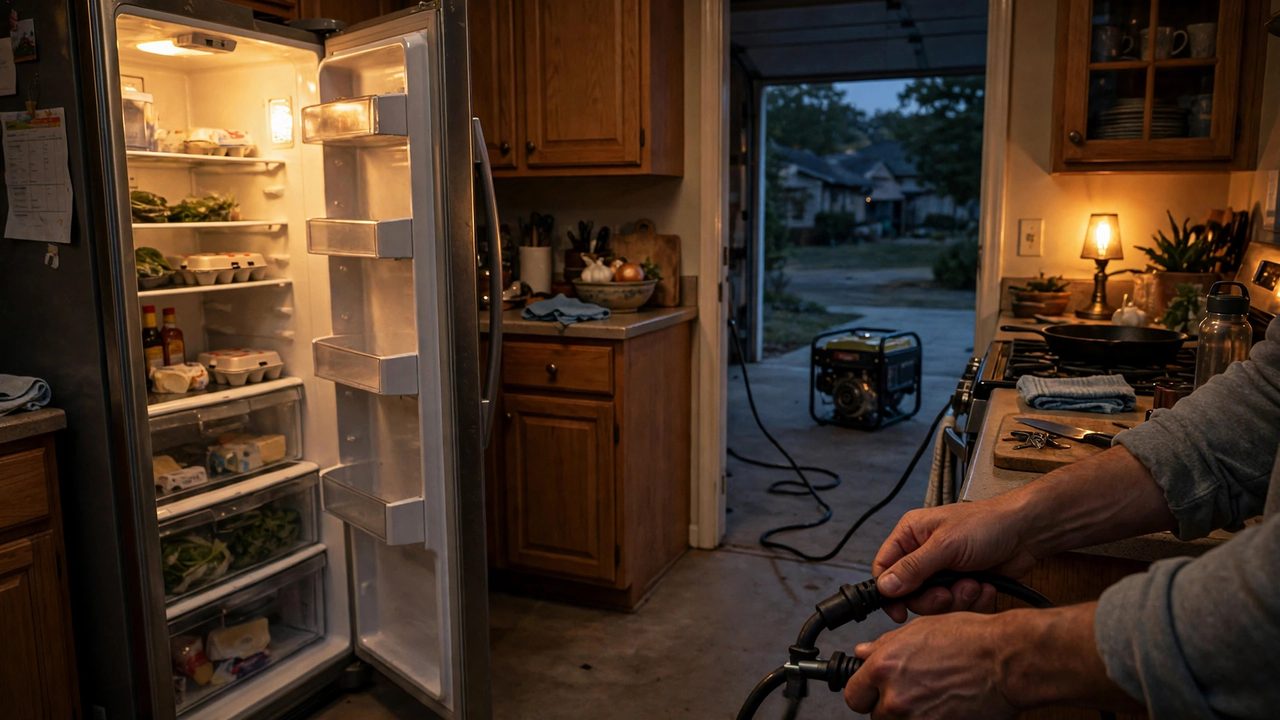
Worked example 2: fridge, freezer, lights and staying connected
This is the most common real list: the refrigerator, a separate freezer, lights for the rooms you live in, the internet router, and chargers. If your freezer is a garage upright, it is the same class of machine compared in our guide to the best upright freezers for garage use, and Champion’s freezer range of 100–500W running and 500–1,000W starting is the right planning band for it. Using the top of each range throughout:
| Load | Running watts | Starting watts | Additional starting watts |
|---|---|---|---|
| Refrigerator | 400 | 1,200 | 800 |
| Freezer | 500 | 1,000 | 500 |
| LED lights (10 bulbs at 15W) | 150 | 150 | 0 |
| Router / modem | 20 | 20 | 0 |
| Phone and laptop chargers | 100 | 100 | 0 |
| Totals | 1,170 running | 1,970 starting (1,170 + 800) | Largest extra: 800 (refrigerator) |
The generator for this list must deliver at least 1,170 running watts and at least 1,970 starting watts. In practice you would shop in the class above those minimums, so the machine is not living at its ceiling and so a cold morning start or an ageing freezer compressor does not push you over. Note what did the work in this example: the two cold boxes together are 900 of the 1,170 running watts, and the refrigerator’s surge alone sets the starting total. The lights, router and chargers — everything that makes an outage feel liveable — added only 270 running watts between them.
Worked example 3: the winter essentials list
Now the list a northern house actually needs in January: refrigerator, furnace fan, sump pump, lights and router. The furnace fan is what turns a gas or oil furnace’s heat into warm rooms, and in Honda’s chart the 1/2 HP fan is a serious load — 875 running watts and 2,350 starting watts — while Champion puts the same fan at 300–800 running and 800–1,600 starting. The example below uses Champion’s top ends for consistency, and then shows what changes if your fan matches Honda’s higher figure.
| Load | Running watts | Starting watts | Additional starting watts |
|---|---|---|---|
| Refrigerator | 400 | 1,200 | 800 |
| Furnace fan (1/2 HP) | 800 | 1,600 | 800 |
| Sump pump (1/2 HP) | 1,050 | 2,150 | 1,100 |
| LED lights (10 bulbs at 15W) | 150 | 150 | 0 |
| Router / modem | 20 | 20 | 0 |
| Totals | 2,420 running | 3,520 starting (2,420 + 1,100) | Largest extra: 1,100 (sump pump) |
This list needs a generator rated at least 2,420 running watts and 3,520 starting watts — roughly double the fridge-and-freezer list, and the sump pump, not the refrigerator, now sets the peak. Swap in Honda’s furnace fan figures and the picture sharpens further: the running total rises to 2,495 watts, the fan’s additional starting watts become 2,350 minus 875, or 1,475, and the starting total climbs to 3,970 watts. Same house, same list, two manufacturers’ charts — and a difference of about 450 starting watts. That gap is the strongest argument in this article for two habits: check your own appliances’ labels where you can, and leave headroom instead of buying to the exact watt.
How long a generator in this class can keep that list running is a separate question of fuel and duty, and it matters for planning an overnight outage; our guide to how long a portable generator can run continuously works through continuous-run limits, refuelling breaks and oil checks in detail.
Worked example 4: adding heat and cooking — where sizes jump
Take the winter essentials list and add the two loads everyone asks about by the second day of an outage: a space heater and a microwave. Neither needs extra starting watts — Champion lists both as running-watts-only loads — so the starting total grows only by their running watts. The running total, however, grows brutally. The heater at the top of its range adds 1,500 watts and the microwave at the top of its range adds 1,200 watts, taking the list from 2,420 to 5,120 running watts, and the starting total from 3,520 to 6,220 watts.
That is a different class of generator, a different amount of fuel burned per hour, and a much louder, heavier machine — all to cover two appliances that are used in bursts. The practical alternatives are management, not machinery. Run the microwave alone, briefly, with the heater switched off, and it never overlaps the big motors at full draw. Heat one room with the furnace fan doing the work it already does in the essentials list, rather than adding a separate electric heater to a generator that is also carrying pumps. And accept that some loads simply do not belong on a portable generator at all: at Champion’s figures, an electric dryer at 4,000–6,000 running watts or an electric water heater at 3,000–4,500 running watts can each exceed the entire essentials list on their own. Sizing honestly sometimes means deciding what the generator is not for.
Inverter vs conventional generators for a refrigerator
Once your two totals point to a size class, the remaining choice is the type of machine. A conventional portable generator runs its engine at a fixed speed to hold output frequency, and its running and starting ratings are the headline numbers on the box. An inverter generator produces power electronically, can vary its engine speed with the load, and is generally the quieter, more fuel-sipping option at the partial loads a refrigerator list represents — remember, for much of the day your fridge list may draw only a few hundred watts while compressors rest, then jump when one starts.
For this specific job, three practical points matter more than the technology label. First, the ratings rule applies identically to both types: an inverter machine whose starting rating is below your starting total will fail to start your fridge just as surely as a conventional one, whatever its other virtues. Compare running to running and starting to starting, from the maker’s own figures. Second, a refrigerator compressor is a motor, and motors are the loads that expose weak surge capacity; a machine that runs your lights beautifully in a showroom test has told you nothing about the moment that matters. Third, if your outage plan includes sensitive electronics alongside the fridge — a laptop doing remote work, a router, a modern television — the cleaner, more stable output that inverter machines are sold on is a genuine consideration, and it costs you nothing in sizing terms as long as the two wattage ratings clear your totals.
There is also a battery alternative worth naming, because many readers asking about a fridge are really asking how to get through a night quietly. A portable power station has no starting-watts rating in the generator sense; it has an output rating and a surge rating, and a battery capacity in watt-hours that decides how long it lasts rather than how much it can start. The sizing tables in this article still tell you whether its output can start and run your fridge, and our guide to how long a portable power station lasts in an outage does the watt-hour maths for runtime. For a fridge-only overnight bridge, that can be the right tool; for a multi-day winter outage with a furnace fan and a sump pump, the fuel-burning generator’s ability to refuel and keep going is usually decisive.
Safety: placement and carbon monoxide are not optional details
None of the sizing above matters if the generator is placed wrongly, and the authority here is blunt. The U.S. Consumer Product Safety Commission says carbon monoxide poisoning from gasoline-powered portable generators can kill in minutes, that CO is colourless and odourless, and that an average of about 100 consumers die in the U.S. each year from CO poisoning from portable generators, according to the CPSC’s latest report. Size and place the machine by these rules, every time.
- Outdoors only. The CPSC says never operate a portable generator inside a home, garage, basement, crawlspace, shed or other enclosed space, and that opening doors or windows will not provide enough ventilation to prevent lethal levels of CO building up.
- At least 20 feet from the house. The CPSC directs users to operate portable generators outside only, at least 20 feet away from the house, not on a porch or in a carport, with the exhaust directed away from the home and other buildings someone can enter, and with nearby windows closed and vent openings sealed off.
- CO alarms and a CO shut-off. The CPSC advises installing battery-operated CO alarms or alarms with battery backup on each level and outside separate sleeping areas, testing them monthly, never ignoring an alarm — get outside immediately, then call 911 — and looking for portable generators that have a CO shut-off safety feature.
- Follow the maker’s weather instructions. The CPSC notes that users should follow the generator manufacturer’s instructions about electrical shock hazards in inclement weather, which may include an NFPA-rated non-combustible generator tent or waiting until rain or snow passes, and should regularly check and maintain the generator and follow all labels, instructions and warnings in the owner’s manual.
Where exactly to set the machine down, how to route cords, and how placement interacts with snow, wind and neighbours are covered step by step in our companion guide on where you should place a generator during a power outage. Read it before the outage, not during it.
Mistakes to avoid when sizing for a refrigerator
- Sizing on running watts alone. The single most common error. A fridge that runs at 150–400 watts needs 800–1,200 watts to start on Champion’s chart; a generator chosen against the smaller number fails at the first compressor start after you plug in.
- Adding every starting wattage together. The opposite error, and an expensive one. The makers’ method adds only the largest single additional starting figure, because motors do not all start in the same instant — especially if you stagger them deliberately.
- Trusting one chart when two disagree. Honda lists an Energy Star fridge at 132–192 running watts; Champion lists a general refrigerator at up to 400. Honda’s 1/2 HP furnace fan starts at 2,350 watts; Champion’s tops out at 1,600. Plan at the top of the ranges, check your own nameplates, and leave headroom.
- Forgetting the heater and the microwave. Resistive loads have no surge, so they look harmless in a starting-watts table — while quietly adding 1,200 to 1,500 running watts each. They are the loads that push a sensible essentials list into the next generator class.
- Letting everything start at once. Restoring power to a fridge, a freezer and a pump in the same second stacks surges the formula assumed would arrive one at a time. Start loads in sequence, largest motor first, and let each settle before adding the next.
- Running the generator in the garage “just for the storm”. The CPSC’s rule has no weather exception: outdoors only, at least 20 feet from the house, exhaust pointed away. A smaller generator placed safely beats a bigger one placed in a garage, every time.
- Ignoring the cycling problem. Your fridge will restart its compressor many times overnight, sometimes while the furnace fan or pump is running. Size for the worst ordinary moment, not for the calm demonstration you did in the driveway at noon.
Frequently asked questions
Will a 2,000-watt generator run a refrigerator?
For the refrigerator alone, the numbers say yes, with room to spare: Champion lists a fridge at up to 400 running watts and 1,200 starting watts, so a machine whose ratings clear both figures starts and runs it. The same machine also covers the fridge-and-freezer example in this article, which totals 1,170 running watts and 1,970 starting watts — but only just on the starting side, which is why staggering the two compressor starts matters at that size.
Why does my generator run everything except when the fridge kicks in?
Because that kick is the starting surge. Virginia Tech Extension notes that a motor draws about three times more current when starting than when running smoothly, and the makers’ charts put a refrigerator’s starting watts at up to roughly three to eight times its running watts depending on which figure in the range you compare. If the generator’s starting rating is below your running total plus that surge, the compressor start is exactly when it will lug, stall or trip.
How do I find my refrigerator’s actual wattage?
Read the nameplate on the back, bottom or inside the door. The Virginia Tech Extension factsheet explains that the stamped wattage is the maximum power the appliance draws, and that if only volts and amps are listed, you multiply them — most U.S. appliances use 120 volts. Use that figure as a ceiling, use the chart ranges for the sizing math, and remember the same factsheet’s rule that a refrigerator operates at its maximum wattage for roughly a third of the time it is plugged in, because the compressor cycles.
Can I run a refrigerator and a freezer on the same generator?
Yes, and the worked example above totals it: at the top of Champion’s ranges, 400 running watts for the fridge plus 500 for the freezer, plus lights, a router and chargers, comes to 1,170 running watts and 1,970 starting watts. Choose a generator rated above both totals, and start the two compressors one at a time rather than together.
Does a space heater change the generator size I need?
Dramatically, and through running watts rather than starting watts. Champion lists a space heater at 750–1,500 running watts with no extra starting watts, so one heater can add more steady load than the refrigerator, freezer, lights and router combined. If heat is on your outage list, put the heater’s full wattage in the running total before you choose a size — or heat with the furnace fan already in your essentials list instead.
Is an inverter generator better for a refrigerator?
It can be, for noise, fuel use at partial load and output quality for electronics sharing the circuit, but it is not exempt from the arithmetic. An inverter machine must still clear your running total with its running rating and your starting total with its starting rating. Judge both types by the same two numbers from the maker’s own figures, then let noise, fuel and outlet layout break the tie.
Conclusion
The refrigerator itself is the easy part: 150–400 running watts and 800–1,200 starting watts on Champion’s chart, 1,200 starting watts on Honda’s as well. The generator you actually need is decided by the company the fridge keeps. Add a freezer, lights and a router and you are at roughly 1,170 running and 1,970 starting watts. Add a furnace fan and a sump pump for a real winter outage and the honest minimum becomes about 2,420 running and 3,520 starting watts — more if your furnace fan matches Honda’s higher figures. Add a space heater and a microwave without managing them, and you have specified a machine twice that size again.
So do the five steps with your own list, at the top of the makers’ ranges, and round up. Check your refrigerator’s nameplate against the chart. Start your motor loads one at a time. And place the machine the way the CPSC directs — outdoors only, at least 20 feet from the house, exhaust away — because the best-sized generator in the world is only a good purchase if it is also a safely placed one. Do that, and the next outage becomes a maths problem you have already solved, with a cold fridge, a warm house and food that never had to be thrown away.










Write Your Review
No reviews yet. Be the first to share your experience!