
Key takeaways
- No water, frost on a pipe, odd smells or banging? Work through the signs one by one, find the frozen section, thaw it safely, and know when to call a plumber.
It is the coldest morning of the year, you turn on the kitchen faucet, and almost nothing comes out. Your first question is simple: is this a frozen pipe, or something else? Learning how to tell if your pipes are frozen comes down to matching a short list of signs against what you can see, hear, smell and feel around your own plumbing. The short answer is this: on a very cold day, a faucet that gives no water or only a trickle is the classic warning, and frost on an exposed pipe, a swollen or bulging section, strange drain smells, and whistling or banging sounds each point the same way. The American Red Cross puts the first test plainly: if you turn on a faucet and only a trickle comes out, suspect a frozen pipe.
A search snippet can give you that one line. What it cannot do is walk your house with you. This guide does that instead. You will check the signs one by one, run a faucet-by-faucet test that separates a frozen branch line from a whole-house problem, learn how to narrow down where the frozen section actually is, and then follow the safe next steps in the right order — including the point at which the honest answer is to stop and call a licensed plumber. Work through it in order and you will know, not guess, what is happening inside your walls.
The signs at a glance: match them against your pipes
Before the detail, here is the whole diagnosis in one table. Find a quiet moment, walk to the fixture that is misbehaving, and compare what you find with each row. One strong sign on a bitterly cold day is usually enough to act on; two or more together make the diagnosis close to certain.
| Sign | What you notice | What it usually means |
|---|---|---|
| No water, or only a trickle | A faucet that ran fine yesterday gives nothing, a few drips, or a thin stream | Ice is blocking the pipe feeding that fixture — the classic first sign |
| Frost on the pipe | A white, frosty coating on an exposed pipe in the basement, crawl space or garage | The pipe wall is below freezing and the water inside is likely already frozen |
| Strange smells | A foul odor coming back up from a drain or faucet | Odors that normally drain away are trapped by ice and forced back toward the room |
| Strange sounds | Whistling or banging from the pipes, or bubbling when you flush a toilet | Water and air are being forced past or around an ice blockage |
| A bulge or crack | A swollen section of pipe, a visible split, or ice seeping out of the pipe wall | The pipe has very likely already burst — treat it as an emergency |
| Damp walls or puddles | Wet drywall, rings on a ceiling, or water pooling with no obvious source | A frozen pipe has cracked and is leaking, possibly only once it starts to thaw |
One thing to understand before you start: a frozen pipe and a burst pipe are not the same event, and the gap between them is where your decisions matter. The American Red Cross explains that water expands as it freezes, and that expansion puts tremendous pressure on whatever contains it — metal or plastic — and that no matter the strength of the pipe, expanding water can cause it to break. State Farm adds that frozen pipes can occur in homes with both plastic and copper pipes, and that pipes can freeze and burst when temperatures dip below 32 degrees Fahrenheit. So the goal of this diagnosis is not just to confirm a freeze. It is to confirm it early, while the pipe is still in one piece.
Sign 1: No water, or only a trickle, from a faucet
This is the sign almost everyone meets first, and it is the one the authorities lead with. The American Red Cross says that if you turn on a faucet and only a trickle comes out, you should suspect a frozen pipe. State Farm gives the stronger version of the same test: if you turn on your faucets and nothing comes out, leave the faucets turned on and contact a plumber. Between those two versions sits the whole range of what a freeze can look like at the tap — a weak stream, a sputtering flow that fades, a few drips and then nothing, or a completely dry faucet.
Read the pattern, not just the faucet in front of you:
- One faucet is dead, the rest of the house is fine. The freeze is almost certainly in the branch line feeding that single fixture — very often the run inside an exterior wall behind a kitchen or bathroom sink.
- Several faucets on the same wall or floor are weak. The frozen section is probably in a shared run feeding that group, such as a line crossing a crawl space or an unheated basement ceiling.
- Every faucet in the house is dead. Suspect the main line where your water service enters the home. The Red Cross specifically names this spot — where your water service enters your home through the foundation — as one of the likely places for a frozen pipe.
- The cold side works but the hot side does not, or the reverse. Hot and cold lines run separately, and one can freeze while the other still flows. Test both sides of every faucet before you conclude anything.
- A toilet will not refill after flushing. The supply line to that toilet is fed by the same kind of small branch line as a faucet, and a silent, empty tank on a cold morning is the same sign in a different fixture.
Context matters as much as the symptom. A dead faucet in July is a valve, a clog or a supply problem. A dead faucet after a night when the temperature fell hard — especially in a house with pipes in unheated spaces — is a freeze until proven otherwise. Trade guidance collected by Contractor Supply Magazine puts the exposure threshold plainly: any pipe exposed to temperatures below 20°F for several hours at a stretch runs the risk of freezing. If last night looked like that where you live, weight every sign in this guide more heavily.
Sign 2: Frost on the outside of the pipe
If you can see the pipe, this is the most direct evidence you will get. Contractor Supply Magazine’s warning-sign rundown states that frost on the outside of a pipe is a likely sign that it is already frozen. The logic is simple: frost forms on the pipe’s surface because the pipe wall itself is at or below freezing, and water sitting inside a pipe that cold, in an unheated space, does not stay liquid for long.
To check properly, go to the coldest plumbing in the house rather than the most convenient. The American Red Cross lists the pipes that freeze most frequently, and your inspection route should follow its list:
- Pipes exposed to severe cold, like outdoor hose bibs, swimming pool supply lines and water sprinkler lines.
- Water supply pipes in unheated interior areas like basements and crawl spaces, attics, garages, or kitchen cabinets.
- Pipes that run against exterior walls that have little or no insulation.
Run your hand along the exposed runs as well as looking at them. A frozen section often feels distinctly colder than the pipe on either side of it, and the frost line — where the white coating starts and stops — can mark the edges of the frozen stretch. Note what you find, because this same inspection becomes your map when you start locating the blockage in detail below. A word of caution: a pipe can be frozen solid with no frost on it at all, particularly inside a wall where you cannot see it. Frost confirms a freeze; the absence of frost does not rule one out.
Sign 3: Strange smells coming from a drain or faucet
This is the sign people least expect, and the one a snippet almost never explains. Contractor Supply Magazine describes it directly: a nasty smell from the drain or faucet is a less obvious warning sign of a frozen pipe, because odors cannot filter out through a frozen pipe and are instead forced back up toward the home. In other words, the same ice plug that stops water going down also stops sewer and drain gases escaping the way they should, so they take the only open path — back into your kitchen or bathroom.
Use the smell as a supporting sign rather than a verdict on its own. A drain odor on a mild day usually means a dry trap or a venting issue. A drain odor that appears on the coldest morning of the year, in the same room as a faucet that has slowed to a trickle, is part of a pattern — and patterns are what this diagnosis is built on. Note which fixture the smell is coming from, because like the dead faucet, it points at the branch line involved.
Sign 4: Whistling, banging and bubbling sounds
Pipes talk, and in a freeze they say specific things. Contractor Supply Magazine lists whistling and banging coming from the pipes, and strange bubbling sounds when you flush a toilet, as warning signs of a freeze. Each sound has a physical cause you can reason about. Whistling is what you hear when water is being forced through a narrowing — the gap between an ice plug and the pipe wall, or the last open channel through a partly frozen section. Banging is the sound of pressure changes hammering against a blockage that will not let water move the way it should. Bubbling at the toilet is air being pushed around a frozen drain or vent path instead of escaping normally.
Sounds are also diagnostic in a second way: they tell you the blockage is partial. A pipe that whistles still has water moving through it, which means you may be catching the freeze while it is still forming. That is genuinely good news, because a pipe caught at the trickle-and-whistle stage — with the faucet left open and gentle heat applied — is far less likely to become the pipe that bursts. Do not ignore new pipe noises on a cold night just because the water still runs. Treat them as the earliest warning you are going to get.
Sign 5: A bulge, a crack, or ice seeping from the pipe
This sign changes the situation from diagnosis to damage control. Contractor Supply Magazine, citing the physics of freezing water, notes that a gallon of water expands to a volume about 9 percent greater when it freezes, and that a bulge or crack in a pipe with ice seeping out is a clear indication of a burst pipe. The same source is blunt about the odds: if a pipe is frozen, there is approximately a 50 percent chance it cracked — although it also notes that a pipe may look fine while hiding small fractures caused by ice expansion, which is why a thawed pipe needs watching even when it appears undamaged.
If you find a bulge, a split, or ice weeping from a joint or the pipe wall, do not start thawing and hope for the best. State Farm’s guidance for a pipe that has already burst is to turn off the water at the main shutoff valve in the house, and to leave the water faucets turned on. Know that the leak may not show its full size until the ice melts: the same trade source notes that a crack as small as 1/8 inch can spray more than 250 gallons of water a day, and State Farm warns that even a tiny crack may spew hundreds of gallons of water, causing flooding and structural damage. A frozen pipe that has cracked is, in effect, a leak waiting for the thaw — which is exactly why the shutoff comes before the hair dryer in this situation.
Sign 6: Damp drywall, ceiling rings and unexplained puddles
The last sign is the one that tells you the freeze already won a round. Contractor Supply Magazine advises checking the drywall and ceilings, and warns that if you notice dampness, puddles, or rings, there is a serious issue. Water from a cracked pipe inside a wall or ceiling rarely appears directly below the break; it travels along joists and framing and shows up as a stain, a soft spot, a drip at a light fitting, or a puddle in a room with no plumbing in it.
This sign often appears a few hours after the others — when temperatures rise slightly, the ice in the cracked section begins to melt, and water under pressure finds the split. That timing fools people into relaxing: the faucets work again, so the problem seems solved, while behind the wall the thawed crack is quietly leaking. After any confirmed freeze, make a deliberate round of the house once flow is restored. Look at ceilings below bathrooms, walls behind exterior-wall plumbing, and the floor around the water heater and main entry point. Catching a damp patch in its first hour is the difference between drying a wall and rebuilding one.
The faucet-by-faucet test: confirming it is a freeze, not something else
Before you commit to the frozen-pipe conclusion, run this ten-minute test. It separates a freeze from the three other common causes of low or no water — a closed or faulty valve, a municipal supply problem, and a single clogged fixture — and it maps the freeze at the same time.
- Step 1 — Test every faucet, hot and cold separately. Walk the whole house and make a quick list of which fixtures are dead, which are weak, and which are normal. The American Red Cross advises exactly this sweep for a second reason as well: check all other faucets in your home to find out if you have additional frozen pipes, because if one pipe freezes, others may freeze too.
- Step 2 — Check the pattern against the house. One dead fixture means a branch line. A dead group on one exterior wall means a shared run. A dead house means the main entry. Your list from Step 1 is the map.
- Step 3 — Rule out the water company. If every faucet is dead, check whether a neighbor has water, or whether your utility has posted an outage or main-break notice. A freeze at your service entry and a street main break look identical from the kitchen sink; the neighbor test separates them in a minute.
- Step 4 — Rule out a single-fixture clog. If only one faucet is weak and it is weak on both hot and cold while the tub or toilet in the same room runs fine, unscrew and rinse the faucet aerator before blaming the weather. A clogged aerator mimics a freeze at exactly one fixture — but it does not care how cold it is outside, and it does not arrive with frost, smells or sounds.
- Step 5 — Check the shutoffs. Confirm nobody has closed a fixture valve, a zone valve, or the main valve — after plumbing work, after a leak scare, or by a child turning the interesting wheel under the sink.
- Step 6 — Weigh the weather. Ask the deciding question: did it get cold enough, for long enough, in the places your pipes actually run? A night below 20°F, per the trade guidance cited earlier, puts exposed pipes at risk after several hours; a mild night makes a freeze unlikely and sends you back to Steps 3–5.
If the test points to a freeze — cold night, matching pattern, at least one more sign from the table — you have your diagnosis. Now you need the location.
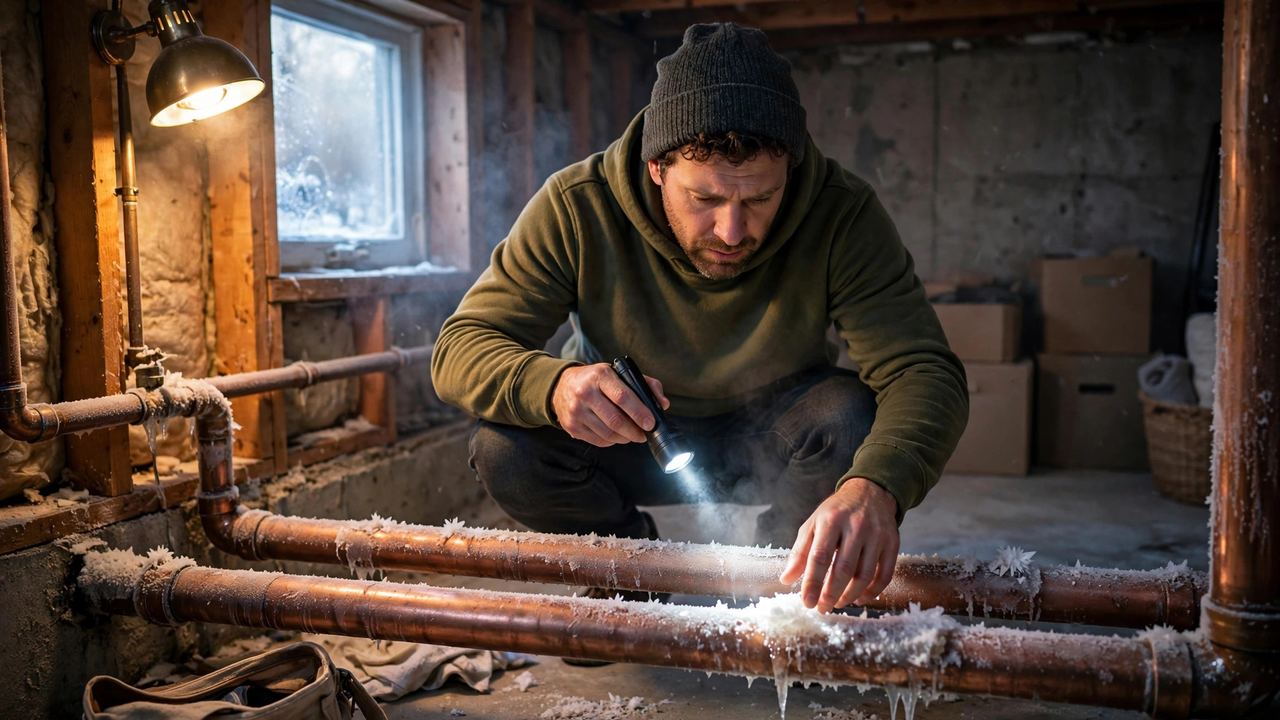
How to locate the frozen section
Thawing works on the section that is actually frozen, so a few minutes of locating beats an hour of heating the wrong pipe. Work through these steps in order:
- Start from the dead fixture and work backward. The frozen section is somewhere on the run between that fixture and the nearest point where water still flows normally. Every working fixture you found in your sweep narrows the search: the blockage is downstream of the last working branch and upstream of the dead one.
- Prioritize the Red Cross locations. Check the run where it passes the places the American Red Cross flags as most likely: against exterior walls, and where your water service enters your home through the foundation. Add the unheated spaces from its list — basement, crawl space, attic, garage, and the cabinet under the sink.
- Use your hands. On exposed pipe, feel along the run. The frozen stretch is noticeably colder, and often carries the frost described in Sign 2. The transition point — where cold, frosty pipe becomes merely cool pipe — is usually very close to the edge of the ice plug.
- Open the cabinets. For a sink on an exterior wall, open the cabinet doors and look and feel inside. The Red Cross recommends opening kitchen and bathroom cabinet doors to let warmer air circulate around the plumbing; during diagnosis, that same open cabinet lets you reach the pipes and check them by hand. Move any harmful cleaners and household chemicals up out of the reach of children first, as the Red Cross also advises.
- Check the crawl space and basement ceiling. Many freezes happen where the run crosses an unheated crawl space or runs along the rim of a basement. If your crawl space has a history of damp as well as cold, that is worth addressing once the emergency is over — our guide to the best crawl space dehumidifiers with condensate pumps covers the moisture side of that space.
- Accept the limit of the search. If the run disappears into a wall or ceiling and you cannot find an exposed cold section, you have reached the point the Red Cross describes: if you are unable to locate the frozen area, or the frozen area is not accessible, call a licensed plumber. That is not a failure of the method — it is one of its designed outcomes.
What to do next: the safe sequence, in order
Diagnosis done and the frozen section found — or at least narrowed down — here is the sequence the American Red Cross and State Farm both describe, in the order that keeps a frozen pipe from becoming a burst one.
Step 1: Keep the faucet open
The American Red Cross is explicit: keep the faucet open. As you treat the frozen pipe and the frozen area begins to melt, water will begin to flow through the frozen area, and running water through the pipe will help melt the ice in the pipe. The open faucet also gives expanding water and melting ice somewhere to go, instead of building pressure against a closed tap. State Farm gives the same instruction from the other side: if you turn on your faucets and nothing comes out, leave the faucets turned on.
Step 2: Know where your main shutoff is — before you need it
State Farm stresses that everyone in the family should know where the water shutoff valve is and how to open and close it. Find yours now, while nothing is leaking: typically where the service line enters through the foundation, or near the water heater or meter. If the pipe turns out to be cracked, this valve is the difference between a mop and a restoration crew — remember that a crack as small as 1/8 inch can spray more than 250 gallons of water a day.
Step 3: Apply gentle heat to the frozen section
The American Red Cross lists the approved tools: an electric heating pad wrapped around the pipe, an electric hair dryer, a portable space heater kept away from flammable materials, or towels soaked in hot water wrapped around the pipes. State Farm adds the technique for the hair dryer: start by warming the pipe as close to the faucet as possible, working toward the coldest section of pipe — so the melting water always has an open path out, rather than being trapped behind remaining ice. If a space heater is your heat source for a basement or crawl-space run, keep it on a stable surface with clear space around it; our roundup of the best portable space heaters for basement home offices covers models suited to exactly these cold lower-level rooms. For pipes in the garage, where the Red Cross notes supply lines often run, steady background warmth matters too — see our guide to the best electric garage heaters for insulated one-car garages.
Step 4: Keep going until full pressure is restored — then check everything
The Red Cross sets the finish line: apply heat until full water pressure is restored. A trickle that improves is progress, not completion; stopping early leaves a partial plug that can refreeze overnight. Once full flow returns, repeat your faucet sweep, watch the thawed section for several minutes for any weeping at joints — remember that a frozen pipe carries roughly a 50 percent chance of having cracked, per the trade source cited earlier — and make the damp-drywall round described in Sign 6. Only then is the incident actually over.
Mistakes to avoid: how frozen pipes get worse
- Never use an open flame. The American Red Cross says it without qualification: do not use a blowtorch, kerosene or propane heater, charcoal stove, or other open flame device to thaw a pipe. State Farm repeats it — never try to thaw a pipe with a torch or other open flame, because it could cause a fire hazard. A scorched pipe or a house fire is a worse outcome than a frozen pipe in every case.
- Do not use electrical appliances around standing water. State Farm warns: do not use electrical appliances in areas of standing water, because you could be electrocuted, and applies the same caution to the hair dryer — make sure you are not in standing water when you use one. If the area is wet, stop, shut off the water, and call a plumber instead.
- Do not close the faucet and walk away. A frozen pipe with the tap shut traps pressure exactly where the ice is expanding. Leave the affected faucet open, as both the Red Cross and State Farm direct.
- Do not thaw a pipe you already know is split. If you found a bulge, a crack, or ice seeping from the pipe wall, heating it just releases the water faster. Shut off the main valve first and treat it as the burst-pipe case it is.
- Do not assume one frozen pipe is the only one. The Red Cross warns that if one pipe freezes, others may freeze too. Skipping the whole-house faucet check is how the second freeze gets discovered by its puddle.
- Do not crank the house heat and assume the walls are warm. A pipe inside an exterior wall or a crawl space can stay below freezing while the living room is comfortable. Heat the space the pipe actually runs through — open cabinets, keep garage doors closed, and warm the unheated zone directly.
When to call a plumber
The American Red Cross draws the line clearly, and it is worth following exactly. Call a licensed plumber if:
- You cannot locate the frozen area.
- The frozen area is not accessible — inside a wall, above a ceiling, or under a floor you cannot open.
- You cannot thaw the pipe with the safe methods above.
- The pipe has burst, is bulging, or is leaking — in which case shut off the main valve first, leave the faucets on, and then call, following State Farm’s sequence.
- Nothing comes out of the faucets at all. State Farm’s advice for that case is direct: leave the faucets turned on and contact your plumber.
Calling early is cheaper than calling after a thaw turns a hidden crack into hundreds of gallons a day through your ceiling. A plumber who arrives while the pipe is still frozen is doing a thaw; a plumber who arrives after the burst is doing damage limitation.
After the thaw: stop it happening again
A pipe that froze once has told you exactly where your house is vulnerable, and it will freeze again at the same spot in the next hard cold snap unless you change something. The prevention steps from the American Red Cross and State Farm are unglamorous and effective:
- Hold the heat steady. Keep the thermostat set to the same temperature day and night during cold weather rather than using a deep nighttime setback — the Red Cross notes the higher heating bill is cheaper than a burst-pipe repair. If you go away during cold weather, leave the heat on, set to a temperature no lower than 55°F; State Farm gives the same 55-degree Fahrenheit floor for a house left on vacation.
- Let a faucet drip on the coldest nights. The Red Cross advises letting cold water drip from the faucet served by exposed pipes when the weather is very cold outside; running water through the pipe, even at a trickle, helps prevent freezing. State Farm similarly suggests letting warm water drip overnight, preferably from an indoor faucet on an outside wall.
- Open the cabinet doors under kitchen and bathroom sinks on exterior walls so warm room air reaches the pipes — with household chemicals moved out of children’s reach.
- Keep garage doors closed if there are water supply lines in the garage, per the Red Cross.
- Insulate the runs that froze. The Red Cross recommends insulating both hot and cold water pipes in unheated areas, and names the products made for the job: pipe sleeves, or UL-listed heat tape, heat cable or similar materials on exposed pipes. State Farm likewise advises pipe insulation in crawl spaces and attics, and sealing air leaks around wiring, dryer vents and pipe entries with caulk or insulation. For the coldest run in most houses, our step-by-step guide on how to insulate water pipes in a crawl space walks through protecting that exact stretch of pipe.
- Seal the drafts that feed the freeze. Cold air washing over a pipe through a cracked foundation or an unsealed attic hatch can freeze it while the room beside it stays warm. The Red Cross recommends adding insulation to attics, basements and crawl spaces to hold temperatures up in those areas; sealing the attic entry is part of the same job — our picks for the best attic stair insulation covers for drafty hallways address the biggest single opening in most ceilings.
- Protect the water heater’s lines too. The pipes at the water heater are part of the same system, and insulating the tank itself helps the whole setup hold heat — see our guide to the best and largest insulation blankets for hot water heaters.
- Drain and disconnect outdoor lines before winter. Remove, drain and store outdoor hoses; close the inside valves supplying outdoor hose bibs and open the outside bibs to drain, leaving the outside valve open so any remaining water can expand without breaking the pipe, per the Red Cross. Drain pool and sprinkler supply lines following the manufacturer’s or installer’s directions — and never put antifreeze in those lines unless directed.
Frequently asked questions
Can a pipe be frozen if water still comes out?
Yes. A partial freeze narrows the pipe before it blocks it, so a faucet that has dropped to a trickle, sputters, or whistles while it runs can mean ice is already forming in that run. The American Red Cross treats even a trickle as grounds to suspect a frozen pipe, so reduced flow on a very cold day deserves the same response as no flow at all: leave the faucet open and find the cold section.
How cold does it have to get for pipes to freeze?
Water freezes at 32°F, and State Farm notes pipes can freeze and burst when temperatures dip below that point — but the pipe’s location decides how fast outdoor cold reaches it. Trade guidance collected by Contractor Supply Magazine warns that any pipe exposed to temperatures below 20°F for several hours at a stretch runs the risk of freezing, with unheated basements, attics, garages and crawl spaces, and pipes along exterior walls with little or no insulation, at the greatest risk.
Will a frozen pipe always burst?
No — State Farm notes plainly that pipes do not always burst when frozen. But the odds are not comforting: Contractor Supply Magazine reports that if a pipe is frozen, there is approximately a 50 percent chance it cracked, and small fractures can hide in a pipe that looks fine. That is why you watch a thawed pipe closely and check for damp walls afterward, rather than assuming a restored flow means no damage.
How long does it take a frozen pipe to thaw with a hair dryer?
Neither the American Red Cross nor State Farm publishes a fixed time, because it depends on the length of the frozen section and how cold the space is. Their shared method is what matters: keep the faucet open, start warming as close to the faucet as possible and work toward the coldest section, as State Farm describes, and continue until full water pressure is restored, as the Red Cross directs. If steady, safe heating is not restoring flow, treat that as the signal to call a licensed plumber.
What should I do first if a pipe has already burst?
Follow State Farm’s sequence: turn off the water at the main shutoff valve in the house, and leave the water faucets turned on. Do not use electrical appliances in areas of standing water. Then call a plumber — and, if there is property damage, your insurer. Speed matters because even a 1/8-inch crack can release more than 250 gallons of water a day.
Should I shut off my main water valve when a pipe is frozen but not burst?
If the pipe is intact and you are thawing it, the priority from the American Red Cross is the opposite move: keep the affected faucet open so melting water can flow and pressure cannot build. The main shutoff is for the burst case — a bulge, a crack, leaking, or a pipe you cannot thaw and need to leave unattended. Either way, follow State Farm’s advice that everyone in the household knows where the shutoff valve is and how to work it, before the emergency rather than during it.
Conclusion
Telling whether your pipes are frozen is a matching exercise, not a guessing game. A faucet reduced to a trickle or nothing on a bitter morning, frost on an exposed run, odors backing up from a drain, whistling or banging from the walls, a bulge in the pipe, damp plaster where no water should be — each sign you can confirm moves the diagnosis from possible to certain, and the faucet-by-faucet sweep tells you whether you are dealing with one branch line or the main entry. Once you know, the response is disciplined and simple: faucet open, gentle heat only — never a flame — applied until full pressure returns, the whole house rechecked, and a licensed plumber called the moment the freeze is hidden, unreachable, unthawable or already split. Diagnose early and that sequence stays a chore. Diagnose late, and it becomes a claim.










Write Your Review
No reviews yet. Be the first to share your experience!