
Key takeaways
- Layer bedding for cold nights in the right order: mattress pad, flannel sheet, blanket, winter duvet and foot throw, matched to your own bedroom temperature.
Learning how to layer bedding for cold nights comes down to order, not just thickness. The short answer is this: insulate under you first, put a warm fitted sheet and a flat sheet next, add a thin adjustable blanket, then your main duvet or comforter, and finish with a coverlet or throw folded at the foot that you can pull up or push off without remaking the bed. Match that stack to your actual bedroom temperature using the table in this guide, and most sleepers will be warm in a cool room without waking up overheated at 3 a.m.
That last point matters more than most bedding advice admits. The Sleep Foundation puts the best room temperature for sleep at approximately 65 degrees Fahrenheit (18.3 degrees Celsius), and says most doctors recommend keeping the thermostat between 65 and 68 degrees Fahrenheit for the most comfortable sleep. Brooklinen, in its winter bedding guide, gives the same practical range, 65 to 68 degrees Fahrenheit (18 to 20 degrees Celsius). In other words, the goal on a cold night is not a hot bedroom with a thin blanket. The goal is a cool bedroom and a warm, adjustable bed. Layering is how you get both at once.
This guide is built the way a snippet cannot be. It gives you the complete layer stack in order, from the mattress up, with what each layer actually does. It gives you a temperature table you can check against a thermometer in your own bedroom tonight. It explains tog ratings in plain numbers, shows separate stacks for hot sleepers, cold sleepers, and couples who disagree, and walks through the mistakes that make a bed look warm on the surface while still sleeping cold underneath.
Why layers beat one very heavy comforter
Calinea, a natural-fiber bedding maker, puts the principle plainly in its winter layering guide: warmth in bedding comes from still air trapped between layers, not from weight alone. Each layer holds a thin pocket of still air above and below your body, and several pockets insulate more efficiently, and more flexibly, than one dense mass of filling. That is the same reason layered clothing works outdoors. No single layer has to do everything, so no single layer has to be extreme.
The second reason is adjustability through the night. Your room does not hold one temperature from bedtime to morning. Heating cycles on and off, outside temperatures usually fall after midnight, and your own comfort changes as you move through the night. Brooklinen makes this point directly: a bed that feels perfect at 10 p.m. can feel oppressive later, and a medium-weight comforter plus a blanket layer gives more flexibility than a single very heavy comforter, because you can remove the blanket without removing the entire top layer. With one heavy comforter, your only choices are all of it or none of it, and none of it at 3 a.m. usually means waking up cold twenty minutes later.
The third reason is moisture. Calinea notes that the body releases moisture all night, in winter too, and that cotton and linen absorb it and let it move away from the skin, while a dense synthetic comforter tends to hold it close. That trapped moisture is part of why people overheat under a heavy comforter, throw everything off, and then wake up cold and damp. Breathable layers break that cycle. They hold warm air while still letting moisture escape, so the bed stays warm without feeling clammy.
Finally, layers let you fix the coldest part of the bed, which is often not the top at all. Heat is lost downward into a cold mattress as well as upward into cold air. If you only ever add blankets on top, you can pile on three of them and still feel a chill coming through from below. A proper stack starts underneath you, and that is where this guide starts too.
The complete layer stack, from the mattress up
Here is the full order. Think of the bed as seven positions. Not every bedroom needs all seven on every night, and the temperature table further down tells you which positions to use at which temperature. But the order never changes. If you add a layer, it goes in its position in the stack, not simply on top of everything else.
Layer 0: The mattress pad or topper, your insulation from below
This is the forgotten layer, and for many cold sleepers it is the most important one. A mattress, especially a thick foam mattress in an unheated room, starts the night cold and draws warmth away from your body while it slowly warms up. A padded mattress pad, or a wool or fleece-style topper, puts insulation between you and that cold mass. It also smooths out the sleep surface and protects the mattress, but on cold nights its real job is thermal: stop heat leaking downward before you worry about heat leaking upward.
Keep this layer relatively thin and breathable. Its job is insulation and comfort, not loft. A pad that is too soft or too deep changes how the mattress supports you, which is a separate problem from warmth. If your fitted sheet no longer fits once the pad is on, that is a sizing issue worth solving properly rather than forcing the sheet, because a fitted sheet that pops off a corner in the night lets cold air in at exactly the edge where you least want it. Readers working through sheet fit at the same time may find our guide to cotton flannel sheet sets for deep pocket mattresses useful, since pad plus mattress depth is what decides whether a sheet stays put.
Layer 1: The fitted sheet, the layer your skin actually meets
The fitted sheet is your first-contact layer, and its material decides whether getting into bed feels like a shock or a relief. Brooklinen compares the main winter options directly. In its guide, classic percale is light with excellent breathability and suits hot sleepers and heated rooms, sateen is medium-warm with moderate breathability and suits cold sleepers and cooler bedrooms, and washed European linen is light to medium in warmth with outstanding breathability and regulates in both directions. None of those is universally best. The right choice depends on whether you run hot or cold, which is why swapping sheets is a real winter decision and not just a laundry one.
Flannel deserves its own mention because it solves a specific problem: cold-sheet shock. Brushed flannel has a raised, napped surface that traps a thin layer of air right against the skin, so it feels warm the moment you get in rather than cold for the first few minutes. For a cold sleeper in a cold room, changing only the fitted sheet to flannel can change the whole feel of the bed before you touch a single blanket. For a hot sleeper, that same change can be a mistake, pushing an already warm bed over the edge. Know which sleeper you are before you buy the warmest version of everything.
Calinea takes a slightly different position worth hearing: it argues that breathable cotton or linen sheets can stay on the bed all year, and that what should change with the season is the number of layers on top, not the sheets themselves. Both approaches work. If you own one good set of breathable sheets, keep them and adjust the upper layers. If getting into bed feels icy every night, the sheet swap is the fastest single fix.
Layer 2: The flat sheet, the small layer that does three jobs
Many people dropped the flat, or top, sheet years ago, and on cold nights that omission shows. A flat sheet adds a genuine, if modest, layer of insulation between you and the blanket above it. It is the easiest layer to adjust without disturbing a partner, because you can fold it down or pull it up on your side alone. And it keeps the duvet cover and blankets cleaner for longer, because the sheet, which is simple to wash, takes most of the direct contact.
In the coldest setup, some sleepers use a flannel flat sheet as well as a flannel fitted sheet, creating a brushed pocket around the body. That is a legitimate cold-room move, but treat it as one notch on the dial, not the default. If you add a flannel top sheet, consider dropping something else, such as the mid-layer blanket, on all but the coldest nights, so the total stack stays balanced.
Layer 3: The mid-layer blanket, your adjustable warmth dial
This is the layer most winter beds are missing, and Brooklinen calls the blanket layer the most underrated part of the system. In its layering table, the mid layer is a blanket placed between you and the comforter, and its function is adjustable warmth: push it aside if you are too warm, pull it up if you are cold. A waffle-weave blanket is a classic choice here because the textured weave holds pockets of air without much weight, but a light wool, fleece, or cotton thermal blanket can play the same role.
Position matters. The blanket goes under the duvet, not over it. Under the duvet, it stays in place, its warmth is sealed in by the duvet above it, and you can still fold it back on your side without exposing yourself to the full cold of the room. Over the duvet, a blanket tends to slide, adds weight where you do not need it, and has to be moved before you can adjust anything else. Think of the mid-layer as the fine adjustment and the duvet as the main setting. You reach for the fine adjustment far more often in a night.
Choose this layer by how often you wake up in the night. If you rarely wake, a slightly warmer blanket you leave in place all night is fine. If you wake once or twice to adjust the covers, choose the lightest blanket that still feels meaningful, because you will actually use its adjustability instead of fighting its weight.
Layer 4: The duvet or comforter, the main insulation
This is the engine of the bed. Everything below it sets the feel and the fine adjustment; this layer provides most of the warmth. Two decisions matter here: the warmth rating, covered in the tog section below, and the fill. Brooklinen notes that for down comforters, fill power measures loft, meaning how much space an ounce of down occupies, and that a 700-plus fill power down comforter is exceptionally warm without being heavy. It also notes that down wins on warmth-to-weight ratio, while down alternative is the right choice for allergy concerns or for anyone who wants something more easily washed at home. Those trade-offs are real, and neither fill is wrong. What is wrong is choosing by total weight alone, because a heavy, flat comforter can be less warm than a lighter, loftier one that holds more still air.
Wool deserves attention in this layer too, especially for sleepers who overheat. Scooms, a duvet maker, explains that wool duvets are not measured with tog ratings at all, and are instead measured in grams per square metre, or gsm: 200 to 300 gsm feels like about a 4.5 tog duvet, 400 to 500 gsm feels like 7 to 9 tog, and 600 to 700 gsm feels like 10 to 13.5 tog. Wool is also widely chosen by people who want warmth with better moisture handling, since the fiber moves moisture rather than simply trapping heat around it. If that sounds like your problem, our roundup of wool filled comforters for cold climates goes deeper on that specific fill. If you prefer a washable synthetic fill, our guide to down alternative comforters for cold bedrooms covers the other side of the same decision.
Whatever fill you choose, keep the duvet in a cover. The cover protects the insert, makes washing practical, and adds one more thin layer of fabric to the stack. In a genuinely cold room, the cover material can contribute too, which is why our look at heavyweight flannel duvet covers for cold rooms exists as its own topic: a brushed cover over a winter insert is a noticeably warmer combination than the same insert in a smooth, cool-feeling cover.
Layer 5: The coverlet or quilt, the whole-bed booster
Calinea calls the coverlet the most useful winter layer, for a simple mechanical reason: it can cover the whole bed on the coldest nights and fold to the foot on milder ones. That dual role makes it the bridge between your normal stack and your coldest-night stack. On a normal winter night it lives folded at the foot, adding weight and warmth to your feet, which are often the coldest part of the body in bed. On the night the temperature drops hard, you unfold it over the whole bed and gain a full extra layer without remaking anything.
A coverlet is thinner and flatter than a duvet, which is precisely why it works in this position. It adds insulation without adding much bulk, it drapes rather than puffing up, and it keeps the layers beneath it from shifting. A quilt can do the same job. What does not work as well in this position is a second full duvet: two lofty inserts stacked together tend to slide, trap too much heat for most heated bedrooms, and leave you back in the all-or-nothing trap.
Layer 6: The throw at the foot, your 4 a.m. layer
The last layer is the smallest and, in practice, one of the most used. A throw folded across the foot of the bed adds warmth exactly where cold collects, over the feet and lower legs, and it can be pulled up over your body at 4 a.m. without getting up, turning on a light, or unmaking the bed. Calinea describes it in almost those terms: the throw at the foot is the layer you pull up in the early morning and push away again later. Brooklinen gives its foot throw the same function in its layering table: on-demand warmth without disturbing the full setup.
Keep the throw light enough to move with one hand while half asleep. If it is heavy, tangled, or stored somewhere else in the room, it will not be used, and an unused layer is not a layer at all. One throw, in the same place, every night, is the whole system.
Match the stack to your bedroom temperature
This table is the heart of the guide, because the right number of layers is not a fixed number. It is a response to a temperature. Measure your bedroom at bedtime, and again you will learn more from one overnight reading: many bedrooms fall several degrees between the evening heating cycle and the coldest hour before dawn. Build your stack for the colder reading, and use the adjustable layers to handle the warmer start of the night.
The suggested layers in the table follow the temperature guide published by Calinea, which pairs bedroom temperatures with sheets, duvet, coverlet, and throw combinations, adjusted here into the seven-position stack described above. The tog ranges follow Scooms, which lists winter duvets at 9 to 13.5 tog and spring and autumn duvets at 7 to 10.5 tog. Treat every row as a starting point: hot sleepers drop one layer from their row, cold sleepers add one.
| Bedroom at night | Use these layers | Duvet guide | What to keep ready |
|---|---|---|---|
| Above 70°F (above 21°C) | Fitted sheet and flat sheet, with a coverlet or throw in place of the duvet | No duvet, or a 2.5 to 4.5 tog summer duvet | The duvet nearby only if the temperature is expected to fall sharply overnight |
| 67 to 70°F (19 to 21°C) | Fitted sheet, flat sheet, and duvet; coverlet stays folded or off the bed | About 7 to 10.5 tog | A coverlet on a bench or at the end of the bed |
| 65 to 68°F (18 to 20°C) | Fitted sheet, flat sheet, mid-layer blanket ready, and duvet | About 9 to 10.5 tog for most sleepers | The blanket folded back, to pull up if you wake cold |
| 62 to 66°F (17 to 19°C) | Fitted sheet, flat sheet, duvet, with the coverlet folded at the foot | About 9 to 13.5 tog, depending on how cold you sleep | The coverlet at the foot, ready to unfold over the whole bed |
| Below 62°F (below 17°C) | Mattress pad, fitted sheet, flat sheet, mid-layer blanket, winter duvet, coverlet over the whole bed, and a throw at the foot | 13.5 tog for a cold or drafty house, per Scooms | The throw within reach, plus socks if your feet stay cold |
Read the table alongside the sleep-temperature guidance, not instead of it. The Sleep Foundation’s range of about 65 to 68 degrees Fahrenheit is where most adults sleep best, and it sits in the middle rows of the table, where a duvet plus one adjustable layer is normally enough. If your bedroom is regularly below 62 degrees Fahrenheit at night, bedding can absolutely make that sleepable, and the full stack in the last row is designed for exactly that case. But it is also worth asking why the room is that cold, whether a draft, a window, or a heating schedule is doing it, because fixing a draft helps every layer above it work better.
Conversely, if your bedroom is above 70 degrees Fahrenheit because the heating runs hard all night, the cheapest and most effective bedding change may be no bedding change at all. Lower the thermostat toward the 65 to 68 degree range, keep the layered bed, and let the bedding do the warmth work in the small space around your body instead of heating the whole room to summer temperatures. Brooklinen makes the same recommendation: turn the thermostat down slightly at night and let the bedding do the work, because a cool room with a properly layered bed solves the cold problem and the overheating problem at the same time.
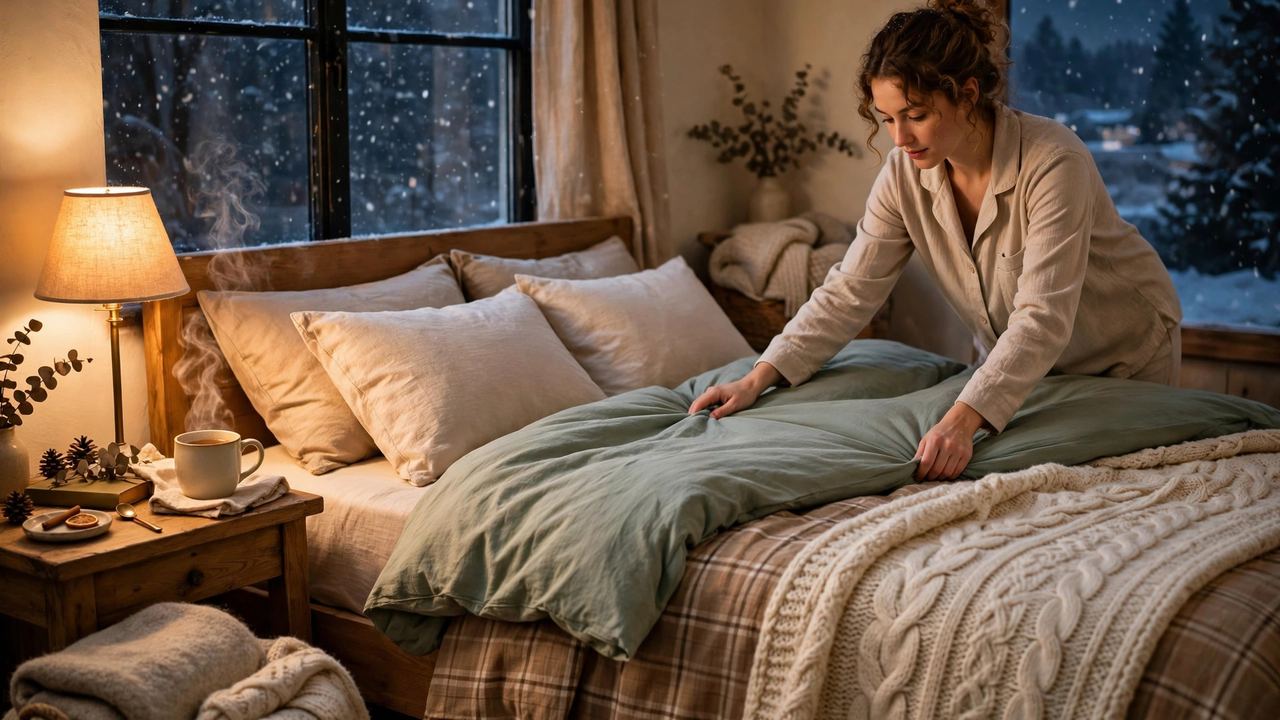
Tog ratings explained, so the duvet layer makes sense
Tog is the rating system most often printed on duvets outside the United States, and it is simpler than it looks. Scooms explains that duvet tog measures thermal insulation on a rating scale of 1.5 tog to 15 tog, that the higher the tog, the warmer the duvet, and that the scale itself was set up in the 1940s by the Shirley Institute in Manchester to show how well a material traps air. Tog measures insulation, not thickness and not quality. A well-made lower-tog duvet is not a worse duvet; it is a cooler one, which is exactly what some bedrooms need.
| Tog rating | Season and use, per Scooms | Best fit |
|---|---|---|
| 2.5 to 4.5 tog | Summer | Warm bedrooms, hot sleepers, or as the light half of an all-seasons pair |
| 7 to 10.5 tog | Spring and autumn, and winter in a warm, well-insulated house | Most heated bedrooms in winter, especially with a blanket layer added |
| 9 to 13.5 tog | Winter | Colder bedrooms, cold sleepers, and houses where the heating is off or low overnight |
| 4.5 tog plus 9 tog, fastened together | All seasons, making 13.5 tog combined | Anyone who wants one purchase to cover the whole year in three combinations |
The all-seasons design deserves emphasis because it is layering applied to the duvet itself. Scooms describes it as two duvets, a 4.5 tog and a 9 tog, that can be used separately or fastened together to make a 13.5 tog duvet. That gives you three warmth levels from one purchase, and it means the winter decision is reversible in October and again in March, without storing a second full bedding set. If you are buying one duvet for a cold-climate home, that flexibility is usually worth more than a single fixed 13.5 tog insert that will be too warm for half the year.
Two cautions on numbers. First, Scooms notes that a 15 tog duvet is too warm for most people, so bigger is not automatically better, even in winter. Second, tog comparisons only work within the same measurement system. American comforters are often sold by fill weight, fill power, or a simple light, medium, and extra-warm label instead of tog, so do not try to convert a vague warmth label into a precise tog number. Use the temperature table to decide how much total warmth your stack needs, then buy the duvet whose stated rating, in whatever system its maker uses, matches that need.
For children, the numbers change, and this is a case where copying the adult stack is the wrong move. Scooms advises that toddlers and children, particularly under the age of ten, should use a lightweight single-size 2.5 tog or 4.5 tog duvet throughout the year, and that if they feel chilly, adding a light blanket is preferable to swapping to a higher tog duvet. Scooms also states that babies under 12 months are too young for duvets and pillows. Keep adult winter stacks for adult beds, and layer children’s beds more lightly.
Separate stacks for hot sleepers, cold sleepers, and couples
If you run hot, even in winter
Brooklinen’s hot-sleeper winter system is a useful corrective to the idea that winter automatically means maximum bedding. It advises hot sleepers to keep classic percale sheets, because switching to sateen will make overheating worse; to use a medium-weight comforter rather than a heavy one; to add a waffle blanket as the primary adjustable warmth layer; to keep the room at 65 to 68 degrees Fahrenheit; and to keep the throw at the foot of the bed, so that when the comforter comes off there is something lighter to pull up instead of restarting the overheating cycle. The principle Brooklinen states is worth repeating in full: breathability first, warmth second, because you can always add a layer, but you cannot easily shed heat once you have built it up.
Your stack, in order, is therefore: a breathable mattress pad, percale or linen fitted sheet, a flat sheet, a light waffle or cotton blanket as your main working layer, a medium duvet you may only half-use on milder nights, and a throw at the foot. Skip the flannel, skip the coverlet over the whole bed, and let the thermostat do more of the work.
If you are always cold in bed
Cold sleepers usually do not need more weight; they need insulation at the right points. Work through the stack in order and fix each point. Add the mattress pad first, because cold from below defeats blankets above. Swap the fitted sheet to flannel or sateen; Brooklinen recommends its denser-weave sateen as the sheet swap for cold sleepers, noting that the denser weave creates a warmer base layer. Keep the flat sheet. Add the mid-layer blanket and leave it in place all night instead of treating it as optional. Move the duvet up one warmth step, for example from 9 tog toward 13.5 tog in a genuinely cold house. Unfold the coverlet over the whole bed. Then seal the edges: Brooklinen notes that most heat loss from a bed happens at the sides, and that a duvet cover that fully encases the comforter and a fitted sheet with deep enough pockets to stay anchored keep warmth from escaping at the perimeter. Cold sleepers often lose more warmth through a gap at the shoulder or a sheet that has come loose than through any lack of blanket thickness.
Warm feet help the whole system. If your feet are cold when you get into bed, the bed has to warm them before you feel warm anywhere else, and that can take long enough to keep you awake. Socks worn to bed, or a throw concentrated over the foot of the bed, address the specific cold point instead of overheating the rest of you. Our guide to flannel sheet sets for winter warmth is a good companion read if the sheet layer is where your cold problem starts.
If you share a bed and disagree about temperature
Do not compromise on a single medium stack that leaves one of you cold and the other warm. Split the adjustable layers by side instead. Calinea suggests layering by side when partners sleep differently: fold the coverlet in half lengthwise over the colder sleeper’s side, or give each person their own throw. Scooms points to the Scandinavian approach, in which couples share a bed but each uses their own duvet at a different tog, allowing each person to customize their own sleep environment. Both methods work. The two-duvet method is the cleaner long-term fix when the difference is large and every night; the folded coverlet and separate throws are the faster fix when the difference is smaller or only appears on the coldest nights. Either way, the shared layers, the mattress pad and the fitted sheet, stay shared, and only the layers above the flat sheet divide.
How to make the bed, step by step
- Step 1: Fit the mattress pad or topper smoothly, with no wrinkles bunched under where your hips will be, and check that the corners are fully seated.
- Step 2: Fit the fitted sheet over pad and mattress together, and confirm every corner still grips. If it rides up, the sheet is too shallow for the combined depth.
- Step 3: Lay the flat sheet with its top edge near the head of the bed, leaving enough length at the foot to tuck in so it does not migrate downward overnight.
- Step 4: Add the mid-layer blanket, pulled up to about shoulder height, and fold its top edge down if you prefer the sheet, not the blanket, against your face and neck.
- Step 5: Shake the duvet insert out inside its cover so the filling reaches the corners, then lay it over the blanket, also to shoulder height, with an even overhang on both sides so neither sleeper gets the short edge.
- Step 6: Fold the coverlet across the foot third of the bed on a normal night, or unfold it over the whole bed on a coldest-night stack.
- Step 7: Lay the throw across the very foot, within arm’s reach of where your hand falls when you are lying down.
- Step 8: Check the shoulder seal. Lie down once before the first real night, pull the layers up, and notice where cold air enters. Adjust the fold, the overhang, or the tuck at that exact spot rather than adding another blanket.
Then leave the system alone for three nights before changing it. One cold night in a new stack often means the room was colder than usual, not that the stack is wrong. Change one layer at a time, in its correct position, and note what you changed. If you change three things at once and sleep better, you will not know which change worked, and you will be stuck with all three on milder nights when you only needed one.
Keeping a layered bed fresh through winter
More layers means more fabric holding moisture, and winter rooms are often closed up, so airing becomes part of the system rather than an optional extra. Calinea’s winter care advice is practical: wash sheets and duvet covers weekly, wash coverlets and throws less often, every few weeks or as needed, cold on a gentle cycle and tumble dry low, make sure everything is completely dry before it goes back on the bed because damp bedding always feels cold, and pull the covers back for a few minutes each morning to let the bed air. That morning habit is the one most people skip and the one that costs nothing. Fold the duvet and coverlet back toward the foot for a short while after you get up, and the moisture from the night has somewhere to go instead of staying sealed in the stack until the next night.
Rotate the adjustable layers too. The mid-layer blanket and the throw do the most adjusting work and get handled the most, so they benefit from being shaken out and aired more often than their wash schedule alone would suggest. And when you store a layer away in spring, store it clean and fully dry; Scooms gives similar advice for duvets specifically, recommending airing or washing before storage so no moisture is left in the filling to cause clumping.
Mistakes to avoid when layering bedding
- Buying one maximum-weight comforter and stopping there. It removes your ability to adjust, and it is the most common cause of the warm-at-bedtime, sweating-at-3-a.m., freezing-by-4-a.m. cycle. A medium or winter duvet plus an adjustable blanket beats it in almost every heated bedroom.
- Adding layers only on top. If the mattress is cold, top layers alone will not fix the chill from below. The mattress pad is layer zero for a reason.
- Putting the blanket over the duvet instead of under it. Over the duvet it slides, adds weight in the wrong place, and blocks access to every layer beneath it. Under the duvet it stays put and works as the fine adjustment.
- Heating the room instead of warming the bed. A bedroom well above the 65 to 68 degree Fahrenheit range the Sleep Foundation recommends works against the bedding, not with it. Lower the room, raise the stack.
- Copying a partner’s or a child’s stack from your own. Partners can need different layers on the same bed, and Scooms advises much lighter 2.5 to 4.5 tog duvets for children under ten, with a light blanket added if they are chilly, rather than an adult-weight duvet.
- Judging a duvet by weight or thickness alone. Tog measures insulation and trapped air, not thickness, per Scooms, and Brooklinen notes that higher fill power down gives more warmth per ounce. A lofty, lighter duvet can be the warmer one.
- Ignoring the edges. Loose fitted sheets, short side overhang, and a gap at the shoulders leak more warmth than a modest duvet choice ever costs you. Seal the perimeter before you spend on more insulation.
- Making the bed up tight in the morning and leaving it sealed all day. A layered bed needs to air. Pull the covers back for a few minutes each morning, as Calinea advises, so the night’s moisture leaves the stack.
- Changing everything at once. Add or remove one layer, in its proper position, and sleep on the change. Otherwise you never learn what your bedroom actually needs, and you end up with a stack that only works on the coldest night of the year.
Frequently asked questions
How many layers of bedding do you need on a cold night?
Calinea’s answer is three or four for most bedrooms: sheets, a duvet, a coverlet, and, on the coldest nights, a throw at the foot. In the full stack in this guide that expands to include a mattress pad underneath and a separate mid-layer blanket, but the working principle is the same. Start with sheets plus a duvet matched to your room temperature, then add the coverlet, blanket, or throw one at a time only as your bedroom temperature demands it.
What order should bedding layers go in?
From the mattress up: mattress pad or topper, fitted sheet, flat sheet, mid-layer blanket, duvet or comforter in its cover, coverlet or quilt, and a throw folded at the foot. The order matters because each layer has a job. Insulation from below comes first, the layers touching your skin come next, the adjustable blanket sits under the main duvet, and the layers you move during the night sit where your hands can reach them.
What tog duvet is best for winter?
Scooms lists winter duvets at 9 to 13.5 tog, with 13.5 tog suited to a cold or drafty house or a sleeper who likes to be really warm, and 9 tog often enough in a warm, well-insulated house. An all-seasons duvet, a 4.5 tog and a 9 tog fastened together to make 13.5 tog, gives you both ends of that range plus the middle. Choose by your bedroom’s overnight temperature, using the table in this guide, rather than by the calendar alone.
Should the blanket go under or over the duvet?
Under it, for the main mid-layer blanket. Brooklinen’s layering system places the blanket between the sheet and the comforter, where it works as adjustable warmth you can push aside or pull up without removing the comforter. The layers that belong over the duvet are the coverlet and the foot throw, because those are the ones designed to be folded back, unfolded over the whole bed, or pulled up in the night.
Is a cooler bedroom really better if I feel cold?
For most adults, yes, provided the bed itself is warm. The Sleep Foundation puts the best room temperature for sleep at approximately 65 degrees Fahrenheit and says most doctors recommend 65 to 68 degrees Fahrenheit. That guidance assumes proper bedding. Feeling cold in a cool room is a signal to add a layer to the bed, starting with insulation under you and at your feet, rather than a signal to heat the whole room until a thin blanket feels sufficient.
What if one of us is hot and the other is cold?
Split the upper layers by side. Calinea suggests folding the coverlet in half lengthwise over the colder sleeper’s side or giving each person their own throw, and Scooms describes the Scandinavian method of two separate duvets at different togs on one shared bed. Keep the mattress pad and fitted sheet shared, divide everything above the flat sheet, and neither of you has to sleep at the other’s temperature.
Conclusion
A warm bed on a cold night is a system, not a purchase. Build it in order: a mattress pad to stop heat escaping downward, a fitted sheet chosen for whether you run hot or cold, a flat sheet, a mid-layer blanket under the duvet as your adjustable dial, a duvet whose tog rating matches your bedroom rather than the season’s worst night, a coverlet that can live at the foot or cover the whole bed, and a throw within reach for the coldest hour before dawn. Then check your room against the temperature table, aim for the 65 to 68 degree Fahrenheit range the Sleep Foundation and Brooklinen both describe, and adjust one layer at a time until three nights in a row feel the same. When the stack is right, you stop thinking about it, which is the real test. The bed is simply warm when you get in, still comfortable when you wake, and ready, with one layer folded back or pulled up, for whatever the next cold night does.










Write Your Review
No reviews yet. Be the first to share your experience!