We independently review everything we recommend. When you buy through our links, we may earn a commission. As an Amazon Associate we earn from qualifying purchases.
Best Insulated Waterproof Winter Boots for Men on Ice
Compare six insulated waterproof winter boots for men on icy sidewalks, with maker-listed insulation, temperature ratings, lug patterns and honest ice notes.
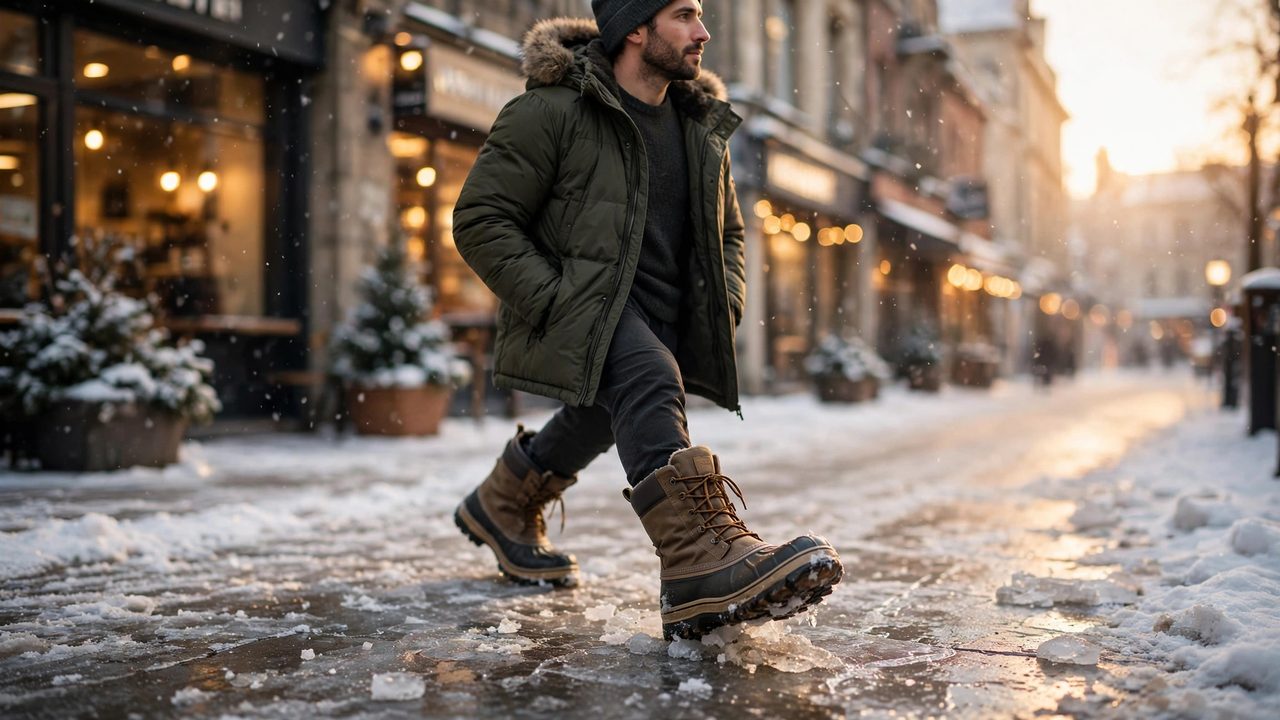
An icy sidewalk changes what a winter boot has to do. Deep snow rewards height and a loose, roomy fit, but a frozen pavement rewards something different: a waterproof build that keeps slush out at the seams, enough insulation to stay warm while you wait for a bus or walk at a normal pace, and an outsole whose lug pattern still has edges to work with on hard, slick ground. This guide to the best insulated waterproof winter boots for men on icy sidewalks compares six real boots sold new, and it reports insulation weights, temperature ratings and outsole designs only as each maker lists them.
One point needs to be stated plainly at the start, because every honest guide on this subject should state it: no boot makes ice safe. Rubber lugs, winter compounds and deep tread can improve footing on packed snow and rough, frosted pavement, and they can shed slush so the sole stays in contact with the ground. On smooth, wet, glare ice, however, any ordinary boot sole can still slide. The boots below are chosen because their makers list a deliberate winter outsole design, a waterproof construction and a stated insulation package, not because any of them can promise slip-proof walking. Walk accordingly, shorten your stride on suspect patches, and treat a boot as one part of staying upright rather than a guarantee.
The six picks split into two families. The pac-style boots, from Sorel, Kamik and The North Face, use a shell or molded lower section with a higher shaft, and they suit men who stand around in the cold, clear long driveways, or walk through slush that reaches the ankle. The hiking-style boots, from Columbia, KEEN and Merrell, lace up closer, weigh less in most builds, and suit men whose icy-sidewalk problem is really a daily walk: to the station, around the neighborhood, or across a parking lot that never quite gets cleared. Both families appear here because icy sidewalks are rarely the only surface a boot meets in a week.
Quick verdict
For the coldest, slowest days, the Sorel Caribou and the Kamik Nation Plus are the warmest-shaped options here, each built around a removable liner and a maker-listed rating well below zero, with tall shafts that keep slush and drifted snow out on uncleared sidewalks. For men who walk a long way each day, The North Face Chilkat V 400 pairs the heaviest insulation weight in this guide with a winter-specific rubber outsole, while the Columbia Bugaboot III offers a molded shell and a reflective-style insulation package in a boot made for town and chores. If your route is mostly cleared pavement with icy patches rather than deep snow, the KEEN Revel IV Mid Polar and the Merrell Thermo Chill 2 Mid Waterproof are the lighter, closer-fitting choices, each with a maker-listed winter traction outsole and a lower shaft that is easier to drive and walk in. None of them removes the risk of slipping on ice, and the right choice is the one whose warmth, height and outsole match the worst stretch of your actual route.
The products in this guide
Sorel Caribou
Warmth comes from a removable 9 mm felt inner boot with a snow cuff, and the maker lists a bonded felt frost plug in the midsole, a layer intended to
Waterproof membrane, PU-coated suede and mesh upper
Merrell sticky rubber, 5 mm lugs
Light, active winter walks
How we selected
Each boot in this guide had to meet four tests drawn from maker listings and retailer specifications that could be opened and read. First, the boot had to be a men’s winter boot sold new, in a current listing, not a discontinued name carried only by resellers. Second, the maker had to list a waterproof construction in specific terms, such as a seam-sealed build, a named waterproof membrane, or a molded shell, rather than a vague claim of water resistance. Third, the maker had to list an insulation package, either as a weight in grams, a named liner system, or a felt thickness, so warmth could be compared on stated figures instead of impressions. Fourth, the maker had to list a winter outsole design, a named traction system or a stated lug depth, because an icy-sidewalk boot lives or dies by what is molded into its sole.
Temperature ratings are reported exactly as the makers list them, and they deserve a caution of their own. There is no single industry test that every brand uses in the same way, and a rating assumes a level of activity, a sock, and dry conditions that may not match your morning. A boot rated far below zero is not automatically the warmest boot for a fast walker, who may prefer less insulation and a better fit, and a 200-gram boot is not automatically cold if you keep moving. Use the ratings to sort boots into broad warmth bands, then choose inside that band on fit, height and outsole.
Boots that could not be verified on opened pages were left out entirely, even when they are widely recommended elsewhere. Where a maker’s current listing uses a newer liner name than older reviews do, this guide follows the current listing, because that is the boot you would actually receive. Finally, a note on language: throughout this guide, specifications are phrased as what the maker lists. That is deliberate. It keeps the difference clear between a stated figure you can check on the product page and a performance promise nobody can honestly make about ice.
The Caribou is the classic pac boot in this group, and its design explains why the shape has lasted. The maker lists a waterproof nubuck leather upper with seam-sealed waterproof construction over a handcrafted vulcanized rubber shell, so the part of the boot that meets sidewalk slush is a continuous rubber lower rather than stitched panels. Warmth comes from a removable 9 mm felt inner boot with a snow cuff, and the maker lists a bonded felt frost plug in the midsole, a layer intended to slow cold rising from frozen ground while you stand. For icy sidewalks specifically, that underfoot insulation matters more than it does in deep snow, because pavement conducts cold steadily and a man waiting at a crossing stands still on it.
The outsole is a rubber design the maker builds to shed snow rather than carry it packed between the lugs, and keeping lugs clear is a real, if modest, advantage on sidewalks that alternate between cleared concrete, packed snow and slush. It does not turn the Caribou into an ice boot, and on smooth ice it will slide like any other rubber sole, so judge it as a cold-and-slush boot with a sensible winter tread. The tall shaft covers the calf, which helps where drifts spill across the walk, and the removable liner can be pulled out at night to dry, which matters for men who wear the same boots daily. The trade-offs are weight and feel: this is a tall, heavy boot that walks with a pac-boot stride, runs roomy, and feels like overkill on a mild day or a short, well-cleared route.
Buy it if: your sidewalks stay slushy and uncleared, you stand outdoors in serious cold, and you want a removable liner you can dry overnight.
Skip it if: your route is mostly cleared pavement, you want a light boot for long walks, or you drive a lot and prefer a lower, more flexible shaft.
The Chilkat V 400 carries the heaviest stated insulation in this guide. The maker lists 400 grams of Heatseeker Eco insulation inside a waterproof full-grain and suede leather upper with seam-sealed waterproof construction and a streamlined molded TPU shell over the foot. That combination suits the man whose icy sidewalk is only the start of the job: shoveling the drive, clearing the car, walking the dog, then standing on a cold platform. The shell shrugs off slush and salt at the toe, the upper keeps meltwater out at the seams, and the insulation weight is aimed at warmth during lower-activity time rather than only while walking fast.
For traction, the maker lists a Surface Control rubber outsole with a tread design optimized for winter conditions, described in retailer specifications as smaller lugs running down the center with larger rectangular lugs around the edge. A pattern with defined edges gives the sole more chances to key into packed snow and roughened ice than a flat, worn tread would, though the same honesty applies here as everywhere in this guide: optimized for winter is not the same as proof against a fall on glare ice. The boot also lists a compression-molded EVA midsole, rustproof metal lacing hardware, a gaiter-compatible D-ring and a heel clip for snowshoe compatibility, which makes it the most feature-complete chore boot here. It looks bulky and walks a little bulky too, and its tongue gusset sits lower than the collar, so very deep puddles deserve respect despite the waterproof build.
Buy it if: you want the most insulation on this list in a laced boot, and your winter days mix icy sidewalks with shoveling and outdoor chores.
Skip it if: you run warm, walk fast for miles, or want the lightest and lowest-profile boot for mostly cleared streets.
Kamik builds the Nation Plus in the Canadian pac-boot tradition, and its listing is one of the most specific in this guide. The maker lists a seam-sealed waterproof suede upper over a flexible synthetic rubber shell, a waterproof gusseted tongue, and a removable HEAT-MX 145 liner rated by the maker to minus 40 degrees Fahrenheit. The current Amazon listing names the same liner system and a SNOWTREAD outsole, which is the maker’s winter rubber tread for this boot. A removable liner is a practical feature for sidewalk use in a wet city winter: slush works into any boot eventually through the top, socks get damp from effort, and a liner that comes out dries far faster than insulation stitched permanently into a shaft.
The shaft stands tall, around eleven inches in retailer specifications, with room for a heavy sock, and the gusseted tongue seals the lacing area to a useful height against slush kicked up with each step. The SNOWTREAD outsole uses deep lugs suited to snow-covered and slushy pavement; deep lugs clear packed snow well, which keeps the sole working on the mixed surface of a half-cleared sidewalk, but lug depth alone does not create grip on polished ice, and this boot should be chosen for cold and snow first. Kamik’s stated temperature rating is at the extreme end of this guide, so treat it as the maker’s figure under its own test conditions rather than a promise for standing still at that temperature. The boot is substantial in weight and traditional in feel, with speed lacing that is easy to manage with gloves on.
Buy it if: you work or stand outdoors in deep cold, want a tall seam-sealed boot with a removable liner, and value a maker’s stated minus 40 rating.
Skip it if: your winters are mild, your route is short and cleared, or you prefer a nimble hiking-boot fit over a pac-boot fit.
The Bugaboot III is the everyday middle of this guide: warmer and more protective than a winter hiker, lighter in spirit than the tall pac boots. The maker lists a waterproof leather upper with an injection molded shell, 200 grams of insulation, and a rating on its listing to minus 25 degrees Fahrenheit. Retailer specifications describe the waterproofing as a breathable waterproof build that sheds snow while letting internal moisture escape, which suits a boot worn for a full working day rather than a single short trip. The molded shell handles the slush zone at the bottom of the boot, where sidewalk meltwater mixed with road salt does the most damage to ordinary footwear.
Underfoot, the maker lists an Omni-Grip non-marking rubber outsole, a tread intended to adapt across wet pavement, packed snow and loose ground, plus a lightweight cushioned midsole that returns some energy at each step. For a man whose icy sidewalk is part of a longer walk, that cushioning is a genuine comfort feature, because winter boots are often warm and waterproof but tiring on hard pavement. Independent measurements of this model have found deep lugs, which help in packed snow at crossings and unplowed corners. The limits are height and insulation weight: the shaft is a mid height, so deep drifts reach the top sooner than on the Sorel or Kamik, and 200 grams is a moderate warmth package better suited to active use than to standing still in extreme cold. Sizing feedback on this model often suggests checking the fit carefully, as it can run snug with thick socks.
Buy it if: you want one boot for commuting, shoveling and weekend chores, with a molded shell, moderate insulation and a cushioned walk on pavement.
Skip it if: you regularly stand still in far-below-zero cold, or your route crosses drifts deep enough to need a tall shaft.
The Revel IV Mid Polar is the pick in this guide designed most explicitly around winter traction as a named system. The maker lists a KEEN.POLAR TRACTION outsole with 5 mm multi-directional lugs, a waterproof leather and performance mesh upper, and a KEEN.DRY waterproof, breathable membrane. Multi-directional lugs matter on sidewalks because you do not only push forward: you turn at corners, step sideways off a curb, and brake on a slope down to a crossing, and a lug pattern with edges facing several directions gives the sole purchase in more of those movements on snow and frosted pavement. The maker also lists heat-trapping layers underfoot and a thermal heat shield footbed, details aimed at the cold that rises from frozen concrete during a commute.
Warmth comes from 200 grams of KEEN.WARM recycled P.E.T. insulation, which the maker rates to minus 25 degrees Fahrenheit for this mid-height version. That rating, and the lower shaft, define the boot’s role: it is for cleared and partly cleared sidewalks with icy patches, packed snow at the edges and slush in the gutters, rather than for wading through deep drifts. It walks more like a hiker than any other boot here, with a closer fit and a toe bumper the maker lists for protection, and it is the easiest of the six to drive in. Be clear about the boundary, though: the Polar Traction name describes an outsole designed for snow and ice, and even a well-designed lug pattern cannot hold on smooth wet ice the way a spiked device can. Choose it for better-designed footing, not for immunity from slipping.
Buy it if: your sidewalks are mostly cleared but patchy with ice and packed snow, and you want a hiking fit with a maker-listed winter traction outsole.
Skip it if: you need a tall shaft for deep snow, or the heaviest insulation for standing still in extreme cold.
The Thermo Chill 2 Mid Waterproof is the lightest approach in this guide, a mid-height winter hiker for men who stay active outdoors. The maker lists a waterproof membrane that seals out water while allowing moisture to escape, a breathable mesh and polyurethane-coated suede upper with a protective toe cap, and 200 grams of insulation with a fleece lining and fleece collar. Retailer specifications put the weight at about one pound per boot in the maker’s figure, which is noticeably less than the pac boots here, and that lightness changes how a boot feels across a long icy walk: less lift with each step, easier balance corrections, and less fatigue when the route includes stairs, platforms and transfers.
The outsole is a sticky rubber design the maker lists with 5 mm lugs. Wide, relatively shallow lugs put a lot of rubber in contact with flat surfaces, which is the right trade for sidewalks, frozen parking lots and packed trails, even if deep, steep snow is not this boot’s home ground. The coated upper resists the salt and grime that city winter spreads everywhere, and the removable footbed and lightweight foam midsole keep the walking feel closer to a hiking shoe than to a snow boot. The compromises follow from the design: the shaft is the lowest here, so snow over the top is a real limit in storms, the fit is reported as somewhat narrow, and 200 grams of insulation suits a walker in motion far better than a man standing at a bus stop for half an hour. For active commuting on treated and partly treated pavement, though, it is the most natural walker in the group.
Buy it if: you walk long distances on mostly treated pavement, want the lightest waterproof insulated boot here, and prefer a hiker’s fit and feel.
Skip it if: you face deep uncleared snow, stand still in severe cold, or need a wide, roomy pac-boot fit.
Buying guide
Start with the honest ice rule. No insulated waterproof boot is ice-proof. Makers design winter outsoles with softer-feeling rubber, deeper or multi-directional lugs and patterns that shed snow, and those features genuinely help on packed snow, frost and rough ice. On smooth, wet ice, friction drops so far that technique matters as much as footwear: short steps, flat foot placement, hands free, and extra care on slopes, painted crossings and polished stone. If your route includes a known sheet-ice stretch, a boot is not the whole answer, whatever its outsole is called.
Match insulation to activity, not just temperature. The maker lists insulation as grams, liner systems or felt thickness, and the right amount depends on whether you move. A man walking briskly generates heat and often does well in a 200-gram boot, while the same boot can feel cold during a long, still wait. Heavier packages, such as 400 grams or a thick removable felt liner, suit slower, colder days and outdoor work. Temperature ratings are the maker’s own figures, useful for ranking boots against each other in broad bands, but they are not measured on a single shared scale across brands.
Read the waterproof construction, not just the word waterproof. Look for how the maker says water is kept out: seam-sealed construction, a named membrane, a molded or vulcanized shell, and a gusseted tongue. On sidewalks, the wettest zone is low, where slush and meltwater splash, so a shell or molded lower protects the area that matters most. Remember that any lace-up boot can admit water over the top or through the tongue area in deep puddles, whatever the membrane is called.
Choose height for your worst stretch, not your average one. A mid-height hiker is pleasanter for driving, stairs and long walks, and it handles cleared sidewalks well. A tall pac boot earns its bulk where drifts spill across the path, where slush reaches the ankle, or where you step off the cleared line into deep snow at crossings. Measure your decision by the worst fifty feet of your route, because that is where a short boot gets wet.
Fit with the sock you will actually wear. Winter boots should leave room for a warm sock and for your toes to move, because a tight boot restricts circulation and feels colder than its insulation rating suggests. Pac boots generally fit roomier and suit thick socks; hiking-style winter boots fit closer and can run narrow or snug depending on the model. If a listing or retailer notes a sizing tendency for your chosen model, follow it, and lace firmly enough that your heel does not lift, since a sliding foot is harder to balance on a slick patch.
Care decides whether the spec sheet survives the season. Brush salt off regularly, let boots dry at room temperature away from direct heat, and pull removable liners out after wet days so insulation dries fully. A dried-out, salt-stiffened upper and a packed-down damp liner will underperform the maker’s listed figures by midwinter, while simple drying keeps the insulation loft and the outsole edges working as designed.
FAQ
Can any winter boot stop me slipping on ice?
No. A winter outsole with deep or multi-directional lugs can improve footing on packed snow, frost and rough ice, as the makers describe their designs, but smooth wet ice can defeat any ordinary boot sole. Walk with short, flat steps on suspect patches and do not treat any boot as ice-proof.
How much insulation do I need for icy sidewalks?
It depends on activity. The maker lists most active-walking boots here at 200 grams, which suits men who keep moving. If you stand still outdoors, wait long for transport, or work outside in deep cold, the heavier options in this guide, such as 400 grams of insulation or a thick removable felt liner, match the job better.
Are temperature ratings comparable between brands?
Only roughly. Each maker sets its rating under its own conditions, so a stated rating is best used to place a boot in a broad warmth band rather than as an exact promise. This guide reports each rating as the maker lists it, alongside the insulation type, so you can judge both together.
Is a tall pac boot or a mid hiker better for commuting?
For mostly cleared sidewalks, a mid hiker is lighter, easier to drive in and more comfortable over long walks. For uncleared routes with drifts and ankle-deep slush, a tall pac boot keeps snow out and usually carries more insulation. Choose by the worst stretch of your commute, not the best.
Why does a removable liner matter?
A liner that comes out dries overnight, so the insulation starts the next day dry and lofty instead of damp and compressed. For men wearing the same boots daily through a slushy winter, that drying cycle is one of the most practical warmth features a maker can offer.
How should winter boots fit with thick socks?
Snug at the heel and midfoot, with room for your toes to move inside a warm sock. A boot laced tight over a thin sock, or bought so large that the foot slides, will feel colder and be harder to balance in. Try your chosen size with the sock you plan to wear most.
Conclusion
The best insulated waterproof winter boots for men on icy sidewalks are the ones whose maker-listed insulation, waterproof construction and outsole design match your real route. Choose the Sorel Caribou or the Kamik Nation Plus for deep cold, tall slush and liners you can dry overnight. Choose The North Face Chilkat V 400 for the heaviest stated insulation in a laced chore boot, or the Columbia Bugaboot III for a molded shell and cushioned everyday walking. Choose the KEEN Revel IV Mid Polar or the Merrell Thermo Chill 2 Mid Waterproof when your sidewalks are mostly cleared and you want a lighter, closer-fitting boot with a winter traction outsole. Whichever pair you pick, keep the honest rule in view: these boots improve your footing and keep your feet warm and dry, but no boot makes ice safe, so walk like it.
M
Modern Line Home Editorial Team
We compare specs, materials and verified owner reviews before a product earns a spot. Rankings are never paid.
Affiliate disclosure. As an Amazon Associate we earn from qualifying purchases at no extra cost to you. Prices accurate as of the date shown.
House cold even with the heat on? Walk this ordered checklist: thermostat and filter first, then drafts, insulation, leaky ducts and a failing heating system.
Windows fogging up in winter? Check where the fog sits: on the room side it is indoor humidity, outside it is harmless, and between panes the seal has failed.
Store the main firewood pile about 30 feet from your house, off the ground and covered only on top. Compare racks, woodsheds, garages and indoor spots safely.
Place a portable generator outdoors only, at least 20 feet from windows, doors and vents, exhaust pointed away. Exact distances, setup steps and CO rules here.
Keep houseplants in the right winter spot: match window direction to plant type, stay clear of radiators and cold glass, and fix dry air and low light at home.
Mice enter through pencil-width gaps at foundations, pipes, vents, doors and the roofline. Walk this room-by-room winter checklist to find and seal each one.
A winter outage timeline: what to do in the first hour, first night and multi-day outage, with food safety times, pipe protection, heat and CO safety steps.
Size a space heater by room area: 10 watts per square foot at 8-foot ceilings, adjusted for insulation and ceiling height, with full wattage and BTU tables.
Start dripping at about 20 degrees, sooner for exposed pipes. Set a pencil-lead stream, drip the right faucets on both lines, and know when to stop safely.
A fridge needs 800-1,200 starting watts, not just 150-400 running watts. Use the tables to total your fridge plus freezer, lights, furnace fan and more today.












Write Your Review
No reviews yet. Be the first to share your experience!