We independently review everything we recommend. When you buy through our links, we may earn a commission. As an Amazon Associate we earn from qualifying purchases.
Best LiFePO4 Power Stations for Home Backup (2026)
Six verified LiFePO4 power stations for emergency home backup, compared on capacity, continuous output, cycle life and temperature ranges each maker lists.
Six verified LiFePO4 power stations for emergency home backup, compared on capacity, continuous output, cycle life and temperature ranges each maker lists.
When the grid goes down in winter, the job of a backup battery is narrow and unforgiving: keep the refrigerator cold, the furnace blower or a small heater circuit moving where the maker allows it, the lights on, and phones and a Wi-Fi router alive until power returns. Lithium iron phosphate, or LiFePO4, has become the chemistry of choice for that job because the makers rate these cells for thousands of charge cycles and publish clear operating temperature windows for indoor use. This guide compares the best lifepo4 power stations for emergency home backup that could be verified on opened maker and retailer pages, with every capacity, output and temperature figure below stated the way the maker lists it.
Every station in this roundup is a battery unit designed to be used indoors, with no fuel, no exhaust and no carbon monoxide risk of the kind that makes fuel-burning generators strictly outdoor equipment. That indoor safety is the core reason to choose a LiFePO4 station for an apartment, a condo, or a house where a generator cannot be placed far enough from windows and doors. The trade-off is stored energy: a battery holds a fixed number of watt-hours, so honest sizing matters more than headline output. The six models below span roughly 2,000Wh to 3,600Wh, which is the range that covers a day or more of essential loads for most homes when the loads are chosen carefully.
Quick verdict
For most households, the EcoFlow DELTA 2 Max is the balanced pick: the maker lists 2,048Wh of LiFePO4 capacity, 2,400W of continuous AC output and expansion up to 6,144Wh with extra batteries, so it can start as an essentials station and grow. If you need the most single-unit capacity and output, the EcoFlow DELTA Pro is the step up, with the maker listing 3,600Wh and 3,600W of continuous output. The Jackery HomePower 3000 matches that output class in a lighter body and adds a fast switchover the maker rates at 20 milliseconds or less. On the portable end, the Jackery Explorer 2000 v2 and the Anker SOLIX C2000 Gen 2 both stay near 40 pounds while keeping a full 2kWh-class battery, and the BLUETTI Elite 200 V2 stands out for the longest cycle life in this group, with the maker listing more than 6,000 cycles.
The products in this guide
EcoFlow DELTA 2 Max Portable Power Station
The DELTA 2 Max is the middle of EcoFlow’s home backup range, and it is the easiest of these six to recommend to a first-time buyer
Best if you want one station that can grow from essentials backup to multi-day coverage
Only models whose battery chemistry could be confirmed as LiFePO4 on an opened page made this list. That sounds basic, but the portable power market still mixes older lithium-ion models into the same product families, and a similar name does not guarantee the same cells. Each pick below was checked against the maker’s own product information or manual for four things: the LiFePO4 chemistry itself, the rated cycle life, the continuous and surge output figures, and the operating and charging temperature ranges. Models that failed any of those checks, or whose current listings could not be confirmed as sold new, were left out entirely rather than written up with gaps.
Temperature tolerance got special attention because this is a winter buying guide. A station that will live in an unheated garage has to discharge safely in the cold, and every maker here separates the discharging range from the narrower charging range. As a rule across these brands, the makers list charging windows that start at freezing, 32 degrees Fahrenheit, even when the same unit can discharge well below that. That single detail shapes where you store and recharge a station in January, so it is covered for every pick where the maker publishes it.
Load handling was judged the same way: only as the makers list it. Continuous watts tell you what a station can run indefinitely, surge watts tell you what it can offer a motor or compressor for the brief moment of startup, and watt-hours tell you how long any of it lasts. No station in this guide is described as powering a whole home, because none of these makers states that a single portable unit does that; what they describe is backup for essential circuits and appliances, and that is the standard used throughout.
The DELTA 2 Max is the middle of EcoFlow’s home backup range, and it is the easiest of these six to recommend to a first-time buyer. The maker lists a 2,048Wh LiFePO4 battery rated for 3,000 cycles to 80% or more of original capacity, which the maker frames as roughly a decade of everyday use. Continuous AC output is listed at 2,400W with a 4,800W surge, and EcoFlow’s X-Boost mode raises the ceiling for compatible resistive appliances to a listed 3,400W. Fifteen outlets are listed in total, so a refrigerator, a router, lights, a laptop and phones can all stay connected at once without a power strip chain.
Expansion is the DELTA 2 Max’s strongest long-term argument. The maker lists compatibility with up to two Smart Extra Batteries, taking total capacity to 6,144Wh. That means a household can start with the base unit for overnight essentials and add storage later for multi-day outages, instead of replacing the station. Recharging is flexible: the maker lists up to 1,000W of solar input across two ports, fast AC charging that reaches 80% in about 1.1 hours on AC alone, and a combined AC and solar figure of 80% in 43 minutes. For winter use, the maker’s published discharge range runs from -4 degrees Fahrenheit to 113 degrees Fahrenheit, so the unit can sit in a cold garage and still deliver power; as with every station here, bring it into a warmer room before recharging in deep cold. At about 50.7 pounds with a built-in handle, it is a two-hand carry rather than a one-hand one, but it stays movable by one adult.
Buy it if: you want one station that can grow from essentials backup to multi-day coverage with extra batteries, and you value fast recharging between outages.
Skip it if: you need more than 2,400W of continuous output on day one, or you want the lightest possible 2kWh unit for frequent carrying.
The original DELTA Pro remains EcoFlow’s large single-unit answer for home backup. The maker lists 3,600Wh of LFP capacity, the joint-largest base capacity in this guide, with a cycle life of 3,500 cycles to 80% or more of capacity. Output is listed at 3,600W continuous across five AC outlets, with a 7,200W surge for motor starts, and X-Boost support for compatible devices up to a listed 4,500W. Two units can be paired for higher output, and the maker lists expansion with extra batteries from the 3.6kWh base up toward whole-system configurations; for a single portable unit, the honest reading is that this is an essentials-plus station, not a whole-home supply, and EcoFlow’s own materials describe it in home backup terms rather than whole-house terms.
Charging options are the broadest here. The maker lists five ways to recharge, including wall outlets, solar at up to 1,600W of input, car charging, EV station charging and pairing with a smart generator, with a full recharge in about 2.7 hours from an 1,800W wall input. The published discharging temperature range runs from 14 degrees Fahrenheit to 113 degrees Fahrenheit, which covers an unheated garage in most winter conditions for delivering power. The cost of the capacity is size: the maker lists about 99 pounds, with a telescoping handle and wheels doing most of the work. Plan its parking spot before the outage, near the loads it will serve, because repositioning it mid-storm is a two-person job on stairs.
Buy it if: you want the largest single-unit capacity and output in this group, with the widest choice of recharge methods and room to expand later.
Skip it if: you need to carry a station up stairs regularly, or your backup list is only a fridge, lights and phones, where a 2kWh unit is easier to live with.
Jackery built the HomePower 3000 specifically for the emergency home backup job rather than for camping first. The maker lists a 3,072Wh LiFePO4 battery with 3,600W of continuous output and a 7,200W surge peak, matching the DELTA Pro’s output class in a body the maker lists at about 59.5 pounds. Cycle life is listed at 4,000 cycles to 70% or more of capacity, supported by Jackery’s ChargeShield 2.0 battery management. A TT-30 outlet is built in, which suits an RV or a compatible transfer-switch inlet, alongside standard AC outlets, dual 100W USB-C ports, USB-A ports and a 12V car port.
Two figures matter most for outage use. First, the maker lists a UPS switchover of 20 milliseconds or less, so connected essentials such as a router, security cameras and lights ride through the moment the grid drops without rebooting. Second, recharging is quick for a 3kWh unit: the maker lists a full recharge in about 2.2 hours on AC, or about 1.7 hours using hybrid AC and DC input, with solar input accepted up to a listed 1,000W. The maker’s published charging temperature range is 32 to 113 degrees Fahrenheit, the standard LiFePO4 pattern of no charging below freezing. The HomePower 3000 does not accept expansion batteries, so the 3,072Wh you buy is the capacity you keep; size your expected outage loads against that fixed figure.
Buy it if: you want 3,600W-class output and a fast UPS switchover in a unit one person can still wheel or carry short distances, and 3,072Wh covers your essentials list.
Skip it if: you want to add expansion batteries later, or you need 240V output, which this 120V station does not provide.
The Explorer 2000 v2, model JE-2000D, is Jackery’s portability play in the 2kWh class. The maker lists 2,042Wh of LiFePO4 capacity in a body of about 39.5 pounds, which Jackery describes as substantially lighter and smaller than typical 2kWh LiFePO4 stations, thanks to a cell-to-body construction borrowed from electric vehicles. Output is listed at 2,200W continuous across three AC outlets with a 4,400W surge peak, plus a 100W USB-C port for direct laptop charging. Cycle life is listed at 4,000 cycles to 70% or more of capacity.
For winter backup, its published temperature windows are typical of the class and worth planning around: the maker lists a charging range of 32 to 113 degrees Fahrenheit and a discharging range of 14 to 113 degrees Fahrenheit. In practice, that means the station can run a refrigerator from a cold garage but should be brought indoors to recharge on the coldest days. Recharging itself is quick: the maker lists 0 to 80% in about 66 minutes with AC fast charging, a full charge in about 102 minutes using the app’s emergency super charging mode, and a quiet charging mode that trades speed for a listed noise level under 30 decibels. Solar input is the modest part of the spec sheet, capped at a listed 400W, so this is a wall-charge-first station with solar as a top-up rather than the main refill route. Capacity is fixed, with no expansion battery option.
Buy it if: you need a 2kWh station you can genuinely carry between rooms or floors, and your recharge plan is mostly wall power with occasional solar.
Skip it if: you want high solar input for off-grid refills, expansion batteries, or more than three AC outlets.
The Elite 200 V2 is BLUETTI’s compact high-output entry, and its headline is longevity. The maker lists an automotive-grade LiFePO4 battery of 2,073.6Wh rated for more than 6,000 cycles, the longest cycle life in this group, which BLUETTI frames as a 17-year lifespan of everyday use. For a station bought for emergency duty, cycle life matters less for the outages themselves than for households that also cycle the battery daily for other work; either way, the rating is the strongest here. Output is listed at 2,600W continuous across four AC outlets, with a Power Lifting mode the maker lists at 3,900W for compatible resistive loads such as kettles and hair dryers, and up to nine devices can be powered at once.
Efficiency is the second theme. BLUETTI lists standby consumption of about 10W, which preserves stored watt-hours for real loads during a long outage, and a UPS switchover the maker lists at 15 milliseconds or less. Charging is app-selectable: the maker lists a Turbo mode reaching 80% in about an hour at 1,800W AC input, a gentler standard mode, and a silent mode for overnight recharging, with solar input accepted up to a listed 1,000W. The trade-offs are a fixed, non-expandable battery and a listed weight of about 53.4 pounds in a compact frame, so it is luggable rather than light. As with the other brands, BLUETTI’s manuals for this class allow discharging in sub-freezing cold but restrict charging to above freezing, so a cold garage is a discharge-only location in winter.
Buy it if: you want the longest rated battery life in the group, strong 2,600W output and low standby draw in a compact, fixed-capacity unit.
Skip it if: you plan to expand capacity later, or you need a TT-30 RV outlet, which this model does not list among its ports.
The SOLIX C2000 Gen 2, model A1783, is Anker’s current 2kWh-class station and the efficiency pick of this group. The maker lists 2,048Wh of LiFePO4 capacity rated for 4,000 cycles to 80% capacity, with 2,400W of continuous output and a 4,000W peak. Its standout figure is idle consumption: Anker lists just 9W of standby draw, the lowest here, which stretches real runtime on the small continuous loads, a router, a few lights, phone chargers, that dominate an actual outage. At about 41.7 pounds in an 18.1 by 9.8 by 10.1 inch body, it is also one of the two genuinely carry-able units in this guide.
Anker lists a 10-millisecond UPS switchover, a TT-30 outlet for an RV or compatible inlet, and expansion with one BP2000 expansion battery to 4,096Wh total. Recharging choice is wide: the maker lists six recharge routes, including AC at up to 1,800W, solar at up to 800W, combined AC and solar that the maker rates for a full charge in 58 minutes, and an 800W alternator charger for vehicle-based recharging. The published charging temperature range is 32 to 104 degrees Fahrenheit, again the no-charging-below-freezing rule, so winter recharging belongs indoors. Solar input at 800W is mid-pack: fine for maintaining a charge over a sunny day, slower than the 1,000W and 1,600W inputs on the EcoFlow and BLUETTI picks if a fast solar refill is the plan.
Buy it if: you want the lowest idle draw and a fast 10-millisecond switchover in a light, expandable 2kWh station for essentials backup.
Skip it if: you need more than 2,400W of continuous output, or you plan to rely on large solar arrays for your main recharge route.
Buying guide
Start with watt-hours, not watts. The capacity figure decides how long anything runs. As planning arithmetic, a refrigerator that averages 100W of draw uses roughly 2,400Wh in a day of cycling, so a 2,048Wh station is an overnight-to-one-day fridge solution once conversion losses are counted, while a 3,600Wh unit stretches that toward two days with little else running. Add a router, lights and phone charging, and the honest approach is to list your essential loads, multiply each by the hours it must run, and buy capacity above that total. Every maker here publishes capacity the same way, in watt-hours, so the comparison is direct.
Then check continuous and surge watts against starting loads. Refrigerators, freezers, sump pumps and furnace blowers draw a brief startup surge well above their running watts. The surge figure the maker lists has to cover the largest single starting load, and the continuous figure has to cover everything running at the same moment. A 1,500W space heater is the classic budget-breaker: it fits inside every continuous rating here, but it consumes a 2kWh battery in little more than an hour, so most outage plans reserve the station for the fridge, lights, communications and short appliance runs instead.
Respect the temperature windows. Across these six makers, the pattern is consistent: discharging is allowed well below freezing, charging is not. The makers list charging ranges that begin at 32 degrees Fahrenheit, because charging a lithium battery below freezing damages the cells, and the battery management system will simply refuse. Store the station indoors, keep it between roughly half and full charge for standby duty, and top it up on a schedule the maker recommends, so a winter outage never finds it cold-soaked in a garage and empty.
Decide about expansion before you buy. The EcoFlow DELTA 2 Max, EcoFlow DELTA Pro and Anker SOLIX C2000 Gen 2 accept extra batteries; the Jackery HomePower 3000, Jackery Explorer 2000 v2 and BLUETTI Elite 200 V2 are fixed-capacity designs. Fixed designs are simpler and often lighter for their size, while expandable designs let a household grow from one day of essentials to multi-day coverage. Neither route is wrong, but switching later means replacing the station, so choose based on the longest outage you realistically prepare for.
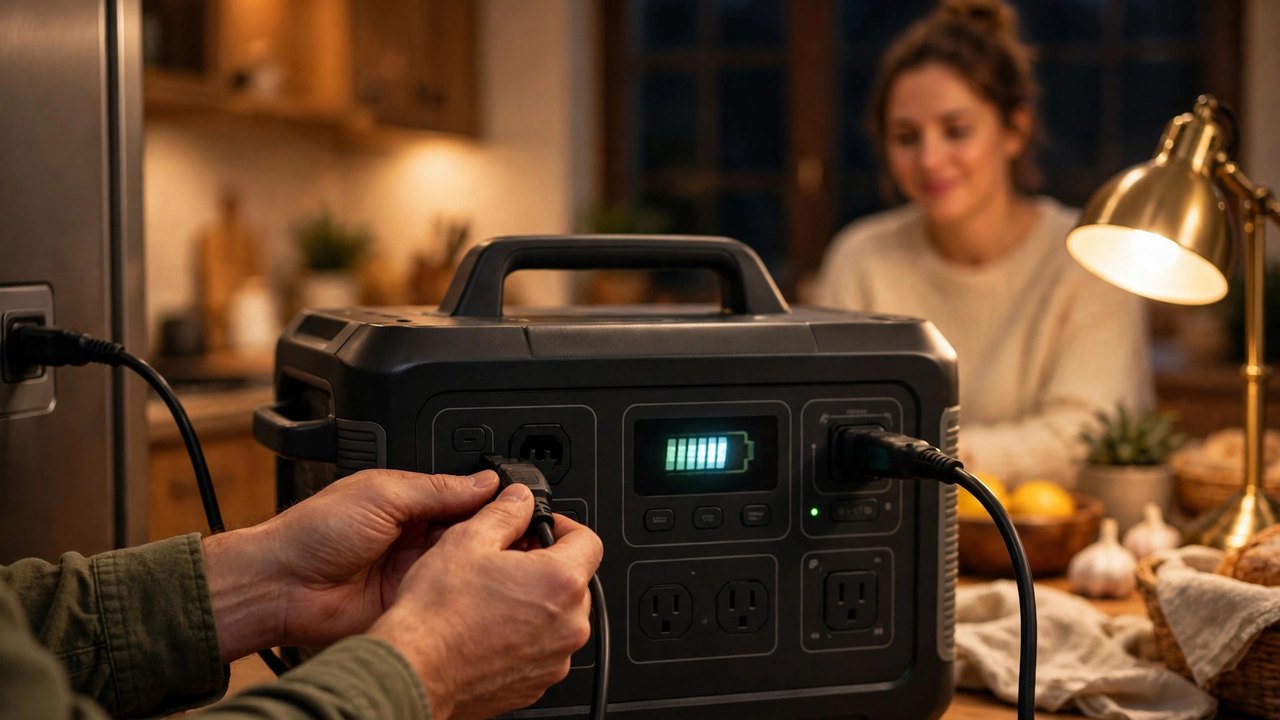
Plan the connection method. The simplest backup is extension cords from the station to the fridge and a lamp, which every unit here handles. A TT-30 outlet, listed on the Jackery HomePower 3000 and the Anker SOLIX C2000 Gen 2, can feed an RV or a compatible inlet. Feeding house circuits through a transfer switch is a job for a licensed electrician, and none of these portable stations should be back-fed into home wiring through an outlet. Finally, remember what these units are not: they are indoor battery systems with no fuel and no exhaust, which is exactly why they suit apartments and attached garages where a fuel-burning generator, which must never run indoors because of carbon monoxide, cannot be used safely.
FAQ
Can a LiFePO4 power station run a refrigerator overnight?
Yes, within the arithmetic of its capacity. A typical refrigerator averages roughly 100W over a day as its compressor cycles. Against a 2,048Wh station, that is an overnight-plus load once conversion losses are allowed for, and the 3,072Wh and 3,600Wh units here stretch it further. Check your own fridge’s energy label and compare it with the capacity the maker lists before relying on any single figure.
Why will my power station not charge in a cold garage?
Because the makers design it that way. Every brand in this guide lists a charging temperature range that starts at 32 degrees Fahrenheit, while discharging ranges extend below freezing. Charging a lithium iron phosphate battery below freezing can damage the cells, so the battery management system blocks it. Bring the station into a heated room to recharge, then return it to the cold space for discharge duty if needed.
How long will a LiFePO4 station last in storage between outages?
The makers rate these batteries by cycles, from 3,000 cycles to 80% capacity on the EcoFlow DELTA 2 Max to more than 6,000 cycles on the BLUETTI Elite 200 V2, and a standby station uses very few cycles. Calendar care matters more: store it indoors, at the partial-to-high charge level the maker recommends, and recharge it on the maker’s stated schedule, commonly every few months, so self-discharge never leaves it flat.
Can one of these stations power my whole home?
No single portable station in this guide is described by its maker as a whole-home supply, and this guide does not claim otherwise. What the makers describe is backup for essential loads: refrigeration, lights, communications, and selected appliances within the listed continuous and surge ratings. Whole-home coverage is the territory of large installed battery systems or multiple expanded units, which is a different purchase.
Is a LiFePO4 station safe to use indoors?
That is the use these products are designed and sold for. They burn no fuel and produce no exhaust, so the carbon monoxide danger that makes fuel-burning generators strictly outdoor equipment does not apply. Follow the maker’s own placement guidance: keep vents clear, keep the unit dry, and respect the operating temperature ranges the maker lists.
What is the difference between continuous watts and surge watts?
Continuous watts are what the station can deliver without time limit; surge watts are a brief ceiling for the startup draw of motors and compressors. Size the continuous figure for everything you run at once, and the surge figure for the single largest motor you start. Both figures in this guide are stated as the makers list them, and exceeding the continuous rating will shut the inverter down to protect itself.
Conclusion
For emergency home backup, the right LiFePO4 station is the one whose maker-listed capacity covers your essentials list, whose surge rating covers your largest motor start, and whose temperature windows match where it will live. The EcoFlow DELTA 2 Max is the flexible default, the EcoFlow DELTA Pro and Jackery HomePower 3000 bring 3,600W-class output for heavier essentials, the BLUETTI Elite 200 V2 leads on rated cycle life, and the Jackery Explorer 2000 v2 and Anker SOLIX C2000 Gen 2 keep a full 2kWh of backup light enough to move around the house. Pick by the loads you cannot do without, keep the station stored warm and charged, and it will be ready the next time the grid is not.
M
Modern Line Home Editorial Team
We compare specs, materials and verified owner reviews before a product earns a spot. Rankings are never paid.
Affiliate disclosure. As an Amazon Associate we earn from qualifying purchases at no extra cost to you. Prices accurate as of the date shown.
House cold even with the heat on? Walk this ordered checklist: thermostat and filter first, then drafts, insulation, leaky ducts and a failing heating system.
Windows fogging up in winter? Check where the fog sits: on the room side it is indoor humidity, outside it is harmless, and between panes the seal has failed.
Store the main firewood pile about 30 feet from your house, off the ground and covered only on top. Compare racks, woodsheds, garages and indoor spots safely.
Place a portable generator outdoors only, at least 20 feet from windows, doors and vents, exhaust pointed away. Exact distances, setup steps and CO rules here.
Keep houseplants in the right winter spot: match window direction to plant type, stay clear of radiators and cold glass, and fix dry air and low light at home.
Mice enter through pencil-width gaps at foundations, pipes, vents, doors and the roofline. Walk this room-by-room winter checklist to find and seal each one.
A winter outage timeline: what to do in the first hour, first night and multi-day outage, with food safety times, pipe protection, heat and CO safety steps.
Size a space heater by room area: 10 watts per square foot at 8-foot ceilings, adjusted for insulation and ceiling height, with full wattage and BTU tables.
Start dripping at about 20 degrees, sooner for exposed pipes. Set a pencil-lead stream, drip the right faucets on both lines, and know when to stop safely.
A fridge needs 800-1,200 starting watts, not just 150-400 running watts. Use the tables to total your fridge plus freezer, lights, furnace fan and more today.











Write Your Review
No reviews yet. Be the first to share your experience!