We independently review everything we recommend. When you buy through our links, we may earn a commission. As an Amazon Associate we earn from qualifying purchases.
Best Attic Stair Insulation Covers for Drafty Hallways
Compare the best attic stair insulation covers for drafty hallways, with verified opening sizes, listed R-values, fire ratings, materials and zipper access.
Compare the best attic stair insulation covers for drafty hallways, with verified opening sizes, listed R-values, fire ratings, materials and zipper access.
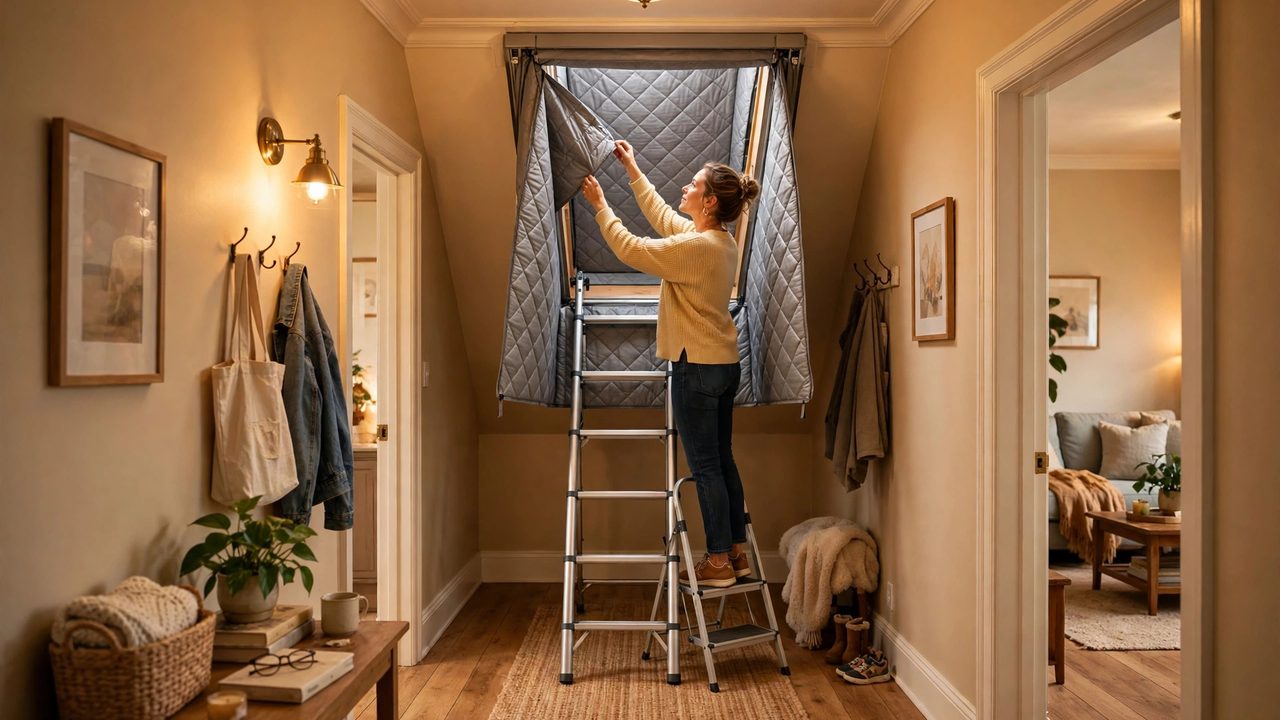
If your hallway feels like the coldest room in the house every winter, look up. Pull-down attic stairs are usually fitted into a rough opening cut through the ceiling, and the folding ladder panel that closes that opening is thin, rarely sealed, and surrounded by gaps at the frame. Conditioned air from the hallway moves through those gaps, attic air moves back down, and the ceiling over a hallway — a space you walk through dozens of times a day — becomes a permanent cold spot. An insulated stair cover fixes the opening from the attic side: it caps the folded ladder with an insulated tent or cover, seals around the frame, and opens with a zipper when you need the attic. This guide to the best attic stair insulation covers for drafty hallways compares six covers that are sold new on Amazon US, each checked on its opened product page for its rough-opening fit, its material, the R-value the maker lists, and any fire rating the maker lists, so you can match a cover to your opening instead of guessing.
One honesty note before the picks: a cover can only work on the opening it actually fits. Most of the covers below are built for the common 25 by 54 inch rough opening, one fits openings up to 25.5 by 54 inches, and all of them need enough height above the folded ladder for the cover to sit without being crushed. Measure your opening and your folded ladder first, then read the picks with those numbers in hand.
Quick verdict
For the standard 25 by 54 inch opening found in most hallways, the Thermal Armor Simple Kit and the Energy Wise Premium cover are the strongest all-round choices: both list an R-value above R-15, both use double-bubble reflective construction, and both open with zippers so the cover stays in place between attic trips. The LEMOONE cover matches that insulation class and adds a fire-resistant construction claim, while the DGSL cover is the straightforward staple-on tent for the same opening size. If your opening measures 25.5 by 54 inches, or you rent and cannot staple anything to the frame, the Duck Brand Stairway Attic Cover is the one built for you: it assembles with flexible rods, needs no tools, and lifts away for access. The Bevel Energy cover rounds out the list as a simple zippered tent for the standard opening. Every pick below states its opening size up front, because in this category fit is the whole decision.
We started from the hallway problem itself: a pull-down ladder in a ceiling opening, with drafts moving around the frame. Only covers designed for pull-down attic stairs were considered — hatch boards, loose batts and door sweeps solve different openings and were left out. Each candidate then had to pass four checks on opened pages. First, the rough-opening fit had to be stated plainly: the listing had to name the opening dimensions it covers, such as 25 by 54 inches or 22.5 by 54 inches, and the cover height, because a tent that is too short crushes against the folded ladder and a cover that is too small leaves the frame exposed. Second, the material had to be named — reflective foil over bubble insulation, aluminum layers, or a flexible fabric shell — since the material decides how the cover seals and how it survives being opened repeatedly. Third, we recorded the R-value and any fire rating exactly as the maker lists them, and only where the maker lists them; where a listing does not publish an R-value, the product was judged on its fit and sealing design instead, and the table says so rather than filling the gap with an estimate. Fourth, the cover had to be removable or openable for attic access — a zipper, or a lift-away design — because a cover that has to be torn off will not stay in service. Finally, each pick had to show a live offer sold new on its opened Amazon product page at the time of checking; listings showing no live offer were excluded and replaced. We never infer or promise energy savings figures for any cover: what a cover saves depends on your house, your climate and how well the frame is sealed, so this guide compares fit, materials and listed ratings only.
The Thermal Armor Simple Kit is built for openings up to 54 by 25 by 11 inches, which matches the standard rough opening most hallway ladders are framed into. The maker lists an R-15.6 rated insulation, the highest figure among the zippered tents in this roundup, and describes aluminum foils that block air exchange at the opening. Access is through a double zipper, so the cover stays fixed over the stair frame while you climb through, and the listing frames the kit as a seal for pull-down stair, hatch and ladder gaps generally — useful if your hallway opening is a stair rather than a simple hatch. For a drafty hallway, the combination that matters is the tall 11 inch cavity plus the zippered seal: the folded ladder gets room to sit inside the tent, and the perimeter is not left open at one end the way a loose drape would leave it. The maker also positions the cover as a dust and pollutant barrier at the entrance, which matters in hallways because everything that drifts down the stair gap lands in the most trafficked part of the house.
Buy it if: your opening measures 25 by 54 inches, you want the highest R-value the maker lists in this group, and you use the attic often enough that double-zipper access matters.
Skip it if: your opening is wider than 25 inches — this kit is sized to that width — or your folded ladder stacks taller than the 11 inch cover height.
The Energy Wise Premium cover fits openings up to 25 by 54 by 11 inches and is built from thick double bubble insulation wrapped in reflective foil; the maker lists an R-value of 15.5 and states the foil reflects up to 97 percent of radiant heat. Its distinguishing detail is the zipper: the maker describes robust failsafe zippers that you unzip as you ascend and re-zip as you descend, which is exactly the motion a hallway ladder demands, since you are usually carrying something with one hand. Installation is staple-on — the maker lists a staple gun as the one tool needed, with instructions included — and once the flange is stapled to the frame the cover becomes a permanent fixture that opens rather than removes. For drafty hallways, that permanence is the point: the seal is not disturbed every time someone fetches a suitcase or a box of decorations, so the perimeter stays closed through the whole heating season instead of being reseated by hand each time.
Buy it if: you want a listed R-15.5 double-bubble cover for a 25 by 54 inch opening and you are comfortable stapling a flange to the stair frame once.
Skip it if: you rent, or your frame cannot take staples — choose the rod-assembled Duck Brand cover below instead.
The LEMOONE cover, model attic-2, is sized 25 by 54 by 11 inches for the standard opening. The maker lists an R-value of 15.5 from a double-layer aluminum foil construction with an upgraded high-density bubble core, and describes the construction as waterproof and fire-resistant — the fire-related claim the maker itself makes for this model, stated here exactly as listed rather than as a formal rating. Access is via a smooth, heavy-duty metal zipper, and the maker highlights a long zipper opening that lets you pass through the folding ladder without removing the cover. Installation follows the same staple-to-frame pattern as most tents in this class: unfold, place over the opening, staple to the door frame. For a hallway, the metal zipper is a practical detail — zippers are the moving part on these covers, they are worked from a ladder with cold hands, and a heavier zipper pull is easier to use mid-climb. The airtight-seal framing in the listing also speaks to the dust side of the hallway problem, keeping attic dust from filtering down around the ladder panel.
Buy it if: your opening is 25 by 54 inches and you want a listed R-15.5 cover whose maker lists a fire-resistant, waterproof construction with a metal zipper.
Skip it if: you need a cover for a wider 25.5 inch opening, or you want a formal fire rating document rather than the maker’s fire-resistant description — none of the tent-style covers here publish one in their listings.
The DGSL cover, sold under the Sealcare name in some listings, fits openings up to 25 by 54 by 11 inches. The maker lists a construction of two layers of aluminum with bubble insulation inside — the air space in the bubble layer acting as the thermal break — and lists an R-value of 14.5, a step below the R-15.5 class above but in the same range. The maker describes the material as fireproof in its listing copy; as with the LEMOONE cover, that is the maker’s own description rather than a cited test rating, and it is reported here as listed. The cover installs by placing it in the attic door opening and stapling it to the door frame, and access is through a zipper, so day to day it behaves like the other staple-on tents: fixed perimeter, openable middle. For a drafty hallway on the standard opening size, it covers the essentials — full 25 by 54 footprint, 11 inches of clearance for the folded ladder, a sealed zippered pass-through — and its listing also frames it as a dust and pollutant seal at the door, which is the second half of why hallway openings feel so unpleasant in winter: it is not only cold air coming down, it is attic air, with everything in it.
Buy it if: your opening is the standard 25 by 54 inches and you want a simple staple-on aluminum bubble tent with a listed R-14.5.
Skip it if: you want the highest listed R-value in this group, or a no-tools installation — this one staples on.
The Bevel Energy cover is a zippered tent for doorways that are 25 by 54 inches, with the 11 inch height the folded ladder needs. The maker lists an aluminum material with insulation inside, a seal at the attic door intended to keep dust and pollutants out of the living space, and a lower front accessed by a zipper for quick entry. The listing sections checked do not publish an R-value for this model, so it is included on fit and design rather than on a listed rating: same standard footprint, same staple-and-zipper pattern, and a reflective aluminum build of the type the rest of this category uses. That makes it a reasonable choice when your priority is simply closing the opening with a proper tent instead of a improvised drape, and you are comparing covers by fit and access rather than by chasing the last point of listed R-value. In a hallway, the practical difference between covers in this class is mostly how well the perimeter sits on your frame and how willingly the zipper works — both things this design addresses with the standard layout.
Buy it if: your doorway measures 25 by 54 inches and you want a straightforward aluminum zippered tent, judged on fit rather than a listed R-value.
Skip it if: a published R-value or fire rating is a requirement for your project — pick one of the R-15 class covers above, whose makers list their figures.
The Duck Brand Stairway Attic Cover, model 286209 from Shurtape Technologies, is the different design in this roundup. It seals attic stairway openings up to 25.5 inches by 54 inches — half an inch wider than the standard tents — and it can be used on smaller openings too. Instead of stapling, you lay the cover on the floor, assemble the flexible rods, run them through the channels on top and seat the ends into the corner pockets; the maker lists no tools required. The cover is flexible and lightweight, has no adhesive, and is repositionable, which the maker specifically frames as safe for renters, leaseholders and temporary living spaces. Access means repositioning or lifting the cover rather than unzipping a fixed tent, so it suits homes where the attic is opened occasionally rather than weekly. The maker does not publish an R-value for this cover in the listing sections checked; its job, as listed, is blocking drafts and retaining room temperature at the opening. For the hallway with the slightly oversize 25.5 inch frame — common in older houses — it may be the only cover here that actually fits, and fit beats rating every time: a well-seated cover with no published R-value seals better than a higher-rated tent bunched up on a frame it does not match.
Buy it if: your opening is up to 25.5 by 54 inches, you rent, or you cannot staple into the frame — this is the no-tools, removable option.
Skip it if: you open the attic constantly and want fixed zipper access, or you need a maker-listed R-value for a weatherization program.
Buying guide
Measure the rough opening first. With the ladder down, measure the inside of the frame the ladder sits in — width and length, in inches. The common sizes are 22.5 by 54 inches and 25 by 54 inches, with some older frames at 25.5 by 54 inches or 30 by 54 inches. Every cover in this guide names the opening it fits; buy to your measurement, not to the ladder brand. A cover sized for 25 by 54 will not seal a 22.5 inch opening well, and it cannot stretch to a 30 inch one.
Check the height, not just the footprint. The folded ladder, its springs and its hardware stack above the ceiling line. Most tents here stand 11 inches tall. Fold your ladder, measure the highest point of the folded stack, and make sure the cover clears it; a tent pressed down by the ladder cannot seal at its base and its zipper will strain.
Read R-values as the maker lists them. The zippered foil tents here list figures from R-14.5 to R-15.6; the rod-assembled and some simpler tents list none. Treat a listed R-value as one input among several. The perimeter seal — stapled flange sitting flat, frame gaps closed — decides how much hallway air actually moves, and no R-value compensates for a cover rocking on an uneven frame. What this guide will not do is convert any of these figures into promised savings: no percentage savings claim appears here, because none can be honestly derived from a cover’s listing.
Fire ratings: know what is actually claimed. Some listings describe their material as fireproof or fire-resistant in their own words; that is a material description, not the same thing as a tested fire rating for the assembly. If your local code, insurer or weatherization program asks for a rating, ask the maker for the test documentation for the exact model before you buy, and do not treat listing adjectives as a substitute.
Choose the access style for how you live. Staple-on zippered tents stay put and open in seconds — right for weekly attic use. The rod-assembled Duck Brand cover lifts away and reinstalls with no trace — right for renters and occasional use. Whichever you choose, confirm the cover can be opened or removed by one person standing on the ladder; a cover that needs two people will eventually be left off, and an opening with no cover is the draft you started with.
Mind the frame seal. Before fitting any cover, check the ladder panel’s own weatherstripping and the frame for gaps, cracks and daylight. A cover caps the opening from above; sealing obvious frame gaps at the same time is what turns a covered hole into a closed one. Work from the attic side where you can, keep insulation and stored boxes clear of the cover so it can sit flat, and re-check the zipper and flange after the first few openings.
FAQ
What size attic stair cover do I need for a 25 by 54 inch opening?
Any cover whose maker lists a fit for 25 by 54 inches — five of the six picks here are sized to that opening, with an 11 inch height for the folded ladder. Measure the inside of your frame rather than trusting the ladder’s nominal size, and check the folded ladder’s stack height against the cover height before ordering.
What if my opening is 22.5 by 54 inches?
None of the six verified picks here is sized to 22.5 by 54 inches; the tents listed fit 25 by 54, and the Duck Brand cover fits up to 25.5 by 54 and can be used on smaller openings. A 25 inch tent on a 22.5 inch frame will have slack at the sides that is hard to seal, so measure first and choose a cover listed for your exact opening where one exists.
Do these covers list fire ratings?
Some makers describe their material as fireproof or fire-resistant in the listing — the DGSL and LEMOONE listings use such descriptions — but the listings checked do not cite a formal tested fire rating for the cover assembly. If a rating is required for your situation, request the documentation from the maker for the exact model.
Can I still use the attic with a cover fitted?
Yes — that is what the access design is for. The zippered tents open with single or double zippers and stay fixed to the frame; the Duck Brand cover is repositioned or lifted away and has no adhesive, so it suits renters. Choose based on how often you climb up: frequent use favors a fixed zippered tent.
Will an attic stair cover stop the hallway draft completely?
It addresses the largest single gap — the stair opening itself. Drafts can also come from the ladder panel’s own seals, frame cracks and other ceiling penetrations, so check the frame weatherstripping when you fit the cover. This guide makes no savings or performance percentage claims; what a cover does is close and insulate an opening that was previously neither.
Can a renter install one of these?
The Duck Brand Stairway Attic Cover is the renter-friendly pick: the maker lists no tools required, no adhesive, and a repositionable design it describes as safe for renters and leaseholders. The staple-on tents modify the frame, so get the property owner’s agreement before stapling.
Conclusion
A drafty hallway with pull-down stairs is a fit problem before it is an insulation problem. Measure the rough opening, confirm the folded ladder’s height, then choose by access style: the Thermal Armor Simple Kit and Energy Wise Premium lead the zippered tents on listed R-value for the standard 25 by 54 inch opening, the LEMOONE adds a fire-resistant construction description and a metal zipper, the DGSL covers the same opening at a listed R-14.5, the Bevel Energy is the simple fit-first tent, and the Duck Brand 286209 is the no-tools answer for 25.5 inch openings and renters. Fit the cover so its perimeter sits flat, keep its zipper or lift-away access easy enough that it always goes back on, and the hallway ceiling stops being the coldest surface in the house.
M
Modern Line Home Editorial Team
We compare specs, materials and verified owner reviews before a product earns a spot. Rankings are never paid.
Affiliate disclosure. As an Amazon Associate we earn from qualifying purchases at no extra cost to you. Prices accurate as of the date shown.
House cold even with the heat on? Walk this ordered checklist: thermostat and filter first, then drafts, insulation, leaky ducts and a failing heating system.
Windows fogging up in winter? Check where the fog sits: on the room side it is indoor humidity, outside it is harmless, and between panes the seal has failed.
Store the main firewood pile about 30 feet from your house, off the ground and covered only on top. Compare racks, woodsheds, garages and indoor spots safely.
Place a portable generator outdoors only, at least 20 feet from windows, doors and vents, exhaust pointed away. Exact distances, setup steps and CO rules here.
Keep houseplants in the right winter spot: match window direction to plant type, stay clear of radiators and cold glass, and fix dry air and low light at home.
Mice enter through pencil-width gaps at foundations, pipes, vents, doors and the roofline. Walk this room-by-room winter checklist to find and seal each one.
A winter outage timeline: what to do in the first hour, first night and multi-day outage, with food safety times, pipe protection, heat and CO safety steps.
Size a space heater by room area: 10 watts per square foot at 8-foot ceilings, adjusted for insulation and ceiling height, with full wattage and BTU tables.
Start dripping at about 20 degrees, sooner for exposed pipes. Set a pencil-lead stream, drip the right faucets on both lines, and know when to stop safely.
A fridge needs 800-1,200 starting watts, not just 150-400 running watts. Use the tables to total your fridge plus freezer, lights, furnace fan and more today.












Write Your Review
No reviews yet. Be the first to share your experience!