We independently review everything we recommend. When you buy through our links, we may earn a commission. As an Amazon Associate we earn from qualifying purchases.
Best Dishwasher Safe Humidifiers for Home Use (2026)
Compare the best dishwasher safe humidifiers for home use, with the exact tank, lid, tray and cap parts each maker allows in the dishwasher, verified per model.
Compare the best dishwasher safe humidifiers for home use, with the exact tank, lid, tray and cap parts each maker allows in the dishwasher, verified per model.
Cleaning is the part of humidifier ownership that decides whether a unit gets used all winter or abandoned in a cupboard by January. Tanks grow slippery film, mineral scale crusts into corners a brush cannot reach, and narrow openings make scrubbing a chore that keeps getting postponed. That is exactly why so many shoppers go looking for the best dishwasher safe humidifiers for home use: if the parts that hold water can go through a normal wash cycle, the weekly clean stops being a project and becomes a habit you can actually keep.
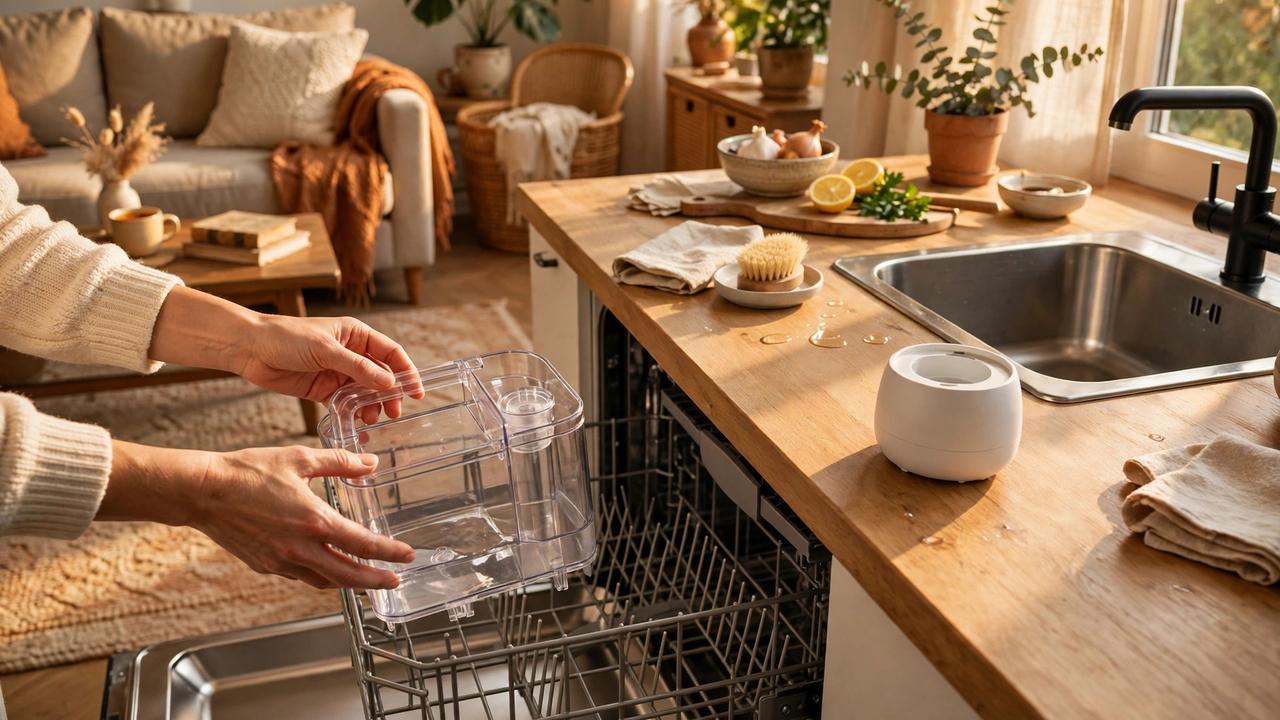
There is one catch, and it runs through every pick below. No humidifier in this guide is a whole unit that goes in the dishwasher. The motor, fan, electronics and base always stay out. What the makers allow in the dishwasher is specific: a named tank on one model, a tank and lid on another, a tray and covers on a third. We checked each model’s own listing and manual language and state dishwasher safety only for the exact parts the maker names, with the maker’s conditions — top rack only, temperature limits, no heated drying — spelled out wherever the maker states them. Read those lines before you load anything, because the difference between a clean tank and a warped one is usually in the fine print.
The six models below cover the main ways households add moisture in winter: evaporative units that leave no visible mist, ultrasonic cool mist units, and one warm mist steam model. Tank sizes run from a compact 1.9 litres for a small bedroom to 4 litres for a full day and night of runtime. Every pick is sold new on Amazon US, every specification is phrased as the maker lists it, and every dishwasher claim is tied to a named part rather than a marketing headline.
Quick verdict
For most households, the Canopy Bedside Humidifier 2.0 is the easiest recommendation: the maker allows the widest set of water parts in the dishwasher — tank, tray, grill, spacer and cap — and its evaporative design produces no visible mist and no white dust. If you want stainless steel instead of plastic in the water path, the Carepod One puts its stainless tank and inner lid in the dishwasher and skips filters entirely. For a larger room with app control, the Blueair DreamWell H38i pairs a dishwasher-safe tank with a washable wick the maker rates for up to a year. The Levoit NeoClassic 350 is the most precisely documented cleaner of the group, with a manual that names four dishwasher-safe parts and exact temperature limits. The Livatro warm mist model is the pick for buyers who specifically want steam from a stainless tank, and the Crane EE-5403 is the small, simple evaporative option whose tank and lid both go in the dishwasher.
The products in this guide
Canopy Bedside Humidifier 2.0
The Canopy Bedside Humidifier 2.0 earns the top spot because the maker allows more of the water path into the dishwasher than any other pick here
Best if you want the broadest maker-stated set of dishwasher-safe parts — tank, tray, grill, spacer
Every model in this guide had to pass the same checks. First, the product had to be a real, current model sold new on Amazon US, with a live featured offer at the time of checking; listings showing no featured offer were excluded, however good their specifications looked. Second, the maker had to state dishwasher safety for at least one specific part that matters for cleaning — a tank, a lid, a tray or a cover — in its own listing or manual. A generic “easy to clean” claim was not enough, and neither was a care line that mentioned a dishwasher without naming what may go in it. Third, we verified the cleaning process and the tank material from the opened product pages: whether the tank is plastic or stainless steel, whether the design is top-fill, whether a wick or filter needs replacing, and what conditions the maker attaches to dishwasher use.
We also kept the health framing deliberately plain. A humidifier’s job is to add moisture to dry indoor air, and this guide makes no medical claims for any model. Where a maker lists a humidity target or an automatic mode, we report it as listed. As a household rule throughout this guide, run a humidifier to keep indoor humidity in a comfortable middle range and do not push it above 50 percent; over-humidifying a room can leave windows wet and surfaces damp, which works against the clean, dry storage conditions these machines need between uses. Finally, prices, ratings and review counts change too often to print responsibly, so none appear here — the comparison rests on verified specifications and cleaning design instead.
The Canopy Bedside Humidifier 2.0 earns the top spot because the maker allows more of the water path into the dishwasher than any other pick here. The listing states that the tank, tray, grill, spacer and cap can all be placed directly in the dishwasher, and the maker’s own cleaning guidance repeats the point in plain terms: essentially, any part of the product that holds water can go in. Just as important is what the maker excludes — the body of the humidifier, which houses the fan and the electrical components, must never go in the dishwasher. That is a clean, honest split between the wet parts and the powered parts, and it is exactly the split a buyer should look for.
As a humidifier, the 2.0 is an evaporative, no-mist design. The maker lists a 2.5 litre tank, up to 36 hours of runtime on a full tank, and coverage for rooms up to 500 square feet. Water passes through the maker’s proprietary filter before evaporation, and the maker lists smart sensors that keep the unit running until the water is used up, so no standing water is left behind in the tank between cycles. The 2.0 version adds a larger, quieter fan system, a white noise setting, and sleep and reading lights compared with the original model. The maker lists filter replacement every 45 days in one place and every five to seven weeks in another, so budget for roughly monthly-to-six-weekly filter changes as an ongoing cost of ownership.
The tank’s large opening matters on the days you do not run the dishwasher: the maker notes you can reach inside with a hand or a brush, which makes a quick rinse-and-wipe realistic between deep cleans. The unit is compatible with tap water as the maker lists it, which keeps daily refills simple. Aroma diffusion is built in, with spots for scent on the grate and the tray, if you want the room to smell as considered as it feels.
Buy it if you want the broadest maker-stated set of dishwasher-safe parts — tank, tray, grill, spacer and cap — in a no-mist evaporative unit sized for a bedroom or living room up to the maker’s listed 500 square feet. Skip it if you do not want an ongoing filter replacement schedule, or if you prefer an ultrasonic unit that produces a visible mist plume.
The Carepod One takes a different route to the same goal: instead of making plastic parts dishwasher-safe, it builds the water path out of stainless steel and keeps the parts count to three. The maker describes a three-piece washable design — the stainless steel tank, the stainless steel inner lid and the oscillator wand. The maker’s cleaning guidance identifies the stainless tank and inner lid as the dishwasher-safe parts; they can also be boiled, which gives you a second deep-clean method that no plastic tank in this guide offers. The wand is the delicate exception: the maker’s guidance has it washed by hand, with the lower half cleaned gently with dish soap and a soft sponge, because abrasive scrubbing can damage it. The main body and its electronics, as always, stay out of water entirely.
The specifications are straightforward. The maker lists a 4 litre stainless steel tank, up to 30 hours of runtime at the lowest mist level and about 10 hours at the highest, three mist levels, a timer, and coverage for rooms up to 500 square feet. It is an ultrasonic cool mist unit with no filter to buy or replace, automatic shut-off, and water-level recognition that stops the unit rather than letting it run dry. The listing lists 29 watts of power draw and touch controls. Included components, as the maker lists them, are the main unit, the stainless steel pot, the stainless steel inner lid, the stainless steel oscillator and the power cable.
Because it is ultrasonic, the usual water advice applies: the maker recommends distilled or filtered water, since mineral-heavy tap water can leave white dust around an ultrasonic unit and scale inside it. With only three washable parts and no filter schedule, the weekly routine is the lightest in this guide — lift the tank and inner lid into the dishwasher, wash the wand gently at the sink, and let everything dry fully before reassembly.
Buy it if you want a stainless steel tank and inner lid that can go in the dishwasher or be boiled, a filter-free design, and a 4 litre tank for rooms up to the maker’s listed 500 square feet. Skip it if you want app control or a built-in humidistat — the maker does not list either — or if you would rather not hand-wash the oscillator wand separately.
The Blueair DreamWell H38i is the large-room, connected option in this guide, and its cleaning story is focused on one big part: the tank. The maker lists a BPA-free, dishwasher-safe tank, so the single component that holds all the water can go through a wash cycle instead of being scrubbed at the sink. The other consumable, the wick filter, is machine-washable rather than dishwasher-loaded, and the maker lists a wick life of up to 12 months — the longest filter interval in this guide by a wide margin. The base, fan and electronics are not dishwasher parts and are cleaned by wiping and routine care, as with every model here.
The H38i uses the maker’s InvisibleMist evaporative technology: a wick draws water up and a fan evaporates it, so there is no visible mist, and the maker positions it as leaving no white dust or sticky residue. The maker lists a 3.8 litre (one gallon) tank, up to 48 hours of runtime, coverage up to 596 square feet, and sound levels from 20 to 40 dB, with a quiet night mode. Refilling can be done from the top or by lifting the bucket out, and the maker lists the unit as tap-water safe, with the wick trapping minerals from the water. App control adds scheduling, humidity monitoring and refill reminders, and there is a built-in aroma stone and mood lighting for households that want those extras.
For a family room or a large bedroom that runs a humidifier around the clock in winter, the combination is practical: a big tank that goes in the dishwasher, a wick you wash rather than replace every few weeks, and automatic humidity sensing so the unit is not simply running flat out. Keep your target sensible — the point of the auto features is steady, moderate humidity, not pushing a room above 50 percent.
Buy it if you want a dishwasher-safe tank on a smart evaporative unit for a larger room, with a washable wick the maker rates for up to a year and app-based scheduling and monitoring. Skip it if you want every water part, not just the tank, to be dishwasher-safe, or if you do not want a wick-based system at all.
The Levoit NeoClassic 350 is the pick for buyers who read manuals, because its manual is the most precise in this guide about what goes in the dishwasher and how. The maker states that the water tank cover, the water tank, the silencer cover and the detachable tray are dishwasher-safe, and then attaches the conditions that protect them: top rack only, a normal or light cycle with mild detergent, a temperature below 158 degrees Fahrenheit, no heated drying, no sterilization or heavy high-temperature cycles, and dishwasher cleaning no more than once a week. The base chamber must never be immersed or placed in the dishwasher; it is wiped clean instead. That level of specificity is what honest dishwasher guidance looks like, and it makes the cleaning routine easy to follow exactly.
The unit itself is an ultrasonic cool mist humidifier with a top-fill design. The maker lists a 3.2 litre tank, up to 26 hours of runtime, a maximum output of 250 millilitres per hour, and coverage up to 375 square feet. The maker lists noise at no more than 23 dB, power draw of 18 watts, and dimensions of 7.3 by 7.3 by 11.8 inches, so it sits comfortably on a nightstand. There is a night light with a blue light-free glow, and an aroma chamber for essential oils — the maker is clear that oils go in the chamber, never directly into the water tank.
Levoit recommends purified or distilled water for this model to avoid white dust, which is standard advice for ultrasonic units and worth following in hard-water areas. Hand washing remains part of the rhythm too: the manual has parts hand-washed every three days or before storage, with the dishwasher run as the weekly deeper clean for the four named parts. Followed as written, that is a realistic routine — a quick hand wash most days the unit is serviced, and one top-rack cycle a week.
Buy it if you want a compact, quiet ultrasonic unit whose maker names four dishwasher-safe parts — tank, tank cover, silencer cover and tray — with exact top-rack and temperature conditions. Skip it if your dishwasher lacks a gentle cycle that stays under the maker’s stated temperature limit, or if you want to run tap water in an ultrasonic unit without managing mineral dust.
The Livatro is the warm mist entry in this guide, and the only steam vaporizer among the six. It heats water to produce warm steam, and the part that makes that practical to live with is the tank: the maker lists a 304 stainless steel tank and states that it is dishwasher safe, with a smooth interior and no hidden crevices to trap scale. Stainless matters more on a warm mist unit than on a cool mist one, because heated water lays down limescale faster, and a tank you can put through a dishwasher — or descale with the maker’s built-in auto-clean mode using lemon, citric acid or vinegar, as the maker describes — is far easier to keep ahead of that buildup. The maker recommends cleaning the stainless tank once a week. Only the tank carries the dishwasher claim; the rest of the unit is cleaned as the maker directs, and the powered base stays out of the dishwasher.
The maker lists a 3 litre capacity, coverage up to 300 square feet, and 6 to 12 hours of continuous mist depending on setting, with high, low and sleep modes. Sleep mode turns the screen off for a darker room. Safety features as the maker lists them include automatic shut-off at low water, a child lock and a screen lock to prevent accidental touches, and the unit is filter-free, so there are no wicks or cartridges on a replacement schedule. Warm mist units use more energy than cool mist designs and produce genuinely hot steam, so placement deserves the usual care: on a stable surface, out of reach of children, exactly as the maker advises.
Buy it if you specifically want warm steam and a stainless steel tank the maker states is dishwasher safe, in a filter-free unit for a bedroom-sized room up to the maker’s listed 300 square feet. Skip it if you want long runtimes between refills — the maker lists 6 to 12 hours — or a cool mist unit for a nursery where hot steam is a concern.
The Crane EE-5403 is the smallest and simplest pick here, built for a single bedroom, nursery or home office rather than a whole floor. Its cleaning claim is short and clear: the maker states that the 1.9 litre water tank and the removable lid are dishwasher safe. The removable fan cage is the third cleaning feature — it comes off so you can reach the interior and fan area for routine wiping — but note that the maker presents the cage as removable for access, and the dishwasher claim itself covers the tank and lid. Crane’s manual also describes the tank being cleaned in a dishwasher as the alternative to a vinegar soak, which is a reassuringly ordinary, well-documented cleaning process.
The EE-5403 is an evaporative unit: a wick filter absorbs water from the tank and a fan circulates air through it, distributing moisture without a visible mist. The maker lists three fan speeds, coverage up to 250 square feet, and runtime up to 15 hours on low or 8 hours on high per fill. The maker lists a built-in UV light in the water path, and the wick filter, model HS-1970, is replaced every three to six months depending on usage, as the maker lists it. The top-fill tank keeps refills simple — pour water in from the top rather than carrying a tank to the sink and flipping it.
Evaporative output is self-limiting in a way the maker notes: as room humidity rises, output naturally slows. That makes this a forgiving choice for a small closed room, though you should still avoid running any humidifier long enough to push a room above 50 percent humidity or leave condensation on the windows. For a desk or nightstand in a small room, the EE-5403’s combination of a dishwasher-safe tank and lid, a removable fan cage and a named replacement wick is a complete, honest maintenance story in a compact footprint.
Buy it if you want a compact evaporative humidifier for a room up to the maker’s listed 250 square feet, with a dishwasher-safe tank and lid and a removable fan cage for access. Skip it if you need a tank that runs more than a night and a morning — the maker lists up to 15 hours on low — or if you do not want a wick filter on a three-to-six-month replacement cycle.
Buying guide
Start with the parts list, not the headline. “Dishwasher safe” on a humidifier box can mean anything from one small cap to nearly the whole water path. The useful question is which parts the maker names. A dishwasher-safe tank, as on the Blueair DreamWell H38i and the Livatro, covers the component that holds standing water and grows the most film. Tank-plus-lid coverage, as on the Crane EE-5403, adds the part that seals the water in. The widest coverage in this guide — Canopy’s tank, tray, grill, spacer and cap, and Levoit’s tank, tank cover, silencer cover and tray — means almost everything that touches water can be machine-washed. Whichever model you choose, the base with the motor and electronics never goes in, and any part the maker does not name should be treated as hand-wash only.
Respect the conditions attached to the claim. Makers attach real limits to dishwasher use, and they are not fine-print trivia. Top-rack placement keeps plastic parts away from the heating element. Temperature limits — Levoit states below 158 degrees Fahrenheit — and bans on heated drying and sanitize cycles exist because those settings can warp thin tank walls and seals. Mild detergent, a normal or light cycle, and a cap on frequency (Levoit states no more than once a week) all protect the parts you are relying on. Stainless steel tanks, like the Carepod One’s and the Livatro’s, tolerate the dishwasher with fewer conditions, which is one reason buyers who clean weekly often end up preferring steel. If your dishwasher only runs hot, aggressive cycles, hand washing with the maker’s vinegar routine is the safer default for plastic parts.
Match the technology to the room. Evaporative models — the Canopy, the Blueair and the Crane — move air through a wet wick or filter and produce no visible mist; minerals stay in the wick, and output naturally eases off as humidity rises. The trade-off is a wick or filter on a replacement schedule, from Crane’s three-to-six-month wick to Blueair’s washable wick listed at up to a year. Ultrasonic models — the Carepod One and the Levoit NeoClassic 350 — are quiet and filter-light or filter-free, but they can project mineral dust if you fill them with hard tap water, so follow the maker’s distilled or filtered water advice. Warm mist, the Livatro’s steam approach, involves no wick and no dust, but the tank scales faster and the steam is hot, so weekly tank cleaning and careful placement matter more.
Size the tank to your routine. Runtime claims are always at the lowest setting, so read them as best cases. A 1.9 litre tank listed at up to 15 hours, like the Crane’s, suits a night at a time in a small room. The 3 to 4 litre class — Levoit, Blueair, Carepod — covers a full night and day. The Canopy’s 2.5 litres listed at up to 36 hours reflects how slowly an evaporative unit uses water at low output. If you dislike refilling, favour capacity; if you dislike carrying a heavy full tank to the sink, favour top-fill designs, which most of these models offer.
Keep humidity moderate and cleaning regular. More humidity is not better. Aim for a comfortable middle range indoors and do not run a unit long or hard enough to push a room above 50 percent, especially in winter when excess moisture condenses on cold windows and can dampen walls and soft furnishings. Empty and dry the tank between uses rather than letting water stand for days, run the dishwasher or hand-wash routine on the maker’s schedule — weekly is the common instruction across these models — and let every part dry fully before reassembly and storage. A humidifier that is easy to clean only helps if the cleaning actually happens; the dishwasher-safe designs above are valuable precisely because they lower the effort enough that it does.
FAQ
Can the whole humidifier go in the dishwasher?
No. On every model in this guide, only named water parts are dishwasher-safe — a tank, a lid, a tray, covers or a cap, depending on the model. The base, which holds the motor, fan and electronics, must never go in the dishwasher or be immersed in water. Canopy states this explicitly for its body section, and Levoit’s manual says the same for its base chamber.
Which parts are dishwasher-safe on these models?
As the makers state them: the Canopy Bedside Humidifier 2.0 allows its tank, tray, grill, spacer and cap; the Carepod One allows its stainless steel tank and inner lid, with the oscillator wand washed by hand; the Blueair DreamWell H38i allows its tank, with the wick machine-washable instead; the Levoit NeoClassic 350 allows its water tank, tank cover, silencer cover and detachable tray on the top rack; the Livatro allows its stainless steel tank; and the Crane EE-5403 allows its water tank and lid.
Are there temperature or cycle limits for dishwasher cleaning?
On some models, yes, and they matter. Levoit’s manual for the NeoClassic 350 specifies the top rack, a normal or light cycle with mild detergent, a temperature below 158 degrees Fahrenheit, no heated drying or sterilization cycles, and dishwasher cleaning no more than once a week. Where a maker states limits like these, follow them exactly; where a maker simply names the parts, a gentle top-rack cycle is still the cautious choice for plastic components.
Does dishwasher cleaning replace hand washing and descaling?
No — the makers treat it as one part of the routine. Levoit’s manual still calls for hand washing parts every three days or before storage, with the dishwasher as the deeper weekly clean. Crane’s manual describes a vinegar soak as the standard clean, with the dishwasher as an alternative for the tank. Warm mist and hard-water use still lay down scale that may need the maker’s descaling process — Livatro builds an auto-clean mode around lemon, citric acid or vinegar for exactly that job.
Stainless steel or plastic tank — which is easier to live with?
Stainless steel tanks, like the Carepod One’s and the Livatro’s, tolerate dishwasher heat with fewer conditions and can also be boiled, in the Carepod’s case, as the maker describes. Plastic tanks are lighter and often larger for the size of unit, but they come with the top-rack and temperature conditions their makers state. Neither material cleans itself: both need the weekly routine, complete drying, and fresh water rather than topped-up old water.
How humid should I keep the room?
Keep it moderate. Use the unit’s settings, auto mode or a separate room hygrometer to hold a comfortable middle range, and do not run the humidifier in a way that pushes indoor humidity above 50 percent. Persistent condensation on windows is a practical sign to turn the output down and air the room out.
Conclusion
The honest version of “dishwasher safe” is a parts list, and on that measure these six models all deliver something real. The Canopy Bedside Humidifier 2.0 offers the widest maker-stated set of dishwasher-safe parts in an evaporative design; the Carepod One answers with a stainless tank and inner lid that can be dishwashed or boiled and nothing else to maintain; the Blueair DreamWell H38i scales the idea up to a smart, large-room evaporative unit with a dishwasher-safe tank and a year-long washable wick; the Levoit NeoClassic 350 documents its four dishwasher-safe parts and their limits more precisely than anyone; the Livatro brings the dishwasher-safe stainless tank to warm steam; and the Crane EE-5403 keeps it small and simple with a dishwasher-safe tank and lid. Choose by the parts you will actually wash, the technology that suits your water and your room, and a cleaning routine you will still be following in February — then follow the maker’s conditions exactly, and the machine will reward you with a winter of easy, regular cleans.
M
Modern Line Home Editorial Team
We compare specs, materials and verified owner reviews before a product earns a spot. Rankings are never paid.
Affiliate disclosure. As an Amazon Associate we earn from qualifying purchases at no extra cost to you. Prices accurate as of the date shown.
House cold even with the heat on? Walk this ordered checklist: thermostat and filter first, then drafts, insulation, leaky ducts and a failing heating system.
Windows fogging up in winter? Check where the fog sits: on the room side it is indoor humidity, outside it is harmless, and between panes the seal has failed.
Store the main firewood pile about 30 feet from your house, off the ground and covered only on top. Compare racks, woodsheds, garages and indoor spots safely.
Place a portable generator outdoors only, at least 20 feet from windows, doors and vents, exhaust pointed away. Exact distances, setup steps and CO rules here.
Keep houseplants in the right winter spot: match window direction to plant type, stay clear of radiators and cold glass, and fix dry air and low light at home.
Mice enter through pencil-width gaps at foundations, pipes, vents, doors and the roofline. Walk this room-by-room winter checklist to find and seal each one.
A winter outage timeline: what to do in the first hour, first night and multi-day outage, with food safety times, pipe protection, heat and CO safety steps.
Size a space heater by room area: 10 watts per square foot at 8-foot ceilings, adjusted for insulation and ceiling height, with full wattage and BTU tables.
Start dripping at about 20 degrees, sooner for exposed pipes. Set a pencil-lead stream, drip the right faucets on both lines, and know when to stop safely.
A fridge needs 800-1,200 starting watts, not just 150-400 running watts. Use the tables to total your fridge plus freezer, lights, furnace fan and more today.












Write Your Review
No reviews yet. Be the first to share your experience!