We independently review everything we recommend. When you buy through our links, we may earn a commission. As an Amazon Associate we earn from qualifying purchases.
Best Cordless Electric Snow Shovels for Decks and Steps
Compare the best cordless electric snow shovels for decks and steps by clearing width, throw, battery platform and surface fit, with six top picks compared.
A deck or a flight of steps is the worst place in the yard to clear by hand and the easiest place to clear badly with the wrong machine. A full-size snow blower is too wide, too heavy and too awkward to lift onto raised boards, while a manual shovel turns every snowfall into a slow series of lifts. The tools built for this in-between job are cordless electric snow shovels: narrow, hand-guided machines that cut a path roughly a foot wide, throw the snow forward or to the side, and can be carried up steps one tread at a time. This guide compares the best cordless electric snow shovels for decks and steps across the details that actually decide whether one suits your home: clearing width, the depth of snow the maker lists per pass, throwing distance and direction control, battery platform, and the surfaces each maker names for the tool.
Width matters more here than raw power. A standard deck board layout, a typical residential step tread and the narrow strip between a handrail and a wall all reward a 12- or 13-inch cut and punish anything wider. Depth matters in a different way: every model in this guide is a single-pass tool with a listed intake depth, and snow deeper than that figure has to be taken in layers, whatever the marketing around the machine implies. Surface fit matters most of all. Wood and composite decking, painted steps and pavers sit at different heights and have different edges than a ground-level concrete walk, so this guide keeps coming back to what each maker lists for its own machine rather than assuming one shovel behaves like another.
Quick verdict
For most decks and steps, the EGO Power+ 12-Inch Electric Snow Shovel SNS1201 is the most complete package: the maker lists a 12-inch clearing width, a throw of up to 25 feet with a 60-degree directional control dial, a two-speed trigger and a 56V 2.5Ah battery and charger in the box. If you want the widest cut and the lightest-duty price of entry in effort terms, the Snow Joe 24V-SS13-TV1 kit clears 13 inches wide, is explicitly listed by its maker for decks and steps, and adds a cover and an ice scraper to the box. WORX WG460 is the pick for households already holding WORX 20V Power Share batteries, because it runs on two of them at once and offers three throwing directions. The two Greenworks models split by voltage: the 40V SS40L412 for owners of that large 40V platform, and the 80V SS80L251CO for anyone who wants the deepest listed cut in this guide at 8 inches. The RYOBI RY408110VNM stands out for attachment capability, since its shaft accepts RYOBI Expand-It attachments, and for a variable speed trigger that lets you trade throw for runtime.
The products in this guide
EGO Power+ 12-Inch Electric Snow Shovel SNS1201
The SNS1201 as a 12-inch cordless snow shovel that throws snow up to 25 feet, and the feature that separates it from the rest of this guide is how
Best if you want the strongest combination of directional throw control
Read the depth column as a ceiling for a single pass, not a promise about a whole storm. Five of these six machines are listed at 6 inches per pass, and the Greenworks 80V model is listed at 8 inches. Where a maker does not publish a figure in its listing, the table says so instead of borrowing a number from a different model in the same range, because shovels that share a brand and a colour do not always share an intake height.
How we selected
Every pick in this guide is a cordless, battery-powered electric snow shovel sold new on Amazon US, and every pick was checked on its opened Amazon product page, where the featured offer, the model number and the maker’s listed specifications could be read together. Models whose pages showed no live featured offer were excluded and replaced, even when the machine itself looked suitable on paper. A product also had to fit the job in the title: a hand-guided shovel narrow enough for steps and deck boards, not a wheeled single-stage blower that happens to run on a battery.
Specifications were taken only from maker listings and maker documentation. Clearing width, listed depth, throwing distance, battery size and included equipment are reported exactly as the maker lists them, in the maker’s own terms. Where a maker states a surface in its listing — decks, steps, patios, sidewalks — that statement is reported for that model only. Where a maker does not state something, this guide does not fill the gap. That discipline matters most for snow type: with one exception noted in its own section below, the makers of these machines do not claim a wet-snow capability in their listings, so this guide does not claim one for them. A shovel listed for a 6-inch pass of snow is a shovel listed for a 6-inch pass of snow.
Battery inclusion was checked model by model, because cordless snow shovels are sold both as complete kits and as bare tools. All six picks here are kits with a battery and charger in the box as listed, which keeps the comparison honest for a first-time buyer: each of these machines can be charged and used on the day it arrives, and each also plugs its owner into a wider battery platform whose other tools share the same packs.
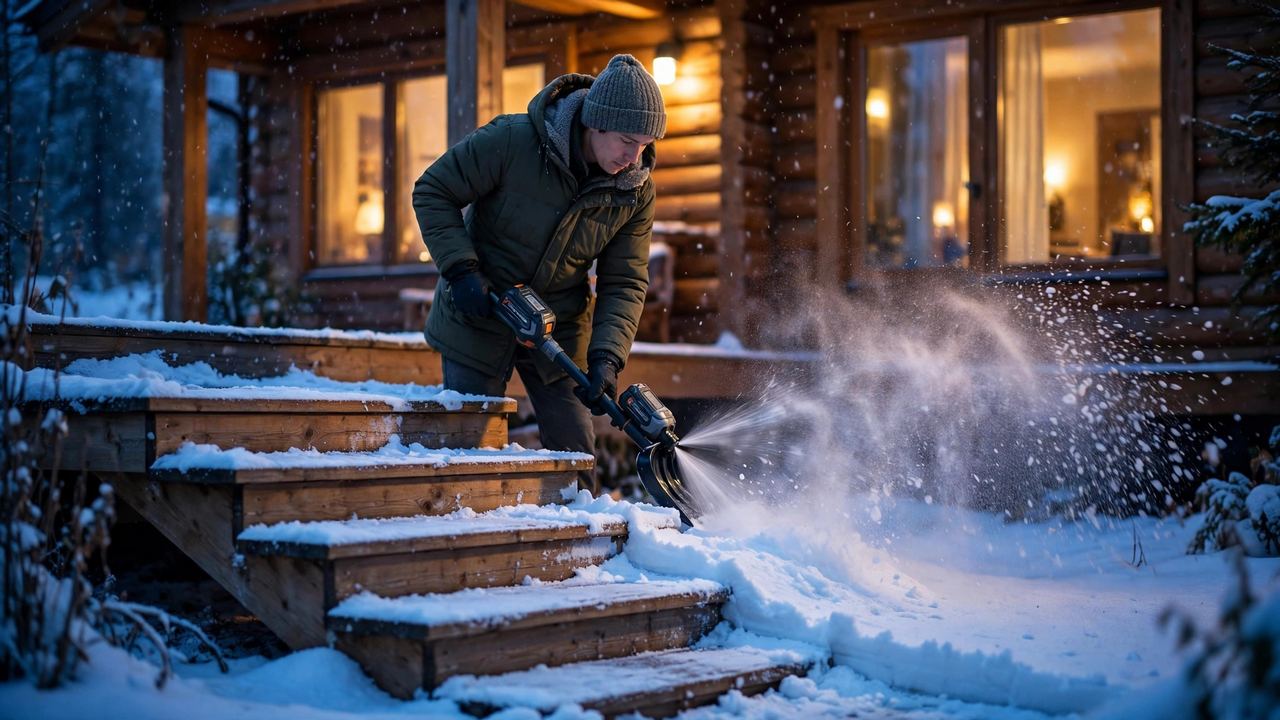
The maker lists the SNS1201 as a 12-inch cordless snow shovel that throws snow up to 25 feet, and the feature that separates it from the rest of this guide is how that throw is aimed. A 60-degree directional control dial lets you angle the discharge rather than accepting wherever a fixed forward throw lands, and on a deck that control is the difference between snow placed neatly over the railing line and snow piled against the house wall to be moved a second time. The maker specifically names sidewalks, driveways and decks for this model, and the 12-inch path suits a deck’s board runs and the landing at the top of a flight of steps, where a wider machine would constantly catch its edges.
Power comes from the included 56V 2.5Ah ARC Lithium battery, with a 210W charger in the box. The maker lists a high-efficiency brushless motor, a trigger with a two-speed selector so throwing distance can be controlled rather than simply maximised, and a clearing figure of up to a three-car driveway with 6 inches of snow on the included battery. Treat that driveway figure as the maker’s own benchmark for capacity; for deck and step work the practical translation is that short, stop-start clearing sessions sit well inside the battery’s listed capacity, and the two-speed trigger lets you run the lower setting on a dusting and save the higher setting for the drifted corner by the door.
Two construction details suit raised surfaces. The maker lists IPX4-rated weather-resistant construction, and a hinged shaft that folds for compact storage, which matters when the tool lives in a small deck box or a hall cupboard rather than a garage bay. The ergonomic handle design the maker describes is relevant on steps, where you work the machine in short pushes at arm’s length rather than walking behind it in a straight line. What the maker does not list is any special claim about snow type beyond the 6-inch depth figure, so plan on layered passes in deeper falls and on clearing while snow is fresh rather than after it has sat and consolidated.
Buy it if: you want the strongest combination of directional throw control, a listed deck use and a complete kit on a widely supported 56V platform.
Skip it if: your steps are unusually narrow and you would rather have the lighter, simpler Snow Joe, or you already own another brand’s batteries and want a shovel that shares them.
Snow Joe’s listing is the most explicit in this guide about the job at hand: the maker describes the 24V-SS13-TV1 as ideal for quick, cord-free snow pickups on decks, steps, patios and sidewalks. It is also the widest machine here, cutting a path the maker lists at 13 inches wide by 6 inches deep in a single pass. On a broad deck that extra inch shortens the job pass by pass; on steps it is still narrow enough to work one tread at a time, though on the narrowest treads the 12-inch models below leave a slightly tidier edge. The maker lists a 400W motor that moves up to 300 pounds of snow per minute, a two-blade high-impact, low-temperature paddle auger, and a throw of up to 20 feet, with a clearing capacity of up to 1,620 pounds of snow per charge as listed.
The kit is built around the maker’s 24V iON+ platform. The box, as listed, contains the shovel, a 24V 4.0Ah battery and a quick charger, and this TV1 bundle adds a protective cover and the IceDozer ice and snow scraper. The scraper is a thoughtful inclusion for steps in particular: a paddle shovel moves loose snow, and the bonded layer at the bottom of a tread is scraper work, so having the hand tool in the same box matches how the job is actually done. The listing gives an item weight of 16.4 pounds, which is the figure to plan around for carrying the machine up and down a flight; the dual-handle layout the maker describes helps keep that weight balanced in both hands.
The shorter listed throw, up to 20 feet against 25 feet for the EGO and WORX models, is rarely a limitation on a deck, where you are usually throwing a short distance over a rail or to one side of a path rather than across a driveway. It can matter on a long ground-level walk, where a short throw means the windrow builds closer to the cleared strip. The listing also notes a UL specification for the machine. As with the EGO, the maker lists a depth per pass of 6 inches and does not state a wet-snow capability, so deeper or older snow should be approached in layers rather than assumed to behave like fresh snow.
Buy it if: decks and steps are your main job, you want the widest cut in this guide, and the included cover and ice scraper appeal as a complete step-clearing kit.
Skip it if: you need the longest possible throw for a long walk or drive, or you want directional discharge control, which this fixed-throw design does not offer.
The SS40L412 is the current Greenworks 40V snow shovel kit, and its listing leads with the platform: the maker states the included 4.0Ah battery and charger are compatible with the full Greenworks 40V battery ecosystem, a range the maker puts at more than 75 tools. For a household that already runs a 40V mower, blower or trimmer, that compatibility is the main reason to choose this shovel, because the battery on the shelf in the garage becomes a spare for snow duty and the snow battery becomes a spare for everything else. The clearing width is listed at 12 inches, the standard step-and-deck size in this guide.
The maker lists a brushless motor, an LED light, directional chute control and an enclosed battery cover. Each of those details maps onto deck and step work in a specific way. Directional chute control lets you place snow to the side on a narrow walk between a wall and a rail. The LED light is genuinely useful at the times decks and steps most need clearing — early morning before a commute and evening after dark — when the light over the back door leaves the far end of the deck in shadow. The enclosed battery cover speaks to a machine that works in falling snow and gets set down on wet boards between passes.
The maker also publishes cold-weather guidance in the listing: for peak performance, batteries should be stored at room temperature, and a unit that will not start on a cold-soaked battery should be allowed to come back to room temperature before trying again. That advice applies across this whole guide in practice, but Greenworks states it for this model, so it is credited here. This listing does not publish a per-pass depth or throw figure in the material checked, and this guide does not borrow those numbers from the earlier SS40L410 version of the shovel; check the maker’s current listing for those two figures before buying if they are decisive for you. No wet-snow capability is stated for this model.
Buy it if: you already own Greenworks 40V tools, or you want an LED light and directional chute control in a 12-inch shovel on a very large battery platform.
Skip it if: you need a published depth and throw figure from the listing itself before you buy, or you own no 40V tools and would get more from the EGO or WORX kits.
The 80V Greenworks is the heavy lifter of this lineup, and its listing is written that way. The maker lists a 12-inch clearing width with an 8-inch clearing depth — the deepest single-pass figure in this guide — and names sidewalks, driveways, decks and patios as its working surfaces. That extra 2 inches of listed depth changes how a storm is handled on a deck: an overnight fall that would need two layered passes from the 6-inch machines can be within this shovel’s single-pass listing, provided the snow is cleared before it accumulates beyond the figure.
Uniquely in this guide, the maker’s listing for this model does state a snow-type capability: it describes the machine as designed to move heavy, wet or packed snow. That sentence is reported here exactly as the maker states it, for this model only, and it should not be read across to any other pick in this guide, including the 40V Greenworks above. The listing also describes a brushless motor on the maker’s 80V lithium-ion platform, an adjustable chute for controlling snow direction, an LED light and a directional vane control in the product title, and one 4.0Ah battery with a fast charger in the box.
The trade-offs follow from the voltage. An 80V platform is a bigger commitment than the 40V and 24V systems here, and the machine is built for owners who expect to use that platform’s other high-demand tools. The maker’s cold-start guidance in the listing is specific: if the unit does not start, remove the battery, let it warm indoors for ten minutes or more, then reinstall it. On steps, the same width discipline applies as everywhere else in this guide — 12 inches suits standard treads — and the adjustable direction earns its keep where snow must be placed off the side of a staircase rather than thrown down onto the treads below.
Buy it if: your snowfall regularly arrives deeper than 6 inches, you want the deepest listed cut and the one maker-stated heavy-snow capability in this guide, and an 80V platform suits your other tools.
Skip it if: your snow is usually light and shallow, where the simpler 24V and 40V kits clear the same decks and steps with less platform to buy into.
RYOBI’s listing names sidewalks, driveways and decks for this 12-inch shovel, and gives the core figures plainly: the maker lists a 12-inch path, snow 6 inches deep per pass, and a throw of up to 22 feet. The kit as listed contains the RY408110 snow shovel, one 40V 4.0Ah battery and a 40V charger, and the listing gives an item weight of 17 pounds. That places it in the middle of this guide for carrying up steps — heavier than the Snow Joe listing figure, comparable to the WORX — and its compact layout is designed, in the maker’s words, for easy storage when the job is done.
The distinctive feature is attachment capability. The maker lists this shovel as fitting most attachment-capable systems and working with RYOBI Expand-It attachments through a 180-degree lock and unlock coupler, so the same power head arrangement can run a blower, edger or pole saw in other seasons. For deck owners that matters less as a snow feature and more as a storage and value feature: one shaft system on the wall instead of several complete tools. The variable speed trigger is the snow-relevant control, and the maker frames its two ends honestly — more speed to power through piles of snow, or a gentler pace that extends runtime. On steps, the gentler end is the useful one, because short pushes at low speed place snow more precisely than full-power bursts.
The listed throw of up to 22 feet sits between the Snow Joe’s 20 feet and the 25-foot figures from EGO and WORX, which in practice separates these machines less than the numbers suggest on a deck, where throws are short. The maker states that all RYOBI 40V batteries work with this tool across a range of more than 75 40V tools, so existing RYOBI 40V owners gain the same spare-battery advantage as Greenworks owners do with the SS40L412. The maker does not state a wet-snow capability for this model, and its 6-inch listed depth should be treated as the working ceiling per pass.
Buy it if: you own or plan to own RYOBI 40V or Expand-It equipment and want one shaft system to cover snow and garden work alike.
Skip it if: attachment systems hold no appeal and you would rather have the EGO’s directional dial or the WORX’s three throwing directions for the snow job alone.
WORX aims the WG460 squarely at this guide’s surfaces: the maker describes it as clearing stairs, decks and patios, with a 12-inch wide and 6-inch deep path, and a throw of up to 25 feet. The control that suits stairs best is its three adjustable throwing directions. On a staircase, forward throw simply moves snow onto the next tread down; a shovel that can discharge to the side lets you work down the flight placing snow off the edge, and the WG460 is one of only two machines here with real direction control, alongside the EGO’s dial. The maker lists a two-speed variable trigger, so the lower speed can be used for that careful side placement and the higher speed for open deck runs.
The power arrangement is different from every other pick. The WG460 runs on two WORX 20V Power Share batteries together to deliver 40V, and the kit includes two 4.0Ah batteries and a charger. For the large number of households that already own WORX 20V drills, trimmers or blowers, those existing packs become spares, and the snow shovel’s packs join the household pool for the rest of the year. The maker lists a brushless motor, a clearing capacity of a two- to four-car driveway on a charge in its listing materials, an item weight of 17.21 pounds, and a handle that folds for storage — a practical detail for a tool that often lives in a porch or under a deck bench.
Because the machine needs both batteries seated to run as a 40V tool, keeping the pair together and charged together is part of ownership; a single 20V pack on its own is not a fallback. The maker lists snow placement up to 25 feet away as a safety benefit in its own materials, keeping cleared snow from creating new slip hazards beside the path, which is a fair framing for steps and deck edges. As with most of this guide, no wet-snow capability is stated by the maker for this model, and the 6-inch listed depth per pass is the figure to plan around.
Buy it if: you have stairs to clear and value side discharge, or your garage already runs on WORX 20V Power Share batteries.
Skip it if: you own no WORX batteries and prefer a single-battery design, or your steps are wide, open runs where the Snow Joe’s wider cut clears them faster.
Buying guide
Match the clearing width to the surface, not the driveway
The single most useful comparison in this guide is width against surface. On ground-level concrete or pavers, width is mostly about speed: a 13-inch Snow Joe finishes a walk in fewer passes than a 12-inch machine, and the difference is pleasant but not decisive. On a deck, width interacts with the boards themselves. Decks are cleared along the board runs, landings are small, and railings, posts and door thresholds interrupt every pass, so a 12-inch cut that turns cleanly in a confined space usually beats a wider cut that has to be wrestled around obstacles. On steps the logic tightens again: a standard tread is shallower than any of these machines is wide, so every shovel here is worked in short forward pushes across each tread, and the narrower, more controllable tools — and especially the ones with side discharge or a directional dial — place snow where you want it instead of pushing it down the flight.
Composite decking deserves a specific mention. Composite boards are a manufactured surface with a finished face, and wood decks have fasteners, board ends and grain that catch at edges. No maker in this guide publishes a separate composite-deck rating for its shovel, so this guide does not invent one. The practical reading of the maker listings is simpler: every pick here is a hand-guided paddle or auger shovel that its maker names for decks, steps or patios, or positions for exactly those small paved and boarded areas, and the correct technique on any finished surface is to keep the machine moving, work in shallow layers within the listed depth, and follow the maker’s own manual for the surface you own. If your deck manufacturer’s care guidance restricts powered tools, that guidance governs, whatever a shovel listing says.
Respect the listed depth, and take deep snow in layers
Five of the six makers here list 6 inches per pass and the Greenworks 80V lists 8 inches. That figure is the height of snow the intake is built to take in one go. Snow deeper than the listing is not a reason to force the machine; it is a reason to clear twice — once partway through a storm, or in two layers after it — because a pass taken in layers stays inside the maker’s specification, while a single forced pass through deep snow is exactly the use the specification warns against by existing. The same discipline applies at the bottom of a plough ridge or where snow has slid off a roof onto a deck: that snow is denser than the fall around it, and no maker here, except Greenworks for its 80V model as its listing states, claims a capability for heavy or packed snow. Work ridges down gradually with the edge of the shovel rather than ramming the full width into them.
Direction control is the deck-and-steps feature
Throwing distance gets the headline numbers — up to 20, 22 or 25 feet as listed — but on decks and steps, direction matters more than distance. A fixed forward throw is fine on an open walk and awkward almost everywhere else in this guide’s territory: it piles snow against walls, buries the next tread down, and fills the gap between deck and fence. The EGO SNS1201 answers with a 60-degree directional control dial, the WORX WG460 with three adjustable throwing directions, and both Greenworks models with chute or vane direction control as listed. If your clearing is mostly stairs and tight deck corners, put direction control at the top of your own shortlist; if it is mostly a straight ground-level path, a fixed throw costs you little.
Buy the battery platform, not just the shovel
Every pick here includes a battery and charger as listed, but the platforms differ in ways that outlast the first winter. The Snow Joe runs on a single 24V pack, the simplest and lightest arrangement. The Greenworks 40V, RYOBI 40V and EGO 56V systems each use one larger pack and each maker counts its platform at dozens of compatible tools. The WORX WG460 needs two 20V packs together for 40V, which is either a drawback or a bonus depending on how many WORX 20V batteries you already own. The Greenworks 80V is the highest-voltage commitment and makes most sense alongside other 80V tools. Two ownership rules apply across all of them, and both Greenworks listings state versions of them directly: store batteries at room temperature in cold weather, and let a cold-soaked battery warm indoors before expecting the machine to start. A second battery, bought within the same platform, is the single most effective upgrade for a large deck, because it turns a mid-job recharge into a ten-second swap.
Weight and storage decide whether you reach for it
A snow shovel for steps is a carried tool as much as a pushed one. The listing weights in this guide run from 16.4 pounds for the Snow Joe kit to 17 pounds for the RYOBI and 17.21 pounds for the WORX, and those figures are worth comparing against your own staircase before buying, because the machine travels up and down it on every outing. Folding and hinged shafts — listed for the EGO and the WORX — shrink the storage footprint, which matters for a tool that often lives in a porch, a deck box or a narrow utility cupboard. A cover, included in the Snow Joe bundle, keeps a stored machine clean in an open deck box. None of these details clears snow, but together they decide whether the shovel is the tool you grab without thinking, which is what a deck-and-steps machine needs to be.
FAQ
What clearing width is best for steps?
A 12- to 13-inch width covers the machines in this guide, and both sizes work on standard treads in short pushes. The 12-inch models are slightly easier to place precisely on narrow treads and landings, while the 13-inch Snow Joe clears open deck areas and wide steps in fewer passes. Choose by your narrowest regular surface: if a landing or gate strip is tight, favour 12 inches and direction control.
Can a cordless snow shovel damage a wood or composite deck?
The makers of the picks in this guide name decks among the intended surfaces for their models, as each listing states. No maker here publishes a separate composite-deck rating, so follow the shovel maker’s manual and your decking maker’s care guidance together: keep within the listed clearing depth, keep the machine moving rather than digging in one spot, and clear in layers. If your decking guidance restricts powered equipment, that restriction takes priority.
How deep a snowfall can these shovels handle?
Per pass, exactly what the maker lists: 6 inches for the EGO SNS1201, Snow Joe 24V-SS13-TV1, RYOBI RY408110VNM and WORX WG460, and 8 inches for the Greenworks 80V SS80L251CO. Deeper storms are handled by clearing in layers or partway through the storm, not by forcing a deeper single pass than the listing allows.
Do these shovels work on wet snow?
Only where the maker says so. The Greenworks 80V SS80L251CO listing states that the machine is designed to move heavy, wet or packed snow. The other makers in this guide do not state a wet-snow capability in their listings, so no such capability is claimed for them here; for those models, clearing fresh snow promptly, within the listed depth, is the use their specifications describe.
Is a kit or a bare tool the better buy?
All six picks in this guide are kits with a battery and charger included as listed, which is the right format for a first cordless shovel. A bare tool only saves money when you already own a compatible battery and charger from the same platform — the same models are often sold both ways, so check which format a listing describes before assuming a battery is in the box.
Can these shovels clear gravel or ground-level paths as well?
The makers here position these machines for decks, steps, patios, sidewalks and driveways as listed for each model — finished surfaces. Gravel is a different case: loose stone can be picked up and thrown by a paddle or auger, and makers’ manuals for this class of tool commonly exclude gravel surfaces. Treat these shovels as finished-surface tools and check the manual for your chosen model before using it on any loose surface.
Conclusion
Decks and steps reward a narrow cut, honest depth limits and control over where the snow lands, and the six machines in this guide divide those virtues cleanly. The EGO Power+ SNS1201 is the best all-round answer, with its 60-degree directional dial, two speeds and a complete 56V kit that its maker lists for decks. The Snow Joe 24V-SS13-TV1 is the most directly aimed at this job, with the widest cut, an explicit decks-and-steps listing and a scraper in the box. The WORX WG460’s three throwing directions make it the natural staircase pick for Power Share households, the Greenworks 40V SS40L412 serves the largest 40V platform with an LED light and enclosed battery cover, the Greenworks 80V SS80L251CO offers the deepest listed cut and the guide’s only maker-stated heavy-snow capability, and the RYOBI RY408110VNM adds Expand-It versatility to a sound 12-inch deck shovel. Match the width to your narrowest surface, respect the depth the maker lists, and any of these six will turn the worst clearing job in the yard into the quickest one.
M
Modern Line Home Editorial Team
We compare specs, materials and verified owner reviews before a product earns a spot. Rankings are never paid.
Affiliate disclosure. As an Amazon Associate we earn from qualifying purchases at no extra cost to you. Prices accurate as of the date shown.
House cold even with the heat on? Walk this ordered checklist: thermostat and filter first, then drafts, insulation, leaky ducts and a failing heating system.
Windows fogging up in winter? Check where the fog sits: on the room side it is indoor humidity, outside it is harmless, and between panes the seal has failed.
Store the main firewood pile about 30 feet from your house, off the ground and covered only on top. Compare racks, woodsheds, garages and indoor spots safely.
Place a portable generator outdoors only, at least 20 feet from windows, doors and vents, exhaust pointed away. Exact distances, setup steps and CO rules here.
Keep houseplants in the right winter spot: match window direction to plant type, stay clear of radiators and cold glass, and fix dry air and low light at home.
Mice enter through pencil-width gaps at foundations, pipes, vents, doors and the roofline. Walk this room-by-room winter checklist to find and seal each one.
A winter outage timeline: what to do in the first hour, first night and multi-day outage, with food safety times, pipe protection, heat and CO safety steps.
Size a space heater by room area: 10 watts per square foot at 8-foot ceilings, adjusted for insulation and ceiling height, with full wattage and BTU tables.
Start dripping at about 20 degrees, sooner for exposed pipes. Set a pencil-lead stream, drip the right faucets on both lines, and know when to stop safely.
A fridge needs 800-1,200 starting watts, not just 150-400 running watts. Use the tables to total your fridge plus freezer, lights, furnace fan and more today.












Write Your Review
No reviews yet. Be the first to share your experience!