We independently review everything we recommend. When you buy through our links, we may earn a commission. As an Amazon Associate we earn from qualifying purchases.
Best Crawl Space Dehumidifiers With Condensate Pumps
Compare the best crawl space dehumidifiers with condensate pumps by AHAM capacity, pump lift, coverage and cabinet size, with picks for tight and large spaces.
Compare the best crawl space dehumidifiers with condensate pumps by AHAM capacity, pump lift, coverage and cabinet size, with picks for tight and large spaces.
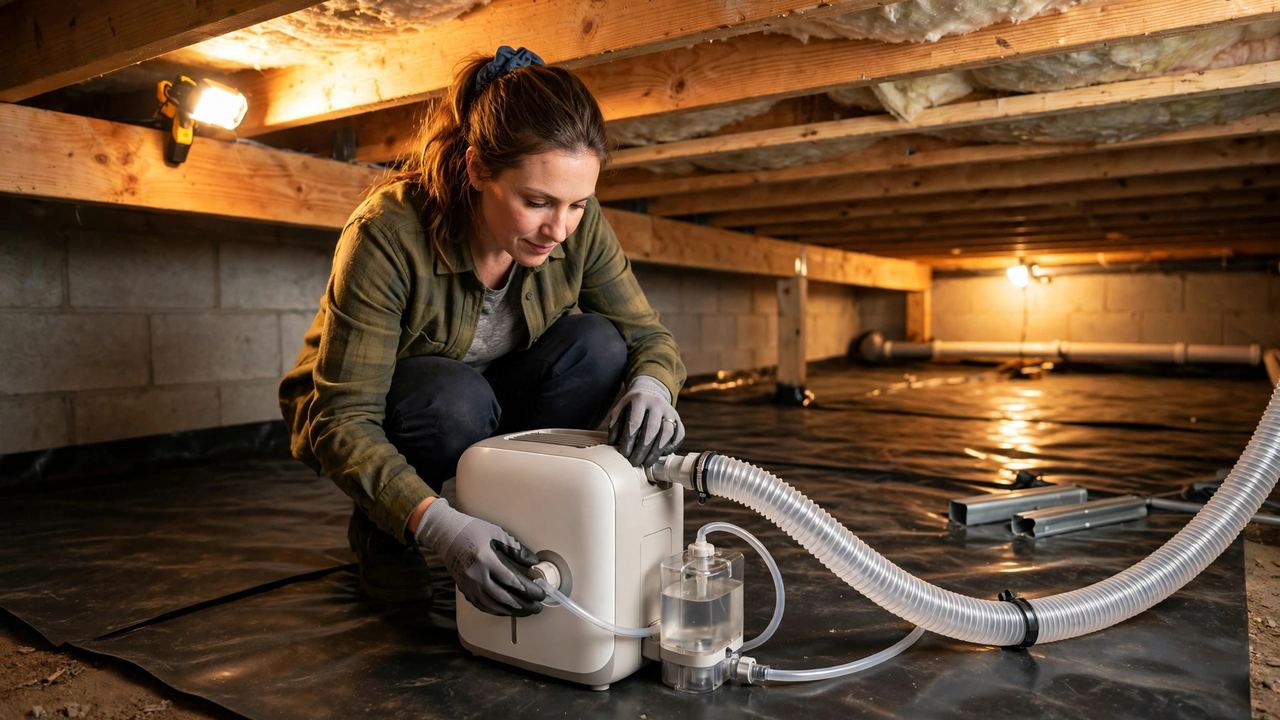
A crawl space is the one part of a house where a bucket-style dehumidifier makes almost no sense. Clearance is low, visits are rare, and the floor drain a gravity hose needs is often on the wrong side of the foundation, higher than the unit, or missing altogether. That is why the best crawl space dehumidifiers with condensate pumps are built the way they are: low horizontal cabinets, no tank to empty, and an internal pump that pushes condensate up and out to a sink, a sump, a standpipe or a discharge point outside the foundation wall. Set the humidity once, route the hose once, and the unit can run for a whole season without anyone crawling in to check a bucket.
The six models below are all purpose-built crawl space and basement units with a built-in condensate pump, sold new and verified on their product pages. They span a useful range: compact 35-pint AHAM units for sealed spaces of around 1,000 square feet, a mid-size 55-pint AHAM model for larger or wetter spaces, and two high-output machines for big, divided or chronically damp crawl spaces. Every capacity figure is given with the condition behind it, because a saturation number and an AHAM number describe the same machine in very different weather, and only one of them resembles a real crawl space.
Quick verdict
For most crawl spaces, start with the AlorAir Sentinel HD35P or the Moiswell Defender ME-7S. Both are rated by their makers at 35 pints per day under AHAM conditions and 70 pints at saturation for spaces up to 1,000 square feet, both carry a built-in pump, and both are small enough to pass through a typical access hatch. The HD35P lifts water the farthest, at up to 19.6 feet as the maker lists, and runs quietly on paper; the ME-7S counters with Energy Star certification and a clear status display that shows whether the pump is working.
Step up to the Abestorm Guardian SNS65S when the space is bigger or wetter: the maker lists 55 pints per day under AHAM conditions and up to 120 pints at saturation for up to 1,300 square feet, with the same 19.6-foot pump lift. The Abestorm Guardian SN35P matches the smaller units on capacity while adding a choice of gravity or pump drainage in a particularly compact cabinet. At the top end, the Waykar AFW2.0DPM-NS3 is the high-airflow option for very large or open under-house areas, and the AlorAir Galaxy 85P pairs the highest standard-condition capacity in this group with the lowest cabinet height, which matters more than almost anything else in a shallow crawl space.
The products in this guide
AlorAir Sentinel HD35P Crawl Space Dehumidifier
The Sentinel HD35P is the balanced default for a typical sealed or semi-sealed crawl space
Best when your crawl space is up to about 1,000 square feet
Read the capacity column carefully. AHAM figures are measured at 80 degrees F and 60 percent relative humidity, which is far closer to a real crawl space than the hot, near-saturated conditions behind the biggest headline numbers. A unit rated at 35 pints under AHAM conditions and 70 at saturation is not two different machines; it is one machine described honestly and optimistically. Where a maker only publishes a hot-condition figure, as with the Waykar below, treat the coverage claim as a best case for warm, very wet air rather than a promise for a cool spring crawl space.
How we selected
Every pick had to meet the same gate. First, it had to be a genuine crawl space design: a low, horizontal, tank-free cabinet made to live under a house, not a tall residential tower that happens to have a pump. Second, the condensate pump had to be built in or included with the unit, not an accessory to hunt down separately, because the whole point of this category is drainage that works when the outlet sits above the machine. Third, the model had to be sold new with a live offer on its product page at the time of checking; listings showing no available offer were excluded and replaced.
Fourth, the specifications had to be verifiable on an opened product page, including the exact model number in the product details. Where a listing family covers several variants, only the variant whose own page confirms the model, the pump and the capacity is included here. Specs are phrased as the maker lists them throughout, and where a maker gives two capacity figures, both are shown with their test conditions. Units that drain by gravity only, however good they are otherwise, were left out, as were models whose pump turned out to be an optional kit rather than part of the machine.
Finally, the six were chosen to cover different jobs rather than to repeat one job six times: two compact all-rounders, one compact unit with dual drainage, one mid-size step-up, one high-airflow machine for very large areas, and one high-capacity, low-height unit for shallow but serious crawl spaces. If your space is small and sealed, the top of the list is where to look; if it is large, divided or wet, read toward the bottom.
The Sentinel HD35P is the balanced default for a typical sealed or semi-sealed crawl space. The maker lists removal of 35 pints per day at AHAM conditions and 70 pints at saturation, for spaces up to 1,000 square feet, which is honest sizing for a single-family crawl space that is damp rather than flooded. Its built-in condensate pump is the headline feature here: the maker lists a vertical lift of up to 19.6 feet and includes a drain hose of the same length, so condensate can be pushed up through the rim joist, across to a sump or laundry drain, or out to a discharge point well away from the foundation, and the unit also supports plain gravity drainage when a low outlet happens to exist.
The cabinet is one of the smallest in this group, listed at 15.2 by 11.2 by 11.4 inches and 38.2 pounds, so it passes through modest access hatches and sits level on a pad or blocks without drama. The maker lists noise at less than 50 dB, which matters when the unit sits under a bedroom. A washable MERV-1 filter protects the coils from crawl space dust, automatic defrost supports the low-temperature operation these spaces demand in spring and autumn, and auto restart with memory returns the machine to its set humidity after a power cut, which is exactly the behaviour you want from equipment nobody visits. The maker lists ETL certification and a 6-year limited warranty with the first 2 years as full coverage.
Buy it if your crawl space is up to about 1,000 square feet, your drain point sits above or well away from the unit, and you want the strongest pump lift in a compact, quiet cabinet.
Skip it if your space is much larger than its rated coverage or stays wet enough that a 35-pint AHAM rating would run continuously without holding humidity down; step up to the SNS65S or Galaxy 85P instead.
The Defender ME-7S matches the HD35P on the numbers that matter most and differs in the details. The maker lists up to 70 pints per day at saturation and 35 pints per day under AHAM conditions, coverage of up to 1,000 square feet, and airflow of 120 CFM. Its built-in pump lifts water vertically up to 16.4 feet as the maker lists, a little less than the AlorAir pair above and below it in this list, but still far more than the few feet most crawl space installations actually need to reach a rim-joist exit or a raised drain.
Where the ME-7S stands out is efficiency and feedback. The maker lists Energy Star certification, which suits a machine that may run for months at a time under a house. The control panel has a large display that shows the operating status, including whether the unit is dehumidifying, defrosting or running its pump, so a quick look during a seasonal visit tells you the drainage is actually working rather than silently failed. A 24-hour timer, automatic defrost and a metal housing round out the specification. At 39.5 pounds with two carrying handles, and listed at 13 by 15 by 12 inches, it is easy to get through the hatch and into position, though its footprint is a little wider and shorter than the HD35P rather than smaller overall.
Buy it if you want Energy Star efficiency, a status display that confirms pump operation at a glance, and proven compact capacity for a space up to about 1,000 square feet.
Skip it if your discharge point is unusually high or distant and you need the full 19.6-foot lift the AlorAir and Abestorm models list, or if your crawl space is larger than its rated coverage.
The Guardian SN35P covers the same ground as the two units above, with a specification built around drainage choice. The maker lists a 70-pint headline capacity with 35 pints per day in the product details, coverage of up to 1,000 square feet, and airflow of 130 CFM. You can drain it by gravity into a floor drain when one is available, or let the built-in condensate pump do the work, with a lift distance of 19.6 feet as the maker lists. That dual arrangement is genuinely useful in crawl spaces that are being improved in stages: run the pump now, and the gravity port is still there if a drain is added during later encapsulation work.
The cabinet is the most compact here, listed at 15.2 by 11.4 by 11.2 inches and 38.2 pounds, which makes the SN35P a sensible pick for the lowest access openings. The maker lists an advanced automatic defrost system that pauses the compressor while the fan thaws the coil, automatic stop when the set humidity is reached, automatic restart when humidity rises again, and memory starting after a power interruption. The maker lists a 5-year limited warranty with lifetime access to technical support. Nothing in the specification is exotic, and that is the point: this is a straightforward, small, pump-equipped machine for a small space, with both drainage routes open.
Buy it if clearance and hatch size are your tightest constraints, or you want the option to switch between gravity and pumped drainage as your crawl space setup changes.
Skip it if you need the higher standard-condition capacity of the SNS65S or Galaxy 85P, or Energy Star certification, which the maker does not list for this model in the sources checked.
The Guardian SNS65S is the step-up pick for crawl spaces that are larger, less tightly sealed or simply wetter. The maker lists up to 120 pints per day at saturation and 55 pints per day under AHAM conditions, for coverage of up to 1,300 square feet. That AHAM figure is the one to plan around, and it gives this unit real headroom over the 35-pint class: in a damp 1,200-square-foot crawl space, headroom is the difference between a machine that cycles and one that runs flat out while humidity creeps up after every rain.
Drainage matches the smaller Abestorm: a built-in condensate pump that the maker lists as lifting water up to 19.6 feet, plus gravity drainage through a hose for continuous operation when a low outlet exists. The maker lists Energy Star certification for this model, a washable MERV-1 filter, automatic defrost with sensors that monitor ambient temperature, and a heavy-duty metal housing. Optional accessories the maker lists include a remote control and a hanging kit, the latter worth considering where floor space is uneven or where suspending the unit keeps it clear of occasional shallow water. The cabinet is listed at 19.2 by 12.2 by 13.3 inches and 41.7 pounds, bigger than the 35-pint units but still a low horizontal profile. The maker lists a 5-year limited warranty.
Buy it if your crawl space runs to roughly 1,300 square feet, is only moderately sealed, or has a moisture load that would keep a 35-pint AHAM unit running without rest.
Skip it if your space is small and well sealed, where its extra capacity buys little, or if your clearance is under its listed height once pads or blocks are added underneath.
The Waykar AFW2.0DPM-NS3 is the outlier in this group, aimed at very large, open under-house and basement areas rather than a typical single crawl space. The maker lists extraction of up to 125 pints per day at 95 degrees F and 90 percent relative humidity, coverage of up to 6,500 square feet, and circulation of up to 177 CFM. Note the test condition: that capacity is quoted in hot, near-saturated air, not at AHAM conditions, so expect substantially less removal in a cool crawl space and treat the coverage figure as a warm-climate best case. Even discounted for conditions, the airflow and cabinet size suit big, interconnected spaces where smaller units cannot move enough air to the machine.
Drainage is well specified. The maker lists a 16.4-foot pump drainage hose with vertical drainage up to 16.4 feet, and a separate 6.6-foot gravity hose for downward drainage, so the built-in pump handles the usual up-and-out route while gravity remains available. The maker lists a rotary compressor, a high-strength metal casing, a touchscreen control panel, adjustable feet, and hooks and handles for positioning, with an optional remote control sold separately for adjusting settings without entering the space. The cabinet is listed at 19.29 by 12.6 by 13.58 inches and 49.8 pounds, the heaviest here, which is worth planning for at the hatch. The listing carries 5-year quality coverage in its title, as the maker presents it.
Buy it if you are drying a very large, open basement or combined crawl space area in a warm, humid climate and need maximum airflow with a properly specified pump hose in the box.
Skip it if your crawl space is a typical cool, sealed residential space, where its hot-condition ratings flatter it and a 35- to 55-pint AHAM-rated unit will hold humidity with less bulk to move.
The Galaxy 85P pairs the strongest standard capacity in this roundup with the shallowest cabinet. The maker lists a dehumidification capacity of 85 pints per day in its product details and up to 180 pints per day at saturation, for spaces up to 2,300 square feet. That makes it the pick for large crawl spaces, divided spaces served from one central machine, and homes where the crawl space shares its moisture load with a basement. Just as important is the shape: the listing gives dimensions of 21.3 by 14.1 by 11.7 inches, so the unit is long and wide but under a foot tall, a profile that fits shallow spaces the taller mid-size units cannot enter.
The built-in pump and included drain hose handle continuous discharge, and the maker lists automatic defrost, low-temperature operation and memory start, so the machine resumes its settings after an outage. An ergonomic handle helps with positioning, which matters in a space where you are moving on your elbows. The maker lists ETL certification and a 6-year limited warranty with the first 2 years as full coverage, matching the cover on the smaller Sentinel in this list. One caution from the listing itself: unlike its stablemates, the Galaxy listing does not state a pump lift figure in the sources checked, so if your discharge route needs a long vertical rise, confirm the lift with the maker before relying on it, or choose the HD35P or SNS65S, which publish theirs.
Buy it if your crawl space is large or chronically wet but shallow, and you need high capacity in the lowest cabinet here, with pumped drainage and long warranty cover.
Skip it if your installation depends on a published pump lift figure, or your space is small enough that an 85-pint class machine would short-cycle; the compact 35-pint units will hold a steadier humidity.
Buying guide
Size by AHAM capacity, not by the biggest number on the box
Crawl space dehumidifiers are sold with two or three capacity figures, and the largest is always the least useful. Saturation ratings are measured in hot, extremely humid air that a crawl space almost never reaches. AHAM ratings, measured at 80 degrees F and 60 percent relative humidity, are the planning number, and in a cool space even they are optimistic. As a working rule from the makers’ own coverage claims: a 35-pint AHAM unit suits a sealed space up to about 1,000 square feet, a 55-pint AHAM unit stretches to about 1,300 square feet or a wetter 1,000, and an 85-pint class unit covers large or divided spaces up to about 2,300 square feet. A space that is unsealed, has exposed earth without a vapour barrier, or takes on water after rain behaves like a bigger space than it measures, so size up rather than down.
Plan the pump route before you choose the unit
The pump is only as good as its route. Measure the vertical rise from the unit to the highest point of the discharge line, then the total run, and compare both with the lift and hose length the maker lists. Most residential installations need only a few feet of lift to clear the foundation wall or reach a sump, which every unit here can do; the long-lift models earn their keep when the only available drain is a raised laundry sink or a standpipe across the house. Keep the hose run as short and smooth as you can, avoid sags where water can sit, and make sure the discharge end cannot freeze, back up or drain against the foundation you just dried out. Where the maker lists both pump and gravity drainage, gravity is the simpler long-term route whenever a genuinely lower outlet exists, because it has no moving parts.
Measure the hatch, the clearance and the turning space
More crawl space purchases fail on geometry than on capacity. Measure the access opening, the clear height where the unit will sit, and the path between them, then compare all three with the cabinet dimensions in the table, remembering to allow for the pad, blocks or hanging kit underneath. Height is the dimension that bites: the models here range from about 11.2 to about 13.6 inches tall before any mounting, and a unit that fits the space but not the hatch fits nothing. Weight matters on the same trip; at roughly 38 to 50 pounds, every unit here is a two-hand carry through a low opening, so plan the visit with help rather than alone.
Look for the unattended-operation features
A crawl space dehumidifier earns its keep while nobody watches it, so the supporting features are not decoration. Automatic defrost keeps the coil clear in the cool conditions where crawl spaces spend much of the year. Auto restart with memory returns the unit to its setpoint after a power cut instead of sitting idle until the next visit. A washable filter protects the coils from dust and is the one maintenance item you will actually service, so check that it slides out without tools. A remote control or remote sensor, offered as an option on several models here, lets you read and adjust humidity from the living space, which turns a quarterly crawl into a glance at a display. Finally, compare warranty structure rather than just length: several makers here list a long limited warranty with a shorter full-coverage period, and that first period is the one that decides what an early failure costs you.
Set expectations for humidity and drainage checks
Install the unit level, on a pad or blocks that keep it clear of any shallow standing water, with clear space around its intake and outlet so it is not breathing its own exhaust. Set a target humidity in the range your encapsulation installer or local practice recommends, then check the space after the first week and again after the first heavy rain: confirm the pump is cycling, the hose is clear, and humidity is trending down rather than holding at the setpoint with the machine running constantly, which is the sign of an undersized unit or an unsealed moisture source. After that, a filter clean and a drainage check a few times a year is the whole maintenance burden, which is precisely why a pumped, tank-free machine suits this space better than any bucket design.
FAQ
Why does a crawl space dehumidifier need a condensate pump?
Because crawl spaces rarely offer a drain below the unit. A gravity hose only works when the outlet is lower than the machine along the whole run, and in most crawl spaces the available exits, a sump, a sink, a standpipe or a point outside the foundation wall, sit above the unit. A built-in condensate pump pushes the water up and out regardless, so the dehumidifier can drain continuously instead of filling a tank nobody is there to empty.
How much pump lift do I actually need?
Measure from the unit to the highest point of your discharge route and add a margin. For most homes that is the height of the foundation wall plus a little, well within the 16.4- to 19.6-foot lifts the makers list for most models here. Long horizontal runs add resistance even without much rise, so if your drain is far away rather than high, favour a model that publishes both its lift and its hose length, and keep the run as short as the layout allows.
What capacity do I need for a 1,000-square-foot crawl space?
For a sealed 1,000-square-foot space, the makers of the 35-pint AHAM models here rate their units for exactly that area. If the space is unsealed, has exposed soil without a vapour barrier, or stays wet after rain, treat it as a heavier load and step up to a 55-pint AHAM unit such as the Guardian SNS65S, because an undersized machine runs constantly and still loses ground in wet weather.
Can these units run in a cold crawl space?
They are designed for cooler operation than room dehumidifiers, and every model here lists automatic defrost, which pauses the compressor while the fan clears frost from the coil. Capacity still falls as temperature drops, which is another reason to size by the AHAM figure and to favour headroom if your crawl space sits near the bottom of its operating range for much of the year.
Do I still need a vapour barrier with a crawl space dehumidifier?
Yes. A dehumidifier removes moisture from the air, but ground moisture evaporating through exposed soil is a continuous load that raises running time and can overwhelm a correctly sized unit. A sealed vapour barrier over the ground, with the vents closed on a sealed crawl space, cuts that load at the source and lets the machine hold its setpoint with normal cycling instead of constant running.
How often does a pumped crawl space dehumidifier need attention?
Very little, which is the point of the format. There is no tank to empty. Plan to clean or check the washable filter and confirm the pump and hose are clear a few times a year, and to glance at the humidity reading after heavy rain or a power cut. Models with a status display or an optional remote sensor make those checks possible without entering the space every time.
Conclusion
The right pumped crawl space dehumidifier is the one whose AHAM capacity matches your moisture load, whose pump lift covers your discharge route with room to spare, and whose cabinet actually fits through your hatch and under your joists. For most homes that is the AlorAir Sentinel HD35P, with the Moiswell Defender ME-7S as the efficiency-minded alternative and the Abestorm Guardian SN35P where drainage flexibility or the smallest cabinet matters most. Wetter or larger spaces belong to the Abestorm Guardian SNS65S, very large warm areas to the Waykar AFW2.0DPM-NS3, and large but shallow spaces to the AlorAir Galaxy 85P. Measure the space, plan the hose route, size by the honest capacity figure, and any of these six will do the quiet, unvisited work a crawl space demands.
M
Modern Line Home Editorial Team
We compare specs, materials and verified owner reviews before a product earns a spot. Rankings are never paid.
Affiliate disclosure. As an Amazon Associate we earn from qualifying purchases at no extra cost to you. Prices accurate as of the date shown.
House cold even with the heat on? Walk this ordered checklist: thermostat and filter first, then drafts, insulation, leaky ducts and a failing heating system.
Windows fogging up in winter? Check where the fog sits: on the room side it is indoor humidity, outside it is harmless, and between panes the seal has failed.
Store the main firewood pile about 30 feet from your house, off the ground and covered only on top. Compare racks, woodsheds, garages and indoor spots safely.
Place a portable generator outdoors only, at least 20 feet from windows, doors and vents, exhaust pointed away. Exact distances, setup steps and CO rules here.
Keep houseplants in the right winter spot: match window direction to plant type, stay clear of radiators and cold glass, and fix dry air and low light at home.
Mice enter through pencil-width gaps at foundations, pipes, vents, doors and the roofline. Walk this room-by-room winter checklist to find and seal each one.
A winter outage timeline: what to do in the first hour, first night and multi-day outage, with food safety times, pipe protection, heat and CO safety steps.
Size a space heater by room area: 10 watts per square foot at 8-foot ceilings, adjusted for insulation and ceiling height, with full wattage and BTU tables.
Start dripping at about 20 degrees, sooner for exposed pipes. Set a pencil-lead stream, drip the right faucets on both lines, and know when to stop safely.
A fridge needs 800-1,200 starting watts, not just 150-400 running watts. Use the tables to total your fridge plus freezer, lights, furnace fan and more today.












Write Your Review
No reviews yet. Be the first to share your experience!