We independently review everything we recommend. When you buy through our links, we may earn a commission. As an Amazon Associate we earn from qualifying purchases.
Best Laundry Hampers With Shelves for Small Laundry Rooms
Compare the best laundry hampers with shelves for small laundry rooms: single-bag shelf units and three-bag sorters, with footprints, capacities, bag details.
Compare the best laundry hampers with shelves for small laundry rooms: single-bag shelf units and three-bag sorters, with footprints, capacities, bag details.
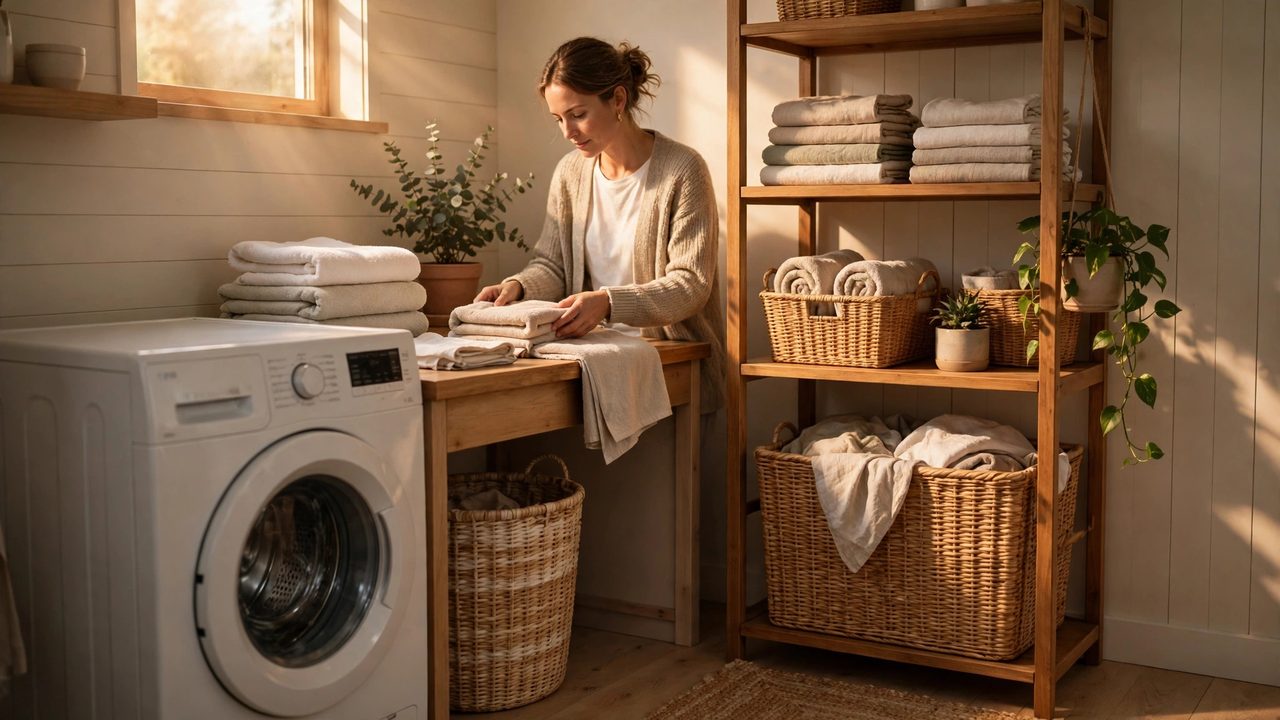
A small laundry room punishes every wasted inch. The washer and dryer take the wall, the sink takes the corner, and what is left is usually a narrow strip of floor where a plain hamper, a detergent bottle, a stain stick, and a pile of folded towels all compete for the same few square feet. That is exactly the problem a combined hamper-and-shelf unit solves: the dirty clothes drop into bags below, and the supplies you reach for on every wash day sit on a shelf directly above them, inside the same footprint. If you are shopping for the best laundry hampers with shelves for small laundry rooms, the real question is not which unit holds the most in absolute terms. It is which unit holds enough for your household while staying shallow enough to leave you room to open the washer door, turn around with a full basket, and close the laundry room door without shoving anything aside.
This guide compares six hamper-and-shelf units that genuinely fit that brief. The smallest is a single-bag unit under twenty inches long, made for one person and one narrow gap beside the machines. The largest are three-bag sorters on wheels, made for households that sort as they go and have a longer, if still shallow, stretch of wall. In between sit the two-bag units that suit most couples and small families: one bag for lights, one for darks, and a shelf on top for detergent, softener, and the small bottles that otherwise migrate to the top of the dryer and vibrate off it. Every pick below combines at least one laundry bag with at least one shelf in a single frame, every pick is thirteen inches deep or close to it in most cases, and every specification quoted is phrased as the maker lists it, so you can check the same figures on the listing before you buy.
Read the footprint figures first and the capacity figures second. In a small room, a hamper that is two inches too deep is a daily annoyance, while a hamper that holds one load less than you hoped is a minor scheduling change. Measure your available strip of floor, including the swing of the washer door and any baseboard or trim, then match that measurement against the dimensions in the comparison table. After that, think about how you sort, how often you wash, and whether you carry laundry to machines in another room, because those habits decide whether you want fixed bags, pull-out bags, wheels, or a single deep bag you empty in one trip.
Quick verdict
For the smallest rooms and single-person households, the VASAGLE single-bag shelf hamper, model UBLH101B01, is the easiest recommendation in this guide. The maker lists it at 19.7 inches long by 13 inches wide by 28.4 inches high, with a 17.2-gallon bag and a slatted shelf above it, which is a complete laundry station in a footprint smaller than most standalone hampers. For most couples, the two-bag version of the same family, the VASAGLE UBLH201B01, is the balanced pick: two 12.2-gallon pull-out bags for lights and darks, the same slatted shelf, and a shelf load figure the maker lists at up to 44 pounds, all in a frame about thirteen inches deep. The Kitstorack organizer runs it close, with two pull-out bags and the shallowest depth here at about twelve inches, which can be the deciding factor in the tightest rooms.
If your household sorts into three streams, skip the two-bag units and go straight to the three-section picks. The Herture three-section hamper adds a top partition shelf and movable wheels to three large, differently colored bags, so sorting by color is visible at a glance. The SwaaVee sorter pairs three 11.4-gallon bags with a wooden top shelf protected by guard rails, which matters if the shelf will hold bottles that must not slide off when the cart moves. The LAATOOREE two-bag unit is the style pick of the group: its top shelf is a two-color panel, rustic brown on one side and black on the other, so the same unit can match two different room schemes without buying anything else. None of these units needs a wide room. All of them need an honest measurement, a realistic idea of your weekly laundry volume, and a shelf habit: if you will not actually store supplies on the shelf, a simpler hamper may serve you better, but if you will, the shelf quickly becomes the most-used surface in the room.
Two patterns in the table are worth noticing before you read the individual reviews. First, depth barely changes across the group: most of these units sit between twelve and thirteen inches deep, because they are designed to stand against a wall in a room where depth is the scarce dimension. Length and height are where the capacity comes from, so a longer unit is not automatically a worse fit for a small room, provided your wall run is long enough and the extra length does not block a door, a sink cabinet, or the path to the machines. Second, the shelf is not a decorative extra on any of these units. On the slatted VASAGLE shelves the maker describes airflow through the slats as a way to help keep laundry odor down, on the SwaaVee the guard rails keep bottles in place on a moving cart, and on the LAATOOREE the shelf doubles as a small tabletop for towels and toiletries. Treat the shelf as working storage when you compare, and count what you will put on it: a family-size detergent bottle, a softener bottle, a stain treatment, and a folded hand towel is a realistic load, and it is worth checking the shelf load figure and the shelf surface size against that group of items.
How we selected
Selection started with the keyword itself: a pick had to be a laundry hamper with a shelf, meaning bags and shelving combined in one unit, sold for laundry room use. Standalone hampers without shelves, wall shelves without hampers, and over-door racks were all excluded, however good they might be on their own, because they do not solve the combined problem this guide is about. Each remaining candidate then had to fit a small room, which in practice meant a depth in the region of twelve to sixteen inches and a design intended to stand flat against a wall or roll along it. Wide laundry carts built for large utility rooms, and sorters whose depth would block a standard doorway swing, were set aside.
Each pick was then verified on its opened Amazon listing, reading the full product details rather than a search snippet: the exact model number, the dimensions, the capacity, the materials, and the shelf description all come from that opened page, and the specifications in this article are phrased as the maker lists them for that reason. Availability was checked on the same opened page: a pick had to show a live featured offer sold new. Listings that rendered as unavailable, or that offered no featured offer, were excluded and replaced, even when the product itself looked ideal on paper. That gate removed a two-section hamper with a shelf whose opened page did not present a clear live offer, and it is why some well-known sorter names you may expect are not here: if the opened page did not confirm a new offer at the time of checking, the product did not make the list.
Finally, the six picks were spread across the realistic range of small-room needs rather than clustered at one size. There is a single-bag unit for one-person households, three two-bag units with different strengths in depth, capacity, and shelf design, and two three-bag units for households that sort more finely. If a category of small-room buyer cannot find a plausible fit among the six, the selection has failed, so tell the truth about your own habits when you use it: the best pick here is the one whose bag count matches how you actually sort, whose footprint matches the floor you actually have, and whose shelf matches the supplies you actually keep. Anything else is a compromise you will notice every wash day.
Buy it if: you wash for one person, or for two people who wash little and often, and your available floor space is a single narrow gap beside the machines or between the sink and the wall. This is the pick for studio flats, small rental laundry closets, and anyone whose current hamper already has to be moved before the washer door will open.
Skip it if: you sort laundry into separate loads as you go, or you wash for a family. One bag means sorting happens at the machine on wash day, and a 17.2-gallon bag fills quickly with towels and bedding in a multi-person household.
The maker lists this single-bag unit at 19.7 inches long by 13 inches wide by 28.4 inches high, and describes it directly as a design that takes up minimal floor space while offering storage with a shelf. That combination is rarer than it sounds: most hampers this narrow are plain fabric bins with no shelf at all, so detergent ends up on the floor or on the dryer. Here the shelf sits directly above the bag, and the maker lists the shelf with a slatted design that allows air to flow through, which the listing presents as a way to help minimize unwanted odors from the laundry below. In a small, often closed laundry room, that airflow detail matters more than it would in a large ventilated utility space, because the hamper is usually within a few feet of the door you close between washes.
The bag itself pulls out and lifts away: the maker lists each liner with a plastic bottom panel to prevent sagging, attached with a hook-and-loop fastener so you can pull the liner out and carry it to the laundry room, or to the machines if the unit stands in a bedroom or bathroom. The unit weighs 10.4 pounds as listed, light enough to shift for cleaning behind it, which is a genuine consideration in small rooms where dust and lost socks collect in the gap behind any fixed furniture. The frame and shelf follow the same construction as the rest of this VASAGLE family, a steel frame with an MDF panel shelf, finished here in ink black and rustic brown, a combination that reads as furniture rather than laundry equipment if the unit has to stand in a visible spot.
Capacity: the maker lists 17.2 gallons (65 L) in a single bag
Product size: the maker lists 19.7 x 13 x 28.4 inches
Materials: the maker lists MDF, steel, and Oxford fabric for this hamper family
Bag: pull-out and removable liner with a plastic bottom panel, as the maker lists
Shelf: slatted top shelf for detergent or toiletries, as the maker lists
Item weight: the maker lists 10.4 pounds
Pros
Smallest footprint in this guide, under twenty inches long
Shelf included despite the compact size, so supplies stay off the floor
Pull-out liner with a bottom panel keeps the bag from sagging when full
Light enough to move for cleaning behind and under the unit
Cons
Single bag means no sorting until wash day
Capacity suits one or two light washers, not family laundry volume
Shelf space is sized for a few bottles, not bulk storage
Buy it if: you are a couple or a small household that sorts into lights and darks, washes two or three times a week, and wants the shelf to double as the room’s detergent station. This is the balanced default pick of the guide, and the one to choose if you do not have a specific reason to choose another.
Skip it if: your room cannot spare roughly twenty-nine inches of wall length, or you need three sorting streams. In the first case the single-bag model above fits better; in the second, look at the three-section picks below.
The maker lists a total volume of 24.4 gallons across the two bags, at 12.2 gallons per bag, which maps neatly onto how most couples actually wash: one bag fills with dark everyday clothes while the other takes whites, towels, and bedding, and each bag is roughly a machine load when full. The upper shelf is the same slatted design as the single-bag model, which the maker describes as an additional area for organizing or displaying items, with the slats allowing optimal airflow to help minimize odors. The frame is where this model earns its place: the maker lists a 0.8-inch thick steel frame and MDF panel, with the shelf supporting up to 44 pounds. That figure matters because the shelf on a unit like this tends to accumulate weight quietly, a large detergent container, a refill bottle, a jar of pods, a small plant if the room has light, and a shelf that is only rated for light decorative loads will bow or wobble long before the bags wear out.
The bags pull out on their frame and lift off their hook-and-loop fasteners for carrying or washing, and the maker lists each bag as supported by a plastic panel at the bottom to prevent sagging, with the Oxford fabric bags described as water-resistant and washable. Two anti-tip kits are listed in the package contents for this hamper family, along with adjustable feet, which is a thoughtful inclusion for a tall, narrow unit in a room where it may be bumped by a swinging washer door or a carried basket. At 28.8 inches long by 13 inches wide by 28.4 inches high as the maker lists, it fits the standard small-room pattern: long enough to be useful, shallow enough to stand against the wall without narrowing the working space in front of the machines.
Capacity: the maker lists 24.4 gallons total, 12.2 gallons per bag
Product size: the maker lists 28.8 x 13 x 28.4 inches
Materials: the maker lists MDF, steel, and Oxford fabric
Shelf load: the maker lists up to 44 pounds on the shelf
Bags: pull-out and removable, washable, with bottom panels, as the maker lists
Included: the maker lists anti-tip kits and adjustable feet in the package contents
Pros
Two-bag sorting that matches a standard lights and darks routine
Shelf load figure is stated and generous for detergent storage
Slatted shelf design supports airflow over the bags below
Anti-tip kits included, suited to a tall narrow frame
Cons
Needs about twenty-nine inches of clear wall length
Two bags will not cover a three-stream sorting habit
Fixed position design, with no wheels for moving a full unit
Buy it if: depth is your binding constraint. At about twelve inches deep as listed, this is the shallowest unit in the guide, and in a room where the door swing, the washer door, and your own working space all compete, that saved inch is the difference between a unit that disappears against the wall and one you sidestep all year.
Skip it if: you want the largest two-bag capacity or a stated shelf load figure to plan heavy storage around. The LAATOOREE below lists a larger total capacity, and the VASAGLE above publishes the clearer shelf rating.
The Kitstorack organizer pairs two pull-out removable bags with a top shelf in a frame the maker lists at 28 inches long by 12 inches wide by 27 inches high. The listing describes the pull-out design plainly: the bags slide out for access and lift away for carrying, with steady handles on each side of the bags so a full bag can be brought to the washing machine without dragging the whole unit or gathering an armful of loose clothes. The maker presents the two bags as a way to store bedding and clothes separately, or to sort laundry by color, which covers the two sorting habits most small households actually keep up. Bags that demand a complicated sorting system tend to end up used as one big bin; bags that ask only lights here, darks there, tend to stay sorted.
The shelf is made with durable MDF, as the maker lists, and is positioned as a place for detergents, fabric softeners, or toiletries, keeping them within reach above the bags. In a bathroom-laundry combination room, which is where many small laundry setups actually live, that toiletries point is practical: the shelf can hold the items for the room’s second job without a separate bathroom caddy taking wall space. The overall height of 27 inches as listed is also the lowest in this guide, which helps if the unit needs to sit under a wall cabinet, a folding counter, or a window sill, all common obstructions in small laundry rooms that taller units cannot fit beneath.
Capacity: the maker lists 11.8 gallons per bag across 2 bags
Product size: the maker lists 28 x 12 x 27 inches
Model: TZYL-165, as the maker lists
Bags: pull-out and removable, washable, with side handles, as the maker lists
Shelf: MDF storage shelf for detergent, softener, or toiletries, as the maker lists
Compartments: the maker lists 2 compartments
Pros
Shallowest depth in this guide at about twelve inches
Lowest height here, fits under cabinets and counters more easily
Bag handles make the carry to the machine straightforward
Shelf suits combined laundry and bathroom storage
Cons
Per-bag capacity is a little smaller than the VASAGLE two-bag unit
No shelf load figure highlighted in the listing details checked
Two compartments only, like the other two-bag picks
Buy it if: the unit will be visible, in a combined bathroom and laundry space, a bedroom corner that handles laundry overflow, or a rental where the laundry area is part of the living space. The reversible two-color shelf panel, rustic brown on one side and black on the other, lets you choose the finish at assembly and change your mind at the next redecoration without replacing the unit.
Skip it if: you need wheels, three bags, or the absolute shallowest depth. This is a stationary two-bag unit, and the Kitstorack above is slightly shallower.
The maker lists this hamper at 28.4 inches long by 12.7 inches wide by 28.7 inches high, with two Oxford fabric bags at 48 liters each, for a 96-liter total capacity. That is the largest two-bag total in this guide, which makes the LAATOOREE the two-bag pick for households whose loads run bulky: gym kits, work uniforms, children’s clothes in volume, or towels that fill a smaller bag in two days. The bags pull out and lift away, and the maker lists a panel built into the bottom of each bag to prevent sagging and keep the bag’s shape, the same anti-sag approach as the VASAGLE picks and one worth having, because a bag that slumps when full also drags on its frame and becomes harder to pull out smoothly.
The top shelf is the headline feature. The maker describes it as a double-sided color wood panel, one side rustic brown and the other black, providing extra storage space for towels, shampoo, laundry detergents, or other bathroom necessities, and functioning as a tabletop as well as a shelf. In practice that tabletop role is what a small room needs: a place to set a folded towel stack, to rest a treated garment before it goes in the machine, or to stand a phone and a coffee while you load. Most hamper shelves are sized and finished as an afterthought; this one is presented by its maker as a surface, and the two-color choice means the surface can match either a warm wood scheme or a black-fixture scheme, which covers most small laundry rooms and bathrooms between them.
Capacity: the maker lists 2 x 48 L, 96 L total
Product size: the maker lists 28.4 x 12.7 x 28.7 inches
Model: LH, as the maker lists
Shelf: two-color reversible top panel, rustic brown and black, as the maker lists
Bags: pull-out and removable Oxford fabric bags with bottom panels, as the maker lists
Compartments: the maker lists 2 compartments
Pros
Largest two-bag capacity in this guide at 96 liters as listed
Reversible shelf panel matches two different room schemes
Shelf works as a small tabletop, not just bottle storage
Bottom panels keep full bags in shape and sliding smoothly
Cons
Stationary design with no wheels for moving a full unit
Two bags only, so fine sorting needs a wash-day step
Slightly taller than the Kitstorack, worth checking under low cabinets
Buy it if: your household sorts by color into three streams and wants that sorting visible. The three bags come in different colors, so the system explains itself to everyone in the house, including guests and children, without labels or instructions. The movable wheels suit a room where the sorter parks against one wall and rolls to the machines on wash day.
Skip it if: your room is shallow as well as short on length. At 15.74 inches deep as listed, this is the deepest unit in the guide, and it needs a longer wall run than any other pick here.
The maker lists the overall dimensions at 33.07 inches long by 15.74 inches wide by 33.66 inches high, with individual bags listed at 9.33 by 15.35 by 25.59 inches and 15.87 gallons (60 L) per bag. Those are generous bags, and the listing presents the three-color design as an easy way to distinguish and organize clothes, separating by color or separating underwear, jackets, and pants. Height is the trade: at 33.66 inches the unit stands noticeably taller than the two-bag picks, which gives the bags their depth but also means checking clearance under counters and wall cabinets before choosing it. The top of the unit carries a partition, the maker’s term for the shelf, providing additional storage space for towels, detergent, and toiletries above the three bags.
The bags are detachable and pull out, as the maker lists, and the metal frame stands on movable wheels, so the whole sorter can be repositioned rather than emptied in place. That rolling design changes how a small room can be used: the sorter can live in a bedroom or hallway alcove during the week, where its shelf still works as storage, and roll into the laundry room only when the machines are running. For households whose laundry room is genuinely too small to store a week’s clothes inside it, that park-elsewhere pattern is often the only workable one, and a fixed unit, however compact, cannot offer it. The three-color bags also travel separately, so one stream can go to the machine while the others stay parked.
Capacity: the maker lists three large bags at 15.87 gallons (60 L) per bag
Product size: the maker lists 33.07 x 15.74 x 33.66 inches
Model: PF04XLN, as the maker lists
Shelf: top partition for towels, detergent, and toiletries, as the maker lists
Bags: three differently colored, detachable and pull-out bags, as the maker lists
Mobility: movable wheels on a metal frame, as the maker lists
Pros
Three-color bags make the sorting system self-explanatory
Largest per-bag capacity in this guide as listed
Wheels let the sorter park outside the laundry room between washes
Top partition shelf keeps supplies above three full bags
Cons
Deepest footprint here, needs a roomier wall than the other picks
Tallest unit in the guide, so under-counter clearance needs checking
Three large bags encourage leaving laundry longer between washes
Buy it if: you want three-bag sorting in a shallow frame and you will actually move the sorter. The SwaaVee is 12.6 inches deep as listed, closer to the two-bag units than to the Herture, and its wooden top shelf has guard rails, so the bottles on top stay on top when the cart rolls across a threshold or a tiled floor.
Skip it if: your household is one or two people. A 120-liter three-bag sorter is more system than a light laundry habit needs, and the smaller VASAGLE units will feel less like furniture you have to justify.
The maker lists a generous 120-liter total storage capacity, presented as an ideal choice for a four-person household, across three bags of 11.4 gallons each, in a frame listed at 32.87 inches long by 12.6 inches wide by 32.28 inches high. The built-in slatted shelf keeps detergents, fabric softeners, and toiletries organized, as the maker lists, and the guard rails around it prevent items from slipping or falling, a detail that sounds minor until a detergent bottle tips off a moving cart onto a clean floor. Each removable bag features a rigid PP plastic base panel, as the maker lists, ensuring structured support and a neat, sag-free appearance, which also helps the bags slide in and out of the metal frame without catching when they are full and heavy.
Mobility is built in rather than added on: the maker lists four 360-degree swivel wheels, two of them with brakes, for smooth movement and secure positioning. In a small laundry room that pattern, roll in, brake, load, brake off, roll out, is what makes a sorter earn its floor space, because the room itself rarely has space for both the sorter and the person working comfortably at the same time. The wooden top shelf also gives the unit a finished surface at a useful height, so when it is parked it reads as a small console rather than a laundry appliance, which matters in the combined rooms and open-plan laundry nooks where many of these units will actually live.
Capacity: the maker lists 120 L total, 3 x 11.4 gallons per bag
Product size: the maker lists 32.87 x 12.6 x 32.28 inches
Shelf: wooden slatted top shelf with guard rails, as the maker lists
Bags: removable bags with rigid PP plastic base panels, as the maker lists
Wheels: the maker lists four 360-degree swivel wheels, two with brakes
Frame: metal frame, as the maker lists
Pros
Three-bag sorting in a shallow 12.6-inch depth as listed
Guard rails keep shelf bottles in place when the cart moves
Braked swivel wheels suit a roll in, load, roll out routine
Rigid base panels keep full bags neat and sliding freely
Cons
More capacity and length than one or two people need
Taller than the two-bag picks, so check cabinet clearance
Wooden shelf needs spills wiped promptly to stay in good condition
Buying guide
Measure depth first, then length, then height. In a small laundry room, depth decides whether a unit works at all, because the unit stands between the wall and your working space. Measure from the wall, including baseboard trim, to the furthest point the unit can occupy without blocking the washer door swing, the room door swing, or your own standing space in front of the machines. Most picks in this guide sit between twelve and thirteen inches deep, and that range is a good target. Then measure the wall length available, remembering that a longer unit is fine if the wall run is clear, and finally measure height against anything overhead: wall cabinets, a folding counter, a window, or a shelf already on the wall. A unit that fits in depth and length but collides with a cabinet door has not actually fit.
Match bag count to your sorting habit, not your sorting ambition. One bag suits one person, or a household happy to sort at the machine. Two bags suit the lights and darks routine that most couples genuinely maintain. Three bags suit households that separate a third stream consistently, delicates, towels and bedding, or a child’s clothes, week after week. Be honest here, because an unused third bag does not stay empty and virtuous; it becomes storage for things that are not laundry, and the system quietly stops working. Capacity follows the same logic. The makers list capacities from 17.2 gallons for the single-bag VASAGLE to 120 liters for the three-bag SwaaVee, and the right figure is the one that holds your laundry between your actual wash days, with a little headroom, not the largest figure available.
Treat the shelf as a specification, not a bonus. Check three things: the shelf load figure where the maker lists one, the shelf surface type, and what you will store on it. A slatted shelf, as on the VASAGLE units, allows airflow, which the makers present as helping with odor in a closed room. A solid panel shelf, as on the LAATOOREE, works as a tabletop for folding and staging. A railed shelf, as on the SwaaVee, protects bottles on a moving cart. Then list your shelf items honestly: detergent, softener, stain treatment, pods, a spare roll of lint sheets, folded towels. If that list is long and heavy, prioritize a stated load figure and a rigid panel. If it is three bottles, any shelf here will do, and other factors should decide.
Decide between fixed and rolling before you decide between models. A fixed unit with adjustable feet and an anti-tip kit, like the VASAGLE two-bag pick, is the steadier detergent station and the better choice when the unit will live permanently beside the machines. A rolling unit, like the Herture or the SwaaVee, is the better choice when the sorter must park somewhere else, a hallway, a bedroom, a bathroom, and travel to the machines. Wheels add a failure point and a little height, and braked wheels matter on tiled or sloped floors, so if you choose rolling, choose brakes. If you choose fixed, choose the anti-tip kit and use it: tall, narrow units in busy small rooms get bumped, and the kit is listed in the box for exactly that reason.
Look at the bags as consumables. The bags do the daily work and take the daily wear, so check how they attach, whether they lift out, whether they have bottom panels to stop sagging, and whether the maker describes them as washable or water-resistant. Pull-out bags with hook-and-loop fasteners, as listed on the VASAGLE and Kitstorack picks, come off for carrying and cleaning without tools. Bottom panels, listed across most of this guide, keep a full bag sliding instead of dragging. A bag you can wash is a bag that will not become the source of the laundry room smell it was bought to contain, and in a small closed room that difference is noticeable within a month.
Plan the room around the unit, once. When the hamper arrives, place it, load the shelf, and then check the three movements you will make a thousand times: opening the washer door fully, carrying a full bag or basket past the unit, and closing the laundry room door. If all three work without a sidestep or a shove, the unit fits, whatever the tape measure said. If one fails, move the unit before you organize anything else around it, because small rooms forgive a rearrangement on day one and punish it on day one hundred. That simple test, applied before you commit, is worth more than any single specification in this guide.
FAQ
How much capacity does a small laundry room hamper actually need?
It depends on household size and wash frequency rather than room size. The makers list the single-bag pick here at 17.2 gallons, which suits one person washing weekly or two people washing more often. Two-bag units in the 24-gallon and 96-liter range suit couples and small families washing two or three times a week. Three-bag units at around 120 liters are presented by their makers for four-person households. Choose for your wash interval: a hamper that overflows two days before wash day is too small, whatever its other virtues.
Will a hamper with a shelf fit under wall cabinets?
Check the listed height against your cabinet clearance. The picks here range from 27 inches high for the Kitstorack to 33.66 inches for the Herture, as the makers list. Measure from the floor to the underside of the cabinet, and remember that you also need hand room above the shelf to lift bottles on and off, so a unit that clears the cabinet by half an inch may still be awkward as a detergent station even though it technically fits.
Are pull-out bags better than a single lift-out hamper?
For sorted laundry, usually yes. Pull-out bags let you take one stream, lights, for example, to the machine while the other stays in place, and the makers list bottom panels on most picks here to keep full bags from sagging and dragging. A single bag is simpler and holds more in one space, which suits one-person households. The trade is sorting: pull-out multi-bag units sort as you go, single bags sort on wash day.
Do the shelves on these units hold full detergent bottles?
Check the maker’s shelf load figure for the specific model. The VASAGLE two-bag unit lists a shelf load of up to 44 pounds, and its three-bag sibling lists up to 55 pounds, figures that cover several full bottles with room to spare. Where a maker does not highlight a load figure, keep the shelf to everyday bottles rather than bulk refill containers, and store the heavy refills elsewhere. In all cases, wipe spills promptly, especially on MDF and wooden shelf panels.
Should a small laundry room hamper have wheels?
Only if it needs to move. Wheels help when the sorter parks outside the laundry room or must roll to machines in another space, and the Herture and SwaaVee picks here are built for that pattern, the SwaaVee with braked swivel wheels as listed. If the unit will stand permanently beside the machines, a fixed frame with adjustable feet and an anti-tip kit is steadier, simpler, and usually a little lower in height for the same bag volume.
How do I stop a hamper-and-shelf unit making a small room smell?
Choose washable or water-resistant bags, as the makers list for several picks here, and wash the bags themselves on a regular cycle. Slatted shelves, as listed on the VASAGLE units, are described by the maker as allowing airflow to help minimize odors. Beyond the unit itself, keep the room door or a vent open when you can, do not leave wet towels sealed in a bag for days, and empty the bags on schedule rather than letting a full unit sit closed through a warm week.
Conclusion
A small laundry room does not need less storage; it needs storage that shares a footprint. That is what every unit in this guide does, in a different proportion. The VASAGLE UBLH101B01 puts a bag and a shelf into under twenty inches of wall for one-person households. The VASAGLE UBLH201B01 is the balanced two-bag default, with a stated shelf load and a slatted shelf, for couples who sort lights and darks. The Kitstorack TZYL-165 wins on shallowness and low height, the LAATOOREE LH wins on two-bag capacity and a reversible shelf that doubles as a tabletop, the Herture PF04XLN wins on visible three-color sorting and rolling storage, and the SwaaVee wins on three-bag sorting in a shallow frame with a railed wooden shelf and braked wheels.
Choose by measurement first, sorting habit second, and shelf use third, and the unit you pick will stop being laundry furniture you work around and become the surface your whole wash routine is organized on. In a room this small, that is not a minor upgrade. It is the difference between a laundry room that merely contains the machines and one that actually works.
M
Modern Line Home Editorial Team
We compare specs, materials and verified owner reviews before a product earns a spot. Rankings are never paid.
Affiliate disclosure. As an Amazon Associate we earn from qualifying purchases at no extra cost to you. Prices accurate as of the date shown.
House cold even with the heat on? Walk this ordered checklist: thermostat and filter first, then drafts, insulation, leaky ducts and a failing heating system.
Windows fogging up in winter? Check where the fog sits: on the room side it is indoor humidity, outside it is harmless, and between panes the seal has failed.
Store the main firewood pile about 30 feet from your house, off the ground and covered only on top. Compare racks, woodsheds, garages and indoor spots safely.
Place a portable generator outdoors only, at least 20 feet from windows, doors and vents, exhaust pointed away. Exact distances, setup steps and CO rules here.
Keep houseplants in the right winter spot: match window direction to plant type, stay clear of radiators and cold glass, and fix dry air and low light at home.
Mice enter through pencil-width gaps at foundations, pipes, vents, doors and the roofline. Walk this room-by-room winter checklist to find and seal each one.
A winter outage timeline: what to do in the first hour, first night and multi-day outage, with food safety times, pipe protection, heat and CO safety steps.
Size a space heater by room area: 10 watts per square foot at 8-foot ceilings, adjusted for insulation and ceiling height, with full wattage and BTU tables.
Start dripping at about 20 degrees, sooner for exposed pipes. Set a pencil-lead stream, drip the right faucets on both lines, and know when to stop safely.
A fridge needs 800-1,200 starting watts, not just 150-400 running watts. Use the tables to total your fridge plus freezer, lights, furnace fan and more today.











Write Your Review
No reviews yet. Be the first to share your experience!