We independently review everything we recommend. When you buy through our links, we may earn a commission. As an Amazon Associate we earn from qualifying purchases.
Best Dual Zone Air Fryers for Weekly Meal Prep (2026)
Compare the best dual zone air fryers for weekly meal prep, with two-basket picks that cook a protein and a side at once and finish together on busy weeks.
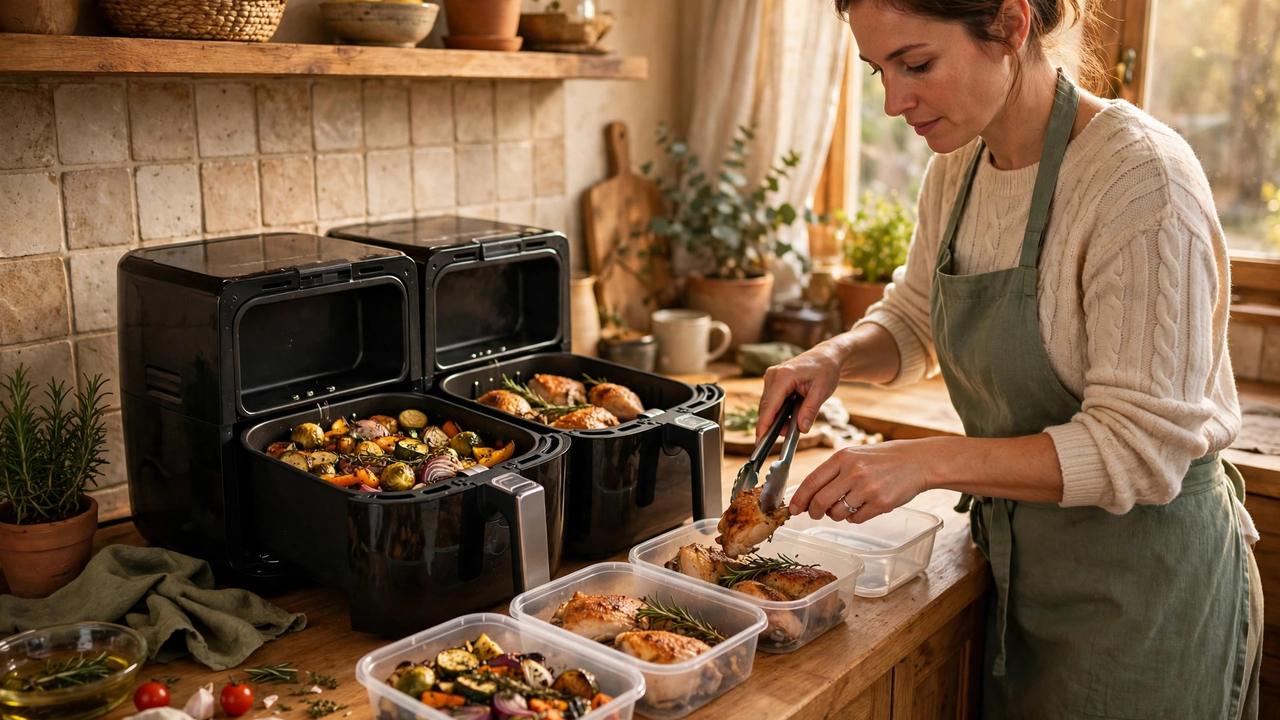
Weekly meal prep fails in the same place for most households: not the shopping, and not the chopping, but the long, serial wait while one batch of food cooks, cools, and clears the way for the next. A single-basket air fryer turns a Sunday prep session into a queue. Chicken waits for sweet potatoes, sweet potatoes wait for green beans, and by the time the last tray finishes, the first one has gone cold and the cook has lost the afternoon. That is exactly the problem the best dual zone air fryers for weekly meal prep are built to solve. Two independent baskets, each with its own heater, fan, temperature, and timer, let a protein and a vegetable cook side by side, at different settings, and — with a sync-finish feature — land on the counter at the same moment, ready to portion into containers while both are still hot.
This guide compares six dual zone models that suit a weekly prep routine, from compact 8-quart two-basket units for one or two people to a 25-quart dual zone oven that can handle a whole week of family dinners in a single run. Every pick below was checked on its Amazon listing for its exact model, its listed capacity and functions, and a live offer sold new. Specs are described the way the maker lists them, and each pick comes with a clear statement of who should buy it and who should skip it, because the right dual zone fryer for a solo prepper cooking four lunches is a very different machine from the right one for a household of five.
Quick verdict
For most people, the Ninja Foodi 8 Qt DualZone Air Fryer DZ201 is the balanced starting point: two independent 4-quart baskets, a sync feature the maker calls Smart Finish, and a Match Cook mode that copies settings across both zones when a single food needs the full capacity. If your prep volume is larger, the Ninja Foodi 10 Qt DualZone XL Air Fryer DZ401 stretches each basket to 5 quarts and adds an IQ Boost function for uneven loads. The Cosori Dual Air Fryer 9 Qt CAF-R901-AUS is the pick for cooks who want the widest function list, with ten functions including Sync Cook, Sync Finish, Preheat, and a Shake reminder. The Chefman TurboFry Touch Dual Air Fryer 9 Qt keeps the same two-basket idea simpler, with Sync Finish timing and a shake reminder. The Gourmia 10 Qt Dual Basket Digital Air Fryer offers the joint-largest basket capacity here in a stainless steel finish with seven presets. And if your meal prep looks more like batch-roasting whole trays for a crowd, the Emeril Lagasse Dual Zone French Door Air Fryer Oven 25 Qt replaces baskets with a divided oven cavity and removable divider, so zones can merge into one very large cooking space.
The products in this guide
Ninja Foodi 8 Qt DualZone Air Fryer DZ201
The DZ201 is the model that defined this category, and it remains the easiest dual zone fryer to build a weekly routine around
Selection started with the format itself. A pick only qualified if it genuinely cooks in two zones at once: either two physically separate baskets with independent controls, or, in the case of the Emeril Lagasse oven, a divided cavity with two temperature zones and a sync system. Single-basket fryers with a divider accessory, and oven fryers with only one heating zone, were left out, because neither can run a protein at one temperature and a vegetable at another and finish them together — and that simultaneous, coordinated finish is the entire point of buying dual zone for meal prep.
Next, each candidate was checked on its Amazon product page. The page title had to match the exact brand and model, the detail section had to list the capacity, functions, and zone features used in this guide, and the availability block had to show the product in stock with a live offer sold new. Models whose pages showed no live new offer were excluded and replaced, even when the model itself was well known. Specs quoted below — capacities, temperature ranges, wattages, dimensions, and function lists — are the figures the maker lists on that page, and where a listing was unclear or internally inconsistent about a figure, that figure was simply left out rather than guessed.
Finally, the six survivors were spread deliberately across the prep spectrum. Two come from the same Ninja DualZone family at different sizes, so readers can see what the extra capacity actually buys. The Cosori and Chefman cover the mid-size 9-quart class with different control philosophies. The Gourmia matches the largest basket capacity in a different finish and preset set. The Emeril Lagasse covers the oven-format end of the category, for households whose prep is built around sheet trays, casseroles, and whole birds rather than baskets. If none of the six fits your kitchen, the buying guide at the end explains the handful of specifications that actually decide that fit, so you can judge any other dual zone model on the same terms.
The DZ201 is the model that defined this category, and it remains the easiest dual zone fryer to build a weekly routine around. The maker lists an 8-quart total capacity split across two independent 4-quart zones, each with its own cooking basket, cyclonic fan, and rapid heater, so the two sides genuinely cook independently rather than sharing one airstream. Six programs are listed: Air Fry, Air Broil, Roast, Bake, Reheat, and Dehydrate. The listed temperature range runs from 105°F to 450°F, which matters for prep more than it might seem — the low end handles gentle dehydrating and proofing-style tasks, while the high end crisps skin and edges properly. The maker lists the unit at 1690 watts, with dimensions of 13.86 inches deep by 15.63 inches wide by 12.4 inches high, a footprint that fits most counters without dominating them.
For meal prep, the two headline features are Smart Finish and Match Cook. Smart Finish is the sync mode: set each basket with its own program, temperature, and time, and the fryer staggers the starts so both finish together, even when one food needs twenty minutes and the other needs twelve. Match Cook does the opposite job, copying one set of settings across both zones so the full 8 quarts behave like a single large fryer — the mode you want when the week’s plan is one big batch of the same food, such as a double load of chicken thighs or two baskets of fries for a family lunch prep. The maker notes the capacity fits mains and sides at the same time, or up to 4 pounds of French fries or chicken wings across the unit.
In a weekly rhythm, the DZ201 suits a Sunday session built from paired cooks: salmon in one basket and asparagus in the other, meatballs beside roasted broccoli, or tofu next to peppers, each pair finishing together and portioning straight into containers. Cleanup supports the routine rather than fighting it — the maker lists the baskets as easy to clean, with dishwasher-safe crisper plates, so a four-pair prep session does not end with a sink full of scrubbing. The honest limitation is basket size: a 4-quart basket is generous for sides and for proteins for two or three people, but a household prepping five days of lunches for four people will run the machine in repeated pairs, at which point the larger DZ401 below earns its extra counter space.
Buy it if: you prep for one to three people, you want the proven Smart Finish and Match Cook pairing, and an 8-quart footprint suits your counter.
Skip it if: you regularly cook for four or more, or your prep centres on whole chickens and large roasts that need the 5-quart baskets of the XL model.
The DZ401 takes the same DualZone idea and scales it for volume. The maker lists a 10-quart total capacity across two independent 5-quart XL baskets, the same six programs as its smaller sibling — Air Fry, Air Broil, Roast, Bake, Reheat, and Dehydrate — and the same 1690 watts, in a body listed at 13.9 inches deep by 17.1 inches wide by 12.8 inches high. That extra width is the trade you are making: two quarts more working capacity, in exchange for a noticeably wider machine that needs a clear stretch of counter and storage.
What the extra capacity buys in prep terms is fewer, larger pairs. The maker describes the baskets as sized for whole-meal cooking and notes the unit can cook two 6-pound chickens up to 30 percent faster than a traditional oven — a claim about the category’s speed rather than a promise for every recipe, but a fair indication of the scale this machine works at. A week’s worth of chicken for a family, a double batch of roasted root vegetables, or lunches for two adults across five days can move through in a couple of paired runs instead of four. Smart Finish and Match Cook work as they do on the DZ201, staggering two different cooks to a shared finish or mirroring settings across the full 10 quarts.
The DZ401 also adds IQ Boost, which the maker describes as a way to distribute power between the baskets when loads are uneven — useful in prep, where one basket might hold a dense tray of potatoes while the other holds a lighter load of green beans that would otherwise finish unevenly. The maker also lists the cooking surface as 100 percent PFAS free and the crisper plates as dishwasher safe, which keeps the cleanup story consistent with the smaller model. For a household that preps in bulk once or twice a week, this is the basket-format pick that minimises the number of runs, and the number of times you wash baskets, between shopping day and a fridge full of containers.
Buy it if: you prep family-size volumes, want two true 5-quart baskets, and have the counter width for a 17.1-inch machine.
Skip it if: your kitchen is small, you mostly cook for one or two, or you would rather have an oven format with trays than baskets.
Cosori’s entry splits the difference on size and goes widest on functions. The maker lists a 9-quart total capacity across two 4.5-quart baskets, ten functions — Air Fry, Roast, Broil, Bake, Dry, Reheat, Sync Finish, Sync Cook, Preheat, and Shake — and a temperature range the maker lists from 95°F to 450°F. The unit is listed at 1750 watts, with dimensions of 17.3 inches deep by 15.4 inches wide by 11.9 inches high, so it sits a little lower and deeper than the Ninja models, a shape worth checking against low wall cabinets. The baskets and parts are listed as dishwasher safe.
The prep-relevant details are in how the sync features are split. Sync Finish staggers two different dishes so they complete at the same time, which is the protein-and-side pattern most weekly prep follows. Sync Cook mirrors one setting set across both baskets for a full 9-quart single-food batch. Having both as named, separate functions keeps the control panel honest about which job you are asking for. The Shake function adds a reminder to shake or turn food partway through, which matters in prep because a basket loaded for the week is a full basket, and full baskets crisp unevenly if nothing moves them halfway. Preheat as a dedicated function is a small thing that adds up across a session of four or five paired cooks.
The maker also emphasises that the separate baskets keep flavours apart — seafood in one basket and vegetables in the other, for example, without the two sharing air and aroma. For meal prep that separation has a second benefit: strong-flavoured batches, such as garlic-heavy chicken or spiced chickpeas, can run beside plainer foods destined for children’s lunches. The maker lists a library of more than 130 nutritional recipes alongside the unit, which suits newer preppers who want structured ideas for using two baskets at once rather than improvising pairings. If your prep style is varied — different proteins, different vegetables, different finish times every week — this is the most flexible control set in the group.
Buy it if: you want the broadest function list, a shake reminder for full baskets, and separate named Sync Cook and Sync Finish modes.
Skip it if: you prefer the simplest possible controls, or the deeper 17.3-inch footprint does not fit your counter.
The Chefman TurboFry Touch Dual takes the same 9-quart two-basket format and strips the experience back to the essentials a prep session actually uses. The maker lists a 9-quart total cooking capacity across double baskets, one-touch digital controls, and a Sync Finish feature that does the timing maths so the two baskets finish together — set both sides, and the machine staggers them to a shared endpoint, which is the core dual zone behaviour presented without extra layers of programming. The model is listed as the TurboFry Touch Dual, model number RJ38-SQPF-45TDB-US, with dimensions of 10 inches deep by 20 inches wide by 13 inches high — the widest and shallowest shape in this group, a low, broad profile that can suit counters where depth is tight but width is free.
Two prep-friendly details stand out in the maker’s listing. First, the shake reminder: the fryer gives a visual and audio prompt about halfway through cooking, because most foods benefit from a shake at that point. In a busy prep session, when the cook is chopping the next batch while the first one runs, an audible reminder is the difference between evenly crisped vegetables and a basket that cooked undisturbed and uneven. Second, cleanup: the maker lists a nonstick interior, bonus basket liners to reduce sticking, and baskets and racks that are top-rack dishwasher safe. Liners are a genuinely practical prep feature, since sticky marinades and cheese-topped batches are exactly the loads that make cleanup drag.
The maker also covers the unit with a one-year warranty, listed on the product page. Where the Chefman gives ground to the Cosori and Ninja models is in the depth of its function list and temperature theatre — this is a machine for households whose prep is a rotation of familiar foods cooked well, rather than an experimental programme of dehydrating, proofing, and broiling. For a family that wants two baskets, a synced finish, and controls a guest or teenager can operate without a manual, that simplicity is the point, and the 9-quart capacity still handles a protein and a family-size side in one paired run.
Buy it if: you want straightforward one-touch dual basket cooking, an audible shake reminder, and a wide, shallow footprint.
Skip it if: you want a long preset list, dehydrate and bake speciality functions, or a narrower machine for a deep counter.
Gourmia’s dual basket model matches the largest basket capacity in this guide and presents it in stainless steel. The maker lists a 10-quart total capacity across two 5-quart baskets, seven cooking presets, a digital display with touch controls, and an adjustable temperature range the maker lists from 90°F to 400°F. The unit is listed at 1600 watts, with dimensions of 14 inches deep by 16 inches wide by 14.5 inches high — the tallest footprint here, worth measuring against the underside of your wall cabinets before committing. The maker lists the special features as automatic shut-off, dual zone features, programmable controls, temperature control, and a timer.
The prep features mirror the category’s best ideas under Gourmia’s own names. A smart finish function syncs cooking times so both baskets finish at the same time, covering the protein-and-side pattern, while Match Cook duplicates settings across both baskets for full-capacity meals — the mode for a 10-quart single-food batch such as a week of roasted potatoes or a double load of wings for a weekend gathering. The maker attributes the cooking to its FryForce 360° technology, its name for the circulating hot air system intended to cook evenly with little to no oil. Seven presets will cover the standard prep rotation — fries and frozen items, chicken, vegetables, reheating — without the longer lists of the Cosori.
Cleanup is listed plainly: two nonstick crisper trays and baskets, all dishwasher safe. For weekly prep, the Gourmia’s appeal is the combination of maximum basket volume with a finish that suits kitchens built around stainless appliances, plus a temperature range that reaches down to 90°F, the lowest listed floor in this group, which the maker positions for gentle tasks at the bottom end. The 400°F ceiling is lower than the 450°F listed for the Ninja and Cosori models, so cooks whose prep depends on very hot finishing — hard-seared edges and maximum crisping at the end of a roast — should weigh that difference honestly against the capacity.
Buy it if: you want two full 5-quart baskets, a stainless steel finish, and both sync-finish and match-cook modes.
Skip it if: you need a 450°F top temperature for hard finishing, or your cabinets sit lower than the unit’s 14.5-inch height allows.
The Emeril Lagasse model answers a different prep question: what if the batch is not baskets of food, but trays of it? This is a French door air fryer oven with dual zone technology, listed at a 25-quart capacity in stainless steel, at 1750 watts, with dimensions of 17.72 inches deep by 15.94 inches wide by 14.17 inches high. Inside, a divider splits the cavity into two temperature zones so a main dish and sides cook simultaneously at different settings; remove the divider and the zones merge into one extra-large cooking space. The maker describes the unit as blending ten kitchen tools into one, with dual zones and custom presets across its oven and air fryer functions.
The sync system here is called QuickSync Technology, which the maker describes as matching cooking times and settings across zones so every portion of the meal finishes simultaneously. In prep terms, that means a tray of chicken thighs in one zone and a tray of roasted vegetables in the other, both landing together, both portioned while hot — the same dual zone logic as the basket models, executed at tray scale. The maker also highlights speed from frozen, describing frozen shrimp turned into a finished dish in minutes without thawing, which suits the realistic prep session where something always comes straight from the freezer.
This format suits a particular kind of weekly prep: big households, batch cooking for freezing, holiday and hosting overflow, and cooks who already think in sheet trays and casserole dishes rather than baskets. Trays also change what prep can include — flatbreads, gratins, and whole roasts sit naturally in an oven cavity in a way they never will in a 4-quart basket. The trade-offs are equally clear. A 25-quart oven is a permanent counter resident, not a cupboard appliance; it heats a larger cavity for small jobs, so a two-person Tuesday reheat is less efficient here than in a basket model; and French door ovens need clearance in front as well as above. Buy it as a prep station, not as an impulse upgrade, and it earns its footprint every single week.
Buy it if: your meal prep is tray-based and large-scale, you want zones that can merge into one big oven, and you have permanent counter space for it.
Skip it if: you cook mainly for one or two, your prep is basket-sized, or you need an appliance that stores away between uses.
Buying guide
Start with honest volume. Dual zone capacities are quoted as totals, but prep happens per basket. An 8-quart unit is two 4-quart cooks; a 10-quart unit is two 5-quart cooks. Estimate your biggest regular pair — say, a family protein plus a family side — and size the baskets to that pair, not to the headline total. Buying one size up is usually right for meal prep, because prep loads are deliberately full loads, and a basket filled to the brim crisps worse than the same food given a little air space in a larger basket.
Sync finish is the feature that matters most. Every pick in this guide can stagger two cooks to a shared finish, under names like Smart Finish, Sync Finish, or QuickSync. That single feature is what turns two baskets into a meal prep system rather than two small fryers sharing a plug: proteins rest while vegetables finish is a problem this eliminates by design. The companion feature, Match Cook or Sync Cook, matters almost as much — it mirrors settings across both zones for single-food mega-batches. If a dual zone model you are considering lacks a sync-finish mode, it is giving up the category’s main advantage.
Check the temperature range at both ends. The models here list ceilings of 400°F to 450°F and floors as low as 90°F to 105°F. A 450°F ceiling gives harder finishing and faster crisping; a low floor opens up dehydrating snacks and fruit for the week, gentle reheating that does not dry food out, and slow tasks. Match the range to your actual prep menu rather than assuming wider is always better — but do not buy a 400°F-ceiling model if your signature prep items are defined by a hard, hot finish.
Measure the counter, not just the capacity. These six machines range from about 15.4 to 20 inches wide and up to 14.5 inches tall, and oven-format models need door clearance in front. Measure width, depth, and the gap to your wall cabinets, and leave breathing room behind and above the unit for hot air exhaust. Meal prep appliances earn their keep by staying out on the counter; a fryer that must be hauled from a cupboard every Sunday quietly stops being used by March.
Plan cleanup before you buy. A serious prep session runs each basket several times. Dishwasher-safe baskets and crisper plates, nonstick interiors, and, on one pick here, included liners, are the difference between a sustainable routine and a chore you abandon. Also consider how many parts each design asks you to wash per run — two baskets and two plates is the basket-format standard, while the oven format trades baskets for trays and a crumb area that needs a wipe.
Think in pairs when you plan the week. The practical way to use any of these machines is a pairing chart: each prep run combines one protein and one produce item with compatible timing, staggered by the sync feature. Chicken with broccoli, salmon with asparagus, meatballs with peppers, tofu with green beans, sausages with root vegetables. Write the pairs before you shop, buy for the pairs, and the dual zone fryer stops being an appliance and becomes the schedule itself — four or five paired runs, each finishing together, and the week’s lunches and dinners are portioned, labelled, and done.
FAQ
Can both baskets really cook at different temperatures at the same time?
Yes — that is the defining feature of the format. On the basket models in this guide, each zone has its own basket and heating setup with independent temperature and timer controls, as the makers list them. The oven-format Emeril Lagasse model achieves the same result with two temperature zones in a divided cavity. What you cannot do is exceed each zone’s own listed temperature range.
What does sync finish actually do?
It staggers the start times. If one food needs 25 minutes and the other needs 15, the fryer holds the shorter cook and starts it later, so both baskets finish at the same moment. The makers call it Smart Finish, Sync Finish, or QuickSync depending on the brand, but the behaviour — different foods, different settings, one shared finish — is the same idea across all six picks.
Is a 10-quart dual zone fryer too big for two people?
Not necessarily for meal prep. Two people prepping five days of lunches are cooking ten portions, and the larger 5-quart baskets let that happen in fewer paired runs with better air space around the food. The real constraint is physical: the 10-quart models here are wider or taller, so let your counter measurements, not your household size alone, make the final call.
Can I cook one food across both baskets?
Yes. Match Cook on the Ninja and Gourmia models, and Sync Cook on the Cosori, copy one set of settings to both zones so the full capacity behaves like a single large fryer. That is the mode for a week-sized batch of one item — a double load of chicken thighs, potatoes, or wings — rather than a protein-and-side pair.
Are the baskets and trays dishwasher safe?
On the picks in this guide, the makers list dishwasher-safe baskets, crisper plates, or trays for the Ninja, Cosori, Chefman, and Gourmia models, with the Chefman specifying top-rack dishwasher safe for its baskets and racks. Check the care notes for the exact model you buy, and let parts cool before washing to protect nonstick surfaces.
Basket format or oven format for meal prep?
Choose baskets if your prep is portioned proteins and vegetables in moderate volumes — they heat fast, crisp well, and clean quickly. Choose the oven format if your prep is tray-based, very large, or includes dishes like gratins and whole roasts that need a flat cavity. Many high-volume households eventually run one of each, using the oven for the Sunday batch and a basket model for midweek reheats and top-ups.
Conclusion
Dual zone air fryers earn their place in a meal prep kitchen by removing the queue: two foods, two settings, one finish. The Ninja DZ201 remains the balanced default for most households, the DZ401 stretches the same system for family volume, and the Cosori CAF-R901-AUS offers the widest function set for cooks who like control. The Chefman TurboFry Touch Dual keeps the idea simple and audible, the Gourmia pairs maximum basket capacity with a stainless finish, and the Emeril Lagasse oven scales the whole concept up to trays for crowd-size prep. Pick by your biggest regular pair of foods, your counter measurements, and how you actually cook on a Sunday — then let the sync finish do the scheduling, and give yourself the afternoon back.
M
Modern Line Home Editorial Team
We compare specs, materials and verified owner reviews before a product earns a spot. Rankings are never paid.
Affiliate disclosure. As an Amazon Associate we earn from qualifying purchases at no extra cost to you. Prices accurate as of the date shown.
House cold even with the heat on? Walk this ordered checklist: thermostat and filter first, then drafts, insulation, leaky ducts and a failing heating system.
Windows fogging up in winter? Check where the fog sits: on the room side it is indoor humidity, outside it is harmless, and between panes the seal has failed.
Store the main firewood pile about 30 feet from your house, off the ground and covered only on top. Compare racks, woodsheds, garages and indoor spots safely.
Place a portable generator outdoors only, at least 20 feet from windows, doors and vents, exhaust pointed away. Exact distances, setup steps and CO rules here.
Keep houseplants in the right winter spot: match window direction to plant type, stay clear of radiators and cold glass, and fix dry air and low light at home.
Mice enter through pencil-width gaps at foundations, pipes, vents, doors and the roofline. Walk this room-by-room winter checklist to find and seal each one.
A winter outage timeline: what to do in the first hour, first night and multi-day outage, with food safety times, pipe protection, heat and CO safety steps.
Size a space heater by room area: 10 watts per square foot at 8-foot ceilings, adjusted for insulation and ceiling height, with full wattage and BTU tables.
Start dripping at about 20 degrees, sooner for exposed pipes. Set a pencil-lead stream, drip the right faucets on both lines, and know when to stop safely.
A fridge needs 800-1,200 starting watts, not just 150-400 running watts. Use the tables to total your fridge plus freezer, lights, furnace fan and more today.












Write Your Review
No reviews yet. Be the first to share your experience!