We independently review everything we recommend. When you buy through our links, we may earn a commission. As an Amazon Associate we earn from qualifying purchases.
Best Recessed Electric Fireplaces for TV Walls (2026)
Front-vent recessed electric fireplaces that sit safely under a TV, compared on depth, heat output, flame control and install options for a clean media wall.
Front-vent recessed electric fireplaces that sit safely under a TV, compared on depth, heat output, flame control and install options for a clean media wall.
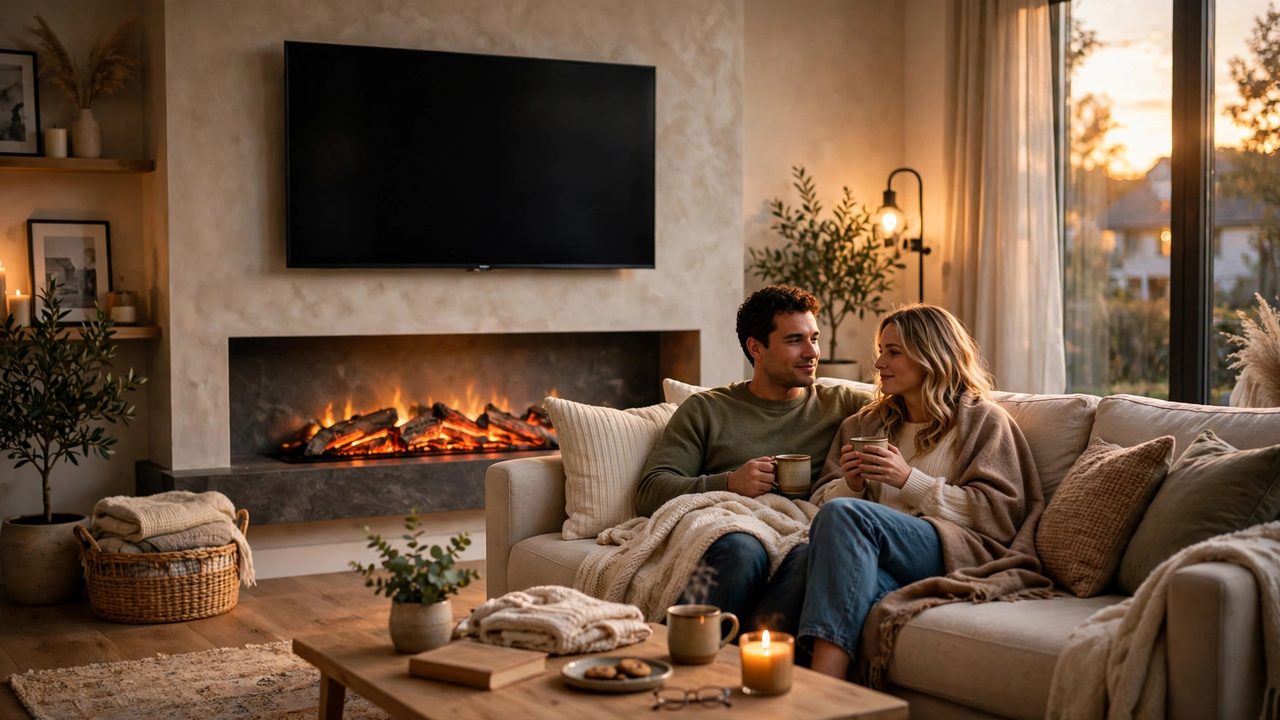
A TV wall only works when the fireplace below it sends its heat into the room, not up into the screen. That single detail is why front heat vents matter so much on a media wall: a unit that exhausts warm air from the top or the back needs extra clearance, pushes heat toward the television, and often cannot sit as close or as flush as the design calls for. A front-venting model blows its warmth straight out of a grille on the face of the unit, so the sides, back and top can stay cool, the fireplace can recess fully into the framing, and the television above it stays out of the heat path. If you are shopping for the best recessed electric fireplaces with front heat vents for tv walls, this guide compares six verified linear models that are built for exactly that job.
Every pick below is a real, named model sold new, checked on opened product pages, with its specifications taken from what the maker lists. The lineup spans two long-established Touchstone Sideline models with documented front-facing heater vents and an explicit minimum gap below a TV, plus four slim linear fireplaces from R.W.FLAME, BOSSIN, EUHOMY and BREEZEHEAT that recess into standard stud walls and are made to sit under a screen. They differ in depth, smart controls, flame customisation, media included and how they wire in, and those differences are what should drive your choice once the front-vent requirement is met.
One caution before the picks: front venting is necessary for a tight TV wall, but it is not the whole clearance story. Each maker still lists its own minimum distance between the top of the fireplace and the bottom of the television, and its own framing dimensions, depth and electrical requirements. Treat the numbers in this guide as a starting point for comparison, then confirm the exact figures for your chosen model in its manual before anyone cuts into the wall.
Quick verdict
For most TV walls, the Touchstone Sideline 50 is the safest all-round choice: the maker lists front-facing heater vents, a recommended minimum of eight inches between the top of the unit and a flat-screen TV, a shallow recessed body, and the flexibility to plug in or hardwire. If you want the same front-vent layout with Wi-Fi, voice control and far more flame and ember colour combinations, step up to the Touchstone Sideline Elite 50. If your wall is built from standard studs and you want the thinnest possible recess, the R.W.FLAME 50 and the BOSSIN 50 are the slim specialists, both under four inches deep on the maker listings. The EUHOMY 50 is the straightforward mid-line option with log and crystal media and touch-screen control, and the BREEZEHEAT 50 is the pick for anyone who wants an ultra-thin unit that can also stand free with the included supports when a full recess is not possible.
The products in this guide
Touchstone Sideline 50 Electric Fireplace – 80004
The Sideline 50 is the reference point for this category, and it earns that position on documentation
Best if you want the most clearly documented front-vent TV-wall case, with a maker-stated eight-inch
Recessed, wall-mounted or freestanding with included supports
Read the depth column carefully, because it decides whether your wall can take the unit at all. A standard interior wall framed with 2 x 4 studs offers only a shallow cavity once drywall is counted, which is why the sub-four-inch models exist. The Touchstone units are deeper and reward you with a larger firebox presence and hardwiring options, while the slim models trade some of that depth for an easier fit in ordinary framing. None of these heaters is a primary heat source; every maker here positions its unit as supplemental heat for a single room, with the flame effect available year-round with the heat switched off.
How we selected
Selection started with the vent location, because that is the requirement in the keyword and the requirement that makes a TV wall safe and practical. A model only stayed on the list if its maker or listing documentation placed the heat outlet at the front of the unit, or described a recessed linear design whose heat is delivered from the face while the cabinet stays suitable for full recessing under a television. Models that vent from the top, that are freestanding stoves, or that are log inserts for an existing masonry fireplace were set aside, however good they are in other settings, because they do not solve the TV-wall problem.
Next, each model had to be a real, exactly named product that could be verified on opened pages, with a maker or listing record of its dimensions, heat settings and controls. Anything whose specifications could not be confirmed was excluded rather than described loosely. Availability was checked on the Amazon product page itself: a pick had to show a live offer sold new and in stock at the time of checking, and one otherwise strong premium candidate was dropped at this stage because its page showed no featured offer. Finally, the six survivors were spread across the realistic range of TV-wall projects, from a contractor-friendly hardwired install to a slim unit a homeowner can recess into an existing stud wall over a weekend, so that the guide answers different walls rather than repeating the same fireplace six times.
A note on how specifications are reported: throughout this guide, figures are phrased as what the maker lists. Heating coverage, for example, is a maker figure for supplemental heat in a well-insulated room, not a promise for every space, and flame colour counts describe the combinations the maker offers across its flame and ember-bed settings. Where two sources from the same maker give slightly different figures for a setting range, the guide says so in general terms rather than picking the more flattering number.
The Sideline 50 is the reference point for this category, and it earns that position on documentation. The maker lists front-facing heater vents as a deliberate design feature, explains that those vents are what allow the unit to sit just eight inches under a flat-screen TV, and states that the sides and back of the unit remain cool to the touch while the heater runs. For a TV wall, that is the clearest maker-stated case in this guide: the heat path is forward into the room, the cabinet is built to recess between framing studs, and the television gap is a number you can plan around rather than a guess.
On specifications, the maker lists a 1,500-watt heater with two heat settings, supplemental heat up to 400 square feet and up to 5,000 BTU, a thermostat, and a built-in timer that runs from one to eight hours with automatic safety shut-off. The flame display offers five settings radiating from a soft ember glow to an intense blaze, and the unit ships with both faux fire logs and crystals, so you can choose a traditional or a contemporary hearth look from the same box. It can be plugged into a standard outlet with the included six-foot cord or hardwired for a cleaner in-wall finish, and a wall-mount bracket is included if you decide to hang it on the surface instead of recessing it. Touchstone also notes the Sideline can be installed into an existing fireplace opening, provided any unused gas lines and vents are properly secured by a licensed professional first.
In a TV-wall project, the Sideline 50 suits the homeowner who wants the paperwork to match the promise. The recessed body is deeper than the slim models below, at five and a half inches the maker lists, so it wants a properly framed bump-out or a wall with enough depth, and in return it gives you a substantial viewing area and a heater layout designed from the start for the space under a screen. Controls run from the included remote for flame colour and intensity, the heater and the shut-off timer, which keeps daily use simple even though this generation of the Sideline is not the Wi-Fi model.
Buy it if: you want the most clearly documented front-vent TV-wall case, with a maker-stated eight-inch minimum gap below the television, both plug-in and hardwire options, and log and crystal media included.
Skip it if: your wall is a shallow 2 x 4 stud wall with no bump-out planned, or you specifically want app and voice control, in which case the Elite model below is the same family with those features added.
The Sideline Elite 50 keeps the same front-venting idea and builds a smarter, more customisable fireplace around it. Dealer and maker material describes a heating element placed in front of the frame, with heat delivered through the vent in the front of the unit, which is what allows the Elite to recess into the wall while still heating the room. The same eight-inch guidance below a mounted flat-screen TV applies in the maker’s material, along with the note that the unit stays cool to the touch on the sides and back even with the heat on.
Where the Elite pulls ahead is control and colour. The maker lists six flame colour options and ten media colour options that run independently, for the sixty combinations in the product name, plus three flame speeds and five flame and fire-bed intensity settings. A thermostat range the maker lists from 68 to 88 degrees Fahrenheit, a one-to-eight-hour timer, and the ability to remember flame settings round out the heating side. It is Wi-Fi enabled and compatible with voice control through smart assistants, it can be switched on by a light switch or a smart device, and it can be plugged in or hardwired. The media package is the fullest in the Touchstone line here: a full log set, driftwood pieces and crystals are all included, so the hearth look can change with the room rather than being fixed at purchase.
For a media wall that is also a smart-home room, that control set matters more than it might sound. The television, lighting and fireplace usually end up on the same evening routine, and a fireplace that joins that routine by voice or app gets used as ambience far more often than one that needs its own remote hunted down. The Elite’s slimmer frame around the glass also gives it a larger, more contemporary viewing area than the standard Sideline, which suits the wide, low proportions of a modern TV wall.
Buy it if: you want front-vent recessed heat plus Wi-Fi, voice control, independent flame and media colours, and all three media types in the box.
Skip it if: you prefer the simplest possible controls, you will never use app or voice features, or your project budget is better spent on the wall build itself, where the standard Sideline covers the same heating ground.
The R.W.FLAME 50 approaches the TV wall from the opposite direction: instead of a deeper firebox, it makes the cabinet as thin as possible so the recess itself becomes easy. The maker lists dimensions of 50 inches wide by 18.11 inches high with a depth of just 3.86 inches, and positions the unit for 2 x 6 stud walls, in both recessed and wall-mounted installations. A slim front-venting linear body like this is what lets a fireplace slide into a framed media wall without building the wall out, and it keeps the finished face close to flush, which is the look most TV-wall designs are chasing.
The feature set is generous for a slim unit. The maker lists twelve adjustable flame colours and twelve LED flame-bed colours, five flame speed modes and five brightness levels, controlled from a touch screen on the unit or the included remote. Heat comes from two settings, 750 and 1,500 watts, with the maker listing coverage up to 400 square feet, and the listing emphasises low-noise operation, which matters more under a television than anywhere else: a blower you can hear over dialogue will be switched off, and a fireplace that is switched off is just a black rectangle. The flame effect runs without heat for warm-weather ambience, as with every pick in this guide.
Choose the R.W.FLAME when the wall is the constraint. If your media wall is a new framed feature built over an existing wall, depth is often the first thing value-engineered away, and a sub-four-inch unit survives that decision where a five-and-a-half-inch unit does not. The trade-off is firebox depth and the hardwiring flexibility of the Touchstone models; this is a plug-in linear fireplace designed around an easy recess, and judged on those terms it is a very complete one.
Buy it if: you need the thinnest practical recess for a 2 x 6 stud media wall, you want wide flame colour choice, and quiet operation under the TV is a priority.
Skip it if: you want a hardwired installation with no visible cord path to plan, or a deeper, more traditional firebox presentation, where the Touchstone models fit better.
The BOSSIN 50 is the other slim specialist in this lineup, and its distinguishing claim is framing flexibility. The maker lists a thickness of about 3.85 inches and describes the unit as fitting both 2 x 4 and 2 x 6 stud walls, for recessed or wall-mounted installation. That 2 x 4 compatibility is worth pausing on: many existing interior walls and many simple media-wall build-outs use the shallower stud, and a fireplace that recesses into it without a deeper bump-out removes a whole layer of carpentry from the project.
On features, the maker lists twelve adjustable flame colours, adjustable flame speed, a touch screen and a remote control with a timer of up to eight hours, and two heat settings at 750 and 1,500 watts. As with the other slim models, the heat is delivered from the front of the linear cabinet, the flame can run without heat, and the overall presentation is a wide, low, frameless-looking band of fire that matches the proportions of a wall-mounted television. The BOSSIN’s design language is deliberately minimal: a black glass face, no mantel, no surround, nothing competing with the screen above it.
In practice, the BOSSIN suits the retrofit project. If you are adding a fireplace to a finished room by building a shallow feature frame against the existing wall, or opening a section of an existing stud wall, its thin body and dual framing fit give you the most forgiving installation in this guide. What you give up versus the premium models is smart-home control and the deeper media presentation; what you gain is a fireplace that fits where the others physically cannot.
Buy it if: your media wall uses 2 x 4 framing, you want an ultra-thin recessed body, and touch-screen plus remote control with a timer covers everything you need.
Skip it if: you want voice or app control, driftwood and log media variety, or a hardwired finish, where the Touchstone Elite is the stronger match.
The EUHOMY 50, model EFL-50 on the maker’s listing, sits in the middle of this lineup on almost every axis, which is exactly its appeal. The maker lists overall dimensions of 50 inches wide by 17.01 inches high by 4.13 inches deep, so it is slim enough for a straightforward recess while keeping a slightly taller viewing area than the thinnest models. It can be fully recessed or wall-mounted, and the maker describes it as blending with a range of home decor styles rather than pushing one strong design statement.
The listing details twelve flame colours and twelve LED fuel-bed colours, five brightness levels, a temperature range the maker lists from 62 to 82 degrees Fahrenheit, and a timer from one to eight hours, controlled by remote or by the touch screen on the glass. Heat is the familiar two-stage 750 and 1,500 watts, with the maker listing coverage up to 400 square feet, and both a log set and crystal media are included, so the hearth can be dressed traditionally or contemporarily without a second purchase. Operation is described as quiet, at a level the maker compares to background room sound, which again suits the under-TV position where the fireplace shares the wall with your speakers and your dialogue.
The EUHOMY is the pick for a buyer who wants the standard modern package with no strong reason to go thinner, deeper, smarter or more traditional. It covers the front-vent recessed requirement, the colour customisation most people actually use, both common media types and both common control methods, in a body that fits a typical framed media wall. Projects with an unusual constraint should look to the specialists above or below; projects without one will find this the path of least resistance.
Buy it if: you want a balanced 50-inch recessed fireplace with log and crystal media, twelve-colour flame and ember control, and both remote and touch-screen operation.
Skip it if: your framing is an unusually shallow 2 x 4 wall where every fraction of depth counts, or you want smart-home voice control built in.
The BREEZEHEAT 50, model 50B-GBL-SSDQ, is the thinnest unit in this guide and the most flexible about how it is installed. The maker lists the newer style at only 3.2 inches thick, and describes three installation routes: recessed into the wall, wall-mounted with the included bracket, or freestanding with the included stand. For renters, for rooms where the wall cannot be opened, and for anyone who wants to try the TV-wall layout before committing to a recess, that third option is genuinely useful: the fireplace can start its life standing below the television and move into a framed recess later.
Features follow the modern linear pattern. The maker lists touch-screen and remote control, two heat settings at 750 and 1,500 watts, an eight-hour timer, and an LED flame presentation behind the glass face, with the flame able to run without heat for year-round ambience. Heat is delivered from the front of the slim cabinet, which is what keeps the unit suitable for the under-TV position in any of its three installation modes, and the quiet operation the maker describes suits a viewing room. The ultra-thin body also makes this the easiest unit here to handle during installation, a practical point on a project where the fireplace is usually lifted into a framed opening by two people working around a mounted screen.
The trade-offs are those of any ultra-thin design: the firebox presentation is shallower than the Touchstone models, and the brand’s media and smart-control packages are simpler. But as a first TV-wall fireplace, or as the unit for a wall that simply will not take depth, the BREEZEHEAT removes more obstacles than any other pick in this guide.
Buy it if: you want the thinnest body available here, the option to start freestanding and recess later, and straightforward touch and remote control.
Skip it if: you want the deepest, most layered flame presentation or built-in voice control, where the Touchstone models are the better spend.
Buying guide
Confirm the vent location in writing. Front heat vents are the whole point of this category, so verify them for the exact model you order, not just the product family. Look for the maker’s own description of a front-facing or front heat outlet, and for a stated clearance below a television. If a listing is vague about where the heat comes out, treat that as a reason to choose a model whose documentation is explicit, like the Touchstone Sideline line, rather than a reason to hope for the best.
Measure the wall before the fireplace. The fireplace must fit the framing, not the other way round. Note your stud size, the depth you can honestly achieve after drywall and any build-out, and the rough-opening dimensions the maker lists for your model, which are not the same as the unit’s outer dimensions. Then check the television gap: makers in this guide recommend a minimum of eight inches between the top of the fireplace and the bottom of the TV, and your screen’s own manual may ask for more. Plan the outlet position at the same time, inside the recess for a plug-in unit or on the circuit your electrician will hardwire, so no cord ever crosses the finished face of the wall.
Match the heat claim to the room. Every model here is a supplemental heater. The maker lists up to 400 square feet and roughly 5,000 BTU at the 1,500-watt setting for most of them, which in practice means taking the chill off the seating area of a living room while the main heating system does the heavy work. A thermostat is worth having because it lets the fireplace hold a temperature instead of cycling on a timer alone, and a low heat setting around 750 watts is the one most evenings actually need. If a room is large, draughty or open-plan, expect ambience first and warmth second, from any model in this class.
Decide how you will control it. Under a television, the fireplace joins an ecosystem of remotes and routines. A basic remote is enough for many households. Touch-screen control on the glass helps when the remote is lost. Wi-Fi and voice control, offered here by the Sideline Elite, let the fireplace follow the same evening command as the TV and lights. None of these change the heat or the flame quality; they change how often you bother to use them, which is a real quality-of-life difference over years of ownership.
Choose media and flame style for your room. Logs read traditional, crystals read contemporary, and driftwood sits between the two. Models that include more than one media type let you change the look without changing the fireplace. Flame and ember colour counts matter less than whether the colours run independently: a natural orange flame over a coloured ember bed is the combination most people settle on, and independent control is what makes it possible. Brightness levels matter in a TV room specifically, because the fireplace shares the wall with a screen; the right setting is bright enough to read as fire and dim enough not to fight the picture, and every model here offers several levels to find it.
Plan the installation honestly. A surface hang is an afternoon. A full recess is framing, electrical work and finishing, and hardwiring is a job for a licensed electrician in most jurisdictions. None of these units needs venting, a chimney or a gas line, which is why they suit TV walls at all, but the wall still has to be opened, the opening still has to match the maker’s framing dimensions, and any existing fireplace conversion still needs its old gas lines and vents secured by a professional first, as Touchstone’s own guidance states.
FAQ
Why do front heat vents matter under a TV?
Because they decide where the heat goes. A front-venting fireplace blows warm air out of its face and into the room, so the top of the unit and the wall above it stay out of the heat path. That is what allows the fireplace to recess fully and sit closer under a television. Makers of front-vent models still list a minimum gap, eight inches in the Touchstone material used for this guide, so front venting reduces the clearance problem rather than abolishing it.
How far below the TV should a recessed electric fireplace sit?
Follow the fireplace maker’s figure first and the television maker’s figure second, and use the larger of the two. In this guide, the maker lists a recommended minimum of eight inches between the top of the Sideline models and a mounted flat-screen TV. Also leave the space the TV maker asks for ventilation, and remember that soundbars, mantels and picture frames above the fireplace each need their own clearance from the heat path.
Can these fireplaces heat a whole room on their own?
They are supplemental heaters. The makers list up to 400 square feet and about 5,000 BTU at full power for most models here, which warms the seating zone of a typical living room but is not a replacement for central heating, especially in open-plan or poorly insulated spaces. The flame effect, by contrast, works all year, because every pick in this guide runs its flames with the heat switched off.
Do I need to hardwire a recessed electric fireplace?
Not always. Several models here, including both Touchstone picks, can plug into a standard outlet or be hardwired, while the slim models are primarily plug-in designs. Hardwiring gives the cleanest finish with no cord to hide, but it should be done by a licensed electrician. Plug-in installation is simpler, provided the outlet is positioned inside or behind the recess as the maker directs, never with a cord draped across the wall face.
Will a recessed electric fireplace fit a standard stud wall?
It depends on depth, which is why this guide lists the depth the maker states for every pick. The slimmest models, at roughly 3.2 to 3.86 inches, are made for standard stud framing, and the BOSSIN is listed for both 2 x 4 and 2 x 6 studs. Deeper models such as the Touchstone units, at five and a half inches, need a deeper cavity or a framed build-out in front of the existing wall, which many media-wall designs include anyway for cable management and acoustic treatment.
Can I run the flame without heat in summer?
Yes. Every model in this guide separates the flame effect from the heater, so the fireplace works as a visual feature in warm weather with no heat output. This is one of the main reasons electric fireplaces suit TV walls better than gas or wood: the focal point stays alive in every season, and the running mode is a remote press rather than a fire to build and tend.
Conclusion
A TV wall succeeds or fails on heat direction, and every fireplace in this guide was chosen because its heat comes out of the front, its body recesses into real framing, and its specifications could be verified on opened pages. Start with the Touchstone Sideline 50 if you want the clearest maker-documented case for the space under a screen, choose the Sideline Elite 50 for the same layout with smart control and the widest colour range, and look to the R.W.FLAME 50, BOSSIN 50, EUHOMY 50 and BREEZEHEAT 50 when depth, framing or installation flexibility is the deciding factor. Measure your wall, respect the television gap your chosen maker lists, and the result is the combination this category promises: a real focal-point fire, a cool screen above it, and a wall that looks built rather than assembled.
M
Modern Line Home Editorial Team
We compare specs, materials and verified owner reviews before a product earns a spot. Rankings are never paid.
Affiliate disclosure. As an Amazon Associate we earn from qualifying purchases at no extra cost to you. Prices accurate as of the date shown.
House cold even with the heat on? Walk this ordered checklist: thermostat and filter first, then drafts, insulation, leaky ducts and a failing heating system.
Windows fogging up in winter? Check where the fog sits: on the room side it is indoor humidity, outside it is harmless, and between panes the seal has failed.
Store the main firewood pile about 30 feet from your house, off the ground and covered only on top. Compare racks, woodsheds, garages and indoor spots safely.
Place a portable generator outdoors only, at least 20 feet from windows, doors and vents, exhaust pointed away. Exact distances, setup steps and CO rules here.
Keep houseplants in the right winter spot: match window direction to plant type, stay clear of radiators and cold glass, and fix dry air and low light at home.
Mice enter through pencil-width gaps at foundations, pipes, vents, doors and the roofline. Walk this room-by-room winter checklist to find and seal each one.
A winter outage timeline: what to do in the first hour, first night and multi-day outage, with food safety times, pipe protection, heat and CO safety steps.
Size a space heater by room area: 10 watts per square foot at 8-foot ceilings, adjusted for insulation and ceiling height, with full wattage and BTU tables.
Start dripping at about 20 degrees, sooner for exposed pipes. Set a pencil-lead stream, drip the right faucets on both lines, and know when to stop safely.
A fridge needs 800-1,200 starting watts, not just 150-400 running watts. Use the tables to total your fridge plus freezer, lights, furnace fan and more today.












Write Your Review
No reviews yet. Be the first to share your experience!