We independently review everything we recommend. When you buy through our links, we may earn a commission. As an Amazon Associate we earn from qualifying purchases.
Best Double-Sided Electric Fireplaces for Dividers
Compare the best double-sided electric fireplaces for room dividers, from true see-through and three-sided models to heat, wiring and framing checks today.
Compare the best double-sided electric fireplaces for room dividers, from true see-through and three-sided models to heat, wiring and framing checks today.
A room divider has a harder job than a normal wall. It has to separate two spaces without closing them off, give each side a reason to face it, and carry services such as power without looking like a piece of site work that never got finished. A fireplace built into that divider can do all three jobs at once, which is why searches for the best double sided electric fireplaces for room dividers keep growing as open-plan homes look for softer ways to split living, dining, sleeping and working zones. Unlike a gas see-through fireplace, an electric unit needs no flue, no gas line and no venting through the roof, so the divider itself can stay slim, movable in concept if not in practice, and far simpler to frame.
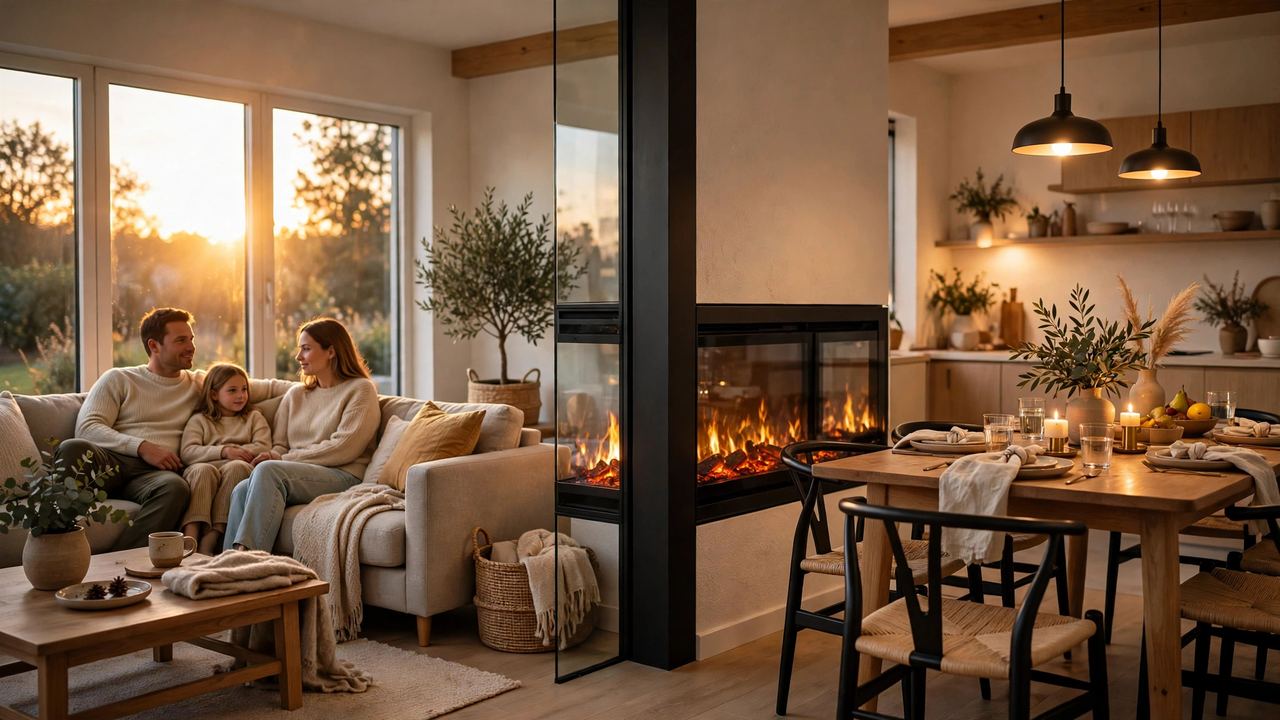
There is an important honesty point at the start of this guide. A true double-sided electric fireplace, with glass on the front and the back and a flame you can literally see through to the room beyond, is a rare product. Only a small number of makers build one. Most of the market instead offers three-sided and corner-configured models, where the flame is visible from the front and from one or both ends of the unit. In a divider that projects into a room, or at the end of a low partition, a three-sided model often works even better than a true pass-through, because people approach it from several directions. This guide covers both families together, labels each one clearly, and never pretends a three-sided bay is the same thing as a see-through tunnel of glass.
Below you will find six verified models: one true two-sided see-through fireplace, two configurable multi-sided built-ins of very different sizes, one three-sided wall-hung mantel design, and two accessible three-sided options, including a freestanding mantel piece that needs no framing at all. Each one was checked on opened product pages, and the specifications quoted are the ones the maker lists, not estimates.
Quick verdict
If your divider is a framed partition between two distinct spaces and you want the genuine article, the Napoleon CLEARion Elite 60 is the standout. It is a true two-sided see-through fireplace, it can heat the two sides at different rates, and its privacy glass can turn transparent, semi-transparent or opaque, which solves the biggest objection to a glass divider between, say, a bedroom and a bathroom or a living room and a study. If your divider is a peninsula that people walk around rather than a wall between rooms, a three-sided configuration makes more sense. The Modern Flames Landscape Pro Multi 80 is the largest and most configurable of those, and the Touchstone Sideline Infinity Pro 50 brings the same three-sided idea down to a standard stud wall depth with smart control and crackle sound. The Touchstone Chesmont suits a divider you do not want to build at all, because it hangs on a finished surface inside a fully finished mantel. The Silonn three-sided model is the compact, lighter route, and the Maxhonor mantel piece is the freestanding option for renters and for rooms where opening a wall is simply not on the table.
The products in this guide
Napoleon CLEARion Elite 60 See-Through Electric Fireplace
The CLEARion Elite is the model this category is named after
Best when your divider separates two real rooms, you want a genuine see-through flame, and independent
Selection started with the divider job itself, not with a generic list of electric fireplaces. A model only qualified if its flame is genuinely visible from more than one direction: through the unit from front to back, around a corner configuration, or from the front and both ends of a three-sided firebox. Single-sided linear fireplaces, however good, were excluded, because in a divider they serve only one of the two spaces the divider creates.
Every model then had to be a real, current product sold new, verified on opened pages. Where a maker publishes a product page or specification sheet, the dimensions, heat output, voltage and installation options quoted here come from that material. Where the clearest full details sit on the retail listing, the listing itself was opened and read, including its availability block, because a divider fireplace is a built project: ordering a unit that turns out to be unavailable, or a different variant from the one described, wastes a framed opening. Models whose specifications could not be verified on an opened page were left out entirely rather than described in vague terms.
Variety of divider situations was the final filter. A framed two-room partition, a walk-around peninsula, a shallow stud wall, a finished surface that cannot be opened, and a freestanding furniture divider are five different projects, and a useful shortlist has to cover them. The six picks below are therefore not six versions of the same fireplace; they are six different answers, and the buying guide after the reviews explains how to tell which question your room is actually asking.
The CLEARion Elite is the model this category is named after. The maker lists it as a true two-sided, see-through electric fireplace, and that phrase carries a specific meaning here: there is glass on both faces and no solid back panel, so from either room you look through the flame picture to the space beyond. Built into a framed divider between a living room and a dining room, a primary bedroom and an ensuite, or a lounge and a home office, it behaves like a window that happens to produce heat and a fire effect. Napoleon describes it as the first truly see-through electric fireplace, and the design details support the claim, because the controls, vents and media bed are all arranged to work from both directions rather than favouring one face.
The specification that matters most in a divider is the heating arrangement. The maker lists heat of up to 10,000 BTU and 3,000 watts, with installation direct-wired to a 120 volt or 240 volt supply, and supplemental heat for up to 800 square feet. More unusually, the unit can heat the two sides at different rates, and it is controlled with two remotes, one for each room. In practice that means the bedroom side can run a gentle evening setting while the bathroom side runs warmer in the morning, without either side overriding the other. No three-sided bay model in this guide can do that, because a bay has one room wrapped around it, not two rooms sharing it.
The second defining feature is the privacy glass. The maker lists a feature that switches the glass between transparent, semi-transparent and fully opaque. That single feature removes the classic objection to a see-through divider: that it connects two spaces even when you do not want them connected. Set opaque, the divider becomes a glowing feature wall with a fire on each face and no sightline through it. Set transparent, it is an open visual link. For a bedroom divider, a guest suite or a bathroom partition, that flexibility is not a gimmick; it is what makes the whole concept acceptable day after day.
The listing dimensions are 60 inches wide, 20.43 inches high and 9.18 inches deep, which tells you the framing story. A divider built around this unit does not need to be a deep chimney breast; a properly framed partition of modest thickness can carry it, although the direct-wire electrical work and the structural framing are professional jobs, not weekend tasks. Both a crystal media ember bed and logs are part of the presentation described for this model, so the look can lean contemporary or traditional depending on which room style dominates. Plan the divider finish on both faces before ordering, because both faces are fully visible design surfaces, including their surrounds.
Buy it if: your divider separates two real rooms, you want a genuine see-through flame, and independent heat and privacy control on each side matter to you.
Skip it if: your divider is a walk-around peninsula rather than a partition, you need plug-in simplicity, or you are not ready for hardwired installation and professional framing.
At the other end of the scale sits the Landscape Pro Multi in its 80 inch size. The listing describes a versatile three-sided fireplace unit with overall dimensions of 80 inches wide, 11.5 inches deep and 24.875 inches high, and a substantial weight that underlines what kind of project this is: this is a piece of architectural joinery with a fireplace in it, not an appliance you hang after decorating. In a large open-plan space, a long low peninsula divider carrying this unit can separate a kitchen from a living area while keeping the flame visible from the front, from the ends, and from the circulation route that passes around it.
Configuration is the headline. The maker lists installation as a single-sided, left corner, right corner or three-sided unit, with installation depths that include built-in clean face, partial recess into a shallow framed structure, or wall mount. For a divider designer that flexibility is gold, because the same fireplace family can terminate a peninsula as a three-sided bay, turn a corner where the divider meets a wall, or sit flat where the plan changes. The framing can be designed around the chosen configuration from the start, rather than the fireplace being forced into a structure designed for something else.
Heat and light are both generously specified. The listing describes a built-in 10,000 BTU ceramic heater with a whisper-quiet fan, and a flame effect that can run with or without heat for year-round use. The flame, ember bed and accent lighting use high-intensity RGB colour, adjustable from the full-featured remote, with app control available and an optional wireless thermostatic wall control. In a divider, accent lighting matters more than in a normal fireplace wall, because the unit is seen in the round and at close range from several seats; being able to tune the ember bed and downlighting separately lets each seating area get a presentation that suits it.
Be realistic about the supporting work. A unit of this size and weight needs a divider structure designed to carry it, proper electrical provision for its higher output, and a plan for how the top of the divider is finished, since people will look down on it from stairs or a mezzanine in some homes. It rewards that effort by doing something no smaller model can: holding together a genuinely large open plan, where a 50 inch fireplace would look lost and read as an appliance rather than architecture.
Buy it if: your divider is a long peninsula in a big open-plan room, you want corner or three-sided flexibility at architectural scale, and your project already includes custom framing.
Skip it if: your room is modest in size, your divider is a simple stud partition, or you want a unit one person can handle and install without a designed structure.
The Sideline Infinity Pro brings the multi-sided idea into the dimensions of an ordinary framed divider. The listing gives product dimensions of 49.75 inches wide, 17.25 inches high and 9.25 inches deep, and describes four installation options: three-sided, left-visible, right-visible, or front-only. That means the same unit can sit at the end of a partition with both ends exposed, turn the corner where a divider meets a return wall, or drop back to a conventional front-only installation if the plan changes. For a divider at the end of a sofa run, separating a seating area from a dining space in the same open room, the three-sided setting is the natural choice: the flame reads from the sofas, from the dining chairs, and from the walkway between them.
Control and atmosphere are where this model earns its place. The maker lists six flame colour options, five flame speeds and intensities, an ember bed in 13 colours with a pulsating setting, and 13-colour downlighting, operated by touchscreen, remote or smartphone app, with Alexa and WiFi compatibility. Built-in crackle sound with adjustable volume is included, which matters in a divider context more than people expect: a fireplace in the middle of a room is heard from all sides, and a silent visual flame in the centre of a living space can feel oddly flat compared with the same effect against a wall.
The heater is listed at 1,500 watts on high and 750 watts on low, with a thermostat range the maker lists from 68 to 88 degrees Fahrenheit, supplemental heat for rooms up to 400 square feet, and a programmable timer from 30 minutes to 9 hours. The unit can be plugged in or hardwired. For divider planning, that choice is about where your power is: a hardwired installation keeps both faces completely clean of cords, which is the right answer for a permanent partition, while a plug-in installation suits a divider built as furniture, where an outlet can be hidden inside the structure.
Media choice is also covered, with painted crushed glass crystals and driftwood among the ember bed media described. Pick one and commit on both visible ends; a three-sided firebox shows its media bed from above at glancing angles, and a sparse or unevenly spread bed is far more noticeable in the round than it is behind a single flat pane of glass.
Buy it if: you want three-sided viewing from a standard-depth framed divider, value app and voice control, and like the idea of crackle sound in the middle of the room.
Skip it if: you need to heat two separate rooms independently, or your divider is longer than a 50 inch unit can visually anchor.
The Chesmont solves a different divider problem: what if there is no wall to open and no appetite for framing? This model, number 80033 in the white finish described on its listing, arrives as a fully finished floating mantel that hangs on a wall surface. Inside that mantel, the flames sit behind a tempered glass box that offers a three-sided view of the media and flames. Hung on the face of an existing partition, mounted on a wide column, or placed on the living-room face of a low room divider, it gives front and side views of the fire without a single cut into the structure behind it.
The maker lists dimensions of 50 inches wide, 20.38 inches high and just 7.13 inches deep, so the projection into the room is modest and furniture-like rather than architectural. The flame specification includes six flame colours, ten media bed colours, five light intensity settings and three flame speeds, with driftwood and crystal hearth media both shipped in the box. Control is by remote, by app, or by voice through Alexa and Google Home compatibility, since the unit is WiFi enabled. The combination of a finished mantel and smart control makes it feel less like a building component and more like a piece of furniture that happens to contain a fire.
Heat is listed at 1,500 watts with a heat output figure of 5,118 BTU on the listing and supplemental coverage of up to 400 square feet, with high and low settings. The heating vent is located at the inside top of the mantel, a discreet position that keeps the front face clean. In a divider setting, remember that this heat serves the room the mantel faces; the other side of the partition gets the visual benefit of a finished divider face only if you finish it, not a second fire view. That is the honest trade of a wall-hung three-sided design, and it is a perfectly good trade when one side of the divider is a hallway, a kitchen run or a circulation space that needs ambience less than the seating side does.
Installation is the simplest in this guide alongside the freestanding Maxhonor: attach the mounting arrangement, hang the unit, plug it in. That also makes the Chesmont the most forgiving pick if your divider plans are still evolving, because it can move to a different wall later without leaving a framed hole behind.
Buy it if: you want three-sided flame views and a finished mantel with no framing, no recess and no hardwiring, on a divider face or partition wall.
Skip it if: both sides of your divider need a real fire view, or you want the unit to disappear flush into the divider structure.
The Silonn three-sided model is the compact route into this category. Its listing gives dimensions of 50 inches wide, 13.78 inches high and 7.35 inches deep, a notably low and shallow profile that suits a divider built at counter or console height, a half-height partition between a kitchen and a snug, or a framed opening in a smaller open-plan flat where a taller firebox would dominate. The design is described as a triple-view fireplace, with the flame visible from the front and the ends, and three installation options are listed: wall-mounted, recessed, and freestanding with installation brackets. That last option is unusual in this category and makes the unit workable on top of, or within, a furniture divider as well as inside a framed one.
Colour control is the party piece. The listing describes LED downlights, back lights and a crystal ember bed, each with 15 colour options, combining into a very large number of possible combinations, with five brightness levels and three flame speeds. Resin faux logs are included, the flame presentation is designed to replicate a natural fire, and built-in speakers simulate the crackling sound of burning wood. Logs and stones can be arranged to suit your style. In a small room, where the fireplace sits close to seating on more than one side, that level of adjustment lets you tone the display down to a soft glow rather than living with a fixed, bright effect at close range.
Heating is listed with a heat output of 5,100 BTU, coverage of up to 400 square feet, and two heating levels, controlled four ways: the LED control panel, the remote, the smartphone app, or Alexa voice control. A timer ranging from half an hour to eight hours is included. For a divider between a living area and a work-from-home corner, app and voice control are genuinely useful, because the person who wants the fire changed is often not the person sitting nearest the unit.
Keep expectations in proportion to the format. This is a shallow, low-profile firebox, so the flame picture is wide and panoramic rather than deep and tall, and the media bed is correspondingly compact. In the right divider, a low slot of flame at seated eye level, that is exactly the effect you want.
Buy it if: your divider is low, shallow or furniture-based, your room is on the smaller side, and you want triple viewing with app and voice control in a compact unit.
Skip it if: you want a tall, deep firebox picture, or a premium built-in that heats two separate rooms.
The Maxhonor is the divider you assemble rather than build. It is a freestanding fireplace with a minimalist mantel, and its listing describes three-sided crystal-clear glass for an immersive view of the flames, with realistic logs and a three-dimensional flame effect that can run with no heat at all. The overall dimensions on the listing are 52.2 inches wide, 32.9 inches high and 9.1 inches deep, which makes it a substantial piece of furniture: placed across the middle of a studio flat, between a bed and a seating area, or across an open-plan room to mark where living ends and dining begins, it divides space physically as well as visually, and the fire can be enjoyed from the front and both sides as people move around it.
The flame and heat specification is straightforward. The maker lists 12 flame colours, five brightness levels, and adjustable heat with a temperature range the listing gives as 64 to 82 degrees Fahrenheit, at 1,500 watts on high and 750 watts on low, for medium-sized rooms up to 400 square feet. Control is by the unit’s buttons or the remote, and a timer from one to eight hours is included. Automatic overheat protection is listed, and the unit is described as running quietly, which matters for a freestanding divider in a studio, where the fireplace may sit only a few feet from a bed.
The practical appeal is reversibility. Assembly is a furniture task with labelled parts, there is no framing, no electrician and no permanent alteration, and if you move home or rearrange the room, the divider moves too. The listing notes that parts may arrive in two separate shipments, which is worth knowing before you book a weekend to build it. What you give up versus the built-ins is the flush, architectural finish and any heating of a second room; what you gain is a three-sided fire divider that a renter can own.
Positioning needs a little thought. A freestanding mantel divider needs floor space on all its visible sides, a sensible route for its power cord to a nearby outlet that does not cross a walkway, and clearance from soft furnishings on the heat side. Solve those three things and it is the fastest route in this guide from an undivided room to a divided one with a fire in the middle of it.
Buy it if: you rent, you cannot or will not open a wall, or you want a movable furniture divider with three-sided flame views and simple plug-in heat.
Skip it if: you want a flush built-in finish, a permanent framed partition, or heat delivered independently to two enclosed rooms.
Buying guide
Decide which kind of multi-sided you actually need. The vocabulary in this category is slippery, so pin it down before anything else. A true double-sided or see-through fireplace has glass front and back and no solid rear panel; you see through it into the next space. A three-sided or bay fireplace has glass at the front and on both short ends, with a solid back; you see around it, not through it. A corner fireplace exposes the front and one end. For a partition between two rooms, only the true see-through design serves both rooms. For a peninsula, an island divider or the end of a partition, a three-sided bay is usually the better and far more available choice. Several models in this guide, including the Modern Flames and the Touchstone Infinity Pro, can be configured more than one way, which lets the framing follow the plan rather than the other way round.
Design the divider around the firebox, not the other way round. Start from the unit’s listed width, height and depth, then design the structure: framing opening, finished thickness, and what happens on top of and beside the fireplace. Shallow units such as the Silonn and the Chesmont suit slim dividers and furniture structures. The Napoleon see-through unit needs a partition that can accept a direct-wired appliance and be finished beautifully on both faces. The largest Modern Flames model needs a structure designed for its size and weight from the outset. In every case, check the maker’s framing dimensions and clearances before the divider is built, and leave access for servicing; a fireplace sealed permanently into a structure with no removable panel is a future problem stored inside your wall.
Plan heat room by room. A divider fireplace sits between two zones, but most models heat only the space their vents face. Read the listing carefully for vent position and for whether heat can be delivered on both sides. The true see-through Napoleon is the exception in this guide, with different heat rates possible on each side. With three-sided models, expect comfortable supplemental heat for the main room, in most cases listed at up to around 400 square feet, and treat the far side of the divider as receiving ambience rather than warmth. If both zones genuinely need heat, that requirement alone may decide your model, your voltage, or whether you add a second heat source.
Get the electrical decision made early. Divider fireplaces split into plug-in models, models that can be plugged in or hardwired, and direct-wire-only models. Hardwiring gives the cleanest result on both faces of a divider, with no cord to hide, and the higher-output models use a 240 volt connection to reach the heat figures the maker lists at that voltage. That work belongs to a qualified electrician and needs to be planned before the divider is closed up, because adding a circuit inside a finished partition is miserable work. If your divider is furniture rather than structure, choose a plug-in model and design an outlet inside or directly behind the structure from the start.
Think about sightlines, privacy and glare. A see-through fireplace connects two rooms visually at all times unless it offers a privacy setting, so walk the plan mentally at different hours: what does the bedroom see of the living room at night, and vice versa? The privacy glass on the Napoleon exists precisely for this. With three-sided models, consider seated eye level on each side of the divider; a flame picture centred for a sofa may sit too low for dining chairs or too high for a bed. Brightness and flame speed controls, present on most models here, help tune the effect once installed, but they cannot fix a firebox placed at the wrong height.
Finish both sides like you mean it. A normal fireplace wall has one audience. A divider has two, plus people passing its ends. Budget finish materials, surround or mantel treatment and media for every visible face, keep the media bed arrangement consistent from all angles, and choose controls that work from wherever people actually sit: two remotes, app control or voice control all beat a single remote that lives on the wrong side of the divider. Finally, measure your access route. Large built-ins and assembled mantel dividers both need to get into the room, and the biggest model in this guide is a serious object to move through a house.
FAQ
Can an electric fireplace really work as a room divider?
Yes, in two ways. A true see-through model can be built into a framed partition so both rooms share one fire, and a three-sided or freestanding mantel model can stand at the end of, or in place of, a partition so the flame is visible from several directions. Electric models suit dividers particularly well because they need no flue, no venting and no gas supply inside the structure.
What is the difference between double-sided and three-sided?
A double-sided, or see-through, fireplace has glass on its front and back, so you look through the flames into the next room. A three-sided fireplace has glass on the front and both ends with a solid back, so you look around it rather than through it. Three-sided models suit peninsulas and island dividers; double-sided models suit a partition between two distinct rooms.
Do both sides of a divider fireplace get heat?
Usually only one side gets the direct heated airflow, because most models vent from one face. The Napoleon CLEARion Elite in this guide is designed to heat its two sides at different rates. With other models, plan on full supplemental heat for the main space and flame ambience for the secondary space, and check the vent position the maker lists before you frame the divider.
Does a divider fireplace need to be hardwired?
Some do and some do not. The true see-through model here is direct-wire only, larger multi-sided models are generally hardwired, and several three-sided models can be plugged in or hardwired. Freestanding and wall-hung mantel models are simple plug-in designs. Decide before the divider is built, because adding wiring inside a finished partition is difficult.
Can I see through a see-through fireplace all the time?
That depends on the model. A basic see-through firebox is transparent whenever the room beyond is lit. The Napoleon in this guide adds privacy glass that the maker lists as switchable between transparent, semi-transparent and opaque, which lets a divider between a bedroom and a living space open up or close down as needed.
Is a freestanding fireplace a real divider?
For open-plan zoning, yes. A wide mantel fireplace such as the Maxhonor in this guide physically occupies the dividing line, blocks sightlines at seated height, and shows flame from the front and both sides. It will not provide the acoustic separation or full-height privacy of a framed partition, but it needs no building work and can move when the room changes.
Conclusion
The right double-sided electric fireplace for a room divider depends first on what your divider is. If it is a framed partition between two rooms, the Napoleon CLEARion Elite 60 stands alone in this guide: a true see-through flame, heat that can differ on each side, and privacy glass to close the view when you want it closed. If your divider is a peninsula or island inside one large space, the three-sided models take over, with the Modern Flames Landscape Pro Multi 80 for architectural scale, the Touchstone Sideline Infinity Pro 50 for a standard-depth framed structure with smart control and sound, and the Silonn for a low, compact, furniture-friendly installation. If building work is off the table entirely, the wall-hung Touchstone Chesmont and the freestanding Maxhonor mantel still deliver genuine multi-sided flame views, one on a finished surface and one anywhere the floor space allows. Decide the divider type, the heat pattern and the wiring route in that order, verify the framing dimensions against the maker’s own figures, and the fireplace will feel less like an appliance placed in a gap and more like the reason the divider was built.
M
Modern Line Home Editorial Team
We compare specs, materials and verified owner reviews before a product earns a spot. Rankings are never paid.
Affiliate disclosure. As an Amazon Associate we earn from qualifying purchases at no extra cost to you. Prices accurate as of the date shown.
House cold even with the heat on? Walk this ordered checklist: thermostat and filter first, then drafts, insulation, leaky ducts and a failing heating system.
Windows fogging up in winter? Check where the fog sits: on the room side it is indoor humidity, outside it is harmless, and between panes the seal has failed.
Store the main firewood pile about 30 feet from your house, off the ground and covered only on top. Compare racks, woodsheds, garages and indoor spots safely.
Place a portable generator outdoors only, at least 20 feet from windows, doors and vents, exhaust pointed away. Exact distances, setup steps and CO rules here.
Keep houseplants in the right winter spot: match window direction to plant type, stay clear of radiators and cold glass, and fix dry air and low light at home.
Mice enter through pencil-width gaps at foundations, pipes, vents, doors and the roofline. Walk this room-by-room winter checklist to find and seal each one.
A winter outage timeline: what to do in the first hour, first night and multi-day outage, with food safety times, pipe protection, heat and CO safety steps.
Size a space heater by room area: 10 watts per square foot at 8-foot ceilings, adjusted for insulation and ceiling height, with full wattage and BTU tables.
Start dripping at about 20 degrees, sooner for exposed pipes. Set a pencil-lead stream, drip the right faucets on both lines, and know when to stop safely.
A fridge needs 800-1,200 starting watts, not just 150-400 running watts. Use the tables to total your fridge plus freezer, lights, furnace fan and more today.












Write Your Review
No reviews yet. Be the first to share your experience!