We independently review everything we recommend. When you buy through our links, we may earn a commission. As an Amazon Associate we earn from qualifying purchases.
Best Hand Vacuums for Car: 6 Cordless Picks for 2026
Compare the best hand vacuums for car interiors, from BLACK+DECKER dustbuster models to the Shark UltraCyclone, with runtimes, dust cups and tools compared.
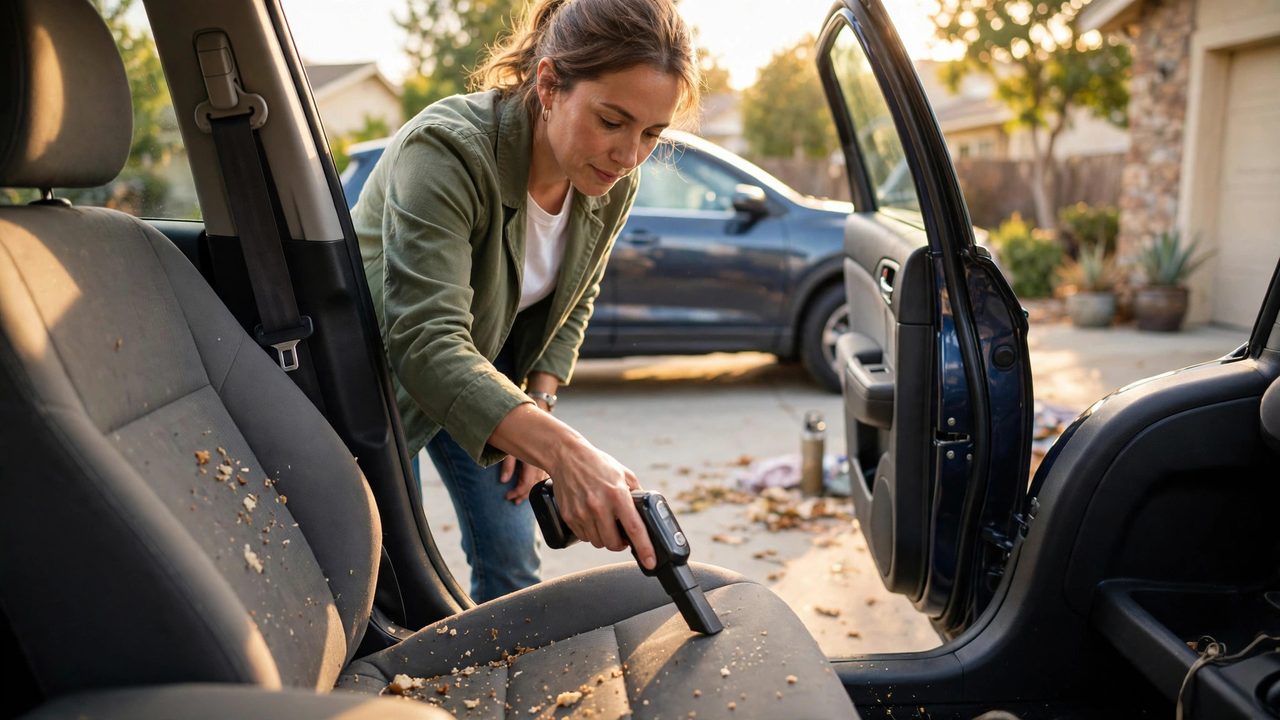
A car interior is one of the hardest small spaces to keep clean. Crumbs fall between the seats, grit grinds into the footwells, pet hair weaves itself into the upholstery, and dust settles over the dash faster than it does anywhere in the house. A full-size vacuum with a hose can do the job, but dragging it out to the driveway for a five-minute mess is exactly why so many drivers end up living with a dirty cabin. That is the gap the best hand vacuums for car use are built to fill: cordless, grab-and-go machines that live in a garage cabinet or a trunk corner and turn a full interior clean into a short, low-effort routine.
The six models below were chosen because each one brings something specific to car work. Two are classic dustbuster-style handhelds with rotating or pivoting nozzles that reach down the side of a seat. One is a pet-focused Shark with a motorized, self-cleaning brush for hair on fabric. One is a BISSELL built around a motorized brush tool and a set of pet tools. One is a DEWALT wet/dry hand vacuum that runs on tool batteries and can pick up spilled drinks as well as dry grit. And one is a compact WORX cube vacuum with a flexible hose that stores almost anywhere. Every specification quoted here is stated the way the maker lists it, and every model was checked on its own Amazon listing with a live offer before it earned a place.
Quick verdict
For most drivers, the BLACK+DECKER dustbuster AdvancedClean CHV1410L is the easiest recommendation: it is light, its nozzle rotates for tight gaps, its dust bowl is the largest of the classic handhelds here, and its pull-out crevice tool and flip-up brush are built in rather than loose in a bag. If pet hair is the main problem, the Shark UltraCyclone Pet Pro Plus CH951 and the BISSELL Pet Hair Eraser 2390A both add motorized brushes that pull hair out of seat fabric instead of skimming over it, with the Shark adding a hands-free dirt ejector and the BISSELL adding the longest runtime in this group. Drivers who need to reach under low seats should look at the BLACK+DECKER Pivot Vac BDH2000PL, whose nozzle pivots through 200 degrees. Anyone already invested in DEWALT 20V MAX batteries gets the most capable wet/dry option in the DCV517B, and anyone short on storage space should look at the WORX WX030L cube, which pairs a tiny footprint with a hose that stretches up to 4 feet.
The products in this guide
BLACK+DECKER dustbuster AdvancedClean CHV1410L
The CHV1410L is the classic dustbuster formula refined for exactly the mix of surfaces a car throws at it
Best if you want one light, simple handheld that lives in the garage and handles
Every model in this guide had to pass the same checks before it was written up. First, it had to be a genuine handheld or hand-carried vacuum that a driver can use inside a cabin without a cord trailing back to a wall outlet, because cord reach is the single biggest reason car cleaning gets postponed. Second, it had to be sold new on Amazon US, and its listing had to show a live featured offer at the time of checking; models whose listings showed no live offer were dropped and replaced, even when the model itself was well known. Third, the specifications had to be verifiable on the opened product page, so the figures in this article — runtime, capacity, weight, voltage, included tools — are the figures the maker lists on that page, not numbers copied from roundups.
Within those gates, we looked for spread rather than sameness. A good shortlist for car use should cover the featherweight everyday handheld, the articulating nozzle for under-seat work, at least one motorized-brush model for pet hair, a wet/dry model for drink spills and winter slush, and a compact model for drivers with almost no storage. Runtime claims were weighed honestly: none of these machines runs for long, so the guide favors models whose dust cups, tools and charging arrangements suit short, frequent cleans over rare marathon sessions. Where a listing gave two different figures for the same detail, the more conservative reading is the one used, and anything the maker does not state clearly has been left out rather than guessed.
The CHV1410L is the classic dustbuster formula refined for exactly the mix of surfaces a car throws at it. The maker lists a 16V lithium-ion battery, cyclonic action that spins dust and debris away from the filter to keep suction consistent, and a rotating slim nozzle that turns to reach into tight, awkward spaces such as the gap between a seat and the center console. A pull-out crevice tool is stored in the body for the seat rails and door pockets, and a flip-up brush handles dusting work on the dash and vents. The translucent bowl holds 605 ml, which is generous for a handheld of this size, and the bowl and filter are washable, so keeping it ready costs nothing but a rinse.
At 2.6 pounds it is the lightest model in this guide, and that matters more in a car than almost anywhere else, because half of car vacuuming is done one-handed at odd angles — reaching across to the passenger footwell, lifting the nozzle up to a headliner, or working down into a child seat. The maker lists an 11-minute runtime, which is enough for a focused pass over one car if you work seat by seat, and a roughly four-hour charge time, so the habit that suits it best is a short clean after a trip rather than a monthly deep clean. Its single speed and cartridge filter keep the design simple, and the two-year limited warranty the maker lists is longer than some rivals here.
Lightest pick here, easy to use one-handed at awkward angles
Rotating slim nozzle and built-in crevice tool suit seat gaps and rails
Largest bowl of the classic handhelds in this guide
Washable bowl and filter keep running costs at zero
Cons
11-minute runtime means one car per charge, worked steadily
No motorized brush, so woven-in pet hair takes extra passes
Single speed only
Buy it if you want one light, simple handheld that lives in the garage and handles the everyday mix of crumbs, grit and dust across the whole cabin. Skip it if your main problem is pet hair embedded in fabric, or you regularly clean two cars back to back on one charge.
The Pivot Vac solves a different geometry problem. Its wide-mouth nozzle pivots through 200 degrees, so instead of twisting your wrist to get the intake flat against the floor under a seat, you angle the nozzle and keep the body comfortable. The maker lists a 20V MAX lithium-ion battery for strong, fade-free suction, cyclonic action to keep the filter clearer for longer, and a translucent 15-ounce bowl that empties easily and washes clean along with the filter. The crevice tool extends for the deep slot beside the seat rails, and the brush flips up from the nozzle for upholstery and dash work, so both tools travel with the machine instead of living in a separate pouch.
The maker lists a 10-minute runtime and a charge time of about four hours, which puts it in the same short-session class as its sibling above. What separates the two is reach and angle: the Pivot Vac is the one to choose when your car has low seats, tight footwells or a third row that forces you to work at full stretch. It weighs 3 pounds, comes with a charging dock that can sit on a bench or mount on a wall, and carries the same two-year limited warranty the maker lists for the CHV1410L. The three-stage filtration system with a pleated filter is a step up in filter design from the simpler cartridge in the cheaper model.
Power: 20V MAX lithium-ion battery, single speed
Runtime: the maker lists 10 minutes
Capacity: the maker lists a 15 ounce translucent bowl
Filtration: three-stage system with pleated filter and cyclonic action
Pros
200-degree pivoting nozzle reaches under low seats without wrist strain
Both tools are built in, so nothing gets lost in the trunk
Charging dock keeps it stored, charged and off the floor
Stronger 20V MAX platform than the 16V model
Cons
Shortest runtime in this guide at 10 minutes
Bowl is smaller than the CHV1410L’s despite the bigger battery
No motorized brush for embedded hair
Buy it if your car’s tight angles — low seats, deep footwells, third-row gaps — are what defeat a normal handheld. Skip it if you need maximum runtime or a motorized brush, because this model trades both for articulation.
Shark built the UltraCyclone Pet Pro Plus around the two things that make car interiors miserable: hair and ground-in grit. The headline tool is a detachable, self-cleaning pet power brush — a motorized head that combs hair out of seat fabric and floor mats while clearing its own brushroll of wrapped hair. Alongside it, the maker includes a crevice tool for the seat-to-console slot and a scrubbing brush for dried mud on mats and pedals. Suction comes from two cyclonic air streams, which the maker credits with strong pickup and longer filter and motor life, and the XL dust cup empties through a CleanTouch dirt ejector, so you push a control and the debris drops out without touching it — a small mercy when the cup is full of gravel and hair.
The maker lists the CH951 at 2.8 pounds, with a 10-minute runtime from its lithium-ion battery and a washable filter. Ten minutes is short, and the honest way to read this model is as a specialist: it does the hair-and-grit work that defeats plain nozzles, and it does a single car well if you move with purpose. Its long, slim body reaches down the side of a seat better than the cube-shaped designs, and at this weight it is easy to sweep across a headliner or a rear parcel shelf. The maker lists a two-year limited warranty. If your dog rides in the car weekly, this is the pick that treats the actual problem.
Power: 10.8V lithium-ion battery, single speed
Runtime: the maker lists 10 minutes
Capacity: the maker lists an XL dust cup with CleanTouch dirt ejector
Weight: the maker lists 2.8 pounds
Tools included: self-cleaning pet power brush, crevice tool, scrubbing brush
Filtration: washable filter, dual cyclonic air streams
Pros
Motorized self-cleaning brush pulls hair out of fabric instead of skimming it
Hands-free dirt ejector keeps emptying clean
Scrubbing brush is made for dried mud on mats
Light, slim body reaches seat sides and shelves easily
Cons
10-minute runtime is tight for a large SUV interior
No hose, so reach depends on the body and tools
Charging dock is a separate accessory, not in the box
Buy it if pet hair on seats and mats is your main battle and you want a motorized brush in a light handheld. Skip it if you need long runtime or wet pickup — this is a dry, hair-focused specialist.
BISSELL’s Pet Hair Eraser takes the same motorized-brush idea and pairs it with the most generous basic numbers in this group. The maker lists a 14V lithium-ion battery with a 17-minute runtime — the longest here — a large, easy-empty dirt bin of 0.18 gallons, and triple-level filtration. The tool set is aimed squarely at fabric: a motorized brush tool for embedded dirt and hair, an upholstery tool that helps attract hair from soft surfaces, and a crevice tool for the gaps. BISSELL positions it for home, auto and pet use, and that triple brief shows in the design: it is as happy doing a sofa as a car seat, which makes it a sensible single purchase for pet owners who clean both.
At 3 pounds it matches the Pivot Vac on weight, and the maker lists a noise level of 70 decibels, the quietest figure in this guide. The trade-off is patience at the wall socket: the maker lists a charge time of about eight hours, by far the longest here, so this is a machine you put back on charge after every use and forget about until the next one. The warranty the maker lists is a one-year limited warranty, shorter than the two- and three-year terms elsewhere in this guide. None of that changes what it does well: steady, fabric-focused cleaning with the best runtime of the six.
Power: 14V lithium-ion battery, single speed
Runtime: the maker lists 17 minutes
Capacity: the maker lists a 0.18 gallon easy-empty dirt bin
Motorized brush plus a dedicated upholstery tool for fabric hair
Large dirt bin for a handheld
Quietest listed noise level here
Cons
Charge time of about eight hours demands a plug-it-in habit
One-year warranty is the shortest in this guide
No hose or scrubbing brush for dried mud
Buy it if you want one pet-focused handheld for both the car and the furniture, and you value runtime over charge speed. Skip it if you need a fast turnaround between cleans or plan to tackle wet spills.
The DCV517B is the outlier here, and for some drivers it will be the obvious winner. It is a wet/dry hand vacuum: the maker lists a Gore HEPA wet/dry filter that traps 99.97 percent of dust at 0.3 microns, a half-gallon tank with a heavy-duty latch, and two clean-up modes — a front utility nozzle for open surfaces, or an extendable heavy-duty rubber hose for reaching down beside seats and into footwells. In a car, wet/dry pickup is not a gimmick: it is spilled coffee in the footwell, melted snow off boots, and the gritty slurry that winter leaves on mats, all handled by the same machine that does the dry crumbs.
The catch is in the words “bare tool.” This model runs on DEWALT 20V MAX battery packs, and no battery or charger is included, so it makes financial sense mainly if you already own DEWALT 20V MAX tools — in which case runtime simply depends on the capacity of the pack you click in, and a big pack outlasts every built-in battery in this guide. At 4.5 pounds it is the heaviest pick here, and its shape is closer to a small shop vac than a dustbuster, but the large one-handed on/off switch and the washable filter — tap it or rinse it — keep it practical. The maker lists a three-year limited warranty, the longest in this guide.
Power: DEWALT 20V MAX battery packs, sold separately; two power levels
Runtime: depends on the battery pack fitted
Capacity: the maker lists a 0.5 gallon tank
Weight: the maker lists 4.5 pounds
Tools included: front utility nozzle and extendable rubber hose built in
Filtration: Gore HEPA wet/dry filter, washable
Pros
Only wet/dry pick here — handles drink spills and slush as well as crumbs
Biggest tank in this guide at half a gallon
HEPA filter rated by the maker at 99.97 percent of dust at 0.3 microns
Runtime scales with the battery packs you already own
Cons
Bare tool: battery and charger cost extra if you are not already on the platform
Heaviest pick here at 4.5 pounds
No motorized brush for woven-in hair
Buy it if you already own DEWALT 20V MAX batteries and want one machine for dry grit, spilled drinks and winter slush. Skip it if you would have to buy into the battery platform from zero — the built-in-battery models work out simpler.
The WX030L rethinks the shape. Instead of a long dustbuster body, WORX put the vacuum in a compact cube that the maker says stores in cabinets, desk drawers, trunks and backpacks, and gave it a flexible hose that extends up to 4 feet. That hose changes how you clean a car: the cube sits on the seat or the floor while the crevice nozzle works the seat rails, the console edges and the dash seams, which is far easier than threading a rigid handheld body through the same gaps. The maker lists two speeds — low for everyday work, high for debris stuck deeper down — 10 kPa of suction, a removable washable HEPA filter, and one-touch emptying.
The kit version listed here includes a 20V 2.0Ah Power Share battery and charger, and that battery also fits the wider WORX 20V and 40V Power Share range, which softens the platform question that complicates the DEWALT. The maker lists up to 15 minutes of runtime, and a dirt cup of about 7 ounces — the smallest in this guide — so this is a spot-cleaning machine for crumbs, dust and grit rather than a whole-car deep clean in one pass. It weighs 3 pounds. Choose it when storage space is tight and most of your car cleaning is little and often: a quick pass after the school run, the beach trip or the dog’s ride to the park.
Power: 20V Power Share lithium-ion battery, included; two speeds
Runtime: the maker lists up to 15 minutes
Capacity: the maker lists a dirt cup of about 7 ounces
Weight: the maker lists 3 pounds
Tools included: flexible hose, crevice nozzle, brush, battery and charger
Filtration: removable, washable HEPA filter
Pros
Hose reach makes seat rails and console gaps genuinely easy
Cube shape stores in a trunk corner or drawer
Two speeds and a HEPA filter at this size are uncommon
Battery is included and shared across the Power Share range
Cons
Smallest dirt cup here — expect to empty it mid-clean on a dirty car
No motorized brush for embedded hair
Dry pickup only
Buy it if storage space is your constraint and your car cleaning is frequent, small and focused on tight gaps. Skip it if you do infrequent deep cleans of a large vehicle, where the small cup will slow you down.
Buying guide
Start with the mess, not the machine. Car dirt falls into four types, and each favors a different design. Loose crumbs and grit respond to any nozzle with decent suction. Hair woven into fabric needs a motorized brush — plain suction slides over it — which is why the Shark and BISSELL exist in this guide. Spills and slush need a wet/dry rating, which only the DEWALT offers here. Dust on the dash and vents needs a brush tool, which most of these include in some form. Naming your dominant mess first cuts the shortlist in half.
Runtime is shorter than you expect, and that is mostly fine. The makers here list between 10 and 17 minutes for the built-in-battery models. A focused clean of one car — seats, footwells, mats shaken and vacuumed, console and dash — fits inside that if you work in a set order and do not leave the machine running while you move mats around. What runtime really decides is whether you can do two cars, or a car plus a staircase, on one charge. If that is your routine, the BISSELL’s 17 minutes or a tool-battery model with a large pack you already own are the safer choices.
Reach beats raw suction inside a cabin. The spaces that stay dirty in most cars — the slot between seat and console, the rails under the seat, the angle where the windshield meets the dash — are reach problems, not power problems. Pivoting nozzles, hoses and slim rotating heads solve them; a stronger motor behind a bulky nozzle does not. If you test one thing when comparing models, compare how each one gets into the seat-to-console gap.
Mind the battery arrangement. Built-in batteries are simple but set a fixed ceiling on runtime, and charge times here range from about four hours to about eight, so the machine has to live on its charger. Tool-platform models swap that simplicity for flexibility: swappable packs, runtime that scales with pack size, and real value only if you already own the platform. A third pattern, the WORX kit, sits between the two — a battery is included, and it happens to fit a wider tool range.
Capacity and emptying shape your habits. Dust cups here range from about 7 ounces to half a gallon. Small cups are fine for spot cleans but punish a neglected car; large tanks invite you to do the whole job at once. Hands-free ejectors and washable filters both lower the friction of using the machine often, and frequency is what actually keeps a car clean — a modest vacuum used weekly beats a powerful one used twice a year.
FAQ
How long should a hand vacuum run to clean a car?
For one car cleaned in a set order, 10 to 15 minutes of runtime is workable, which is why most models in this guide land in that band. Shake the mats out first, vacuum from the top surfaces down, and switch the machine off while you reposition. If you regularly clean two vehicles in one session, choose the longest listed runtime or a swappable-battery model.
Is a motorized brush really necessary for pet hair in a car?
For hair sitting on top of fabric, no — a crevice tool and patience will move it. For hair woven into seat fabric and carpet, a motorized brush makes a clear difference because the rotating bristles lift hair that suction alone slides over. That is the specific job the Shark CH951’s pet power brush and the BISSELL 2390A’s motorized brush tool are built for.
Can a hand vacuum pick up spilled drinks?
Only if the maker rates it for wet pickup. Of the models here, only the DEWALT DCV517B is a wet/dry vacuum, with a wet/dry HEPA filter and a tank designed for liquid. Running liquid through a dry-only handheld can damage the motor and filter, so treat the dry-only models as strictly dry.
Hand vacuum or a cordless stick vacuum for the car?
A stick vacuum with a handheld mode can work, but inside a cabin the long body is usually a liability: you end up holding the weight of the whole machine while threading the nozzle around seats. A true handheld or a hose-based compact like the WORX cube keeps the weight on the seat and only the nozzle in your hand, which suits the space better.
Where should a car hand vacuum live?
Wherever it stays charged and within reach of the car: a garage shelf near the door, a utility cabinet, or a trunk corner for the smallest models. The habit that works is charging it after every use, because the built-in-battery models here take hours to recharge and a flat vacuum is one you stop using.
Conclusion
The right hand vacuum for your car is the one matched to your mess and your storage. The BLACK+DECKER CHV1410L is the best default: light, simple and roomy enough in the bowl for a full cabin pass. The Pivot Vac BDH2000PL earns its place when low seats and tight angles are the obstacle. The Shark CH951 and BISSELL 2390A answer pet hair with motorized brushes, the Shark adding hands-free emptying and the BISSELL adding the longest runtime. The DEWALT DCV517B stands alone for wet and dry work, provided its batteries already live in your garage. And the WORX WX030L proves that a hose and a small cube can out-clean a bigger body in the gaps that matter. Pick by mess first, keep it charged, and use it little and often — that routine, more than any single specification, is what keeps a car interior clean.
M
Modern Line Home Editorial Team
We compare specs, materials and verified owner reviews before a product earns a spot. Rankings are never paid.
Affiliate disclosure. As an Amazon Associate we earn from qualifying purchases at no extra cost to you. Prices accurate as of the date shown.
House cold even with the heat on? Walk this ordered checklist: thermostat and filter first, then drafts, insulation, leaky ducts and a failing heating system.
Windows fogging up in winter? Check where the fog sits: on the room side it is indoor humidity, outside it is harmless, and between panes the seal has failed.
Store the main firewood pile about 30 feet from your house, off the ground and covered only on top. Compare racks, woodsheds, garages and indoor spots safely.
Place a portable generator outdoors only, at least 20 feet from windows, doors and vents, exhaust pointed away. Exact distances, setup steps and CO rules here.
Keep houseplants in the right winter spot: match window direction to plant type, stay clear of radiators and cold glass, and fix dry air and low light at home.
Mice enter through pencil-width gaps at foundations, pipes, vents, doors and the roofline. Walk this room-by-room winter checklist to find and seal each one.
A winter outage timeline: what to do in the first hour, first night and multi-day outage, with food safety times, pipe protection, heat and CO safety steps.
Size a space heater by room area: 10 watts per square foot at 8-foot ceilings, adjusted for insulation and ceiling height, with full wattage and BTU tables.
Start dripping at about 20 degrees, sooner for exposed pipes. Set a pencil-lead stream, drip the right faucets on both lines, and know when to stop safely.
A fridge needs 800-1,200 starting watts, not just 150-400 running watts. Use the tables to total your fridge plus freezer, lights, furnace fan and more today.












Write Your Review
No reviews yet. Be the first to share your experience!