We independently review everything we recommend. When you buy through our links, we may earn a commission. As an Amazon Associate we earn from qualifying purchases.
Best Microfiber Towels to Dry a Car: 6 Picks for 2026
Compare the best microfiber towels to dry a car, from plush twist-loop and PFM terry to waffle weave, with sizes, GSM, blends, edges and care compared today.
Compare the best microfiber towels to dry a car, from plush twist-loop and PFM terry to waffle weave, with sizes, GSM, blends, edges and care compared today.
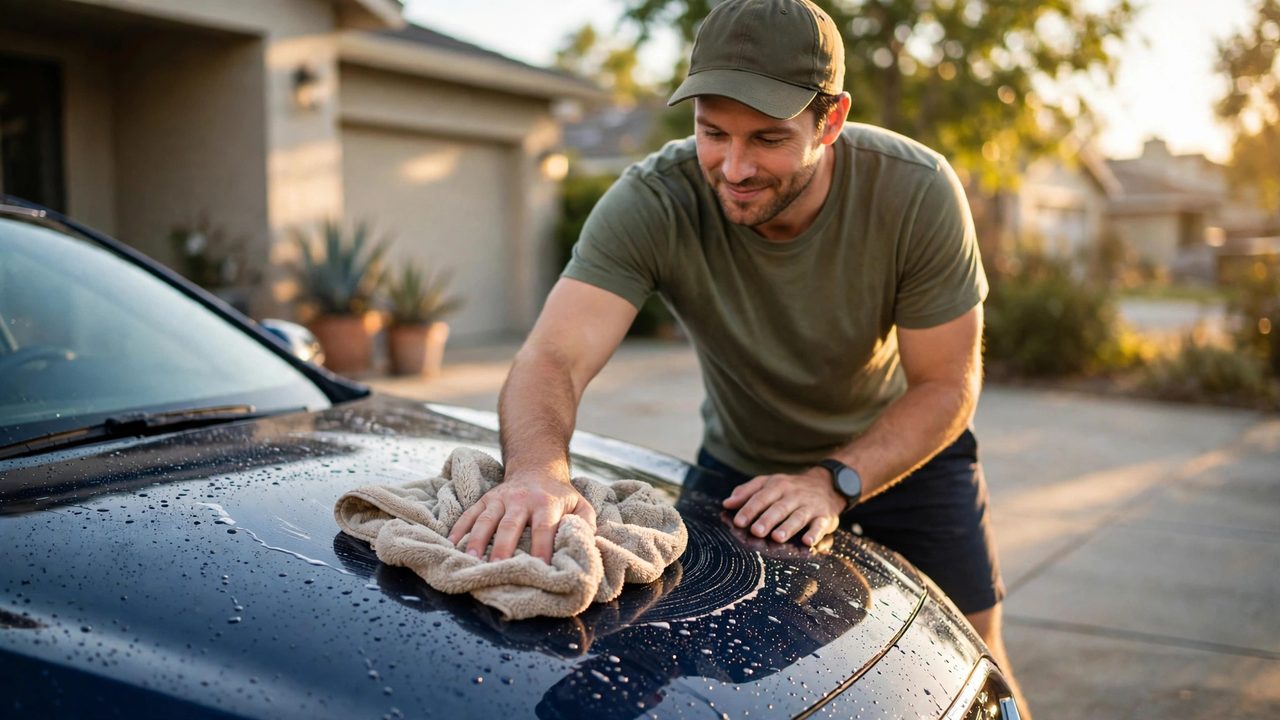
Drying is the step where a careful wash can still go wrong. Water left sitting on paint dries into spots, and the wrong cloth dragged across a wet panel can undo an hour of gentle washing in a few passes. That is why choosing the best microfiber towels to dry a car matters as much as the shampoo or mitt you used before it. A proper drying towel is not just a bigger cleaning cloth. It is built to pull a large volume of water into deep fibers in as few passes as possible, to keep any grit lifted away from the surface while it works, and to release that water cleanly when you wring it or wash it.
The six towels in this guide cover the main ways makers solve that problem. There are dense twist-loop towels that drink water through looped fibers, a very thick terry-weave towel built for the largest vehicles, a deep plush towel designed to be laid flat and pulled across a panel, and two waffle-weave towels that trade pile depth for a lighter feel and fast wringing. Every pick is a real, named model from an established car care brand, checked on its own product listing, with the size, fabric weight, blend and edge construction the maker lists. Where the six differ most is not marketing language but physics: how much water the fabric can hold, how large a panel one pass covers, and how the edge is finished, because the edge is the part most likely to touch paint under pressure.
If you wash one car at home, almost any towel here will feel like a revelation next to a bath towel or an old T-shirt. If you dry large trucks, wash in hard-water areas, or maintain dark paint that shows every mark, the differences below are the ones that decide which towel belongs in your bucket.
Quick verdict
For most drivers, the Gauntlet from The Rag Company is the balanced first choice: the maker lists a 900 GSM weight, a 70/30 Korean split microfiber blend and a patented twist-loop hybrid weave in a 20 x 30 inch size that is large enough for hoods and roofs yet still easy to fold, steer around mirrors and wring out. Drivers who want maximum capacity in a single towel should look at the same brand’s Liquid8r, a 25 x 36 inch twist-loop towel the maker lists at 1,100 GSM, or at the Griot’s Garage Extra-Large PFM Edgeless, a 29 x 36 inch towel listed at 1,120 GSM with an edgeless, double-ply build made for SUVs, trucks and RVs.
Prefer a plush towel you lay flat and pull? The Chemical Guys Woolly Mammoth, at 36 x 25 inches, is built around exactly that technique. Prefer a lighter towel that wrings out in seconds and packs flat? The two waffle-weave picks, the Meguiar’s Water Magnet at 22 x 30 inches and the Chemical Guys Gray Matter at 25 x 36 inches, cover that style at two different sizes. The sections below explain how each towel earns its place, and the buying guide explains the weave, weight and edge terms so you can match a towel to your vehicle rather than buying on size alone.
The products in this guide
The Rag Company Gauntlet Drying Towel (20 x 30 in)
It at 900 GSM in a 70/30 blend of AA-grade Korean split microfiber, with a patented twist-loop hybrid weave that alternates twist-loop and plush
We started with a simple rule: a towel only belongs in this guide if it is purpose-built for drying a vehicle, not a general cleaning cloth that happens to be microfiber. Small 16 x 16 inch detailing towels are excellent for wax removal and interiors, but they saturate almost immediately on a wet hood, so they were left out even when the brand is excellent. Each pick below is a full-size drying towel from a brand that publishes its construction details, and each was checked on its own opened product listing so the size, fabric weight, blend and edge finish in this article are the ones the maker lists for that exact model, not numbers borrowed from a sibling size in the same range.
Availability mattered too. A drying towel you cannot actually buy new is no use to anyone, so each model here was confirmed as a current, purchasable new product at the time of checking. We also deliberately spread the selection across constructions rather than picking six near-identical towels. Twist loop, terry weave, deep plush and waffle weave behave differently on a wet panel: looped fibers hold more water, waffle pockets wring out faster, and deep plush cushions the contact patch. Edge design was treated as a first-order criterion, because a hard stitched edge or a care label dragged under pressure is a classic source of fine marks. Finally, care instructions were checked for every pick, since a drying towel’s life is decided in the wash: all six are machine washable, and the makers’ shared warnings about fabric softener and high heat are covered in the buying guide.
The Gauntlet is the towel to start with if you want one drying towel that does everything well. The maker lists it at 900 GSM in a 70/30 blend of AA-grade Korean split microfiber, with a patented twist-loop hybrid weave that alternates twist-loop and plush stripes across the face. That hybrid layout is the point: the looped stripes pull bulk water off a panel quickly, while the plush stripes keep the contact soft and reduce drag as the towel loads up. The maker also lists more than 500,000 fibers per square inch, which is why a towel of this moderate size can clear a hood or a roof panel without constant trips to wring it out.
At 20 x 30 inches, the Gauntlet sits in the handling sweet spot. It is large enough to fold into a thick, cushioned pad that covers a door or fender in a couple of passes, yet small enough to steer around mirrors, spoilers and badges without the corners flopping onto the ground and picking up grit. The border is the maker’s ButterSoft suede microfiber, a soft edge finish designed to glide over delicate finishes and coatings rather than presenting a hard stitched seam to the paint. For a sedan, hatchback or crossover washed weekly at home, this combination of capacity, control and edge safety is hard to beat, and it explains why the Gauntlet anchors so many two-towel home setups as the main panel towel.
Care is straightforward but worth following: the maker advises washing separately with a non-bleach detergent and air drying or tumble drying on low heat. Treat it as a dedicated paint towel. Using it on wheels or exhaust tips will load the deep fibers with brake dust and grime that later washes may not fully release, and the towel will never feel as safe on paint again.
Buy it if: you want one balanced, paint-safe drying towel for a car or crossover, and you value easy handling and a soft border as much as raw capacity.
Skip it if: you dry full-size trucks or large SUVs every week and would rather have the extra coverage of the 25 x 36 inch Liquid8r or the 29 x 36 inch Griot’s towel below.
If the Gauntlet is the balanced pick, the Liquid8r is the capacity pick from the same maker. The maker lists this version at 25 x 36 inches and 1,100 GSM, in the same 70/30 premium microfiber family, but with a twist-loop weave across the whole face rather than a hybrid stripe layout. Twist loop is the construction most associated with modern high-capacity drying towels: the looped fibers present a large surface area to the water film and hold what they pick up deep in the pile, so the towel keeps drinking through a whole side of a vehicle instead of pushing a bow wave of water ahead of it.
The practical difference shows up on larger vehicles and on horizontal panels. A 25 x 36 inch towel laid over a truck hood or an SUV roof covers enough area that a slow pull clears most of the panel in one motion, and the 1,100 GSM density means the towel is still absorbing at the end of that pull rather than merely smearing the last of the water around. The maker lists a hidden hem edge on this towel, which keeps the perimeter soft and low-profile, and describes the build as retaining its absorbency and texture through repeated wash cycles. It also pairs naturally with a drying aid: the listing notes it works well with one, and a light mist of drying aid improves glide on a towel this grippy.
The trade-off is wet weight and handling. A large, dense twist-loop towel full of water is heavy, and on a small car it can feel like more towel than you need, with extra material bunching in tight areas around mirrors and trim. Wringing it takes both hands and some effort. None of that matters if your priority is drying a big vehicle with a single towel and minimal wringing stops, which is exactly the job this model was built for.
Buy it if: you dry SUVs, trucks or several cars in a row and want one high-capacity twist-loop towel that rarely needs wringing mid-vehicle.
Skip it if: you mainly dry a compact car and prefer a lighter towel you can fold small and wring out with one hand.
Griot’s Garage takes a different route to capacity. Instead of twist loop, this towel uses the maker’s PFM Terry Weave, a long-loop terry-style microfiber, in a double-ply construction the maker lists at 1,120 GSM, the heaviest fabric weight in this guide. At 29 x 36 inches it is also the largest towel here, and the maker positions it squarely at SUVs, trucks and RVs, noting it is larger than the standard PFM drying towel and built so large vehicles can be dried without stopping to wring it out. The long looped fibers give it a soft, almost blanket-like hand feel that glides over paint, glass and trim.
The defining detail is in the name: edgeless. There is no stitched border or banded edge at all, so the absorbent face runs from edge to edge and there is no harder perimeter material to catch on an emblem or press into soft clear coat. For owners of dark or delicate finishes who worry about edge marks, that design removes the question entirely. The double-ply build also means both faces are working faces, so flipping the towel mid-vehicle presents a fresh, dry surface without reaching for a second towel.
As with the Liquid8r, size brings a wet-weight cost. A 29 x 36 inch, 1,120 GSM towel holding a large vehicle’s worth of water is a substantial thing to lift and wring, and on a small coupe it will feel oversized. The maker’s care guidance is specific: machine wash with a free and clear detergent, avoid fabric softeners because they can reduce absorbency and lifespan, and dry on low or no heat, or air dry. Followed properly, a terry-weave towel of this density should stay thirsty for a long time; dried on high heat or washed with softener, it will slowly glaze over and start pushing water instead of absorbing it.
Buy it if: you dry large vehicles, want the heaviest fabric weight in this guide, and prefer a completely edgeless design on sensitive paint.
Skip it if: you want a compact towel for a small car, or you dislike managing a large towel that becomes heavy when saturated.
The Woolly Mammoth is the plush traditionalist of the group. At 36 x 25 inches it has the longest single dimension here, and its deep, shaggy pile is designed around a specific technique the maker describes plainly: lay the towel flat on the panel and pull it slowly across, rather than wiping back and forth. Spread flat, the face covers a hood or roof in one draw, the deep weave lifts water and any leftover grit up into the pile and away from the surface, and the panel dries with almost no hand pressure on the paint. On dark clear coat, where drying marks are easiest to install and hardest to ignore, that low-pressure technique is the whole appeal.
This listing is the blue version of the towel, model MIC1996, and the maker presents it as a generalist beyond the driveway as well, listing paint, glass, wheels and door jambs among its uses, plus household glass and counters. For car drying, though, it is best kept as a paint-and-glass towel: the deep pile that makes it so gentle on a hood will happily trap wheel grime, and once it does, it should not go back on paint. Within its lane, the size is the story. One towel, started dry, is presented by the maker as enough to dry a full-size truck or SUV in a continuous pass without stopping to wring, which makes it a genuine one-towel solution for owners who do not want a rotation system.
Care follows the plush-towel pattern: the maker advises washing in warm water with detergent only, no fabric softener and no bleach, then tumble drying on low so the deep pile stays lofty instead of matting flat. A matted plush towel still feels soft, but it holds noticeably less water, so the low-heat rule is worth respecting from the first wash.
Buy it if: you like the lay-flat-and-pull technique, dry dark or delicate paint, and want one oversized plush towel to handle a whole vehicle.
Skip it if: you prefer a towel you can fold into a small pad and flip frequently, or you want a listed GSM figure to compare density before buying.
The Water Magnet, model X2000, is the long-running waffle-weave option from Meguiar’s, and it represents the opposite philosophy from the heavy twist-loop towels above. Instead of depth, it uses a waffle texture: a grid of raised squares and recessed pockets that increases the surface area in contact with the water film and gives the absorbed water somewhere to go. The maker lists the size at 22 x 30 inches and states the towel can absorb up to two times the water of a traditional terry towel, while being far thinner and lighter than a plush dryer.
That lightness is a real working advantage. A waffle towel folds small, steers easily around mirrors, door handles and trim, and wrings out almost completely with a quick twist, so it returns to near-full absorbency in seconds rather than staying heavy and half-saturated. It is also the easiest style here to use as a second towel: many home detailers dry the main panels with a big plush or twist-loop towel, then follow with a waffle towel for glass, jambs and the last streaks, because the waffle texture leaves a particularly clean finish on glass. The maker lists it for cars, motorcycles and boats, and its modest folded size makes it a sensible glovebox or wash-bucket spare.
The limits follow from the same design. A thin waffle towel saturates sooner than a 1,100 GSM twist-loop towel on a large, very wet vehicle, so drying a big SUV with one Water Magnet alone means more wringing stops. It also offers less pile cushion between hand and paint, which is why technique matters: keep it clean, keep it folded, and let the texture do the work rather than pressing hard. Used that way, it is a durable, machine-washable staple that has stayed in the Meguiar’s range for years because it does a simple job well.
Buy it if: you want a light, fast-wringing towel for everyday cars, glass and finishing passes, or a compact second towel alongside a larger dryer.
Skip it if: you want to dry a large truck or SUV with a single towel and as few wringing stops as possible.
The Gray Matter, model MIC_781_01, takes the waffle-weave idea and stretches it to full drying-towel size. The maker lists it at 25 x 36 inches, substantially larger than the Water Magnet, with a waffle texture intended to maximise water absorption and streak-free drying across the whole panel. The listing describes an 80/20 microfiber blend and a soft-banded edge, a perimeter finish designed to limit scratches and swirls during high-contact drying while keeping the towel’s shape wash after wash.
In practice, this is the pick for drivers who like how waffle weave behaves but found smaller waffle towels slow on big panels. The extra area means a hood, roof or truck door takes fewer passes, and the waffle pockets still wring out quickly, so the towel recovers fast when it does load up. The maker lists it as safe for paint, glass, chrome and plastic, and for cars, trucks, motorcycles, RVs and boats, and also suggests it for glass cleaning and household use where a streak-free result matters. That breadth makes it a good single-towel answer for someone who washes one vehicle of almost any size and wants the drying step to double as the glass step.
Compared with its Chemical Guys stablemate above, the choice is about feel and technique rather than quality. The Woolly Mammoth’s deep plush pile cushions contact and suits a slow pull across the panel; the Gray Matter’s flatter waffle face gives more feedback through the towel, loads and wrings faster, and stores flatter. Owners in hard-water areas often prefer waffle for the final pass because it tends to leave less residual moisture sitting in deep pile to redeposit as spots. Either way, the same care rules apply: wash microfiber separately, skip softener and bleach, and dry on low heat.
Buy it if: you want waffle-weave behaviour in a large 25 x 36 inch format that can dry a whole vehicle and finish glass in the same pass.
Skip it if: you prefer the cushioned, deep-pile feel of a plush or twist-loop towel on soft or freshly corrected paint.
Buying guide
Weave decides how the towel drinks. Twist-loop towels, like the Gauntlet and Liquid8r, loop their fibers so water is drawn in and held deep; they offer the highest capacity per pass and are the current default for serious drying. Terry weave, used by the Griot’s PFM towel, uses long looped fibers in a denser, blanket-like face that feels exceptionally soft and holds a great deal of water. Deep plush piles, like the Woolly Mammoth, maximise cushion and suit a lay-flat pulling technique. Waffle weave, used by the Water Magnet and Gray Matter, trades depth for speed: less capacity per pass, but far faster wringing and a finish on glass that many drivers prefer. None of these is universally best; they are answers to different drying styles.
GSM is density, not a score. Grams per square metre tells you how much fiber is packed into the towel. The listed figures here run from 900 GSM for the Gauntlet to 1,100 GSM for the Liquid8r and 1,120 GSM for the Griot’s towel. Higher GSM generally means more water held before saturation, but also more wet weight and slower drying in storage. A 900 GSM towel that you can fold, steer and wring easily will dry a small car faster in real hands than a heavier towel you struggle to control. Match GSM to vehicle size: compact cars are well served at the lower end, while trucks and SUVs justify the heavy towels. Note that not every maker publishes GSM for every model; where a maker does not list it, this guide says so rather than estimating.
Blend affects softness and bite. Microfiber blends are usually described as a polyester and polyamide split. A 70/30 blend, listed for both Rag Company towels here, carries more polyamide and typically feels softer and thirstier, which suits delicate paint. An 80/20 blend, listed for the Gray Matter, is a little firmer and is common in waffle towels where structure matters. The difference is real but secondary to weave and care: a well-kept 80/20 towel will out-dry a neglected 70/30 towel whose fibers have been glazed by fabric softener.
Size the towel to the vehicle, then to your hands. Coverage speeds drying, but only coverage you can control. Towels around 20 x 30 inches suit most cars and fold into a manageable pad. Towels at 25 x 36 inches and above shine on trucks, SUVs and large roofs, laid flat and pulled. Whatever the size, fold the towel into quarters: you get a cushioned pad, several fresh faces to rotate to as each side loads up, and no loose corners dragging on the ground or across dirty lower panels.
Edges and labels are where marks come from. The safest finishes here are the Gauntlet’s suede microfiber border, the Griot’s towel’s fully edgeless build, the Liquid8r’s hidden hem and the soft-banded edges on the Chemical Guys towels. Whatever you buy, check the perimeter before first use, remove any care label, and keep edges and corners from being the part under pressure on paint. If a towel ever drops on the ground, it leaves paint duty until it has been washed; grit embedded in microfiber is nearly invisible and very effective at scratching.
Technique beats towel choice. Dry in the shade on a cool panel when you can, start with the glass and roof, and work down, because lower panels carry the most residual grit. Lay the towel flat and pull it slowly rather than scrubbing in circles, flip to a dry face as each side saturates, and use a light mist of drying aid on the final pass if your routine includes one, since it improves glide and reduces the water left to spot. Blow or shake loose water off first if you have a blower, and the towel’s whole job gets easier.
Care decides how long any of this lasts. Wash microfiber separately from cotton, which sheds lint into the fibers, using a plain detergent without fabric softener; softener coats the fibers and steadily destroys absorbency. Avoid bleach, and dry on low heat or air dry, because high heat can melt the fine split fibers that do the absorbing. Store towels clean and dry, keep paint towels separate from wheel and engine towels permanently, and retire a paint towel to glass or jamb duty when it starts to drag, streak or feel rough. Followed consistently, these habits matter more than which of the six towels above you chose.
FAQ
How many drying towels do I need for one car?
One large, high-capacity towel from this guide can dry a typical car on its own, especially the 25 x 36 inch and larger models. Many home detailers still prefer two: a large towel for the main panels and a smaller or waffle towel for glass, mirrors and door jambs, because the second towel stays clean for the fiddly areas after the first has done the heavy lifting.
Is a higher GSM always better?
No. Higher GSM means more fiber and more potential capacity, but also more weight when wet and slower handling. The 900 GSM Gauntlet is easier to control on a small car than a heavier towel, while the 1,100 and 1,120 GSM towels earn their weight on large vehicles. Match the density to the vehicle and to how much towel you can comfortably wring out.
Why does my microfiber towel push water around instead of absorbing it?
The usual causes are fabric softener or dryer sheets coating the fibers, high drying heat damaging the split fibers, or detergent residue building up over time. Wash the towel separately with plain detergent, no softener, and dry on low heat. A towel that still smears after a proper wash has likely reached the end of its paint-duty life and should move to glass or jamb work.
Can I use the same towel for wheels and paint?
It is strongly discouraged. Wheels carry brake dust and grit that lodge deep in microfiber and may not wash out fully, and dragging that residue across paint is a reliable way to add fine scratches. Keep dedicated towels for paint, and let older paint towels graduate to wheels only once they will never return to bodywork.
Waffle weave or twist loop: which should I choose?
Choose twist loop for maximum water capacity per pass and the fewest wringing stops on larger vehicles. Choose waffle weave for a lighter towel that wrings out almost completely in seconds, folds small, and leaves an especially clean finish on glass. Several picks in this guide let you combine both styles in a two-towel routine.
How should a drying towel be used to avoid water spots?
Work in shade where possible, dry glass and horizontal panels first, lay the towel flat and pull it slowly so water is absorbed rather than spread thin, and rotate to a dry face as each section loads up. Spots form when a thin film of water is left to evaporate, so a towel that fully clears the panel in one or two passes, used promptly after rinsing, is the main defence.
Conclusion
The right drying towel turns the last step of a wash from the riskiest into the easiest. Start with the Gauntlet if you want one balanced towel for a car or crossover, step up to the Liquid8r or the Griot’s Extra-Large PFM Edgeless if capacity for big vehicles is the priority, choose the Woolly Mammoth for a plush lay-flat-and-pull dry on delicate paint, and keep the Water Magnet or the Gray Matter in the bucket if you prefer the light, fast-wringing feel of waffle weave. Whichever you pick, fold it, keep it clean, keep it off the ground and out of the softener, and it will keep your paint dry, clear and unmarked wash after wash.
M
Modern Line Home Editorial Team
We compare specs, materials and verified owner reviews before a product earns a spot. Rankings are never paid.
Affiliate disclosure. As an Amazon Associate we earn from qualifying purchases at no extra cost to you. Prices accurate as of the date shown.
House cold even with the heat on? Walk this ordered checklist: thermostat and filter first, then drafts, insulation, leaky ducts and a failing heating system.
Windows fogging up in winter? Check where the fog sits: on the room side it is indoor humidity, outside it is harmless, and between panes the seal has failed.
Store the main firewood pile about 30 feet from your house, off the ground and covered only on top. Compare racks, woodsheds, garages and indoor spots safely.
Place a portable generator outdoors only, at least 20 feet from windows, doors and vents, exhaust pointed away. Exact distances, setup steps and CO rules here.
Keep houseplants in the right winter spot: match window direction to plant type, stay clear of radiators and cold glass, and fix dry air and low light at home.
Mice enter through pencil-width gaps at foundations, pipes, vents, doors and the roofline. Walk this room-by-room winter checklist to find and seal each one.
A winter outage timeline: what to do in the first hour, first night and multi-day outage, with food safety times, pipe protection, heat and CO safety steps.
Size a space heater by room area: 10 watts per square foot at 8-foot ceilings, adjusted for insulation and ceiling height, with full wattage and BTU tables.
Start dripping at about 20 degrees, sooner for exposed pipes. Set a pencil-lead stream, drip the right faucets on both lines, and know when to stop safely.
A fridge needs 800-1,200 starting watts, not just 150-400 running watts. Use the tables to total your fridge plus freezer, lights, furnace fan and more today.












Write Your Review
No reviews yet. Be the first to share your experience!