We independently review everything we recommend. When you buy through our links, we may earn a commission. As an Amazon Associate we earn from qualifying purchases.
Best Car Vacuum Cleaners: 6 Picks for Clean Interiors
Find the best cleaners vacuums for cars, from cordless handhelds with crevice tools to compact wet/dry vacs built for seats, mats, trunks and tight footwells.
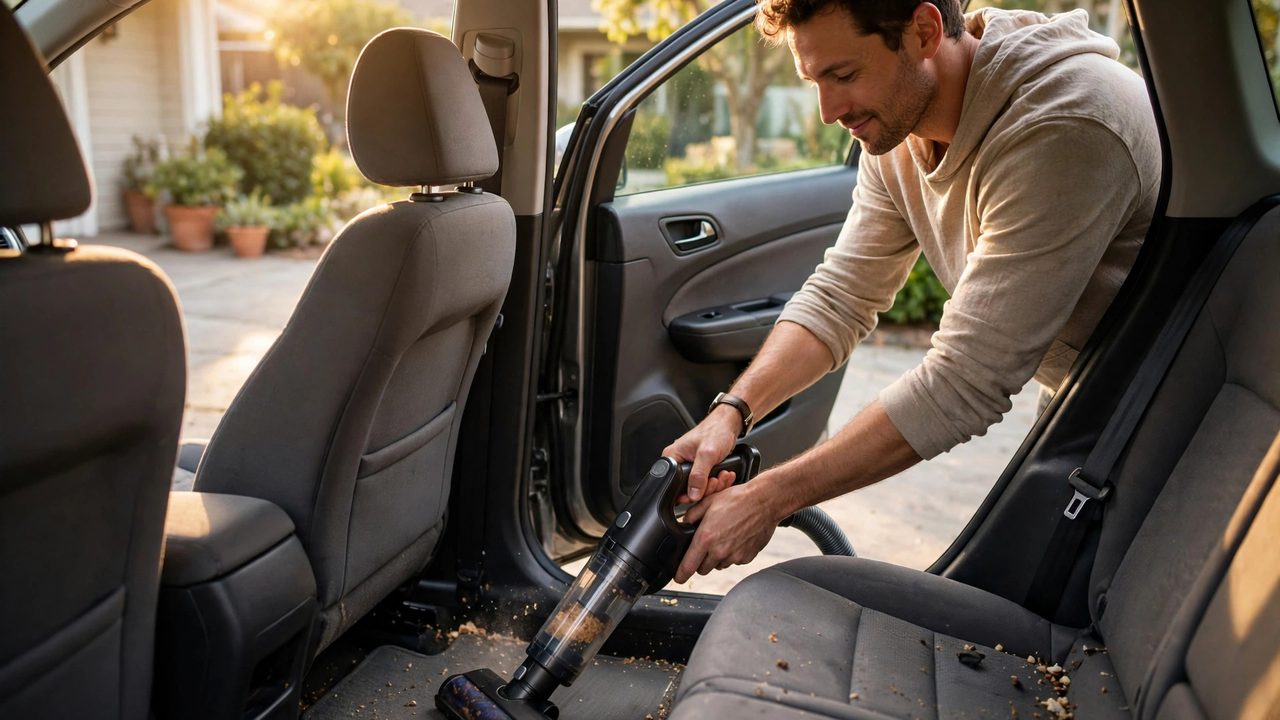
A car interior is one of the hardest small spaces to keep clean. Sand works its way into carpet pile, crumbs settle into the gap between the seat and the center console, pet hair weaves itself into upholstery, and grit collects in footwells where a full-size vacuum head simply cannot fit. That is why the best cleaners vacuums for cars are not just smaller versions of household machines. The good ones are shaped around the job: a narrow crevice tool for seat rails, a brush that agitates carpet instead of skating over it, a body light enough to hold at an angle through an open door, and a dust cup or tank sized for the amount of debris a vehicle actually produces. This guide brings together six machines that cover the main ways people clean a car, from a cordless handheld that lives in the trunk to compact wet and dry vacuums that can handle a spilled drink as well as dry dirt.
Some drivers want a grab-and-go cordless for weekly crumbs and dog hair. Others detail a family SUV after beach trips and need a hose, extension wands, and a tank that does not need emptying every few minutes. A third group already owns power-tool batteries and wants a vacuum that runs on the same platform. All six picks below were chosen because the maker lists the details that matter for vehicle work: the included tools, the power source, the capacity, and the filtration. Read the quick verdict first if you are in a hurry, then use the comparison table and buying guide to match a machine to your car, your mess, and where you plan to store it.
Quick verdict
For most drivers, the Shark UltraCyclone Pet Pro Plus CH951 is the easiest recommendation: it is cordless, light at the weight the maker lists of 2.8 pounds, and it ships with the three tools car interiors actually need, including a motorized pet power brush for upholstery. If pet hair is the whole problem, the BISSELL Pet Hair Eraser 2390A is built around exactly that, with a motorized brush tool, an upholstery tool, and triple-level filtration. Drivers who want the smallest possible kit should look at the Fanttik Slim V8 APEX, a 1.1-pound mini vacuum with a flexible hose and a storage bag that disappears into a trunk corner. For wet messes and heavier debris, step up to a tank machine: the DEWALT DCV517B if you already own 20V MAX batteries, the CRAFTSMAN CMXEVBE17250 for a light corded wet/dry vac with a blower port, or the Armor All AA255W if you want the longest accessory list, including a dedicated car nozzle.
The products in this guide
Shark UltraCyclone Pet Pro Plus Cordless Hand Vacuum CH951
Two cyclonic air streams for suction, an XL dust cup, and a weight of 2.8 pounds, which matters more than it sounds: cleaning a car means holding a
The table shows the real dividing line in this category. The three handhelds trade capacity for freedom: no cord, no hose to drag around the car, and storage that fits in a trunk or a closet. The three tank machines trade that freedom for volume and versatility: they swallow more debris, most of them pick up liquid, and a hose lets the machine sit on the driveway while only the nozzle travels around the cabin. Neither side is better in the abstract. The right choice depends on whether your typical job is a five-minute crumb patrol or a full interior reset.
How we selected
We started with the way cars actually get dirty and the spaces a vacuum has to reach. Every pick had to be genuinely suited to a vehicle interior, not just small. That meant a crevice tool or a narrow nozzle for the seat-and-console gap, a form factor that works through an open door without the body fouling on the seat, and a power source that makes sense outside the house: a battery, or a cord and hose long enough to work around a parked car from a garage outlet.
Next, we checked what each maker lists on its product pages. Suction claims are not measured the same way across brands, so we weighted the verifiable details more heavily: included attachments, dust cup or tank capacity, weight, filter type and whether it is washable, and for cordless models the battery system and the runtime the maker states. A motorized brush tool counted for a lot, because loose suction alone rarely lifts hair and ground-in grit out of carpet and fabric seats. For the wet/dry models, we looked for a hose, a utility nozzle, and a filter setup that the maker describes for both wet and dry pickup.
Finally, we balanced the list across use cases and ownership costs. A washable filter and a bagless cup keep running costs near zero, while a filter-bag machine trades a small ongoing cost for tidier emptying. Battery-platform picks only make sense if you already own the batteries, so we flagged that clearly rather than presenting a bare tool as a complete purchase. The result is six machines that overlap less than they first appear to: each one is the right answer for a different driver.
The Shark UltraCyclone Pet Pro Plus is the most complete handheld package here for car work. The maker lists two cyclonic air streams for suction, an XL dust cup, and a weight of 2.8 pounds, which matters more than it sounds: cleaning a car means holding a vacuum sideways, upside down under a seat, and out at arm’s length across a back seat, and a light body is the difference between finishing the job and stopping halfway. The CleanTouch dirt ejector empties the cup without you reaching in to pull out a wad of hair and grit, a small feature you appreciate every single time you use it in a driveway rather than over a kitchen bin.
The accessory set is the real reason this model leads the list. The self-cleaning pet power brush is a motorized tool that works hair out of upholstery and carpet instead of pushing it around, and the maker describes the brush as designed to avoid hair wrapping around the brushroll. The crevice tool handles the seat rails, the gap beside the console, and the channels around the trunk floor. The scrubbing brush is the one people forget they need until they face dried mud on a floor mat or ground-in dirt on a plastic sill; stiff bristles loosen it so the suction can take it away. The filter is washable, so upkeep is a rinse and a dry rather than a standing order for replacements.
Know its limits before you buy. A handheld dust cup, even an extra-large one, fills quickly with the sand and leaf litter a family car collects, so expect to empty it during a deep clean. Runtime on any compact cordless is measured in minutes rather than the open-ended power of a cord, which makes this a machine for regular maintenance cleans and spot jobs, not for detailing three neglected cars back to back. Within that role, though, it is hard to beat: it stores easily, deploys in seconds, and covers seats, carpets, and hard trim without a tool change feeling like a project.
Buy it if: you want one cordless vacuum that handles the whole car, you carry pets, and you value a motorized brush and a hands-off way to empty the cup.
Skip it if: you regularly face wet spills or very large debris loads, or you need long continuous runtime for multi-car detailing sessions.
The BISSELL Pet Hair Eraser 2390A is a specialist, and it does not pretend otherwise. Everything about it is aimed at hair on fabric: the maker lists a motorized brush tool designed for embedded pet hair, an upholstery tool for seat faces and cushions, and a crevice tool for the seams where hair collects along piping and seat edges. Power comes from a 14V lithium-ion battery, and the listing gives a runtime of 17 minutes, which is honestly matched to the job: a thorough pass over the seats, backs, and cargo area of one car fits inside that window if you work steadily.
Filtration is the other half of the design. The maker lists triple-level filtration, which helps keep the fine dust that rides along with pet hair from blowing straight back into the cabin while you clean. The dirt bin is listed at 0.18 gallons and is designed to empty easily, which matters because hair takes up volume fast; a bin that dumps cleanly in one shake keeps a quick job quick. At the listed weight of 3 pounds, it is easy to maneuver around headrests and child seats, and the cordless format means you can walk around the car without managing a cable or hunting for an outlet.
The trade-offs are the mirror image of its strengths. This is a dry, fabric-focused tool: it is not a wet/dry machine, and its small bin and short runtime are not built for a garage floor or a season of neglect. Charging takes considerably longer than the runtime it returns, so it rewards owners who plug it in after each use and keep it ready. If your car life involves dogs on seats every week, though, a dedicated hair tool that lives charged and ready will get used far more than a bigger machine that stays in the garage. There is also a feel-good footnote the maker states plainly: purchases support the BISSELL Pet Foundation and its work with pets in need.
Buy it if: pet hair on seats and carpet is your main problem and you want a motorized brush, an upholstery tool, and cordless convenience in one light package.
Skip it if: you need wet pickup, a large bin, or runtime for cleaning several vehicles between charges.
The Fanttik Slim V8 APEX takes the opposite approach to the tank vacs: shrink everything until the vacuum can live in the car itself. The maker lists a weight of just 1.1 pounds and a 4-in-1 design that vacuums, blows, inflates, and vacuum-seals. Suction is listed at up to 19,000Pa (45AW) in Max mode from an 80,000rpm brushless motor, with two modes: Eco, listed at up to 40 minutes, and Max, listed at up to 13 minutes. That split is the honest way to think about mini vacuums. Use Eco for dust, crumbs, and console debris on a weekly pass; save Max for sand and grit that needs persuading out of carpet.
The accessory count is remarkable for something this small. The maker lists ten practical accessories, including a crevice nozzle and a flexible hose for the gaps a rigid body cannot enter, a push-in brush for stubborn dust, multi-surface and pet brushes for fabric, and short and long blow nozzles. The blower side is genuinely useful in a car: blowing crumbs and dust out of air vents, cupholder recesses, and seat seams first, then vacuuming what lands on the mat, cleans details that suction alone skips. Charging is by Type-C, listed at about 2.5 hours with a suitable charger, so the same cable ecosystem as a phone tops it up in the car or at a desk. A one-touch emptying lid and a HEPA filter, which the maker lists as capturing 95.99 percent of dust and particles, round out a design that expects to be used in small, frequent bursts. The included storage bag keeps the body and all those small tools together in a trunk corner or glovebox-adjacent cubby.
Be realistic about scale. The dust cup is listed at 120 milliliters, and the maker itself notes that a compact vacuum of this type is less powerful than larger models and is intended for small jobs such as interior detailing. It will not replace a full-size vacuum for a trashed family SUV, and Max mode drains the battery quickly. But as a resident car tool that handles the mess while it is still small, nothing else in this guide is as easy to store or as quick to reach for.
Buy it if: you want a vacuum that lives in the car, charges over Type-C, and doubles as a blower for vents and seams.
Skip it if: your typical job is a whole-car deep clean, heavy sand, or large debris that would overwhelm a 120-milliliter cup.
The DEWALT DCV517B is the pick for drivers who already own yellow batteries. It is a cordless wet/dry hand vacuum that runs off DEWALT 20V MAX battery packs, sold as a bare tool, so the purchase only makes sense, and makes excellent sense, if a compatible battery and charger are already in your garage. The tank is listed at 1/2 gallon with a heavy-duty latch, which is generous for a handheld and means fewer stops to empty when you are working through a footwell full of gravel and leaf debris.
Two cleaning modes define how it works in a car. The front utility nozzle handles open areas such as mats, trunk floors, and seat bases, while the extendable rubber hose reaches under seats, down seat rails, and into the corners a rigid body cannot bend into. The hose is listed as heavy-duty rubber, built to survive being dragged around a workshop as well as a cabin. Filtration is a washable HEPA wet/dry filter that the maker lists as trapping 99.97 percent of dust at 0.3 microns, and because it is a wet/dry design, a spilled bottle of water in a footwell or melted snow off boots is a vacuum job rather than a towel job. A large on/off switch that the maker describes as easy to reach with one hand sounds minor until you are holding the machine inside a car with your other hand moving a seat.
The caveats are about ownership, not performance. Budget for a battery and charger if you do not already run the 20V MAX platform, and remember that runtime depends entirely on the capacity of the pack you fit. It is also a working tool in character: no pet brush, no detail accessory kit, just a nozzle, a hose, and a tank. For the right garage, that simplicity is the point. One battery system runs the drill, the impact driver, and now the vacuum that keeps the truck cab presentable.
Buy it if: you already own DEWALT 20V MAX batteries and want one cordless machine that handles wet spills and dry debris in the car and the garage.
Skip it if: you would have to buy into a battery platform from scratch, or you want a motorized pet brush and a detail accessory set.
The CRAFTSMAN CMXEVBE17250 is the lightest way into a true hose-and-tank setup. The maker lists a 2.5-gallon tank, a 2.5 peak HP motor, and a weight of 6.7 pounds, which is easy to carry from a garage shelf to the side of a car. Because it is corded, there is no runtime clock: a full interior, a trunk, and a second car can all be done in one session, and suction does not fade as a battery drains. For households that clean cars on the driveway every few weeks and do it properly, that consistency is worth more than cordless freedom.
The included kit is short and purposeful. The maker lists a 1-1/4 inch by 5 ft friction-fit hose, a crevice tool, a utility nozzle, and a filter bag. The hose keeps the tank on the ground while the nozzle works the cabin, and the slim 1-1/4 inch accessories are sized for tight areas between seats and along door sills. The vacuum also works as a blower through its blowing port, useful for clearing dust and leaves out of the cowl area at the base of the windshield and for drying mats after a wash. Storage is thought through: the maker lists a carry handle and a cord wrap, so the whole unit hangs or shelves as one tidy package. The maker lists a 3-year limited warranty, a reassuring number for a garage tool.
Understand what the filter-bag design means for running costs and habits. Bags keep emptying clean and help filtration, but they are a consumable you will replace, and the maker notes the compatible bag model so you can stock the right one. The maker also states this model is not compatible with its separate car cleaning kit, so the included tools are the toolkit; if you want a dedicated car nozzle and a long accessory list, the Armor All below is the better match. As a compact, corded wet/dry vac for cars, trucks, and vans, exactly the uses the maker names, it is a straightforward and durable formula.
Buy it if: you clean cars at home from a garage outlet and want a light, corded wet/dry vac with a hose, a blower port, and no battery to manage.
Skip it if: you need cordless freedom away from an outlet, or you dislike buying replacement filter bags.
The Armor All AA255W is built specifically around the car-and-garage brief, and its accessory list proves it. The maker lists a 2.5-gallon polypropylene tank, a 2 peak HP motor for wet and dry messes, and a wheel-base with a top handle, so the unit rolls and carries easily around a vehicle. The cord is listed at 12 ft and the hose at 6 ft by 1-1/4 inch, a combination that reaches around most cars from a single outlet position without constantly re-plugging.
Thirteen accessories are listed, and several are car-specific in a way generic shop vac kits are not. There is a deluxe car nozzle shaped for vehicle interiors, a crevice tool for seat gaps, a round dust brush and a detail brush for vents, dashboards, and trim, three extension wands for reach, and a floor brush and squeegee nozzle that handles garage floors and wet mats. The vacuum converts to a blower, which the maker suggests for clearing leaves and debris from the garage or a windshield. Filtration covers both jobs with a reusable cloth filter for dry work and a foam wet filter for liquid pickup, and the integrated hose and accessory storage keeps the whole kit in one place instead of scattered across the garage. At the listed weight of 11 pounds it is the heaviest pick here, but the wheels mean you rarely carry all of it.
The trade-off is that this is a corded, garage-based system. It will not live in your trunk, and it asks for storage space, modest as a 2.5-gallon footprint is. In return you get the most complete single purchase in this guide for someone who details at home: wet and dry pickup, a blower, car-shaped nozzles, and enough reach to do a whole vehicle properly. If your routine is a Saturday driveway session with mats out and doors open, this is the machine that matches the ritual.
Buy it if: you detail at home and want the fullest car-focused accessory kit, wet and dry pickup, and a blower in one compact utility vac.
Skip it if: you need a cordless vacuum that stores inside the car, or your cleaning happens away from a power outlet.
Buying guide: choosing a vacuum for your car
Start with the mess, not the machine. Dry crumbs, dust, and pet hair point to a handheld with a brush tool. Sand and grit need stronger sustained suction and a crevice tool that can follow carpet edges. Wet messes, spilled drinks, melted snow, wet mats, rule out the dry-only handhelds entirely and push you to a wet/dry model. Mixed family use, which is most households, is why the wet/dry tank vacs exist; dedicated handhelds win when the job is frequent, small, and dry.
Cordless, 12V, or corded? Cordless handhelds offer total freedom and trunk storage, paid for with limited runtime and small cups. Corded wet/dry vacs offer unlimited runtime and the strongest sustained pickup, paid for with an outlet, a cord, and garage storage. Think about where the car sleeps. A car that parks in a garage or driveway makes a corded vac easy. A car that parks on the street or in a shared lot makes a cordless that charges indoors the practical choice.
Attachments decide real-world results. A crevice tool is non-negotiable: the seat-to-console gap is where cars hide the most debris. A motorized brush is the single best upgrade for carpet and fabric seats, because agitation frees what suction alone cannot. A flexible hose extends any machine into footwells and under seats. A scrubbing or detail brush handles dried mud and dashboard dust. Compare kits tool by tool, not by the headline count.
Capacity and emptying. Handheld cups are measured in fractions of a gallon or in milliliters; tank vacs in gallons. A small cup is fine if you empty it without fuss, so look for one-touch or shake-free emptying and a filter you can wash. Hair fills volume faster than dirt, so pet owners should size up or empty often. Filter-bag machines empty cleanest but add a consumable; bagless machines cost nothing to empty but ask you to tap out a filter now and then.
Runtime and charging honesty. Maker runtime figures are usually for the gentlest mode, and the high-power mode that tackles sand can cut that figure dramatically, as the two-mode listings in this guide show. Match the stated runtime to one full car with a margin, and check the charge time and connector: a Type-C model tops up anywhere, while a platform tool is only as ready as the battery you remembered to charge.
Storage is a feature. A vacuum that lives where the mess happens gets used. Mini and handheld models can stay in the trunk or a closet; tank vacs need a garage corner but reward you with hose reach and capacity. On-board accessory storage sounds like a brochure line until you are hunting for a crevice tool in a dark garage; kits that store on the machine stay complete.
FAQ
Can a handheld car vacuum really replace a full-size vacuum for the car?
For routine interior maintenance, yes. A cordless handheld with a crevice tool and a brush covers seats, mats, footwells, and the trunk, which is the whole job for a car that is cleaned regularly. A full-size or tank machine still earns its place for deep cleans, wet messes, and vehicles that have gone a long time between sessions, where cup size and sustained suction decide how many stops you make.
Is a wet/dry vacuum safe for a car interior?
Yes, used as the maker directs. Wet/dry models in this guide are built to pick up liquid as well as dry debris, and their hoses and nozzles are sized for vehicle work. Keep the tank and filter setup matched to the job, dry filters for dry work and the wet filter where the maker provides one, and empty liquid promptly rather than storing it in the tank. Avoid soaking electrical fittings and connectors in the cabin, and let mats and carpet dry fully after a wet clean.
How do I get pet hair out of car carpet and seats?
Agitation first, suction second. A motorized brush tool, like the ones listed for the Shark and BISSELL picks, works hair loose from fabric so the vacuum can remove it; a plain nozzle mostly slides over embedded hair. Work in short overlapping passes, empty the cup before it packs down, and finish seams and piping with a crevice tool, where hair collects most densely.
How long should a cordless car vacuum run?
Long enough to finish one car without rushing. The makers of the picks here list figures from 13 minutes in a mini vacuum’s max mode to 17 minutes for a dedicated handheld and up to 40 minutes in a mini vacuum’s eco mode. Treat max-mode figures as your planning number for carpet and sand, and eco figures as fine for dust and crumbs. If you clean two cars or a large SUV with a third row, favor a bigger battery platform or a corded model.
What is the best way to clean under car seats?
Move the seat fully forward, clean the exposed rear footwell and rails, then move it fully back and repeat from the front. A crevice tool follows the rails, and a flexible hose, such as the ones listed with the Fanttik and DEWALT picks, reaches the center tunnel and the far corners without folding yourself into the footwell. A blower pass first can push hidden debris into the open, where the vacuum can reach it.
How often should I vacuum my car?
A light pass every one to two weeks keeps grit from grinding into carpet fibers and makes each session short, which suits handheld runtimes. Pet owners and beach or trail users benefit from a quick pass after trips, before sand and hair work deep into the pile. A deeper clean with mats removed, roughly once a season, is where a tank vac’s capacity and hose pay off.
Conclusion
The right car vacuum is the one that matches your mess, your parking situation, and your patience. Choose the Shark UltraCyclone Pet Pro Plus for the best all-round cordless package, the BISSELL Pet Hair Eraser when hair is the whole story, and the Fanttik Slim V8 APEX when the vacuum has to live in the car and handle detail work. Step up to the DEWALT DCV517B if your garage already runs on 20V MAX batteries and your messes turn wet, the CRAFTSMAN CMXEVBE17250 for light corded wet/dry work with a blower port, or the Armor All AA255W for the fullest car-focused accessory kit. Any of the six will keep an interior cleaner than a household vacuum dragged out to the driveway, because each was chosen for the spaces and debris that make cars their own cleaning problem.
M
Modern Line Home Editorial Team
We compare specs, materials and verified owner reviews before a product earns a spot. Rankings are never paid.
Affiliate disclosure. As an Amazon Associate we earn from qualifying purchases at no extra cost to you. Prices accurate as of the date shown.
House cold even with the heat on? Walk this ordered checklist: thermostat and filter first, then drafts, insulation, leaky ducts and a failing heating system.
Windows fogging up in winter? Check where the fog sits: on the room side it is indoor humidity, outside it is harmless, and between panes the seal has failed.
Store the main firewood pile about 30 feet from your house, off the ground and covered only on top. Compare racks, woodsheds, garages and indoor spots safely.
Place a portable generator outdoors only, at least 20 feet from windows, doors and vents, exhaust pointed away. Exact distances, setup steps and CO rules here.
Keep houseplants in the right winter spot: match window direction to plant type, stay clear of radiators and cold glass, and fix dry air and low light at home.
Mice enter through pencil-width gaps at foundations, pipes, vents, doors and the roofline. Walk this room-by-room winter checklist to find and seal each one.
A winter outage timeline: what to do in the first hour, first night and multi-day outage, with food safety times, pipe protection, heat and CO safety steps.
Size a space heater by room area: 10 watts per square foot at 8-foot ceilings, adjusted for insulation and ceiling height, with full wattage and BTU tables.
Start dripping at about 20 degrees, sooner for exposed pipes. Set a pencil-lead stream, drip the right faucets on both lines, and know when to stop safely.
A fridge needs 800-1,200 starting watts, not just 150-400 running watts. Use the tables to total your fridge plus freezer, lights, furnace fan and more today.












Write Your Review
No reviews yet. Be the first to share your experience!