We independently review everything we recommend. When you buy through our links, we may earn a commission. As an Amazon Associate we earn from qualifying purchases.
Best Vacuums for Detailing Cars: 6 Top Picks (2026)
Compare the best vacuums for detailing cars, from a wall-mounted wet/dry vac with a 32-foot hose to cordless handhelds built for crevices, mats and pet hair.
Detailing a car interior is a different job from vacuuming a living room. The debris is ground into carpet pile, wedged along seat rails, scattered through the trunk, and mixed with the occasional spilled drink. The best vacuums for detailing cars are the ones that reach all of that: a hose or nozzle slim enough for the gap between seat and console, enough suction to pull grit out of floor mats, and attachments shaped for upholstery, vents, and tight seams rather than open floor space. A big household canister can work, but it is rarely the tool that makes the job fast or thorough.
This guide compares six vacuums that suit car detailing in different ways. At one end is a wall-mounted wet/dry vacuum with a 32-foot hose that turns a garage bay into a permanent detailing station. At the other is a cordless mini vacuum that lives in the glove box and handles crumbs before they become a project. Between them sit compact corded shop vacs with proper car nozzles, a cordless wet/dry vac that runs on a common tool battery platform, and a handheld with a pivoting nozzle made for seat crevices. Every pick below was chosen because its maker lists the tank size, hose or nozzle setup, and accessory kit in enough detail to judge it for interior work before you buy.
Quick verdict
If you detail in a fixed garage space, the BISSELL Garage Pro 18P03 is the standout: it mounts on the wall, the maker lists a 32-foot hose, and it converts to a blower for clearing dust out of vents and door jambs before you vacuum. If you want cordless freedom with real wet/dry ability, the DEWALT DCV580H runs on the 20V MAX battery platform and carries a HEPA-rated filter. For a compact corded vac with a proper detailing kit in the box, the Armor All AA255W ships with the maker listing 13 accessories, including a deluxe car nozzle and a detail brush. The CRAFTSMAN CMXEVBE17250 is the lightweight corded alternative with a filter bag that keeps fine dust contained. For quick handheld work, the BLACK+DECKER BDH2000PL pivots its nozzle up to 200 degrees for under-seat angles, and the Fanttik Slim V8 Apex is the glove-box option that also blows, inflates, and vacuum-seals. Read the full picks below to match each one to how and where you detail.
The products in this guide
BISSELL Garage Pro Wet/Dry Vacuum 18P03
A 12-amp motor, a 4-gallon semi-translucent dirt tank, and a hose that stretches 32 feet, which is enough to walk around a vehicle parked in a
Best if you detail in your own garage and want a permanent station with the longest
We started from the tasks that define interior detailing rather than from headline suction numbers. A detailing vacuum has to pull sand and grit out of carpet and mats, reach the narrow channels beside and under seats, clean fabric upholstery without scattering debris, and handle the trunk, cargo area, and door pockets in the same session. Models that could not do at least most of that with the tools in the box were left out, however strong their motors looked on paper.
Each pick had to be a real, current product sold new, with its specifications published by the maker or on its retail listing in enough detail to verify the essentials: tank or bowl capacity, hose length and diameter where a hose exists, the accessory list, the filter type, and the power source. Where a figure appears in this article, it is phrased the way the maker lists it, because suction is measured differently across brands — peak horsepower, sealed suction, air watts, and pascals are not interchangeable numbers, and treating them as if they were would mislead you. We also applied an availability check: a pick only stayed on the list if its listing showed a live offer for a new unit at the time of checking, since a detailing guide is no use if it points at a product you cannot actually buy.
Finally, we spread the six picks across the ways people actually detail. Some owners have a garage and want a fixed station. Some detail in a driveway or apartment car park with no outlet nearby. Some want one machine for the car, the garage floor, and the occasional wet spill, while others only need to stay ahead of crumbs, pet hair, and dust between deep cleans. The list covers each of those situations at least once, and the Buy it if / Skip it if notes under each pick say plainly who should pass.
The Garage Pro is built around a simple idea: mount the vacuum on the garage wall, and let a very long hose do the travelling. The maker lists a 12-amp motor, a 4-gallon semi-translucent dirt tank, and a hose that stretches 32 feet, which is enough to walk around a vehicle parked in a typical two-car garage and reach the far side, the trunk, and the interior without moving the unit or hunting for a second outlet. An LED full-tank indicator on the semi-translucent tank shows when liquid pickup needs emptying, a small detail that matters when you are pulling water out of floor mats or a soaked cargo liner.
For detailing specifically, the included auto tool kit is the point. The maker lists seven versatile attachments with an accessory bag, covering bare floor, carpeting, and upholstery work, and the machine converts to a blower — useful for pushing dust and loose grit out of air vents, seat seams, and door jambs before you vacuum, and for clearing leaves from the cowl area at the base of the windshield. Wet and dry pickup means a spilled drink in a footwell or a wet boot tray in the trunk is the same tool’s job, not a second machine’s. The wall-mounting kit is included, and the maker lists a two-year limited warranty.
The trade-offs are about commitment and space. A wall-mounted unit is a fixed installation: it earns its keep in a garage you use regularly, and it makes little sense for renters, apartment dwellers, or anyone who details at more than one location. The 4-gallon tank is generous for car work but the unit is a canister on a wall, not something you carry to a car parked on the street. If your detailing happens wherever the car happens to be, one of the portable picks below fits better.
Buy it if: you detail in your own garage and want a permanent station with the longest hose reach on this list, wet/dry pickup, and a blower mode.
Skip it if: you rent, detail away from home, or need a vacuum you can carry to the car rather than a car that comes to the vacuum.
The DCV580H is the cordless option for people who already own DEWALT 20V MAX tools, and it is a genuine wet/dry vacuum rather than a dry-only handheld. The maker lists a 2-gallon tank, a heavy-duty, crush-resistant flexible hose of 5 feet by 1-1/4 inches, a crevice tool, and a wide nozzle attachment, with on-board accessory storage and a mounted handle so the whole unit carries to the car in one hand. The maker lists runtime at 25 minutes on a suitable battery, which is enough for a full interior session on one vehicle, including mats, seats, and trunk.
Filtration is where this pick separates itself from most small cordless vacs. The maker lists a HEPA-rated wet/dry filter that traps 99.97 percent of particles at 0.3 microns, and the filter is washable and reusable, with easy access for cleaning. Fine dust is the hidden problem in car interiors — it is what puffs back out of a cheap filter and resettles on the dashboard you just wiped — so a washable HEPA-rated filter is a practical detailing feature, not a spec-sheet decoration. The crevice tool is Airlock compatible, which matters if you want to add other DEWALT dust-extraction accessories later.
Be clear about what is in the box: this is a tool-only listing, and the maker states that the battery and charger are sold separately. If you are already on the 20V MAX platform, that is a non-issue and the value is strong. If you are not, the true cost includes a battery and charger, and one of the corded picks below may make more sense. The 2-gallon tank is also smaller than the corded canisters here, so a badly neglected interior may need a mid-session empty. The maker lists a three-year limited warranty.
Buy it if: you own DEWALT 20V MAX batteries and want cordless wet/dry cleaning with a washable HEPA-rated filter for driveway or car-park detailing.
Skip it if: you would have to buy into the battery platform from scratch, or you regularly detail several cars back to back and need a bigger tank.
The AA255W is the pick that most obviously starts from the car and works outward. It is a compact 2.5-gallon wet/dry canister, and the maker lists 2 peak HP of suction in a durable polypropylene tank on a wheel base with a top handle, so it rolls around the car and carries up a driveway without drama. The maker lists a 6-foot by 1-1/4-inch hose and a 12-foot cord, giving you a working radius that covers a vehicle parked nose-in without re-plugging halfway through the job.
What earns it a place here is the accessory count. The maker lists 13 accessories: three extension wands, a crevice tool, a blower nozzle adapter, a deluxe car nozzle, a round dust brush, a detail brush, a 2-in-1 utility nozzle, and a floor brush and squeegee nozzle, plus a reusable cloth filter and a foam wet filter. The deluxe car nozzle and detail brush are the two tools most budget shop vacs leave out, and they are exactly the ones that matter on upholstery seams, seat-back pockets, and the carpet edges under the pedals. Like several picks here, it converts to a blower for clearing loose debris from the garage floor or the windshield base, and integrated storage keeps the hose, cord, and nozzles on the unit instead of in a lost box in the corner of the garage.
The compromises are the usual ones for a compact corded canister. The tank fills faster than a full-size shop vac’s, the 1-1/4-inch accessories are a smaller diameter than professional 2-1/2-inch shop systems, and you are tethered to an outlet. None of that hurts it for single-car detailing sessions, which is the job it is shaped for. If your detailing is one or two family cars at home, this is the most car-focused kit on the list at the compact end.
Buy it if: you want a compact corded wet/dry vac whose included kit already contains a car nozzle and detail brush, with no extra accessory purchases needed.
Skip it if: you have no outlet near where you park, or you want one vac for heavy workshop cleanup as well as the car — look at a larger tank instead.
CRAFTSMAN’s 2.5-gallon CMXEVBE17250 takes a slightly different approach to the same compact corded format: it uses a filter bag. The maker lists 2.5 peak HP, 49 CFM of airflow, and 50 inches of sealed suction, with a 5-foot friction-fit hose, a 10-foot cord, and 1-1/4-inch accessories — a crevice tool and a utility nozzle are included, along with the filter bag itself. The maker lists the weight at 6.7 pounds, with a carry handle and cord wrap, so it stores on a shelf and comes down one-handed when the car needs attention.
The filter bag is the detailing-relevant decision here. Dry interior debris is mostly fine dust, hair, and grit, and a bag captures that material in a sealed packet you lift out and throw away, rather than shaking a dusty filter over a bin. For owners who detail often and dislike the dust cloud of emptying a bare tank, that is a real quality-of-life difference, and it helps the filter itself last longer between changes. The unit also works as a blower through its blowing port, and the maker positions it for home, garage, cars, trucks, and vans, with a three-year limited warranty listed.
Two honest limitations. First, the included accessory set is the slimmest of the corded canisters here — a crevice tool and utility nozzle cover the basics, but there is no dedicated car nozzle or brush in the box, and the maker specifically lists this model as not compatible with its separate car cleaning kit, so check accessory fit before planning add-ons. Second, filter bags are a running cost the bagless picks do not have. If you mostly vacuum dry debris and value clean emptying, the trade is worth it; if you expect frequent wet pickup, a foam-filter bagless design is simpler.
Buy it if: you detail mostly dry interiors, want the cleanest emptying routine in a compact corded vac, and like the light weight and cord-wrap storage.
Skip it if: you want a full car accessory kit in the box, or you plan on regular wet pickup where a bagless foam-filter setup is more convenient.
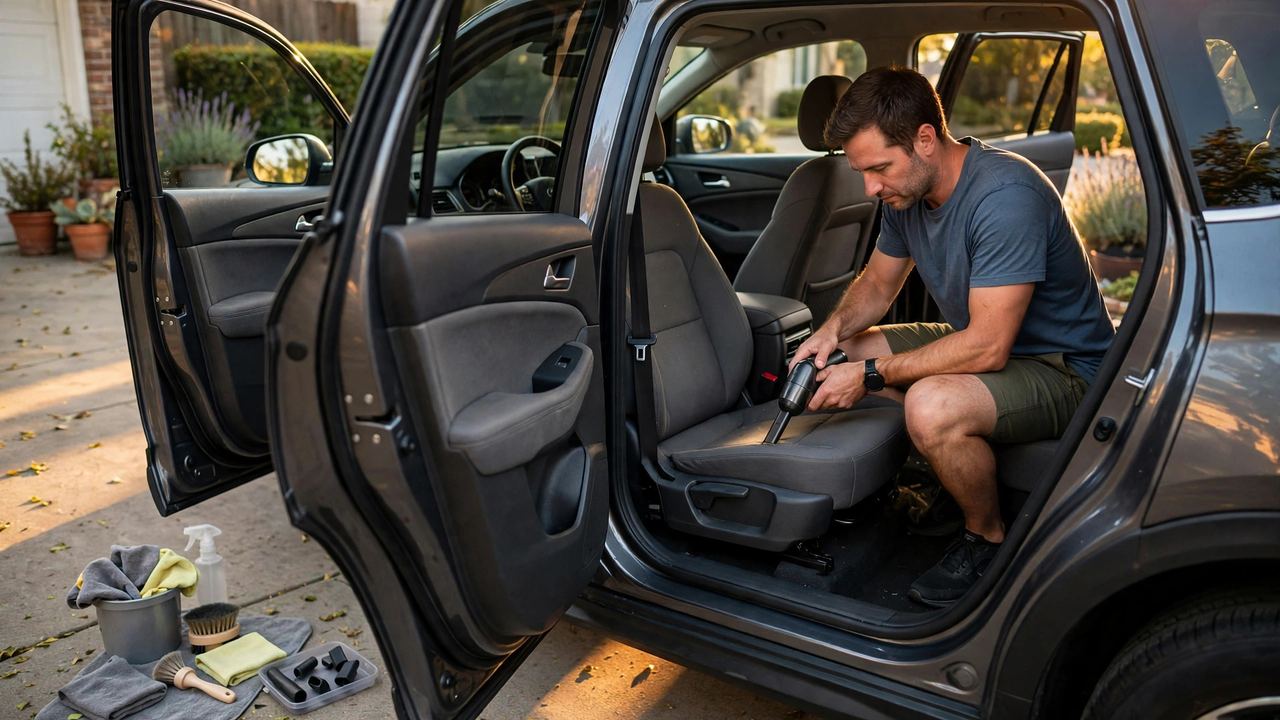
The Pivot Vac solves the specific geometry problem of car interiors: most of the mess sits at angles a straight handheld cannot reach. Its wide-mouth nozzle pivots up to 200 degrees, so the same tool that runs flat across a seat cushion angles down into the gap between seat and door, under the front seats, and along the footwells. The maker lists a 20V MAX lithium-ion battery, an extendable crevice tool and a flip-up brush built into the unit, and cyclonic action that spins dust and debris away from the filter to keep suction consistent as the bowl fills.
The maker lists the dust bowl at 15 ounces, translucent and easy to empty, with a washable filter, and the whole unit at 3 pounds — light enough to work one-handed around a cabin without your arm giving up before the back seat is done. A charging base is included, and the maker lists a two-year limited warranty. As a between-deep-cleans tool it is excellent: it lives charged, comes out for the post-beach sand, the spilled snack, and the pet hair on one seat, and goes back on its base in minutes.
Set expectations correctly, though. The maker lists runtime at 10 minutes per charge, and a 15-ounce bowl is a maintenance capacity, not a full-detail capacity. This is not the tool for a minivan that has not been cleaned since last season, and it is dry-only — a spilled drink needs one of the wet/dry picks above. Think of it as the vacuum that keeps a car from ever getting bad, paired with occasional deeper cleans, rather than the vacuum that rescues a neglected interior in one session.
Buy it if: you want a light cordless handheld whose pivoting nozzle and built-in crevice tool are shaped for seat gaps, footwells, and quick upkeep between details.
Skip it if: you need wet pickup, long runtime, or enough capacity for a full deep clean of a large vehicle in one go.
The Slim V8 Apex is the smallest tool here by a wide margin — the maker lists it at 1.1 pounds — and it is designed to be stored in the car itself, in the included storage bag, rather than in the garage. The maker lists a brushless motor spinning at 80,000 rpm with suction up to 19,000 Pa (45 air watts) in its maximum mode, and two suction modes: an Eco mode listed at up to 40 minutes of runtime and a Max mode listed at 13 minutes. It charges over USB-C, with the maker listing a full charge in about 2.5 hours from a suitable adapter, so it can top up from the car itself between uses.
Its party trick is that vacuuming is only one of four functions. The maker lists it as a 4-in-1 tool that also blows, inflates, and vacuum-seals, and ships it with 10 practical accessories, including a crevice nozzle and flexible hose for corners, a push-in brush for stubborn dust, and multi-surface and pet brushes for fabric. In a car, the blower mode is genuinely useful — it pushes crumbs and dust out of cup holders, vents, and seat seams so the vacuum can pick them up instead of chasing them. The dust cup is small, at 120 ml as the maker lists it, but it empties with a one-touch lid, and the HEPA filter handles the fine dust. The maker is candid that this compact vacuum is less powerful than larger models and is intended for small tasks and interior touch-ups, and that honesty matches its role here.
This is a maintenance and spot-cleaning tool, full stop. It will not extract a winter’s worth of ground-in grit from floor mats, and its tiny bin fills fast on a genuinely dirty car. But for drivers who detail in small, frequent passes — five minutes while fueling, a quick pass after the kids or the dog — it removes the friction that makes people skip the job entirely, because the vacuum is already in the car, charged over the same cable standard as a phone.
Buy it if: you want an ultra-light cordless mini vacuum that lives in the car for spot cleans, with a blower mode for vents and cup holders and USB-C charging.
Skip it if: your car needs deep extraction of mats and carpets — start with one of the wet/dry canisters above and treat this as a later add-on.
Buying guide
Start with where you detail, not with suction figures. The single biggest decision is your workspace. A garage with a wall and an outlet you control makes a wall-mounted or corded canister the strongest and simplest choice. A driveway, street, or shared car park pushes you toward cordless, and then the question becomes which battery you already own. A car that mostly needs upkeep between proper cleans is handheld territory. Every other specification matters less than this fit, because a powerful vacuum that is awkward to deploy simply does not get used.
Read suction numbers as maker-specific, not comparable. Brands publish different measures: peak horsepower on corded shop vacs, sealed suction in inches of lift, airflow in CFM, air watts, and pascals on mini cordless models. A higher number in one system does not beat a lower number in another. What you can compare fairly is the combination a maker lists together — airflow moves loose debris, sealed suction pulls grit out of carpet pile — and the accessory set, because in a car the nozzle shape usually matters more than the last increment of motor power. A crevice tool that fits the seat rail beats raw suction that cannot reach it.
Match the accessory kit to interior surfaces. For detailing, look for four tools: a crevice tool for seat rails and console gaps, a brush (ideally a detail brush) for vents, seams, and switchgear surrounds, a wider car or utility nozzle for mats and cargo floors, and a soft brush for upholstery. Check what is actually in the box — some compact vacs include a full kit, others include two basics and sell the rest separately, and at least one model on this list is explicitly not compatible with its brand’s separate car kit. Extension wands help with the garage floor and the area around the car, but they are secondary for interior work.
Decide how you feel about filters and emptying. Three systems appear in this guide. A filter bag captures dry dust in a sealed packet — cleanest to empty, with a small ongoing cost. A cartridge or cloth filter with a bare tank costs nothing per use but needs shaking out and occasional washing. A washable HEPA-rated filter, like the one the maker lists for the DEWALT pick, is the best choice if fine dust bothers you, because it traps the smallest particles and rinses clean instead of being replaced. For wet pickup, every wet/dry model here expects a foam sleeve or a filter change before liquids, so read the maker’s wet-use instructions before the first spill, not during it.
Size the tank to your session, not your vehicle. A 2 to 2.5-gallon canister empties once or twice in a heavy session and stores on a shelf; a 4-gallon tank suits owners who also clean the garage. Handheld bowls measured in ounces or millilitres are for maintenance only. Cordless runtime deserves the same realism: the maker-listed figures on this list run from 10 minutes for a compact handheld to 40 minutes in a mini vacuum’s Eco mode, and maximum-suction modes are always shorter. If your typical session is one car, any of them works; if it is three cars on a Saturday, corded or swappable tool batteries are the honest answer.
Wet/dry is worth having if your car carries life. Drinks, wet boots, melted snow, and damp dogs all argue for a wet/dry pick, and four of the six vacuums here offer it. If your car stays dry and garaged, a dry handheld is lighter and simpler. Either way, a blower function — included on several picks — is an underrated detailing feature: blowing dust out of vents, seams, and the cowl before vacuuming is faster than picking at it with a nozzle, and it is how professionals start an interior.
FAQ
Is a shop vac good for detailing a car?
Yes — compact wet/dry shop vacs are the traditional detailing tool because they combine strong suction, a hose that reaches the whole cabin, and wet pickup for spills. Choose a smaller 2 to 5-gallon model with 1-1/4-inch accessories, which fit seat gaps and interior contours better than large 2-1/2-inch workshop fittings, and check that a car nozzle or brush is included or available.
How much suction does a car detailing vacuum need?
There is no single cross-brand number, because makers publish different measures — peak horsepower, inches of lift, CFM, air watts, or pascals. For interior work, technique and nozzles matter as much as the figure: a crevice tool concentrates whatever suction a machine has into the channels where debris hides. Any pick on this list has enough maker-listed suction for its intended role, from spot cleaning to full wet/dry sessions.
Cordless or corded for detailing?
Corded vacs give unlimited runtime and usually stronger sustained suction, and they suit a fixed garage setup. Cordless vacs win on convenience — no outlet hunt, no cord dragging across paintwork — and modern tool-platform models like the DEWALT on this list handle a full interior on one battery. If you already own batteries for a major tool platform, cordless is an easy choice; if not, corded compact canisters are simpler and lighter on accessories cost.
Can I use a car vacuum on wet spills?
Only if it is a wet/dry model. Four of the six picks here are wet/dry; the two handhelds are dry-only. Wet/dry models typically need their foam sleeve fitted or the dry filter removed before liquid pickup, exactly as the maker instructs, and the tank should be emptied and rinsed after wet use so residue does not sour.
What attachments matter most for car interiors?
A crevice tool first — seat rails, console edges, and door pockets are where debris collects. Next, a detail or dusting brush for vents and seams, and a car or utility nozzle for mats and trunk carpet. A blower mode or blower nozzle is a bonus that clears dust from vents before vacuuming. Extension wands are useful around the car but least important inside it.
How often should I vacuum my car’s interior?
A light pass every week or two keeps grit from grinding into carpet fibres and makes deep details faster and rarer. That rhythm is exactly what the handheld picks are for; save the canister sessions for monthly deep cleans, seasonal resets, and spill recovery.
Conclusion
The right detailing vacuum is the one matched to your space and your habits. Garage owners get the most complete setup from the wall-mounted BISSELL Garage Pro 18P03, with its 32-foot hose and blower mode. DEWALT 20V MAX owners get cordless wet/dry freedom and the best filtration here in the DCV580H. The Armor All AA255W is the compact corded pick with the car-focused kit already in the box, while the CRAFTSMAN CMXEVBE17250 trades that kit for the cleanest filter-bag emptying. For upkeep, the BLACK+DECKER BDH2000PL reaches the angles other handhelds miss, and the Fanttik Slim V8 Apex lives in the car so small messes never become big ones. Pick the format that fits where you park, keep the crevice tool busy, and your interior will stay at the standard the rest of your detailing deserves.
M
Modern Line Home Editorial Team
We compare specs, materials and verified owner reviews before a product earns a spot. Rankings are never paid.
Affiliate disclosure. As an Amazon Associate we earn from qualifying purchases at no extra cost to you. Prices accurate as of the date shown.
House cold even with the heat on? Walk this ordered checklist: thermostat and filter first, then drafts, insulation, leaky ducts and a failing heating system.
Windows fogging up in winter? Check where the fog sits: on the room side it is indoor humidity, outside it is harmless, and between panes the seal has failed.
Store the main firewood pile about 30 feet from your house, off the ground and covered only on top. Compare racks, woodsheds, garages and indoor spots safely.
Place a portable generator outdoors only, at least 20 feet from windows, doors and vents, exhaust pointed away. Exact distances, setup steps and CO rules here.
Keep houseplants in the right winter spot: match window direction to plant type, stay clear of radiators and cold glass, and fix dry air and low light at home.
Mice enter through pencil-width gaps at foundations, pipes, vents, doors and the roofline. Walk this room-by-room winter checklist to find and seal each one.
A winter outage timeline: what to do in the first hour, first night and multi-day outage, with food safety times, pipe protection, heat and CO safety steps.
Size a space heater by room area: 10 watts per square foot at 8-foot ceilings, adjusted for insulation and ceiling height, with full wattage and BTU tables.
Start dripping at about 20 degrees, sooner for exposed pipes. Set a pencil-lead stream, drip the right faucets on both lines, and know when to stop safely.
A fridge needs 800-1,200 starting watts, not just 150-400 running watts. Use the tables to total your fridge plus freezer, lights, furnace fan and more today.












Write Your Review
No reviews yet. Be the first to share your experience!