
Key takeaways
- Find the best towels for drying and polishing a car, from twisted-loop dryers to plush polish removers, with sizes, GSM, weaves and care compared clearly today.
Drying and polishing look like two separate jobs, but they share the same risk: whatever touches the paint last decides how the finish looks when the light hits it. A towel that drags grit across a wet panel can undo a careful wash in one pass, and a towel that smears polish residue instead of lifting it leaves the haze you were trying to remove. That is why choosing the best towels for drying and polishing a car is less about buying the thickest cloth on the shelf and more about matching weave, weight and size to each step of the job.
This guide splits the work the way detailers actually do it. First comes bulk drying, where a large, high-capacity towel pulls rinse water off hoods, roofs and doors before minerals can spot. Then comes the finishing work, where a smaller, plush towel removes polish, wax and spray detailer without leaving swirls behind. Some towels here are pure dryers, one is a pure polishing towel, and several can cross over for light duty in the other role. Every specification below is taken from the maker’s own listing, phrased as the maker lists it, so you can compare like with like.
We also explain the numbers that actually matter. GSM tells you how dense the fabric is, but weave decides how that density behaves: twisted loop drinks water fast, terry loop feels plush and forgiving, waffle weave wrings out easily, and a deep dual-sided pile is built to trap polish residue. Size matters too, because a towel that covers a panel in one draw needs fewer passes, and fewer passes means fewer chances to drag anything across clear coat.
Quick verdict
For most drivers, the balanced starting point is The Rag Company Gauntlet Car Drying Towel 20×30: the maker lists a 900 GSM Korean 70/30 blend with a hybrid twist-loop weave and a soft suede border, which suits everyday sedans and crossovers well. If you dry a truck, SUV or RV and want maximum water capacity in a single towel, Griot’s Garage PFM Terry Weave Drying Towel 25×35 and the Blackline Twisted-Loop Drying Towel 24×36 are the heavy lifters, at 1120 GSM and 1300 GSM as the makers list them. The Chemical Guys Woolly Mammoth Drying Towel Blue 36×25 is the plush oversized option for owners who prefer a deep pile and a lay-flat-and-pull technique. Meguiar’s Water Magnet Microfiber Drying Towel X2000 is the lighter, easy-wringing waffle-style choice for smaller cars and quick work. And for the polishing half of the job, Meguiar’s Supreme Shine Microfiber Towels X2020 3-Pack is the dedicated pick, with a dual-sided plush pile made for removing compounds, polishes and waxes.
Comparison table
| Product | Best for | Size as listed | Weight as listed | Weave or pile |
|---|---|---|---|---|
| The Rag Company Gauntlet Car Drying Towel 20×30 | Balanced everyday drying | 20 x 30 inches | 900 GSM | Hybrid twist-loop, 70/30 Korean blend |
| Griot’s Garage PFM Terry Weave Drying Towel 25×35 | Maximum capacity, large vehicles | 25 x 35 inches | 1120 GSM | Long loop terry weave, double-sided |
| Chemical Guys Woolly Mammoth Drying Towel Blue 36×25 | Plush oversized drying | 36 x 25 inches | Plush pile, GSM not listed | Deep plush microfiber pile |
| Blackline Twisted-Loop Drying Towel 24×36 | Fast one-pass drying | 24 x 36 inches | 1300 GSM | Twisted loop, 70/30 blend |
| Meguiar’s Water Magnet Microfiber Drying Towel X2000 | Light, easy-wringing drying | 22 x 30 inches | Not listed as GSM | Waffle-style microfiber |
| Meguiar’s Supreme Shine Microfiber Towels X2020 3-Pack | Polish and wax removal | 16 x 24 inches, 3 towels | Not listed as GSM | Dual-sided plush pile |
How we selected
We started with the two jobs in the keyword itself, drying and polishing, and required every pick to be a current, real product from a known car-care maker, with a maker listing that states its size, construction and intended use. A towel with no verifiable specifications was excluded entirely rather than described with filler, because a buying decision based on invented numbers is worse than a shorter list.
For the drying picks, we looked for three things. The first was capacity, expressed by the maker as GSM, absorbency claims or both, since a drying towel that saturates halfway across a hood forces extra passes and extra wringing. The second was paint safety in the construction itself: soft borders, satin edging, edgeless or twisted-loop faces and plush piles that lift water and loose grit away from the surface instead of pushing it along. The third was size relative to vehicle, because a 20 by 30 inch towel that suits a sedan can feel undersized on a truck roof, while a 36 inch towel can be clumsy around mirrors and trim on a small car.
For the polishing pick, the criteria flipped. Bulk absorbency matters less than pile depth and residue control: the towel needs a soft, deep face that pulls dried polish and wax off the panel and holds it in the pile, away from the paint, plus a size that folds into a manageable pad. We also favoured packs, because polishing with a single towel means folding to a clean face again and again, while a multi-pack lets you rotate fresh towels panel by panel.
Finally, we checked care requirements. Every towel here is machine washable as the makers list, and all of them share the same basic rules: wash microfiber with microfiber, skip fabric softener and bleach, and dry on low heat or air dry. A towel that cannot survive routine washing is a poor pick no matter how well it works on day one, so durability claims and wash tolerance formed part of the selection too.
Top picks
The Rag Company Gauntlet Car Drying Towel 20×30
The Gauntlet is the towel to start with if you want one dryer that behaves well on almost any daily driver. The maker lists a patented twist-loop hybrid weave, meaning the face alternates twist-loop and plush stripes, and that combination is the point: the twisted loops pull water off the panel quickly, while the plush stripes reduce drag so the towel glides instead of grabbing. On a wet hood that difference is easy to feel, because a towel that sticks and skips tempts you to press harder, and pressure is exactly what you want to avoid on soft clear coat.
The maker lists the fabric as a 900 GSM, 70/30 AA-grade Korean split microfiber blend, with more than 500,000 fibers per square inch. In plain terms, the 70/30 blend carries more polyamide than cheaper 80/20 towels, and polyamide is the fiber that does much of the absorbing and gives the towel its softer hand. The 20 by 30 inch size sits in the useful middle: large enough to cover a door or half a hood per draw, small enough to control around mirrors, badges and window frames without the corners flopping onto the ground.
Edge treatment is where this towel earns its place for careful owners. The maker lists a ButterSoft suede microfiber border, which replaces the stitched or banded edges that can mark paint on some towels. If your car wears a ceramic coating, the maker positions this weave as coating-friendly, and the low-drag face supports that use, since coated panels shed water into beads and sheets that a twist-loop face picks up cleanly.
- Size: the maker lists 20 x 30 inches for this version, with other sizes in the same line
- Fabric weight: the maker lists 900 GSM
- Blend: the maker lists 70/30 Korean split microfiber
- Weave: the maker lists a patented twist-loop hybrid with plush stripes
- Border: the maker lists a ButterSoft suede microfiber border
- Care: the maker lists the towel as withstanding hundreds of washes
Pros
- Hybrid weave dries fast without the grabbing feel of pure plush
- Soft suede border removes a common source of edge marks
- Mid-range size suits sedans, hatchbacks and crossovers well
Cons
- One towel may need a wring-out on a large SUV
- Not a polishing towel; the twist-loop face is built for water, not residue
Buy it if you want one dependable dryer for a car or crossover and care about a soft border. Skip it if you dry trucks daily and want the largest capacity in a single pass, or if you mainly need towels for polish removal.
Griot’s Garage PFM Terry Weave Drying Towel 25×35
PFM stands for Pure Freaking Magic in Griot’s Garage naming, and the towel behind the name is a heavyweight terry-loop dryer. The maker lists a 1120 GSM weight with a long loop terry weave, and states that the towel holds up to 5 pounds of water. That capacity is the story here: laid across a roof or hood and pulled slowly toward you, it takes the bulk of the rinse water in one draw, which is exactly the technique that keeps drying quick and keeps you from chasing drips panel by panel.
The maker lists the size at 25 by 35 inches with a double-sided construction, so both faces work and the towel effectively gives you two drying surfaces before it needs wringing. Terry weave feels different from twisted loop: the loops are longer and plusher, the hand is softer and more forgiving, and the towel tends to glide on its thick fibers rather than squeegeeing the panel. Owners of dark cars often prefer that feel, because the cushion of terry pile keeps any particle that survived the wash suspended in the pile instead of pressed against the paint.
For edges, the maker lists radiused corners with soft satin edging, designed to prevent scratching while drying. The thick fibers also reduce drag and surface tension, as the maker lists it, so the towel pulls across panels without sticking or catching. The trade-off of all that capacity is wet weight: a towel holding several pounds of water is a heavy towel, and on vertical doors you will feel it. Folding it into quarters and rotating faces spreads the load and keeps a drier face against the paint for longer.
- Size: the maker lists 25 x 35 inches
- Fabric weight: the maker lists 1120 GSM
- Weave: the maker lists long loop terry weave, double-sided
- Capacity: the maker lists holding up to 5 pounds of water
- Edges: the maker lists radiused corners with soft satin edging
- Care: the maker lists machine washing after use
Pros
- Very high listed capacity for one-pass drying on big panels
- Plush terry feel suits dark and delicate finishes
- Double-sided build doubles the working surface
Cons
- Heavy when saturated, especially on vertical panels
- Bulk can feel clumsy around mirrors and tight trim
Buy it if you dry a truck, SUV or large sedan and want a plush, high-capacity towel with soft edging. Skip it if you prefer a light towel you can wring constantly, or you wash a small car where the size is more than you need.
Chemical Guys Woolly Mammoth Drying Towel Blue 36×25
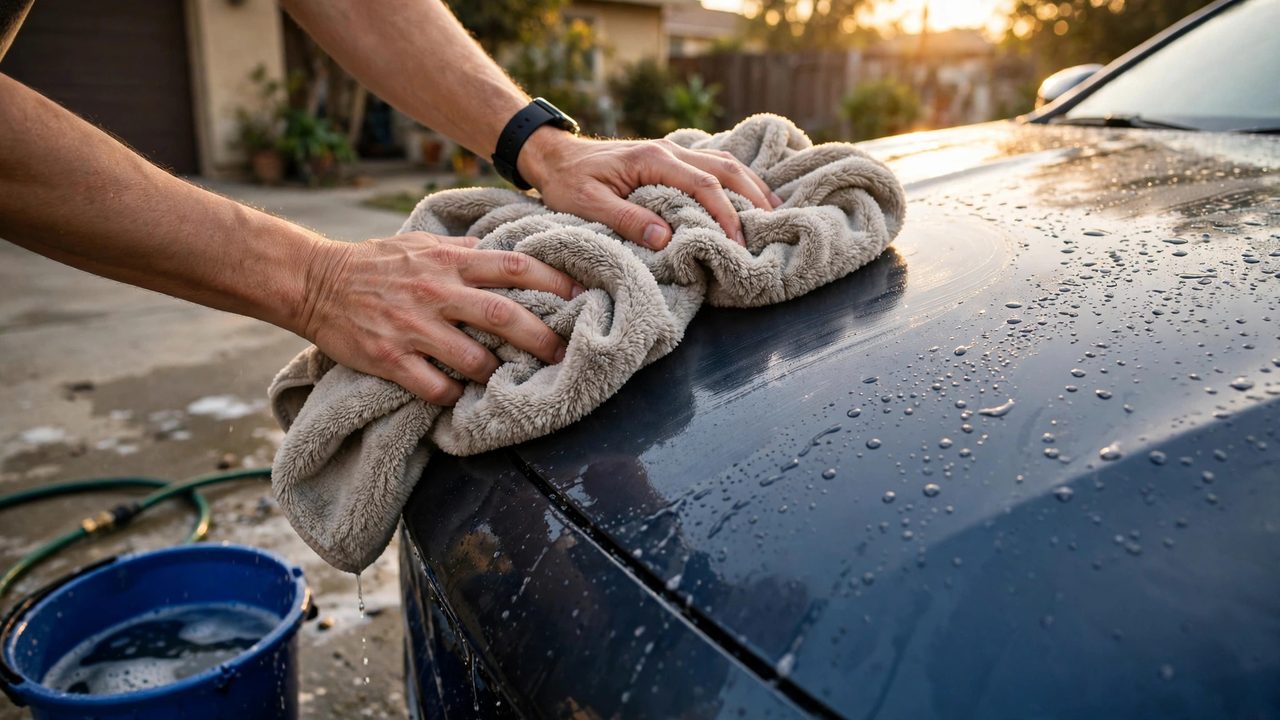
The Woolly Mammoth takes the opposite approach to the dense twist-loop towels: instead of a tight, technical weave, it uses a deep, shaggy plush pile at an oversized 36 by 25 inches, as the maker lists it. The technique the maker describes is simple and worth copying whichever towel you buy: lay the towel flat on the panel and pull it toward you, rather than wiping back and forth. One draw of a towel this size covers a hood or a roof section, which means fewer passes, less pressure and less time for water to sit and spot.
The maker lists the deep weave as lifting water and leftover grit up off the surface rather than dragging it, and positions the plush pile as safe on dark clear coat. That matters most on black and dark blue cars, where drying marks show first. The maker also lists the towel for use beyond paint: glass, wheels and door jambs, plus cars, trucks, motorcycles, RVs and boats. In practice, most owners keep a towel this plush for paint only and let older towels handle jambs and wheels, because a towel’s softness is a resource you protect by keeping grit out of it.
Chemical Guys does not headline a GSM figure for this towel in the listing we read, so compare it on size, pile and technique rather than density. The maker lists machine washing in warm water with detergent only, no fabric softener and no bleach, then tumble on low, and states the deep pile stays absorbent instead of going flat. Follow that exactly: softener residue is the most common reason a plush towel starts pushing water around instead of drinking it.
- Size: the maker lists 36 x 25 inches
- Construction: the maker lists a deep plush microfiber pile
- Technique: the maker lists lay-flat-and-pull drying, not wiping
- Uses: the maker lists paint, glass, wheels and door jambs
- Colour: this listing is the blue version
- Care: the maker lists warm wash, detergent only, tumble low
Pros
- Oversized face covers hoods and roofs in one draw
- Deep plush pile is gentle on dark clear coat
- Simple care routine, fully machine washable
Cons
- No GSM figure listed, so density cannot be compared directly
- Plush pile can hold onto lint and debris if washed with cotton
Buy it if you like the lay-flat-and-pull method and want the plushest feel for a dark car. Skip it if you want a tightly specified towel with a stated GSM, or a compact towel for a small wash kit.
Blackline Twisted-Loop Drying Towel 24×36
Blackline builds this towel around one number and one weave: the maker lists 1300 GSM in a twisted-loop construction, the densest specification in this guide. Twisted loop works by presenting thousands of looped fibers that trap water inside the loops as the towel glides, and the maker states the towel absorbs more than six times its weight in water, up to a gallon, and can dry an entire car in one go. Treat those as maker claims, but the underlying logic is sound: density plus loop structure is what lets a towel keep drinking after a thinner cloth has saturated.
The maker lists the size at 24 by 36 inches and the blend at 70 percent polyester and 30 percent polyamide, the same premium ratio as the Gauntlet. That combination of footprint and density is aimed at owners who dry full-size cars, trucks and SUVs and dislike stopping to wring. Spread flat, it covers a large share of a hood at once; folded, it gives you thick, cushioned faces for doors and fenders.
The maker lists the towel as streak-free and lint-free in use, and the twisted-loop face is the reason streaks are less likely: the loops pull water into the towel instead of smearing a thin film across the panel. Care follows the standard microfiber rules the maker lists: wash in cold water with a mild detergent, keep it with other microfiber only, and air dry or use low heat, avoiding bleach and fabric softener. One caution that applies to every heavy towel applies doubly here: a saturated 1300 GSM towel is weighty, so support it with both hands on vertical panels rather than letting a wet corner drag.
- Size: the maker lists 24 x 36 inches
- Fabric weight: the maker lists 1300 GSM
- Blend: the maker lists 70 percent polyester, 30 percent polyamide
- Weave: the maker lists twisted-loop construction
- Absorbency: the maker lists more than six times its weight in water
- Care: the maker lists cold wash with mild detergent, air dry or low heat
Pros
- Highest listed GSM in this guide for maximum capacity
- Large footprint suits trucks and SUVs
- Premium 70/30 blend as listed
Cons
- Heavy when fully loaded with water
- Oversized for compact cars and tight garage wash setups
Buy it if one-pass drying of a large vehicle is your priority and you want the densest listed towel. Skip it if you have limited strength or storage, or you prefer to wring a light towel often.
Meguiar’s Water Magnet Microfiber Drying Towel X2000
The Water Magnet is the veteran of this list and the representative of the waffle-weave school of drying. Where plush towels hold water in deep pile, a waffle texture holds it in pockets, and the practical difference is wringing: a waffle towel gives its water back easily, stays light in the hand, and keeps working through a wash session with quick wring-outs. The maker lists the towel at 22 by 30 inches and states it absorbs up to two times the water compared to terry towels, with a spot-free, streak-free finish as the goal.
That lighter character makes the X2000 the natural pick for smaller cars, for glass-heavy work, and for owners who dry in stages: a first pass with a big towel, then the Water Magnet for mirrors, window frames, door shuts and the drips that escape from badges and trim minutes after you think you are done. It is also a sensible second towel for anyone who finds the heavyweight options tiring, because drying should be the gentle, unhurried step of the wash, not a workout.
The maker lists the construction as premium microfiber, machine washable and built for repeated use. Waffle towels also tend to release grit more readily in the wash than deep plush, which helps them stay soft over time. The compromise is ultimate capacity: on a large, very wet vehicle you will wring this towel more often than the 1120 or 1300 GSM options, and on a big hood a plush towel’s single draw is faster. Judge it as the control-and-convenience pick, not the capacity pick.
- Size: the maker lists 22 x 30 inches
- Model: the maker lists model X2000
- Weave: waffle-style microfiber texture
- Absorbency: the maker lists up to two times the water of terry towels
- Finish: the maker lists a spot-free, streak-free result
- Care: the maker lists machine washable, reusable construction
Pros
- Light in the hand and easy to wring out
- Handy size for glass, mirrors and drip-chasing
- Long-established model from a mainstream maker
Cons
- Lower total capacity than the heavyweight towels
- Waffle texture has less cushion than deep plush on soft paint
Buy it if you drive a smaller car, want an easy-handling dryer, or need a second towel for glass and details. Skip it if you want to dry a large SUV with the fewest possible wring-outs.
Meguiar’s Supreme Shine Microfiber Towels X2020 3-Pack
Every towel above is a dryer first. The Supreme Shine is the polishing half of this guide, and it exists because using a damp drying towel to buff off polish is how residue gets smeared and grit gets introduced at the worst moment. The maker lists these towels for removing compounds, polishes, waxes and spray detailers, and for use on paint, glass, plastic and chrome. That is the final-touch stage, where the towel’s job is to lift dried product cleanly and leave the panel clear.
The maker lists a thick, deep, dual-sided microfiber pile that absorbs two times more than traditional terry towels. Dual-sided matters for polishing technique: fold the towel into quarters and you have eight faces; work a panel, and when a face loads with residue, flip or refold to a clean face instead of rubbing the collected product back across the paint. The maker lists the size at 16 by 24 inches, larger than the typical small buffing cloth, which gives each folded pad more clean area and makes the towel easier to keep flat against the panel.
The pack format is the other half of the value. The maker lists three towels per pack, so you can dedicate one to polish removal, one to wax or sealant wipe-off, and keep one clean for a final detailer pass, rather than asking a single towel to do every stage. The maker also lists a special edging intended to reduce the risk of swirling or scratching, and machine washing with similar microfiber, keeping colours separate and avoiding fabric softener and bleach. Retire these towels to glass and interior duty once the pile mats down, and promote a fresh pack to paint.
- Size: the maker lists 16 x 24 inches per towel
- Pack: the maker lists 3 towels
- Model: the maker lists model X2020
- Pile: the maker lists a thick, deep, dual-sided microfiber pile
- Uses: the maker lists removing compounds, polishes, waxes and spray detailers
- Surfaces: the maker lists paint, glass, plastic and chrome
Pros
- Purpose-built for polish and wax removal, not a drying compromise
- Three-towel pack supports clean-face rotation
- Larger format folds into a generous, easy-to-control pad
Cons
- Not a bulk drying towel for a fully wet car
- Yellow pile shows residue clearly, so it needs washing after each session
Buy it if you polish or wax your car and want dedicated towels for residue removal. Skip it if you only wash and dry, with no polishing step in your routine.
Buying guide
Separate the two jobs. The single most useful decision is to stop asking one towel to dry and polish. A drying towel spends its life wet and loaded with rinse water; a polishing towel must start bone dry and stay grit-free. Keep at least one large dryer and a small set of polishing towels, and never let the polishing set touch wheels, jambs or exhaust tips.
Read GSM as density, not a verdict. GSM measures grams per square metre. Higher GSM usually means more capacity and more cushion, which is why the makers list figures from 900 to 1300 GSM on the big dryers here. But weave changes how density behaves: twisted loop at 900 GSM can dry faster than a loose plush at a higher number, and a waffle towel with no headline GSM can be the right tool for glass and detail work. Use GSM to compare towels of the same weave first.
Match size to the vehicle. For a sedan or hatchback, a towel around 20 by 30 inches is easy to control and big enough for efficient draws. For trucks, SUVs and RVs, step up to 25 by 35 or 24 by 36 inches so the roof and hood do not need pass after pass. Oversized towels on small cars mostly add risk: trailing corners pick up grit from the ground and from lower panels.
Check the edges. Whatever touches paint should be soft all the way to the boundary. Look for suede borders, satin edging, radiused corners or edgeless construction as the makers list them, and be wary of hard stitched tags; many owners remove tags before first use. Edges are a small detail that decides whether a towel stays paint-safe after you fold it.
Use the right technique. After rinsing, work top down. Lay the dryer flat on the roof or hood and pull it slowly toward you, letting the towel’s weight do the work. Fold it into quarters, rotate to a drier face as you move to the sides, and finish with a smaller towel around mirrors, handles and badges. For polishing, apply and remove product panel by panel, folding to a clean face whenever the pile loads up, and use straight, light strokes for the final wipe.
Wash microfiber like it matters, because it does. Wash towels separately from cotton, in warm or cold water with a plain detergent, and never use fabric softener or bleach: softener coats the fibers and kills absorbency, which is the main reason good towels seem to wear out early. Tumble dry low or air dry. Store paint towels in a closed container so garage dust stays out of the pile, and demote tired paint towels to wheels and interiors instead of throwing them away.
FAQ
Can one towel really handle both drying and polishing?
A plush towel can do light duty in both roles, and several picks here can chase drips or wipe detailer in a pinch. But a towel used for bulk drying starts the polishing step damp and possibly carrying grit, so for regular polishing a dedicated dry set like the Supreme Shine 3-pack gives cleaner, safer results.
What GSM should I choose for a drying towel?
For most cars, the makers’ listings in the 900 GSM range offer a good balance of capacity and control. Step up to 1120 or 1300 GSM if you dry large vehicles and want the fewest wring-outs, and accept that the towel will be heavier when wet. GSM is density, though, so weigh weave and size alongside it.
Is twisted loop or terry weave better?
Twisted loop pulls water off quickly and glides with little drag, which suits fast, efficient drying and coated cars. Terry loop is plusher and more cushioned, which many owners prefer on dark or delicate paint. Neither is universally better; they are different feels for the same job, and both appear in this guide for that reason.
How many towels do I need for one car?
A workable minimum is one large drying towel, one smaller towel for glass and drips, and two to three polishing towels so you can rotate clean faces. Trucks and SUVs often justify a second large dryer. It is better to rotate towels than to keep working with one saturated or loaded towel.
Why did my towel stop absorbing water?
The usual cause is fabric softener or dryer-sheet residue coating the fibers, followed by washing with cotton, which loads the pile with lint. Wash the towel again with plain detergent and no softener, dry it on low, and keep it in a microfiber-only wash load. If the pile is matted or the towel leaves lint, demote it to non-paint jobs.
Are these towels safe for ceramic-coated cars?
Soft microfiber with gentle edges is the standard choice for coated paint, and the Gauntlet’s maker specifically positions its low-drag hybrid weave for coating care. The same rules apply: rinse well first, use the lay-and-pull method, keep pressure light, and never use a towel that has touched wheels or the ground.
Conclusion
The right setup is a small system, not a single hero towel. Choose a dryer that matches your vehicle: the Gauntlet 20×30 for balanced everyday use, the Griot’s Garage PFM Terry Weave 25×35 or the Blackline 24×36 for maximum capacity, the Woolly Mammoth 36×25 for plush oversized draws, or the Water Magnet X2000 for light, easy-wringing control. Then add the Supreme Shine X2020 3-pack so polishing gets its own clean, dry towels. Keep them washed without softener, stored away from dust, and separated by job, and the towels that finish your wash will protect the finish instead of threatening it.
More from Amazon
Programs that pair well with the guide above. Offers and eligibility are set by Amazon and may change.
Collect the home and kitchen items you want in one registry that guests can shop from.
Create a wedding registrySet up recurring deliveries of everyday items on eligible products. Terms and savings are set by Amazon.
Explore Subscribe & SaveFree shipping on eligible items, Prime Video and more. Eligible new members can start with a free trial.
Start a Prime free trialAudiobooks and podcasts to listen to on the go. Eligible new members can start with a free trial.
Try Audible freeAs an Amazon Associate we earn from qualifying purchases.










Write Your Review
No reviews yet. Be the first to share your experience!