We independently review everything we recommend. When you buy through our links, we may earn a commission. As an Amazon Associate we earn from qualifying purchases.
Best Travel Pillows for Car: 6 Picks for Road Trips
Compare the best travel pillows for car passengers, from strap-on memory foam to chin support and inflatable designs that pack flat for long road trips ahead.
Compare the best travel pillows for car passengers, from strap-on memory foam to chin support and inflatable designs that pack flat for long road trips ahead.
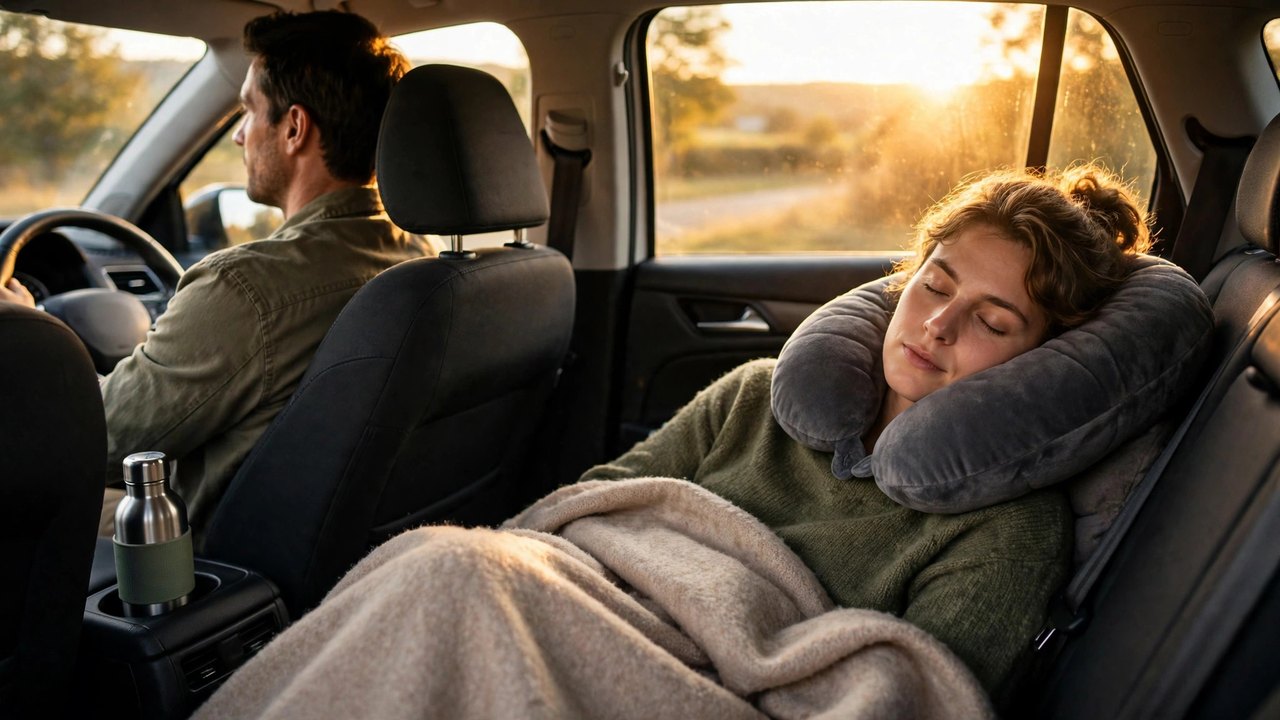
A car seat is a harder place to sleep than it looks. The headrest pushes the head forward, the seat back is too upright for real rest, and every lean to the side ends at a hard door panel or a seat belt buckle. That is why the best travel pillows for car passengers are not simply smaller versions of bed pillows. The right design fills the gap between the head, the neck and the seat, keeps the chin from dropping toward the chest, and stays slim enough at the back that the headrest does not shove the whole head forward. This guide compares six real pillows that suit car travel, each checked on its opened Amazon listing, and explains which design fits which kind of passenger, seat and trip.
One safety point comes before every pick. A travel pillow in a car is a passenger accessory. The driver needs a clear range of motion, an unobstructed view and no bulky support changing how the headrest and seat belt sit, so every pillow in this guide is discussed for passenger seats, front or back, on parked breaks and on the road. If a pillow interferes with a seat belt, a child seat or a headrest in your car, choose a slimmer design or leave that seat without one.
Quick verdict
For most car passengers, the Cabeau Evolution S3 is the strongest all-round choice because the maker lists raised side supports, a slim flattened back and a seat strap system that can anchor the pillow to a car headrest, which stops it sliding down the seat back on long drives. Passengers whose heads fall forward rather than sideways should look first at the BCOZZY, whose overlapping arms support the chin as well as the neck, or the napfun, which pairs a raised-lobe memory foam shape with chin support in a simpler, lighter package. Anyone who hates carrying a bulky U-shape should consider the Trtl Pillow, a fleece wrap with an internal support that packs almost flat, or the TRAVELREST Ultimate, an inflatable body pillow that deflates and rolls up small. The MLVOC kit suits passengers who want the pillow, an eye mask and earplugs bought in one box.
The products in this guide
Cabeau Evolution S3 Travel Pillow
The Evolution S3 is the most car-aware design in this guide, and the reason is its strap system
Best when Passengers who want the pillow anchored to the headrest
Every pick in this guide had to pass four checks before it earned a place. First, the product had to be a real, named model from a real brand, with its design and materials described on an opened product listing rather than in a roundup summary. Second, the listing had to show the pillow available to buy new at the time of checking, because a discontinued pillow helps nobody planning a trip this season. Third, the design had to make sense against a car seat specifically: a slim or flat back that works with a headrest, support that does not depend on leaning against an airplane window, and a size that fits between a passenger and a door or centre console. Fourth, the pillow had to offer something distinct, so this list covers six different answers to the same problem rather than six copies of one shape.
Car use changes the usual travel pillow priorities in three ways. The headrest is the first. In a plane seat the back of a thick U-pillow pushes against a flat seat back; in a car it pushes against a headrest that already angles forward, so flat-back and slim-back designs matter more in a car than almost anywhere else. The seat belt is the second. A passenger pillow should sit above the belt line and never wedge between the belt and the body, which favours neck-level designs over large body cushions worn across the torso, and it is why the one long body pillow in this guide is described as a side-leaning support to position carefully, not as something to strap across the chest. The third difference is storage. A car pillow lives in the boot, the door pocket or the back seat between trips, so washable covers and carry bags matter, and a pillow that compresses earns its place in a family car that is already full.
Specs in the product sections are phrased as the maker lists them, taken from the opened listings. Where a maker gives a size guide, a weight or a care instruction, that figure is reported as listed. Comfort itself is not a spec, so the buying guide at the end translates each design into the sleeping style it suits, which is the honest way to choose: match the shape to the way your head actually falls when you doze in a seat.
The Evolution S3 is the most car-aware design in this guide, and the reason is its strap system. The maker lists a seat strap system that attaches the pillow to the seat, raised side supports, a slim flattened back and an adjustable front clasp, all built around an ergonomic memory foam core. In a car, that strap can loop around the headrest posts or the headrest itself on many seats, which solves the most common car pillow failure: the pillow slowly sliding down behind the shoulders until it is doing nothing at all. Anchored at headrest height, the raised sides stay where they are meant to be, beside the head, ready to catch a sideways lean before it reaches the door or the neighbouring passenger.
The flattened back is the second car-specific strength. The maker lists the back as slim and flattened rather than rounded, so the pillow adds far less forward push against a headrest that is already angled toward the dashboard. Passengers who have tried a fat U-pillow in a car and felt their chin forced down will recognise the problem this shape avoids. The front clasp adjusts the opening, so the pillow can sit snug on a smaller neck or looser on a larger one, and the memory foam gives a firmer, more structured hold than fibre-filled designs, which suits passengers who want to feel genuinely held rather than lightly cushioned.
The maker lists a removable, washable cover and a carry bag that lets the pillow compress down for storage, both of which matter for a pillow that will live in a car. The cover fabrics listed include quick-dry materials, useful when a pillow is used on summer road trips and stored in a warm boot between stops. In the glovebox-versus-boot decision, this is a boot pillow: compressed in its bag it is tidy, but it is still a full-size memory foam U, and it will not disappear into a door pocket.
Buy it if: you are a regular front or back seat passenger on long drives, your pillow always ends up sliding down the seat, and you want firm, structured memory foam support that stays anchored to the headrest.
Skip it if: your car has fixed headrests with no gap or posts for a strap to grip, you prefer a soft and squashy feel over firm support, or you need a pillow that packs down to almost nothing.
The BCOZZY attacks the other direction of car sleep failure: the forward drop. Its patented design uses overlapping arms that wrap around and support the head, neck and chin together, and the maker lists three ways to wear it. Placed with the overlapping arms under the chin, it gives double chin support. Folded in half and placed on one shoulder, it becomes a side support for leaning. Rotated so the overlap sits partly to one side, it combines front and side support for passengers whose heads fall forward and sideways at once. That flexibility is unusually well matched to car seats, where the direction a head falls often depends on which seat, and which side of the car, the passenger is sitting in.
The maker lists the fill as a bounce-back down alternative inside a shell that combines cosy microfleece on one side and a smoother microsuede on the other, so the pillow feels soft rather than structured, and the passenger can choose the warmer or cooler face against the skin. The back is designed flat, which again helps against a car headrest, and the sizing is explicit: the maker lists the Large size for necks up to 16 inches and an X-Large for necks of 16 inches and above, with separate smaller sizes in the same range made for children in car seats. For families, that size spread is a genuine advantage, because one design can cover the adult in the front passenger seat and a child in the back, each in the right size.
Care and carrying are simple. The maker lists the whole pillow as fully machine washable, not just the cover, and it comes with a carry bag and a snap loop that clips to luggage or hangs in the car. The trade-off for the soft fill is support style: this is cushioning that cradles, not a firm brace, and the overlapping wrap adds bulk around the chin and jaw that some passengers love and others find too enclosing on a warm day.
Buy it if: your head drops forward when you doze in the car, you want chin support as well as neck support, you prefer a soft feel, or you are buying matching pillows in adult and child sizes for family road trips.
Skip it if: you want firm, structured memory foam support, you dislike anything wrapped under your chin, or your neck measures well above the listed size guide for the size you are considering.
The Trtl Pillow abandons the U-shape entirely. The maker lists an internal support system hidden inside a soft fleece wrap: you place the support against the side of the neck, wrap the fleece around like a scarf and fasten it, and the internal structure holds the head upright while the fleece keeps everything comfortable against the skin. For car passengers, the appeal is what is missing. There is no thick back section pushing against the headrest, no wide arms filling the space between the passenger and the door, and nothing bulky to store. The maker lists the pillow at a featherweight build of roughly a few ounces and describes it as designed for travelling by plane, car and train alike.
Because the support works on one side at a time, the Trtl suits the way many people actually sleep in cars: leaning consistently toward one side, usually toward the window or toward the centre of the car. You position the support on the side you lean toward, and it holds the head at a gentler angle instead of letting it hang. Swapping sides mid-journey is just a matter of unwrapping and re-wrapping the other way. The fleece wrap adjusts with a fastening, so the fit can be snug or loose, and the whole pillow is machine washable, which the maker lists as a core feature rather than a cover-only instruction.
Storage is where this design wins outright in a car. It wraps flat, weighs very little and can live in a seat-back pocket or glovebox permanently, ready for any passenger, instead of needing a dedicated corner of the boot. The limits are equally clear. It gives no chin support at the front, so a head that drops straight forward gets less help here than from the BCOZZY or the napfun, and the wrap style takes a journey or two of practice before fastening it feels automatic.
Buy it if: you lean to one side when you sleep in the car, you hate the bulk of U-shaped pillows, or you want a pillow that lives in the glovebox so it is always in the car when a passenger wants it.
Skip it if: your head falls forward rather than sideways, you want cushioning all the way around the neck, or you prefer a pillow you can simply drop over your head with no wrapping or fastening.
The MLVOC is a classic memory foam U-pillow sold as a complete kit, and for car passengers the kit is the point. Alongside the pillow, the maker lists a 3D contoured eye mask, earplugs and a travel bag in the box. On a road trip, light through the windscreen and road noise are the two things that break a passenger nap most often after discomfort itself, so a kit that addresses all three in one purchase is a practical buy for a family car or for a passenger who regularly sleeps through long motorway stretches while someone else drives.
The pillow itself uses what the maker lists as 100 percent pure memory foam with a five-second return, shaped with contoured curves to hold the neck and keep the head from falling forward, plus an adjustable rope lock at the front that lets the wearer tighten or loosen the opening. That rope lock matters in a car because passengers shift position as the seat reclines or the journey wears on, and a fit that can be re-snugged without removing the pillow is easier to live with. The maker lists the pillow at 11 by 9.2 by 4.6 inches and the package weight at 0.6 pounds, so it is a standard-size U: supportive and substantial, but not a slim-back specialist like the Cabeau, so passengers in cars with strongly angled headrests should expect some forward presence from the back section.
The cover is listed as a breathable, sweat-resistant magnetic therapy cloth that is machine washable, and the pillow compresses down to about half its size into its travel bag, with a snap strap for attaching it to luggage or a headrest between uses. In a car, that strap earns its keep by keeping the pillow on the back seat rather than on the floor. As with most memory foam designs, the foam itself is not the washable part, so the cover does the hygiene work.
Buy it if: you want the pillow, eye mask and earplugs handled in one purchase, you like an adjustable front closure, and your road trips are long enough that light and noise bother you as much as neck support.
Skip it if: your car headrest already pushes your head forward and you need the slimmest possible back section, or you already own masks and earplugs and would rather pay for pillow design alone.
The napfun is the straightforward memory foam option in this guide: a contoured U-shape with raised lobes on each side and support at the front for the chin. The maker lists the fill as 100 percent pure memory foam with a five-second return, and describes the raised lobe shape as supporting the head as it tilts from side to side while the front section helps stop the head falling forward. That combination, side lobes plus a supportive front, is exactly the profile a car passenger needs when the seat offers nothing to lean on in the middle of the back seat, which is where this pillow makes most sense: the middle rear passenger has no window to lean toward and no door to rest against, so the pillow itself has to do all the work in every direction.
The maker lists the pillow at 10.88 ounces in weight, which keeps it light for a full memory foam U, and it comes with a travel bag that the pillow rolls or compresses into for storage. The cover is removable for washing, listed with a breathable, soft fabric, and the range includes set versions bundled with extras such as a sleep mask and earplugs on their own listings, so check which configuration a given listing describes before assuming the contents. The base pillow keeps things simple: no straps, no rope lock, no wrap to learn, just a shaped foam collar that goes on in seconds, which suits occasional passengers and shared family cars where the pillow changes hands often.
Fit is the thing to check. A contoured foam U in a single size fits average necks best, and the raised lobes that support taller heads can feel high under the jaw of a shorter passenger. In a car, try it first in the seat it will actually be used in, because the headrest behind it changes how high the back of the pillow sits. Passengers who run warm should also note that memory foam and a close contoured fit hold heat more than the fleece wrap or inflatable designs in this guide.
Buy it if: you want simple, shaped memory foam support with help in both the sideways and forward directions, especially for a middle back seat passenger with nothing to lean on.
Skip it if: you are short in the neck and find raised lobes push under your jaw, you want straps or an adjustable closure, or you sleep hot and prefer a cooler, airier design.
The TRAVELREST Ultimate is the odd one out, deliberately. Instead of a collar around the neck, it is a long inflatable pillow that runs down one side of the body, and the maker lists three ways to use it: attached to the headrest of a car seat, attached to the wings of a vehicle seat, or worn messenger-bag style across the body so the top of the pillow cradles the head and neck from the side. For a car passenger who sleeps by leaning, really leaning, toward the window, this gives a padded surface for the whole side of the head rather than a collar that merely limits how far the head can tilt. On a long drive in a front passenger seat reclined a little, that leaning post arrangement is genuinely different from everything else in this guide.
Because it is inflatable, firmness is adjustable in a way no foam pillow can match. The maker lists inflation in just a few breaths and instant deflation through the valve, so a passenger can run it firm on a smooth motorway and let a little air out when the road gets rough, or soften it as the journey goes on. The maker lists the weight at 8 ounces, and deflated it rolls up small enough to attach to a bag or tuck into a seat pocket, which makes it the easiest full-support option here to keep in the car permanently. The fabric is listed as a velvet-feel flocked surface, and the pillow is washable.
Two car-specific cautions apply. First, positioning: worn across the body it must never sit between a seat belt and the passenger or change how the belt lies, so in a moving car the headrest-attached arrangement is the one to default to, with the belt running normally over the body. Second, an inflatable is only as reliable as its valve and seams, so it suits passengers who are happy to top up air occasionally and who value pack size over the set-and-forget solidity of foam.
Buy it if: you sleep in the car by leaning hard to one side, you want adjustable firmness, or you need real side support that still packs down to almost nothing between trips.
Skip it if: you want support that works the moment you put it on with no inflating, you sleep upright without leaning, or any arrangement involving a strap across the body would distract you from resting.
Buying guide
Start with the direction your head falls. Watch a passenger, or be honest about yourself, on the next long drive. Heads fall in three directions, and each has a design answer in this guide. Forward droppers need front support: the overlapping chin arms of the BCOZZY or the supportive front and raised lobes of the napfun. Side leaners need height and a surface to lean into: the raised sides of the Cabeau, the internal support of the Trtl positioned on the lean side, or the full leaning post of the TRAVELREST. Passengers who slump in every direction need the most complete enclosure, which is the strapped, high-sided Cabeau or the BCOZZY worn in its combined front-and-side position.
Check the headrest before the pillow. Cars differ more than plane seats. Some headrests are flat and upright, some angle sharply forward, some remove or adjust, and some rear seats have headrests shaped for occasional use. A thick-backed U-pillow on a forward-angled headrest is the most common cause of car pillow disappointment, so if your headrest already brings your head forward, shortlist the flat-back BCOZZY, the slim-back Cabeau or the backless Trtl. If you plan to use a strap system, confirm there is something for it to grip: posts, a gap under the headrest, or a headrest shape a loop can hold on.
Match the pillow to the seat position. The front passenger seat usually reclines furthest and has the most room, so almost any design works there. Outer back seats add a window and door to lean toward, which suits the Trtl and the TRAVELREST. The middle back seat is the hardest place to sleep in any car, with no lean surface and often a firmer, higher cushion, and it rewards the self-sufficient designs, the napfun and the strapped Cabeau, that bring their own support in every direction. For children, use a pillow sized for children, such as the smaller sizes the BCOZZY maker lists, and never let a pillow change how a child seat or its harness fits.
Think about heat, washing and storage. Cars get hot, and a pillow stored in a summer boot needs a washable cover at minimum; the BCOZZY goes furthest with a fully washable pillow, while the memory foam designs rely on removable covers. Memory foam holds warmth against the neck, fleece wraps feel cosy in winter and warm in summer, and the inflatable TRAVELREST puts the least material against the skin. For storage, rank the designs by how they live between trips: the Trtl and the deflated TRAVELREST can stay in the car full time, the MLVOC and napfun compress into bags for the boot, and the Cabeau and BCOZZY in their carry bags suit cars with boot space to spare.
Keep the safety basics non-negotiable. Pillows are for passengers, never for the driver while the car is moving. A pillow must never sit between a seat belt and a body, block a belt from lying flat, interfere with a headrest’s position, or obstruct any airbag area, including seat-mounted side airbags in the front seats. If a design cannot be positioned without touching one of those, it is the wrong design for that seat, and the right answer is a slimmer pillow or none at all.
FAQ
Can the driver use a travel pillow on a long drive?
No. A travel pillow is a passenger accessory. The driver needs full head movement, an unobstructed view and the headrest and seat belt working exactly as designed. Drivers should plan rest stops instead, and use a pillow only while parked and out of the driving position, if at all.
Which design is best for the middle back seat?
The middle seat offers nothing to lean on, so choose a pillow that supplies support in every direction by itself. A strapped, high-sided memory foam design such as the Cabeau Evolution S3, or a contoured design with raised lobes and front support such as the napfun, suits that seat better than a one-sided wrap or a leaning pillow.
Will a travel pillow work with a forward-angled headrest?
Yes, if the back of the pillow is slim or flat. Thick, rounded backs add to the forward push and force the chin down. The flat-back BCOZZY, the slim flattened back of the Cabeau Evolution S3 and the backless Trtl wrap are the designs in this guide built for that situation.
Are these pillows suitable for children in the back seat?
Only in sizes made for children, and only when the pillow does not interfere with the child seat, its harness or the seat belt. The BCOZZY range includes smaller sizes that the maker lists for younger children in car seats. Adult U-pillows are too large for small necks and should not be used as a substitute.
How do I keep a car travel pillow clean?
Follow the care the maker lists for that model. In this guide, the BCOZZY is listed as fully machine washable, the Trtl wrap is machine washable, and the memory foam designs have removable washable covers while the foam itself stays out of the machine. Storing the pillow in its carry bag between trips keeps boot dust off it.
Inflatable or memory foam: which lasts better in a car?
Memory foam asks nothing of you and keeps its shape for years, but it stores at full or half size and holds heat. An inflatable such as the TRAVELREST packs smallest and adjusts in firmness, but depends on its valve and seams and may need a top-up of air on a long trip. For a pillow that lives in the car, pack size usually wins; for a pillow used every week, foam usually wins.
Conclusion
Choosing a pillow for car travel is mostly about respecting what a car seat already does. The headrest handles the back, the belt handles safety, and the pillow only has to handle the rest: catching the sideways lean, stopping the forward drop and staying where it was put. The Cabeau Evolution S3 does that most completely with its straps, raised sides and slim back. The BCOZZY answers the forward drop with chin support and family sizing, the Trtl removes the bulk entirely, the MLVOC bundles the whole sleep kit, the napfun keeps memory foam simple and self-sufficient, and the TRAVELREST turns leaning into a supported position while packing down to nothing. Match the design to the direction your head falls and the seat you actually sit in, and the next long drive becomes a chance to arrive rested instead of arriving with a stiff neck and a pillow lost somewhere behind the seat.
M
Modern Line Home Editorial Team
We compare specs, materials and verified owner reviews before a product earns a spot. Rankings are never paid.
Affiliate disclosure. As an Amazon Associate we earn from qualifying purchases at no extra cost to you. Prices accurate as of the date shown.
House cold even with the heat on? Walk this ordered checklist: thermostat and filter first, then drafts, insulation, leaky ducts and a failing heating system.
Windows fogging up in winter? Check where the fog sits: on the room side it is indoor humidity, outside it is harmless, and between panes the seal has failed.
Store the main firewood pile about 30 feet from your house, off the ground and covered only on top. Compare racks, woodsheds, garages and indoor spots safely.
Place a portable generator outdoors only, at least 20 feet from windows, doors and vents, exhaust pointed away. Exact distances, setup steps and CO rules here.
Keep houseplants in the right winter spot: match window direction to plant type, stay clear of radiators and cold glass, and fix dry air and low light at home.
Mice enter through pencil-width gaps at foundations, pipes, vents, doors and the roofline. Walk this room-by-room winter checklist to find and seal each one.
A winter outage timeline: what to do in the first hour, first night and multi-day outage, with food safety times, pipe protection, heat and CO safety steps.
Size a space heater by room area: 10 watts per square foot at 8-foot ceilings, adjusted for insulation and ceiling height, with full wattage and BTU tables.
Start dripping at about 20 degrees, sooner for exposed pipes. Set a pencil-lead stream, drip the right faucets on both lines, and know when to stop safely.
A fridge needs 800-1,200 starting watts, not just 150-400 running watts. Use the tables to total your fridge plus freezer, lights, furnace fan and more today.












Write Your Review
No reviews yet. Be the first to share your experience!