We independently review everything we recommend. When you buy through our links, we may earn a commission. As an Amazon Associate we earn from qualifying purchases.
Best CPAP Pillows for Side Sleepers: 6 Mask-Fit Picks
Compare the best cpap pillows for side sleepers on cutouts, height and mask fit, with six verified picks for full-face, nasal and nasal-pillow masks today.
Compare the best cpap pillows for side sleepers on cutouts, height and mask fit, with six verified picks for full-face, nasal and nasal-pillow masks today.
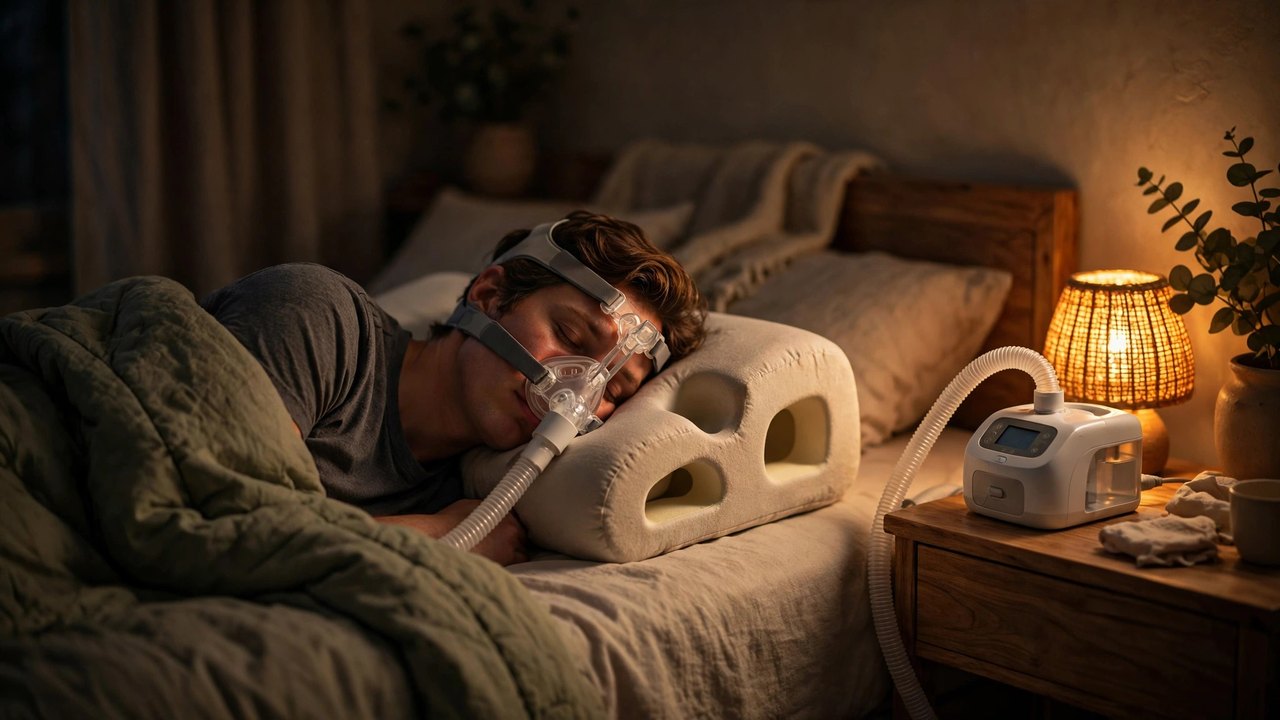
Side sleeping and a CPAP mask make an awkward pair on an ordinary pillow. Turn onto your side and the flat edge of a standard pillow meets the side of the mask first. The cushion can be pushed sideways, the headgear can be nudged, and the hose can end up trapped between your face and the bedding. That physical problem — pillow geometry getting in the mask’s way — is exactly what CPAP pillows are built to solve, and it is the only problem this guide judges. If you are shopping for the best cpap pillows for side sleepers, the useful questions are narrow and practical: where are the cutouts, how deep and wide are they, how high is the pillow, can that height be changed, and does the shape still support your head and neck once the mask has somewhere to go?
A plain note before the picks, because it matters: a CPAP pillow is an accessory, not a medical treatment. Nothing in this article claims that any pillow treats sleep apnea, changes therapy, or improves therapy outcomes, and marketing language from makers is described here as maker language, not as medical fact. Questions about your therapy, your pressure settings, your mask type, or whether a persistent leak is clinically important belong with your clinician or your equipment provider, not with a pillow purchase. What a pillow can do — all it can do — is change the physical space around your face while you lie on your side, and that is what the six picks below were compared on.
Every pick in this guide is a real product that was checked on an opened product page, with its shape, height system, and included parts taken from what the maker lists. Where a maker describes mask-fit benefits, this article phrases them as the maker describes them and keeps the focus on geometry: edge cutouts, contour shape, and height. Read the sections on height and cutout placement carefully, because for side sleepers those two measurements decide more than brand, foam marketing, or cover fabric ever will.
Quick verdict
Start with the Lunderg CPAP Pillow for Side & Back Sleepers if you want the most complete side-sleeper package: the maker lists cutouts on both sides, a removable layer for height, and two pillowcases in the box, so there is no gap in your routine while one case is in the wash. Choose the EnduriMed CPAP Pillow for Side Sleeping if you prefer a simpler, patented contour shape with two thickness levels and a removable pad, and no extra cases or tethers to manage. Choose the Contour CPAPMax Cooling Gel Pillow 2.0 if you want two different sleep surfaces in one pillow — the maker lists a plush fiber side and a memory foam side — plus a cool gel layer and ventilated foam.
Choose the IKSTAR CPAP Pillow for Side Sleepers with Larger Cutouts if cutout size is your first concern: as the name says, the maker lists larger cutouts, along with a small removable insert for height. Choose the HOMCA CPAP Pillow for Side Sleeping if you want a choice of two fixed heights in one contour, a hollow centre detail the maker lists for ear space on your side, and foam the maker lists as CertiPUR-US certified. Choose the Elviros Cervical Neck CPAP Pillow if you want the most height combinations: the maker lists four heights from rotating the pillow and removing a base spacer, plus small inserts to change the feel.
None of these is the right answer for everyone. A side sleeper with broad shoulders usually needs more height than a side sleeper with a narrow frame. A full-face mask usually needs a wider, deeper cutout than a small nasal-pillow mask. And a sleeper who rolls from side to back all night needs a centre that still works on their back, not just edges that work on their side. The comparison table and the buying guide below are built to help you match those three things — shoulder width, mask footprint, and how much you move — to one specific shape.
The products in this guide
Lunderg CPAP Pillow for Side & Back Sleepers
A two-sided contour design with cutouts intended to give a mask room at the edge of the pillow, a memory foam fill, and a removable layer the maker
Best if you want cutouts, two heights, and a spare shaped case in one purchase
Use this table as a geometry shortlist, not as a ranking of medical benefit. The right row is the one whose cutout position and height range match your mask and your shoulders. A pillow with the deepest cutout in the wrong place for how you actually lie is still the wrong pillow, and a simpler contour at exactly the right height will usually feel better night after night than a feature-heavy shape you have to fight into position.
How we selected
Selection started with a simple filter: the product had to be a pillow designed for CPAP mask users, with a shape intended for side sleeping, sold as a complete pillow rather than as a case, insert, or accessory on its own. General cervical pillows with no mask cutouts were left out, even when they are good pillows, because they do not address the side-sleeper problem this keyword is about — the edge of the pillow meeting the mask. Wedges were also left out: raising the whole upper body is a different product category with different trade-offs, and it does not give a side sleeper’s mask anywhere to go.
Each remaining candidate was then checked on an opened product page. That check covered three things. First, existence and identity: the brand, the product name, and the model details had to be clear on the page itself, not just in a roundup article. Second, geometry: the maker had to list the features this guide compares — cutouts or corner gaps for the mask, a contour shape, a stated height or height system, and the fill material. A product whose shape or height could not be confirmed from the maker’s own listing was excluded rather than described vaguely. Third, availability: the opened page had to show a live featured offer for the pillow sold new. A candidate whose page showed it as unavailable, or with no featured offer, was excluded and replaced, however well known the brand is. One well-known clover-shaped CPAP pillow was dropped at exactly this step during research for this guide.
Health discipline shaped the writing as much as the selection. This guide describes only what makers list about pillow geometry — edge cutouts, contour shape, and height — and mask-fit practicality as the makers describe it. It does not repeat makers’ medical marketing as fact, it does not claim that any pillow treats sleep apnea or improves therapy outcomes, and it does not score pillows on health effects. When a maker uses leak or pressure language, the article attributes that language to the maker and returns to the physical question you can actually judge from a listing: is there space at the edge of this pillow for your mask and hose when you lie on your side?
Finally, variety mattered within those rules. The six picks differ in the ways that change a purchase decision: one fixed contour versus removable layers, two heights versus four, a single surface versus two surfaces, standard cutouts versus larger cutouts, and one case versus two. If two pillows were effectively the same shape with the same height system, keeping both would not have helped a reader choose, so the shortlist favours distinct geometry over more of the same.
The Lunderg is the most complete package in this guide, and its completeness is practical rather than decorative. The maker lists a two-sided contour design with cutouts intended to give a mask room at the edge of the pillow, a memory foam fill, and a removable layer the maker lists at 1.1 inches, so the pillow can be used at a lower profile or, with the layer in place, at a higher one — the maker lists the height as 4.4 inches, or 5.5 inches including the removable foam layer. For a side sleeper, that choice matters more than it might sound: the distance from the mattress to your head is largely set by your shoulder width, and a pillow that is even an inch too low or too high changes the angle of your neck all night.
The maker lists the pillow as compatible with nasal, nasal pillow, full-face, and hybrid masks, and names compatibility with masks from major mask makers. Treat that list the way you should treat any maker’s compatibility list: as a statement that the cutouts were sized with those mask styles in mind, not as a guarantee for your specific mask and head position. What you can judge for yourself is the geometry — cutouts on the pillow, a contour for the head and neck, and two heights to try. If your mask is a bulky full-face model, start with the higher setting so your head sits up and the mask hangs into the cutout rather than resting on the pillow edge; if your mask is a minimal nasal-pillow model, the lower setting may put less pillow near the mask in the first place.
The two included pillowcases are the detail owners tend to undervalue before purchase and value most afterwards. The maker lists a soft premium-comfort case, already fitted, and an extra cooling-fabric case in the box. CPAP pillows only work in the case made for their shape — a standard rectangular case can pull across a cutout and partly defeat it — so having the spare shaped case means laundry day does not force a night back on a regular pillow. The maker lists the foam as slow-rebound memory foam and is candid that it will feel firm to someone used to a down pillow; the maker suggests its separate down-alternative model for sleepers who want a softer feel. That candour is useful: if you know you dislike firm foam, believe it before you buy.
Buy it if: you want cutouts, two heights, and a spare shaped case in one purchase, and you prefer a firm, structured memory foam feel.
Skip it if: you want a soft, plush pillow feel, or you want a single fixed height with nothing to configure.
The EnduriMed takes the opposite approach to the Lunderg: fewer extras, one clear shape. The maker lists a patented contour design — the listing cites US Patent No. D856,707 — made from memory foam, with two thickness levels to support side, back, and stomach sleeping, and a removable memory foam pad so you can keep the pillow thicker for extra loft or remove the pad for a lower profile. The maker describes corner gaps in the design, intended to give a mask and tubing room at the corners of the pillow rather than a deep notch cut into the middle of each edge. That distinction is worth picturing before you buy: if your mask mostly interferes at the corner where your face meets the pillow as you turn, a corner-gap shape may suit your sleeping position; if your mask sits squarely against the side edge, a centred side cutout may suit you better.
The maker lists the pillow for full-face masks and for BiPAP and APAP mask users, while noting that some nasal masks may vary — again, maker language about fit, best read as a prompt to check your own mask’s footprint against the shape rather than as a promise. The foam is described by the maker as soft, supportive memory foam that cradles the head and neck. In practice, a single-piece contour like this has one setup advantage: there is almost nothing to assemble or reconfigure. You choose whether the removable pad stays in, put the pillow on the bed, and the shape you bought is the shape you sleep on, which some sleepers strongly prefer over layered designs they have to rebuild after washing the case.
Care is the trade-off to note. The maker lists the product care as hand wash only, which is less convenient than a machine-washable case routine, so check the current listing for exactly which parts can be washed and how before you order. Also consider your turning pattern: the EnduriMed is listed for side, back, and stomach positions, and its contour is meant to work across them, but a sleeper who spends the whole night on one side may get more from a pillow whose cutouts are optimised for that one position, while a sleeper who rotates through positions may prefer this kind of general contour.
Buy it if: you want a simple, patented contour with two thickness levels, a removable pad, and almost nothing to set up.
Skip it if: you want deep centred side cutouts, a spare case in the box, or machine-wash convenience as a priority.
Contour is one of the longest-standing names in CPAP pillows, and the CPAPMax line is its adjustable flagship idea: one pillow, two sleep surfaces. On this Cooling Gel version, the maker lists a 2-in-1 design that lets you choose between a plush fiber feel and an adaptive memory foam surface, with adjustable memory foam layers to change the loft, side cutouts for the mask, a ventilated foam design, and a built-in cool gel layer. The maker lists the pillow for side, back, and stomach sleepers and for nasal, full-face, and nasal-pillow mask styles.
For a side sleeper, the two-surface idea solves a real indecision. Some sleepers love the slow, moulded feel of memory foam under the cheek and jaw; others find it too dense and prefer the softer give of fiber, especially around a mask’s headgear straps. With this pillow you do not have to guess which camp you are in before ordering — you can try the foam side for a few nights, flip to the fiber side, and keep the surface that lets your mask sit most naturally in the cutout. The adjustable loft works the same way: change the layers rather than buying a second pillow when the first height feels wrong. That trial-friendly flexibility is the strongest reason to pick this model, and it is a geometry and comfort argument, not a medical one.
The cooling features deserve a measured description. The maker lists a cool gel layer and a ventilated design intended to let heat escape from the foam. Whether any given sleeper feels a foam pillow as warm depends on the room, the case, and the sleeper, so treat cooling here as a listed construction feature — gel layer plus ventilation — rather than as a promise about how cool you will feel. Note also what you are buying: the listing is for the pillow in its Cool Gel configuration, and Contour sells related variants and a separate pillowcase, so confirm on the listing that the configuration in your cart is the pillow itself in the version you intended.
Because this design has the most moving parts in the guide — layers, two surfaces, gel — it also asks the most of the buyer. If you enjoy dialling in a setup, that is a plus. If you know you will never flip a pillow or remove a layer after the first night, a fixed contour will serve you just as well with less to manage.
Buy it if: you are torn between a fiber feel and a memory foam feel, want adjustable loft, and like the idea of a gel layer and ventilated foam.
Skip it if: you want a single fixed shape with nothing to flip, remove, or configure.
The IKSTAR makes one promise in its name and builds the pillow around it: larger cutouts. The maker lists larger CPAP-friendly cutouts intended to give a mask room to sit naturally when side sleeping, a centre cradle for the head, supportive side wings, and a removable insert the maker lists at 2 cm for adjusting height. The maker lists the size as 25.2 inches long by 15.4 inches wide, with heights of 5.1 and 4.5 inches, and lists the pillow for most nasal, full-face, and pillow masks.
Cutout size is not a trivial detail. A cutout that is too small for your mask simply moves the contact point: instead of the pillow edge pressing the mask, the wall of the cutout does. Larger cutouts give a bulky full-face mask — and the hose connection that often sticks out from it — more empty space to occupy when your head is turned. That is the specific situation this pillow is shaped for, and it is why a side sleeper who has already tried a standard CPAP pillow and still felt the mask catch should look at cutout dimensions, not just at whether a pillow has cutouts at all. The centre cradle and side wings the maker lists address the other half of side sleeping: when you roll from one side to the other, your head crosses the middle of the pillow, and a cradle shape helps it settle rather than perching on a flat top.
The height system is deliberately small-scale. A 2 cm insert is a fine adjustment, not a transformation, so this pillow suits a sleeper whose required height is already roughly in the listed range and who wants to trim it slightly, rather than a sleeper who needs a dramatically higher or lower pillow. The maker lists slow-rebound memory foam with a breathable, removable, washable cover with a cooling feel. As with every pick here, read the maker’s mask-fit language as the maker’s description of its geometry: the verifiable facts are the larger cutouts, the cradle-and-wing contour, the listed dimensions and heights, and the removable insert.
Buy it if: your mask is bulky, your hose connection needs room, or a standard cutout has felt too small, and your needed height is close to the listed range.
Skip it if: you need a large height adjustment, or your mask is minimal and a smaller, simpler cutout would put less empty space under your cheek.
The HOMCA approaches height differently from the layered pillows above: instead of inserts, the maker lists two fixed heights built into the contour itself — a higher side at 4.33 inches and a lower side at 3.54 inches — in a queen-size pillow the maker lists at 25.6 inches long by 15.7 inches wide. You choose your height by choosing which edge you sleep against, which makes nightly adjustment as simple as rotating the pillow. The maker also notes that a 0.8-inch booster is available through its customer service if the built-in heights feel insufficient, so check the current listing and the maker’s terms if that extra height matters to your decision.
The shape details are side-sleeper specific. The maker lists cutout notches on both sides of the pillow, intended as a pressure-free zone for a mask and tube, and a hollow centre design the maker lists as reducing ear pressure and friction when sleeping on your side. That ear detail is easy to overlook in a listing and hard to overlook at 3 a.m.: side sleepers fold or press an ear against the pillow for hours, and a hollow or softer zone at ear position is a comfort feature you can evaluate from the shape alone. The maker lists the foam as CertiPUR-US certified and OEKO-TEX approved, slow-rebound memory foam, and lists a breathable 3D mesh pillowcase with a hidden zipper, removable for cleaning, over a dustproof inner cover; the maker lists care as machine wash for the pillowcase only, with the pillow core not washable — the standard arrangement for memory foam pillows in this guide.
Who does the two-fixed-heights design suit best? A sleeper who shares the pillow decision with their own two shoulders, so to speak: many people sleep on both sides but settle slightly differently on each, and some simply want to experiment for a week — higher edge on Monday, lower edge on Friday — without pulling a pillow apart. It also suits a buyer who is wary of loose inserts shifting inside a case. The limit is the mirror image of the benefit: if neither fixed height is right for you, there is no third built-in option, only the booster route the maker describes.
Buy it if: you want two heights with no inserts to manage, value the ear-space hollow detail, and prefer a mesh, zip-off case.
Skip it if: you need a height outside the two listed options, or you want a spare case included in the box.
The Elviros offers the most height combinations in this guide, and the maker lists exactly how they are achieved. The pillow measures, as the maker lists, 23.6 inches long by 16.3 inches wide, with heights of 4.9 and 5.1 inches; remove the included 0.8-inch base spacer and the heights become 4.1 and 4.3 inches. Rotate the pillow to switch between the two heights in either configuration — four heights in total from one pillow. The maker also lists two small memory foam inserts, one soft and one firm, to change the feel, an adjustable-firmness idea none of the other picks here offers in the same way.
The CPAP-specific geometry is a cut-out design on both sides, which the maker lists as keeping tubing organised and giving a mask room at the edge of the pillow, for full-face, nasal, and other mask styles. Around that, the shape is a cervical contour: the maker describes an ergonomic curve for the head, neck, and shoulders with even pressure distribution. For a side sleeper, that combination — cervical contour in the middle, cutouts at the edges — is the classic CPAP pillow layout, and the Elviros version distinguishes itself mainly by how many ways you can set its height and feel before deciding whether the layout works for you.
The maker lists the foam as CertiPUR-US certified, high-density, slow-rebound memory foam, and the pillowcase as a breathable nylon-spandex case that is machine washable. The maker is explicit that the memory foam core itself must never be washed — wipe it with a dry towel and air it in a shaded, ventilated place instead — and notes the foam may have a slight natural scent at first and should be ventilated for several days. Plan for that airing-out period when you order: unbox it well before the night you intend to judge it, so scent and first impressions do not get tangled together.
With four heights and two feel inserts, this is the tinkering-friendly end of the guide alongside the Contour, but in a different way: the Contour changes surface and loft, the Elviros changes height in smaller steps and changes firmness at the neck. If your past pillow failures have been near-misses — almost high enough, almost firm enough — small-step adjustability is exactly what you want. If you have never used a contour pillow at all, the simpler two-height designs above are an easier first step.
Buy it if: you want four height combinations, a choice of soft or firm inserts, and a cervical contour with cutouts on both sides.
Skip it if: you want the fewest possible setup choices, or you do not want to air out a foam pillow for a few days before first use.
Buying guide
Start with height, not with brand
For side sleepers, height — often called loft — is the single most consequential specification on the page. When you lie on your side, your shoulder holds your head away from the mattress, and the pillow has to fill that gap. Too little height and your head tips down toward the mattress; too much and it tips up. Either way, your head position shifts, and when your head shifts, your mask’s position relative to the pillow shifts with it. Measure your current setup before you shop: lie on your side on your current pillow, note whether your head feels level, tipped down, or propped up, and use that as your baseline. Then compare the heights makers list — including, crucially, whether the listed height is with or without a removable layer. In this guide, the Lunderg maker lists 4.4 inches or 5.5 inches including its removable layer; the Elviros maker lists four heights between 4.1 and 5.1 inches depending on rotation and its base spacer; the HOMCA maker lists fixed sides at 4.33 and 3.54 inches; the IKSTAR maker lists 5.1 and 4.5 inches with a small insert for trimming. Those numbers, matched to your shoulders, will predict your experience better than any other line in a listing.
Match the cutout to your mask’s footprint
Cutouts are not interchangeable. Look at three things: position, size, and what happens to the hose. Position first: some pillows cut notches into the side edges, some shape gaps at the corners, and some, like the Elviros and HOMCA here, combine a cervical centre with cut sides. Picture where your mask actually touches your current pillow — centre of the edge, or toward a corner as your head turns — and choose the shape that puts empty space there. Size second: a minimal nasal-pillow mask needs only a little clearance, while a full-face mask with a hose elbow needs a genuinely open area; that is the case for a larger-cutout design like the IKSTAR. Hose third: several makers describe their cutouts as giving tubing room or keeping it organised. A hose that drapes into the cutout space is less likely to be pinned under your cheek than one forced across a flat pillow edge, and that is a practical, physical benefit you can reason about without any medical claim.
Decide how much adjustability you will actually use
Adjustability is only valuable if you use it. Removable layers (Lunderg, EnduriMed), removable inserts (IKSTAR, Elviros), a removable base spacer (Elviros), two sleep surfaces (Contour), and two fixed heights (HOMCA) all solve the same problem — a pillow bought online cannot be squeezed in a shop first — in different ways. Be honest about your habits. If you are the kind of buyer who will spend a week systematically trying configurations, buy the most adjustable pillow your budget allows. If you know you will set a pillow down and judge it as it arrives, buy a fixed or two-height shape whose listed height already matches your measurement, and spend your attention on cutout position instead. There is no virtue in owning four heights and using one at random.
Foam feel and the firmness surprise
Almost every dedicated CPAP pillow in this guide is memory foam, and makers themselves warn that slow-rebound memory foam feels firm compared with a down or down-alternative pillow. That firmness is functional for this category: a shape with cutouts has to hold its edges, and a very soft fill would let the cutout walls collapse toward the mask. Expect a structured feel, give a new foam pillow several nights before judging it if you are coming from a soft pillow, and if you already know firm foam is not for you, look for the down-alternative variants some makers sell alongside their foam models rather than hoping a foam pillow will feel soft. Foam also cannot be washed — makers across this guide list cases as washable and cores as wipe-clean or air-out only — so a removable, washable case is not a luxury; it is the hygiene plan. A spare shaped case, as the Lunderg includes, is the most convenient version of that plan.
Check the case, the size, and your bed
Three practical checks close the purchase. First, the case: a CPAP pillow needs its shaped case, because a standard case can bridge a cutout. Confirm the pillow comes with its case, whether a spare is included or sold separately, and how it washes. Second, footprint: these pillows are smaller and odder-shaped than standard pillows — the listings here run roughly from the low-20s to about 26 inches long — so check the stated dimensions against your bed, especially on a twin or a shared bed where a partner’s pillow space matters. Third, position range: if you are a combination sleeper who spends real time on your back, weight the centre contour heavily; a pillow that is perfect on its edge and awkward in its centre will annoy you every time you roll over. Several picks here are listed by their makers for side, back, and stomach use, but the balance between edge and centre differs by model, and your own rolling pattern should decide which balance you buy.
What a pillow cannot decide for you
End where this guide began. A pillow is an accessory that changes the space around your mask. It is not a medical treatment, and persistent problems — a leak that will not settle, a mask that leaves you sore, therapy that does not feel effective — are questions for your clinician or equipment provider, who can look at your mask fit, your settings, and your data. Bring them specifics: which mask you use, where it contacts the pillow, and what you changed. That conversation, plus a pillow whose geometry matches your shoulders and your mask, is the complete and honest version of shopping in this category.
FAQ
Do I need a special pillowcase for a CPAP pillow?
In practice, yes. The cutouts and contours only work if the case follows the shape, and makers supply shaped cases with these pillows for that reason. A standard rectangular case can pull fabric across a cutout and reduce the space your mask was supposed to get. Check whether a spare case is included, as with the Lunderg in this guide, or available separately, so laundry does not force you back onto a regular pillow.
How high should a CPAP pillow be for a side sleeper?
High enough to fill the gap between the mattress and your head when you lie on your side, which depends mostly on your shoulder width and how much your mattress lets your shoulder sink in. Use the heights makers list as your comparison tool — the picks here list options roughly between 3.5 and 5.5 inches, many of them adjustable — and start from how your current pillow leaves your head: tipped down means try higher, propped up means try lower. Adjustable designs exist precisely because this cannot be judged perfectly from a listing.
Will a CPAP pillow work with a full-face mask?
Makers list most of the pillows in this guide for full-face, nasal, and nasal-pillow masks, and the geometry logic favours full-face users in one way: a bulky mask has the most to gain from a cutout, because it has the most contact with a flat pillow edge. If your mask is large or its hose connects at the front, favour a larger cutout, like the IKSTAR design, and check the maker’s listed mask compatibility for your mask style before ordering.
Can a CPAP pillow treat sleep apnea or improve my therapy?
No. A pillow is an accessory, not a medical treatment, and this guide makes no claim that any pillow treats sleep apnea or improves therapy outcomes. Makers describe their cutouts and contours in terms of mask space and comfort, and that physical description is what you should buy on. Questions about therapy itself belong with your clinician or equipment provider.
How do I clean a memory foam CPAP pillow?
Follow the maker’s care listing for your model, but the pattern across this guide is consistent: the case comes off and can be washed — several makers list machine washable cases — while the memory foam core itself is not washed. Makers list cores as hand wash only, wipe-clean, or air-out only; the Elviros maker, for example, says never to wash the foam core and to air it in a shaded, ventilated place. Washing a foam core against the maker’s instructions can damage its structure.
What if I sleep on both my side and my back?
Choose a pillow whose centre works as well as its edges. Look for a centre cradle or cervical contour in the maker’s description, a height that is not extreme, and a design the maker lists for both positions — most picks in this guide are listed for side and back use, and several for stomach use as well. Then judge the pillow over several nights in both positions, not just on the side-sleeping test of the first night.
Conclusion
The best cpap pillow for a side sleeper is a geometry match, nothing more mysterious than that: empty space where your mask sits, a height that fills your shoulder gap, and a centre that still works when you roll onto your back. The Lunderg is the safest all-round starting point in this guide, with cutouts on both sides, two heights, and a spare case. The EnduriMed is the simple patented contour for buyers who want almost nothing to configure. The Contour CPAPMax Cooling Gel 2.0 is for buyers who want to choose between two sleep surfaces and add a gel layer. The IKSTAR is for bulky masks that need larger cutouts. The HOMCA is for two fixed heights, an ear-space hollow, and a mesh case. And the Elviros is for fine-step height and firmness tuning across four combinations.
Whichever you choose, buy it as an accessory and judge it as an accessory: does the mask clear the pillow, does your head sit level, and can you keep its shaped case clean without losing a night’s setup? If a therapy problem persists beyond those physical questions, take it to your clinician or equipment provider. A well-matched pillow will not answer medical questions — but it will stop your bedding from arguing with your mask every time you turn onto your side, and for a side sleeper, that is a genuinely better night’s starting point.
M
Modern Line Home Editorial Team
We compare specs, materials and verified owner reviews before a product earns a spot. Rankings are never paid.
Affiliate disclosure. As an Amazon Associate we earn from qualifying purchases at no extra cost to you. Prices accurate as of the date shown.
House cold even with the heat on? Walk this ordered checklist: thermostat and filter first, then drafts, insulation, leaky ducts and a failing heating system.
Windows fogging up in winter? Check where the fog sits: on the room side it is indoor humidity, outside it is harmless, and between panes the seal has failed.
Store the main firewood pile about 30 feet from your house, off the ground and covered only on top. Compare racks, woodsheds, garages and indoor spots safely.
Place a portable generator outdoors only, at least 20 feet from windows, doors and vents, exhaust pointed away. Exact distances, setup steps and CO rules here.
Keep houseplants in the right winter spot: match window direction to plant type, stay clear of radiators and cold glass, and fix dry air and low light at home.
Mice enter through pencil-width gaps at foundations, pipes, vents, doors and the roofline. Walk this room-by-room winter checklist to find and seal each one.
A winter outage timeline: what to do in the first hour, first night and multi-day outage, with food safety times, pipe protection, heat and CO safety steps.
Size a space heater by room area: 10 watts per square foot at 8-foot ceilings, adjusted for insulation and ceiling height, with full wattage and BTU tables.
Start dripping at about 20 degrees, sooner for exposed pipes. Set a pencil-lead stream, drip the right faucets on both lines, and know when to stop safely.
A fridge needs 800-1,200 starting watts, not just 150-400 running watts. Use the tables to total your fridge plus freezer, lights, furnace fan and more today.











Write Your Review
No reviews yet. Be the first to share your experience!