We independently review everything we recommend. When you buy through our links, we may earn a commission. As an Amazon Associate we earn from qualifying purchases.
Best Mattresses for a Metal Platform Bed: 6 Top Picks
Find the best mattresses for metal platform bed frames: six Queen all-foam picks that need no box spring, with slat spacing, profile and firmness guidance.
A metal platform bed gives a mattress a very different job from an old sprung base. There is no box spring to absorb weight, no give in the frame, and the support comes from a grid of steel slats or bars that the mattress has to bridge on its own. Pick the wrong mattress and you feel every bar through the foam, the edges dip between supports, and a warranty can quietly disappear because the foundation underneath did not meet the maker’s terms. Pick the right one and the setup is simple, low, quiet and supportive for years. This guide to the best mattresses for metal platform bed frames covers six Queen all-foam models that are sold for direct platform use, need no box spring, and were each checked on their opened Amazon listing for a live new offer, their exact size variant, and the construction details the maker lists.
Every pick below is an all-foam mattress in a box. That is deliberate. Foam mattresses are the natural partner for a metal platform: they are built to rest on a flat, rigid or closely slatted surface, they do not need the flex of a traditional box spring, and their dense base layers spread weight across steel slats far better than an old-fashioned connected-coil mattress designed for a sprung foundation. The six models differ in profile, firmness and feel, so the real work is matching the mattress to your frame’s slat spacing, your preferred bed height, and how you sleep.
Quick verdict
If you want one answer, start with the Zinus 12 Inch Green Tea Memory Foam Mattress in Queen. The maker lists a medium firm feel, a zoned pressure relief design, and an A+ answer on the listing confirming it works with platform beds and slatted frames, and the 12 inch profile gives foam enough depth to bridge typical metal slats comfortably. For a firmer, taller-feeling sleep surface, the Nectar Classic 12 inch is the firm pick of the group. For the clearest platform statement of all, the Lucid 10 Inch Gel Memory Foam Mattress states outright on its listing that it works on platform frames and slatted frames with no box spring needed. The Novilla Bliss 12 Inch adds a gel foam build at a full 12 inch profile, the Leesa Original 10 Inch brings a three-layer all-foam design from a US-assembled line, and the Tuft and Needle Original Legacy answers with a responsive, bouncier foam that does not feel like classic memory foam at all.
The products in this guide
Zinus 12 Inch Green Tea Memory Foam Mattress
The 12 inch Queen profile matters here: on a slatted metal frame, extra foam depth is what keeps your hips from feeling the support structure
Selection started with the frame, not the mattress. A metal platform bed supports a mattress in one of two ways: a solid or near-solid deck, or a series of steel slats or bars with open gaps between them. Any mattress on this list had to be a model the maker sells for that kind of direct, rigid support, with no box spring required in the setup. All-foam mattresses in a box dominate that category, because their makers design them from the start to sit on platform beds, slatted frames, foundations and adjustable bases rather than on a sprung box.
Each candidate was then opened on its Amazon listing and checked three ways. First, the availability gate: the listing had to show a live featured offer for a new mattress, in stock, on the day of checking. Listings showing no featured offer or an unavailable status were excluded, however good the mattress looked on paper. Second, the size pin: mattresses are variant products, and a Queen ASIN is not interchangeable with a King or Full one. Each ASIN in this article was pinned from the listing’s own variation data for the Queen size and the exact profile named in the heading, then confirmed on that ASIN’s own product page. Third, the spec check: every construction detail, layer count, weight and care instruction quoted below comes from what the maker lists on that opened page, phrased as the maker lists it, with nothing added from reviews or roundups.
Firmness and feel were balanced across the six so the list is useful for different sleepers: one firm option, two medium firm options, and three medium options, in 10 and 12 inch profiles. Thinner or very soft mattresses that would let a sleeper bottom out onto steel slats were left off, as were innerspring models whose makers design them around a flexing foundation. What remains is a short list where every mattress can go straight onto a metal platform frame the day it arrives, unroll, expand, and be slept on without any extra foundation purchase.
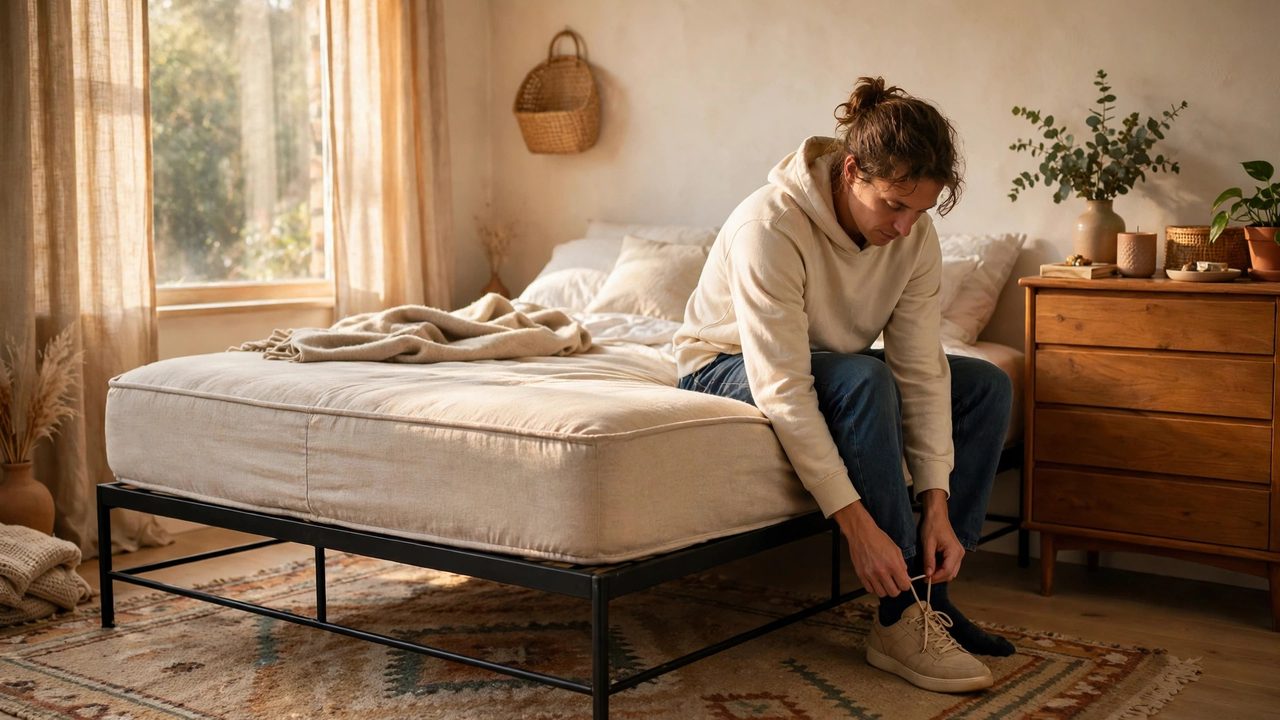
The Zinus Green Tea is the default recommendation for a metal platform bed because the maker has thought about foundations more than most. On the listing’s question-and-answer block, the maker confirms this mattress in a box works with platform beds, box springs, slatted frames and adjustable bases, which covers the full range of metal platform designs from solid decks to open steel slats. The 12 inch Queen profile matters here: on a slatted metal frame, extra foam depth is what keeps your hips from feeling the support structure underneath, and the maker lists a durable base foam layer as the bottom of this build.
Size pinned: Queen, 12 inch, Green Tea, White
Construction the maker lists: memory foam, 3 layers
Feel the maker lists: medium firm, with patented zoned pressure relief
Cover the maker lists: breathable knitted cover
Infusions the maker lists: green tea extract and purified charcoal for freshness
Certifications the maker lists: CertiPUR-US certified foams, OEKO-TEX Standard 100 cover, fiberglass free with a carbon rayon fire barrier
Weight the maker lists: 62.3 pounds in Queen
Care the maker lists: spot clean only
Pros:
Maker confirms platform bed and slatted frame compatibility on the listing itself
Full 12 inch profile bridges metal slat gaps better than thinner foam mattresses
Zoned pressure relief suits side, back and stomach sleepers on one surface
Fiberglass free construction, which matters when a mattress sits on an open frame you can see under
Cons:
Classic memory foam feel is slower to respond than the Tuft and Needle pick
The maker notes a mild off-gassing smell on unboxing that typically dissipates within 24 to 48 hours
Spot clean only, and the cover is not a removable washable design
Buy it if: your metal platform has typical steel slats and you want the safest all-round pairing of profile, firmness and confirmed platform compatibility. Skip it if: you dislike the slow, contouring feel of traditional memory foam, or your frame’s slats are spaced very wide and you cannot add support, in which case read the buying guide section on slat spacing before choosing any foam mattress.
The Nectar Classic is the firm option in this group, and firmness is a genuine advantage on a metal platform. A firmer foam build rests on top of slats rather than sinking between them, so sleepers who worry about feeling the frame usually do better here. The maker lists a five-layer construction in a 12 inch profile, built around what it calls its signature combination of breathable cooling fabric, contouring memory foam and dynamic support foam in the top layers. On a rigid metal base with zero flex, that layered foam stack is doing all the work a box spring used to do, and the maker positions the Classic as firm with a touch of comfort rather than extra firm and board-like.
Size pinned: Queen, Classic 12 inch, mattress only
Construction the maker lists: memory foam, 5 layers
Feel the maker lists: firm, with contouring memory foam over a dynamic support layer
Setup the maker lists: unbox, unroll and let expand; snooze ready in 24 hours
Weight the maker lists: 78 pounds in Queen, the heaviest pick here
Care the maker lists: do not remove cover or dry clean; use a mattress protector
Pros:
Firm feel sits high on steel slats instead of dipping into the gaps
Five-layer build gives a substantial, dense feel on a rigid base
12 inch profile keeps total bed height comfortable on low metal frames
Suits back and stomach sleepers who find medium foam too soft on a hard platform
Cons:
At 78 pounds it is the heaviest mattress here to rotate on a metal frame
Side sleepers who need deep shoulder cushioning may find the firm surface unyielding on a base with no flex
Cover is not removable, so a protector is effectively mandatory
Buy it if: you sleep on your back or stomach, prefer a firm surface, and want a dense 12 inch foam mattress that a rigid metal platform will support exactly as designed. Skip it if: you are a strict side sleeper who relies on plush contouring, because a firm mattress on an unforgiving metal base doubles down on pressure at the shoulder and hip.
The Lucid 10 Inch earns its place with the most explicit platform wording of any pick. The maker lists, in its own bullet points, that this mattress works on adjustable bases, platform frames and slatted frames right out of the box, with no box spring needed. That sentence covers nearly every metal platform design sold, including the common welded steel frames with closely spaced bars. The build is three layers: the maker lists 3 inches of gel memory foam, a 1.5 inch transition layer, and a 5.5 inch high-density base, in a medium feel. The gel infusion and bamboo charcoal in the foam are listed as the cooling and moisture management features, which is relevant on metal frames because a steel deck can feel cooler but also less breathable than wood slats if the mattress itself traps heat.
Construction the maker lists: gel memory foam and bamboo charcoal foam, 3 layers
Layer split the maker lists: 3 inch gel foam comfort layer, 1.5 inch transition layer, 5.5 inch high-density base
Feel the maker lists: medium
Foundation wording the maker lists: works on adjustable bases, platform frames and slatted frames; no box spring needed
Certifications the maker lists: CertiPUR-US certified foam, made in the USA with global and US parts, 10-year limited warranty
Weight the maker lists: 57.9 pounds in Queen, the lightest pick here
Pros:
Clearest maker statement of platform and slatted frame compatibility in this list
Lightest Queen here, which makes rotating it on a metal frame genuinely easy
Medium feel is the most forgiving middle ground for mixed sleeping positions
High-density base layer is the right design for spanning slat gaps
Cons:
At 10 inches it has less foam depth over widely spaced bars than the 12 inch picks
The maker instructs not to remove or wash the cover; spot clean only
Medium feel may be too soft for heavier stomach sleepers on a rigid base
Buy it if: your metal platform is a slatted steel frame and you want the maker’s own written confirmation that the pairing works with no box spring. Skip it if: your frame has unusually wide bar spacing and you cannot add a bunkie board or deck, because a 10 inch profile leaves less margin over big gaps than the 12 inch models.
The Novilla Bliss is the couples and guest room pick: a 12 inch gel memory foam mattress whose maker says it fits all kinds of bed frames and typically regains its full shape within 72 hours of unboxing. The maker lists a multi-layer foam design built around NanoGel memory foam for contouring, with comfort and support layers underneath, and describes the triple-layer construction as absorbing motion at every level. On a metal platform that matters twice over, because a rigid steel frame transmits movement across the bed more readily than a heavy wooden one, so a mattress that isolates motion in its own layers is doing work the frame will not.
Size pinned: Queen (U.S. Standard), Bliss, 12 inch
Construction the maker lists: gel memory foam, 4 layers in the listing details, model NV0M801
Feel the maker lists: medium, with gel foam listed for heat dissipation
Cover the maker lists: soft knitted breathable cover
Frame fit the maker lists: fits all kinds of bed frames; arrives rolled and compressed in a box
Certifications the maker lists: CertiPUR-US certified foam and ISPA certification
Weight the maker lists: 61.5 pounds in Queen
Expansion the maker lists: typically regains full shape within 72 hours
Pros:
Motion-absorbing layered build suits couples on a rigid, movement-transmitting metal frame
Full 12 inch profile with reinforced edge support as listed by the maker
Gel foam and breathable knit cover address the warm sleep surface foam is known for
Maker states it fits all kinds of bed frames, including platform styles
Cons:
Full expansion can take up to 72 hours, longer than most picks here
Hand wash only care for the cover
Medium gel foam feel will be too contouring for sleepers who want a lifted, on-top sensation
Buy it if: you share the bed, your metal frame is rigid and a little lively, and you want a 12 inch gel foam mattress that damps movement in its own layers. Skip it if: you need the bed fully expanded and at final height the same evening it arrives, or you prefer a responsive foam you can move across easily.
The Leesa Original is the low-profile, design-led option. At 10 inches it keeps the sleep surface lower, which suits metal platform frames with tall headboards, low windows, or a minimalist look where a 12 or 14 inch mattress would swallow the frame. The maker lists a three-layer all-foam construction designed for all sleep positions, with a breathable grey twill cover in its signature four-stripe design and no tapered edges, so the mattress sits squarely on a rectangular steel deck. It is assembled in the USA, and the Queen ASIN here is pinned from the listing’s own variation data, where the Queen and King are separate ASINs that are easy to confuse.
Size pinned: Queen, Original 10 inch mattress
Construction the maker lists: all-foam memory foam construction, 3 layers
Cover the maker lists: grey twill, four-stripe design, no tapered edges
Origin the maker lists: designed and assembled in the USA
Weight the maker lists: 71 pounds in Queen
Care the maker lists: hand wash only
Pros:
10 inch profile keeps bed height in check on taller metal platform frames
Square, untapered edges use the full width of a rectangular steel deck
All-position design suits households where the bed serves different sleepers
Established US-assembled line with a long sales history in this exact Queen variant
Cons:
Heavier than the other 10 inch pick here, at 71 pounds in Queen
Listing availability can run to a several-day shipping window rather than next-day
Less foam depth over wide slat gaps than the 12 inch models
Buy it if: bed height and a clean, low look matter, your metal platform has closely spaced support, and you want a proven all-foam mattress designed for every sleep position. Skip it if: your frame’s bars are far apart, or you want the deepest possible cushion between you and a steel deck.
The Tuft and Needle Original Legacy is for people who like the idea of a foam mattress on a platform bed but not the sinking, stuck feeling of memory foam. The maker lists its T&N Adaptive foam, an open-cell foam infused with cooling gel and heat-conducting graphite, designed for contouring pressure relief with bounce-back support, over a Flex foam layer that firms up the deeper you settle into it. On a metal platform that responsiveness is amplified, because the base adds no softness of its own: what you feel is purely the foam, and this foam pushes back. The maker lists a medium firm feel in a 10 inch Queen, assembled in the USA, with CertiPUR-US and GREENGUARD Gold certifications.
Size pinned: Queen, 10 inch, Original Legacy
Construction the maker lists: T&N Adaptive foam with gel and graphite, 4 layers
Feel the maker lists: medium firm, responsive with bounce-back support
Trial and warranty the maker lists: 100-night sleep trial and 10-year limited warranty
Certifications the maker lists: CertiPUR-US and GREENGUARD Gold
Weight the maker lists: 72 pounds in Queen
Care the maker lists: spot clean only; cover not made to be removed
Break-in the maker lists: allow two weeks of use for the mattress to break in and air out
Pros:
Responsive foam suits combination sleepers who change position often on a rigid base
Open-cell, gel and graphite design is listed for better airflow than standard memory foam
Medium firm feel keeps sleepers lifted on top of steel slats rather than sunk between them
GREENGUARD Gold certification is a step beyond the foam-only certifications most picks list
Cons:
Maker advises a two-week break-in, the longest adjustment guidance here
Less deep contouring than the memory foam picks for strict side sleepers
Cover cannot be removed, so a protector is essential on an open metal frame
Buy it if: you move around at night, dislike memory foam’s slow sink, and want a medium firm foam mattress whose character comes through clearly on a firm metal platform. Skip it if: you want maximum pressure-relieving contour at the shoulder and hip, where the Zinus or Novilla memory foam builds are the better match.
Buying guide: pairing a mattress with a metal platform bed
Measure your slat or bar spacing first. This is the single most important check, and it takes a tape measure, not a guess. Foam mattress makers commonly require slats spaced no more than about 3 inches apart for warranty-valid support, because wider gaps let foam sag into the openings, which both feels bad and can be treated as improper support. Many welded steel platform frames use closely spaced bars or a wire grid and pass easily. Others, especially folding frames with a few wide crossbars, do not. If your gaps are too wide, the fix is simple and cheap: lay a bunkie board, a sheet of plywood, or a low-profile foundation panel over the bars to create a continuous deck, then put any mattress in this list on top.
Check for a center support rail and legs. Queen and King metal platform frames should have a center rail with supporting legs that reach the floor. Without one, even a good mattress will develop a valley down the middle over time, and the problem is the frame, not the mattress. Before blaming a new mattress for a dip, get under the bed and confirm the center legs are present, vertical, and actually touching the floor.
Match profile to frame height. Metal platform frames commonly stand 12 to 18 inches tall. Add the mattress and you get the finished bed height. A 10 inch mattress on a tall frame keeps the surface easy to get in and out of and shows more of the headboard; a 12 inch mattress on a low frame restores a conventional height. The 10 inch Leesa and Tuft and Needle and the 12 inch Zinus, Nectar and Novilla in this list cover both directions, so decide from your frame’s measured height rather than from habit.
Think about noise and movement. Metal frames can creak at the joints and transmit movement across a rigid deck. A mattress cannot fix loose bolts, so tighten the frame first. After that, motion-isolating foam builds like the Novilla Bliss, whose maker describes motion absorption through its layers, genuinely help, while responsive foams like the Tuft and Needle will feel livelier. A thin rug or felt pads under the frame legs also quiets a metal bed on hard floors.
Protect the mattress from the frame. Check the top of your metal frame for burrs, sharp weld points or protruding bolt ends before unrolling a foam mattress onto it; foam covers snag and tear on rough steel. A mattress protector, recommended by several makers here in their care instructions, doubles as a barrier layer. Also confirm the frame’s stated weight capacity covers the mattress plus sleepers: the Queens here run from about 58 to 78 pounds as the makers list, before anyone gets in.
Skip the box spring. Every mattress in this list is designed to work without one, and adding a traditional flexing box spring under a foam mattress on top of a platform frame stacks two support systems that were not designed for each other. If your bed feels too low, raise it with a taller frame or risers rated for the load, not with a sprung box that can undermine the foam and complicate a warranty claim.
FAQ
Do I need a box spring with a mattress on a metal platform bed?
No. A metal platform bed is itself the foundation. Every mattress in this list is an all-foam model sold for direct placement on a platform or slatted frame, and the Lucid listing states the point explicitly: it works on platform frames and slatted frames with no box spring needed. Adding a box spring raises the bed and can reduce the support the foam was designed around.
How far apart can the slats on a metal platform be?
Foam mattress makers commonly require slats no more than about 3 inches apart, and that is the safe target to measure against. Closely spaced steel bars and wire-grid decks are fine. If your frame has wider gaps, add a bunkie board or a plywood deck over the bars so the mattress rests on a continuous surface, which protects both comfort and warranty coverage.
Is memory foam or a hybrid better for a metal platform bed?
All-foam mattresses are the straightforward match because their makers design them for rigid, non-flexing support, which is exactly what a metal platform provides. Hybrids with pocketed coils can also work on platforms when the maker approves a slatted base, but they are heavier and their coil units need even support. This list stays with all-foam models whose platform use is confirmed on their own listings.
Why can I feel the bars of my metal frame through my mattress?
Usually one of three reasons: the mattress is too thin for the gap spacing, the foam is very soft and bottoms out under your hips, or a center support leg is missing or not touching the floor. Fixes in order of cost: check the center legs, add a bunkie board or deck to close the gaps, and if the mattress itself is the problem, move to a thicker or firmer foam model such as the 12 inch firm and medium firm picks in this list.
Will a foam mattress slide on a smooth metal platform?
It can, especially on powder-coated steel decks and folding frames without a lip. A non-slip mattress pad or a thin rug gripper mat between the frame and the mattress solves it without adhesives. Frames with raised edges or retainer bars hold a mattress best, and the square, untapered edges the Leesa maker lists also help a mattress sit still and use the full deck.
How long should I let a mattress in a box expand on the frame?
Unroll it directly onto the platform so it expands in place. The makers here list windows from 24 hours for the Nectar to 24 to 72 hours in the Zinus guidance and up to 72 hours for the Novilla to regain full shape. You can usually sleep on it the first night, but judge the final height and firmness only after the maker’s stated window has passed.
Conclusion
A metal platform bed is the easiest foundation to pair well: it is rigid, flat and honest, and it asks only that the mattress be built for direct support, thick enough for the slat spacing, and firm enough not to dip into the gaps. The six Queen all-foam mattresses in this guide all meet that brief with ASINs pinned to the exact size and profile, live new offers on their opened listings, and specs taken from what each maker lists. Choose the Zinus 12 Inch Green Tea for the best all-round balance, the Nectar Classic for firm support, the Lucid 10 Inch for the clearest written platform approval, the Novilla Bliss for couples, the Leesa Original for a lower profile, and the Tuft and Needle Original Legacy for responsive foam. Measure your slats, check your center legs, skip the box spring, and any of the six will turn a metal platform frame into a quiet, supportive bed.
M
Modern Line Home Editorial Team
We compare specs, materials and verified owner reviews before a product earns a spot. Rankings are never paid.
Affiliate disclosure. As an Amazon Associate we earn from qualifying purchases at no extra cost to you. Prices accurate as of the date shown.
House cold even with the heat on? Walk this ordered checklist: thermostat and filter first, then drafts, insulation, leaky ducts and a failing heating system.
Windows fogging up in winter? Check where the fog sits: on the room side it is indoor humidity, outside it is harmless, and between panes the seal has failed.
Store the main firewood pile about 30 feet from your house, off the ground and covered only on top. Compare racks, woodsheds, garages and indoor spots safely.
Place a portable generator outdoors only, at least 20 feet from windows, doors and vents, exhaust pointed away. Exact distances, setup steps and CO rules here.
Keep houseplants in the right winter spot: match window direction to plant type, stay clear of radiators and cold glass, and fix dry air and low light at home.
Mice enter through pencil-width gaps at foundations, pipes, vents, doors and the roofline. Walk this room-by-room winter checklist to find and seal each one.
A winter outage timeline: what to do in the first hour, first night and multi-day outage, with food safety times, pipe protection, heat and CO safety steps.
Size a space heater by room area: 10 watts per square foot at 8-foot ceilings, adjusted for insulation and ceiling height, with full wattage and BTU tables.
Start dripping at about 20 degrees, sooner for exposed pipes. Set a pencil-lead stream, drip the right faucets on both lines, and know when to stop safely.
A fridge needs 800-1,200 starting watts, not just 150-400 running watts. Use the tables to total your fridge plus freezer, lights, furnace fan and more today.












Write Your Review
No reviews yet. Be the first to share your experience!