We independently review everything we recommend. When you buy through our links, we may earn a commission. As an Amazon Associate we earn from qualifying purchases.
Best Robot Vacuums for Pet Owners: 6 Owner-Friendly Picks
Find the best robot vacuums for pet owners, with self-empty docks, pet-waste avoidance, tangle-resistant brushes and mops that lift clear of carpet at home.
Find the best robot vacuums for pet owners, with self-empty docks, pet-waste avoidance, tangle-resistant brushes and mops that lift clear of carpet at home.
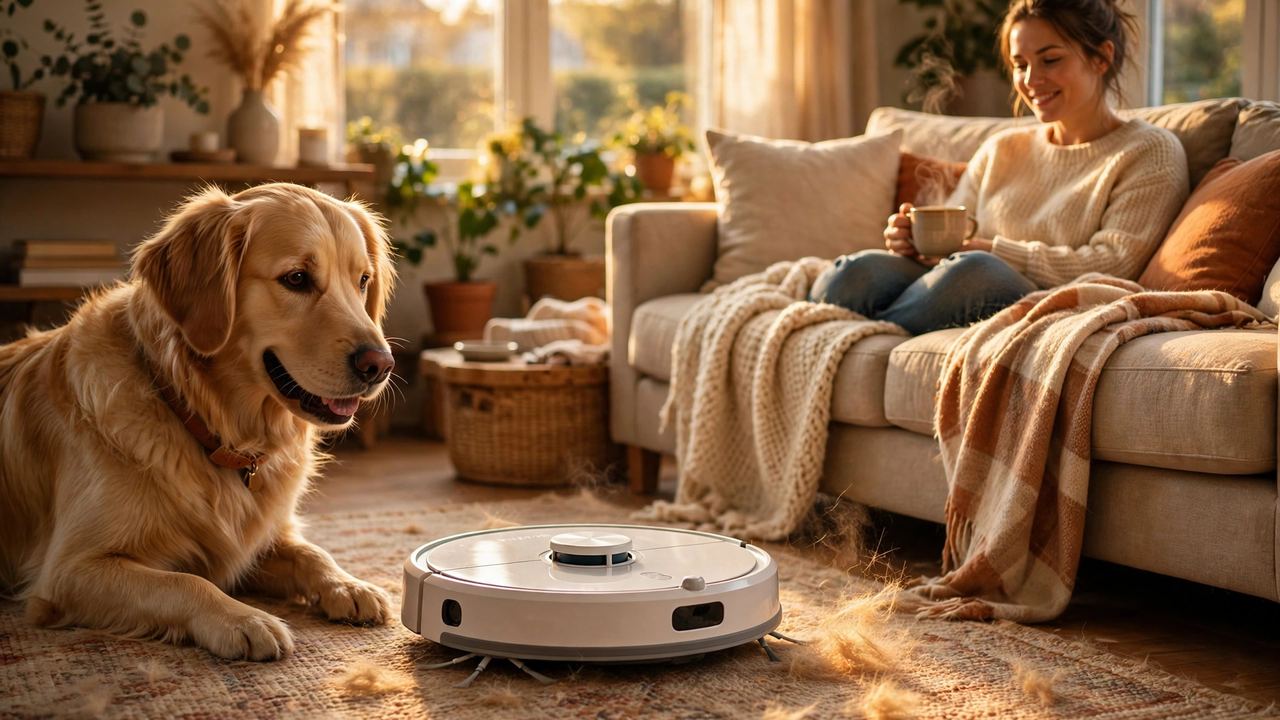
Living with a dog or a cat changes what a robot vacuum has to do. It is not only about fur on a rug. It is about litter tracked out of a tray, kibble scattered around a bowl, water splashed onto hard floors, toys left in hallways, and the one accident every owner dreads finding after the robot has already driven through it. That is why choosing among the best robot vacuums for pet owners is really a decision about the owner experience: how often you empty something, how often you untangle something, how confidently you can run a clean while you are out, and how well the machine steers around the animals and the messes that come with them.
This guide is framed for owners, not just for hair pickup. Every pick below self-empties into a dock, because handing an owner a tiny onboard bin that fills in two days defeats the point of automation in a shedding household. Every pick also offers a way to keep mops off carpet, keep brushes from wrapping, or keep the robot away from bowls, beds, and waste. Some do all of those things. Others do a few of them very well and cost you less daily attention in a different way, through a bagless base, a simpler bin swap, or obstacle avoidance built specifically around pet waste.
Read the sections in order if you are new to robot vacuums, or jump to the comparison table and the individual picks if you already know your floor mix. Either way, keep your own routine in mind. A robot that fits a single-cat apartment with hard floors is not the same robot that fits a two-dog house with carpeted bedrooms, a litter room, and children leaving socks on the stairs.
Quick verdict
For most pet owners, the Roborock Qrevo S5V is the easiest recommendation. Its dock empties, washes, dries, and refills, its brush system is designed to resist tangles, and its obstacle avoidance and multi-floor mapping suit busy, cluttered homes. If avoiding pet waste is your single highest priority, the iRobot Roomba Combo j5+ is the specialist pick, because the maker builds its navigation and its Pet Owner Official Promise around that exact problem. The eufy X10 Pro Omni is the strong all-round mop-and-vacuum alternative, the Dreame X40 Ultra is the premium choice for owners who want the most automated dock and the most flexible mop handling, the Shark Matrix Plus 2-in-1 is the pick for owners who dislike buying replacement bags, and the Dreame L10s Ultra Gen 2 rounds out the list as a capable self-emptying mop combo with a long auto-empty interval and thoughtful carpet modes.
No robot on this list removes the need for owner judgement. You still need to clear fragile items, check a room after an accident, wash mop pads on the schedule the maker sets, and replace filters and brushes when they wear. What these machines change is the frequency and the unpleasantness of that work. Instead of vacuuming by hand several times a week, you supervise a system that keeps floors presentable between deeper cleans.
The products in this guide
Roborock Qrevo S5V
The Qrevo S5V suits pet owners who want the dock to do as much as possible
The table is a starting point, not a ranking that fits every home. Bag capacity claims, for example, are maker estimates based on typical debris volumes, and a heavily shedding dog in spring will fill any base faster than the headline interval suggests. Likewise, obstacle avoidance reduces risk but never guarantees it, especially with very small, dark, or flat objects on a dark floor. Use the individual pick sections to match the dock, the brush, and the mop system to the way your household actually lives.
How we selected
We started with the owner problems, not with suction headlines. First, each candidate had to be a current model sold as a complete robot system with a self-emptying dock, because emptying a small bin by hand every day is the task pet owners most often say made them stop using an earlier robot. Second, each candidate had to address at least one other recurring pet problem in a documented way: tangle-resistant brush design for long fur, obstacle recognition for waste, cords, and toys, mop lifting or mop removal for carpets, or a dock that washes and dries pads so damp pet odours do not linger.
Third, we checked the exact model on its opened Amazon listing and applied an availability gate. A listing had to show a live featured offer for a new unit, with stock and a working purchase path. Listings that showed no featured offer, or whose featured seller was a resale channel, were excluded and replaced, even when the model itself was well regarded. That is why some famous flagship names do not appear here in the form you might expect: the exact listing we opened did not pass the gate at the time of checking, so we chose a closely related model whose listing did.
Fourth, we recorded specifications only as the maker lists them. Suction figures, mop lift heights, dock intervals, and tank sizes in this article come from the maker descriptions on those opened listings. Suction figures in particular are not directly comparable across brands, because makers measure them differently, so we treat them as a guide to a model position in its own range rather than as a promise of pickup on your carpet. Finally, we favoured a spread of ownership styles: bagged and bagless bases, vacuum-only focus within a combo system, and docks that range from simple self-emptying to full wash, dry, and refill automation.
We did not include budget robots without self-emptying, robots that require you to empty a small bin after every run, or models whose pet relevance was only a marketing label with no supporting brush, dock, or avoidance feature. We also left out models aimed mainly at workshops or outdoor use. Everything here is intended for indoor homes with dogs, cats, or both.
The Qrevo S5V suits pet owners who want the dock to do as much as possible. The maker lists 12,000 Pa HyperForce suction, a DuoDivide and floating main brush arrangement described as a zero-tangle system, and dual spinning mops with a FlexiArm extension for edges and corners. For an owner, the practical meaning is straightforward: fur is directed toward the inlet instead of wrapping tightly around a single roller, edges around skirting boards and furniture legs get deliberate attention, and the robot can work through a mixed home without you following it with a hand vacuum.
The all-in-one dock is the centre of the ownership case. The maker lists auto dust emptying into a storage bin rated for up to ten weeks, mop self-washing, warm air drying, and automatic water tank refilling for mopping. In a pet home, warm drying matters more than it sounds, because pads that stay damp after cleaning up tracked-in mud and paw prints develop odour quickly. A dock that washes and then dries those pads, and that refills its own clean water, turns a daily chore into a periodic check of water levels and a bin you empty on a much slower cycle.
Navigation is built for clutter. The maker lists Reactive Tech obstacle recognition using structured light, PreciSense LiDAR navigation, and mapping for up to four floors. The robot is described as detecting cables, toys, and furniture legs and as suggesting no-go zones for areas where it tends to get stuck. Set those zones around water bowls, litter trays, and the tangle of cables behind a television, and you remove the most common reasons a run fails while you are out. The mops lift by the amount the maker lists as 10 mm, which helps keep low-pile carpet from getting damp, though deep-pile rugs still deserve an avoid setting in the app.
Daily life with the S5V is mostly app work: scheduling rooms, choosing water flow from the levels the maker lists, and checking the dock when the app prompts you. Only 2.4 GHz Wi-Fi is supported according to the maker, so confirm your network can provide that band before you buy.
Buy it if: you want a dock that empties, washes, dries, and refills, and a brush system designed to resist tangles in a busy, multi-pet home.
Skip it if: your home has mostly deep-pile carpet you never want a mop near, or if your network cannot provide the 2.4 GHz band the maker lists.
The Roomba Combo j5+ is the pick built most explicitly around the fear every pet owner has: the robot finding an accident before you do. The maker lists PrecisionVision Navigation with a camera that identifies and avoids obstacles including pet waste, charging cords, socks, and shoes, and it backs that system with what it calls the Pet Owner Official Promise, under which the maker says it will replace the robot if it does not steer clear of solid pet waste, subject to its terms. No avoidance system should be treated as infallible, but a maker willing to attach a promise to that specific scenario is signalling where this model priorities lie.
As a cleaner, the Combo j5+ uses a two-bin approach. Swap in the vacuum bin for a full vacuuming configuration, or the combo bin when you want vacuuming and mopping in one run. The maker lists a four-stage cleaning system, Dirt Detect technology that focuses extra attention on dirtier areas when the vacuum bin is installed, and smart mapping so you can clean by room. For pet owners, room-level control is genuinely useful: send the robot to the hall and kitchen after a muddy walk, keep it out of a nursery or a nervous cat sleeping room, and schedule the litter room more often than the bedrooms.
The Clean Base is a bagged self-empty system. The maker lists automatic emptying for up to 60 days into an enclosed bag that holds the debris. Enclosed bags are a small but real quality-of-life detail for allergy-conscious households and for anyone who dislikes the puff of dust that comes from tipping a bagless bin. The trade-off is ongoing bag purchases and the need to keep spares at home, because a full bag in a shedding season arrives sooner than the headline interval.
Choose the Combo j5+ if your home is mostly about avoidance, room control, and a simple, proven self-empty routine, and if you are comfortable with a mop system that is lighter than the large wash-and-refill docks elsewhere in this list. It does not wash its own mop pads in a dock, so owners who mop large hard-floor areas daily may prefer one of the fuller dock systems.
Buy it if: avoiding pet waste and cords is your top priority and you like sealed-bag emptying and clean-by-room control.
Skip it if: you want a dock that washes and dries mop pads for you, or if you do not want ongoing replacement bag purchases.
The X10 Pro Omni is a balanced choice for owners who vacuum and mop in roughly equal measure. The maker lists 8,000 Pa suction, dual mops with 12 mm auto-lift and carpet detection, and the MopMaster 2.0 system. That lift height is relevant in pet homes with low and medium rugs, because the pads can clear carpet while the robot crosses it, then return to scrubbing hard floors where paw prints, water drips, and kitchen spills collect.
Its Omni station handles the repetitive work. The maker lists self-emptying into a 2.5 litre dust bag that it says needs replacing about every two months, a 3 litre clean water tank, mop washing with fresh water, and drying with heated air at the temperature the maker lists. As with the Roborock dock, the drying step is the owner-friendly detail: clean, dry pads are ready for the next run and far less likely to smell. The station also self-refills the robot, so long mopping runs across a large ground floor do not stall halfway for water.
Avoidance is handled by the AI.See system. The maker lists detection of more than 100 objects, including wires and toys, and operation day or night. Combined with AI.Map customisation, no-go zones, and virtual boundaries, that gives owners practical tools for the real layout of a pet home: block the corner where the dog toys accumulate, keep the robot away from feeding mats during meals, and let it work everywhere else. A pro-detangling roller brush is also listed, described as removing hair from itself, which reduces the scissor-and-tweezers maintenance that puts many owners off robot vacuums.
The X10 Pro Omni makes most sense for hard-floor-heavy homes with rugs, where mopping quality and pad maintenance matter as much as vacuuming. Owners with mostly deep carpet will use its mop strengths less, and should weigh the simpler or bagless options accordingly.
Buy it if: you mop hard floors often and want self-washing, heated drying, strong obstacle detection, and a detangling brush in one station.
Skip it if: your home is almost entirely carpet, where its mopping and pad-care strengths will rarely be used.
The X40 Ultra is the premium, most automated system in this list, and its pet relevance comes from flexibility. The maker lists 12,000 Pa suction, an extendable and liftable side brush for corners and furniture legs, and a mop system that can either lift by the amount the maker lists as 10.5 mm or be removed entirely to keep carpets dry. That removable option is distinctive. For a home with prized rugs, a nervous pet who dislikes damp smells, or a carpeted bedroom level, leaving the mops at the dock removes a whole category of worry.
The dock washes both the mop and its washboard with hot water at the temperature the maker lists, with additional temperature levels selectable in the app, and it provides auto-emptying and auto-refilling. Hot-water washing is aimed at the stubborn, greasy dirt that pets track in and that cold rinsing leaves behind on pads and on the washboard itself. Owners still need to clean the dock periodically, but the routine interval stretches, and the pads return to the floor in better condition.
For navigation, the maker lists 3D structured light, a built-in camera, and an LED light, plus OmniDirt detection and MopExtend RoboSwing technology for scrubbing under low furniture and into corners. The app allows customised modes, pet zones, and mopping levels. A pet zone is a thoughtful framing: instead of treating the area around beds and bowls as a problem to avoid entirely, you can tell the robot to pay it extra attention on vacuuming while keeping mopping behaviour appropriate for mats and hard floors.
Only 2.4 GHz Wi-Fi is supported according to the maker, and the system is described as for use in the USA. The X40 Ultra is for owners who want the fullest feature set and are happy to manage a capable app to get it. If you prefer a simpler dock and a simpler routine, its strengths may be more than you need.
Buy it if: you want premium automation, hot-water mop and washboard washing, and the option to leave the mops behind for carpet-only runs.
Skip it if: you prefer a simple routine with fewer app settings, or if your network cannot provide the 2.4 GHz band the maker lists.
The Shark Matrix Plus 2-in-1 takes a different ownership route: a bagless self-empty base. The maker lists a base capacity of up to 60 days of dirt and debris with no replacement bags required, and HEPA filtration in the base system. For pet owners who run a robot daily, bag costs and bag stock are a real friction point, and a bagless base removes both. Emptying a bagless base does expose you to its contents more directly than swapping a sealed bag, so owners who are sensitive to dust may still prefer a bagged dock, but many will gladly trade that moment for never running out of bags.
Cleaning is organised around Matrix Clean. The maker lists precision matrix grid cleaning with multiple passes over dirt and debris, LiDAR home mapping, and CleanEdge Detect, which uses air blasts and corner recognition to pull debris from edges into the cleaning path. Edge performance matters in pet homes because fur, litter, and kibble migrate to skirting boards and settle there. A system that deliberately works edges and corners addresses the line of debris that a centre-only clean leaves behind.
The brushroll is self-cleaning and described by the maker as capturing pet hair while preventing hair wrap, maintaining pickup across carpets and hard floors. Sonic mopping scrubs hard floors at the rate the maker lists, and a Matrix Mop mode in the app targets zones for deeper stain cleaning. That targeted mode suits feeding areas and entryways, where the same few square metres get dirty every day and benefit from repeated attention rather than a single pass.
Recharge and Resume is also listed, so a large home does not need to be finished in one charge. Choose the Matrix Plus if you want strong pet-focused cleaning, a grid pattern you can understand at a glance, and a base that keeps consumables simple. It does not offer the hot-water pad washing of the premium docks, so mop pads need your own washing routine.
Buy it if: you want a bagless self-empty base with no replacement bags, grid-style multi-pass cleaning, and deliberate edge and corner work.
Skip it if: you prefer sealed bags for dust-sensitive emptying, or if you want a dock that automatically washes mop pads with hot water.
The L10s Ultra Gen 2 is the long-interval option from Dreame. The maker lists auto-emptying for up to 75 days using a dust bag in its all-in-one base station, mop self-washing and warm-air drying, and a 10,000 Pa Vormax suction system with a floating rubber brush that detangles hair. A rubber brush is a sensible choice for pet homes, because hair tends to release from rubber more easily than from dense bristles, and the floating design helps it stay in contact with uneven floors and rug edges.
Its mopping system uses two high-speed rotary mops under pressure, described by the maker as the DuoScrub system, and MopExtend technology to reach edges and clean under low furniture. The maker lists edge recognition and an adjustable mop extension for cleaning around table legs, chairs, and skirting boards. For owners, that reach translates into fewer missed strips along the walls of hallways and kitchens, which is exactly where tracked litter and dust accumulate.
Carpet handling is unusually configurable. The maker lists multiple carpet modes, including mop raising, intensive carpet cleaning with suction boost, vacuum and mop, carpet avoidance, and prioritised carpet cleaning, along with ultrasonic carpet recognition. In a mixed pet home you can treat each rug differently: boost the living-room rug where the dog sleeps, avoid a delicate bedroom rug entirely, and mop-raise over the low hall runner. That per-carpet control is the kind of owner-level detail that matters more over months than any single headline figure.
Navigation uses Smart Pathfinder path planning and 3DAdapt obstacle avoidance, with furniture information that can be added during mapping. The L10s Ultra Gen 2 suits owners who want a full wash-and-dry dock and the longest listed auto-empty interval here, without stepping up to the flagship X40 Ultra system.
Buy it if: you want the longest listed auto-empty interval in this guide, a wash-and-dry dock, and per-carpet cleaning modes for a mixed home.
Skip it if: you want a bagless base, or if removable mops for completely dry carpet runs are a must-have feature for you.
Buying guide
Start with the dock, because the dock is your chore list. A self-empty base turns daily bin emptying into a weekly or monthly task, but the details differ. Bagged bases seal debris away neatly and suit dust-sensitive owners, at the cost of replacement bags. A bagless base removes that cost and that stock-keeping, at the cost of a dustier emptying moment. Docks that also wash, dry, and refill add water tasks instead: you gain clean, dry pads and longer mopping runs, and in exchange you empty dirty water and top up clean water on the dock schedule. None of these is objectively best. The right dock is the one whose remaining chores you will actually do without resentment.
Match obstacle avoidance to your real risk. If you have a puppy in training, an elderly dog, or a cat prone to hairballs, prioritise camera and structured-light systems that specifically list pet waste among the obstacles they avoid, and still do a quick room check before a scheduled run. If your risk is mainly toys, shoes, and cables, a broader object-recognition system with no-go zones may serve you just as well. Remember that avoidance works best with light, contrast, and a floor that is not already crowded edge to edge.
Think about fur length and brush design. Long human hair and long pet fur wrap differently, but both punish a brush that traps them. Look for detangling, self-cleaning, rubber, or split-brush designs, and plan a monthly brush check regardless of the claims. A brush that releases hair easily is worth more over a year than a small difference in a suction figure, because a wrapped brush quietly loses pickup long before it stops turning.
Decide how mopping should treat your carpets. Options range from a small lift that clears low rugs, to higher lifts for medium pile, to mops that can be left at the dock entirely. List your rugs honestly, including the thick one you forget in the spare room, and choose the system that handles the tallest pile you own. Use carpet avoidance or no-mop zones in the app for anything delicate, flat-woven, or prone to colour transfer.
Plan the pet-proofing, not just the purchase. Before the first run, lift cables, move fragile bowls, decide where litter trays and feeding mats will live, and set no-go zones around them. Keep the dock on a hard, level surface with clearance the maker specifies, away from water bowls that splash. Run the first mapping clean while you are home, watch where the robot hesitates, and adjust furniture and zones once. That single supervised hour prevents most of the stuck, tangled, and missed-room complaints that follow a rushed setup.
Budget for consumables and time. Bags where fitted, filters, side brushes, main brushes, and mop pads all wear out. Check how the maker describes replacement intervals, keep one set of spares, and put a recurring reminder in your calendar. A robot vacuum for a pet home is a system you maintain lightly and often, not an appliance you forget entirely, and the owners who enjoy them most are the ones who accepted that trade from the start.
FAQ
Can a robot vacuum really avoid pet waste?
Some models are designed to, and the Roomba Combo j5+ in this guide lists pet waste among the obstacles its navigation identifies and avoids, backed by the maker promise described in its section. Avoidance reduces risk substantially, but no system guarantees it in every light and on every floor. A quick check of rooms before a run, especially with puppies and unwell pets, remains the sensible owner habit.
How often will I empty the base in a shedding household?
More often than the headline interval. Maker figures such as up to 60 or 75 days assume typical debris volumes, and a large dog in a seasonal shed can fill a bag or a bagless base in a fraction of that time. Treat the listed interval as a maximum, check the base when the app prompts you, and expect shorter cycles during peak shedding.
Do I still need a regular vacuum?
Yes, for stairs, upholstery, car interiors, and the deep clean a robot cannot do on skirting, mattresses, and curtains. A robot vacuum keeps floors at a good everyday standard between those sessions, which is the real benefit for pet owners: the background level of fur and tracked litter stays low, so deep cleans start from a better place and take less effort.
Will mopping robots make my carpets wet?
They are designed not to. The picks here list mop lifting, carpet detection, carpet avoidance modes, or, in the case of the Dreame X40 Ultra, mops that can be removed and left at the dock. Set the correct carpet mode for each rug in the app, use no-mop zones for delicate rugs, and check the first few runs to confirm the lift clears your tallest pile.
How do I stop the robot bothering my pet?
Most pets adapt quickly, especially if the first runs happen while you are home and calm. Schedule cleans for times when a nervous pet is in another room or out on a walk, keep the dock away from beds and feeding areas, and use room selection to skip a room where an animal is sleeping. A pet that can retreat to a robot-free space will usually ignore the machine within a week or two.
What maintenance do pet owners forget most?
The brush ends, the front caster, the filter, and the dock. Hair collects under brush end caps and around casters long before it is visible, dirty water tanks need rinsing even when a dock self-washes pads, and filters lose airflow gradually. A short monthly routine covering those four areas keeps pickup strong and prevents most odour and performance complaints.
Conclusion
For pet owners, the best robot vacuum is the one whose remaining chores fit your life. The Roborock Qrevo S5V offers the most complete hands-off dock and tangle-resistant cleaning for most homes. The Roomba Combo j5+ is the avoidance specialist for owners who worry about accidents. The eufy X10 Pro Omni balances vacuuming, mopping, and pad care, the Dreame X40 Ultra adds premium hot-water washing and removable mops, the Shark Matrix Plus 2-in-1 removes replacement bags from the equation, and the Dreame L10s Ultra Gen 2 stretches the auto-empty interval furthest with detailed carpet control.
Whichever you choose, pet-proof the first run, set your zones around bowls, beds, and litter areas, and keep a light monthly maintenance routine. Do that, and a robot vacuum stops being a gadget you supervise and becomes what pet owners actually wanted from it: floors that stay presentable every day, with far less of your time spent keeping them that way.
M
Modern Line Home Editorial Team
We compare specs, materials and verified owner reviews before a product earns a spot. Rankings are never paid.
Affiliate disclosure. As an Amazon Associate we earn from qualifying purchases at no extra cost to you. Prices accurate as of the date shown.
House cold even with the heat on? Walk this ordered checklist: thermostat and filter first, then drafts, insulation, leaky ducts and a failing heating system.
Windows fogging up in winter? Check where the fog sits: on the room side it is indoor humidity, outside it is harmless, and between panes the seal has failed.
Store the main firewood pile about 30 feet from your house, off the ground and covered only on top. Compare racks, woodsheds, garages and indoor spots safely.
Place a portable generator outdoors only, at least 20 feet from windows, doors and vents, exhaust pointed away. Exact distances, setup steps and CO rules here.
Keep houseplants in the right winter spot: match window direction to plant type, stay clear of radiators and cold glass, and fix dry air and low light at home.
Mice enter through pencil-width gaps at foundations, pipes, vents, doors and the roofline. Walk this room-by-room winter checklist to find and seal each one.
A winter outage timeline: what to do in the first hour, first night and multi-day outage, with food safety times, pipe protection, heat and CO safety steps.
Size a space heater by room area: 10 watts per square foot at 8-foot ceilings, adjusted for insulation and ceiling height, with full wattage and BTU tables.
Start dripping at about 20 degrees, sooner for exposed pipes. Set a pencil-lead stream, drip the right faucets on both lines, and know when to stop safely.
A fridge needs 800-1,200 starting watts, not just 150-400 running watts. Use the tables to total your fridge plus freezer, lights, furnace fan and more today.












Write Your Review
No reviews yet. Be the first to share your experience!