We independently review everything we recommend. When you buy through our links, we may earn a commission. As an Amazon Associate we earn from qualifying purchases.
Best HEPA Vacuums Under $50: 4 Verified Compact Picks
Four vacuums whose makers list a HEPA filter for the exact model: a corded stick for floors, a corded car vacuum, and two cordless minis, checked page by page.
Four vacuums whose makers list a HEPA filter for the exact model: a corded stick for floors, a corded car vacuum, and two cordless minis, checked page by page.
Finding best hepa vacuums under 50 takes more care than the price tag suggests. At this level the market splits into two very different groups: a small number of compact vacuums whose makers genuinely list a HEPA filter for the exact model, and a much larger group that uses words like HEPA-style, HEPA-type or high-efficiency without ever listing a HEPA filter in the product information. Those two groups are not the same thing, and treating them as if they were is how buyers end up with a foam or cloth filter they did not intend to purchase. This guide therefore starts from the filter itself. Every pick below is a model for which the maker lists a HEPA filter, or a washable HEPA filter, in the product information for that specific model, and every pick was checked on its own opened product page for a live offer in this price class at the time of checking.
That strict filter-first rule is also why this guide contains four picks rather than a longer list padded with near misses. Several familiar budget names were checked and left out because their current listings do not list a HEPA filter for the model in question. A well-known budget stick vacuum, for example, currently lists a foam filter in its product information, whatever older descriptions may have said, and a popular slim handheld from a major floor-care brand lists a washable filter with dual-level filtration rather than a HEPA filter. A mattress vacuum with a genuine HEPA filter was also checked and left out because its current offer sits above this price class. Honesty about those exclusions matters more than list length: a shorter list of vacuums that actually meet the stated criteria is more useful than a longer list that quietly relaxes them.
What you can realistically expect in this class is a compact machine for specific jobs rather than a whole-home workhorse. The field divides into corded stick vacuums that convert to handhelds for floors, stairs and furniture, corded car vacuums that run from a vehicle outlet and never need charging, and small cordless mini vacuums that double as air dusters for desks, keyboards and car interiors. None of these replaces a full-size vacuum for deep-cleaning carpet throughout a house. What they do well is frequent, small-scale cleaning: crumbs on hard floors, dust along baseboards, grit in footwells, hair on upholstery and debris in the narrow places a big machine handles awkwardly. If that matches the jobs you actually do most often, a compact HEPA-filter model in this class can be the vacuum you reach for daily while the full-size machine stays in the closet for weekly sessions.
Quick verdict
Start with the Vacmaster VSJ01 if the job is floors. It is the only pick here built as a floor vacuum first, a corded two-in-one stick that converts to a handheld, and the maker lists a washable HEPA filter for it. Choose the ThisWorx TWC-01 if the job lives in your car: it runs from the vehicle outlet, so there is no battery to manage, and the maker lists a washable HEPA filter with a spare included in the kit. Choose the KMM LT-161 if you want the stronger of the two cordless mini vacuums, with the maker listing higher suction and a thirty-minute runtime, for car interiors, desks and keyboards. Choose the KMM LT-117C if you want the smaller, lighter cordless format for quick spot jobs and want the vacuum-and-duster combination in the most compact body of the group. All four keep the same promise on filtration, so the decision is really about power source and form factor rather than about which one filters properly.
The products in this guide
Vacmaster Corded Stick Vacuum Cleaner VSJ01
The Vacmaster VSJ01 is the most conventional vacuum in this guide and, for most homes, the most useful one
Selection began with the filter claim, because that is the defining promise of this keyword. A model qualified only when the maker lists a HEPA filter for that exact model in its product information, not when a review site, a retailer headline or an older description used the word. Listings change over time, and a model whose current product information lists a foam filter was excluded even when earlier material described a HEPA filter for it. That single rule removed several famous budget models from contention, and it is the main reason the final list is short.
The second check was the offer itself. Each candidate was opened on its own product page, and the page had to show a live featured offer for a new item in this price class. Pages showing no featured offers, pages whose featured offer came from a resale channel rather than a new-item seller, and pages whose current price had moved above this class were all excluded, however good the specifications looked. A vacuum you cannot actually buy new at the relevant level is not a pick, it is a footnote, and this guide treats it that way.
The third check was basic specification coherence. The model number on the page had to match the model the filter claim belonged to, because budget listings frequently share pages, images and description blocks across near-identical variants. Where a brand sells several lookalike mini vacuums, the suction figure, power figure and included accessories were taken only from the page for the exact model named in the heading. Specifications below are phrased as the maker lists them, and where a listing gave conflicting figures in different fields, the conflicting figure was simply left out rather than guessed at.
Finally, the surviving models were spread across genuinely different jobs instead of stacking the list with four versions of the same tool. The result covers a corded stick for floors, a corded car vacuum with effectively unlimited runtime while the vehicle powers it, and two cordless mini vacuums of different sizes and strengths for detail work. If none of those shapes fits your cleaning, the honest conclusion is that this price class, with a genuine HEPA filter, does not currently offer your shape, and the buying guide below explains what to look for if you shop beyond this list.
The Vacmaster VSJ01 is the most conventional vacuum in this guide and, for most homes, the most useful one. The maker lists it as a two-in-one corded stick vacuum that converts to a handheld, with a washable HEPA filter, and Cleva, the company behind the Vacmaster brand, presents the same model on its own site as a corded handheld stick vacuum with a HEPA filter for home, car, pet hair, carpet and hard floor use. That agreement between the brand’s own product page and the retail listing is exactly the kind of confirmation this guide looked for, and it is rarer in this price class than it should be.
On power and reach, the maker lists fourteen kilopascals of suction and a four-hundred-watt motor, with a sixteen-foot cord. Corded power is the quiet advantage here. There is no battery to fade halfway through a job, no runtime ceiling to plan around and no charging routine to forget; you plug in and clean for as long as the job takes, and suction stays at its listed level from the first pass to the last. The sixteen-foot cord will not cover a large open-plan floor from one outlet, but for a kitchen, a hallway, a bedroom or a small apartment it is generally enough to work a room in one position, and moving the plug once for a bigger space is a small price for unlimited runtime.
The body weight matters for a stick vacuum you push and carry, and the maker lists three point seven pounds. That is light enough to carry upstairs without thinking about it, to lift for cobwebs at ceiling corners in handheld form and to store in a narrow gap beside a refrigerator or inside a closet door. In stick form it handles the daily hard-floor load of crumbs, tracked-in grit and kitchen debris, and the listing names both carpet and hard floor as recommended surfaces, so a low rug or a carpeted bedroom is within its brief. In handheld form, with the floor head removed, it becomes the tool for stairs, sofa cushions, car mats brought indoors and the crumbs that collect in drawer runners and window tracks.
Filtration is the reason it leads this guide. The maker lists the filter type as a washable HEPA filter, which means the fine-particle stage is both present and reusable. Washable matters for running costs and for performance: a clogged filter strangles suction on any vacuum, and a filter you can rinse, dry fully and refit is one you are more likely to actually maintain. The discipline is simple. Empty the cup before debris reaches the filter, rinse the filter as the maker directs, and let it dry completely before refitting, because a damp filter in a closed cup is a recipe for musty smells. Kept clean, the filter supports the suction figure the maker lists; neglected, no filter design can rescue airflow.
The compromises are the honest ones for a corded budget stick. The cord itself is the first: if you want to grab a vacuum for a thirty-second spill with zero setup, a cordless mini is faster to deploy. The second is scale. This is a small vacuum with a small cup, built for frequent light cleaning rather than weekly deep cleans of a large carpeted house, and buyers expecting full-size upright performance will find its limits quickly on thick carpet. Judge it as what it is, a light daily cleaner for hard floors and light carpet in modest spaces, and it is the strongest fit in this guide.
Buy it if: your main job is hard floors, stairs and furniture in a small home, you want a genuine maker-listed HEPA filter in a floor vacuum, and you prefer corded consistency over cordless convenience.
Skip it if: you need to clean large carpeted areas, you want grab-and-go cordless use for tiny spills, or your home layout would mean constant outlet changes over long distances.
The ThisWorx TWC-01 takes the opposite approach to power: instead of a wall outlet or a battery, it runs from the vehicle’s twelve-volt outlet, and the maker lists a sixteen-foot cord so the vacuum can reach from the front outlet through the cabin and into the trunk area of most cars. For car cleaning specifically, that arrangement solves the two problems that undermine cordless car vacuums. There is no battery to discover flat on the day you finally decide to clean the car, and there is no runtime countdown while you work through footwells, seat seams and the boot. As long as the vehicle powers the outlet, the vacuum runs.
The maker lists a one-hundred-and-six-watt motor with cyclonic action, a weight of two point four pounds and a large dust bin for a car vacuum. In practice those figures describe a tool aimed at the debris cars actually collect: sand and grit in footwells, crumbs in seat seams, dust on the dashboard ledge and the film of fine dirt that settles into carpet mats. The kit is part of the appeal. The maker lists three attachments, including flathead, extendable and brush nozzles, a carry bag, a filter brush and, notably, an additional HEPA filter in the box. A spare filter is a thoughtful inclusion in a car vacuum, because it lets you swap in a clean filter and wash the used one at home rather than cutting a cleaning session short, and it confirms the filter is treated as a serviceable part rather than a sealed mystery.
On filtration, the product information lists the filter type plainly as a HEPA filter, and the description describes it as washable, with the included brush for cleaning it. That combination suits car use well. Car interiors concentrate fine dust in enclosed space, and a vacuum that exhausts through a listed HEPA filter while you work in that enclosed cabin is a better tool for the job than one that simply stirs fine particles back into the air you are sitting in. Maintenance follows the same pattern as the other picks: brush debris from the filter regularly, wash it as directed, dry it fully, and rotate the spare so a clean filter is always available.
The limitations follow directly from the design. This is a car vacuum, full stop. The twelve-volt vehicle supply that makes it so convenient in the driveway makes it unusable for indoor jobs unless a vehicle outlet is genuinely the nearest power source, so it will not clean your kitchen floor or your stairs. The maker lists car interior surfaces as the recommended use, and buyers should respect that scope. Suction from a vehicle-powered motor is also sized for interior detailing rather than workshop debris; it is the right tool for crumbs, dust and grit, not for gravel, leaves by the handful or anything wet and heavy. Kept in the car, in its bag, with its attachments together, it is the pick most likely to actually get used after every trip rather than admired once and forgotten.
Storage discipline is what makes this pick work over years. Coil the long cord loosely rather than winding it tightly around the body, keep the nozzles in the bag so the extendable tool is there when a seat rail needs it, and empty the bin before it packs down, because a car vacuum’s small bin loses suction quickly once debris bridges across the filter face. None of that is difficult, and all of it is easier than remembering to bring a cordless vacuum indoors to charge after every use, which is the routine this design exists to eliminate.
Buy it if: the vehicle is your main cleaning problem, you want unlimited runtime without charging, and you value a complete kit with a spare HEPA filter included.
Skip it if: you need one vacuum for both house and car, you want cordless freedom away from the vehicle, or your cleaning jobs are indoors and far from a vehicle outlet.
The KMM LT-161 is the stronger of the two cordless mini vacuums in this guide, and its shape explains its jobs. The maker lists it as a cordless, rechargeable handheld with ten thousand pascals of suction, a high-speed motor, a HEPA filter in the product information and an accessory kit that includes a crevice tool, a dusting brush and the HEPA filter itself among the listed components. The maker lists a thirty-minute runtime and a weight of sixteen ounces. A vacuum that light, in a slim handheld body, is not trying to clean floors. It is built for the layer of cleaning that happens between floor sessions: the car console, the desk, the keyboard, the drawer, the windowsill and the top of the skirting board.
The dual character of these mini vacuums is worth understanding. Models in this family are commonly listed as both vacuum and air duster, using the exhaust side to blow dust out of keyboards, vents and crevices before vacuuming it up. Used in that order, blow first and vacuum second, the combination handles places a nozzle alone cannot reach, such as between keys, inside car air vents and along the seams of a centre console. The crevice tool then takes the loosened debris from the corners where it settled. It is detail work, and the LT-161’s listed accessory set is aimed squarely at it.
Filtration is listed plainly: the product information gives the filter type as a HEPA filter, and the special features list it as a washable-filter design in this model family, so the same maintenance rule applies. A mini vacuum’s filter is small, which means it loads with fine dust faster than a full-size filter does, and suction drops noticeably when it does. Tap or brush the filter clean after dusty jobs and wash it on the maker’s schedule. Because the dust cup is also small, empty it after each session rather than letting debris sit against the filter; that one habit preserves most of the listed suction over the vacuum’s life.
Runtime expectations should be set by the job list, not by comparison with a stick vacuum. Thirty listed minutes is several desk sessions, a thorough car interior detail or a round of keyboards and vents, provided you work in the normal mode for most of it and save maximum suction for the stubborn patches. Charging is part of the ownership routine with any cordless mini: return it to its cable or its place after use, and it will be ready. Buyers who know they will not maintain that routine should look again at the corded picks above, which ask for no charging discipline at all.
Where the LT-161 earns its place over cheaper no-name minis is the coherence of its listing. The model number is consistent, the filter type is stated in the structured product information rather than only in marketing copy, the suction and runtime figures are published, and the included components name the filter and tools the description promises. In a category full of listings that contradict themselves between the headline and the specification table, that consistency is a genuine buying signal, and it is why this model, rather than a lookalike variant, is the one named here.
Buy it if: you want a cordless mini for car interiors, desks and keyboards, you will use the blower-and-vacuum combination for vents and crevices, and you want the stronger suction figure of the two KMM picks.
Skip it if: your jobs are floors rather than details, you need long continuous runtime, or you know a rechargeable tool will sit uncharged when you need it.
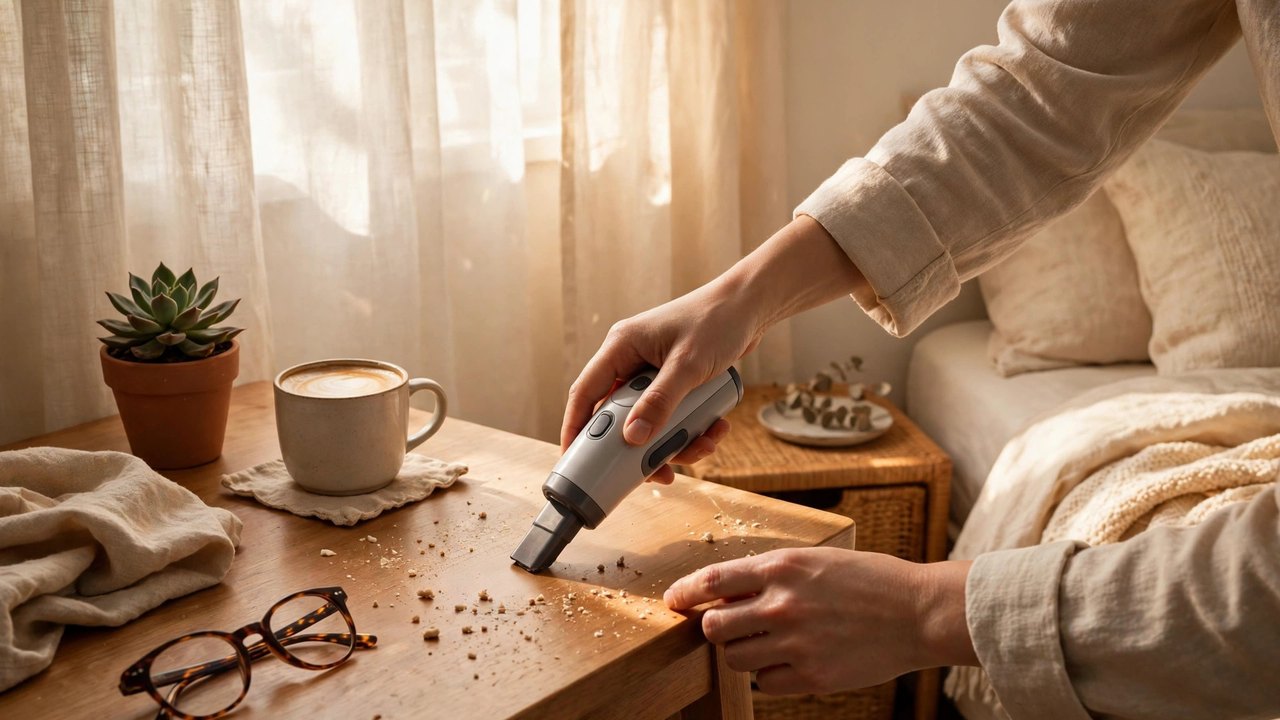
The KMM LT-117C covers the lightest end of this guide. The maker lists it as a cordless, rechargeable handheld vacuum and air duster with nine thousand pascals of suction, a one-hundred-and-twenty-watt motor and a HEPA filter in the product information. The listed battery is a four-thousand milliamp-hour lithium-ion pack with fast charging, and the included components centre on the brush and nozzle set for small jobs. The recommended uses the maker lists are revealing: keyboards, cameras, air conditioners, sofas, windows, pets and plants appear alongside the car, which tells you this model is aimed at the small, delicate, frequent jobs around a home and desk as much as at vehicle interiors.
That breadth is the LT-117C’s argument. A vacuum this size lives where the messes happen, in a desk drawer, on a shelf or in the glovebox, and gets used for thirty seconds at a time: crumbs after lunch, dust blown out of a keyboard, hair on a chair, grit on a windowsill, debris around a pet’s feeding spot. Frequency beats power for that layer of dirt. A stronger vacuum stored in another room will be used weekly; a light one within arm’s reach gets used daily, and daily small cleaning is what keeps desks, cars and pet corners from ever reaching the state that needs a deep session.
The duster function deserves the same emphasis here as on its sibling. Blowing dust out of a keyboard, a camera bag, a plant’s leaves or an air-conditioner vent, then vacuuming the fallout, is a two-step job that a vacuum-only tool does awkwardly. The maker lists this model for exactly those surfaces, and the nozzle set is the means: a brush for delicate surfaces, a narrow nozzle for seams and gaps. Work gently on electronics, keep the vacuum itself dry, and treat the blowing function as a way to move dust somewhere the vacuum can collect it rather than as a way to scatter it around the room.
Filtration, again, is stated in the structured information: filter type, HEPA filter. For a tool used at desk distance, close to your face and hands, that listing matters more than it might seem, because the exhaust air of a mini vacuum is released near the user. The washable-filter design in this family means maintenance is a rinse-and-dry routine rather than a purchase, but the small filter loads quickly with fine dust, so check it whenever suction feels softer than usual. A clean filter is the difference between the listed suction and a fraction of it.
Set against the LT-161 above, the choice is size and emphasis rather than quality. The LT-161 lists more suction and suits a car interior worked thoroughly in one session. The LT-117C lists a wider spread of delicate household uses and the lightest, quickest format. Households that want one mini for the car might prefer the first; households that want one mini for the desk, the pet corner and the occasional car tidy will find this one’s listed brief closer to their day. Either way, both keep the HEPA filter listing that defines this guide, so the decision can be made purely on shape and jobs.
Buy it if: you want the lightest cordless option for desks, keyboards, pet corners and quick car tidies, and you will use the duster function on electronics and vents.
Skip it if: you need maximum suction for a full car detail, your main jobs are floors, or you want a corded tool that never needs charging.
Buying guide
Start any search in this class by verifying the filter claim yourself, because it is the claim most often blurred. Open the product information, not just the headline, and look for the filter type field. If it names a HEPA filter for that model, the claim is on the record. If it names foam, cloth or a washable filter without the HEPA designation, the vacuum may still be a decent cleaner, but it is not the product this keyword promises, and descriptions elsewhere that call its filter HEPA-style or HEPA-type are telling you, in careful language, that it is not one. Also check that the model number in the specification table matches the model in the title, since shared listing pages are common at this level.
Next, match the power source to your habits honestly. Corded stick vacuums give consistent suction and unlimited runtime but tie you to outlets and a cord’s reach. Vehicle-powered vacuums remove charging entirely but work only at the car. Cordless minis are the fastest to deploy and the easiest to store, but they ask for a charging routine and give you a fixed runtime per session. None of these is best in the abstract. The right answer is the one whose inconvenience you will actually tolerate, because a vacuum’s real performance is the product of its specifications and how often it leaves its storage place.
Then size the tool to the debris. Mini vacuums with small cups excel at crumbs, dust, hair and grit in confined spaces, and struggle with volume: a spilled bag of rice, a muddy footwell or a whole room’s floor will mean repeated emptying and declining patience. Stick vacuums handle area cleaning but remain light-duty on carpet. If your home’s main load is carpeted floors throughout, this entire price class is a supplement rather than a solution, and the money is better kept toward a full-size machine while a mini from this list handles the detail layer.
Filter maintenance is the running cost nobody advertises. Prefer washable filters, as all four picks here have, and then actually wash them: rinse as directed, dry completely, and never run the vacuum with a damp filter. Keep the cup emptied so debris does not sit packed against the filter face. If a model uses replaceable filters instead, check that replacements for that exact model are easy to find before buying, because an orphan filter size turns a cheap vacuum into a disposable one within a year.
Finally, treat suction figures as comparisons within a brand’s own line rather than as laboratory measurements across brands. Pascal figures for mini vacuums are quoted under differing conditions, and a higher number on one listing does not guarantee stronger pickup than a lower number on another. Weight, cord length, cup size, the accessory set and the honesty of the specification table are more reliable guides, and they are the figures this guide leaned on when separating the picks from the exclusions.
FAQ
Do budget vacuums really have HEPA filters?
Some do, and many do not, which is why the check matters. A minority of compact models list a HEPA filter in their product information for the exact model, and those are the models in this guide. Many other budget models list foam or cloth filters and are described with phrases like HEPA-style, which is not the same claim. Always read the filter type field for the specific model before buying.
Is a mini car vacuum enough for a whole car interior?
For the usual load of crumbs, dust, sand and hair, yes, provided the cup is emptied as it fills and the filter is clean. The corded ThisWorx in this guide adds unlimited runtime at the vehicle outlet, which suits a thorough session. Heavy debris, soaked mats and workshop-level mess are beyond this class and call for a larger machine.
How often should the HEPA filter be cleaned?
Check it whenever suction feels reduced, brush or tap debris from it after dusty jobs, and wash it on the maker’s schedule for that model. Always let a washed filter dry completely before refitting it. A clean filter is the single biggest factor in keeping a small vacuum performing near its listed suction.
Can one of these replace a full-size vacuum?
For a small hard-floored flat, the corded stick pick can carry most daily cleaning. For carpeted rooms, family traffic and weekly deep cleans, treat every pick here as a supplement that handles the frequent small jobs between full-size sessions. That division of labour is what this class is designed for.
Why are some famous budget models not in this guide?
Because their current listings do not list a HEPA filter for the model. One popular slim handheld lists a washable filter with dual-level filtration, and a well-known budget stick currently lists a foam filter in its product information. Both may clean perfectly well, but this guide only includes models whose makers list a HEPA filter for the exact model, and it does not relax that rule for famous names.
Does a HEPA filter in a small vacuum need replacing?
The picks here use washable HEPA filters, so routine care is rinsing and drying rather than buying replacements. Over a long life a filter can eventually wear or hold odours that washing does not clear, at which point a replacement for the exact model is the fix. The ThisWorx kit shortens that concern by including a spare filter in the box.
Conclusion
The honest shape of this market is a short list. With the filter claim verified model by model and the offer checked page by page, four vacuums earn their place: the Vacmaster VSJ01 for floors in small homes, the ThisWorx TWC-01 for car interiors without charging, and the two KMM minis, the LT-161 for stronger detail work and the LT-117C for the lightest desk-and-home jobs. Each one carries a maker-listed HEPA filter, which is the whole point of the search, and each one is sized for the frequent small cleaning that dominates real life. Choose by power source and form factor, keep the filter clean, and a vacuum in this class will do its layer of work reliably every day.
M
Modern Line Home Editorial Team
We compare specs, materials and verified owner reviews before a product earns a spot. Rankings are never paid.
Affiliate disclosure. As an Amazon Associate we earn from qualifying purchases at no extra cost to you. Prices accurate as of the date shown.
House cold even with the heat on? Walk this ordered checklist: thermostat and filter first, then drafts, insulation, leaky ducts and a failing heating system.
Windows fogging up in winter? Check where the fog sits: on the room side it is indoor humidity, outside it is harmless, and between panes the seal has failed.
Store the main firewood pile about 30 feet from your house, off the ground and covered only on top. Compare racks, woodsheds, garages and indoor spots safely.
Place a portable generator outdoors only, at least 20 feet from windows, doors and vents, exhaust pointed away. Exact distances, setup steps and CO rules here.
Keep houseplants in the right winter spot: match window direction to plant type, stay clear of radiators and cold glass, and fix dry air and low light at home.
Mice enter through pencil-width gaps at foundations, pipes, vents, doors and the roofline. Walk this room-by-room winter checklist to find and seal each one.
A winter outage timeline: what to do in the first hour, first night and multi-day outage, with food safety times, pipe protection, heat and CO safety steps.
Size a space heater by room area: 10 watts per square foot at 8-foot ceilings, adjusted for insulation and ceiling height, with full wattage and BTU tables.
Start dripping at about 20 degrees, sooner for exposed pipes. Set a pencil-lead stream, drip the right faucets on both lines, and know when to stop safely.
A fridge needs 800-1,200 starting watts, not just 150-400 running watts. Use the tables to total your fridge plus freezer, lights, furnace fan and more today.












Write Your Review
No reviews yet. Be the first to share your experience!