We independently review everything we recommend. When you buy through our links, we may earn a commission. As an Amazon Associate we earn from qualifying purchases.
Best Cordless Vacuums for Stairs: 6 Light Picks (2026)
Compare the best cordless vacuums for stairs by weight, handheld mode, runtime and tools, with six light, proven picks for carpeted and bare steps alike today.
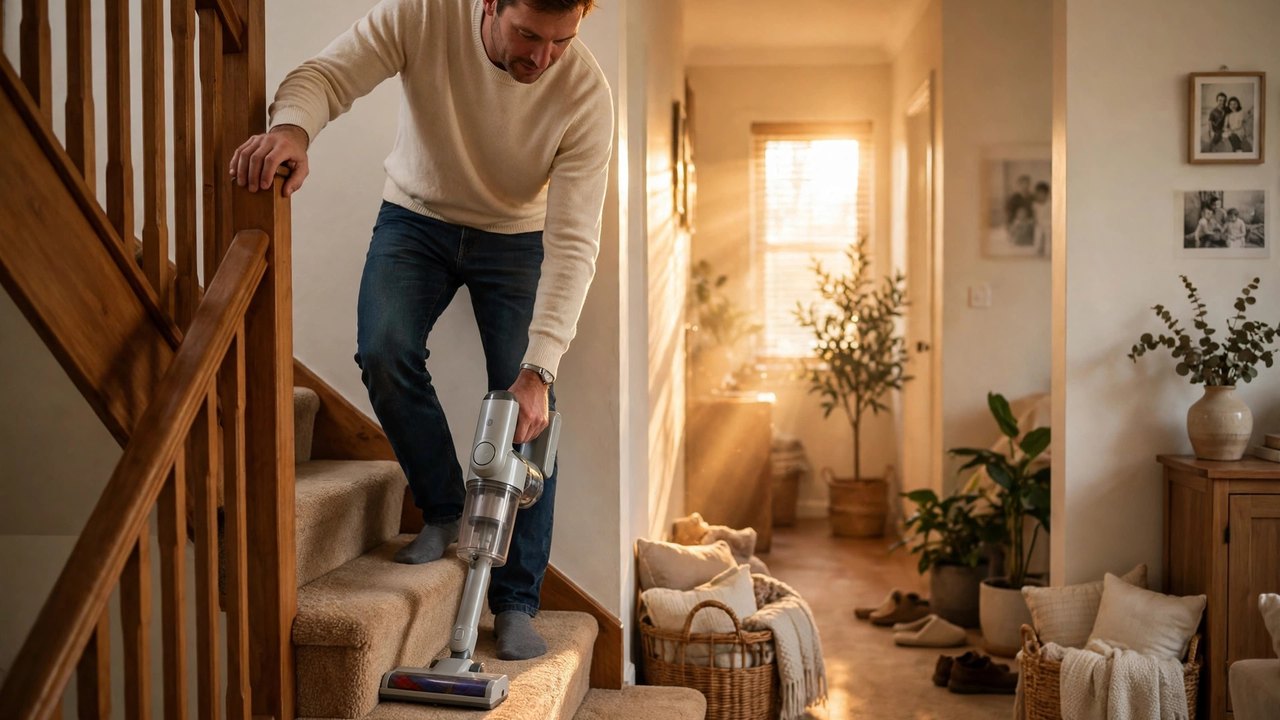
Stairs punish the wrong vacuum. A cord that trails behind you is a trip hazard, a heavy upright has to be balanced on a tread, and a full-size stick can feel top-heavy the moment you lift it onto the next step. The best cordless vacuums for stairs solve those problems in a specific way: they are light enough to carry in one hand while the other hand stays on the rail, they convert quickly to a handheld for risers and corners, and they bring a small motorised head or a focused tool to the narrow strip of carpet or wood that makes up each tread. This guide compares six cordless models that fit that brief, from a laser-equipped Dyson flagship to a simple, light LEVOIT value pick, so you can match the machine to your staircase rather than to a headline suction figure.
Your staircase type should drive the choice. Carpeted stairs need a motorised brush that can agitate pile in a short stroke and resist hair wrap, because pet hair and grit settle deep where the tread meets the riser. Bare wood, tile or laminate stairs need the opposite touch: a soft roller or a lighted head that reveals fine dust without scattering it, and enough control to work the back edge of each tread where debris collects. Most homes have a mix, plus a landing, a hallway runner and maybe upholstered furniture nearby, which is why every pick here is a convertible stick rather than a single-purpose handheld. You get the wand for landings and floors, and the handheld unit for the flight itself.
Quick verdict
For most homes, the Dyson V12 Detect Slim Absolute is the easiest recommendation: the maker lists a single-button power control, a laser that reveals dust on hard treads and an LCD particle display, and that combination makes stair cleaning controlled rather than strenuous. The Dyson V8 is the proven all-rounder for carpeted stairs, with a de-tangling Motorbar head and a listed run time of up to 40 minutes. If your steps are deep carpet and you want the strongest automatic boost, the Shark Stratos pairs Clean Sense IQ with a folding MultiFlex wand and a listed run time of up to 60 minutes. The Tineco Pure ONE S15 Essentials is the smart-suction middle option, the LEVOIT LVAC-200 is the light value pick, and the Shark Pet IX141 is the simple pet-hair choice with an XL dust cup.
The products in this guide
Dyson V12 Detect Slim Absolute
The defining stair feature here is control without a held trigger
Best for Homes with mostly bare or mixed stairs who want the lightest-feeling, most controlled clean
Pet tools, XL dust cup, up to 40 minutes listed in handheld
How we selected
Selection started with the staircase, not with a brand list. Each model had to be a genuine cordless convertible, able to work as a stick for landings and as a handheld for the flight itself, because a machine that cannot shorten down forces you to balance a long wand on narrow treads. Weight and balance were weighed heavily: a vacuum that is manageable on a flat floor can become tiring when lifted step after step, so lighter machines and designs with the mass close to the hand scored well. We then checked the tools that stair work actually uses, namely a crevice tool for edges, a small brush or pet tool for risers, and a motorised head sized for treads rather than only for wide open floors.
Specifications were taken from maker listings and product pages and are phrased here as the maker lists them. Run times are maximum figures measured under the conditions each maker states, usually in a low-power mode with a non-motorised tool, so treat them as a ceiling rather than a promise for boosted carpet cleaning. Suction figures are not directly comparable across brands because makers measure them differently, so this guide leans on the features that change stair cleaning in practice: automatic suction adjustment, de-tangling brush designs, lighted heads, folding wands and dust cups that are easy to empty. Models that could not be verified on opened pages, or that showed no live new offer, were excluded and replaced.
Finally, we spread the six picks across budgets and priorities rather than choosing six versions of the same idea. There is a sensing flagship, a proven mid-range all-rounder, a power pick for deep carpet, a sensor-driven Tineco, a light value model and a pet-focused Shark. If your staircase is short and bare, the value pick may be all you need; if it is long, carpeted and shared with shedding pets, the stronger heads and larger bins earn their place. The buying guide after the picks explains how to weigh those trade-offs for your own home.
The defining stair feature here is control without a held trigger. The maker lists a single-button power control, so you can swap hands while working around a banister or newel post instead of keeping one finger squeezed for a whole flight. A precisely angled laser on the cleaner head makes fine dust visible on hard treads, and the machine sizes and counts dust particles and shows the results on its LCD screen as you clean. On carpeted steps that display matters less than the motorised head, but on wood, tile and laminate stairs it helps you see whether a second slow pass is actually needed. The hygienic bin ejection drives dust deep into the bin in one action, which keeps emptying after a dusty flight simple, and the machine drops into a wall-mounted charging dock between cleans. In handheld form, without the wand, it becomes a compact unit for risers, edges and the corners where treads meet stringers.
On a staircase, technique matters as much as the machine. Work from the top step down so loose grit falls onto a step you have not cleaned yet, keep your free hand on the rail, and use the handheld form for the vertical riser faces and the inside corners. Short, overlapping passes with the motorised head lift more from carpet pile than one fast sweep, while on bare treads a slower pass lets the brush or roller reach the grit that collects along the back edge of each step. Empty the bin before it passes the fill line, because a packed bin reduces airflow exactly when you are asking the machine to pull debris out of pile at an awkward angle.
Buy it if: Homes with mostly bare or mixed stairs who want the lightest-feeling, most controlled clean and a power button instead of a trigger.
Skip it if: You want the longest possible runtime for several flights plus whole-house cleaning in one session, or you prefer a self-standing machine that needs no wall dock.
The V8 is the familiar, balanced answer for stairs. The maker lists up to 40 minutes of run time, two power modes and 115AW of suction, and the Motorbar cleaner head is listed as deep cleaning all floor types while de-tangling wrapped long hair and pet hair as you clean. That de-tangling behaviour is valuable on carpeted treads, where hair winds tightly around a brush bar in the pile. The machine converts to a handheld, which is the configuration most owners will actually use for a flight: short, light and easy to angle into the inside corner of each step. Because the design has been in service for years, the handling is predictable, the balance sits close to the hand, and moving from tread to riser to landing feels natural rather than top-heavy. It is a sensible middle path between the sensing V12 above and the value picks below.
On a staircase, technique matters as much as the machine. Work from the top step down so loose grit falls onto a step you have not cleaned yet, keep your free hand on the rail, and use the handheld form for the vertical riser faces and the inside corners. Short, overlapping passes with the motorised head lift more from carpet pile than one fast sweep, while on bare treads a slower pass lets the brush or roller reach the grit that collects along the back edge of each step. Empty the bin before it passes the fill line, because a packed bin reduces airflow exactly when you are asking the machine to pull debris out of pile at an awkward angle.
Buy it if: Carpeted stairs with pet hair, and anyone who wants a proven handheld conversion with a de-tangling motorised head.
Skip it if: Your stairs are mostly hard surfaces and you want a laser or lighted head to reveal fine dust, or you need more than the listed run time for a large multi-storey clean.
The Stratos is the power pick, and also the heaviest-feeling choice here, so its stair case rests on features rather than feather weight. The maker lists up to 60 minutes of runtime, Clean Sense IQ that detects debris you cannot see and automatically boosts suction, and a MultiFlex wand that bends to reach under furniture and folds for freestanding storage. The DuoClean PowerFins HairPro brushroll is listed as delivering hair pickup without hair wrap, digging into carpets with the fins while a soft roller lifts debris from hard floors. An anti-allergen complete seal with HEPA filtration, odor neutralizer technology and LED headlights round out the listing. On stairs, use it mainly in handheld form with the included crevice tool and anti-allergen brush; the full stick is better saved for landings and the floors at the top and bottom. Households with deep-pile carpeted steps will appreciate the boosted suction most.
On a staircase, technique matters as much as the machine. Work from the top step down so loose grit falls onto a step you have not cleaned yet, keep your free hand on the rail, and use the handheld form for the vertical riser faces and the inside corners. Short, overlapping passes with the motorised head lift more from carpet pile than one fast sweep, while on bare treads a slower pass lets the brush or roller reach the grit that collects along the back edge of each step. Empty the bin before it passes the fill line, because a packed bin reduces airflow exactly when you are asking the machine to pull debris out of pile at an awkward angle.
Buy it if: Carpeted stairs and landings that need strong, automatically boosted suction, plus a folding wand for storage in a hall cupboard.
Skip it if: Weight is your top priority, or your staircase is narrow and winding and you will carry the machine in one hand for the entire clean.
The S15 Essentials brings smart suction adjustment to a mid-priced stair vacuum. The maker lists the iLoop smart sensor, which automatically adjusts suction power according to the soiling detected, so a gritty tread gets more power and a clean one gets less without you changing modes. ZeroTangle technology uses a specially designed brush roller to vacuum hair without tangling, and Tineco Pure Cyclone technology separates air and dust to avoid pre-filter clogging and suction loss, which the maker describes as strong, fade-free suction. A one-touch trigger wipes the dustbin clean, scraping dust and hair from the bin into the trash, and the freestanding charging base needs no drilling or wall installation, which renters on multiple floors will value. The detachable battery can be swapped for a separately sold pack to extend a long session. In handheld form it suits risers, edges and upholstered stair runners well.
On a staircase, technique matters as much as the machine. Work from the top step down so loose grit falls onto a step you have not cleaned yet, keep your free hand on the rail, and use the handheld form for the vertical riser faces and the inside corners. Short, overlapping passes with the motorised head lift more from carpet pile than one fast sweep, while on bare treads a slower pass lets the brush or roller reach the grit that collects along the back edge of each step. Empty the bin before it passes the fill line, because a packed bin reduces airflow exactly when you are asking the machine to pull debris out of pile at an awkward angle.
Buy it if: Homes that mix carpeted and bare steps and want suction that adapts on its own, with a no-drill charging base.
Skip it if: You want a laser display or particle-count screen, or you prefer the simplest possible controls with no sensor modes to think about.
The LVAC-200 is the lightweight value pick that still behaves like a proper stick. The maker lists up to 50 minutes of power with the crevice or pet tool in Eco mode, 30 minutes with the vacuum head and 12 minutes in Turbo mode, with runtimes measured at room temperature. It is listed as lightweight and flexible for everyday use, able to lie 180 degrees flat to reach under furniture, with three LED lights to spot dust as you go. The custom two-in-one pet tool simplifies hair cleanup, and the dusting brush doubles as a crevice tool for hard-to-reach areas, which covers the two tools stair cleaning actually uses most: an edge tool and a small brush for risers and spindles. The tangle-resistant design and removable battery keep upkeep simple, and the self-standing style means it can wait on a landing while you move a stair gate or carry laundry down. For low-pile runners and bare treads it is an easy carry.
On a staircase, technique matters as much as the machine. Work from the top step down so loose grit falls onto a step you have not cleaned yet, keep your free hand on the rail, and use the handheld form for the vertical riser faces and the inside corners. Short, overlapping passes with the motorised head lift more from carpet pile than one fast sweep, while on bare treads a slower pass lets the brush or roller reach the grit that collects along the back edge of each step. Empty the bin before it passes the fill line, because a packed bin reduces airflow exactly when you are asking the machine to pull debris out of pile at an awkward angle.
Buy it if: Budget-minded homes, renters and anyone who wants the easiest carry up and down long staircases for everyday crumbs and hair.
Skip it if: Your stairs are deep-pile carpet that needs maximum boosted suction, or you want a premium sensing head and display.
The IX141 is the straightforward pet-hair pick for stairs. The maker lists HyperVelocity accelerated suction for everyday cleaning, up to 40 minutes of runtime measured at the handheld vacuum in standard mode, and a bristle brushroll with powerful suction for carpets, rugs and bare floors. It converts to a removable handheld vacuum for above-floor cleaning on stairs, furniture, upholstery and tight corners, and the listing includes LED headlights, a crevice tool and a pet multi-tool, plus an XL dust cup that means fewer trips to the bin halfway through a flight. That combination maps neatly onto real stair work: the stick form for landings, the handheld with the pet tool for treads where hair collects against the riser, and the crevice tool for the line where carpet meets the skirting. It lacks the sensing and folding tricks of the Stratos, but it is simpler and easier to live with day to day.
On a staircase, technique matters as much as the machine. Work from the top step down so loose grit falls onto a step you have not cleaned yet, keep your free hand on the rail, and use the handheld form for the vertical riser faces and the inside corners. Short, overlapping passes with the motorised head lift more from carpet pile than one fast sweep, while on bare treads a slower pass lets the brush or roller reach the grit that collects along the back edge of each step. Empty the bin before it passes the fill line, because a packed bin reduces airflow exactly when you are asking the machine to pull debris out of pile at an awkward angle.
Buy it if: Pet owners with carpeted stairs who want a larger dust cup, LED headlights and dedicated pet tools without paying for sensing features.
Skip it if: You want automatic suction adjustment, a folding wand or a laser dust display for hard treads.
Buying guide
Weight and balance come first. On stairs you lift the vacuum constantly, often with one hand while the other holds the rail. A lighter machine with its motor and bin close to your hand will feel easier than a slightly more powerful model whose weight sits at the top of a long wand. If you have two or more flights, or anyone in the home finds lifting difficult, prioritise the lightest picks and use the handheld configuration for most of the flight, bringing out the full stick only for landings.
Handheld conversion should be quick. The useful stair setup is the motor unit with a crevice tool, a small brush or a mini motorised tool attached directly. Check how the wand releases and whether the tools you need are included rather than sold separately. A crevice tool reaches the line where the tread meets the wall, a dusting brush suits risers, spindles and banisters, and a pet tool lifts hair from carpeted treads and upholstered stair runners. LED headlights, listed on the Shark and LEVOIT picks, help on dim enclosed staircases where the back of each tread sits in shadow.
Match the head to your tread surface. Carpeted stairs benefit from a motorised brush with de-tangling or anti-wrap design, because hair winds around a brush bar quickly in pile and a wrapped bar loses contact with the carpet. The Dyson Motorbar, Shark PowerFins HairPro and Tineco ZeroTangle designs all address that problem in different ways. Bare stairs benefit from a soft roller or a lighted head: the V12 laser reveals fine dust on hard surfaces, while LED lights give a simpler version of the same visibility. If your stairs are a mix, a model with automatic suction adjustment, such as the Shark Clean Sense IQ or Tineco iLoop sensor, saves you changing modes at every landing.
Read run time figures carefully. Makers list maximum run times, and those figures usually apply in the lowest mode with a simple tool. Boosted carpet cleaning on a motorised head will use the battery much faster, as the LEVOIT listing makes clear by separating its Eco, head and Turbo figures. For a single flight plus landings, even the shorter listed figures are ample. For several flights plus the rest of the house, look for a longer listed maximum, a removable battery you can swap, or a second battery sold by the maker. Charging arrangements matter too: a wall dock keeps a machine ready in a hall, while a freestanding base suits renters who cannot drill.
Bin size and emptying affect real use. Stair debris is gritty and hair-heavy, and a small bin can fill during one thorough flight. A larger cup, like the XL cup on the Shark IX141, means fewer interruptions, while hygienic ejection systems and one-touch bin wiping, listed on the Dyson V12 and Tineco S15 Essentials respectively, reduce contact with dust when you empty. Whatever you choose, empty before the fill line and check the brush bar weekly if pets use the stairs, because hair builds up fastest in the corners of the head.
Filtration and upkeep. Sealed systems with HEPA filtration, listed on the Shark Stratos, trap fine dust inside the machine instead of blowing it back onto the steps you just cleaned, which matters in an enclosed stairwell. Washable or replaceable filters need a simple routine: tap or rinse as the maker directs, let parts dry fully, and keep a note of replacement intervals. None of this is difficult, but a machine whose filter is awkward to reach tends to be neglected, and a clogged filter is the most common reason a cordless vacuum feels weak on carpeted stairs.
FAQ
Are cordless vacuums strong enough for carpeted stairs?
Yes, for the short, focused passes stair cleaning involves. The picks here include motorised heads designed to agitate carpet pile and de-tangle hair as they clean, and several makers list automatic suction boosting when the machine detects heavier soiling. Technique helps: use slow, overlapping strokes and let the head sit in the pile rather than skimming across it.
Is a handheld or a stick better for stairs?
A convertible that does both is best. Use the handheld form, with a crevice tool, brush or pet tool attached directly to the motor unit, for treads, risers and corners. Use the stick form for landings, hallways and the floors at the top and bottom of the flight, where the longer reach is an advantage rather than a balancing problem.
How long a run time do I need for stairs?
A single flight usually takes only a few minutes of active cleaning, so even modest listed run times cover stairs easily. Run time becomes important when you clean several flights plus adjoining rooms on one charge. Remember that maker figures are maximums in low modes, and boosted carpet work will be shorter, so choose a removable or swappable battery if you regularly clean a large multi-storey home.
What tools matter most for stair cleaning?
A crevice tool for edges and corners, a small dusting brush for risers and spindles, and a motorised or pet tool for carpeted treads cover almost every stair task. Lighted heads help on dim staircases. Long extension wands and large floor heads, by contrast, are mostly useful away from the staircase itself.
How do I clean stairs safely with a cordless vacuum?
Start at the top and work down, keep one hand on the rail, and never balance the machine or its dock on a tread where it could be knocked down the flight. Keep the staircase clear of charging cables, empty the bin at the bottom, and store the vacuum off the stairs so the route stays unobstructed for everyone else in the home.
Conclusion
The right cordless vacuum turns stairs from the most awkward job in the house into a few minutes of handheld work. Choose the Dyson V12 Detect Slim Absolute for controlled, visible cleaning on mixed stairs, the Dyson V8 for proven carpet performance, the Shark Stratos for boosted power on deep pile, the Tineco Pure ONE S15 Essentials for sensor-driven suction with a no-drill base, the LEVOIT LVAC-200 for the lightest value carry, or the Shark Pet IX141 for simple pet-hair duty with a larger bin. Match the weight, head and tools to your treads, work top-down in handheld form, and any of these six will keep a staircase cleaner with far less effort than dragging a corded machine step by step.
M
Modern Line Home Editorial Team
We compare specs, materials and verified owner reviews before a product earns a spot. Rankings are never paid.
Affiliate disclosure. As an Amazon Associate we earn from qualifying purchases at no extra cost to you. Prices accurate as of the date shown.
House cold even with the heat on? Walk this ordered checklist: thermostat and filter first, then drafts, insulation, leaky ducts and a failing heating system.
Windows fogging up in winter? Check where the fog sits: on the room side it is indoor humidity, outside it is harmless, and between panes the seal has failed.
Store the main firewood pile about 30 feet from your house, off the ground and covered only on top. Compare racks, woodsheds, garages and indoor spots safely.
Place a portable generator outdoors only, at least 20 feet from windows, doors and vents, exhaust pointed away. Exact distances, setup steps and CO rules here.
Keep houseplants in the right winter spot: match window direction to plant type, stay clear of radiators and cold glass, and fix dry air and low light at home.
Mice enter through pencil-width gaps at foundations, pipes, vents, doors and the roofline. Walk this room-by-room winter checklist to find and seal each one.
A winter outage timeline: what to do in the first hour, first night and multi-day outage, with food safety times, pipe protection, heat and CO safety steps.
Size a space heater by room area: 10 watts per square foot at 8-foot ceilings, adjusted for insulation and ceiling height, with full wattage and BTU tables.
Start dripping at about 20 degrees, sooner for exposed pipes. Set a pencil-lead stream, drip the right faucets on both lines, and know when to stop safely.
A fridge needs 800-1,200 starting watts, not just 150-400 running watts. Use the tables to total your fridge plus freezer, lights, furnace fan and more today.












Write Your Review
No reviews yet. Be the first to share your experience!