We independently review everything we recommend. When you buy through our links, we may earn a commission. As an Amazon Associate we earn from qualifying purchases.
Best Car Air Purifiers for Weed Smoke Odor Removal
Compare the best car air purifiers for weed smoke odor, with top activated carbon and HEPA picks from IQAir, Pure Enrichment, Westinghouse, Scosche and more.
Compare the best car air purifiers for weed smoke odor, with top activated carbon and HEPA picks from IQAir, Pure Enrichment, Westinghouse, Scosche and more.
Weed smoke leaves a car cabin smelling stale long after the smoke itself has cleared. The visible haze is only part of the problem: fine smoke particles drift into seat fabric, headliners and vents, while the odor-carrying gases in the smoke cling to soft surfaces and keep releasing that skunky, burnt smell on every warm day. Venting the windows helps for a few minutes, and a hanging freshener only covers the smell with a stronger one. A real purifier takes a different approach, pulling cabin air through filter media again and again so particles are trapped and odor compounds are adsorbed instead of masked. If you are shopping for the best car air purifiers for weed odor, the filter stack matters more than the badge on the housing: you want a HEPA-grade stage for the smoke particles and an activated carbon or other gas-phase stage for the smell itself.
This guide compares six car and portable purifiers that fit that brief in different ways. At one end sits a large, headrest-mounted unit with a combined particle and gas-phase filter built for whole-cabin work. At the other end are cup-holder and personal-space models that clean the air immediately around the driver and front passenger. Between them are dashboard and travel designs with odor-focused filter coatings, catalytic oxidation and simple carbon pre-filters. None of them can reach into upholstery and pull odor out of foam, and none replaces a proper interior clean, but the right one, run consistently after each drive, steadily works through the airborne share of the problem, which is the share that greets you every time you open the door.
Quick verdict
For the strongest all-round answer to weed smoke odor, the IQAir Atem Car is the standout: its HyperHEPA Plus filter combines particle filtration with gas-phase media in one large cartridge, and the maker lists it for odors, gases and smoke as well as ultrafine particles. If you want something small, cordless and inexpensive to run, the Pure Enrichment PureZone Mini pairs an activated carbon pre-filter with a true HEPA stage and a rechargeable battery, making it the easiest pick to move between cars. The Westinghouse 1804 takes a different route with its NCCO catalytic technology alongside an H13 HEPA filter, and the maker lists cigarette smoke and VOCs among the contaminants it is built to handle. Drivers who want a purifier designed specifically around odor destruction in a vehicle should look at the GreenTech Environmental Active HEPA+ Car, whose ODOGard-coated filters are the centerpiece of its design. For a simple cup-holder fit with a 12V adapter in the box, the Scosche FrescheAIR Pro AFP-SP is the straightforward choice, and the HoMedics Portable Air Purifier AP-P59 is the compact rechargeable option with a HEPA-type filter and activated carbon for personal-space use in the car.
The products in this guide
IQAir Atem Car
For the particle side, the maker lists filtration of 99% of particles down to 0.003 microns, which covers the fine end of smoke particulate with room
Best if you want the strongest combined particle and gas-phase filtration available in a car purifier
HEPA-type filter with activated carbon and pre-filter
USB rechargeable battery
Compact personal-space use
How we selected
Every product in this guide had to pass the same checks. First, it had to be a real, identifiable model from a named brand, with its filtration, dimensions and power requirements published on an opened product page, so nothing here rests on a vague marketplace description. Second, it had to be sold new on Amazon US with a live featured offer at the time of checking; listings showing no available new offer were excluded and replaced. Third, and most important for this keyword, the filtration had to address both halves of weed smoke: particles and odor. That meant a HEPA or HEPA-type stage for the fine particulate side, plus activated carbon, a gas-phase filter medium, a catalytic process or an odor-focused filter coating for the smell. Ionizer-only plugs and fragrance-based fresheners were left out, because they do not filter particles out of the air and do not adsorb odor compounds in a filter bed.
We also weighed how each unit actually lives in a car. A purifier that needs a mains outlet is no use on the road, so every pick runs from a 12V socket, a USB connection or its own rechargeable battery. Mounting mattered too: headrest straps, dashboard pads and cup-holder shapes all keep a unit secure and keep its intake unobstructed, which is what lets it cycle the small volume of a cabin repeatedly. Finally, we considered the running-cost picture in general terms: replaceable filter cartridges are a normal, predictable part of owning any of these devices, and models differ in how often the maker says those cartridges need changing. Specs below are phrased as the maker lists them, because filter names and test figures are defined by each brand.
The Atem Car is the most serious piece of filtration hardware in this roundup, and it is the pick that most directly targets the gas side of weed smoke. The maker lists its HyperHEPA Plus filter as a combination of particle filter media and gas-phase media in a single C-shaped cartridge that wraps around the fan, and the maker’s own description says that gas-phase media captures VOCs and unpleasant odors from sources including smoke. For the particle side, the maker lists filtration of 99% of particles down to 0.003 microns, which covers the fine end of smoke particulate with room to spare. Most small car purifiers separate these jobs or skip the gas stage entirely; here both happen in one large filter with a listed surface area of 0.23 square metres, which is substantial for a device of this size.
The hardware is built around vehicle use rather than adapted to it. The maker lists three default fan speeds with air delivery of 12, 20 and 30 cubic metres per hour, power draw under 3.4 watts on those speeds, and a 12–24V DC supply fed by the included car power adapter. The unit measures about 30 by 30 by 10 centimetres including the mount and weighs 2.4 kilograms with the mount and adapter fitted, and it attaches to a headrest with the supplied belt and buckle, which positions the outlet near the breathing zone of the front seats. Control is by tapping the logo on the front of the unit or through the maker’s smartphone app, and the maker lists an average filter life of roughly one year based on about three hours of daily use on the top default speed, which makes running costs predictable. Sound levels are listed at 35, 45 and 55 dB(A) across the three speeds, so the lower settings suit conversation and the top setting is there for a hard post-drive purge.
For weed odor specifically, the routine that suits this unit is to let it run on a higher speed for the drive home and for a while after parking where power allows, because each pass through that combined filter removes another share of airborne odor compounds. Its size is the trade-off: this is a disc that lives on a headrest, not a gadget that disappears into a cup holder, and smaller cars may find it visually prominent. It is also a single-purpose investment compared with the pocket-size models below. But if the goal is the deepest filtration of both smoke particles and smoke smell that a car accessory can offer, this is the benchmark the rest of the list is measured against.
Buy it if: you want the strongest combined particle and gas-phase filtration available in a car purifier, you have a headrest it can mount to, and you will run it consistently after drives.
Skip it if: you need something that hides in a cup holder, you move between several cars and want a grab-and-go unit, or your odor problem is mild enough that a small personal purifier would do.
The PureZone Mini is the opposite philosophy to the Atem: a personal-space purifier small enough to sit on a console or seat, built around a two-stage filter that is exactly the combination this keyword calls for. The maker lists stage one as an activated carbon pre-filter that traps odors and gases, and stage two as a true HEPA filter, and the maker states the system is rated to capture 99.97% of particles down to 0.3 microns, listing smoke among the particles the HEPA stage addresses. The carbon stage sits first in the airflow path, which is the right order for odor work: the smell compounds meet the adsorbent media before the air reaches the particle filter. For a driver whose weed odor problem is concentrated around the front seats rather than the whole cabin, that little stack, run close by, is a sensible and honest tool.
The maker lists the unit at just 9.6 ounces, with dimensions of about 8.5 by 3.3 by 2.7 inches, so it fits where larger purifiers cannot. Power comes from a rechargeable lithium-ion battery that the maker lists at up to 12 hours of runtime on the low setting, with USB charging and three fan speeds to choose from. The maker also lists a personal coverage figure, describing the unit as cleaning the air in a small area around the user rather than a whole room, and that framing is important: in a car, place it on the centre console, a flat section of dash away from airbags, or the seat beside you, and it will cycle the air in your immediate zone many times on a single drive. An adjustable handle lets it stand upright or lie on its side, which helps it settle into awkward cabin spaces, and because it is cordless it can come indoors with you and keep working on a desk or bedside table between drives.
Set expectations by size. A purifier this small moves a modest amount of air, so it will not purge a smoke-filled cabin in minutes the way the headrest-mounted Atem can; its strength is steady, close-range running that keeps the driver’s area from building up odor over repeated trips, and chips away at airborne smell each time it runs. The filter is a combined 2-in-1 cartridge, so when performance fades you replace the whole cartridge rather than separate stages. For renters of their own schedule, ride-share drivers who swap vehicles, or anyone who wants one device for car, desk and travel bag, it is the most flexible pick here.
Buy it if: you want a cordless, pocketable purifier with a genuine activated carbon plus HEPA stack that you can move between car, desk and luggage.
Skip it if: you need whole-cabin turnover in a large SUV, or you want a set-and-forget unit that lives permanently wired into one vehicle.
The Westinghouse 1804 attacks odor with chemistry rather than a carbon bed. Alongside an H13 true HEPA filter, the maker lists its patented NCCO technology, short for Nano Confined Catalytic Oxidation, and describes it as using active oxygen to decompose pollutants into compounds such as carbon dioxide and water. That distinction matters for weed smell: an adsorbent filter holds odor molecules until the media is saturated, while a catalytic process is presented by the maker as breaking pollutants down, so the odor stage does not simply fill up in the same way. The maker lists the unit’s contaminant capability as including cigarette smoke, odors and volatile organic compounds, which maps closely onto the mix that weed smoke leaves in a cabin, and lists the HEPA stage at 99.97% of airborne particles down to 0.3 microns.
As a piece of travel hardware it is easy to live with. The maker lists a weight of about 2 pounds, a woven and leather carry strap, a noise level of 35 dB, and battery-powered operation with up to 8 hours of use, so it can ride on a seat, hang from a headrest by its strap, or come with you into a hotel room and keep working there. The maker lists the HEPA filter life at up to 3,000 hours of use, with a filter indicator to flag replacement, and the NCCO reactor is a long-life component rather than a consumable cartridge. Its listed floor-area figure is a room-scale number, but in practice a car cabin is a far smaller volume than any room, so a personal purifier of this output cycles cabin air repeatedly on a drive. The blue finish and rounded case look more like a small speaker than a medical device, which helps it blend into an interior.
The honest caveats are about scale and style of use. Like the PureZone Mini, this is a personal purifier, not a whole-vehicle system with a vehicle power supply and mount engineered around a headrest; it earns its place by being carried to wherever the air problem is. Drivers fighting a heavy, baked-in smell throughout a large cabin should treat it as a strong personal-zone tool and pair it with a thorough interior clean. Drivers whose routine is one car, moderate odor, and frequent travel will find its combination of HEPA filtration and catalytic odor handling unusually complete for its size.
Buy it if: you like the idea of catalytic odor decomposition instead of a carbon bed alone, and you want one portable unit for car, travel and small rooms.
Skip it if: you want a permanently mounted, vehicle-powered purifier, or you need the largest possible filter volume for a big cabin.
Most purifiers in this guide are portable units that can work in a car; the Active HEPA+ Car is designed for the car first. The maker describes a dual approach that combines active and passive purification, built around two specialized HEPA filters coated with its ODOGard technology. The maker says that coating is designed to bond with, trap and break down odor compounds and other particulates on contact, and lists the unit’s contaminant capability as including odors and volatile organic compounds alongside dust and pollen. For weed smoke, that pitch is aimed squarely at the lingering smell rather than only the particles: two filter elements give the coating more surface to work with, and the unit is shaped and sized, at about 6.33 by 6.33 by 2.5 inches, to sit on a dashboard on its anti-slip pad or strap into place.
The running gear suits permanent installation. The maker lists power consumption of just 3.9 watts, a 12V USB-C power cable in the box and two USB-C power ports, so it can live off the car’s supply without draining anything meaningful, and it stays where you put it instead of being charged and carried. At 3.1 pounds it is heavier than the personal minis, which reflects the dual-filter build, and the maker lists certifications including CARB and FCC, a relevant detail for in-car electronic air cleaners. Because it is always in the vehicle, the use pattern is effortless: it runs when the car runs, steadily processing cabin air on every trip, which is exactly the consistent, repeated cycling that airborne odor reduction depends on. There is no battery to remember and no unit to carry in at night.
What it asks in return is a fixed spot and a bit of dashboard or console real estate, and drivers who split time between two cars cannot take it with them. Its filtration story is also more brand-specific than the standard carbon-plus-HEPA recipe: the ODOGard coating and the active purification stage are this maker’s own technologies, described in the maker’s terms, rather than commodity filter media you can comparison-shop across brands. If you want a dedicated, always-installed answer to cabin odor from a company that builds air treatment equipment for demanding environments, it is the most purpose-built option here after the Atem.
Buy it if: you want a purifier that lives in one car permanently, runs from the car’s own power, and is engineered around odor-focused coated filters.
Skip it if: you need to move the purifier between vehicles, or you prefer a standard replaceable carbon and HEPA cartridge system.
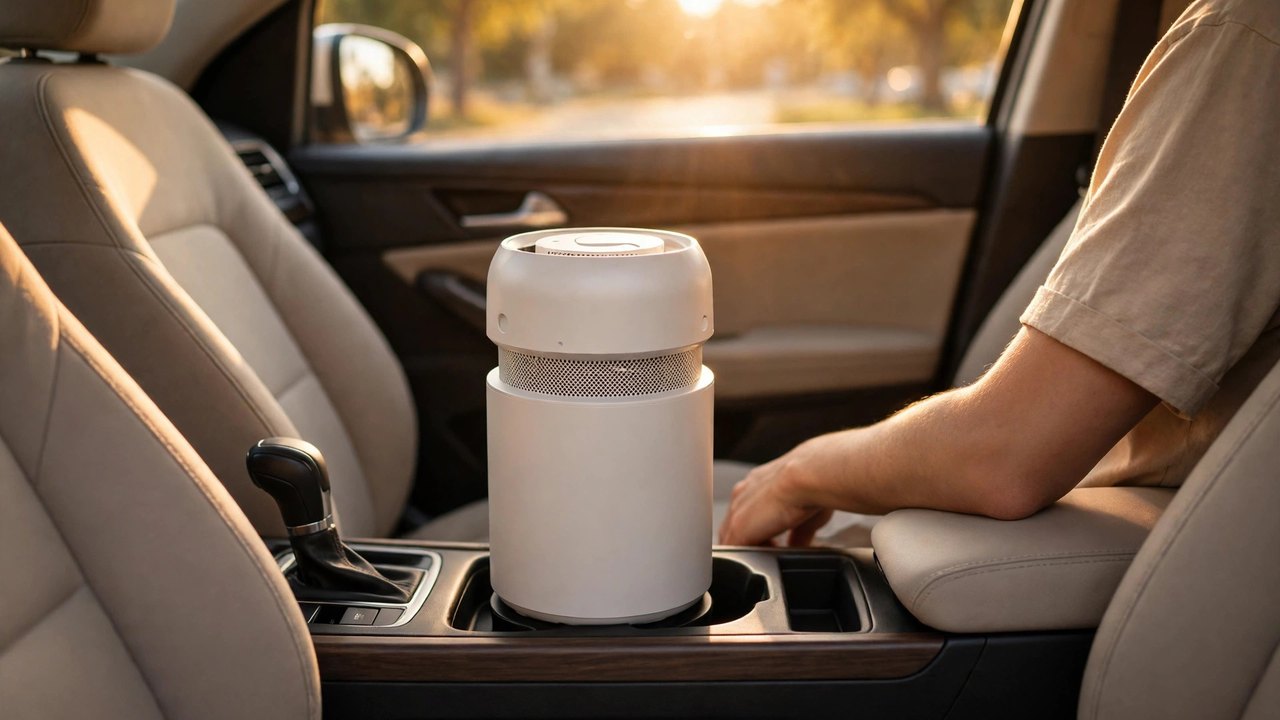
The FrescheAIR Pro is the pragmatist’s pick: a cylindrical HEPA purifier shaped to drop into a cup holder, from a brand whose main business is car accessories. The maker lists it as a purifier and deodorizer intended to help remove unwanted odors including food odors, smoke fumes and pet odors, which is precisely the company weed smell keeps in a cabin. It stands about 7.1 inches tall on a 2.6-inch footprint, weighs 0.7 kilograms, and the maker lists a noise level of 30 dB and power draw of 5 watts. In the box, the maker lists the purifier, one filter, a 12V dual adapter, a 4-foot USB cable and a manual, so it can run from the car’s socket with a spare charging port left over, or from USB power.
Two touches make it easy to use while driving. The fan has two speeds and is touchless: the maker describes changing settings with a wave of the hand over the top of the unit, so there are no small buttons to hunt for at a red light. A digital display on the unit shows air quality, temperature and humidity readings, giving you a rough sense of whether the cabin air is improving as it runs. Because it lives in a cup holder, placement is genuinely secure, the intake and outlet stay clear, and moving it to another car takes seconds. The maker lists a one-year warranty. As with every cup-holder design, you give up one cup holder, and in cars where the holders sit low between the seats, the cleaned air starts its circulation from that low point rather than up at dash level.
Filtration expectations should be set by its class: this is a compact single-filter unit for maintaining a cabin and working on everyday odor, not a deep-purge machine for a car that has been hot-boxed daily for a year. Run it on the higher speed for the first stretch of a drive, let it keep cycling air on the lower speed after that, and replace the filter on the maker’s schedule so the media stays effective. For drivers who want the least possible friction between buying a purifier and actually using it every day, the cup-holder format is hard to beat, and the smoke-odor focus in the maker’s own description makes it a natural fit for this guide.
Buy it if: you want a no-fuss cup-holder purifier with vehicle power in the box, simple touchless controls and a display, aimed at everyday smoke and food odors.
Skip it if: you cannot spare a cup holder, or your odor problem is severe and whole-cabin rather than routine and moderate.
The HoMedics AP-P59 rounds out the list as the small rechargeable option with the right filter recipe for odor. The maker lists a 3-in-1 system: a built-in pre-filter, a HEPA-type filter and activated carbon, and states the filter removes up to 99% of airborne particles as small as 0.3 microns. The maker’s own contaminant list for the model includes odors and cigarette smoke, so the carbon stage is there for exactly the gas-phase side of the weed smell problem, while the pre-filter catches the larger lint and dust that would otherwise load the main filter. The maker lists the unit at about 6.89 inches tall and 2.68 inches across, a slim cylinder that tucks into a door pocket, a console or the edge of a seat, and includes three essential oil pads for drivers who like a light scent alongside filtration, though the pads are optional and the filtration does the odor work on its own.
Power and noise are commuter-friendly. The maker lists USB rechargeable operation with up to 8 hours of use per charge, three fan speeds, and quiet operation listed from 17.5 to 34.0 dBA across those speeds, so the low setting can run through a workday drive cycle without intruding on calls or music. The maker advises replacing the filter every two to three months for best performance, which is a shorter interval than the big Atem cartridge but typical for a filter this small, and worth factoring into running costs. Because it is a personal-space unit, its effective arena is the air around one or two seats: position it upright near the centre console and it will steadily process the air the front occupants are actually breathing, which is where weed odor is most noticeable after a drive.
Be clear about what HEPA-type means in the maker’s listing: it is the maker’s term for a filter in the HEPA family rather than a true HEPA rating, and the stated particle figure is up to 99% rather than the 99.97% the true HEPA models here list. For odor, though, the activated carbon layer is the working stage, and that is present and correct. As a second purifier for a partner’s car, a work vehicle, or a small cabin where the smell issue is light but persistent, it is a tidy, low-effort answer.
Buy it if: you want a slim, quiet, rechargeable purifier with activated carbon for personal-space odor control in a small car or as a second unit.
Skip it if: you want a true HEPA rated filter, the longest possible filter-change interval, or whole-cabin coverage in a large vehicle.
Buying guide: clearing weed smoke odor from a car
Start with the two-part nature of the problem. Weed smoke is particles plus gases. The particles are the visible haze and the fine ash-like residue that settles on surfaces; the gases carry the characteristic skunky, herbal, burnt smell and are what your nose detects days later when the cabin warms up in the sun. A HEPA or HEPA-type filter handles the first part by trapping particles in a dense fibre mat. Only a gas-phase stage handles the second: activated carbon adsorbs odor compounds into its pore structure, gas-phase media in a combined cartridge does similar work, and catalytic or coated-filter technologies aim to break odor compounds down. A purifier with only a particle filter will clear haze and leave most of the smell; a freshener with no filter only perfumes it. Every pick in this guide pairs particle filtration with some form of odor stage for that reason.
Match the purifier to the cabin and the habit. A compact car with occasional odor needs a different tool from a large SUV smoked in daily. Whole-cabin, permanently installed units like the headrest-mounted Atem and the dashboard GreenTech unit cycle the full cabin volume and suit drivers who want the purifier to simply always be there. Personal-space units like the PureZone Mini, Westinghouse 1804 and HoMedics AP-P59 clean the zone around the front seats and suit drivers who value portability, battery power and use outside the car. Cup-holder models like the Scosche sit between the two camps: fixed in place while you own them, but trivially removable. Be honest about which pattern you will actually sustain, because a purifier only reduces airborne odor while it runs, and the best unit is the one that is switched on after every smoky drive.
Power and placement decide real-world results. Check how a unit is powered before buying: 12V adapters tie the purifier to the car and allow long purge sessions, USB power is nearly as flexible, and batteries free you from cables but cap each session at the listed runtime. Placement matters as much as power. Keep intakes unobstructed, keep the unit secured so it cannot become a projectile in a sudden stop, and keep it clear of airbag deployment zones on the dashboard and pillars. A purifier wedged under a seat with its intake against carpet will move a fraction of its potential air; the same unit upright on a console works at full effect.
Plan for filters, and clean the car too. Carbon and coated media lose their appetite for odor as they load up, and HEPA media clog gradually, so follow the maker’s replacement schedule rather than waiting for performance to fall off a cliff; a saturated carbon stage is the most common reason a once-effective purifier seems to stop helping with smell. Finally, remember the boundary of what any purifier can do: odor that has soaked into seat foam, headliner and carpets is no longer airborne, and no filter can pull it out of the fabric. Vacuum the cabin, wipe hard surfaces, clean the glass inside, and consider a fabric and upholstery clean for a heavy case; then let the purifier handle the airborne share and keep the smell from building back up. Used together, cleaning plus consistent filtration is what actually returns a car to neutral.
FAQ
Will a car air purifier completely remove weed smell from my car? It will steadily reduce the airborne part of the smell, which is a large part of what you notice when you get in, especially if you run it after every drive. Odor that has soaked into upholstery, headliner and carpet is not airborne, so a purifier cannot extract it; pair the purifier with a thorough interior clean for a heavy case, then use the purifier to stop the smell building back up.
Why does the filter need activated carbon for weed odor? The smell of weed smoke is carried mainly by gases and vapours, and a particle filter alone cannot capture gases. Activated carbon adsorbs those odor compounds into its pore structure, which is why the makers of the carbon-equipped models here list odors and smoke among what their filters address. Gas-phase media, catalytic oxidation and odor-focused coatings, as listed for the IQAir, Westinghouse and GreenTech models, are alternative ways of tackling the same gas side of the problem.
How long should I run the purifier after a smoky drive? Longer and more consistently beats short and occasional. A practical routine is to run the unit on a higher fan speed for the first part of the drive or while the car is occupied afterwards, then let it keep cycling on a lower speed. Small cabins turn over their air volume quickly, but odor keeps desorbing from surfaces, so repeated sessions across several drives do more than one marathon session.
Can I leave a purifier running in a parked car? Only within the limits of its power source. Battery models will run until their listed runtime ends, and 12V models draw from the car’s battery when the engine is off, so long parked sessions risk a flat battery. Most drivers get better results running the purifier while driving and for a short period after arriving, rather than leaving it unattended in a parked car.
Do I still need to clean the car if I buy a purifier? Yes. Vacuuming, wiping hard surfaces and cleaning the inside of the glass removes the settled particle residue that keeps re-releasing odor, and it makes the purifier’s job possible. Think of cleaning as removing the stored smell and the purifier as handling the airborne smell and preventing a rebuild.
How often do the filters need replacing? It depends on the model and how smoky the car gets. The makers here list schedules ranging from a few months for the smallest personal filters to roughly a year for the Atem Car’s large cartridge under the maker’s stated usage assumptions. Heavy smoke exposure loads media faster, so treat the maker’s schedule as the outer limit and replace sooner if odor performance fades.
Conclusion
Clearing weed odor from a car is a filtration problem with two halves, and the six purifiers here each solve it in a form factor that suits a different driver. The IQAir Atem Car offers the deepest combined particle and gas-phase filtration for whole-cabin work. The Pure Enrichment PureZone Mini is the cordless all-rounder with a proper carbon and HEPA stack. The Westinghouse 1804 adds catalytic odor handling to a travel-friendly HEPA design, the GreenTech Environmental Active HEPA+ Car is the dedicated, always-installed odor specialist, the Scosche FrescheAIR Pro AFP-SP makes cup-holder simplicity its virtue, and the HoMedics AP-P59 covers quiet personal-space use with carbon in the mix. Choose by how you will power it, where it will sit and how consistently you will run it, pair it with one good interior clean, and the smell that greets you at the door will fade drive by drive.
M
Modern Line Home Editorial Team
We compare specs, materials and verified owner reviews before a product earns a spot. Rankings are never paid.
Affiliate disclosure. As an Amazon Associate we earn from qualifying purchases at no extra cost to you. Prices accurate as of the date shown.
House cold even with the heat on? Walk this ordered checklist: thermostat and filter first, then drafts, insulation, leaky ducts and a failing heating system.
Windows fogging up in winter? Check where the fog sits: on the room side it is indoor humidity, outside it is harmless, and between panes the seal has failed.
Store the main firewood pile about 30 feet from your house, off the ground and covered only on top. Compare racks, woodsheds, garages and indoor spots safely.
Place a portable generator outdoors only, at least 20 feet from windows, doors and vents, exhaust pointed away. Exact distances, setup steps and CO rules here.
Keep houseplants in the right winter spot: match window direction to plant type, stay clear of radiators and cold glass, and fix dry air and low light at home.
Mice enter through pencil-width gaps at foundations, pipes, vents, doors and the roofline. Walk this room-by-room winter checklist to find and seal each one.
A winter outage timeline: what to do in the first hour, first night and multi-day outage, with food safety times, pipe protection, heat and CO safety steps.
Size a space heater by room area: 10 watts per square foot at 8-foot ceilings, adjusted for insulation and ceiling height, with full wattage and BTU tables.
Start dripping at about 20 degrees, sooner for exposed pipes. Set a pencil-lead stream, drip the right faucets on both lines, and know when to stop safely.
A fridge needs 800-1,200 starting watts, not just 150-400 running watts. Use the tables to total your fridge plus freezer, lights, furnace fan and more today.












Write Your Review
No reviews yet. Be the first to share your experience!