We independently review everything we recommend. When you buy through our links, we may earn a commission. As an Amazon Associate we earn from qualifying purchases.
Best Chair Tips for Wood Chairs on Old Tile Floors
Find the best chair tips for wood chairs on old tile floor, from grippy rubber pads to tap-on felt glides and silicone caps that protect cracked, uneven tile.
Find the best chair tips for wood chairs on old tile floor, from grippy rubber pads to tap-on felt glides and silicone caps that protect cracked, uneven tile.
Old tile is unforgiving. The glaze may be worn thin, a few tiles may sit a fraction higher than their neighbours, and the grout lines have usually sunk or cracked with age. A bare wood chair leg concentrates the whole weight of the chair and the person sitting in it onto a small, hard point, and every time that chair is pulled out or pushed back, the point drags across the surface. On new, flat tile that is mostly a noise problem. On old tile it can chip a raised edge, scratch through tired glaze, and rock the chair every time a leg crosses a lipped tile. That is why choosing the best chair tips for wood chairs on old tile floor is less about buying any pad that fits and more about matching the tip to two problems at once: the leg has to be cushioned so it cannot damage the tile, and the tip has to behave predictably on a surface that is not flat, not smooth, and not consistent from one tile to the next.
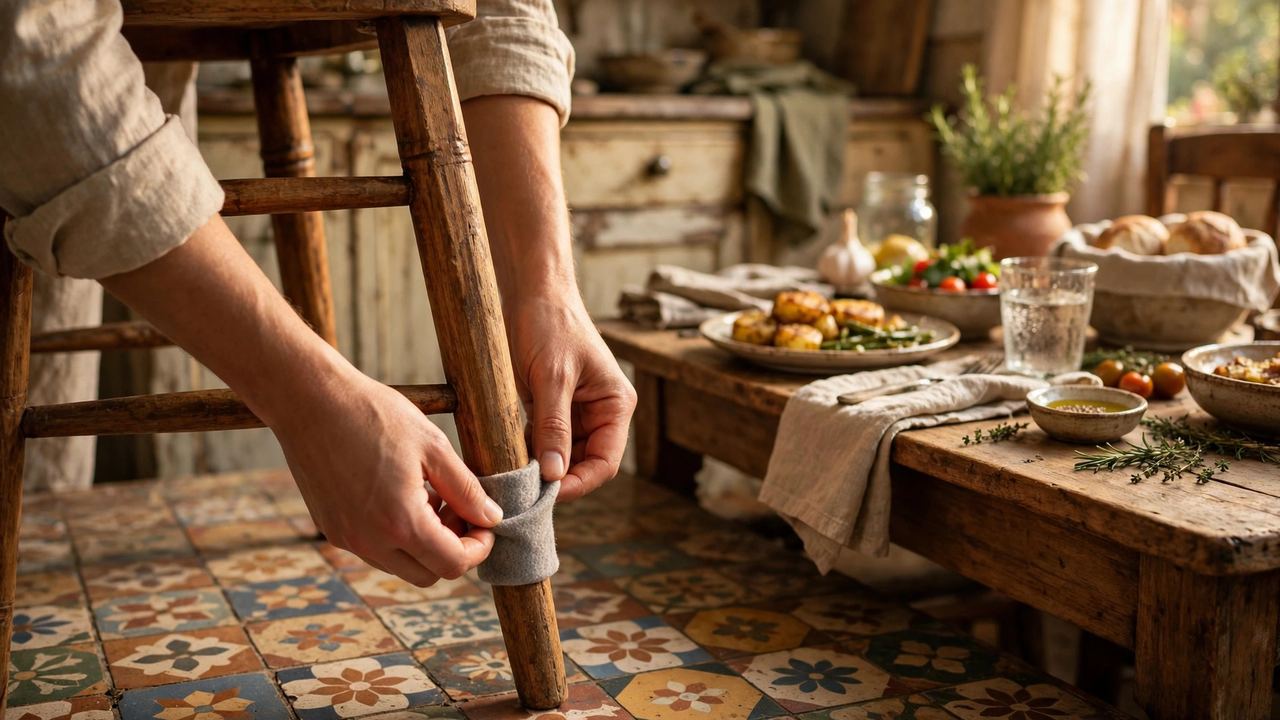
Chair tips come in several distinct families, and they do not all suit old tile equally. Silicone and thermoplastic caps stretch over the leg and put a felt base between wood and floor. Tap-on felt glides fix mechanically into the bottom of a wood leg, which makes them a natural fit for solid wood chairs. Self-adhesive rubber gripper pads do the opposite of a glide: instead of helping the chair slide, they hold it in place, which can be exactly right for a chair that wanders or twists on uneven tile. And simple felt pads remain the budget staple, provided the adhesive holds and the felt is thick enough to bridge minor unevenness. This guide works through six real products across those families, explains what the maker lists for each one, and helps you decide which style belongs under your chairs.
Quick verdict
If your wood chairs have round or square legs in the common one-inch range and you want the simplest all-round fix, start with the BALEINE silicone caps: the felt base is bonded to the cap as one piece, the maker lists tile as the surface recommendation, and there is nothing to glue or hammer. If your chairs are solid wood and the legs are at least three quarters of an inch across, the Slipstick GorillaFelt tap-on glides are the most permanent answer, because steel prongs plus adhesive hold them on when stick-on pads would have peeled away. If the real problem is chairs sliding, twisting, or walking across sloping old tile rather than gliding too freely, the Slipstick GorillaPads and the X-Protector non-slip pads trade glide for grip. Rectangular legs are covered by the Ezprotekt caps, which wrap the leg and put a thickened felt bottom underneath. The right choice depends on leg shape, leg size, and whether you want your chairs to slide quietly or stay firmly put.
Every product in this guide was checked on its own opened Amazon listing page, and only products with a live featured offer for a new item were kept. Listings that showed no featured offer, or that could not be opened and read in full, were excluded rather than written up from a search snippet. That matters in this category because chair tips are sold under endless near-identical names, and the only reliable way to separate them is to read the actual listing: the fit range, the material, the model number, and the surfaces the maker recommends.
Selection also favoured variety of attachment method, because old tile punishes weakness in attachment. A pad that relies on light adhesive may survive on a flat modern floor yet shear off the first time a chair leg catches a raised tile edge. So this guide deliberately mixes slip-on caps that wrap the leg, a tap-on glide that fixes into the wood itself, and full-grip rubber pads for chairs that should stay planted. Within each family we favoured products whose makers publish concrete numbers: a stated fit range in inches, a stated felt thickness, a stated pack count, and a model number that identifies the exact variant. Products whose listings offered only vague promises were passed over.
Finally, we weighted tile suitability. Some of these makers name tile directly in their surface recommendations; others list hard floors generally and describe rubber or felt contact layers that suit tile. Where a maker lists a specific surface recommendation, it is reported as listed. Specs throughout are phrased as the maker lists them, and nothing here is based on hands-on testing: the judgements are comparisons of published specifications applied to the known behaviour of old, uneven tile.
These clear caps are the most straightforward answer for a standard set of wood dining chairs. The maker lists the material as thermoplastic elastomer with a silicone grip, and the design point that matters most is the base: the silicone and the felt pad are molded together as one piece, which the maker says helps prevent the peeling and detachment that kill ordinary felt pads. On old tile, detachment is the main failure mode, because a leg that rocks over a lipped tile works a glued felt disc loose in weeks. A bonded base removes that weak joint, so the felt stays where it belongs even when the chair is dragged at an angle.
The maker lists the surface recommendation for this listing as tile, which is unusually direct for this category, and describes a thick cushion base that absorbs vibration and helps the caps glide quietly across hardwood, tile, laminate, and vinyl. For old tile, quiet matters: a cap that cushions the contact point softens the knock when a leg drops off a raised tile edge, and the clear finish keeps the protector discreet under a dining table. The Round Small size in this listing fits legs from 1 to 1-1/4 inches, and the maker notes the same size covers round or square legs in that range, which helps with the slightly tapered square legs found on many older wood chairs. The pack covers four chairs, and because the caps simply stretch on, fitting a whole set takes minutes with no tools, no adhesive, and no drying time.
Brand: BALEINE
Model: Baleine-588
Type: slip-on cap, removable
Material: the maker lists thermoplastic elastomer (TPE) with silicone grip
Base: felt pad molded to the cap as one piece
Fit: Round Small fits legs 1 to 1-1/4 in, round or square
Surface recommendation: the maker lists tile
Colour: clear
Pack size: 16 pieces, enough for four chairs
Pros
Bonded one-piece felt base addresses the most common failure on uneven floors
Tile is the maker’s stated surface recommendation for this listing
Stretch-on fitting needs no tools, adhesive, or curing time
Clear finish stays discreet under wood chairs
Cons
This size only suits legs in the 1 to 1-1/4 in range, so measure before ordering
Slip-on caps can work loose on sharply tapered legs
Buy it if your wood chairs have legs in the stated range and you want a quiet, cushioned glide over old tile with the least possible fuss. Skip it if your legs are rectangular, much larger than the fit range, or so tapered that stretch-on caps have already failed you; look at the Ezprotekt or the tap-on glides instead.
Most chair tips assume a round leg, but plenty of wood chairs, especially older kitchen and farmhouse styles, have rectangular legs that round caps fit badly. A round cap on a rectangular leg grips at the corners, stretches thin at the faces, and twists off. This Ezprotekt set is shaped for the job: the maker lists a fit for rectangular legs with widths of 0.9 to 1.2 inches and lengths of 1.3 to 1.7 inches, and the high-elasticity material stretches to wrap the leg snugly. The maker describes the caps as not easy to fall off and says the integrated felt pad will not detach, which again targets the weak point that uneven tile exploits.
The felt bottom is the second reason this set suits old tile. The maker lists an upgraded, thickened bottom of 0.2 inches (5 mm) of felt, with the wrap giving 360-degree protection around the leg. A thicker felt layer is genuinely useful on lipped and uneven tile: it compresses over a raised edge instead of letting the hard rim of the cap catch, and it spreads the contact so a single high spot on the tile does not take the full load through one point of the leg. The maker lists the surface recommendation as hardwood and tile, and describes the caps as protecting ceramic tile and linoleum from scratches and scuffs while reducing noise. The pack of 24 covers six chairs, which suits a full dining set with a couple of spares, and the clear finish keeps the look neutral against wood.
Brand: Ezprotekt
Model: Clear-24pcs
Type: slip-on rectangular cap
Material: the maker lists TPE with felt pads
Fit: rectangular legs, width 0.9 to 1.2 in, length 1.3 to 1.7 in
Felt bottom: the maker lists 0.2 in (5 mm) thickened felt
Surface recommendation: the maker lists hardwood and tile
Colour: clear
Pack size: 24 pieces, enough for six chairs
Pros
Rectangular shape fits legs that round caps grip poorly
Thickened 0.2 in felt bottom cushions raised and lipped tiles
Integrated felt is designed not to detach from the cap
Generous 24-piece pack covers a full dining set
Cons
Only fits the stated rectangular size window
Clear caps can show dust and wear over time
Buy it if your wood chairs have rectangular legs in the stated range and stand on tile the maker explicitly lists as a recommended surface. Skip it if your legs are round, square, or outside the fit window; a mismatched stretch cap will twist and walk off on uneven tile.
For solid wood chairs, the most durable chair tip is the one that becomes part of the leg. These Slipstick glides tap into the bottom of the leg: the maker lists three steel prongs paired with a strong self-stick adhesive backing, a combination sold as guaranteed to stay on. That dual hold is exactly what old tile demands, because the repeated catching and rocking over grout lines and lipped edges is what strips adhesive-only pads away. A pronged glide does not care how uneven the floor is; it stays fixed to the leg and presents the same felt face to every tile.
The felt itself is a step up from basic pads. The maker lists a 3/4 inch round pad of wool blended felt, 1/4 inch thick, designed to last longer and to give silent, smooth sliding over hard surfaces. The maker lists the surface recommendations as hardwood, laminate, tile, and vinyl, and describes the glides as premium pads for wooden furniture, designed for wood legs 3/4 inch in diameter and larger, with dining chairs named as a prime use. A quarter inch of wool-blend felt is thick enough to absorb the small height differences between old tiles without bottoming out, and because the glide is fixed, the felt cannot creep sideways and expose the leg’s edge to the tile. The brown and grey colour options sit discreetly under most wood finishes. Fitting takes a hammer and a few minutes per chair, and the legs must be solid wood with enough diameter for the prongs, but once fitted these are close to fit-and-forget.
Brand: Slipstick
Model: CB240-16
Type: tap-on felt glide
Attachment: the maker lists 3 steel prongs plus self-stick adhesive backing
Felt: the maker lists 3/4 in round, 1/4 in thick wool blended felt
Fit: wood legs 3/4 in diameter and larger
Surface recommendation: the maker lists hardwood, laminate, tile, and vinyl
Colour: brown / grey
Pack size: 16 pieces, enough for four chairs
Pros
Prongs plus adhesive give the strongest hold in this guide
Thick wool blended felt cushions uneven tile and slides quietly
Made specifically for wood legs, the exact use case here
Fixed fitting cannot twist, creep, or be kicked off
Cons
Needs a hammer and solid wood legs of at least 3/4 in
Permanent fitting is not easily moved between chairs
Buy it if your chairs are solid wood, get moved daily, and have already shed every stick-on pad you have tried. Skip it if your chair legs are hollow, metal-cored, narrower than 3/4 inch, or antique pieces you do not want to tap prongs into; a slip-on cap is kinder.
Not every chair on old tile needs to glide. A chair at a desk, a carver that only gets pulled out twice a day, or any chair on a noticeably sloping old floor may be better held still, and that is the GorillaPads idea. The maker lists these as rubber gripper feet: a durable rubber foam base layer that grips between the furniture foot and the floor, with a dark brown solid felt core that stops the furniture foot punching through. The pad is self-adhesive, so it sticks to the bottom of the leg and presents rubber, not felt, to the tile. Rubber on glazed tile grips far more strongly than felt, which stops the slow creep and twist that uneven floors cause when one leg carries less weight than the others.
This CB147 variant is the small one: the maker lists it as a 1 inch round pad, 0.13 inches thick, in a pack of 16, which suits the narrower legs of side chairs and kitchen chairs. The maker describes the adhesive as heavy duty and the pads as working on all hard floors and surfaces, protecting them from scratches and damage. The felt core matters for old tile in a specific way: if a leg rocks onto the edge of the pad over a lipped tile, the core keeps the wood from cutting through the rubber and reaching the glaze. Because the pads grip, they also quieten a chair in a different way than glides do: there is no scrape because there is no slide, just a small lift and set-down. The trade-off is real, though. A chair fitted with grippers has to be lifted rather than slid, so these belong on chairs that mostly stay where they are put.
Brand: Slipstick
Model: CB147
Type: self-adhesive non-slip gripper pad
Material: the maker lists rubber, with a solid felt core
Size: 1 in round, 0.13 in thick
Attachment: self-adhesive backing
Colour: black
Pack size: 16 pieces, enough for four chairs
Pros
Rubber grip stops chairs creeping or twisting on uneven tile
Solid felt core protects the tile if the pad is stressed at an angle
Small 1 in size suits narrow chair legs
Quick peel-and-stick fitting with no tools
Cons
Chairs must be lifted to move; they will not slide to the table
Adhesive pads can eventually shear on very rough grout lines
Buy it if your problem is chairs that wander, twist, or feel unstable on sloping or uneven old tile. Skip it if the chairs are pulled in and out at every meal by people who expect them to slide; choose a felt glide or a felt-bottomed cap instead.
The CB149 is the larger sibling of the CB147, built on the same gripper principle but sized for broader feet. The maker lists it as a 1-1/2 inch round pad with the same construction: a durable rubber foam base layer for grip and a dark brown solid felt core to keep the furniture foot from punching through. The size difference is not trivial on old tile. A wider pad spreads the load over more of the tile’s surface, which reduces the pressure on any single raised point, and it gives the rubber more contact area to grip with, so a heavy carver or a broad-legged farmhouse chair stays planted instead of pivoting on one high tile.
Usefully for this guide, the maker lists the surface recommendations for the CB149 explicitly as hardwood, laminate, tile, and vinyl, and the recommended uses as non-slip and scratch protection. The pads are self-adhesive, listed as heavy duty and non-slip, and the pack of eight covers two chairs, which matches how these are usually bought: for the two armchairs or the heavy pair at the ends of the table rather than a whole set. On old tile with a noticeable slope or a lot of lippage, the combination of a wide footprint and a rubber face is the most secure arrangement short of a mechanical fixing, and the felt core still stands between the wood and the glaze if the chair is dragged by someone who did not know it was fitted with grippers. As with the CB147, the honest limitation is movement: these pads are furniture feet, not sliders, and chairs fitted with them should be lifted.
Brand: Slipstick
Model: CB149
Type: self-adhesive non-slip gripper pad
Material: the maker lists rubber, with a solid felt core
Size: 1-1/2 in round
Surface recommendation: the maker lists hardwood, laminate, tile, and vinyl
Attachment: self-adhesive backing
Colour: black
Pack size: 8 pieces, enough for two chairs
Pros
Wider pad spreads load and grips more strongly on uneven tile
Tile is in the maker’s stated surface recommendations
Felt core guards the glaze if the chair is dragged
Suits heavy chairs and broad legs that overwhelm small pads
Cons
Pack of eight only covers two chairs
No glide: chairs must be lifted to reposition
Buy it if you have one or two heavy, wide-legged wood chairs that need to stay exactly where they are placed on old tile. Skip it if you need to cover a whole dining set economically, or your chair legs are narrower than the pad and would overhang it.
Some wood chairs do not have neat round feet at all. Heavy rustic chairs, bench-style seating, and chairs with wide slab or sled-like feet present a broad, flat bottom that small round tips cannot cover. These X-Protector pads are built for that case: the maker lists them as 4 inch square pads with a three-layer construction of thick felt, listed at 1/5 inch, and soft rubber, creating a shield between the furniture and the floor. The maker lists the pads as suitable for hardwood, laminate, vinyl, tile, marble, linoleum, and concrete, and describes a tenacious adhesive that holds the pads on furniture feet for a long period.
On old tile, the appeal is the footprint. A 4 inch square pad bridges across the small height differences between neighbouring tiles and across sunken grout lines, so the chair rests on the pad rather than rocking from tile to tile. The rubber layer grips, keeping a heavy chair from skating when someone sits down heavily, while the felt layer cushions the contact so the grip does not come at the cost of the glaze. The maker suggests the size for sofas, chairs, and tables, and for chair use the honest reading is wide feet: a standard narrow dining leg would be swamped by a pad this size. Within that niche, though, nothing else in this guide covers as much area or spreads load as gently, which is precisely what fragile, cracked, or hollow-sounding old tiles need under a heavy piece.
Brand: X-Protector
Model: 3Lay8pad4in
Type: self-adhesive non-slip pad
Construction: the maker lists 3-layer design, felt 1/5 in thick with soft rubber
Size: 4 in square
Surfaces: the maker lists hardwood, laminate, vinyl, tile, marble, linoleum, and concrete
Attachment: self-adhesive backing
Colour: grey / black
Pack size: 8 pieces
Pros
Large footprint bridges lipped tiles and sunken grout lines
Layered felt and rubber combine cushioning with grip
Tile is among the surfaces the maker lists
Spreads the load of heavy chairs over fragile old tiles
Cons
Far too large for standard narrow chair legs
Grip design means chairs must be lifted, not slid
Buy it if your wood seating has wide, flat feet, or a heavy chair is rocking across uneven tiles and needs its load spread. Skip it if your chairs have ordinary round or square legs under two inches; every other pick in this guide fits that case better.
Buying guide
Start by measuring the leg, not by guessing. Chair tips fail on fit more than on any other factor. Measure round legs across the diameter at the very bottom of the leg, where the tip will sit, and measure square or rectangular legs on both faces. Wood chair legs often taper, so the foot may be noticeably smaller than the leg higher up. Compare your measurement with the fit range the maker lists, and choose a size where your leg sits inside the range rather than at its extreme edge: a cap stretched to its limit splits sooner, and a cap at the loose end of its range twists off on the first raised tile it meets. For adhesive pads and tap-on glides, the pad should cover the foot without a large overhang, because overhanging felt folds, collects grit, and peels.
Decide between glide and grip before you decide between brands. This is the defining choice for old tile. Felt-faced tips, whether a bonded felt cap or a tap-on glide, let the chair slide. Sliding is convenient at a dining table, but on lipped tile a sliding leg repeatedly strikes raised edges, which is why the felt needs to be thick and the attachment strong. Rubber-faced grippers hold the chair still. Stillness protects both the tile and the chair joints, because a chair that cannot twist does not rack its frame, but everyone using it must lift rather than drag. A practical household answer is often mixed: glides or caps on the everyday side chairs that move constantly, grippers on the armchairs, the desk chair, or the chair on the sloping corner of the room.
Match the attachment to how much the chair moves. Adhesive is the weakest hold and the easiest fitting. It is acceptable for light chairs on gentle floors, but old tile is not a gentle floor, so if you choose adhesive, choose pads where the maker describes a heavy duty or tenacious adhesive and a felt core or layered build, and clean and dry the bottom of each leg before sticking. Slip-on caps hold mechanically by stretch and are the best tool-free option, provided the size is right. Tap-on and nail-on glides hold best of all and are the natural choice for solid wood legs, at the cost of a small permanent fixing in the bottom of the leg. The more a chair is moved, and the rougher the tile, the further you should move along that scale from adhesive toward mechanical fixing.
Respect the tile as well as the chair. Old tile may be cracked, hollow-sounding, or softer-glazed than modern porcelain, and some of it is best treated as a surface to protect rather than a surface to use hard. Thick felt and wide pads spread load and reduce point pressure. Grit is the enemy in both directions: sand and grit trapped under any tip turn it into an abrasive disc, so lift chairs occasionally, brush the tips clean, and replace felt that has worn thin or gone hard. Avoid hard plastic glides on old glazed tile, since a rigid, narrow contact point concentrates load and can skate unpredictably on a worn glaze. Finally, check the maker’s own surface list for the exact product you are buying. Several picks in this guide name tile directly; where a maker lists only hard floors generally, treat the product as suitable for tile with ordinary care rather than as tile-specific.
Count the pack against your chairs. A four-legged chair needs four tips, and packs in this category range from eight to twenty-four pieces. Work out how many chairs you are fitting, add a small allowance for spares, and note that gripper pads are often sold in smaller packs aimed at one or two heavy pieces. Buying the right count matters because mixing tip types under one chair, or fitting three legs and leaving one bare, is worse than any single product choice in this guide: the bare leg will take the damage and do the damage, and the chair will rock on its one shorter corner.
FAQ
What type of chair tip is best for old, uneven tile?
For most wood dining chairs, a slip-on cap with a bonded felt base or a tap-on felt glide works best, because the felt cushions the leg over lipped tiles and the attachment does not rely on adhesive alone. If the chairs should stay in place rather than slide, a rubber gripper pad is the better type. The common thread is thickness and hold: thin, lightly glued pads are the ones old tile defeats first.
Will felt tips scratch old tile?
Clean felt does not scratch tile; it is softer than the glaze and is used precisely to protect hard floors. The risk comes from grit trapped in or under the felt, which can be dragged across the surface. Brush or wipe the tips regularly, and replace felt that has worn thin, hardened, or picked up embedded debris. A bonded or thick felt, like the options in this guide, lasts longer before reaching that state.
Why do chair tips keep falling off on my tile floor?
Uneven tile works tips loose. Each time a leg crosses a raised tile edge or drops into a sunken grout line, the tip takes a sideways knock that adhesive alone struggles to resist, and tapered legs make the problem worse. The fixes are a correctly sized slip-on cap that wraps the leg, or a mechanically fixed glide such as a tap-on design with prongs. Check the fit range the maker lists against the measurement at the foot of your leg before reordering the same style that already failed.
Can I use tap-on glides on any wood chair?
Tap-on glides need solid wood at the bottom of the leg and enough diameter for the prongs; the Slipstick glides in this guide are listed for wood legs 3/4 inch in diameter and larger. They are not suitable for hollow legs, metal tube frames, or legs with a plastic insert in the foot. For antique chairs where you do not want to make holes, a stretch-on cap protects the leg without altering it.
Should dining chairs on tile glide or grip?
Chairs that are pulled in and out at every meal are usually better gliding, with felt caps or glides, so people are not tempted to drag a gripped chair and stress its joints. Chairs that mostly stay in one place, such as desk chairs, armchairs, or a chair on a sloping floor, are usually better gripping. Many homes end up using both types in different spots, which is a sensible outcome rather than a compromise.
How often should chair tips be replaced?
Replace a tip when the felt has worn thin or hard, when a cap has split or stretched loose, or when a pad has started to peel or creep. On old tile, check the tips whenever a chair starts to feel rocky or noisy again, since a single failed tip leaves one leg unprotected. Keeping a few spares from the original pack makes replacement a one-minute job.
Conclusion
Old tile asks two things of a chair tip: cushion the leg so a hard wood foot never strikes the glaze directly, and hold on through the knocks that lipped, uneven tiles deliver every day. The six products in this guide answer those demands in different ways. The BALEINE and Ezprotekt caps wrap the leg and put bonded or thickened felt underneath, with fits for round, square, and rectangular legs. The Slipstick GorillaFelt glides fix into solid wood legs with steel prongs for the most permanent hold. And the GorillaPads and X-Protector pads trade sliding for grip, holding chairs steady and spreading their load across fragile tiles. Measure your chair feet, decide honestly whether each chair should glide or grip, and match the attachment strength to how rough your floor really is. Do that, and a set of wood chairs can live on old tile quietly, without chipping another edge or scratching another glaze.
M
Modern Line Home Editorial Team
We compare specs, materials and verified owner reviews before a product earns a spot. Rankings are never paid.
Affiliate disclosure. As an Amazon Associate we earn from qualifying purchases at no extra cost to you. Prices accurate as of the date shown.
House cold even with the heat on? Walk this ordered checklist: thermostat and filter first, then drafts, insulation, leaky ducts and a failing heating system.
Windows fogging up in winter? Check where the fog sits: on the room side it is indoor humidity, outside it is harmless, and between panes the seal has failed.
Store the main firewood pile about 30 feet from your house, off the ground and covered only on top. Compare racks, woodsheds, garages and indoor spots safely.
Place a portable generator outdoors only, at least 20 feet from windows, doors and vents, exhaust pointed away. Exact distances, setup steps and CO rules here.
Keep houseplants in the right winter spot: match window direction to plant type, stay clear of radiators and cold glass, and fix dry air and low light at home.
Mice enter through pencil-width gaps at foundations, pipes, vents, doors and the roofline. Walk this room-by-room winter checklist to find and seal each one.
A winter outage timeline: what to do in the first hour, first night and multi-day outage, with food safety times, pipe protection, heat and CO safety steps.
Size a space heater by room area: 10 watts per square foot at 8-foot ceilings, adjusted for insulation and ceiling height, with full wattage and BTU tables.
Start dripping at about 20 degrees, sooner for exposed pipes. Set a pencil-lead stream, drip the right faucets on both lines, and know when to stop safely.
A fridge needs 800-1,200 starting watts, not just 150-400 running watts. Use the tables to total your fridge plus freezer, lights, furnace fan and more today.











Write Your Review
No reviews yet. Be the first to share your experience!