We independently review everything we recommend. When you buy through our links, we may earn a commission. As an Amazon Associate we earn from qualifying purchases.
Best Travel Pillows for Stomach Sleepers: 6 Flat Picks
Compare the best travel pillows for stomach sleepers: six low, flat, adjustable picks with removable fill, cinch foam and inflatables that pack tiny for trips.
Compare the best travel pillows for stomach sleepers: six low, flat, adjustable picks with removable fill, cinch foam and inflatables that pack tiny for trips.
Finding best travel pillows for stomach sleepers starts with a mismatch. Most travel pillows are built for sitting upright: tall U-shaped neck collars, raised chin supports and firm moulded foam designed to hold a head that is vertical. A stomach sleeper needs almost the opposite. Lying face down, at home or away, calls for a low, flat, forgiving surface that lets the head rest close to the mattress and turn easily to one side. Height is the enemy, bulk under the face is the enemy, and anything that props the head up at an angle works against the position from the first minute.
That is why this roundup looks past the classic neck-pillow shelf and towards flat travel pillows: small rectangular pillows, adjustable-fill pillows you can thin down, compressible foam pillows you can spread out, and inflatables you can deliberately under-inflate. Used in a hotel bed, a tent, a camper, a sleeper train or across a row of spare bedding at a relative’s house, these are the travel pillows that can go genuinely low. Each pick below is a real product from an established maker, listed with the construction, dimensions and packed size the maker publishes, so you can judge the shape and the loft for yourself.
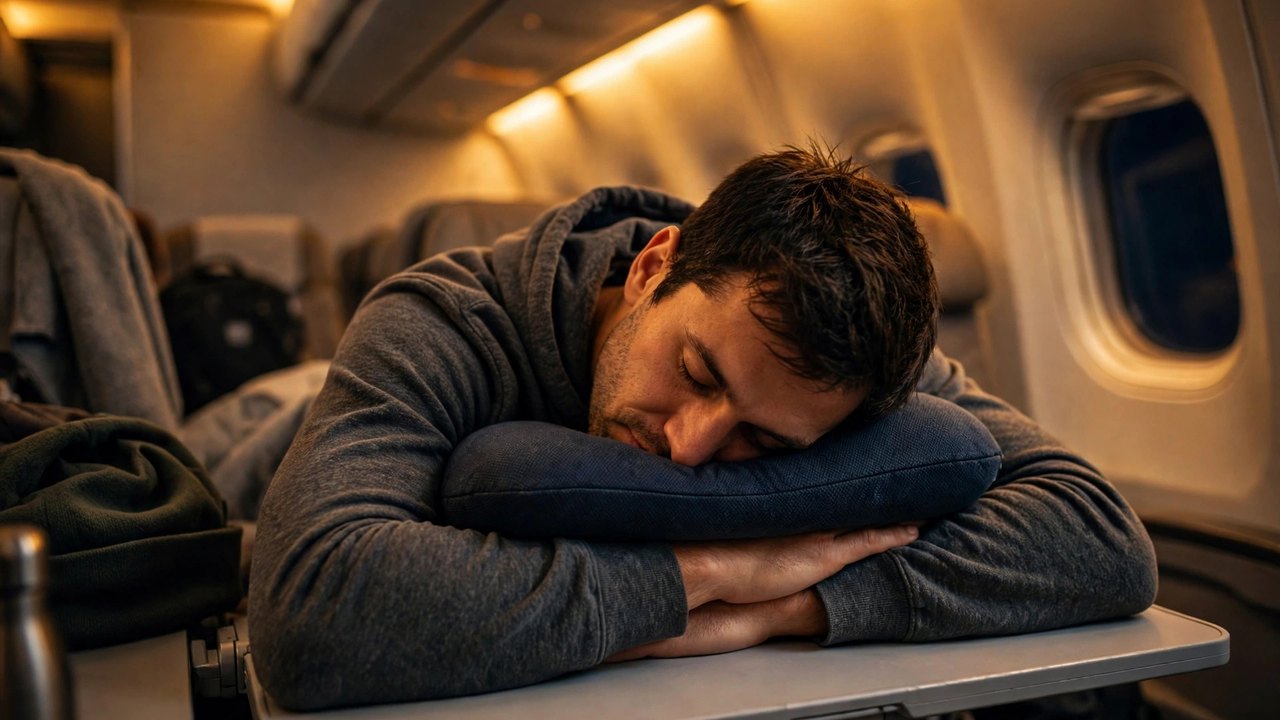
One honest note on aeroplanes: a standard economy seat does not let anyone lie face down, and no pillow changes that. What these pillows do is cover the parts of a trip where flat sleeping actually happens, which for most travellers is most of the sleeping they do away from home. Pack one low, flat pillow and the hotel, hostel, campsite and overnight stop all get easier, even if the flight itself remains an upright compromise.
Quick verdict
For most stomach sleepers, the Coop Home Goods Original Travel and Camping Adjustable Pillow, Small is the easiest recommendation, because removing shredded foam is the most direct way to make a travel pillow flatter, and adding it back keeps the pillow useful for other positions and other people. If you prefer an inflatable, the NEMO Fillo pairs a valve you can bleed down to a low height with a foam-topped surface that feels less like a balloon. The Therm-a-Rest Compressible Cinch Pillow, Regular suits travellers who want foam comfort plus a cinch cord to change loft without any valve. The Wise Owl Outfitters Camping Pillow, Small is the simple, light, solid-foam option. The TREKOLOGY ALUFT 2.0 Small Inflatable Camping Pillow and the Sea to Summit Aeros Ultralight Pillow, Regular cover the ultralight end, packing to pocket size while still letting you run them low and soft for face-down sleeping.
The products in this guide
Coop Home Goods Original Travel and Camping Adjustable Pillow, Small
The Small at 19 by 13 inches, with a fill of shredded memory foam inside a Lulltra fabric cover made from a polyester and rayon blend
Best for Removing fill for the flattest hotel or tent setup
We started from the position, not from bestseller lists. Every candidate had to work lying flat, so upright-only neck collars, however popular, were set aside unless they could also serve as a flat pillow. Each remaining product had to be a real, current model from an identifiable maker, with published dimensions, fill or bladder construction and packed size that could be checked on the maker’s own pages or a full retail listing. Products whose specifications could not be confirmed were excluded rather than described loosely.
Within that filter, we prioritised height control. For a stomach sleeper, the single most useful feature is a way to make the pillow lower: loose fill that can be removed, a cinch that lets foam spread out, or a valve that lets air escape in small steps. Fixed, tall, moulded pillows scored poorly no matter how well made they were. We then weighed packed size, because a travel pillow that only works in a checked suitcase solves a smaller problem than one that lives in a carry-on, and surface feel, because a pillow used face down is in contact with cheeks and forehead for hours.
The final six split deliberately across constructions. Two are foam pillows with mechanical adjustment, one is solid memory foam, one is a foam-topped hybrid inflatable, and two are ultralight pure inflatables. That spread matters because stomach sleepers disagree about almost everything except loft: some want the familiar give of foam, others want a pillow that vanishes into a pocket. All dimensions, weights and materials in the product sections are the figures the makers list for the exact models named.
The Coop travel pillow is the closest thing in this roundup to a small version of a home bed pillow, and that is exactly why it suits stomach sleeping away from home. The maker lists the Small at 19 by 13 inches, with a fill of shredded memory foam inside a Lulltra fabric cover made from a polyester and rayon blend. Because the fill is loose shredded foam rather than a single moulded block, you can open the pillow and take foam out, and that single feature matters more for a stomach sleeper than almost anything else in this guide. A stomach sleeper generally wants the lowest, flattest surface in the bag, and a pillow you can deliberately thin down gives you a way to get there instead of accepting whatever loft came out of the box.
The maker also includes extra fill, referred to as additional foam you can add back, so the adjustment runs in both directions. Start a trip with foam removed for flat hotel or tent sleeping, then add some back if the pillow spends a night under your chest or forearm instead. The cover fabric is listed as breathable, the foam is listed as CertiPUR-US and GREENGUARD Gold certified, and the pillow arrives with a water-resistant stuff sack that the maker says compresses it to nearly half its size. At a listed weight of about a pound, it is not the lightest pick here, and the packed bundle is bulkier than any inflatable, but it is the pick that behaves most like the pillow you already know.
In practice, the routine is simple. Unzip, remove foam in small handfuls, lie face down, and check whether your head sits low and turns easily to one side. Keep the removed foam in its bag so the pillow can be rebuilt for a different trip or a travelling partner who sleeps differently. The rectangular shape gives your cheek and forehead a broad, even surface with no raised wings, no chin cradle and no contoured ridge pushing back, which is the geometry stomach sleepers usually end up hunting for after trying upright neck pillows.
Buy it if: you want a travel pillow you can physically thin down by removing shredded foam, and you mostly sleep flat in hotels, tents or a camper rather than upright in a seat.
Skip it if: packed size is your top priority, because a foam pillow compressed to half size still takes far more room than an inflatable that rolls to pocket size.
The NEMO Fillo takes a hybrid route: the maker lists an internal I-beam baffled air cell cushioned with a layer of foam, wrapped in a recycled polyester jersey cover. The listed dimensions are 17 by 11 inches with a thickness of about 4 inches fully inflated, a minimum weight the maker lists at 9.2 ounces, and a packed size of about 6 by 4 inches in its integrated stuff sack. For a stomach sleeper, the important part is not the full-inflation number. It is the micro-adjustable valve. Let air out in small amounts and the Fillo drops from a firm, lofty camp pillow to a much lower, softer pad under your head, and that range is what makes an inflatable genuinely useful for face-down sleeping.
The foam layer on top does quiet, practical work. Pure air pillows can feel like resting your cheek on a balloon, with the surface pushing back and shifting as you move. The Fillo’s foam topping softens that contact, spreads the feel of the air cell underneath, and makes a partially inflated pillow feel like a thin cushion rather than a deflated toy. The cover is removable and machine washable according to the maker, which matters on longer trips where a pillow lives in a stuff sack between stops.
Packing is built in rather than added on. The stuff sack is integrated, so there is no separate bag to lose in a dark tent or a hotel room, and the whole pillow rolls into a bundle that fits a carry-on pocket or the top of a backpack. Set up is a few breaths, then fine-tuning at the valve until your head sits at the height you want. Stomach sleepers who share gear will also like that the same pillow can be inflated fully for a side-sleeping partner on the next trip, so one purchase covers two very different sleep styles.
Buy it if: you want one pillow that can run low for stomach sleeping and fuller for other positions, with a soft foam-topped surface instead of bare air-pillow fabric.
Skip it if: you dislike inflatables on principle, or you want a pillow that is ready the second it leaves the bag with no valve adjustment at all.
The Therm-a-Rest Compressible Cinch takes the brand’s long-running compressible pillow idea and adds a drawstring, and that cord is the feature stomach sleepers should notice. The maker lists the Regular at 18 by 14 inches, filled with upcycled urethane foam and topped with a soft stretch-knit cover, at a listed weight of about 11 ounces. The integrated cinch cord lets you gather the pillow and change its loft and firmness: cinched tighter, the foam bunches into a firmer, higher shape; left loose, the pillow spreads flatter and wider, which is the setting a stomach sleeper will live in.
Unlike an inflatable, there is no valve, no breaths and no leak to chase. The foam expands on its own after unpacking, and the maker advises letting the pillow sit open for about a day when it first arrives so the foam recovers its full volume from packaging, and storing it open and uncinched between trips for the same reason. That storage note is worth following, because a compressible foam pillow that lives permanently squashed in a stuff sack will not feel like the pillow described here.
The cinch system doubles as the compression system, pulling the pillow down to a smaller packed bundle for a backpack or duffel and then releasing it at camp or in the hotel. The rectangular footprint is generous for a travel pillow, giving a stomach sleeper room to rest a cheek at one end and drape an arm alongside without running off the edge. The cover’s stretch knit feels closer to bedding than to technical shell fabric, which suits travellers who use the pillow as their main pillow for a whole trip rather than a short nap.
Buy it if: you want foam comfort with a simple mechanical way to change loft, and you prefer a larger rectangular surface you can spread flat.
Skip it if: you travel with a small personal-item bag only, because even compressed, a foam pillow of this size claims real space.
The Wise Owl Outfitters Camping Pillow is the straightforward memory foam option in this group. The maker lists the Small at 12 by 16 inches and about 4 inches thick when fluffed, with a memory foam fill, a soft microsuede-feel cover, and a listed weight of about 9 ounces. There is no valve and no loose fill to manage. The foam compresses under your head, so the resting height ends up lower than the fluffed measurement suggests, and it compresses again for packing into the included waterproof stuff sack.
For a stomach sleeper, a small solid foam pillow like this works best as a low, stable base that does not shift, squeak or slowly leak through the night. Memory foam responds to pressure and warmth, so the surface settles where your cheek and forehead rest rather than springing back the way an air cell does. The rectangular shape is plain in the best sense: no wings, no cut-outs and no raised edges, so turning your head from one side to the other is unobstructed.
The removable cover is machine washable according to the maker, which keeps care simple after camping trips, road trips or long stays where the pillow doubles as the main pillow. The maker offers the design in Small and Medium sizes, so travellers who want a little more surface can size up within the same construction, while strict packers can stay with the Small tested in listings here. Between trips it rolls into its sack and rides in a car boot, a carry-on or a camp bin without any setup ritual beyond giving the foam a short moment to expand after unpacking.
Buy it if: you want the set-and-forget simplicity of solid memory foam in a small, light rectangle that packs into its own waterproof sack.
Skip it if: you need precise height control, because a solid foam block cannot be thinned or partially deflated the way the adjustable picks here can.
The TREKOLOGY ALUFT 2.0 Small is the ultralight inflatable in the lineup, and its numbers explain its following among pack-conscious travellers. The maker lists an inflated size of 16 by 12 inches, a weight of about 3.9 ounces, and a folded size of roughly 5 by 2 inches, small enough for a jacket pocket or the corner of a personal-item bag. The shell is an elastic TPU fabric the maker describes as durable and water resistant, and the back carries rubber anti-slip dots intended to keep the pillow from sliding across a sleeping mat or a smooth surface.
Stomach sleepers should treat the ALUFT 2.0 as a height-adjustable platform rather than a pillow to inflate fully. A few breaths bring it up; stopping well short of full, or releasing air after lying down, leaves a low, wide cushion that keeps your head just off the mat or mattress without the tall, rounded crown of a fully blown pillow. The valve makes that adjustment quick, and because the pillow is so light, small shifts in position are easy to correct by nudging it back under your cheek.
The trade-offs are the familiar inflatable ones. The surface feel is fabric over air, firmer and less plush than foam, and the pillow offers no insulation layer of its own. In return you get the smallest packed footprint in this guide by a wide margin, a pillow that wipes clean, and a spare you can carry permanently in a daypack for delays, naps and unplanned overnight stops. For stomach sleepers who travel light and sleep flat wherever they land, that exchange is often the right one.
Buy it if: packed size and weight outrank plushness, and you are happy to fine-tune height with the valve each time you lie down.
Skip it if: you want a soft, bedding-like surface, because an ultralight air pillow feels noticeably firmer and cooler than foam.
The Sea to Summit Aeros Ultralight in Regular is the minimalist’s answer to the same problem. The maker lists inflated dimensions of 14.2 by 10.2 by 4.7 inches, a weight of just about 2.1 ounces, and a packed size of roughly 2 by 2.8 inches in its included stuff sack. The face fabric is a stretch knit 20-denier polyester the maker describes as soft against the skin, over a TPU air bladder, and a multi-function mini valve handles inflation, fast deflation and fine-tuning of firmness.
That fine-tuning is the stomach sleeper’s tool here as well. Inflated fully, the Aeros is a relatively tall pillow with a scalloped bottom edge the maker shapes to cradle the shoulders for back, side or upright sleeping. Let a portion of the air out and it settles into a lower, broader rest that suits face-down sleeping far better, while the contoured shape keeps the edges from curling away. A few grams of pillow will never feel like a home pillow, but the soft face fabric keeps the experience closer to bedding than to a pool toy.
The Aeros line is also built to work with the maker’s sleeping mats through PillowLock patches that hold the pillow in place, a detail campers will appreciate more than hotel travellers. On a plane tray, a hostel bunk or a tent floor, the same stability helps a stomach sleeper who shifts position through the night. When the trip ends, the valve dumps air quickly and the pillow disappears into a pocket of your bag until the next departure, which is exactly the role an ultralight travel pillow is meant to play.
Buy it if: you count every gram, want the smallest packed pillow here, and like a soft knit face fabric over an adjustable air bladder.
Skip it if: you prefer a wide pillow surface, because the Regular is the narrowest pick in this roundup and larger sleepers may feel perched on it.
Buying guide: travel pillows for stomach sleepers
Loft comes first, and lower is usually better
For face-down sleeping, pillow height decides comfort more than any other specification. A tall pillow lifts the head and forces a sharper turn of the neck to breathe comfortably, while a low pillow lets the head rest nearer the surface with a gentler turn. When you read a listing, treat the stated thickness as the maximum, then ask how the pillow behaves below that maximum. Shredded fill can be removed handful by handful. A foam pillow with a cinch cord can be spread wide and flat. An inflatable can be filled to a third of its capacity. A solid foam pillow compresses under weight but starts and ends at its moulded height, so its listed thickness needs to be modest to begin with.
Shape: rectangles beat collars for flat sleeping
U-shaped neck pillows earn their keep in upright seats, but laid flat their raised arms and chin sections become lumps in exactly the wrong places. A plain rectangle gives a stomach sleeper an even field: cheek at one end, forehead near the middle, an arm draped alongside, and nothing pushing back. Contoured flat pillows sit in between; a gentle scallop or a thinner centre panel can work well, provided the edges do not rise higher than the middle. If a product photo shows dramatic wings or a deep cradle, it was designed for a different job.
Fill and bladder: how each construction feels face down
Shredded memory foam feels closest to a home pillow and can be redistributed, pushed away from the face or gathered under the chest. Solid memory foam feels stable and quiet, settling under pressure without springing back. Compressible polyurethane foam, the kind used in camp pillows, is springier and lighter for its size, and it recovers its shape quickly after unpacking. Pure inflatables feel the firmest and coolest, and their height control is the most precise, but the surface can shift under a turning head. Hybrids that put a foam layer over an air cell split the difference, softening contact while keeping the valve’s adjustability.
Packed size and the way you actually travel
Match the pillow to the bag. Inflatables in this guide fold or roll to the size of a drinks can or smaller and weigh a few ounces, so they suit backpacks, personal-item-only flights and anyone who wants a pillow permanently stashed in a daypack. Foam pillows, even compressed into their stuff sacks, occupy real volume, roughly the space of a folded sweatshirt, and suit checked luggage, car trips, campers and travellers who unpack once and stay put. Neither is better in the abstract; the right answer is the one that matches the luggage you genuinely carry.
Surfaces, covers and cleaning
A face-down sleeper’s skin spends the night against the pillow, so the cover matters. Knit and jersey faces feel softer and quieter than smooth technical nylon, and microsuede-style covers add a little grip that keeps the pillow from skating across a sheet. Removable, washable covers simplify life on long trips and after camping; a pillow that cannot be washed needs at least a wipe-clean shell. If you run warm, look for covers the maker describes as breathable, and remember that foam holds warmth more than an air bladder does.
Using a travel pillow well as a stomach sleeper
Set the height before you settle, not after. With an inflatable, lie down first, then open the valve briefly and let your own weight push out the air you do not need. With shredded fill, remove foam in stages across a couple of nights rather than emptying the pillow on night one. Many stomach sleepers also rest the pillow partly under the upper chest or a shoulder rather than entirely under the head, or turn it diagonally so one corner sits under a cheek; a rectangle supports all of these arrangements without fighting back. Finally, give a compressed foam pillow time to expand after travel before judging it, because foam that has spent a day in a stuff sack needs a while to recover the loft the maker lists.
FAQ
What height travel pillow suits a stomach sleeper?
Lower is generally better for face-down sleeping, and the exact figure matters less than adjustability. A pillow you can thin, spread or partially deflate lets you find your own height on different mattresses, which vary far more than pillows do. Start low, then add small amounts of fill or air only if the surface feels too hard through the pillow.
Can a stomach sleeper use a travel pillow on a plane?
In a standard seat, nobody sleeps truly face down, and these flat pillows will not change that. They still earn their place on a trip because most travel sleeping happens lying flat: hotels, hostels, tents, sleeper trains and spare beds. On the flight itself, a small flat pillow can support your head against the window or serve as lumbar padding, then do its real job when you arrive.
Are inflatable pillows comfortable for sleeping on your stomach?
They can be, provided you under-inflate them. Fully blown, an inflatable is tall and firm, which suits few stomach sleepers. Bled down through the valve, it becomes a low, wide cushion with precise height control and the smallest packed size of any construction. A foam-topped hybrid softens the surface further if bare air-pillow fabric bothers you.
How do I make a travel pillow flatter?
It depends on the construction. Remove handfuls of shredded fill and keep them in the supplied bag. Loosen a cinch cord so compressible foam spreads wide instead of bunching tall. Release air from an inflatable’s valve while lying on it. Solid memory foam cannot be thinned, so choose a modest listed thickness when you buy.
What size travel pillow should a stomach sleeper pack?
Enough surface for your head to turn without leaving the pillow, and no more. Most picks here fall between about 12 by 16 inches and 19 by 13 inches. Ultralight travellers can accept the smaller inflatables, while travellers sleeping on the same pillow for a week in one place usually prefer the larger foam rectangles.
Conclusion
A stomach sleeper travelling well is mostly a matter of refusing height. Choose a flat pillow with a way to go lower, set it up patiently on the first night, and the rest of the trip takes care of itself. Pick the Coop if you want to remove fill and rebuild the pillow at will, the NEMO Fillo for a soft-topped inflatable that bleeds down beautifully, the Therm-a-Rest Cinch for foam with a drawstring, the Wise Owl for simple solid foam, and the TREKOLOGY or Sea to Summit inflatables when every gram and cubic inch of your bag is spoken for. Whichever construction fits your luggage, the principle stays the same: low, flat and adjustable beats tall and moulded, every night of the trip.
M
Modern Line Home Editorial Team
We compare specs, materials and verified owner reviews before a product earns a spot. Rankings are never paid.
Affiliate disclosure. As an Amazon Associate we earn from qualifying purchases at no extra cost to you. Prices accurate as of the date shown.
House cold even with the heat on? Walk this ordered checklist: thermostat and filter first, then drafts, insulation, leaky ducts and a failing heating system.
Windows fogging up in winter? Check where the fog sits: on the room side it is indoor humidity, outside it is harmless, and between panes the seal has failed.
Store the main firewood pile about 30 feet from your house, off the ground and covered only on top. Compare racks, woodsheds, garages and indoor spots safely.
Place a portable generator outdoors only, at least 20 feet from windows, doors and vents, exhaust pointed away. Exact distances, setup steps and CO rules here.
Keep houseplants in the right winter spot: match window direction to plant type, stay clear of radiators and cold glass, and fix dry air and low light at home.
Mice enter through pencil-width gaps at foundations, pipes, vents, doors and the roofline. Walk this room-by-room winter checklist to find and seal each one.
A winter outage timeline: what to do in the first hour, first night and multi-day outage, with food safety times, pipe protection, heat and CO safety steps.
Size a space heater by room area: 10 watts per square foot at 8-foot ceilings, adjusted for insulation and ceiling height, with full wattage and BTU tables.
Start dripping at about 20 degrees, sooner for exposed pipes. Set a pencil-lead stream, drip the right faucets on both lines, and know when to stop safely.
A fridge needs 800-1,200 starting watts, not just 150-400 running watts. Use the tables to total your fridge plus freezer, lights, furnace fan and more today.












Write Your Review
No reviews yet. Be the first to share your experience!