We independently review everything we recommend. When you buy through our links, we may earn a commission. As an Amazon Associate we earn from qualifying purchases.
Best Lightweight Vacuums for Kitty Litter: 6 Top Picks
Find the best lightweight vacuums for kitty litter: featherweight sticks and handhelds that catch scattered granules on hard floors without pushing them around.
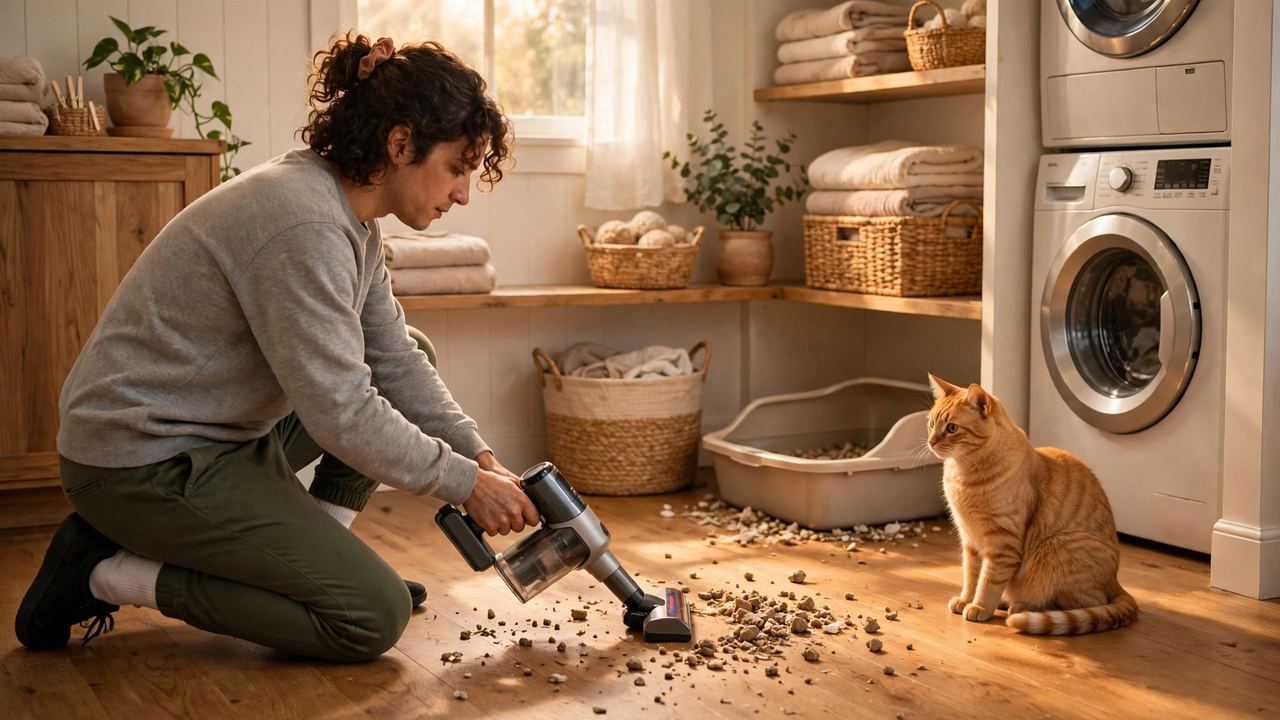
Kitty litter does not stay in the box. It rides out on paws, gets kicked over the rim by an enthusiastic digger, and ends up scattered across the bathroom tile, the laundry room floor, and the hallway runner you just cleaned. The granules are small, hard, and surprisingly mobile, and a heavy full-size vacuum is a miserable tool for a job that takes ninety seconds. That is why so many cat owners end up shopping for the best lightweight vacuums for kitty litter as a second, grab-and-go machine rather than as a replacement for their main vacuum.
A good litter vacuum has a specific set of talents. It needs to lift hard, dense granules off smooth floors without spitting them backwards, it needs to work in the tight gap between the litter box and the wall, and it needs to be light enough that you actually reach for it every day instead of letting the scatter build up for a week. Weight matters more here than in almost any other vacuum category, because the whole point is frequency: a two-minute cleanup done daily beats a twenty-minute deep clean done reluctantly.
This guide covers six lightweight machines in three shapes: featherweight corded sticks that live in a corner by the litter box, a compact upright with a proper brush roll for homes where litter gets tracked onto carpet, and two cordless handhelds built for spot duty around the box itself. Every pick is a real, named model from a known maker, and every specification below is phrased the way the maker lists it, so you can compare like with like.
Quick verdict
For most cat owners, the Bissell FeatherWeight Stick Vacuum 2033 is the simplest answer: it is the lightest full-length stick in this guide, it converts to a handheld for the rim of the box, and its corded design means it is always ready. If litter in your home lands on carpet as often as on hard floors, the Shark Rocket Pet Corded Stick Vacuum HV302 adds swivel steering, a pet multi-tool, and stronger above-floor reach. The Bissell CleanView Compact Upright Vacuum 3508 is the pick when tracked litter reaches rugs and you want a rotating brush and a larger dirt cup in a body the maker lists at under eight pounds. The Eureka Blaze Stick Vacuum NES210 is the maneuverability pick, with swivel steering and a capture nozzle the maker designed to pick up larger debris instead of pushing it around. For pure spot cleaning right around the box, the Shark UltraCyclone Pet Pro Plus CH951 and the BLACK+DECKER dustbuster AdvancedClean CHV1410L are cordless handhelds you can keep charged nearby and use in short, frequent bursts.
The products in this guide
Bissell FeatherWeight Stick Vacuum 2033
The FeatherWeight is the machine most litter owners picture when they go looking for a dedicated box-side vacuum, and the numbers explain why
Rotating nozzle, washable filter as the maker lists
Tight gaps, shelves, and quick pickups
How we selected
We started with weight, because a litter vacuum that feels like a chore will not get used daily. Every machine in this guide is one the maker lists at under nine pounds, and most are far lighter than that. We then looked at floor-head behavior on hard surfaces, since clay and crystal litter granules are notorious for scattering ahead of a brush roll or bouncing off a stiff suction inlet. Models that advertise scatter-reducing or large-debris capture designs earned a closer look, as did simple suction-only stick designs with no aggressive brush to fling granules.
Format came next. A litter routine usually has two zones: the floor around the box, where a stick or upright covers ground quickly, and the box itself, its rim, the mat underneath, and the baseboards behind it, where a handheld or a crevice tool does the real work. That is why this guide mixes full-length machines that convert to handhelds with two dedicated cordless handhelds. We also weighed dirt cup size against the reality that litter is dense: a cup that looks adequate for dust fills fast with clay granules, and a cup that empties cleanly, without a cloud of fine litter dust, matters day after day.
Finally, we checked power source honestly. Corded sticks never need charging and never fade mid-cleanup, which suits a machine that lives permanently beside the litter box. Cordless handhelds trade runtime for total freedom, which suits spot duty. Neither is automatically better; the right answer depends on where your litter box sits and whether an outlet is nearby. Every product below was checked as a named model with maker-listed specifications, and each pick earned its place for a distinct litter scenario rather than as a near-duplicate of the pick before it.
The FeatherWeight is the machine most litter owners picture when they go looking for a dedicated box-side vacuum, and the numbers explain why. The maker lists it as a three-in-one design that works as a stick vacuum, a handle vacuum, and a stair vacuum, and the comparison data on its listing puts the weight at about three pounds. At that weight, carrying it from a closet to the litter corner, or holding the handheld unit up to clear the top edge of a high-sided box, never feels like work.
For litter specifically, the format is the feature. As a stick, it covers the scatter zone around the box in a few passes over hard floors and area rugs. Pop the handle off and it becomes a handheld that can run along the rim of the box, across a litter mat, and into the corner where granules collect against the baseboard. The included crevice tool, which the maker lists among the included components, is the right shape for the narrow slot between the box and a wall, the place brooms and wide floor heads both miss.
The maker lists a dirt cup capacity of 0.67 liters and a power cord of fifteen feet. The cup is generous for a machine this light, which helps because litter is heavy for its volume; you will still want to empty it after a few heavy scatter days rather than letting dense granules sit in it. The fifteen-foot cord is the honest trade-off of the design: it reaches comfortably within one room, which is all a litter station usually needs, but it will not wander far from an outlet. Because it is corded, suction never fades and there is no battery to remember to charge, so the machine is ready the moment a cat finishes an energetic digging session.
Filtration is a simple foam and disk arrangement as the maker lists it, and the bagless cup keeps running costs down to rinsing and drying the filter on schedule. This is not a deep-cleaning carpet machine and it does not pretend to be one; its suction is tuned for quick pickups on hard floors, rugs, stairs, and upholstery. Judged on the litter job alone, that focus is exactly right.
Buy it if: you want the lightest full-length option for daily scatter duty, your litter box sits within reach of an outlet, and you like the idea of one machine that handles the floor, the stairs, and the rim of the box.
Skip it if: your litter area is far from an outlet, you need cordless freedom, or tracked litter in your home mostly ends up deep in carpet pile rather than on hard floors.
The Rocket Pet is the heavyweight of this guide, which in this company still means a machine the maker lists at 8.2 pounds and describes as under nine pounds in total. That extra weight over the featherweight sticks buys a more substantial floor head, swivel steering, and a tool set aimed squarely at pet messes, which makes it the strongest pick here when litter does not stay politely on tile but gets tracked across carpet and onto furniture.
Swivel steering is worth more around a litter box than it sounds. Boxes live in corners, beside toilets, and at the ends of laundry rooms, and a head that pivots lets you sweep the scatter arc around the box without dragging the whole machine back and forth. The maker lists the dust cup at 0.31 quarts, which is the smallest cup in this guide, so plan on emptying it often when you are picking up dense clay granules; the upside is that the compact cup keeps the handheld unit trim when you detach it.
And you will detach it. The Rocket converts to a hand vacuum for floor-to-ceiling cleaning, and the maker lists the included components as a crevice tool, a pet multi-tool, and a precision duster. For litter duty, the crevice tool handles the box-to-wall gap, while the pet multi-tool is useful when litter dust and hair combine on upholstery near the box. The corded design delivers continuous power with no runtime clock, which suits longer sessions when you decide to do the whole room rather than just the scatter zone.
The maker lists foam filtration and a five-year limited warranty in the listing details, both reassuring for a machine that will inhale fine litter dust regularly. The trade-offs are the cord, which you manage rather than forget, and that small dust cup. Neither matters much if your litter problem is really a whole-room pet problem; both matter if all you need is a thirty-second sweep beside one box.
Buy it if: litter in your home travels onto carpet, rugs, and upholstery, you want swivel steering in tight litter corners, and you prefer corded power with a real pet tool set.
Skip it if: you only clean a small hard-floor area around one box, you want the lightest possible machine, or a small dust cup would frustrate you.
The CleanView Compact is the only true upright in this guide, and it earns its place for homes where the litter trail leads from the box across a room and onto rugs. The maker lists it at less than eight pounds, which is remarkable for an upright with a rotating brush, and describes a compact design aimed at apartments, dorms, and small living spaces. If your litter station shares a small room with everything else you own, that footprint matters.
Its headline litter feature is the one the maker names scatter-free technology, engineered, as the maker puts it, to capture messes on hard floors with less scatter. Scatter is the central frustration of vacuuming litter: granules are round, hard, and light enough to roll, and a careless floor head pushes them into corners instead of picking them up. A design that explicitly targets scatter is directly relevant here, and the rotating brush then helps when the trail continues onto carpet, where granules lodge between fibers and suction alone struggles.
The maker lists a dirt cup capacity of one liter, the largest among the full-length picks in this guide, plus an easy-empty bagless container that releases with the push of a button. A bigger cup is a genuine advantage with litter, because dense granules fill volume fast and weigh a cup down; fewer emptying trips make a daily routine easier to keep. The maker also lists a removable extension wand for above-floor cleaning, which covers curtains, upholstery, and baseboards near the box, and a washable filter that keeps upkeep simple.
As a corded upright, it never needs charging and holds its suction through a whole-room session. It is less nimble than a stick for a quick pass under a low litter-box stand, and its upright shape wants a corner of its own for storage. For a small home that needs one lightweight machine to handle both the litter zone and general floor duty, those are fair trades.
Buy it if: litter gets tracked onto rugs and carpet, you want scatter-reducing hard-floor behavior and a larger dirt cup, and you prefer an upright that stores in a corner.
Skip it if: your litter area is all hard floor and tight gaps, you want a handheld mode for the box itself, or storage space is too tight for an upright shape.
The Blaze takes a different approach to the litter problem: instead of a brush-first design, the maker highlights a capture nozzle that, as the maker lists it, picks up larger debris with ease unlike stick vacuums that push larger particles around. Litter granules are exactly the kind of larger, hard particle that gets pushed, so that nozzle design is the reason this model belongs in a litter guide. At 3.97 pounds as the maker lists it, it is also one of the lightest machines here.
The maker lists a three-in-one design with an onboard crevice tool, so the Blaze works as a stick for the floor around the box, converts to a handheld for the mat and the box rim, and keeps its crevice tool stored on the body where you will actually find it. Onboard storage sounds minor until you have owned a vacuum whose crevice tool lives in a drawer in another room; for the daily box-to-wall gap, having the tool attached is the difference between doing the job properly and skipping the edges.
Swivel steering is the other maker-listed highlight, and it helps the Blaze work the tight arc around a box in a bathroom or laundry corner. The maker lists a 240-watt motor, an eighteen-foot power cord, and a washable filtration system, along with an extra-large dust cup in the product description. The eighteen-foot cord gives a little more working radius than the shortest corded picks here, useful when the only free outlet in a laundry room sits across from the box. The washable filter suits litter dust, provided you let it dry fully before refitting it.
Like the other corded sticks, the Blaze is a surface-cleaning specialist: the maker positions it for surface dirt and dust across multi-surface floors, hard floors, carpets, stairs, and upholstery, not for deep extraction from thick pile. For the litter scatter zone, which is overwhelmingly a surface problem on hard floors and low rugs, that is the right specialty.
Buy it if: your main frustration is granules being pushed around instead of picked up, you want swivel steering and an onboard crevice tool, and your litter floors are hard surfaces or low rugs.
Skip it if: you need cordless operation, deep carpet cleaning, or a powered pet brush for upholstery.
The UltraCyclone Pet Pro Plus is not a floor vacuum at all, and that is its strength. This is a cordless handheld the maker lists at 2.8 pounds, built for the thirty-second jobs that surround a litter box: the spill on the mat, the granules on the rim, the trail across the bathroom counter side, and the scatter that lands on the step or the car seat after a vet trip. A handheld that lives on a shelf near the box gets used constantly, because there is nothing to unroll, plug in, or put away properly.
The maker lists an XL dust cup at 0.11 gallons, which is large for a handheld and well judged for litter, since a small handful of clay granules is heavier and bulkier than the dust a typical handheld swallows. The maker also lists a CleanTouch dirt ejector for hands-free debris disposal, a detail that matters when what you are emptying is used-adjacent litter dust; keeping your hands off the cup’s contents is a genuine hygiene convenience. A washable filter keeps the routine cheap.
The tool set is the other reason to pick it. The maker lists a detachable self-cleaning pet power brush, a crevice tool, and a scrubbing brush among the included components. The pet power brush works litter dust and hair out of a fabric mat or upholstery, the crevice tool reaches the box-to-wall slot, and the scrubbing brush helps with the textured surfaces where granules wedge in. The maker describes two cyclonic air streams behind its suction, intended to keep suction strong and extend filter and motor life.
The limits are plain. The maker lists a runtime of ten minutes and a battery charge time of four hours, so this is a burst tool, not a whole-room machine, and its noise level is listed at 80 decibels. Used as intended, in short daily bursts around the box, ten minutes is several days of litter duty per charge. Asked to clean a whole apartment, it will run dry long before you finish.
Buy it if: you already have a main vacuum and want a cordless specialist for the box, the mat, and the car, with a large cup and a pet brush in a 2.8-pound body.
Skip it if: you need a single machine for whole floors, long runtime, or quiet operation during long sessions.
The dustbuster AdvancedClean is the classic cordless handheld shape, refined around one litter-relevant idea: reach. The maker lists a rotating slim nozzle that turns to help clean tight, hard-to-reach spaces, plus a pull-out crevice tool that stays part of the machine. Around a litter box, the mess hides in exactly those places: behind the box, under the lip of a covered box, along the baseboard, and between the box and a washing machine. A nozzle that rotates into those gaps is more useful than raw power left pointing at open floor.
The maker lists the weight at 2.6 pounds, the lightest figure in this guide, and describes cyclonic action that spins dust and debris away from the filter to keep suction consistent. The included components, as the maker lists them, are the hand vacuum, a charger, a crevice tool, a flip-up brush, and a washable filter. The flip-up brush adds a dusting option for shelves and the top of a covered litter box, a surface that collects a fine layer of litter dust in most homes and rarely gets cleaned because no tool is handy.
Storage is part of the litter routine too. The listing describes a charging station, so the machine can live mounted or parked in one known spot near the litter area, fully charged, instead of migrating around the house. A handheld that is always in the same place and always charged is the one that actually gets used when a cat kicks a pile of litter onto the tile at an inconvenient moment.
Set expectations correctly and it shines: this is a spot machine for dry debris such as hair, dirt, and scattered granules on hard surfaces, stairs, furniture, and in the car, as the maker describes its uses. It will not vacuum a room, and its dust bowl, while sized for handheld work, needs frequent emptying during a big spill. As the second vacuum in a cat home, kept beside the box, it is one of the most practical shapes ever made.
Buy it if: your litter mess hides in tight gaps and along baseboards, you want the lightest cordless option, and a charging station near the box fits your space.
Skip it if: you need floor coverage, long continuous runtime, or a brush roll for carpeted litter trails.
Buying guide
Start with where the litter actually lands
Map your own scatter before you shop. In most homes, ninety percent of stray litter lands within a few feet of the box, on a hard floor, with a smaller trail following the cat’s favorite exit route. If that describes your home, a featherweight corded stick or a cordless handheld covers the job completely, and spending more on carpet capability buys you nothing. If the trail crosses a runner, a rug, or a carpeted room, prioritize a rotating brush and scatter control, which in this guide means the compact upright or the Shark Rocket. Let the floor map, not the feature list, choose the format.
Understand scatter, the litter-specific problem
Litter granules behave differently from ordinary dirt. They are hard, rounded, and dense, so a fast brush roll can flick them forward, a stiff suction inlet can plow them ahead of the head, and static can make fine litter dust cling to plastic cups and filters. Designs that help are the ones the makers call out for this behavior: capture nozzles shaped to swallow larger debris, scatter-free hard-floor technology, and plain suction heads with no aggressive brush for pure hard-floor zones. Technique helps too: approach a spill slowly from the edge, overlap passes, and empty the cup before it is packed, because a cup full of dense granules chokes airflow faster than a cup full of dust.
Weight, honestly assessed
Every machine here is light, but the differences still matter. Under three pounds, a handheld disappears into one-handed use and can be lifted to the top of a covered box or a shelf without thought. Around four pounds, a stick still feels effortless for a full room. Near eight pounds, you gain brush rolls, bigger cups, and sturdier heads, and you pay with a machine you will not carry up stairs for a thirty-second job. Match the weight to the session length you actually have: daily litter duty is measured in seconds and minutes, so lighter usually wins, and the best litter vacuum is the one you reach for without hesitation.
Corded versus cordless for a fixed station
A litter box does not move, which makes this decision easier than for general cleaning. A corded stick parked beside the box is always ready, never fades, and costs you nothing in battery care; its only demand is a nearby outlet and a cord you route once and forget. A cordless handheld offers total freedom for the box, the mat, the stairs, and the car, but it lives or dies by its charging spot and its runtime, which the makers list in minutes, not hours. Many cat homes end up happiest with one of each shape over time, but if you buy one first, buy for the zone you clean most often.
Cups, filters, and litter dust
Litter dust is fine, dry, and persistent, and it coats filters faster than household dust does. Washable filters, which most makers in this guide list, keep costs down, but only if you wash them on schedule and let them dry completely before refitting. Cup design matters as much as cup size: a cup that empties from the bottom, or ejects its contents without you reaching inside, keeps litter dust off your hands. Check the cup after heavy clay-litter sessions rather than on a calendar, because dense granules fill volume deceptively fast.
Tools that earn their place
For litter work, three tools matter and the rest are decoration. A crevice tool is non-negotiable, because the gap between box and wall is where granules accumulate undisturbed. A small brush, whether a flip-up brush, a dusting brush, or a pet multi-tool, handles the top of a covered box, baseboards, and mats. A motorized pet brush earns its keep only if litter dust and hair combine on fabric near the box. When you compare models, count the tools you will use weekly, not the tools in the box photograph.
FAQ
Can a lightweight vacuum handle clay litter, or will the granules damage it?
Clay granules are dense but well within what these machines are built to pick up as dry debris, and every pick here is a bagless dry vacuum from a major maker. The practical limits are cup capacity and filter loading: dense granules fill a cup quickly and litter dust coats filters, so empty often and wash filters on schedule. Avoid vacuuming wet litter or spills, since none of these picks is a wet pickup machine.
Is a stick or a handheld better for litter?
They do different halves of the job. A stick covers the floor around the box quickly and is the better single purchase for most homes. A handheld is better for the box rim, the mat, inside a covered box between changes, and the car. If you can only buy one, choose the stick if your scatter spreads across a floor, and the handheld if your mess stays within arm’s reach of the box.
Why does my current vacuum scatter litter instead of picking it up?
A fast brush roll and a stiff, high inlet both tend to push or flick hard, round granules. Slowing down, approaching the spill from its edge, and using a suction-only or scatter-focused head all help. Two picks in this guide address the problem directly in their maker descriptions: a capture nozzle for larger debris and scatter-free technology for hard floors.
How often should I vacuum around the litter box?
Little and often beats occasional and thorough. A quick pass daily, or after any enthusiastic digging session, keeps granules from being tracked further, ground into grout lines, or carried to carpet where they are harder to remove. That frequency is exactly why weight and ready-to-go storage matter more for this job than maximum power.
Can I use one of these as my only vacuum?
The full-length picks can serve as the only vacuum in a small home with mostly hard floors and low rugs, and the compact upright stretches furthest into general duty. The two handhelds cannot; they are specialists. If your home has extensive or thick carpet, treat every pick here as a litter and quick-clean machine alongside a full-size vacuum rather than a replacement for one.
What should I do about litter dust in the air when I empty the cup?
Empty the cup outdoors or into a bag held close around the cup opening, empty slowly, and use any hands-free eject feature your model offers. Wash washable filters as the maker directs and let them dry fully before refitting, which keeps suction strong and dust capture consistent.
Conclusion
Litter cleanup is a frequency problem disguised as a power problem. The winning machine is light enough to grab without thinking, shaped for the tight geometry around a box, and honest about scatter on hard floors. For most homes, that is the Bissell FeatherWeight Stick Vacuum 2033, with the Eureka Blaze Stick Vacuum NES210 close behind for its capture nozzle and swivel steering. When the trail reaches carpet, step up to the Bissell CleanView Compact Upright Vacuum 3508 or the Shark Rocket Pet Corded Stick Vacuum HV302. And if your floors are already covered by a main vacuum, add the Shark UltraCyclone Pet Pro Plus CH951 or the BLACK+DECKER dustbuster AdvancedClean CHV1410L as the charged-and-ready specialist that lives beside the box. Pick for the floor your litter actually lands on, keep the cup empty and the filter clean, and the scatter zone shrinks to a thirty-second habit instead of a weekly chore.
M
Modern Line Home Editorial Team
We compare specs, materials and verified owner reviews before a product earns a spot. Rankings are never paid.
Affiliate disclosure. As an Amazon Associate we earn from qualifying purchases at no extra cost to you. Prices accurate as of the date shown.
House cold even with the heat on? Walk this ordered checklist: thermostat and filter first, then drafts, insulation, leaky ducts and a failing heating system.
Windows fogging up in winter? Check where the fog sits: on the room side it is indoor humidity, outside it is harmless, and between panes the seal has failed.
Store the main firewood pile about 30 feet from your house, off the ground and covered only on top. Compare racks, woodsheds, garages and indoor spots safely.
Place a portable generator outdoors only, at least 20 feet from windows, doors and vents, exhaust pointed away. Exact distances, setup steps and CO rules here.
Keep houseplants in the right winter spot: match window direction to plant type, stay clear of radiators and cold glass, and fix dry air and low light at home.
Mice enter through pencil-width gaps at foundations, pipes, vents, doors and the roofline. Walk this room-by-room winter checklist to find and seal each one.
A winter outage timeline: what to do in the first hour, first night and multi-day outage, with food safety times, pipe protection, heat and CO safety steps.
Size a space heater by room area: 10 watts per square foot at 8-foot ceilings, adjusted for insulation and ceiling height, with full wattage and BTU tables.
Start dripping at about 20 degrees, sooner for exposed pipes. Set a pencil-lead stream, drip the right faucets on both lines, and know when to stop safely.
A fridge needs 800-1,200 starting watts, not just 150-400 running watts. Use the tables to total your fridge plus freezer, lights, furnace fan and more today.












Write Your Review
No reviews yet. Be the first to share your experience!