We independently review everything we recommend. When you buy through our links, we may earn a commission. As an Amazon Associate we earn from qualifying purchases.
Best Solar Blankets for Camping: 6 Reflective Picks
Compare the best solar blankets for camping, from heavy-duty reflective tarps to ultralight mylar packs, with sizes, materials and pack counts from the makers.
Compare the best solar blankets for camping, from heavy-duty reflective tarps to ultralight mylar packs, with sizes, materials and pack counts from the makers.
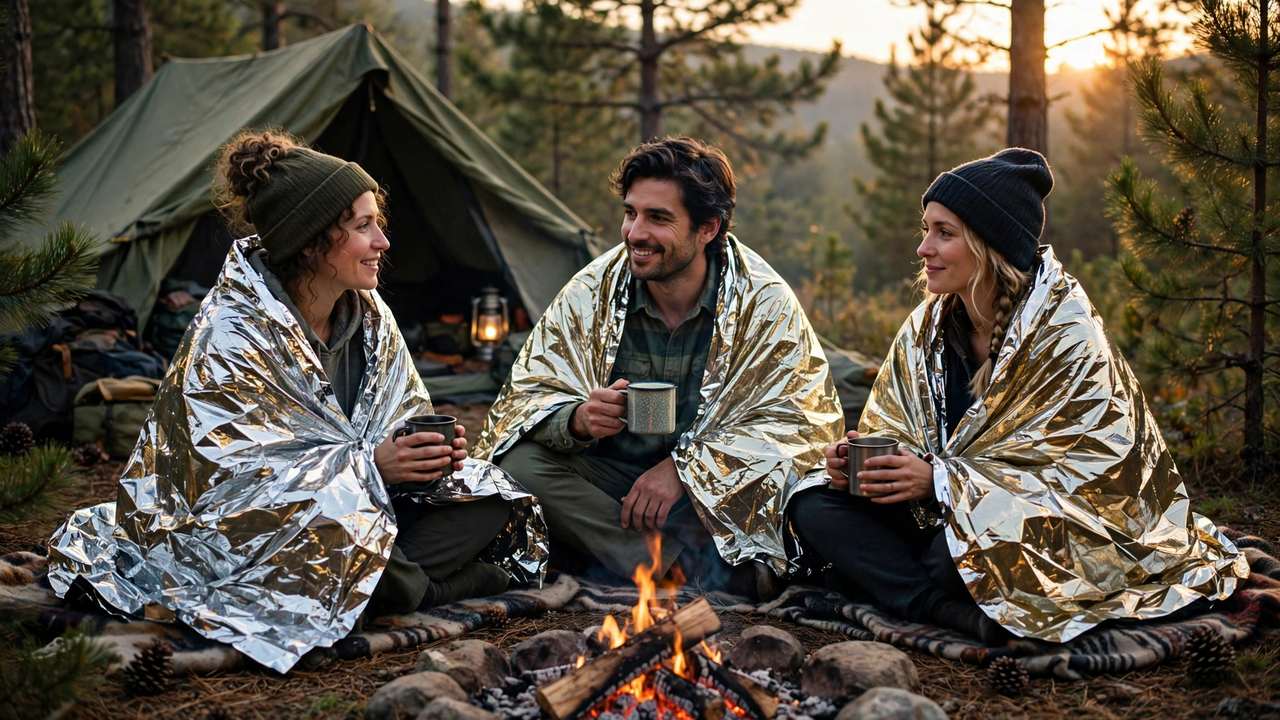
A solar blanket is the lightest layer in a camp kit that can do the most jobs. The name covers reflective mylar emergency blankets and heavier solar-reflective camping blankets, and both work on the same simple principle: a shiny, aluminised surface reflects radiant heat instead of letting it escape, and reflects strong sun away when you flip it or rig it as shade. Campers carry them as a backup wrap on a cold night, a ground cloth under a tent, a rain fly over a pack, a windbreak beside a stove, and a bright signalling sheet that is easy to spot from a distance. Choosing the best solar blankets for camping is mostly about deciding which of those jobs matters most to you, because the products in this class split into two very different families. At one end are ultralight foil sheets that weigh almost nothing, fold to the size of a wallet, and are sold in multi-packs so you can stash one everywhere. At the other end are reusable, tarp-like reflective blankets with reinforced layers and grommets, built to be rigged, staked, sat on and used trip after trip. This guide compares six real options across both families, using only the sizes, materials and pack counts the makers themselves list, so you can match a blanket to the way you actually camp.
Quick verdict
If you want one blanket that will still be working after seasons of camp use, the Arcturus Heavy Duty Survival Blanket is the standout: the maker lists a three-layer build, reinforced grommets and a carry bag, and it works as a wrap, a tarp, a ground cloth and a shelter layer in a single piece of kit. If you camp with a group, a family or a scout troop and simply need a blanket in every pack and every car, the Primacare HB-10 ten-pack is the practical bulk choice, while the QIO CHUANG four-pack covers the same ground in a smaller bundle. For backpackers who count every gram and want maximum coverage per blanket, the Don’t Die In The Woods Squatch Size four-pack lists the largest sheet in this roundup. The Mart Cobra four-pack is a straightforward, tear-resistant mylar option for glove boxes and daypacks, and the Grabber Original Space Brand blanket is the classic single sheet, from the brand that has made space blankets for decades, for campers who want one proven blanket rather than a bundle. None of these replaces a sleeping bag or an insulated sleeping pad, and none should be your only warmth layer on a cold night. They are backup, shelter and utility layers, and judged on those terms, all six earn their place in a kit.
The products in this guide
Arcturus Heavy Duty Survival Blanket – 60 x 82 Inches, Coyote Brown
A three-layer design that combines reflective mylar with rugged polypropylene, a finished size of 60 x 82 inches, a weight of about 1.4 pounds, and
Best for Reusable shelter, tarp and ground cloth duty
Sizes, pack counts and materials in this table are the figures the makers list for each model. Where a maker states a heat-reflection figure, it is discussed in that product’s section below and attributed to the maker, because reflection percentages are laboratory-style claims that depend on how the blanket is used, how much air gap sits between the blanket and the body, and whether the surface stays clean and unwrinkled in the field.
How we selected
We started with the product class itself. A solar blanket, for this guide, is a reflective blanket positioned by its maker for camping and outdoor use: either a mylar emergency or survival blanket, or a heavier solar-reflective camping blanket built on the same reflective principle. Ordinary fleece, wool and down camp blankets were excluded, however good they are, because they do not reflect radiant heat and do not belong to this class. Quilted moving blankets, car windscreen shades and reflective insulation rolls were also excluded; they share a shiny surface but are not sold as blankets you carry and use at camp.
Every product that made the final six had to clear three checks. First, it had to be a real, identifiable model from a named brand, with a size, a material and a pack count that the maker publishes. Second, its current Amazon US listing had to be opened and read in full, including the availability block: a listing with no live featured offer for a new item did not count, however famous the product, and three well-known blankets were dropped from this guide at exactly that step. Third, the model’s details had to be consistent between the listing and the maker’s own description, so the specifications below could be phrased as what the maker lists rather than guessed. Products that failed any check were excluded entirely rather than written up with gaps.
Within the six, we deliberately kept a spread. There is one heavy-duty reusable blanket for campers who want a single durable piece of shelter kit, and five mylar options that cover bulk buying, standard four-packs, extra-large sheets and the classic single blanket. That spread matters because the right answer for a family car-camping kit, where weight is irrelevant and numbers count, is the opposite of the right answer for a solo backpacker, where a blanket must justify its grams and will probably be used as a tent footprint or a rain layer more often than as a wrap.
The Arcturus is the blanket in this guide that behaves least like a disposable sheet and most like a piece of shelter equipment. The maker lists a three-layer design that combines reflective mylar with rugged polypropylene, a finished size of 60 x 82 inches, a weight of about 1.4 pounds, and four reinforced grommets, and it ships with a waterproof carry bag. Those grommets change what the blanket can do at camp. Tied between two trees or trekking poles it becomes a shade canopy with the reflective side facing the sun, or a heat-reflecting wall behind a campfire seat with the reflective side facing you. Staked flat, it is a ground cloth that keeps tent floors and sleeping pads off wet grass, and because the outer layer is a woven-style material rather than bare foil, it tolerates boots, knees and pack buckles far better than a plain mylar sheet. Wrapped around shoulders on a cold evening it works as a windproof outer layer over a fleece, which is where a reflective blanket earns its keep in ordinary camping rather than in an emergency.
The trade-offs are weight and pack size. At the maker-listed weight, this is a car-camping, canoe-camping or short-carry blanket, not the sheet an ultralight backpacker throws in as an afterthought, and it covers one person generously rather than a whole group. The Coyote Brown finish is also a deliberate choice: the reflective side does the thermal work, while the coloured side is easier on the eyes around camp and less glaring in bright sun than an all-silver blanket. For campers who have shredded a thin foil blanket on its first outing and sworn off the category, this is the model that answers the complaint, because it is designed to be folded, rigged and reused rather than opened once and thrown away.
Buy it if: you want one durable reflective blanket that doubles as a tarp, ground cloth and shade sheet across many trips.
Skip it if: you are counting grams for a long backpacking route, or you need several blankets for a group on a small budget.
The Primacare HB-10 is the organiser’s pick. The maker lists a pack of ten individually folded blankets, each opening to 84 x 52 inches, in a silver foil and mylar construction described as waterproof and weatherproof. Ten blankets is a genuinely useful quantity for camping life: one in each family member’s pack, a couple in the car, a couple in the tent spares bag, and still some left for the kitchen shelter box or to hand to the neighbouring pitch when the weather turns. Because each blanket is sealed separately, the spares stay clean and compact until the moment they are needed, and a used or torn blanket can be retired without touching the rest of the supply.
At 52 inches wide, the HB-10 is a standard single-person sheet rather than a wide wrap, so taller campers will find it long enough but not generous across the shoulders, and like all thin mylar it crinkles, flaps in wind and needs tucking or weighting at the edges. It has no grommets and no reinforced layer, so treat it as a wrap, a tent inner liner, a pack cover or a signalling sheet rather than something to stake out as a working tarp. Primacare supplies first-aid and emergency markets as well as campers, and the HB-10’s plain, no-frills presentation reflects that: this is a dependable commodity blanket bought in quantity, and for group leaders, event marshals, scout and guide units, and families who run several kits at once, that is exactly the point.
Buy it if: you kit out several people or several vehicles and want a sealed spare blanket in every bag.
Skip it if: you want one wide, reusable blanket for shelter building rather than a stock of single sheets.
The QIO CHUANG four-pack sits in the middle of this guide: more blankets than a single, fewer than a bulk box, and slightly wider than the standard sheet. The maker lists each blanket at 84 x 55 inches, made from dual-sided aluminised mylar, with every blanket individually folded, wrapped and sealed, and describes the material as reusable, waterproof and windproof. The extra width over a 52-inch sheet is noticeable when the blanket is used as a wrap, because it gives a little more overlap across the chest and shoulders, and it also helps when the sheet is laid as a ground layer under a sleeping pad, where edges that curl short leave cold, damp gaps.
In camp, a four-pack divides neatly: two blankets stay in the camping box as wraps and liners, one lives in the car, and one goes in a daypack for summit stops and viewpoint picnics where a reflective sheet doubles as a dry seat. Dual-sided mylar also gives you the two classic solar tricks in one sheet. Reflective side out under a strong sun, it throws heat away from a tent or a resting camper; reflective side in on a cold evening, it bounces radiant heat back toward the body, which is the use the maker’s heat-retention figure refers to. Like its peers, it is still thin foil at heart, so keep it away from stove flames and sharp stove stands, fold it rather than stuffing it to limit creases and tears, and expect a service life measured in trips rather than seasons if it is used hard as a ground sheet.
Buy it if: you want a sensibly sized four-pack of wider sheets for family camping and car kits.
Skip it if: you need grommets and a reinforced build for rigging a proper shelter.
Size is the whole story with the Squatch Size blanket. Don’t Die In The Woods lists each sheet at 5 x 7 feet, which the maker presents as larger than a standard foil blanket, in a pack of four double-sided blankets that the maker lists at about 2 ounces per blanket, supplied in a zipper pack with a carabiner. That extra area matters in the ways campers actually use these sheets. A 7-foot length wraps a tall person head to toe without the usual cold gap at the ankles, two blankets overlap into a ground layer wide enough for a two-person tent footprint, and a single sheet rigged with tape and cord, as the maker suggests, covers a respectable lean-to or a bike-and-rider rain shelter. The green colour on one side is also a thoughtful touch for ordinary camping: it looks at home in woodland, keeps glare down when the sheet is used as a picnic or sitting layer, and still leaves the reflective side available when you need it.
The brand’s presentation is playful, but the format is practical for backpackers and bikepackers: four large blankets that still pack to almost nothing means a sheet can live permanently in a hip-belt pocket, a seat bag and a trail-running vest rather than being a deliberate packing decision. The limits are the usual mylar ones, only more so, because a bigger sheet catches more wind and needs more care when it is rigged or wrapped on a blustery ridge. It is a coverage upgrade, not a durability upgrade, so campers who mainly want a working tarp should look at the Arcturus above, while campers who mainly want the most wrap per ounce in a conventional mylar pack will find this the most generous option here.
Buy it if: you are tall, you share a tent, or you want the largest lightweight sheet for wrapping and ground cover.
Skip it if: you camp in exposed, windy places and need a blanket that rigs taut and stays quiet.
Mart Cobra’s four-pack is the no-nonsense option. The maker lists each blanket at 82 x 52 inches, made from aluminised mylar described as tear-resistant and reusable, folding down to a compact size for a backpack, car kit or emergency box. There are no grommets, no carry system and no colour choices to think about, and that simplicity is the appeal: this is the pack you buy to make sure every kit you own has a reflective blanket in it, from the tent bag to the glove box to the child’s first independent camping pack.
Used as the maker positions it, as a wrap, a ground cover and a shelter layer for camping and hiking, a sheet of this size handles the standard jobs well. It lines a tent floor on a wet pitch, covers a stack of packs outside the tent door overnight, shades a cool box in a sunny lay-by, and wraps a camper who underestimated an evening temperature drop. The maker states a heat-retention figure of up to 90 percent of body heat, which should be read the way all such figures should: as the maker’s description of the reflective material’s potential under ideal conditions, not as a promise that a thin sheet replaces insulation. Pair it with a proper sleeping bag and pad, treat it kindly around zips and crampons, and a four-pack quietly covers a household’s worth of kits.
Buy it if: you want simple, compact four-pack blankets to distribute across cars, packs and camp boxes.
Skip it if: you want extra width, reinforced construction or a blanket you can stake out as a tarp.
The Grabber blanket is the original article in this category: a single space blanket from the brand built around the reflective material developed for the space programme. The maker lists a size of 56 x 84 inches, a weight of 3 ounces, and a folded size of about 4 x 2 x 2 inches, and describes the blanket as windproof and waterproof, for use inside a sleeping bag, over a sleeping bag, or on its own as an emergency wrap. Notably, the maker lists a heat-reflection figure of over 80 percent rather than the higher numbers used elsewhere in this guide, a conservatism that suits a product that has been sold, in essentially this form, for a very long time.
As a camping purchase, the single-blanket format is the point. One Grabber lives in one kit, chosen deliberately: the winter daypack, the bothy bag’s companion, the car kit that already has everything else. The 56-inch width is a little more generous than the common 52-inch sheet, and the folded packet is small enough to disappear into a jacket pocket on a summit day. Campers building kits for a whole family will find the multi-packs above more economical in effort, and campers wanting a reusable shelter layer should again look to the Arcturus, but for a single, proven, pocket-sized reflective blanket with a long track record, this is the benchmark the rest of the category is measured against.
Buy it if: you want one classic, pocket-sized space blanket from the original brand for a single well-planned kit.
Skip it if: you are stocking several kits at once, where a multi-pack is the simpler purchase.
Buying guide
Thin mylar or heavy-duty reflective tarp?
This is the first and most important decision. Thin mylar blankets weigh almost nothing, cost little per sheet and are bought in packs, but they are fragile, noisy in wind and awkward to rig. Heavy-duty reflective blankets like the Arcturus in this guide add a woven or bonded layer, grommets and real durability, at the cost of weight more like a lightweight tarp. Backpackers who want insurance they will barely notice should choose mylar. Car campers, canoeists and anyone who plans to use the blanket as shade, ground cover or a fire reflector on every trip should choose the heavy-duty style, because a mylar sheet used that hard will not last the season.
Size and coverage
Most mylar camping blankets cluster around 82 to 84 inches long and 52 to 55 inches wide. Length is rarely the problem; width is what decides whether a wrap actually closes around shoulders and hips. If you are tall or broad, or you want one sheet to double as a two-person ground layer, look for the wider and longer formats, such as the 5 x 7 foot sheet in this guide. For children and for pure backup use inside a sleeping bag, standard sizes are perfectly adequate and pack smaller.
What the reflection figures really mean
Makers list heat-reflection figures for these blankets, commonly up to 90 percent of radiated body heat. Read those numbers as descriptions of the reflective surface, attributed to the maker, not as a warmth rating. A reflective blanket has almost no insulation of its own: it does not trap air like a sleeping bag, and it cannot warm you through a cold, compressed layer underneath. What it does well is reflect radiant heat, block wind and shed water, which is why the classic camp uses are as an outer wrap over insulation, a liner that adds a margin on a colder-than-expected night, a reflector behind a seat near a fire, and a shade sheet that throws the sun off a tent at midday. Judge any solar blanket by those jobs and it will not disappoint you; judge it as a sleeping bag substitute and it will.
Pack counts and where blankets should live
Multi-packs are not just about saving money; they are about placement. A reflective blanket only helps if it is in the kit you are actually carrying, so a sensible plan puts one in each person’s pack, one in the tent spares bag and one in each vehicle. Singles and four-packs suit solo campers and couples. Ten-packs suit families, group leaders and anyone equipping a club, a rental fleet or a holiday property’s worth of outdoor kits. Whatever the count, keep each blanket in its sealed fold until it is needed, because refolding a used mylar sheet to its original size is a campsite puzzle nobody enjoys.
Care, limits and safety basics
Keep reflective blankets away from open flame and stove burners; mylar melts and the heavier layered blankets can be damaged by direct heat at close range, so rig a fire reflector at a sensible distance and never cook under a low reflective canopy. Wipe layered blankets clean and dry them before storage, and store mylar sheets folded in a dry bag so grit does not abrade the surface. Check a blanket before a winter trip rather than during it, replace sheets with torn or flaking surfaces, and remember the honest limit of the whole category: these are wind, water and radiation layers that support a proper sleep system and shelter plan, not replacements for either.
FAQ
What is a solar blanket, and is it the same as a space blanket?
Yes, the terms overlap. Solar blanket, space blanket, emergency blanket and survival blanket all describe reflective sheets, usually mylar or a related metallised film, that reflect radiant heat and sunlight. In this guide the phrase covers both the thin mylar sheets and the heavier layered reflective blankets that makers position for camping and outdoor use.
Can a solar blanket replace a sleeping bag on a camping trip?
No. A reflective blanket has no meaningful insulation of its own and does not trap warm air. Makers position these blankets as wraps, liners, ground covers, shade and shelter layers that support a sleep system. Carry a sleeping bag and an insulated pad rated for the temperatures you expect, and treat the solar blanket as a versatile backup and utility layer.
Which side of a reflective blanket should face out?
For warmth, the reflective side faces the body, so radiant heat is reflected back toward you, ideally with a small air gap and an insulating layer underneath. For shade and cooling, the reflective side faces the sun, rigged above a tent, a seat or a cool box so heat is thrown away before it builds up. Coloured or dull sides, where a model has one, face outward when you want less glare or a lower profile around camp.
Are solar blankets reusable?
Thin mylar sheets can be refolded and reused for light duties such as ground cover and pack covers, but they crease, tear and lose surface quality with hard use, and makers generally treat them as limited-life items. Layered blankets with reinforced construction and grommets, such as the heavy-duty model in this guide, are designed for repeated use across many trips.
How many solar blankets should a camper carry?
One per person is a sound baseline for group and family camping, plus one spare in the tent kit and one in the vehicle. Solo backpackers usually carry a single sheet. Because the lightweight models pack so small, placement matters more than quantity: a blanket in the pack you are wearing is worth more than three in a box at home.
Can a solar blanket be used as a tent footprint or tarp?
As a footprint, yes: any of the sheets in this guide will keep a tent floor off damp ground for a night, though thin mylar will wear quickly on rough surfaces. As a tarp, only the reinforced, grommeted style is really suited, because plain mylar tears at tie-out points. If shelter building is a main job, choose the heavy-duty layered blanket.
Conclusion
The best solar blanket for your camping is the one matched to the job you will actually give it. Choose the Arcturus Heavy Duty Survival Blanket if the blanket is working equipment that must rig, stake and last. Choose the Primacare HB-10 ten-pack to put a sealed blanket in every kit a group owns, the QIO CHUANG four-pack for a slightly wider everyday sheet, the Don’t Die In The Woods Squatch Size four-pack for the most lightweight coverage, the Mart Cobra four-pack for simple distribution across cars and packs, and the Grabber Original Space Brand blanket for a single classic sheet in one well-planned kit. Keep expectations honest, pair the blanket with real insulation, and this lightest of layers will repay its tiny corner of your pack on trip after trip.
M
Modern Line Home Editorial Team
We compare specs, materials and verified owner reviews before a product earns a spot. Rankings are never paid.
Affiliate disclosure. As an Amazon Associate we earn from qualifying purchases at no extra cost to you. Prices accurate as of the date shown.
House cold even with the heat on? Walk this ordered checklist: thermostat and filter first, then drafts, insulation, leaky ducts and a failing heating system.
Windows fogging up in winter? Check where the fog sits: on the room side it is indoor humidity, outside it is harmless, and between panes the seal has failed.
Store the main firewood pile about 30 feet from your house, off the ground and covered only on top. Compare racks, woodsheds, garages and indoor spots safely.
Place a portable generator outdoors only, at least 20 feet from windows, doors and vents, exhaust pointed away. Exact distances, setup steps and CO rules here.
Keep houseplants in the right winter spot: match window direction to plant type, stay clear of radiators and cold glass, and fix dry air and low light at home.
Mice enter through pencil-width gaps at foundations, pipes, vents, doors and the roofline. Walk this room-by-room winter checklist to find and seal each one.
A winter outage timeline: what to do in the first hour, first night and multi-day outage, with food safety times, pipe protection, heat and CO safety steps.
Size a space heater by room area: 10 watts per square foot at 8-foot ceilings, adjusted for insulation and ceiling height, with full wattage and BTU tables.
Start dripping at about 20 degrees, sooner for exposed pipes. Set a pencil-lead stream, drip the right faucets on both lines, and know when to stop safely.
A fridge needs 800-1,200 starting watts, not just 150-400 running watts. Use the tables to total your fridge plus freezer, lights, furnace fan and more today.












Write Your Review
No reviews yet. Be the first to share your experience!