We independently review everything we recommend. When you buy through our links, we may earn a commission. As an Amazon Associate we earn from qualifying purchases.
Best Beach Blankets With Stakes for Windy Beach Days
Compare the best beach blankets with stakes, from oversized nylon mats to a padded 3-layer pick, with sizes, stake counts and carry details to check first.
Compare the best beach blankets with stakes, from oversized nylon mats to a padded 3-layer pick, with sizes, stake counts and carry details to check first.
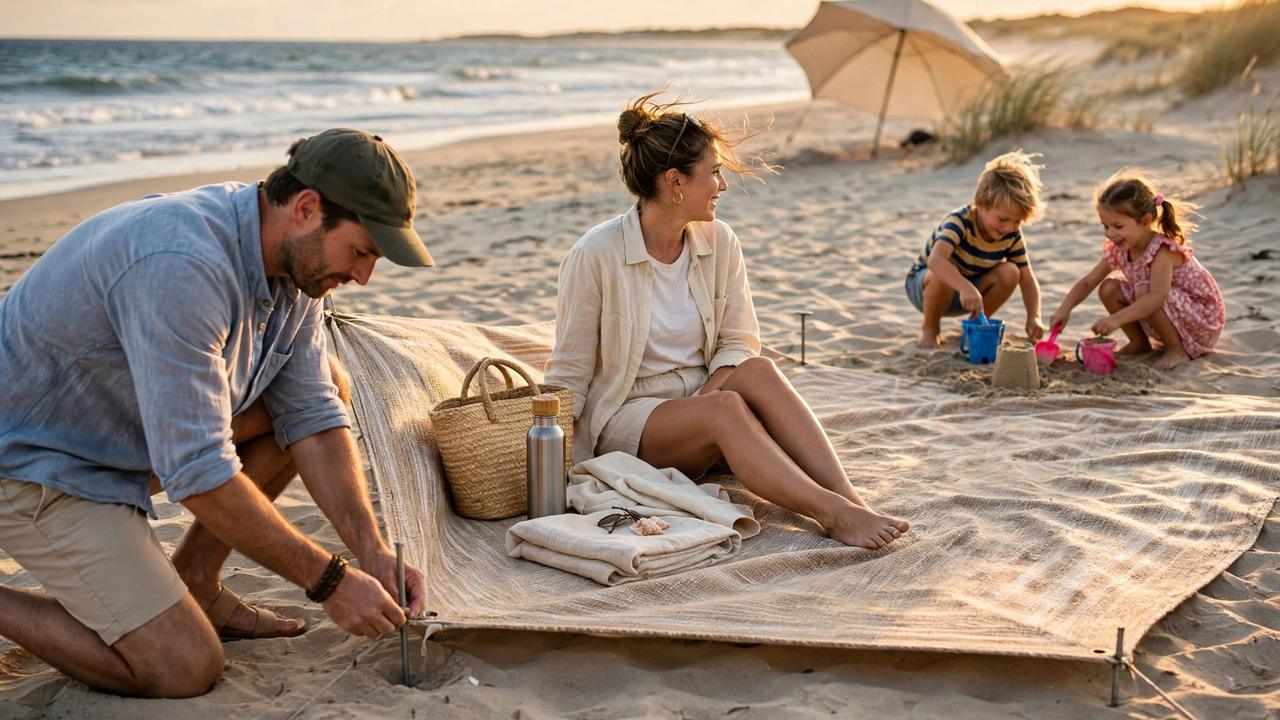
A lightweight beach blanket is easy to carry and hard to keep still. The moment a sea breeze lifts a corner, towels slide, sand blows across lunch, and someone ends up sitting on an edge for the rest of the afternoon. That is why the best beach blankets with stakes pair a sand-shedding fabric with anchor loops and ground stakes that pin the corners down, so the blanket stays where you spread it while you swim, walk, or simply leave your spot for a few minutes.
This guide compares six blankets that actually include stakes in the box, according to each maker’s own listing. They range from a very large ripstop nylon mat for a big group to a padded three-layer blanket that feels closer to a picnic rug, plus several light polyester and nylon mats in the roughly seventy-nine by eighty-three inch class. Every pick below was checked on its opened product page, including whether the listing includes stakes and whether a live new offer was showing.
Quick verdict
For most groups, the WEKAPO Sand Free Beach Blanket in the ten by nine foot size is the easiest recommendation: the maker lists five metal stakes for four anchor loops, four weightable corner pockets, and a ripstop nylon surface that covers a large group area. If you travel light, the MIULEE and BYDOLL blankets pack the same basic idea — stakes, corner pockets, and a carry bag — into smaller, lighter kits. If you sit for hours and want cushioning under you, the ZAZE three-layer blanket is the different kind of pick here, trading a little pack bulk for padding. The WIWIGO and EASYFUN blankets suit buyers who want a mid-size polyester mat with a simple four-stake setup and a carry bag.
We started with one hard rule: the blanket had to include stakes or pegs in the box, stated by the maker on its own product page. Blankets that rely only on sand pockets, corner weights, or the weight of your bags were left out, however good they might be as plain mats, because a buyer searching for a staked blanket wants hardware that goes into the ground. Each candidate was then opened and read in full, and only listings that clearly listed stakes among the included components or in the maker’s own description stayed in.
Next, each listing had to show a live offer for a new blanket. A page with no live featured offer does not count as a usable pick, so those candidates were dropped and replaced, even when the blanket itself looked suitable. That availability check is why this list contains six blankets that a buyer can actually order new, rather than a longer list padded with discontinued or unavailable models.
We also compared the things that decide whether a staked blanket works in practice: the number of stakes against the number of anchor loops, whether spare stakes are included, whether corner pockets back up the stakes on soft sand, the fabric and how the maker says sand and water behave on it, the unfolded size against the packed size and weight, and how the blanket folds and carries. Finally, we kept the set varied on purpose — one oversized nylon mat, several light mid-size mats, and one padded option — because the right answer depends on group size and how long you sit, not on a single specification.
The WEKAPO is the big-coverage pick. The maker lists this size at ten by nine feet, comfortably fitting seven people, in a durable ripstop nylon that the maker describes as sand proof and water resistant, with sand shaking off in one go. Weight is listed at sixteen ounces for the blanket, and the maker lists the smaller packed form as an attached compression sack, so the large surface does not demand a large bag.
The staking system is the headline. The maker lists five metal stakes in a pouch for four anchor loops, so there is one spare stake in the kit, and four corner pockets that can be filled with sand or used for storage as a second anchoring method. On a windy day you can stake the loops and weight the pockets together; on a calm day the pockets alone may be enough, which gives this blanket more setup flexibility than a stakes-only design. The maker also lists triple stitching for strength and durability.
Keep two trade-offs in mind. A ten by nine foot sheet catches more wind before it is staked, so it takes a minute more to lay out and pin down than a smaller mat, and thin ripstop nylon is a ground barrier rather than padding, so most people will still put a towel over it for a long lie-down. Neither point is unusual for this category, and both are the direct cost of the coverage.
Buy it if: you take a large group to open, breezy beaches and want stakes plus sand pockets working together on the biggest surface in this guide.
Skip it if: you travel solo with a small tote and would rather have a compact mat you can spread and stake in seconds.
The MIULEE is the compact double-anchor pick. The maker lists this blue version at seventy-eight by eighty-two inches, fitting one to four adults in the maker’s bullet description, with a listed weight of nine point six ounces in the product details and a carry bag in the box. The maker lists the fabric as nylon, sand resistant and water repellent, and says sand does not filter through and shakes off easily.
Its wind setup is deliberately redundant. The maker lists four ground stakes for four anchor loops and four large corner pockets, describing the combination of corner sandbags and ground stakes as dual wind-resistant protection. The included components list also names a carabiner alongside the stakes and carry bag, which makes it easy to clip the packed blanket to a beach bag rather than burying it inside.
The compromise is coverage. At seventy-eight by eighty-two inches this is a couples-and-small-family blanket, not a base camp for a large group with a cooler and bags in the middle. The thin nylon surface also follows the WEKAPO pattern: excellent as a sand and damp barrier, minimal as cushioning. Buyers who mostly sit, eat, and keep gear off the sand will feel that trade less than buyers who nap on the blanket.
Buy it if: you want the lightest complete kit here — stakes, corner pockets, carabiner, and carry bag — for one to four people.
Skip it if: your group regularly spreads out with five or more people plus coolers and beach toys on the same blanket.
The WIWIGO is the straightforward mid-size polyester pick. The maker lists it at seventy-nine by eighty-three inches, providing space for four to seven people, in a lightweight, quick-drying one hundred percent polyester with a smooth, silky surface that the maker says keeps sand from sticking. The product details list the material as ripstop polyester and the included components as the beach blanket, a storage bag, and four ground stakes.
The maker’s description adds that the blanket includes four ABS plastic anchors to secure it and prevent it from blowing away, and that it folds compactly into an included carry bag listed at seven point five by five point two inches. The maker also lists the blanket as waterproof and machine washable, which suits families who use the same mat for beach days, picnics, and park stops and want to wash it between uses rather than just shake it out.
Plastic anchors are the point to weigh. They are light and will not corrode, and they suit sand and soft ground well, but a buyer who often sets up on firm, packed ground may prefer the metal stakes of the WEKAPO or ZAZE kits. The WIWIGO also keeps the design simple, without the corner sand pockets of the WEKAPO and MIULEE, so the stakes carry the whole anchoring job.
Buy it if: you want a machine-washable polyester mat with a simple four-stake setup and a very small packed size.
Skip it if: you want metal stakes or a second anchoring method such as fillable corner pockets for very windy beaches.
The BYDOLL is the featherweight parachute-fabric pick. The maker lists this size at seventy-eight by eighty-one inches, comfortably fitting four to seven adults, made from parachute fabric described as rip-stop 210T polyester, and lists the folded blanket at twelve ounces, easy to carry in its storage bag. The maker describes the surface as waterproof and sandproof, with sand coming off with a gentle shake, and lists machine or hand washing.
The package, as the maker lists it, includes one beach blanket, four ground stakes, and one carabiner, with four anchoring loops, one on each corner, to fix the blanket against the wind. That is the complete, minimal kit: no corner pockets and no spare stake, just loops and stakes sized to the job. The maker also notes wider uses for the same mat, including as a rain shed, sunshade, tent ground cover, or emergency mat, which reflects how thin and adaptable this kind of fabric sheet is.
Minimalism is both the appeal and the limit. There is no padding and no backup anchoring, and if a stake is lost there is no spare in the bag, so careful owners will keep the stakes in the storage bag with the blanket. For walkers, cyclists, and anyone carrying their beach kit in a backpack, the twelve-ounce listed weight makes that discipline easy to accept.
Buy it if: packed weight matters most and you want a full-size staked blanket that carries at a listed twelve ounces.
Skip it if: you want spare stakes, corner pockets, or any cushioning between you and the ground.
The ZAZE is the padded outlier, built more like a picnic rug than a fabric sheet. The maker lists it at eighty by eighty inches, fitting four to six adults, with a three-layer build: a sturdy fabric top, soft cotton in the middle, and a durable fabric backing. The maker says those layers provide extra cushioning and comfort for sitting or lying on the beach, which is a genuinely different experience from the single-layer nylon and polyester mats above.
Wind security comes from four metal ground stakes, which the maker lists as designed to keep the blanket secure even in high winds, and the included components list names the blanket and metal stakes. The surface carries a sand-free and waterproof coating, as the maker lists it, so sand shakes off and water is repelled despite the thicker build. Folding is integrated rather than bag-based: the maker lists that the blanket folds to fifteen by five inches using the included Velcro, weighs two point three pounds, and has a sewn handle for carrying.
That weight is the trade. At two point three pounds the ZAZE is roughly double the listed weight of the light mats here, and a padded blanket takes longer to dry and more room to store than a nylon sheet. It is also listed as machine washable, which helps after picnics. Choose it when comfort on the ground is the priority and the walk from the car is short.
Buy it if: you sit or picnic for hours and want real cushioning plus metal stakes to hold the blanket down.
Skip it if: you hike or walk a long way to your spot and count every ounce in the beach bag.
The EASYFUN rounds out the set as a family-size sewn polyester mat. The maker lists it at seventy-nine by eighty-three inches, sleeping up to seven in the maker’s description, in a sewn polyester fabric that the maker describes as wear resistant and quick drying, with sand and water droplets coming off with a shake. The listed item weight is about two hundred ninety grams, keeping it in the light class despite the family sizing.
The staking kit is complete and simple. The maker lists the set as including one beach blanket, four stakes, and one carabiner, and the blanket packs into its equipped beach bag for carrying. The maker also lists machine or hand washing and a three-color patchwork pattern on this blue version, so it doubles as a picnic and park mat that does not look like camping equipment. Like several makers here, EASYFUN also lists secondary uses such as a rain shelter, awning, or ground cover.
As with the WIWIGO and BYDOLL, there are no fillable corner pockets listed, so the four stakes do the anchoring work, and the single-layer surface is a barrier rather than a cushion. Within those normal limits for a light mat, the EASYFUN offers one of the larger surfaces in this guide at one of the lowest listed weights, which is a useful combination for families who walk to the beach.
Buy it if: you want family-size coverage and a four-stake kit at a very low listed carry weight.
Skip it if: you want corner pockets as a second anchor or a padded surface for long sitting sessions.
Buying guide
Match stake count to anchor loops. Every blanket here stakes its four corners, which is the minimum that keeps a rectangular mat flat and still. Kits differ in the extras: the WEKAPO lists five metal stakes for four loops, so a spare travels with the blanket, while the other kits list four stakes for four loops. If you choose a four-stake kit, keep the stakes bagged with the blanket, because a three-corner blanket flaps, collects sand, and quickly becomes a two-person job to hold down.
Consider a second anchoring method for soft sand. Stakes hold best when the ground gives them something to grip. In very dry, loose sand a short stake can work free, which is where the fillable corner pockets on the WEKAPO and MIULEE help: sand weight and stakes together resist different kinds of pull. On grass and firmer ground, stakes alone usually do the work, and the simpler WIWIGO, BYDOLL, ZAZE, and EASYFUN kits are perfectly rational choices.
Size the blanket to the group, not the car. The roughly seventy-eight to eighty-three inch mats here suit one to four adults comfortably, or a family that keeps coolers and bags at the edges. Groups of five to seven, or anyone who wants gear on the blanket rather than on the sand, should look at the WEKAPO ten by nine foot size first. Remember that a bigger sheet also needs its stakes: an unstaked oversized blanket in a gust is a sail, not a mat.
Choose fabric by how you sit. Ripstop nylon and rip-stop polyester sheets are the lightest, dry the fastest, and shed sand with a shake, but they add almost no cushioning. A padded three-layer build like the ZAZE feels far better over a long picnic and insulates you from hot or uneven ground, at roughly double the carry weight and with slower drying. Neither is better in the abstract; the right pick follows the length of your typical stay.
Check the carry system. An attached compression sack, as the maker lists for the WEKAPO, cannot be left behind. A separate carry bag, listed for the MIULEE, WIWIGO, BYDOLL, and EASYFUN, packs smaller but must be kept with the blanket. The ZAZE folds with Velcro and a sewn handle instead. Carabiners, listed with the MIULEE, BYDOLL, and EASYFUN kits, let the packed blanket ride outside a full beach bag, which is a small detail that matters on the walk back with wet gear.
Plan care before the first trip. Most of these makers list machine or hand washing, and all of them expect sand to shake off a dry blanket far more easily than a wet one. Let a staked blanket dry before packing it, pull stakes straight out rather than levering them against the loops, and store stakes inside the bag so the kit is complete next time. A blanket that is washed, dried, and packed with its stakes is the one that actually gets used all season.
FAQ
Do the stakes work in dry sand? They work best when pushed in fully and angled slightly away from the blanket, and they hold better in damp or compacted sand than in very dry, loose sand. On the loosest beaches, pair the stakes with filled corner pockets where the blanket has them, or place bags at the corners as extra weight.
How many stakes does a beach blanket need? Four, one per corner, is the standard setup in this guide. A spare stake in the kit, as the maker lists for the WEKAPO, is a practical bonus because small stakes are easy to lose in sand at packing-up time.
Can I use a staked blanket on grass? Yes. Stakes suit grass and park ground well, and several makers here list picnics, camping, and festivals among the intended uses. Push stakes through the anchor loops only, never through the blanket fabric itself.
Are metal or plastic stakes better? Metal stakes, listed for the WEKAPO and ZAZE, cope better with firm ground. The plastic anchors listed for the WIWIGO are lighter and will not corrode, and they suit sand and soft ground. Match the stake to the ground you visit most.
Will a staked blanket stay flat in strong wind? Stakes greatly reduce lifting and travelling, but no light blanket is immovable in a gale. Stake all four corners, keep heavy items near the edges, and expect to re-seat a stake occasionally on exposed beaches.
How do I clean a sandproof blanket? Shake it dry first, which the makers here describe as removing the sand in one go, then follow the maker’s washing directions. Several of these blankets are listed as machine washable; air drying keeps light nylon and polyester fabrics in their best condition.
Conclusion
A staked blanket turns the windiest part of a beach day into a non-event: spread it, pin the corners, and the blanket stays your base instead of your chore. Take the WEKAPO ten by nine foot blanket for maximum coverage with a spare stake and corner pockets, the MIULEE or BYDOLL for the lightest complete kits, the WIWIGO or EASYFUN for simple mid-size polyester value, and the ZAZE when padding matters more than pack weight. Whichever you choose, confirm the stakes are in the bag before you leave — the best anchoring system is the one that arrives at the beach with you.
M
Modern Line Home Editorial Team
We compare specs, materials and verified owner reviews before a product earns a spot. Rankings are never paid.
Affiliate disclosure. As an Amazon Associate we earn from qualifying purchases at no extra cost to you. Prices accurate as of the date shown.
House cold even with the heat on? Walk this ordered checklist: thermostat and filter first, then drafts, insulation, leaky ducts and a failing heating system.
Windows fogging up in winter? Check where the fog sits: on the room side it is indoor humidity, outside it is harmless, and between panes the seal has failed.
Store the main firewood pile about 30 feet from your house, off the ground and covered only on top. Compare racks, woodsheds, garages and indoor spots safely.
Place a portable generator outdoors only, at least 20 feet from windows, doors and vents, exhaust pointed away. Exact distances, setup steps and CO rules here.
Keep houseplants in the right winter spot: match window direction to plant type, stay clear of radiators and cold glass, and fix dry air and low light at home.
Mice enter through pencil-width gaps at foundations, pipes, vents, doors and the roofline. Walk this room-by-room winter checklist to find and seal each one.
A winter outage timeline: what to do in the first hour, first night and multi-day outage, with food safety times, pipe protection, heat and CO safety steps.
Size a space heater by room area: 10 watts per square foot at 8-foot ceilings, adjusted for insulation and ceiling height, with full wattage and BTU tables.
Start dripping at about 20 degrees, sooner for exposed pipes. Set a pencil-lead stream, drip the right faucets on both lines, and know when to stop safely.
A fridge needs 800-1,200 starting watts, not just 150-400 running watts. Use the tables to total your fridge plus freezer, lights, furnace fan and more today.











Write Your Review
No reviews yet. Be the first to share your experience!