
Key takeaways
- Six easy-on slippers for after hip surgery, chosen for wide openings, closed heels, adjustable straps and hands-free entry, with practical fit checks first.
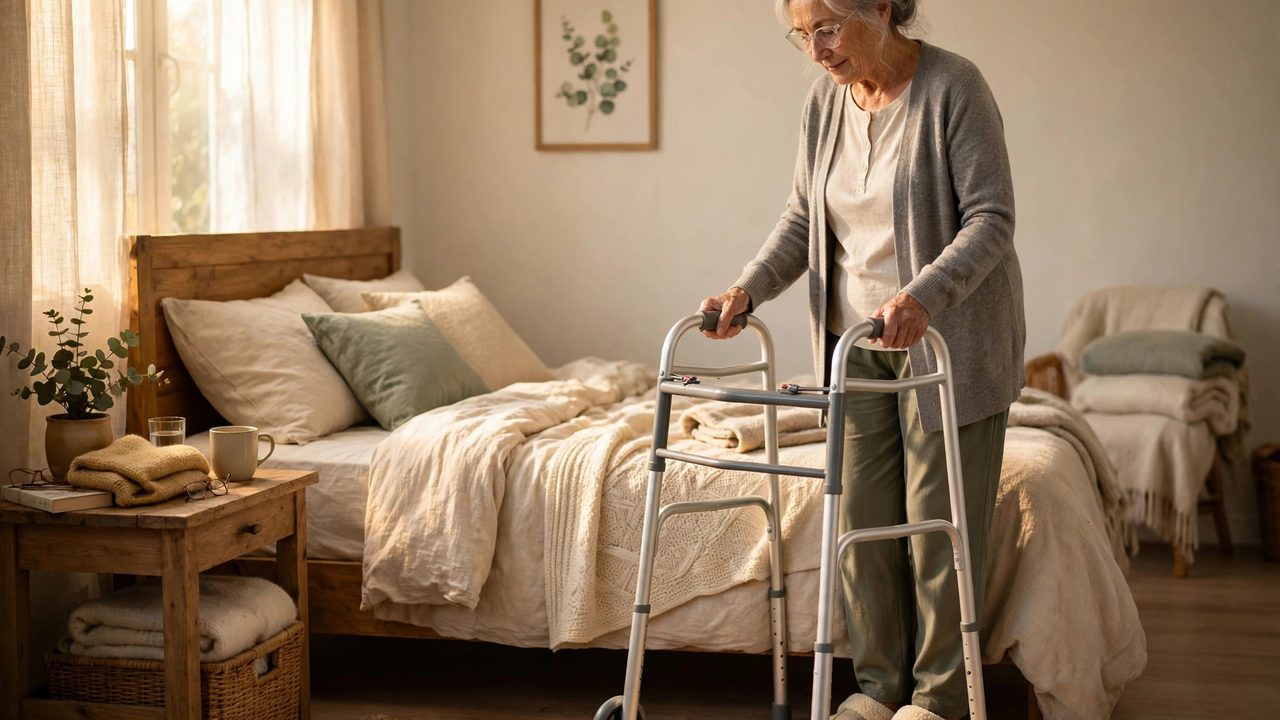
Choosing the best slippers for after hip surgery is mostly a dressing problem, not a fashion problem. In the first weeks at home, the everyday act of putting footwear on and taking it off can involve exactly the movements your surgical team may ask you to limit, such as bending far forward, twisting, or pulling a shoe on with both hands while seated on a low surface. This guide does not make any medical promises, and no slipper can do that. What a well-chosen pair can do is reduce the amount of bending, gripping, and balancing involved in getting dressed, because the slipper itself is built with a wide opening, a strap that does the fastening work, a heel that stays in place, and a sole the maker lists as non-slip or traction-textured. Every feature described below is a physical feature the maker lists for that model, nothing more, and the final decision on what you may wear, and when, belongs to your surgical team and physiotherapist.
That framing matters, so it is worth stating plainly at the start. Slippers are not medical devices in this context, and this article does not claim that any pair listed here will improve an outcome, speed anything up, or keep you safe. Makers use a great deal of therapeutic language in their own marketing, and that language has deliberately not been carried into the descriptions below. Instead, each pick is described the way you would describe a piece of clothing: how it opens, how it closes, what covers the heel, what the sole is made of, what widths and sizes the maker lists, and what the lining is. Those are the details you can actually check before ordering, and they are the details that decide whether a pair works with a long-handled shoehorn, a reacher, thick socks, or a foot that is simply hard to bend toward.
The six picks below split into three design families. Two use wide-opening adjustable straps that fold the upper out of the way so the foot can be placed in from above. One is a hands-free step-in design the maker says needs no bending at all to put on. One is a closed-back adjustable style with a strap that changes both the width and the height of the fit. And two are cushioned clog and mule styles that trade a fully enclosed heel for the simplest possible step-in entry, a trade-off this guide flags honestly rather than hides. Between them they cover women’s and men’s sizing, medium through extra-wide widths, and warm lined options for cold floors as well as lighter terry-lined options.
Quick verdict
If you only read one section, read this one. For the widest, most adjustable opening in a women’s slipper, the Orthofeet Charlotte is the standout: the maker lists a side strap that opens fully, a built-in heel lip, a suede upper, a faux fur lining, and a removable orthotic insole, in medium, wide, and extra-wide widths. For men who want to avoid bending altogether, the Orthofeet Vito is the pair built around that single job, with a hands-free step-in entry the maker describes as requiring no bending down, plus a water-repellent finish and an adjustable fit. The Vionic Carlin is the pick for a defined footbed shape, with a deep heel cup and an adjustable strap over the vamp, although its open back is a real compromise to weigh. The LazyStep Nana is the closed-back adjustable option with a strap that adjusts width and height and a machine-washable build. The ERGOfoot clog is the roomy unisex step-in with an elastic collar and a grooved rubber sole. And the Skechers BOBS Keepsakes Ice Angel is the warm sweater-knit bootie-style clog with a memory foam footbed and a traction outsole for short trips across hard floors.
Whichever pair you choose, run the same three checks before the surgery date if you can. First, confirm with your surgical team that the style, including heel height and back design, is acceptable for your situation. Second, practise the entry motion while you are still fully mobile, ideally with the dressing aids you plan to use, because a strap that is easy in the shop may be awkward with a reacher. Third, check the sole on your own floors at home, walking slowly on the surfaces you cross most, such as bathroom tile, kitchen flooring, and any loose rugs you may want to remove for the first weeks.
Comparison table
| Product | Sizing | Entry and closure | Heel coverage | Upper and lining | Fit range the maker lists |
|---|---|---|---|---|---|
| Orthofeet Charlotte Orthopedic Women’s Slippers | Women’s | Side strap opens fully; adjustable hook-and-loop | Heel lip at the back | Suede with faux fur lining | Medium, Wide, X-Wide |
| Orthofeet Vito Orthopedic Men’s Slip-On Slippers | Men’s | Hands-free step-in; adjustable fit | Closed slip-on back | Water-repellent upper with faux fur lining | Wide toe box; wide options listed |
| Vionic Carlin Slipper | Women’s | Slip-on with adjustable hook-and-loop strap over vamp | Open back mule | Flannel upper with faux fur lining | Medium and wide options listed |
| LazyStep Women’s Nana Adjustable Slippers with Wide Width | Women’s | Adjustable strap changes width and height | Closed back | Terry and coral fleece lining | Wide and extra-wide fits listed |
| ERGOfoot Orthopedic Slippers with Arch Support | Unisex | Slip-on clog with stitched elastic collar | Open heel clog | Knit upper with cotton terry lining | Roomy toe box; dual women’s and men’s sizing |
| Skechers Women’s BOBS Keepsakes Ice Angel Slipper | Women’s | Slip-on clog entry | Low clog back | Sweater knit with faux fur lining and trim | Standard women’s sizing |
Read the heel coverage column carefully, because it is the column that separates the two design philosophies in this guide. The Charlotte, the Vito, and the Nana keep material behind the heel, which means the slipper tends to travel with the foot through a full step rather than being dragged by the toes. The Carlin, the ERGOfoot clog, and the Ice Angel are open or low at the back, which makes them the easiest of all to step into and out of, but places more responsibility on fit at the front of the foot. Neither philosophy is automatically right. Your surgical team may have a view on heel coverage, and that view should win over anything in this table.
How we selected
Selection started with the entry motion, because that is the feature this keyword actually turns on. Priority went to slippers that can be put on with the foot placed in from above, with a strap fastened by one hand, or with a step-in design that needs no hands at all. Pure scuffs with narrow openings, slippers that need both hands to pull on, and styles with laces or buckles were set aside, however comfortable they might be for general use. Every model that made the final list was checked on its maker’s product information and on its Amazon listing, and only features stated in those sources are described here.
The second filter was heel and sole construction. The maker had to list either material behind the heel, a heel lip or cup that holds the foot’s position, or, for the open-back styles, an honest clog or mule description so the compromise is visible rather than disguised. For soles, the maker had to list a rubber or traction outsole rather than a plain fabric or foam bottom, because hard household floors are where slippers are actually worn. The third filter was fit range: models listing wide or extra-wide widths, adjustable volume, or a roomy toe box scored ahead of single-width models, because feet at home after surgery are often in thick socks and may not match the size you wore before.
Finally, anything that could not be verified on opened pages was excluded entirely rather than described from secondary roundups. That is also why this guide contains no prices, no ratings, and no review counts: prices and stock move by size and colour, and the only honest instruction is to check the live listing for your exact size. Where a maker’s therapeutic marketing language exists, it has been left out on purpose. The descriptions below stick to openings, straps, materials, soles, and sizes, and where a maker lists a support feature such as an orthotic insole or a contoured footbed, it is reported as a listed feature, not as a promise about what it will do for you.
Top picks
Orthofeet Charlotte Orthopedic Women’s Slippers
The Charlotte is built around the single most useful feature in this category: the maker lists a wide-opening adjustable side strap that opens fully, so the top and side of the slipper fold away and the foot can be placed in from above rather than pushed in from behind. Once the foot is in, the strap closes with hook-and-loop and sets the volume over the instep, which means the same pair can sit closer on a bare foot or open up over thick socks. A built-in heel lip at the back helps the slipper stay positioned on the foot as you move around the house, and the maker lists a wide toe box so the toes are not compressed by the suede upper.
The upper is suede with a plush faux fur lining, which makes the Charlotte a warm slipper suited to cold floors and draughty rooms. Inside, the maker lists a premium orthotic insole with anatomical arch support and multilayered cushioning, and the insole is removable, so it can be taken out to make room or replaced with an insert of your own if your care team has recommended one. Sizing runs across a broad women’s range with half sizes, and the maker lists medium, wide, and extra-wide widths, which is the widest fit range in this guide. The sole material is listed as synthetic, and the closure type is listed as pull-on with the adjustable strap doing the fitting work.
Two practical notes. First, a suede upper with a faux fur lining is an indoor slipper: the maker lists it as not water resistant, so it is not the pair for wet bathroom floors or trips outside in damp weather. Second, the strap is the whole mechanism, so check that you can reach and press it closed with the dressing aids you plan to use; the wide opening helps here, because the strap sits on the side and top rather than underneath the foot. If your team prefers a fully enclosed heel over a heel lip, look at the Nana below instead.
- Buy it if: you want the widest-opening strap design in a women’s slipper, with wide and extra-wide widths and a removable insole.
- Skip it if: you need a water-resistant upper, or your surgical team wants a fully closed heel rather than a heel lip.
Orthofeet Vito Orthopedic Men’s Slip-On Slippers
The Vito takes the opposite approach to the Charlotte: instead of a strap you open, it is built as a hands-free slip-on. The maker describes a patented hands-free entry that lets you step in without bending down, which is the exact movement many people are told to avoid in the early weeks at home, and the reason this model earns its place near the top of a list for this keyword. The fit is adjustable, the toe box is wide, and the maker lists the same style of premium orthotic insole with anatomical arch support and multilayered cushioning found across this maker’s slipper range, removable if you need the extra depth.
The upper is listed as water-repellent, which distinguishes the Vito from the suede and knit models in this guide and makes it more forgiving of kitchen splashes and damp hall floors, although water-repellent is not waterproof and it should still be kept out of standing water. Faux fur lining runs throughout, from the collar to the footbed, so it is a warm slipper despite the practical exterior. The listing covers men’s sizing including wide options, and the colour shown on the verified listing is a loden tone that reads more like a casual shoe than a bedroom slipper, which some wearers will prefer for answering the door.
The trade-off with any step-in design is that entry depends on the heel structure holding its shape, so the fit needs to be right: too large and the foot moves inside it, too small and the step-in action becomes a push. Use the maker’s size guidance, consider the socks you will actually wear, and confirm with your team that a slip-on shoe-style slipper is acceptable, since some teams specify a strap or a fully closed design for the first weeks.
- Buy it if: avoiding bending to put footwear on is your top priority, and you want a water-repellent, shoe-like men’s slipper.
- Skip it if: your team wants a strap-fastened design, or you prefer a soft, unstructured house slipper over a shoe-like build.
Vionic Carlin Slipper
The Carlin is the shaped-footbed option in this guide. The maker lists a textile-covered EVA footbed built on the same footbed technology the brand uses in its sandals, with a deep heel cup that holds the heel in a defined position, and the model carries the APMA Seal of Acceptance as the maker lists it. Entry is a slip-on slide with an adjustable hook-and-loop strap over the vamp, so the fit across the front of the foot can be set with one hand and changed between bare feet and socks without re-threading anything.
The upper on the verified listing is black flannel with a soft faux fur lining, and the sole is listed as durable rubber. Women’s sizing runs in whole and half sizes with medium and wide options in the range. As a piece of clothing, the Carlin is tidy and structured: it looks and behaves more like a shoe with the back removed than like a soft bedroom slipper, and the footbed has a definite contour rather than a flat foam feel, which is either its main appeal or its main drawback depending on what your feet are used to.
The compromise must be stated clearly: the maker describes the Carlin as an open back design. There is no strap or material behind the heel, so the slipper is held on by the vamp strap and the heel cup alone. That makes it exceptionally easy to step into and kick off, which is a genuine advantage when bending is limited, but it is exactly the feature some surgical teams ask their patients to avoid in slippers. Treat the Carlin as a pick to clear with your team first, and as a strong later option if they are comfortable with an open back once you are moving more freely.
- Buy it if: you want a contoured footbed with a deep heel cup and a one-hand adjustable vamp strap, and your team accepts an open back.
- Skip it if: your team specifies a closed heel, or you dislike a firm, shaped footbed underfoot.
LazyStep Women’s Nana Adjustable Slippers with Wide Width
The Nana is the closed-back adjustable in this guide, and its strap does more than most. The maker lists an adjustable strap that changes both the width and the height of the shoe, so the fit can be opened up for a foot in thick socks or a foot that needs more room over the top, then brought back in as things settle. The back is closed, in a loafer-style silhouette, so the heel is covered and the slipper moves with the foot. The footbed is memory foam, the upper is a soft terry with a classic diamond pattern embroidery, and the lining is a velvety coral fleece the maker describes as soft and skin-friendly.
The sole is listed as an ultralight rubber sole that the maker describes as non-slip, intended for indoor use on bedroom and household floors. Women’s sizing includes wide fits, and the fit type on the verified listing is listed as wide. One unusually practical feature for a slipper at home during a long recovery period: the maker lists the Nana as machine washable in cold water, laid flat to dry, which makes it easier to keep a pair fresh when laundry help is limited and the same slippers are worn all day, every day.
Set expectations on structure. This is a soft slipper, not a shoe-like one: there is no orthotic insole system and no rigid heel counter in the maker’s description, so the support story is cushioning and fit adjustability rather than a shaped footbed. If your team has asked for a firmer, more structured slipper, the Charlotte or the Vito fits that brief better. If the brief is a closed back, an adjustable opening, and easy washing, the Nana covers it in one model.
- Buy it if: you want a closed heel, a strap that adjusts width and height, wide fits, and a machine-washable slipper.
- Skip it if: you want a structured orthotic-style insole or a firm, shoe-like build.
ERGOfoot Orthopedic Slippers with Arch Support
The ERGOfoot entry is a unisex clog, sold in dual women’s and men’s sizing, and it is the roomiest step-in in this guide. The maker lists a classic slip-on clog design with a roomy toe box, a stitched elastic collar that holds the slipper snugly without squeezing, and an open heel so the pair can be kicked off as easily as they are stepped into. The footbed is an orthotic-style footbed with a deep heel cup as the maker lists it, which gives the heel a defined seat even though the back is open, and the upper is a breathable marl knit with a soft cotton terry lining, a lighter and less sweaty combination than the faux fur models above.
The sole is rubber, and the maker lists it with engraved anti-skid grooves for traction, describing the clog as suitable for indoor and outdoor use, from the hallway to the mailbox. That indoor-outdoor sole matters in a recovery routine, where the alternative is often changing footwear at the door, an extra bending-and-balancing act several times a day. Sizing is listed in combined women’s and men’s equivalents, so read the maker’s size chart against your usual size rather than assuming the first number is yours.
The maker also includes an adaptation note worth repeating as practical advice rather than a claim: with a contoured orthotic-style footbed, the maker suggests wearing the slippers for only a few hours a day at first while your feet get used to the shape. And the open heel carries the same caution as the Carlin: clear it with your surgical team, especially for the earliest weeks, and note the maker’s own care limit that the clog is not for shower or wet use despite the grooved sole.
- Buy it if: you want a roomy unisex clog with a grooved rubber sole for indoor and short outdoor use, in a breathable knit.
- Skip it if: your team requires a closed heel, or you want a warm faux fur lining for cold floors.
Skechers Women’s BOBS Keepsakes Ice Angel Slipper
The Ice Angel is the warmth-first pick. Sold under the BOBS from Skechers line, it is a slip-on clog in a soft sweater knit fabric with plush faux fur lining and trim, a cushioned Skechers Memory Foam footbed, and a low bootie-like profile that covers more of the foot than a standard mule. The maker lists a heel height of three quarters of an inch, a flexible indoor and outdoor traction outsole, and a shock-absorbing midsole. Entry is a simple slip-on with no straps to manage, which suits wearers who find hook-and-loop fastenings fiddly.
Women’s sizing is standard, and the verified listing shows black, black on black, and charcoal colourways. As a recovery-period slipper, its strengths are warmth, cushioning, and an outsole the maker builds for traction on both indoor floors and short outdoor surfaces, so a slow walk to the door or across a dry patio does not require a footwear change. The knit upper also has some give, which helps over socks, although it does not adjust in the deliberate way a strap design does.
The limits are the mirror image of the strap models. There is no adjustability, so fit depends entirely on choosing the right size, and the back is a low clog back rather than a closed heel, so it belongs in the same check-with-your-team category as the other open and low-back styles here. The memory foam footbed is flat cushioning rather than a contoured orthotic shape. Choose the Ice Angel for warmth and simplicity, not for fit tuning.
- Buy it if: you want a warm sweater-knit slipper with memory foam cushioning and a traction outsole, with nothing to fasten.
- Skip it if: you need width adjustability, wide widths, or a fully closed heel.
Buying guide
Start with your surgical team’s instructions. Everything else in this guide is subordinate to them. Teams differ on heel height, heel coverage, and how soon particular footwear is appropriate, and your own situation, including any other conditions or mobility aids, changes the answer again. If a instruction sheet from your hospital specifies enclosed footwear with a back, treat the closed and heel-lip models in this guide as your shortlist and the open-back models as later options to ask about. If anything in this article conflicts with what your team told you, follow your team.
Choose the entry style around your dressing aids. If you will use a long-handled shoehorn and a reacher, a wide-opening strap design such as the Charlotte or the Nana lets you place the foot from above and fasten with the reacher hand. If bending is the main obstacle and your team accepts a slip-on shoe style, a hands-free step-in such as the Vito removes the fastening step entirely. Practise before the surgery date if you can: put the slippers on and take them off using only the aids and the chair you will actually use at home, and swap any pair that needs two hands, a strong pull, or a twist to get on.
Weigh heel coverage honestly. Material behind the heel, a heel lip, or a closed back helps a slipper travel with the foot. An open back is easier to enter but relies on the front fit. Neither is a safety guarantee, and this guide makes no such claim for any model. What you can do is match the design to your team’s guidance and to your floors: the more time you spend crossing smooth tile or polished wood, the more the sole and the heel design both matter, and loose rugs are worth lifting for the first weeks regardless of footwear.
Check the sole description, not the marketing. Look for a maker-listed rubber or traction outsole, ideally with a tread or groove pattern described, rather than a fabric, suede, or plain foam bottom. Then test the pair at home at walking pace on your own surfaces before relying on them, including the bathroom and kitchen where floors can be damp. A sole that the maker lists as non-slip is a product description, not a promise, and wet floors deserve caution in any slipper.
Fit for the feet you will have, not the feet you had. Plan for the socks you will actually wear, which may be thicker than usual, and favour models with adjustable volume or listed wide widths if your feet tend to change size across the day. A removable insole, as on the Charlotte and the Vito, adds another fit lever, since removing it creates depth. Order early enough to exchange sizes before the surgery date, and keep the packaging until the fit is settled, because a slipper that slides at the heel or pinches over the instep will not improve with wear in the timeframe you need it.
Think about washing and warmth. A pair worn all day for weeks benefits from being washable, which the maker lists for the Nana, or at least easy to air and brush clean, which suits the suede Charlotte. Warmth cuts both ways: faux fur linings are welcome on cold floors in winter and can be too warm in a heated house in summer, where the terry-lined ERGOfoot clog or the flannel Carlin may be more comfortable. If the budget allows, some households keep a warm pair and a lighter pair and rotate them, which also gives each pair a day to dry out between wears.
FAQ
What type of slipper is usually easiest to put on after hip surgery?
Designs that open wide, fasten with a strap, or step in hands-free ask the least bending and pulling of the wearer, which is why this guide leads with those constructions. The exact style your team prefers comes first, though: ask them about heel coverage and heel height before ordering, and practise with your dressing aids while you are still mobile.
Are open-back slippers a good idea after hip surgery?
They are the easiest to step into and out of, and the hardest to keep travelling with the foot, and this guide includes two of them with that trade-off stated openly. Whether they suit your situation is a question for your surgical team, particularly for the earliest weeks. If your team prefers a back, choose a closed-back or heel-lip model instead.
Should I size up to allow for socks?
Not automatically. A better route is an adjustable strap or a wide width in your usual size, because an oversized slipper can move on the foot. Use the maker’s size chart, factor in the socks you plan to wear, and use any removable insole as extra depth rather than jumping a full size. Order in time to exchange if the fit is not right.
Can I wear these slippers outside?
Some models here have maker-listed indoor and outdoor soles, such as the ERGOfoot clog and the Ice Angel, and the Vito adds a water-repellent upper. That covers short, dry trips to the door or mailbox. They remain slippers, not walking shoes: for longer walks or uneven ground, ask your team what footwear they want you in and follow that.
How do I keep slippers hygienic during a long recovery at home?
Follow the maker’s care instructions for your model. The Nana is listed as machine washable in cold water and laid flat to dry. Suede and faux fur models are generally spot-cleaned and aired instead. Rotating two pairs, if you have them, gives each pair time to dry fully between wears.
When should I stop using a recovery-period pair?
When your team clears you for your usual footwear, or sooner if the pair no longer fits well, the sole is worn smooth, or a strap stops holding. Footwear needs change across the weeks after surgery, so treat the pair as equipment for a phase, and check in with your team at follow-up appointments about what to wear next.
Conclusion
The right slipper for the weeks after hip surgery is the one that asks the least of you at dressing time while matching what your surgical team has specified. For a wide-opening strap and the broadest width range in a women’s model, that is the Orthofeet Charlotte. For a men’s step-in that the maker designs to need no bending, it is the Orthofeet Vito. The LazyStep Nana covers the closed-back, adjustable, washable brief, the Vionic Carlin offers a contoured footbed with an adjustable vamp for those cleared to wear an open back, the ERGOfoot clog brings a roomy unisex fit with a grooved indoor-outdoor sole, and the Skechers BOBS Ice Angel keeps things warm and simple. Check your size and colour on the live listing before ordering, practise with your dressing aids early, and let your team’s guidance settle any question this guide leaves open.
More from Amazon
Programs that pair well with the guide above. Offers and eligibility are set by Amazon and may change.
Collect the home and kitchen items you want in one registry that guests can shop from.
Create a wedding registrySet up recurring deliveries of everyday items on eligible products. Terms and savings are set by Amazon.
Explore Subscribe & SaveFree shipping on eligible items, Prime Video and more. Eligible new members can start with a free trial.
Start a Prime free trialAudiobooks and podcasts to listen to on the go. Eligible new members can start with a free trial.
Try Audible freeAs an Amazon Associate we earn from qualifying purchases.










Write Your Review
No reviews yet. Be the first to share your experience!