We independently review everything we recommend. When you buy through our links, we may earn a commission. As an Amazon Associate we earn from qualifying purchases.
Best Rugs for Painted Garage Steps: 6 Top Safe Picks
Find the best rugs or coverings for painted garage steps, from loose rubber mats that spare the paint to grit strips and carpet treads that add real grip now.
Find the best rugs or coverings for painted garage steps, from loose rubber mats that spare the paint to grit strips and carpet treads that add real grip now.
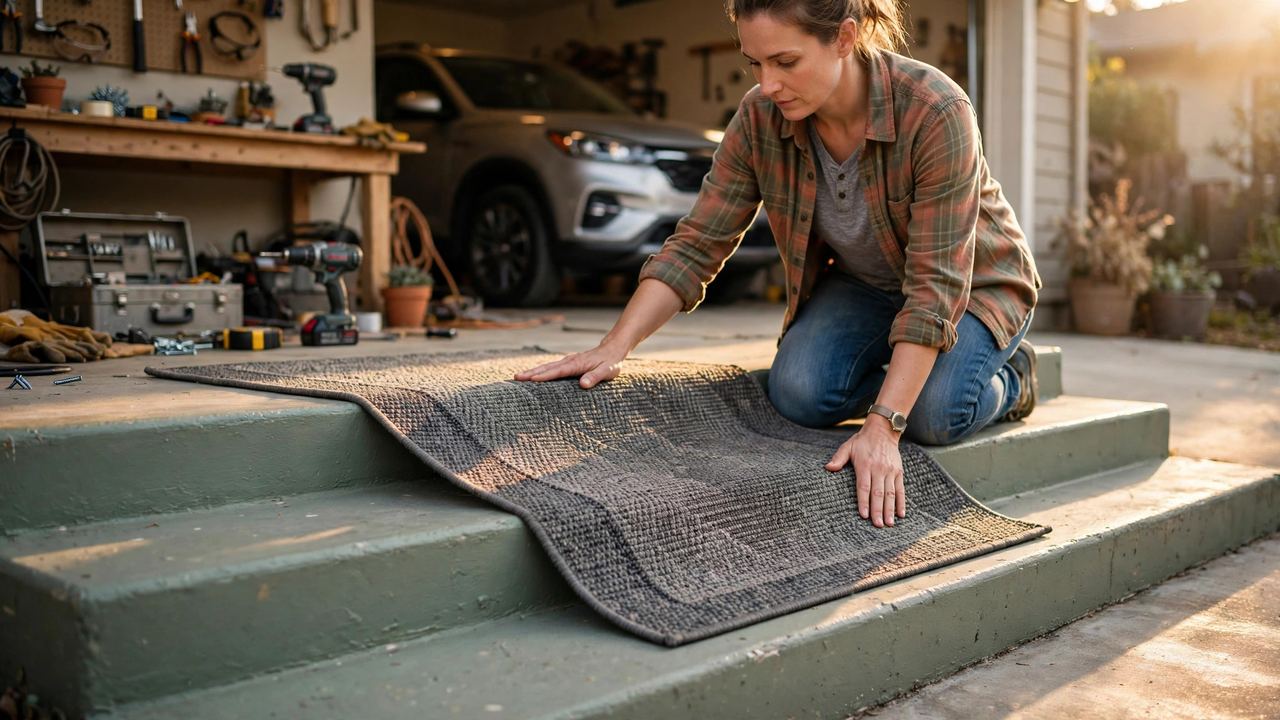
Painted garage steps look clean and finished, but paint changes the footing equation. A smooth painted tread gives shoe soles less to bite into than bare concrete or wood, and the problem gets worse when dust, tracked-in grit, or a little moisture sits on that glossy surface. The fix is a covering, but painted steps add a second question that plain concrete steps never raise: what will the covering do to the paint underneath? A loose mat can shift on a slick painted surface. A strong adhesive can pull paint up when it is removed. Screws and construction glue hold beautifully and mark the finish permanently. Choosing the best rugs or coverings for painted garage steps therefore means balancing three things at once: traction on top, stability in the middle, and respect for the painted finish below.
This guide compares six real coverings sold for stair use, spanning the main families a garage-step owner actually chooses between. There are heavy rubber mats that lay in place and can be lifted for cleaning, a wide rubber tread with a nosing that is glued down as a permanent installation, pre-cut grit strips that bond directly to the step, a glow-striped traction tread for dim garages, and a carpet-style tread set that adds a softer, quieter surface. Each pick was selected for painted-step relevance, and each section is frank about how its fixing method interacts with paint, because on painted steps the fixing method matters almost as much as the tread surface itself.
A note on expectations before the picks: no covering makes a step maintenance-free. Dust and grit still collect, edges still need checking, and any product that relies on weight alone deserves a second look on a smooth painted tread, where friction between mat and step is lower than on rough concrete. The safest painted-step setup pairs a grippy top surface with a fixing method you have chosen deliberately, knowing whether you want to preserve the paint job for years or treat the covering as a permanent part of the staircase.
Quick verdict
For most painted garage steps, start with the Spurtar Rubber Stair Treads. The maker lists a diamond-protuberance rubber surface, a practical 29.69 by 9.85 inch footprint, and included adhesive tape for the edges, which gives a painted step both grip and a way to stop the mat wandering without drilling or gluing. If you want the gentlest option for the paint itself, the Jorviz carpet treads need no adhesive at all and simply lay in place, trading some hold for easy lifting and washing. If the garage is dim and the steps are used after dark, the LifeGrip treads add a glow-in-the-dark stripe to an 80-grit traction surface. For a permanent, wide-coverage installation where the paint job is no longer the priority, the FINEHOUS nosing treads and the THUNDER GRIP rubber mats are the heavy-duty routes, while the MBIGM grip tape strips are the broad, low-profile peel-and-stick option for owners who want maximum coverage per pack.
The products in this guide
Spurtar Rubber Stair Treads 29.69 x 9.85 Inch 6-Pack
The Spurtar treads are the most straightforward answer to the painted-step problem because they attack both halves of it
Selection started with the surface problem. Painted garage steps are smooth, often slightly glossy, and usually made of concrete or wood under the paint. Every pick therefore had to be a covering the maker lists for stair use on hard surfaces such as wood, concrete, tile, metal, or stone, rather than a general floor rug that was never designed for a tread. Products that only suit carpeted stairs were left out, because a garage step is a hard, narrow, high-traffic surface and the covering has to behave accordingly.
The second filter was fixing diversity. Because the right fixing for painted steps depends on how much the owner values the paint, the list deliberately spans lay-in-place carpet treads, tape-assisted rubber mats, peel-and-stick grit strips, and permanent glue-or-screw installations. A guide that only recommended adhesive products would fail owners who repaint often, and a guide that only recommended loose mats would fail owners whose painted steps are so slick that loose mats creep. Each pick below states its fixing method plainly so the trade-off is visible before purchase.
The third filter was verification. Each product was checked on its opened Amazon listing, including the availability block: a pick only stayed on the list if the listing showed a live featured offer sold new. Listings that rendered as currently unavailable, or whose featured offer was not a new sale, were excluded and replaced. Specifications quoted in this article are phrased as the maker lists them, taken from the listing details and the maker’s own product descriptions, and no specification has been carried over from a different size or variant of the same product line.
Finally, pack size and dimensions were weighed against real garage staircases. Most garage entries have two to five steps, so packs in the five-to-fourteen-piece range cover a typical flight with spares left over for the landing edge or a future replacement. Width matters too: a tread that spans most of the step width leaves fewer exposed painted edges to catch a heel, which is why the wider rubber mats earned their places alongside the narrower, cheaper-to-cover grit strips.
The Spurtar treads are the most straightforward answer to the painted-step problem because they attack both halves of it. On top, the maker lists a surface covered in diamond protuberances, small raised diamonds that increase friction between shoe and mat in dry and wet conditions. Underneath, the set includes adhesive tape for the edges of each mat, which is the detail that matters most on paint: a loose rubber mat on a smooth painted tread can creep forward a fraction with every footfall until an edge overhangs the nosing, while taped edges pin the mat where you placed it. The maker lists the tape as the semi-permanent route and construction adhesive as the permanent one, so the owner chooses how committed the installation is.
The dimensions suit garage steps well. The maker lists each tread at 29.69 by 9.85 inches with a thickness of 0.12 inches, deep enough to cover most of the tread depth on a standard step while staying thin enough not to create a noticeable lip at the front edge. The maker lists the material as flexible rubber and describes the mats as sunscreen-resistant and waterproof, with resistance to high temperature and oxidation, which suits a garage that swings between summer heat and winter cold. The mats can also be cut to fit, so a narrower utility step does not force you to leave an overhang. Six pieces cover a typical garage flight with a spare.
On paint specifically, edge tape is a middle path. It holds far better than weight alone, and it is less invasive than construction glue, but any adhesive on a painted surface should be treated as a commitment: test the tape on an inconspicuous corner first, and expect that removing a long-bonded strip may lift tired paint. On sound, well-cured paint the tape route is the balanced choice, which is why this set leads the list. The part number the maker lists for this set is HFM000206.
Buy it if: you want real rubber grip plus a supplied way to stop the mats shifting on smooth paint, without drilling or gluing.
Skip it if: your paint is fresh, chalking, or peeling, because edge tape needs a sound surface to hold and may pull weak paint on removal.
The FINEHOUS treads are the wide-coverage, permanent-installation option. The maker lists this set, model name RST-Nosing, at 42 by 10 inches per tread with five pieces in the pack, a diamond weave surface, low pile, and a thickness of 0.22 inches. That width spans nearly the whole of a wide garage or basement step, and the nosing profile wraps the front edge of the step, which protects the painted nosing itself — the part of a painted step that chips first under heel strikes and dragged toolboxes. The maker lists the backing as rubber and the care as hand wash only, and describes the rubber as durable in both harsh winter conditions and hot summer temperatures.
The installation method defines this pick. The maker states the treads have to be installed with heavy-duty construction glue, which is not included, and lists compatibility across hardwood, wood, concrete, marble, tile, vinyl, metal, and laminate steps. Gluing produces the most secure result of any pick here: no creep, no lifted corners, no dependence on the friction between mat and paint. It also means the covering should be treated as part of the staircase from that day forward. Removing a glued rubber tread from a painted step will take the paint with it in most cases, so this is the right choice when the steps are being covered for the long term and the paint underneath is a base coat rather than a finish you intend to show again.
The maker also notes the treads can be cut to fit exact dimensions, which helps on steps narrower than the full width. Because the set is five pieces, measure the flight first: five wide treads cover five steps completely, and a garage with a landing may need the landing left painted or covered by a different product. For a permanent, tidy, edge-to-edge result on steps that see heavy daily traffic, this is the most finished-looking option in the guide.
Buy it if: you want the widest coverage and a glued-down, no-shift installation, and you accept that the paint underneath is committed.
Skip it if: you rent, repaint often, or want to lift the coverings for cleaning, because construction glue makes removal a refinishing job.
LifeGrip takes the opposite approach to a mat: instead of covering the step, it bonds a grit traction strip directly to it. The maker lists this 10-pack, part number SAND-TREAD-6X32X10P-GLOW, as 6 by 32 inch treads with a PET base and a silicon carbide traction surface, a thickness of 0.05 inches, and an 80-grit aluminum oxide pad in the maker’s description of the traction layer. The defining feature is the green glow-in-the-dark stripe: the maker lists the photoluminescent stripe as chargeable by natural or artificial light, so the edge of each step stays visible in a dark garage during an evening trip or a power cut, which is a genuine use case for steps between a house door and a garage.
Bonded strips have a particular advantage on painted steps: there is nothing to creep, kick, or curl, because the strip becomes part of the step surface. The maker lists a thick acrylic adhesive that forms a strong, waterproof bond to smooth surfaces including concrete, metal, plastic, wood, tile, stone, and laminate, and lists the PET base as withstanding temperatures from 14 degrees Fahrenheit to 140 degrees Fahrenheit without cracking or peeling. A painted step is a smooth surface, so it sits squarely in the intended application range, provided the paint itself is sound and fully cured — the strip bonds to the paint, and the paint bonds to the step, so the weakest of those two layers sets the strength of the whole installation.
The trade-offs are profile and removal. At 6 inches deep, a strip covers the front portion of the tread where feet actually land, but leaves the back of the step as bare paint, which some owners prefer visually and others find unfinished. The grit surface is also harder underfoot than rubber or carpet, and grit strips are not kind to bare feet or pet paws compared with the softer picks. Removal of a strongly bonded strip from paint should be expected to mark the finish. Choose LifeGrip when the bond and the visibility stripe are worth more than easy removal.
Buy it if: your garage steps are used in low light and you want a bonded, zero-shift traction strip with a visible step edge.
Skip it if: you walk the steps barefoot often, have pets using them daily, or need the paint to survive removal untouched.
The Jorviz set is the paint-friendliest pick in this guide. The maker lists these carpet-style treads at 32 by 8 inches in a set of 14, with a braided weave, low pile, a backing the maker lists as polyvinyl chloride and rubber, and a PVC fiber construction the maker describes as suitable for indoor and outdoor use. Installation needs no adhesive at all: the maker states the treads are simply placed on clean, dry stairs, with optional double-sided tape, not included, for owners who want extra security. Nothing bonds to the paint, nothing screws through it, and each tread lifts straight off when you want to clean underneath or repaint.
That gentleness shapes how the set should be used. A lay-in-place tread depends on the friction between its backing and the step, and painted steps are the smoothest common surface, so placement discipline matters: center each tread, check it after the first days of use, and add the optional tape at the front edge if a tread shows any tendency to travel. Used that way, the set brings benefits the rubber and grit picks do not. The carpet surface is quieter underfoot, softer for bare feet and pet paws, and the maker notes the treads muffle paw sounds and collect dirt and water at the step, which keeps tracked grit off the painted surface below. The maker lists the care as machine washable, and vacuuming handles day-to-day dust.
Fourteen pieces is the largest count in this guide, which suits a longer flight from a garage up into the house, or a short flight plus spares. The maker lists the water resistance level as not water resistant, so on steps that regularly get wet — an open garage doorway in the rain, for example — the rubber mats above are the better tool. For covered, mostly dry painted steps where preserving the finish and keeping the staircase quiet matter most, Jorviz is the natural first choice.
Buy it if: protecting the paint job is your top priority and you want a soft, quiet, lift-off tread you can wash.
Skip it if: your painted steps get wet regularly or a loose tread has shifted on them before, because this set relies on placement and backing friction.
THUNDER GRIP builds its rubber treads, part number THNDRF6-30X10, for steps that live outdoors in spirit even when they sit inside a garage: the maker lists the 30 by 10 inch mats, six to a pack, as suitable for rain, snow, and heat, and names wood, deck, garage, and concrete stairs as intended surfaces. That garage call-out is not decoration. Garage steps collect the worst mixture a tread meets — road grit, drips from a wet car, cold air every time the door opens — and a heavy rubber mat is the covering that shrugs that mixture off with a shake or a hose-down rather than a wash cycle.
The maker’s installation guidance is unusually direct and suits painted steps well because it is honest about fixing. The mats can be laid directly on clean, dry steps, but the maker instructs owners to secure every tread outdoors: screws on wood, exterior adhesive on concrete. On a painted wooden garage step, screws give a mechanical hold that no adhesive debate can match, at the cost of small holes through the paint at the fixing points. On painted concrete, exterior adhesive avoids drilling but bonds to the paint layer, so the same sound-paint rule applies as with the grit strips. Either way, a secured THUNDER GRIP mat is not going to skate on a glossy painted tread, which is the failure mode that rules out purely loose heavy mats for many painted-step owners.
The maker is equally plain about limits, noting the treads do not melt or prevent ice and advising a placement check after rain, snow, or severe weather. Treat that as part of the routine: any step covering in a working garage deserves a quick look after a storm or a spill. Within those limits, this is the pick for the garage whose steps function as exterior steps — open to weather, used in boots, and expected to grip the same in January as in July.
Buy it if: your garage steps behave like outdoor steps and you are willing to screw or bond the mats down for a hold that cannot creep on paint.
Skip it if: you want a no-tools, lift-off covering, because the maker’s own guidance is to secure these treads rather than leave them loose.
MBIGM’s grip tape strips, part number TREADS002-8X30-12-MFN, are the broad-coverage peel-and-stick option. The maker lists each pre-cut strip at 8 by 30 inches with 12 strips in the pack, an 80-grit aluminum oxide traction surface, and a weatherproof triple-layer glue the maker describes as resisting peeling through continuous use. Eight inches of depth covers more of the tread than the narrower grit strips in this category, so a foot lands on grit across most of its length rather than on a single band, and twelve strips cover a long flight or a short flight with replacements in reserve.
Installation is the simplest in the guide: the maker describes a clean, peel, and stick process with no cutting or tools, because the strips arrive pre-cut. For painted steps, preparation decides the result. The strip bonds to the paint, so the paint must be clean, dry, fully cured, and free of flaking; dust and garage grime should be washed off and allowed to dry completely before a strip goes down, and pressing the full length firmly, especially at the corners, keeps edges from lifting where heels catch them. The maker lists the strips as waterproof and suitable for indoor and outdoor use across surfaces including concrete, metal, plastic, tile, and laminate, which covers the painted concrete and painted wood found in most garages.
As with every bonded pick, removal is the compromise: a weatherproof glue layer that refuses to peel in service will also resist coming off later, and painted finishes often come away with a long-bonded strip. The low profile is the compensation — at tape thickness, these strips add grip without changing the step’s geometry, tripping a toe, or interfering with a door that swings close over the top step. For owners who want the whole flight covered in one afternoon with nothing to shift afterward, MBIGM is the efficient route.
Buy it if: you want wide grit coverage, the lowest profile, and a one-session peel-and-stick installation across the whole flight.
Skip it if: the paint is decorative and must survive removal, or the steps are rough and uneven, because grip tape bonds best to smooth, sound surfaces.
Buying guide
Decide how much the paint matters first. Every other choice follows from this one. If the painted finish is recent, decorative, or belongs to a rented property, stay with coverings that lay in place or use light edge tape, and accept the small discipline of checking tread position. If the paint is a functional base coat on steps that will stay covered for years, bonded and glued options give the most secure result and the paint question becomes irrelevant. Being honest about this at the start prevents the classic mistake of gluing down a permanent tread and then being surprised at repaint time.
Match the fixing to the paint’s condition. Adhesives of every kind — edge tape, acrylic bonds, triple-layer glue, construction glue — hold to the paint film, not to the step beneath it. Paint that is chalking, flaking, blistering, or only days old will fail under any of them, taking the covering’s grip with it. Before bonding anything, wash the steps, let them dry fully, and press a strip of ordinary tape firmly onto an inconspicuous tread, then pull it off: if paint comes with it, fix the paint before fixing a covering. Fresh paint should be fully cured, not merely dry to the touch, before a bonded product goes down.
Measure depth, width, and the nosing. Tread depth decides whether a covering leaves bare paint at the back of the step; tread width decides how much painted edge stays exposed at the sides. The picks here range from 6-inch grit strips that cover the landing zone to 10-inch mats that cover nearly the whole tread, and widths from 29.69 inches to a full 42 inches. Note the nosing shape as well: a squared painted edge accepts flat mats and strips cleanly, while a rounded or bullnose edge favors a tread with a formed nosing, like the FINEHOUS set, or a flexible strip that can sit flat just behind the curve. A covering that bridges a curve without touching it will rock, and a rocking covering is worse than none.
Think about water, grit, and cleaning. Garage steps collect abrasive grit that grinds paint under any loose covering, so lift lay-in treads regularly and sweep beneath them; trapped grit is a quiet way to sand a painted finish. Rubber mats hose off and dry fast. Carpet-style treads trap dirt in the pile, which protects the paint from that grit but needs vacuuming and occasional washing. Grit strips cannot be lifted for cleaning, so they suit steps where a brush-down is enough. If the steps regularly get wet, favor waterproof rubber or bonded grit over a carpet tread the maker does not list as water resistant.
Plan the count and the spares. Count every step, including the top landing edge if feet land there, then compare with pack sizes: the sets here run from five to fourteen pieces. A pack that covers the flight with two or three spares is worth more than an exact-fit pack, because the bottom step — the one that takes road grit and weather first — wears fastest and is the one you will want to replace without buying a whole new set.
Keep edges and corners under review. Whatever you choose, the first month tells you whether the fixing suits your paint. A corner that lifts on a bonded strip, a mat that has crept a quarter inch, a carpet tread that travels — each is a small warning to correct early by re-pressing, adding edge tape, or moving to a stronger fixing on that step. A covering that is checked monthly stays a safety feature; one that is ignored can become the hazard it was bought to prevent.
FAQ
Will adhesive stair treads pull the paint off my garage steps?
They can, especially on removal. A bonded strip grips the paint film, so if the paint is old, poorly adhered, or not fully cured, the strip may lift it when peeled up. On sound, well-cured paint, strips usually hold for their service life and the risk concentrates at removal time. Test on a hidden corner first, and choose lay-in-place treads if the finish must stay perfect.
Are loose rubber mats safe on painted steps?
They can be, but paint is smoother than bare concrete or wood, so a loose mat has less friction holding it in place. Heavy rubber mats with textured undersides perform best, and the safer approach on paint is a mat with a fixing option — edge tape, screws on wood, or exterior adhesive on concrete — used exactly as the maker directs. Check position regularly either way.
What is the best covering for painted steps that get wet?
Waterproof rubber mats and bonded grit strips handle wet conditions best. The Spurtar and THUNDER GRIP rubber treads are listed by their makers as waterproof or weather-suitable, and the LifeGrip and MBIGM grit strips use waterproof adhesives. Carpet-style treads are better kept to covered, mostly dry steps unless the maker lists water resistance.
How do I prepare painted steps before installing a covering?
Sweep and wash the steps to remove dust, grit, and grease, then let them dry completely. Confirm the paint is fully cured and firmly bonded — a firm tape press-and-pull on a corner is a quick check. Measure each tread, mark the covering’s position before committing any adhesive, and round or trim coverings to sit flat without overhanging the nosing.
Can I cut these coverings to fit narrower steps?
Several makers say yes: the Spurtar rubber treads and the FINEHOUS nosing treads are both listed as cuttable to fit. Grit strips are pre-cut and are better bought in the right size than trimmed, and carpet treads should be chosen by size where possible. Always cut before removing any adhesive backing, and keep cut edges away from the front of the step where heels land.
How often should step coverings be replaced?
Replace a covering when its top surface has worn smooth, when edges lift and will not re-bond, when a mat has cracked or curled, or when a carpet tread’s backing no longer grips. The bottom step usually wears first. Keeping spare pieces from the original pack makes that first replacement a five-minute job instead of a new purchase decision.
Conclusion
Painted garage steps ask for a covering that grips on top, stays put in the middle, and treats the paint underneath with the level of respect you choose in advance. The Spurtar rubber treads are the balanced default, pairing a diamond-textured rubber surface with included edge tape. Jorviz is the gentle option that never touches the paint with adhesive at all. LifeGrip and MBIGM bond grit directly to the step for zero-shift traction, with LifeGrip adding a glow stripe for dark garages. FINEHOUS and THUNDER GRIP are the committed installations — glued wide coverage with a protective nosing, and weather-ready rubber secured by screws or exterior adhesive. Measure the flight, test the paint, pick the fixing you can live with at repaint time, and any of the six will turn a slick painted staircase into a set of steps you stop thinking about, which is exactly what good steps should be.
M
Modern Line Home Editorial Team
We compare specs, materials and verified owner reviews before a product earns a spot. Rankings are never paid.
Affiliate disclosure. As an Amazon Associate we earn from qualifying purchases at no extra cost to you. Prices accurate as of the date shown.
House cold even with the heat on? Walk this ordered checklist: thermostat and filter first, then drafts, insulation, leaky ducts and a failing heating system.
Windows fogging up in winter? Check where the fog sits: on the room side it is indoor humidity, outside it is harmless, and between panes the seal has failed.
Store the main firewood pile about 30 feet from your house, off the ground and covered only on top. Compare racks, woodsheds, garages and indoor spots safely.
Place a portable generator outdoors only, at least 20 feet from windows, doors and vents, exhaust pointed away. Exact distances, setup steps and CO rules here.
Keep houseplants in the right winter spot: match window direction to plant type, stay clear of radiators and cold glass, and fix dry air and low light at home.
Mice enter through pencil-width gaps at foundations, pipes, vents, doors and the roofline. Walk this room-by-room winter checklist to find and seal each one.
A winter outage timeline: what to do in the first hour, first night and multi-day outage, with food safety times, pipe protection, heat and CO safety steps.
Size a space heater by room area: 10 watts per square foot at 8-foot ceilings, adjusted for insulation and ceiling height, with full wattage and BTU tables.
Start dripping at about 20 degrees, sooner for exposed pipes. Set a pencil-lead stream, drip the right faucets on both lines, and know when to stop safely.
A fridge needs 800-1,200 starting watts, not just 150-400 running watts. Use the tables to total your fridge plus freezer, lights, furnace fan and more today.











Write Your Review
No reviews yet. Be the first to share your experience!