We independently review everything we recommend. When you buy through our links, we may earn a commission. As an Amazon Associate we earn from qualifying purchases.
Best Rugs for a Gym Floor: Top 6 Large Mats and Rolls
Compare the best rugs for a gym floor, from large exercise mats to heavy rubber rolls, with the sizes, thicknesses and materials the makers list for each pick.
Compare the best rugs for a gym floor, from large exercise mats to heavy rubber rolls, with the sizes, thicknesses and materials the makers list for each pick.
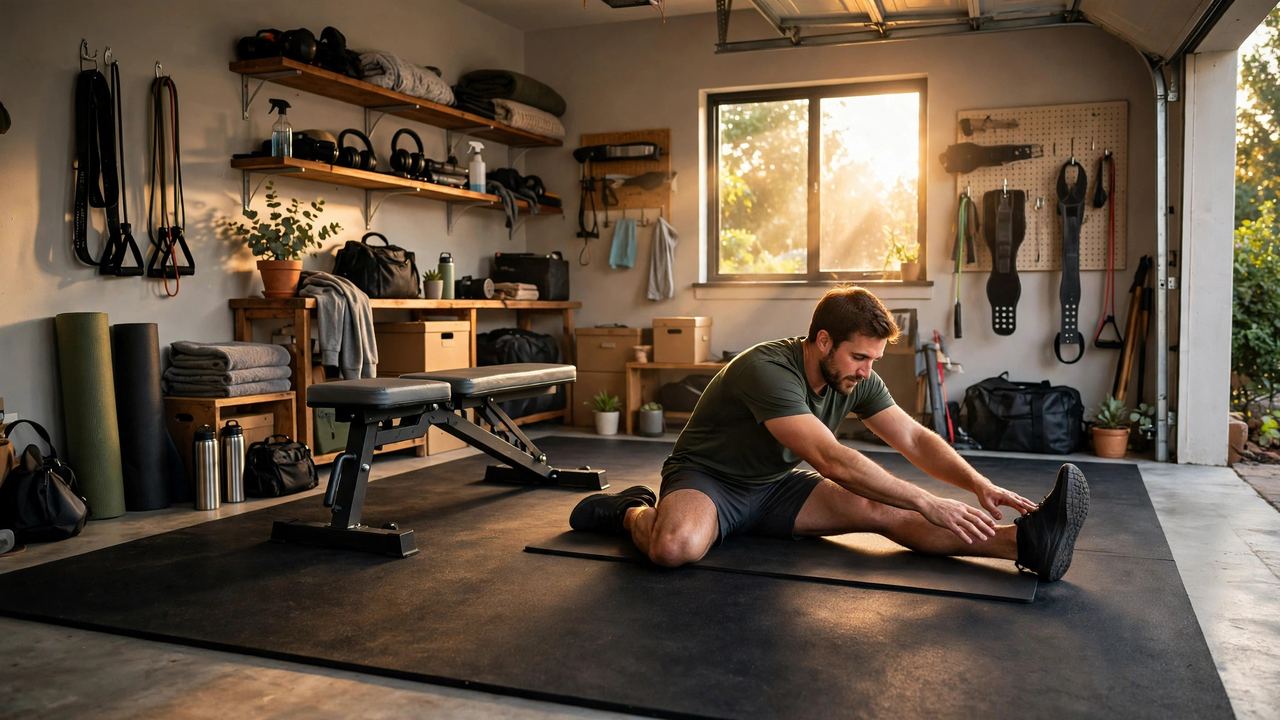
A gym floor takes a beating from two directions at once. From above, there are dropped dumbbells, dragging benches, treadmill feet and the scuff of training shoes. From below, there is the floor itself — concrete that sweats in summer, hardwood that dents, tile that cracks at the grout line. The layer you put between them decides how much of that punishment the room absorbs and how much your equipment absorbs. That is why shoppers looking for the best rugs for a gym floor are really shopping for a protective surface: something rug-like in the way it rolls out, covers a wide area and softens the room, but built from mat and flooring materials that can survive real training.
This guide covers six products that fit that brief in different ways. Two are large exercise mats that roll out like rugs over an existing floor. Two are thick roll-out training mats that turn a garage or basement into a grappling and conditioning space. Two are genuine rubber flooring rolls, the closest thing to a permanent gym rug, sold in long lengths you trim to fit. Every product below was checked on its opened listing page, and every specification is phrased the way the maker lists it, so you can compare sizes, thicknesses and materials without guesswork.
Quick verdict
For most home gyms, start with the Gorilla Mats Large Exercise Mat in the 7 by 5 foot size. It is the most rug-like option here: it unrolls flat, works with or without shoes, and rolls back up with straps when the room needs to be a room again. If your priority is protecting the floor under heavy equipment rather than cushioning your own workouts, the Traxxon by FlooringInc rubber roll is the better foundation, because the maker lists it as a recycled rubber roll that lays flat under treadmills and benches. For wrestling, martial arts and high-impact floor work, the two 10 by 10 foot roll-out mats from Dollamur and Meister provide the thick foam surface that thin mats cannot. And if you are covering a whole room or a long garage bay, the American Floor Mats and Rubber-Cal rolls give you continuous rubber coverage in lengths a single mat cannot match.
The products in this guide
Gorilla Mats Large Exercise Mat 7 x 5 ft
This variant at 7 feet long by 5 feet wide and 6mm thick — the quarter-inch class — in Gorilla Black, with a part number of GM100-75BLK
We started from the way people actually use the phrase gym rug: a wide, flat, roll-out covering that protects the floor beneath a workout area. That ruled out small single-person yoga mats and ruled in three families of products — large exercise mats, roll-out training mats and rubber flooring rolls. Each candidate had to be sold new on Amazon US, had to come in a size large enough to define a workout zone rather than a single stance, and had to have its key specifications published by the maker or on its listing page: dimensions, thickness, material and model or part number.
We verified each finalist on its opened product page, including the size and color variant described in this article, because large mats are sold in families of sizes that look identical in search results. Where a listing’s variation map tied a specific size and color to a specific listing, we described exactly that variant. Products we could not verify that way were excluded, even when they looked like a good fit on paper. We also favored variety: a home gym used for barefoot mobility work needs something different from a garage used for deadlifts, so the six picks span thin shoe-friendly mats, thick foam training surfaces and dense rubber rolls rather than repeating one design six times.
A note on language: throughout this guide, specifications are introduced with the phrase the maker lists. That is deliberate. Thickness claims, material names and coverage figures come from the makers’ own published information for the exact variant named, and where two fields on a page differ slightly — a nominal thickness in a product name versus a rounded figure in a dimensions field — we describe the nominal figure the maker puts in the product’s name.
The Gorilla Mats exercise mat is the pick that behaves most like a rug. The maker lists this variant at 7 feet long by 5 feet wide and 6mm thick — the quarter-inch class — in Gorilla Black, with a part number of GM100-75BLK. The maker lists the material as its Ultra Durable ProFoam and describes the mat as suitable for use with or without shoes, which is the single most important distinction in this category: many large mats are barefoot-only surfaces that training shoes would chew up, while this one is built for shoe-on cardio, lifting and jump rope work as well as stretching and yoga.
The construction details the maker lists are practical ones. The top layer is non-slip, the patterned bottom is designed to grip the floor so the mat stays put, and the maker lists it as working on carpet, hardwood, concrete and tile. It ships with a microfiber towel, a carry bag and two storage straps, so rolling it up and standing it in a corner is part of the design rather than an afterthought. At the weight the maker lists for this size, one person can move it without help, which matters in a spare room that doubles as a guest room.
As a gym floor rug, its strengths are coverage and convenience. Seven by five feet is enough for a full workout footprint — a bench plus floor work, or a cardio station with room to move laterally — and two mats can be laid side by side to build a larger surface. Its limit is impact: a quarter-inch of foam is a protective and comfort layer, not a drop pad, so repeated heavy dumbbell drops belong on rubber instead.
Buy it if: you want one roll-out surface for mixed home workouts, with or without shoes, that stores away in minutes.
Skip it if: your training centers on heavy barbell work or dropped weights, where a dense rubber roll protects the floor better.
The Traxxon roll is where this guide crosses from mats into flooring. The maker lists this variant as a 4 foot by 10 foot roll covering 40 square feet at 3/8 inch thick, in black, under model number 38rolls410. The maker lists the material as recycled black rubber bonded with EPDM fleck, made in the USA, with a textured surface for wet or dry traction and a moisture-resistant finish that wipes clean. At the per-square-foot weight the maker lists, the roll lays flat on concrete and stays where you put it.
That density is the point. The maker lists this roll for use under treadmills, weight benches and heavy equipment, and as a deadlift mat or jump rope station, because rubber absorbs scuffs, vibration and noise in a way foam cannot. A single 4 by 10 foot piece covers a lifting platform zone or a full equipment row with no interlocking seams or gaps, and the maker lists pre-cut sizes from 3 to 50 feet long, all 4 feet wide, if your room needs a different footprint.
Installation is part of the appeal. The maker lists the roll as trimmable with a utility knife and installable loose-laid, with double-sided tape, or with adhesive, on concrete, carpet or gravel. It also rolls back up for storage, so a garage gym can still park a car. The trade-off is comfort underfoot: 3/8 inch of dense rubber is firm, so floor stretches and mobility work feel harder here than on a foam mat.
Buy it if: your first job is protecting the floor under heavy equipment, a rack or a treadmill, with a seamless rubber surface.
Skip it if: you mostly train barefoot on the floor itself and want cushioning under knees, elbows and hips.
Dollamur builds mats for competition venues, and the Flexi-Connect is its home version of that surface. The maker lists this variant at 10 feet by 10 feet in black, under part number 114CBLKA10X10FC, with a nominal thickness of 1.25 inches in the product name. The maker lists a vinyl surface over sports foam — the same construction approach as its competition mats — and describes the surface as water-resistant, so sweat and spilled water wipe off instead of soaking in.
The Flexi-Connect name refers to how the sections join. The listing describes the mat as arriving in sections that connect into a single 10 by 10 foot training surface, which solves the oldest problem with big roll-out mats: seams that separate mid-session and edges that catch a foot. Rolled out in a garage, driveway, deck or dedicated training room, it gives wrestlers and grapplers a practice area that behaves like one continuous mat rather than two halves.
Thickness is this mat’s defining advantage over everything else in the guide except the Meister. At the 1.25-inch class, the foam is built for takedowns, throws and repeated falls — work that would bottom out a quarter-inch exercise mat instantly. The flip side is specialization: this is a training surface for mat sports and floor work, not a foundation for a squat rack, and its size demands a room or garage bay that can give it a permanent or semi-permanent home.
Buy it if: you practice wrestling, grappling or martial arts at home and need a thick, connected, competition-style surface.
Skip it if: you need flooring under heavy gym equipment, or a mat you can roll up and closet away daily in a small room.
The Meister FlexFloor is the other 10 by 10 foot roll-out in this guide, listed here in the gray variant under model number 1182WM10CG. The maker lists a triple-layer construction: a textured vinyl surface — listed at 50 mil — over a premium cross-linked foam base 1.25 inches thick. The maker lists the vinyl as providing grip for both bare feet and shoes without feeling abrasive during grappling, which is the balance a multi-sport training room needs.
The design detail that sets it apart is the two-section roll-out format. The maker lists the mat as shipping in two mirrored halves, each 5 feet wide by 10 feet long, joined by an overlapping hook and loop connector flap 2 inches wide that is topped with foam and vinyl, so the finished 100 square foot surface is nearly seamless. Because the halves mirror each other, the maker lists the mat as rolling out or storing away in seconds without separating the sections — a genuine advantage over mats that must be taped or re-joined every session.
Meister stamps this mat with an 8 foot diameter circle and center starting lines for wrestling and grappling, and lists it for boxing, MMA and general training as well. It is also listed in other colors on the same listing family, but the gray variant described here is the one tied to this listing. Like the Dollamur, it is a training surface rather than equipment flooring, and its foam construction is meant for bodies in motion, not for a loaded barbell’s resting place.
Buy it if: you want a full 100 square foot grappling and conditioning surface that sets up and stores faster than a taped-together mat.
Skip it if: your space is smaller than 10 by 10 feet, or your workouts are mainly machine and rack based.
American Floor Mats sells rubber the way carpet is sold: by the roll, in lengths that cover a room rather than a workout spot. The maker lists this variant as a solid black roll 4 feet wide by 50 feet long at 1/4 inch (7mm) thick, under part number AFM_GEVRM_0.25_4_x_50_Solid_Black. The maker lists the material as 100% rubber, USA sourced, and the same listing family spans sizes from 4 by 6 feet up to this 4 by 50 foot roll, so the format scales from a single equipment mat to a full floor.
A 50 foot roll is a commitment, and that is exactly its use case. If you are flooring a long garage, a basement gym that runs the length of the house, or a small commercial space, one continuous roll means long seamless runs with cuts only at walls and corners. The maker lists these rolls as protective exercise mats and home gym rubber flooring, and the 1/4 inch thickness keeps the profile low at doorways while still putting dense rubber between equipment and the slab.
Working with a roll this size is a two-person job, and trimming is part of the installation rather than an exception. The reward is the most finished result in this guide: wall-to-wall rubber that reads as a gym floor, not as equipment sitting on a floor. Choose a shorter length from the same family if your room is modest — the material and thickness the maker lists are the same proposition at a smaller scale.
Buy it if: you are covering a whole room or a long run and want continuous rubber flooring instead of individual mats.
Skip it if: you only need one workout zone covered, where a pre-cut roll or large mat is simpler to handle and store.
Rubber-Cal’s Elephant Bark is the veteran of this list — a recycled rubber flooring line the maker has sold for years in a wide range of lengths. The maker lists this variant at 3/16 inch thick, 4 feet wide and 15 feet long, in black, under model number 03-100-WEB-AB-15. The maker lists the material as recycled rubber and describes the line as a green flooring option, with the textured bark-style surface that gives the range its name.
At 3/16 inch, this is the thinnest covering in the guide, and its role is different from the foam mats: it is a protective skin for the floor. The maker lists Elephant Bark for home and commercial gyms as an exercise floor that provides impact protection and vibration reduction, and also lists it for garages, decks, cellars and concrete basement floors. The maker lists it as offering UV and water resistance, which extends its use to covered outdoor and utility spaces where a foam mat would degrade.
Installation is the other selling point. The maker lists this flooring as an easy DIY install without messy adhesive or professional installers, so a 4 by 15 foot run can go down as a loose-laid runner under a row of equipment or along a garage wall. It will not cushion a fall or a dropped kettlebell the way thicker rubber or foam does, so pair it with a thicker mat at a lifting station if your training demands one.
Buy it if: you want a long, low-profile rubber runner that protects concrete or garage floors and handles moisture and sunlight.
Skip it if: you need real impact absorption for dropped weights or a cushioned surface for floor exercises.
Buying guide
Decide what the rug has to protect
Every choice in this category starts with a direction of protection. If the rug protects you — your knees during floor work, your body during takedowns, your feet during cardio — you want a mat, and thickness in foam is what you are buying. If the rug protects the floor — from treadmill feet, bench legs, deadlift impacts and dragged equipment — you want rubber, and density is what you are buying. Many home gyms honestly need both: a rubber foundation under the equipment zone and a mat on top of the open floor. Buying one product to do both jobs usually means it does the second job poorly.
Match thickness to the work
The makers in this guide list thicknesses from 3/16 inch to 1.25 inches, and that range maps to use. Thin rubber rolls, around 3/16 to 1/4 inch, are floor protection and vibration control; they are not landing pads. The 3/8 inch class of rubber roll is the heavy-duty floor standard for lifting areas and equipment rows. Quarter-inch foam exercise mats cushion bodyweight work and light equipment but compress under heavy loads. The 1.25 inch foam training mats exist for impact from bodies, full stop — they are the wrong choice under a rack, where that same softness makes equipment feel unstable.
Measure the room, then the workout
Measure twice: first the room, then the footprint of what you actually do. A 7 by 5 foot mat suits a single training station. A 4 by 10 foot roll suits a lifting platform or an equipment row. A 10 by 10 foot mat needs a room or garage bay that can hold it with clearance to move. Long rolls reward careful measuring most of all, because a 4 foot wide roll covers a room in parallel runs, and the run count decides how much you order. Leave allowance for trimming at walls, posts and door swings, and remember that roll goods are easiest to cut slightly long and trim in place.
Material and surface
Recycled rubber is the durable, moisture-tolerant, slightly industrial option; the makers here list it with textured surfaces for traction and wipe-clean care. Vinyl-over-foam surfaces are smoother, sealed against sweat, and made for skin contact during grappling and floor work. Shoe-friendly foam mats sit between the two: softer than rubber, tougher than a barefoot yoga surface. Check the maker’s own description for shoe use before training in shoes on any foam mat, because that single detail separates mats that last from mats that shred.
Seams, storage and setup
How a covering handles its edges decides how it lives day to day. Single-piece mats and rolls have no seams to separate. Sectioned training mats rely on their connection systems — the hook and loop and Flexi-Connect designs listed above — to behave as one surface. If the gym shares space with the rest of the house, weigh storage honestly: strap-and-roll mats disappear into a corner, rubber rolls can be rolled but are heavy, and a 50 foot flooring roll is effectively permanent once cut and laid.
Care and the room around it
The makers here list simple care — wipe with a damp cloth or mop for the rubber rolls, wipe-clean surfaces on the mats — but the room matters too. Rubber has a smell when new that fades with ventilation and time, so plan to air out a garage install. Foam training mats prefer indoor storage away from sharp objects and direct heat. On hardwood or laminate, any of these coverings protects against scuffs, but check periodically underneath in humid rooms, because a sealed floor covering can trap moisture against the finish below it.
FAQ
Can a gym rug replace real gym flooring?
For a home gym, often yes. A large exercise mat or a rubber roll covers the working area where damage and noise actually happen, without the cost and permanence of flooring the whole room. Full flooring makes more sense when equipment covers most of the room or when the space is dedicated to training full time, which is where the long rolls in this guide come in.
How thick should a rug under a treadmill or rack be?
Look at the rubber options first. The makers here list 3/8 inch recycled rubber rolls for use under treadmills and benches, and 1/4 inch rolls as protective gym flooring. Foam exercise mats compress under machine feet and can make equipment rock, so they are better in the open workout area than under the machines themselves.
Will these mats work on carpet, hardwood and concrete?
The Gorilla Mats listing specifically lists carpet, hardwood, concrete and tile as suitable surfaces, and the rubber rolls are listed for concrete and carpet installations. On any surface, start with a clean, dry floor, let a new mat unroll and relax flat, and check that doors still clear the added thickness — a 1.25 inch training mat changes a room’s clearances more than a 1/4 inch roll does.
Can I drop weights on a gym rug?
It depends on the material and the weight. Dense rubber rolls are the category built for lifting zones, and the Traxxon maker lists its roll for deadlift use. Foam mats, even thick ones, are training surfaces for bodies rather than drop zones for barbells, and repeated drops will damage both the mat and, eventually, the floor under it. Serious deadlift training still belongs on a platform with rubber at the drop points.
How do I stop a large mat from sliding or curling?
Weight and surface texture do most of the work: the rubber rolls here are heavy per square foot and are listed as laying flat without curling, and the Gorilla Mats design uses a patterned bottom to grip the floor. For lighter mats on smooth concrete, double-sided flooring tape at the corners — a method the Traxxon maker lists among its install options — is the standard fix.
What size should I buy for a one-person home gym?
Start with the footprint of your longest movement plus your equipment. A 7 by 5 foot mat covers most single-station routines, floor work and a bench. If a rack or treadmill joins the room, a 4 by 10 foot rubber roll under the equipment plus the mat in the open area is the combination most home gyms end up with.
Conclusion
The best rugs for a gym floor are not really rugs at all — they are mats and rubber rolls that borrow the rug’s best qualities: wide coverage, a softened room and a surface you can roll out and put away. Match the product to the direction of protection and the work you do. Choose the Gorilla Mats exercise mat for an all-round, shoe-friendly home gym surface; the Traxxon roll for dense rubber protection under equipment; the Dollamur or Meister 10 by 10 foot mats for wrestling and martial arts training; and the American Floor Mats or Rubber-Cal rolls when the job is covering a whole floor or a long run. Measure your room, check the thickness and material the maker lists for the exact size you are ordering, and the layer between your training and your floor will do its job quietly for years.
M
Modern Line Home Editorial Team
We compare specs, materials and verified owner reviews before a product earns a spot. Rankings are never paid.
Affiliate disclosure. As an Amazon Associate we earn from qualifying purchases at no extra cost to you. Prices accurate as of the date shown.
House cold even with the heat on? Walk this ordered checklist: thermostat and filter first, then drafts, insulation, leaky ducts and a failing heating system.
Windows fogging up in winter? Check where the fog sits: on the room side it is indoor humidity, outside it is harmless, and between panes the seal has failed.
Store the main firewood pile about 30 feet from your house, off the ground and covered only on top. Compare racks, woodsheds, garages and indoor spots safely.
Place a portable generator outdoors only, at least 20 feet from windows, doors and vents, exhaust pointed away. Exact distances, setup steps and CO rules here.
Keep houseplants in the right winter spot: match window direction to plant type, stay clear of radiators and cold glass, and fix dry air and low light at home.
Mice enter through pencil-width gaps at foundations, pipes, vents, doors and the roofline. Walk this room-by-room winter checklist to find and seal each one.
A winter outage timeline: what to do in the first hour, first night and multi-day outage, with food safety times, pipe protection, heat and CO safety steps.
Size a space heater by room area: 10 watts per square foot at 8-foot ceilings, adjusted for insulation and ceiling height, with full wattage and BTU tables.
Start dripping at about 20 degrees, sooner for exposed pipes. Set a pencil-lead stream, drip the right faucets on both lines, and know when to stop safely.
A fridge needs 800-1,200 starting watts, not just 150-400 running watts. Use the tables to total your fridge plus freezer, lights, furnace fan and more today.












Write Your Review
No reviews yet. Be the first to share your experience!