We independently review everything we recommend. When you buy through our links, we may earn a commission. As an Amazon Associate we earn from qualifying purchases.
Best Pillows for a 20 x 26 Sham: Six Inserts That Fit
Find the best pillows for a 20 x 26 sham: six verified 20 x 26 inserts and bed pillows compared by fill, cover fabric, pack size and care, plus a sizing guide.
Find the best pillows for a 20 x 26 sham: six verified 20 x 26 inserts and bed pillows compared by fill, cover fabric, pack size and care, plus a sizing guide.
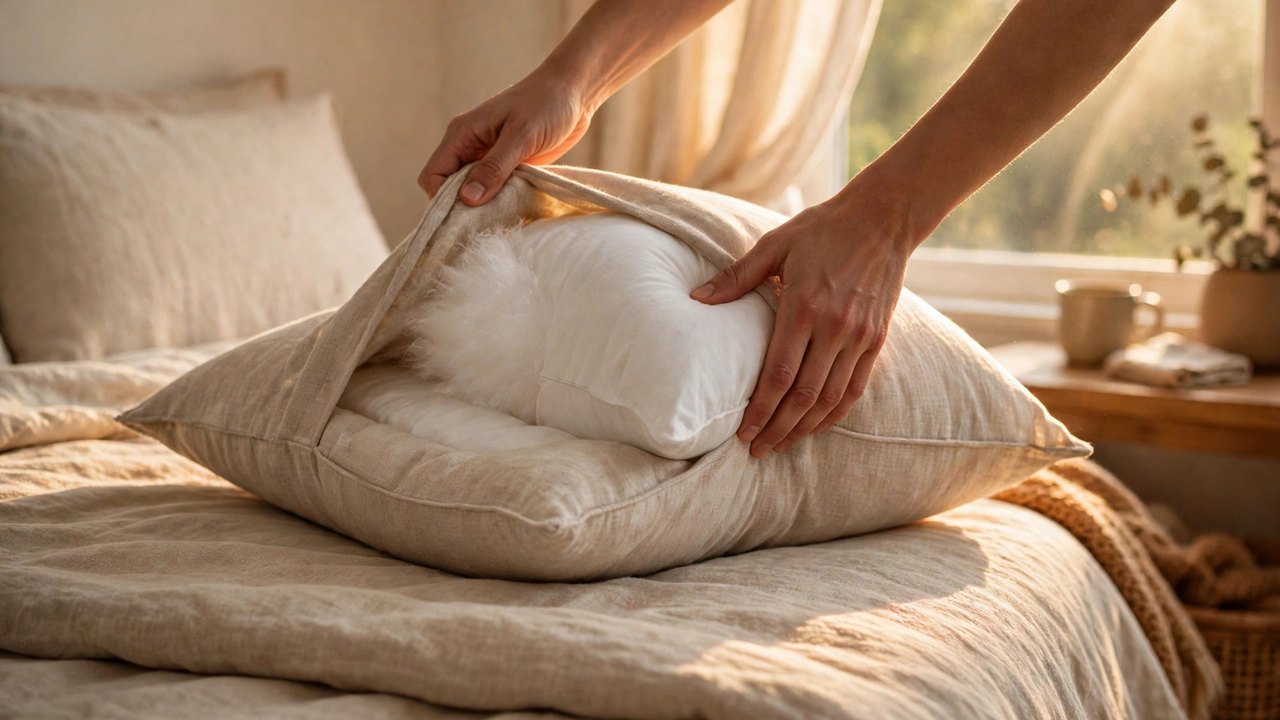
A 20 x 26 inch sham is the standard sham size on most bedding sets, and it looks its best when the pillow inside fills it corner to corner without straining the seams. The trouble is that “standard size” means slightly different things across brands: some inserts are cut exactly 20 x 26, some makers size their forms around the sham’s corner-to-corner measurement rather than the label, and some standard pillows sold for sleeping double as sham stuffers with a very different feel. This guide rounds up the best pillows for 20 x 26 sham use — six real inserts and sham-ready bed pillows, each checked on its maker’s listing — and explains how to choose between an exact-fit insert, a sleeping pillow that moonlights as a stuffer, and the different fills on offer.
Every pick below is listed by its maker in a 20 x 26 inch size (or a standard size the maker defines as 20 x 26), so you are not guessing whether a “standard” pillow will actually match your sham. Where a maker gives specific sizing guidance for shams, we pass it on, because an insert that is right on paper can still leave a sham looking limp if the fill is sparse, and an overstuffed one can bow the edges of a lightweight sham fabric.
Quick verdict
For most people dressing a pair of standard shams, the Utopia Bedding Pillow Inserts 20 x 26 (Pack of 2) are the straightforward choice: a matched pair of inserts in the exact size, with a virgin fiber fill the maker describes as high-rebound and a brushed fabric cover. If your shams measure a touch under the label size — many do once seam allowances are counted — the Pillowflex Premium Polyester Pillow Insert 20 x 26 is the specialist pick, because the maker publishes explicit guidance on matching this insert to shams in the 19 x 25 to 20 x 26 range for a plump finish. Shoppers who prefer a natural-fiber shell should look at the Artscope Synthetic Down Pillow Insert 20 x 26, the only pick here with a 100 percent cotton cover. And if the pillows inside your shams also need to work as sleeping pillows, the Seward Park Bed Pillow Standard Size Set of 2 is built and marketed for both jobs at once.
The products in this guide
Utopia Bedding Pillow Inserts 20 x 26 (Pack of 2)
Shams almost always come in pairs, so an insert sold as a matched pair in the exact 20 x 26 size removes the most common annoyance in this category
We started from the sham itself. A standard sham is sold as 20 x 26 inches, so every product in this guide had to be offered by its maker in that exact size, confirmed on the product’s own listing page rather than inferred from a size chart for a different model. Products that only came in nearby sizes, or where the 20 x 26 variant could not be pinned down, were left out entirely.
Within that size, we looked for a spread of constructions, because the right fill depends on the sham and the bed. We included high-rebound polyester fiber inserts for a crisp, structured look, a siliconized fiber insert from a maker that specializes in pillow forms, a down alternative insert in a cotton shell for people who dislike synthetic covers, a deliberately soft and fluffy insert for relaxed, casual shams, and one true bed pillow set whose maker explicitly positions it as a sham insert as well. Pack configuration mattered too: shams usually come in pairs, so we noted which picks are sold as pairs and which are singles you would need to order twice.
Finally, we recorded only specifications the maker lists — fill material, cover fabric, pack count, care directions and any sizing guidance — and we have flagged the care differences, because they vary more than shoppers expect: some of these inserts are machine washable and others are spot clean only, which matters for a decorative sham that gets handled daily.
Shams almost always come in pairs, so an insert sold as a matched pair in the exact 20 x 26 size removes the most common annoyance in this category: ordering two singles and ending up with inserts that loft slightly differently. The maker lists these inserts with a 100 percent virgin fiber fill and describes the fill as high-rebound, meaning it is designed to spring back into shape after being leaned on or compressed rather than staying flattened. The cover is a 115 GSM brushed fabric, which gives the insert a soft, matte surface that slides into a sham without catching on seams or embroidery.
The maker positions these as 2-in-1 inserts: decorative forms for shams on the bed, but also usable as back support pillows on a sofa, in a reading chair or at a desk. That dual role suits the way standard shams actually live in most homes — propped at the head of the bed during the day and leaned against in the evening. The inserts ship compressed; the maker instructs you to unpack them, shake and pat them, and press them from all sides to fluff them back up before dressing them in the shams.
Care is the one compromise. Where several picks in this guide can go in the washing machine, the maker recommends spot cleaning these inserts for a longer life and better performance. If your shams sit on a bed that sees pets, kids or breakfast trays, weigh that against the convenience of the matched pair. For a guest room or a primary bed where the shams are mostly decorative, the pair format, the exact sizing and the resilient fill make this the easiest recommendation in the roundup.
Buy it if: you are filling two standard shams at once and want a matched pair of exact-size inserts with a springy, shape-holding fill.
Skip it if: you need inserts you can machine wash regularly — the maker recommends spot cleaning only — or you are filling a single sham and do not want a spare.
Pillowflex is a pillow-form specialist, and this is the one pick in the guide whose maker publishes sham-specific sizing advice: measure your sham from corner to corner rather than trusting the size marked on it, and note that the maker lists this 20 x 26 insert as suitable for shams measuring 20 x 24, 20 x 25, 20 x 26 and 19 x 25 inches to achieve a plump, finished look. That guidance matters because a sham’s sewn size is often a half inch or more smaller than its label once seam allowances are taken in, and an insert chosen strictly by the label can leave the corners empty. If your shams have always looked slightly underfilled, this is the insert designed around that problem.
The maker lists the fill as a soft, full 7D virgin fiber treated with silicon to prevent clumping, inside a polyester cotton blend shell. The shell is not removable, and the maker notes a built-in safety stitch intended to keep the insert from unravelling in the wash — a detail that lines up with the machine washable positioning in the product name. The maker also lists the insert as made in the USA, crafted in Palmetto, Georgia, from American-made polyester fiber, and describes the fill as free of odors, lint, dust and flame retardant chemicals.
Because it is sold as a single, outfitting a pair of shams means ordering two, and the per-sham cost of a specialist form is worth it mainly when fit is the priority. Choose this one when your sham fabric is structured — a quilted sham, a matelassé or a heavier woven — and you want the corners pushed fully out without moving up to a king-size insert that would distort the sham’s shape.
Buy it if: your shams measure slightly under their stated size, or you want the maker’s own corner-to-corner sizing method and a plump, tailored finish.
Skip it if: you want a matched pair in one package, or your sham is a soft, stretchy knit that a firmly filled form could distort.
MIULEE is best known for square throw pillow inserts, and this rectangular 20 x 26 version applies the same recipe to a standard sham. The maker lists the fill as 700 grams of 7D virgin fiber — and calls out that this is a fuller fill weight than typical — inside a smooth brushed fabric cover. In practical terms, a heavier fill weight in the same dimensions means a firmer, more structured insert: the sham stands up on the bed rather than slumping, and the insert doubles convincingly as lumbar support when the sham is used as a backrest on a sofa or in a chair.
The maker is candid about tolerances: because the insert is made by hand, it lists a possible size variation of 1 to 2 centimeters, which is worth knowing if your sham is cut exactly to size with no spare room. The insert arrives in vacuum packaging and begins to expand as soon as it is opened; the maker advises giving it time to reach full size, tapping it to fluff it, or putting it in the dryer on low heat for a few minutes, with or without tennis balls, to restore its full shape.
This is a single insert, so a pair of shams takes two. Its firmer character suits shams in sturdy fabrics — linen, canvas-look weaves, quilted cotton — and beds styled with the shams standing upright against the headboard. If your sham fabric is very light or your style preference is a soft, relaxed drape, the fuller fill may feel like more pillow than you want; the Acanva pick below is the softer alternative in the same size.
Buy it if: you want one firmly filled, structured insert that holds a sham upright and can double as lumbar support.
Skip it if: you prefer a soft, slouchy sham, or your sham is cut with no tolerance for the maker’s listed 1 to 2 centimeter handmade size variation.
Every other pick in this guide wraps its fill in a synthetic cover; the Artscope insert is the exception. The maker lists a 100 percent cotton cover over a down alternative polyester fiber fill, and describes the fill as mimicking the fluff of a natural down pillow — soft and yielding rather than springy. For a sham that sits against skin when you read in bed, or for anyone who simply prefers the feel and breathability of a cotton shell, that combination is the differentiator.
The cotton cover also changes how the sham behaves. A cotton shell has a drier, crisper hand than brushed microfiber, so the sham keeps a slightly more tailored surface, while the down alternative fill lets the pillow compress softly where it is leaned on and settle back afterward. The maker sells this size as a single insert, vacuum packed, and advises letting it expand overnight after opening for optimal fluffiness; a session in the dryer with dryer balls on a warm setting for 20 to 30 minutes is the maker’s suggested shortcut to full loft.
Note that the maker markets this insert under its lumbar and decorative pillow line, and the 20 x 26 is the largest of the rectangular sizes — it is a true standard-sham dimension, not a stretched lumbar. It suits decorative shams on the bed and large rectangular cushion covers on a deep sofa alike. If you want the crispest possible corners and a sham that stands at attention, a firmer synthetic fill will do that job better; if you want the sham to feel like a pillow rather than a prop, this is the pick.
Buy it if: you want a cotton-covered insert with a soft, down-like feel for shams you actually lean against.
Skip it if: you want maximum corner definition and a firm, upright sham, or you need a pair in a single package.
Not every sham should stand at attention. For a relaxed, unmade-bed look — or for shams in soft fabrics like washed linen or jersey that a firm insert would strain — the Acanva insert takes the opposite approach to the MIULEE above. The maker describes it as more fluffy than firm, with a medium support level, and lists an ultra-soft polyester down alternative filling inside a high thread count polyester microfiber shell. The result is an insert that fills the sham’s volume without pushing hard against its seams, so the sham drapes softly and looks inviting rather than upholstered.
The maker positions this insert for sleeping as well as for sham stuffing, noting it suits stomach sleepers and anyone who prefers low firmness, which makes it a sensible spare: it can dress a sham on the bed most of the time and serve as a soft extra pillow when guests arrive. Care is straightforward — the maker lists it as machine washable on a gentle cycle with a low tumble dry — and it ships vacuum packed, with the maker’s tip to run it in the dryer on medium heat for about 15 minutes to reach maximum fluffiness.
The trade-off is structure. A soft fill in a sham with a decorative flange can leave the flange looking wavy rather than crisp, and on a neatly made bed this insert gives a casual finish. That is a style choice, not a flaw — but if your bedding set’s product photos show razor-sharp shams, this is not the insert that produced them. For everyday family beds and soft-fabric shams, its forgiving fill and easy care are the point.
Buy it if: you want a soft, low-loft fill for relaxed shams in soft fabrics, with machine washable care and occasional duty as a soft sleeping pillow.
Skip it if: you want crisp corners and an upright, tailored sham, or a firm insert for back support.
The Seward Park set is the one pick that starts life as a true bed pillow: the maker sells it explicitly as a standard size set of two and as a sham insert in the 20 x 26 size, so the same pair can sleep under your head at night and fill the decorative shams by day. The maker lists a down alternative fill with a soft-medium support profile and a microfiber cover, with the fabric listed as 100 percent polyester, and describes the pillows as measured at 20 x 26 inches and filled so they will not go flat or develop unsightly bulges inside a sham.
That dual purpose changes the feel compared with a dedicated insert. A sleeping pillow is built to compress under weight and recover, so inside a sham it gives a softer, more relaxed profile than a firm form — closer to the Acanva in spirit, but sold as a matched pair and with a fuller sleeping-pillow loft. The maker also lists practical touches for the pillow role: the cover and stuffing are described as breathable and hypoallergenic with an OEKO-TEX certification noted on the listing, the microfiber is chosen to stay quiet when you roll over, and the pillows are machine washable at warm temperatures or on a permanent-press cycle.
The set ships vacuum packed in a box; the maker advises tapping the pillows by hand on unpacking and letting them sit for 24 hours to restore full fluff. Choose this set if your shams cover the pillows you actually sleep on — a common setup in smaller bedrooms and guest rooms — because it saves buying separate inserts. If your shams are purely decorative and never opened, a dedicated insert will hold a crisper shape for longer.
Buy it if: your shams dress the pillows you sleep on, and you want one matched pair that does both jobs and machine washes.
Skip it if: your shams are purely decorative and you want the firmest, most structured insert shape available.
Buying guide
Measure the sham, not the label
A sham sold as 20 x 26 is measured in more than one way. Some brands measure the fabric flat from seam to seam; others include the flange in the dimension; and the sewn interior — the space the pillow actually occupies — is smaller than the flat measurement once seam allowances are counted. Before ordering, measure your sham’s interior from corner to corner along the seam lines, the method the Pillowflex maker recommends. If the interior measures the full 20 x 26, an exact-size insert fills it neatly. If it measures an inch or two less, which is common, an exact-size insert will actually give you the plump look, because the fill compresses slightly into the smaller space. Only if the interior measures larger than the label — rare, but it happens with relaxed linen shams — should you consider stepping up a size, and then only to the next size the maker offers, since a much larger insert bows the sham’s edges and stresses its closure.
Match the fill to the sham fabric
Fill firmness is the biggest variable in this category. High-rebound and siliconized polyester fibers, like those in the Utopia Bedding, Pillowflex and MIULEE picks, push outward evenly and hold corners, which suits structured shams in quilted cotton, matelassé, canvas-look weaves and embroidered fabrics. Down alternative fills, like those in the Artscope, Acanva and Seward Park picks, compress more softly and suit smooth sateen, washed linen and jersey shams, as well as any sham you lean against. A useful rule: the stiffer the sham fabric, the firmer the insert it can showcase; the softer the fabric, the softer the fill it needs to avoid looking stuffed.
Cover material is not a footnote
The insert’s own cover affects how the sham slides on, how it feels through a thin sham fabric, and how it sounds and breathes. Brushed synthetic covers, listed on the Utopia Bedding and MIULEE inserts, are smooth and let the insert glide into the sham without snagging. A polyester cotton blend shell, as on the Pillowflex, is the traditional pillow-form construction. A 100 percent cotton cover, as on the Artscope, is the choice if the sham is thin enough that you can feel the insert through it, or if you run warm and the sham doubles as a reading pillow. Microfiber covers, as on the Seward Park set, are chosen for a quiet, smooth surface on a pillow that is also slept on.
Pairs, singles and spares
Standard shams are usually sold in pairs, so check the pack configuration before comparing options: the Utopia Bedding and Seward Park picks are sold as pairs, while the Pillowflex, MIULEE, Artscope and Acanva inserts are singles. Singles let you replace one damaged insert or fill one accent sham, but a pair bought together guarantees both inserts share the same fill batch and loft, which keeps the bed looking symmetrical. If you style the bed with the shams in front of your sleeping pillows, also consider whether the inserts will ever be slept on — if so, the dual-purpose picks save a second purchase.
Care and fluffing
Almost every insert here ships vacuum packed and needs fluffing: shaking, patting and pressing by hand, time to expand — up to 24 hours for the Seward Park set, overnight for the Artscope — or a short low-heat dryer session, which several makers recommend as the fastest route to full loft. Do the fluffing before judging the fit, because a half-expanded insert will make a correct size look wrong. For ongoing care, note the split in this guide: the Acanva and Seward Park picks are machine washable, the Pillowflex is built with a safety stitch the maker describes as wash-ready, and the Utopia Bedding pair is spot clean only per the maker. If the shams live on a hard-working bed, washable inserts will save you replacing them later.
Closures and flanges
Finally, look at your sham’s closure. Envelope and overlap closures flex a little and forgive a fuller insert; zipper closures do not stretch, so an overfilled insert puts its strain directly on the zipper teeth. Flanged shams — where a flat border of fabric frames the pillow — look best with a fill that reaches the corners without overwhelming the center, which is exactly the balance the maker sizing guidance for the Pillowflex addresses. Knife-edge shams with no flange are the most forgiving and work with any pick in this guide.
FAQ
What size pillow goes in a 20 x 26 sham?
A pillow listed by its maker at 20 x 26 inches is the standard match, and every pick in this guide is offered in that size. Because a sham’s sewn interior is often slightly smaller than its label, an exact-size insert usually produces a full, plump result. Measure your sham corner to corner along the seams before ordering; one maker in this guide lists its 20 x 26 insert as suitable for shams measuring from 19 x 25 up to 20 x 26 inches.
Can I use a regular standard sleeping pillow in a sham?
Yes — a standard sleeping pillow is nominally 20 x 26 inches, and one pick in this guide, the Seward Park set, is marketed by its maker for both sleeping and sham use. The difference is feel: sleeping pillows are built to compress under your head, so the sham will look softer and more relaxed than with a dedicated insert, and a very lofty sleeping pillow can strain a zippered sham. Dedicated inserts hold a crisper, more decorative shape.
Should I size up for a fuller sham?
Only based on measurement, not habit. If your sham’s interior measures less than 20 x 26 — the common case — an exact-size insert already fills it fully. Sizing up into a smaller interior bows the edges and stresses the closure. Follow the corner-to-corner measurement and any sizing guidance the insert maker publishes for shams.
Which fill looks best in a decorative sham?
For a tailored, upright look in a structured sham fabric, a high-rebound or siliconized polyester fiber holds corners best. For a soft, relaxed look — or a sham you lean against — a down alternative fill is more comfortable and drapes more naturally. Match the fill to the fabric: firm fills for stiff fabrics, soft fills for soft fabrics.
How do I fluff a vacuum packed insert?
Unpack it, then shake, pat and press it by hand to break up the compressed fill. Makers of the picks in this guide variously advise letting the insert expand for several hours to overnight — up to 24 hours in one case — or running it in the dryer on low or medium heat for a few minutes up to about half an hour, sometimes with dryer balls or tennis balls, to restore full loft before you put the sham on.
Can these inserts be washed?
It depends on the model, so check the maker’s directions for the specific insert. In this guide, the Acanva insert is listed as machine washable on a gentle cycle, the Seward Park pillows as machine washable at warm temperatures or on a permanent-press cycle, and the Utopia Bedding inserts are spot clean only per the maker. Washing the sham itself according to its own label, and airing the insert, covers most routine care.
Conclusion
The right pillow for a 20 x 26 sham is the one whose size, fill and cover suit your sham’s fabric and the way you use the bed. Start with the Utopia Bedding pair for a matched, exact-size solution; choose the Pillowflex if your shams measure under size and you want the maker’s own plump-fit guidance; pick the MIULEE for a single firmly filled form, the Artscope for a cotton cover and down-like softness, the Acanva for a relaxed low-loft fill, and the Seward Park set when the pillows inside the shams also need to be slept on. Measure corner to corner, fluff fully before judging the fit, and your shams will hold the shape your bedding set promises.
M
Modern Line Home Editorial Team
We compare specs, materials and verified owner reviews before a product earns a spot. Rankings are never paid.
Affiliate disclosure. As an Amazon Associate we earn from qualifying purchases at no extra cost to you. Prices accurate as of the date shown.
House cold even with the heat on? Walk this ordered checklist: thermostat and filter first, then drafts, insulation, leaky ducts and a failing heating system.
Windows fogging up in winter? Check where the fog sits: on the room side it is indoor humidity, outside it is harmless, and between panes the seal has failed.
Store the main firewood pile about 30 feet from your house, off the ground and covered only on top. Compare racks, woodsheds, garages and indoor spots safely.
Place a portable generator outdoors only, at least 20 feet from windows, doors and vents, exhaust pointed away. Exact distances, setup steps and CO rules here.
Keep houseplants in the right winter spot: match window direction to plant type, stay clear of radiators and cold glass, and fix dry air and low light at home.
Mice enter through pencil-width gaps at foundations, pipes, vents, doors and the roofline. Walk this room-by-room winter checklist to find and seal each one.
A winter outage timeline: what to do in the first hour, first night and multi-day outage, with food safety times, pipe protection, heat and CO safety steps.
Size a space heater by room area: 10 watts per square foot at 8-foot ceilings, adjusted for insulation and ceiling height, with full wattage and BTU tables.
Start dripping at about 20 degrees, sooner for exposed pipes. Set a pencil-lead stream, drip the right faucets on both lines, and know when to stop safely.
A fridge needs 800-1,200 starting watts, not just 150-400 running watts. Use the tables to total your fridge plus freezer, lights, furnace fan and more today.












Write Your Review
No reviews yet. Be the first to share your experience!