We independently review everything we recommend. When you buy through our links, we may earn a commission. As an Amazon Associate we earn from qualifying purchases.
Best Pillow for Nasal Pillows CPAP: 6 Cutout Picks
Find the best pillow for nasal pillows CPAP users: six cutout pillows with adjustable loft, edge notches and hose room for side, back and stomach sleep today.
Find the best pillow for nasal pillows CPAP users: six cutout pillows with adjustable loft, edge notches and hose room for side, back and stomach sleep today.
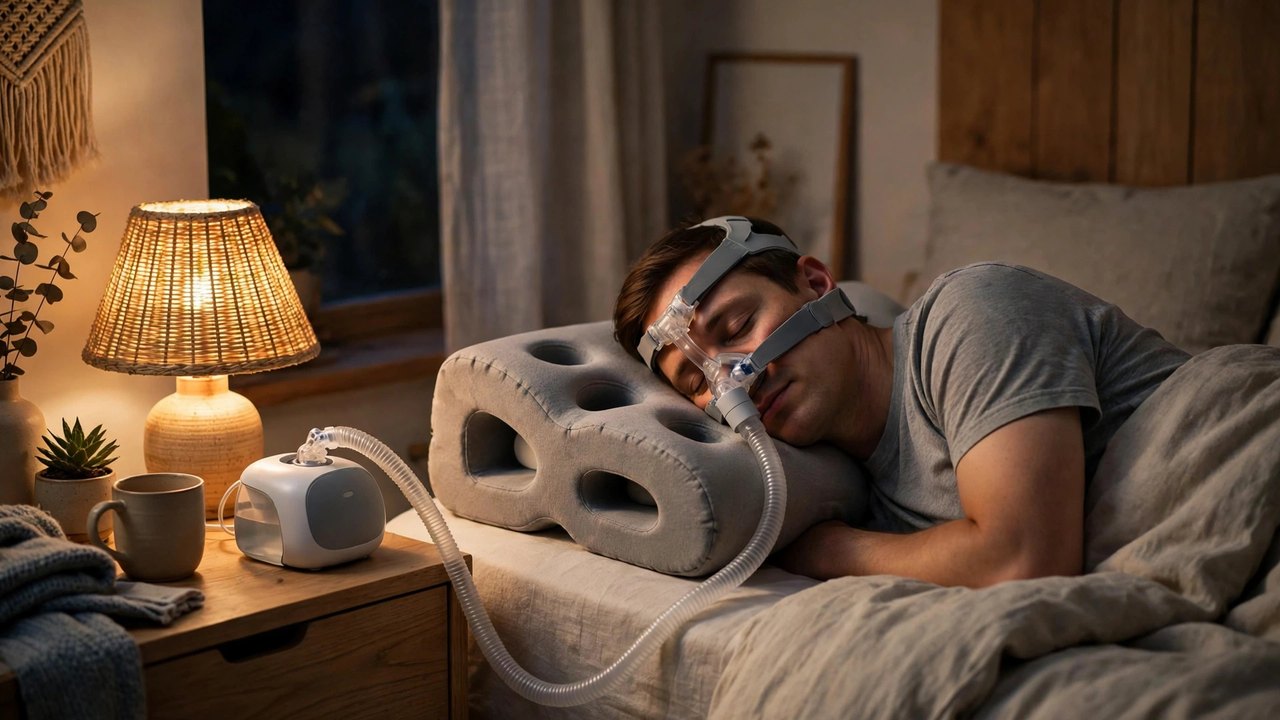
A nasal pillow mask is the smallest mask style most people wear at night. Two soft cushions sit at the nostrils, a slim frame crosses the cheek, and a short tube or top-of-head connection carries the hose away. That low profile is exactly why the mask feels light on your back, and exactly why a regular bed pillow can undo it on your side. Roll over and a flat, full pillow presses straight into the frame, nudges a cushion sideways, pushes headgear straps out of line, and leaves you reaching up half asleep to reseat everything. Finding the best pillow for nasal pillows cpap use is therefore not about finding the softest pillow in the store. It is about finding a pillow that gets out of the way at the edge, where the mask actually lives, while still holding your head and neck at a height that feels natural for your shoulders.
That edge problem shapes every pick in this guide. Each pillow below has cutouts, notches or contoured corners designed to leave open space beside the cheek when you sleep on your side. Most also offer some way to change the loft, because nasal pillow masks are sensitive to angle as well as pressure: tip the head too far down or lift it too high and the cushions can feel pulled even when nothing is touching them. Adjustable layers, removable inserts, dual-height ends and booster pieces all appear here, and they matter more for this mask style than decorative cooling fabrics or extra pillowcases. Those extras are noted where the maker lists them, but they never outrank cutout shape and height range.
A short boundary before the picks. A bed pillow is bedding, not a medical device. Nothing in this guide claims that a pillow treats a condition, changes therapy, or guarantees any outcome with your equipment. What follows describes maker-listed design features only: where the cutouts sit, how the height changes, what the pillow is made from, and which sleep positions and mask styles the maker lists it for. If a mask keeps leaking, if cushions will not seal, or if your equipment settings feel wrong, that is a conversation for your clinician or equipment supplier, not for a pillow purchase. Use this guide to solve the mechanical problem a pillow can solve, which is pillow foam pushing against mask hardware, and judge every pick on that basis alone.
Quick verdict
Start with the Lunderg CPAP Pillow for Side & Back Sleepers if you want the most complete nasal pillow setup in one box: cutouts on both sides, a removable layer for height, two different neck contours and two pillowcases included. Choose the IKSTAR CPAP Pillow for Side Sleepers with Larger Cutouts when cutout size is your main complaint and you want the widest footprint in this group, with dual contour heights and an adjustable insert underneath. Pick the EnduriMed CPAP Pillow for the firmest, simplest one-piece approach, with four cutouts, two thickness levels and a removable insert, and nothing to assemble or re-stack each night.
Choose the Elviros Cervical Memory Foam CPAP Pillow when height fine-tuning matters most, because its rotation plus removable base piece gives four height combinations and its inserts let you change the feel as well as the height. Take the HOMCA CPAP Pillow for Side Sleeping for a straightforward dual-height memory foam design with cutouts on both sides and a booster option the maker lists for sleepers who find the standard height too low. Finish with the Contour CPAPMax Cooling Gel CPAP Pillow if you want the longest-established name in this category in its cooling gel form, with layered adjustability, two sleep surfaces and a hose tether to keep tubing from dragging across the pillow.
There is no single winner for every nasal pillow user, because shoulders, mattresses and mask frames differ. A narrow-shouldered back sleeper who sometimes rolls to one side needs a lower, gentler contour than a broad side sleeper who stays put all night. Read the height figures for each pick against your current pillow before you decide, and treat the first nights as a fitting exercise: change one layer at a time, keep the mask fitting routine you already use, and notice whether the frame clears the pillow edge without you holding your head in a particular spot to make it work.
The products in this guide
Lunderg CPAP Pillow for Side & Back Sleepers
The Lunderg is the most rounded starting point for a nasal pillow user because it solves the three common problems at once
Best when Side and back sleepers who want two cases included
Removable layers; the maker lists a range from 2.25 to 5.25 inches for the CPAPMax design
Position changers who want a hose tether and two surfaces
The table is a map, not a ranking shortcut. Two pillows can share a headline height and feel completely different, because one reaches that height with a firm single block of foam and the other with a stack of softer layers. Cutout position matters as much as cutout size: a notch that sits where your cheek lands is useful, while a deeper notch placed too far toward the corner may never meet your mask at all. Use the table to narrow the field to two candidates, then read those two sections in full, paying attention to footprint. Several of these pillows are noticeably narrower than a standard bed pillow, and active sleepers who travel across the pillow at night feel that difference more than anyone.
How we selected
Every product in this guide had to pass the same checks. First, it had to be a real bed pillow designed for mask users, with cutouts, notches or contoured edges that the maker explicitly links to mask clearance, not a generic cervical pillow with no mask-specific shaping. Second, the maker or its listing had to state compatibility that includes nasal or nasal pillow masks, because a pillow shaped only around a large full-face cushion can be overbuilt and oddly placed for a minimal nasal pillow frame. Third, the exact model had to be verifiable on opened pages, with dimensions, materials or height details stated by the maker or the listing itself. Products that could not be verified that way were excluded entirely rather than described from summaries.
Height adjustability carried extra weight in the selection, for a reason specific to this mask style. Nasal cushions seal at the nostrils, so a small change in head angle changes how the frame hangs and how the short tube pulls. A fixed-loft pillow gives you one chance to get that angle right. A pillow with a removable layer, a second contour height or an insert gives you several, and lets you lower the pillow for back sleeping and raise it for side sleeping without buying a second pillow. Firmness was judged the same way: the foam has to hold the cutout walls open under cheek pressure, because a very soft pillow can collapse into the mask and recreate the problem the cutout was meant to solve.
Finally, practical details were checked for each model: whether a washable cover or pillowcase is included, whether the case is shaped for the pillow, what the footprint is compared with a standard pillow, and whether the listing is for the pillow itself rather than a replacement case or a cooling variant sold under a similar name. Where a brand sells several lookalike versions, the section names the exact version and the feature that identifies it, such as the larger cutouts on the IKSTAR pick or the cooling gel layer on the Contour pick, so you can match the listing you open to the product described here.
The Lunderg is the most rounded starting point for a nasal pillow user because it solves the three common problems at once. The maker lists contoured cutouts on both sides of the pillow, so the mask frame and the cheek-side tubing have somewhere to sit whether you favour your left side or your right. Because the pillow has two long edges with different contours, there are effectively four mask cut-outs across the design, plus two shoulder cutouts of different sizes. For a minimal nasal pillow mask that mainly needs the frame and straps kept clear, that geometry is well matched: the mask is small, so it does not need an enormous recess, but it does need the recess in the right place on both sides, and that is what the dual-edge layout provides.
Height is the second strength. The maker lists the pillow at 4.4 inches, rising to 5.5 inches with the removable memory foam layer included in the box. That single removable layer is a meaningful range for side sleeping, where shoulder width sets the height your neck needs, and it also lets back sleepers drop the pillow lower rather than sleeping propped up all night. The maker lists the foam as medium-firm memory foam and is candid that the slow-rebound feel is firmer than a down pillow, which is useful information: the firmness is part of how the cutout walls hold their shape, but it is also the most likely reason someone used to a soft, squashy pillow would not settle on it.
Practical touches are stronger here than on most rivals. The maker lists two pillowcases in the box, one plush and one smoother cooling style, both shaped to hug the pillow so loose fabric does not bunch against the mask or catch on the hose. Compatibility is listed broadly, across nasal, nasal pillow, full-face and hybrid masks, including named mask families from major makers, so a household sharing a pillow style across two different masks is not forced to choose. The footprint is more compact than a standard pillow, which keeps the cutouts close to where your head rests but gives restless sleepers less room to roam.
Buy it if: you sleep mainly on your side, sometimes on your back, use a nasal pillow or nasal mask, and want adjustable height plus spare cases without buying accessories separately.
Skip it if: you strongly prefer a soft, plush pillow feel, you want a full standard width to move across, or you are a dedicated stomach sleeper who needs a much lower profile.
The IKSTAR pick earns its place on cutout size. The maker lists this version with larger cutouts, and that distinction matters when you shop the brand, because IKSTAR sells several similar-looking CPAP pillows. This is the larger-cutout, adjustable-height model, listed at a large size of 25.2 inches long by 14.9 inches wide, with contour heights the maker lists at 5.5 inches and 4.7 inches for the two ends. That makes it the widest footprint among the dedicated mask pillows in this guide, and width is a real feature for combination sleepers: the more surface you have, the less likely you are to roll off the contoured centre and land with your mask on a flat, unshaped edge.
For nasal pillow masks specifically, the larger recess gives the frame, the cheek straps and the short tube room to settle without the pillow edge steering them. The listing describes the pillow as fitting most nasal, full-face and pillow masks, with a centre head cradle that helps hold a back-sleeping position and side zones shaped for mask clearance. Height adjustment comes from the dual contour ends plus a removable insert underneath, listed as a 2 centimetre insert in the maker’s descriptions of the adjustable design, so you can start with the lower end, test the seal angle, and add height only if your shoulder is lifting your head out of line. Change one variable at a time, because with two ends and an insert it is easy to change everything at once and learn nothing.
The cover is listed as removable and washable with a cooling feel, and the listing notes snap details that help keep the case in place on an unusually shaped pillow, which matters more than it sounds: a loose case can wrinkle into the cutout and narrow it. The foam feel on this listing is described as soft in its product information while other IKSTAR descriptions emphasise slow-rebound memory foam, so expect a less rigid cutout wall than the firmest picks here and check that the edge holds its shape under your cheek. That softness will suit some nasal pillow users very well, since the mask itself is light and needs clearance more than it needs a hard shelf.
Buy it if: your current pillow catches the side of your mask frame, you move between side and back positions, and you want the largest cutouts and widest surface in this group.
Skip it if: you want the firmest possible foam, you need a compact travel-friendly size, or the choice of several similar IKSTAR versions makes you want a brand with a single, simpler model line.
The EnduriMed is the straightforward pick: one contoured piece of memory foam, no layer system to configure, and a shape that has been sold for years under the model the maker lists as EM005. The maker lists four cutouts in the design, placed diagonally across both long edges, with a shoulder cutout on each edge as well. One long edge is higher and the other is lower, so flipping the pillow end to end changes the neck support height, and a removable foam insert pad lets you raise or lower the overall loft further. For a nasal pillow user, the diagonal placement is interesting because nasal pillow headgear often runs along the cheek toward the ear rather than straight down the face, so a diagonal recess can follow that line more naturally than a square notch.
Reviewers of this category consistently describe the EnduriMed foam as the firmest among the mainstream cutout pillows, and the maker lists it as a medium-feel memory foam design. Treat firm as the headline characteristic either way. Firm foam keeps the cutout open when your full cheek weight is on the pillow, which is when softer pillows quietly fail, and it holds head position steadily for sleepers who stay on one side for long stretches. The trade-off is adaptation: a firm, contoured pillow feels very different from a conventional pillow for the first nights, and back and stomach sleepers generally have less use for a shape tuned this closely to side sleeping with a mask.
The included pillowcase is described by the maker as plush on the sleep surfaces with quilted, breathable fabric inside the mask cutouts, a small detail that keeps the recess itself comfortable against the cheek. Dimensions are listed at about 22 inches by 12 inches in adjustable form, so this is a compact pillow that centres your head rather than spanning the bed. It is listed for back, side and stomach positions by the maker, and for CPAP, BiPAP and APAP mask users generally, but its natural home is side sleeping with a mask that needs a firm, unmoving edge to clear. If your nasal pillow mask is being displaced mainly because your current pillow is too soft, this is the most direct answer in the guide.
Buy it if: you want firm, stable support, a simple one-piece pillow with no layers to manage, and cutouts on both edges for either sleeping side.
Skip it if: you prefer a soft or plush feel, you have very broad shoulders and need a taller maximum loft, or you sleep mostly on your back and want a gentler contour.
The Elviros is the tuning pick. The maker lists this cervical CPAP pillow at 23.6 inches long by 16.1 inches wide, which is a generous width for a contoured pillow, with cutouts on both sides and distinct zones shaped for the neck and shoulders and a hollow centre for the head. The headline is height: rotate the pillow to choose between the two contour heights the maker lists at 4.92 inches and 5.12 inches, then remove the 0.78 inch base piece and those heights become 4.14 inches and 4.33 inches. Four combinations from one pillow is the widest fine-tuning range here short of a fully layered system, and it suits nasal pillow users who have already discovered that a centimetre of height changes how their cushions sit.
Beyond height, the maker lists two interchangeable memory foam inserts that change the support feel, describing a softer option and a firmer option, so you can adjust firmness independently of loft. That separation is rare and genuinely useful: most pillows force you to accept whatever feel comes with the height you need. The foam is listed as CertiPUR-US certified high-density memory foam with a slow rebound, and the cover as a breathable, removable and washable case. The maker also notes the foam has a mild scent on opening that dissipates over several days, and that the neck may need an adjustment period, both worth knowing before the first night rather than after it.
For nasal pillow masks, the listing states suitability for nasal and other CPAP mask types, and the side cutouts are positioned for side sleeping while the cervical contour supports back sleeping. The larger frame of this pillow, in both width and available height, makes it a natural candidate for bigger sleepers who find mainstream CPAP pillows low and narrow, and a less natural one for petite sleepers, who may find even the lowest combination too much under the neck. Measure your current comfortable pillow height honestly before ordering, and start with the base piece removed so you can add height rather than starting at the maximum.
Buy it if: you need higher or more precisely tuned loft, you are a larger-framed side or back sleeper, and you like the idea of changing firmness and height separately.
Skip it if: you want a pillow that works with no setup at all, you prefer a low and soft profile, or you are sensitive to new-foam scent during the first days.
The HOMCA is the uncomplicated dual-height option. The maker lists mask cutouts on both sides of a memory foam pillow measuring about 25.6 inches by 15.75 inches in the maker’s descriptions of the design, with two contour heights listed at 4.33 inches on the high side and 3.54 inches on the low side. That is a clean, understandable system: sleep on the high edge when you are on your side and need shoulder clearance, turn to the low edge for back sleeping, and let the cutouts keep the mask frame off the foam in either position. For a nasal pillow mask, whose frame is slim, the HOMCA cutouts provide the clearance without the deep, wide recesses shaped for bulky full-face cushions, which some minimal-mask users find easier to settle into.
The maker lists the pillow for all CPAP mask users, explicitly including nasal pillows in its listing title and descriptions, and describes the design as a cervical neck support shape as well as a mask pillow. One practical offer stands out in the maker’s listing material: if the pillow sits too low, the maker says it will send a free 0.8 inch booster cushion. Treat that as a listing promise to confirm on the page you buy from, but as a concept it softens the biggest risk of a fixed dual-height pillow, which is discovering your shoulders need a little more height than either edge provides. It turns a two-height pillow into a three-height one for the sleepers most likely to need it.
The cover is listed as removable and washable, and the pillow’s product information places it in the same certification family as several rivals, with textile certification details shown on the listing. Feel is the main thing to set expectations on: HOMCA’s memory foam is a contoured, supportive foam rather than a plush fill, and the cervical shape centres your head more firmly than a conventional pillow does. Combination sleepers who roll freely all night may prefer the wider IKSTAR or the layered Contour, while steady side sleepers who want a clear high side and low side, and a booster safety net, will find this the easiest design in the guide to understand and to live with.
Buy it if: you want a simple high-edge and low-edge system, a full-width footprint, and mask cutouts sized comfortably for a slim nasal pillow frame.
Skip it if: you need several precise height steps rather than two heights plus a booster, or you dislike a contoured cervical shape that positions your head in one place.
The Contour pick is the cooling gel version of the CPAPMax design, and the version matters. The listing for this model, with package dimensions the maker lists at 20 inches by 13 inches by 6 inches, describes a built-in cool gel layer on one surface and a fibre-filled feel on the other, over an adjustable memory foam construction. The wider CPAPMax design is the category’s best-known layout: side pressure-free zones where the mask sits, a crescent cutout that supports the shoulders and face, a centre contour that cradles the head, and a hose tether at the top edge. That tether is uniquely relevant to nasal pillow masks with a front hose connection, because it gives the tube a managed path off the pillow instead of letting it drag across the frame each time you turn.
Height adjustment on the CPAPMax design comes from removable foam layers. Contour lists the design as adjustable from 2.25 inches to 5.25 inches across its layer combinations, which is the broadest stated range in this guide and the only one that drops low enough to suit stomach sleepers and very low-profile back sleepers while still reaching a proper side-sleeping height. The layers in the maker’s description include high-resiliency foam, memory foam and a charcoal-infused layer the maker lists for odour control. More layers mean more setup, and the honest cost of this pillow is fiddling: you will spend the first evenings adding and removing layers and flipping between the gel and fibre surfaces to find your combination.
Two cautions belong in this section. First, Contour sells the standard CPAPMax 2.0, this cooling gel version and a pillowcase under similar names, so confirm the listing you open is the cooling gel pillow itself, as this section describes. Second, at 20 inches by 13 inches the footprint is the joint smallest here, so very active sleepers may find the edge sooner than they expect. For nasal pillow users who change position often, run a front-connected hose, and want one pillow that can be tuned from very low to fairly high, those trade-offs are worth it: no other pick combines that height range, two sleep surfaces and a tether in one design.
Buy it if: you change positions through the night, your hose drags your nasal pillow mask sideways, and you want the widest height range plus a cooler sleep surface option.
Skip it if: you want zero setup, a large pillow surface to move across, or a single firm foam feel rather than layered, changeable construction.
Buying guide
Match the cutout to the frame, not to the mask category in general. Nasal pillow masks differ more than their shared name suggests. Some route the hose from the front of the frame, some from the top of the head, and headgear straps sit in different places. Look at where your frame and straps actually touch the pillow when you lie on your side, then choose a cutout position that clears those exact points. A pillow with cutouts on both long edges, like the Lunderg and EnduriMed designs, gives you four chances to find a clear spot. A larger cutout, like the IKSTAR version, gives you more room in one spot. Neither is automatically better; the right answer is the one that matches your hardware.
Set height from your shoulder, then fine-tune for the mask. On your side, the pillow should fill the space between your ear and the mattress so your neck stays level, and that space is set by your shoulder width and how deeply your shoulder sinks into your mattress. Start from the maker’s listed heights, not from the tallest setting. Then adjust in small steps using the layer, insert or rotation the pillow provides, and judge each step by two things together: neck comfort and whether the nasal cushions stay seated without you tightening headgear. If a height feels perfect for your neck but pulls the frame, a small step down or a turn to the pillow’s other edge often resolves it, because nasal pillow fit is sensitive to angle.
Respect firmness as a functional feature. A CPAP pillow is not trying to be the softest pillow you own. Its foam has to hold a cutout open under load and keep your head from sinking until the mask meets the pillow anyway. Medium-firm and firm foams dominate this category for that reason. If you love a soft pillow, look for the designs that soften the surface rather than the structure: a fibre-filled face over a foam core, a plush pillowcase over firm foam, or interchangeable inserts that let you soften the feel without removing the support. And allow an adjustment period with any contoured foam pillow; the maker of the Elviros design, for example, lists one to two weeks for the neck to adapt, which is a fair expectation for the category.
Check the footprint against how you actually sleep. Dedicated CPAP pillows run smaller than standard pillows, commonly around 20 to 26 inches long and 12 to 16 inches deep. Tidy sleepers who stay centred barely notice. Active sleepers should favour the wider designs, keep their regular pillow nearby for the first nights, and be honest about whether they will stay on a contoured centre. Also check the case situation before you buy: these shapes need their own pillowcases, standard cases bunch and can intrude into the cutouts, and brands differ on whether a case, or two, is in the box. A washable, shaped, included case is worth real money in this category because replacements must come from the same maker.
Keep the pillow in its lane. Buy a CPAP pillow to stop bedding from pushing against your mask, to give the hose a clear path, and to hold a comfortable head height. Do not buy one expecting it to fix a mask that is the wrong size, cushions that are worn out, or settings that need professional review. If you have changed pillows and the same leak or discomfort follows you, the pillow was never the problem. Replace worn cushions on schedule, refit the mask following its maker’s instructions, and talk to your clinician or supplier about persistent issues. The best pillow in this guide is the one you stop noticing, because the mask finally gets to do its job undisturbed.
FAQ
Is a nasal pillow mask the same thing as a CPAP pillow? No, and the similar names cause real confusion. Nasal pillows are a mask style: small cushions that seal at the nostrils. A CPAP pillow is bedding: a bed pillow with cutouts or contours shaped to leave room for a mask and hose. This guide is about the bedding, chosen for people who already use the nasal pillow mask style.
Do I need a CPAP pillow if my nasal pillow mask is very small? Not always. A minimal mask on a back sleeper may never touch the pillow enough to matter. The case for a cutout pillow gets strong when you sleep on your side and wake with the frame shifted, straps displaced or the short tube pulled, or when you find yourself bunching a regular pillow into shapes to keep it away from the mask. If none of that happens, keep your current pillow.
Which height should I start with? Start at or below the height of the pillow you currently find comfortable for your neck, then adjust upward only if your shoulder needs it on your side. With layered or insert designs, change one element at a time and give each setup a full night. Nasal cushions react to small angle changes, so small, recorded steps beat random restacking.
Can I use a normal pillowcase on a CPAP pillow? Usually not well. These pillows have cutouts and contours that a rectangular case will bridge over, bunch into or pull tight across, narrowing the very recesses you bought the pillow for. Use the shaped case the maker supplies or sells for that exact model, and prefer listings that include one or two cases in the box.
Will a firmer pillow feel uncomfortable at first? It can. Contoured memory foam holds your head in a defined position, which feels restrictive for the first nights if you are used to soft fill you can reshape freely. Makers of these pillows commonly describe an adjustment period. Judge the pillow after several nights at the correct height, not after one night at a guessed height.
What if the pillow does not stop my mask shifting? Check the mechanical basics first: cutout position against your frame, pillow height, case tightness and hose routing, including whether a tether or a top-of-head hose connection would clear the pillow better. If the mask still shifts with the pillow fully clear of it, the cause is in the mask fit or the equipment, and your clinician or equipment supplier is the right next step.
Conclusion
For most nasal pillow users, the Lunderg CPAP Pillow for Side & Back Sleepers is the safest first purchase: bilateral cutouts, a useful two-step height, two included cases and broad listed mask compatibility cover the common problems without demanding much setup. If edge room is the whole problem, take the IKSTAR with larger cutouts and the widest surface. If softness in your current pillow is the whole problem, take the firm, simple EnduriMed. Tuners and larger frames should look at the Elviros, simplicity seekers at the HOMCA, and restless position changers with a dragging hose at the Contour CPAPMax Cooling Gel. Whichever you choose, set the height carefully, keep the shaped case on it, and let the pillow do its one job: staying out of the mask’s way, all night, on either side.
M
Modern Line Home Editorial Team
We compare specs, materials and verified owner reviews before a product earns a spot. Rankings are never paid.
Affiliate disclosure. As an Amazon Associate we earn from qualifying purchases at no extra cost to you. Prices accurate as of the date shown.
House cold even with the heat on? Walk this ordered checklist: thermostat and filter first, then drafts, insulation, leaky ducts and a failing heating system.
Windows fogging up in winter? Check where the fog sits: on the room side it is indoor humidity, outside it is harmless, and between panes the seal has failed.
Store the main firewood pile about 30 feet from your house, off the ground and covered only on top. Compare racks, woodsheds, garages and indoor spots safely.
Place a portable generator outdoors only, at least 20 feet from windows, doors and vents, exhaust pointed away. Exact distances, setup steps and CO rules here.
Keep houseplants in the right winter spot: match window direction to plant type, stay clear of radiators and cold glass, and fix dry air and low light at home.
Mice enter through pencil-width gaps at foundations, pipes, vents, doors and the roofline. Walk this room-by-room winter checklist to find and seal each one.
A winter outage timeline: what to do in the first hour, first night and multi-day outage, with food safety times, pipe protection, heat and CO safety steps.
Size a space heater by room area: 10 watts per square foot at 8-foot ceilings, adjusted for insulation and ceiling height, with full wattage and BTU tables.
Start dripping at about 20 degrees, sooner for exposed pipes. Set a pencil-lead stream, drip the right faucets on both lines, and know when to stop safely.
A fridge needs 800-1,200 starting watts, not just 150-400 running watts. Use the tables to total your fridge plus freezer, lights, furnace fan and more today.











Write Your Review
No reviews yet. Be the first to share your experience!