We independently review everything we recommend. When you buy through our links, we may earn a commission. As an Amazon Associate we earn from qualifying purchases.
Best Hail Blankets for Cars: 6 Padded Covers Compared
Compare the best hail blankets for cars, from 5mm EVA and XPE padded full covers to an inflatable system and a rapid shield, with sizing and fit advice today.
Compare the best hail blankets for cars, from 5mm EVA and XPE padded full covers to an inflatable system and a rapid shield, with sizing and fit advice today.
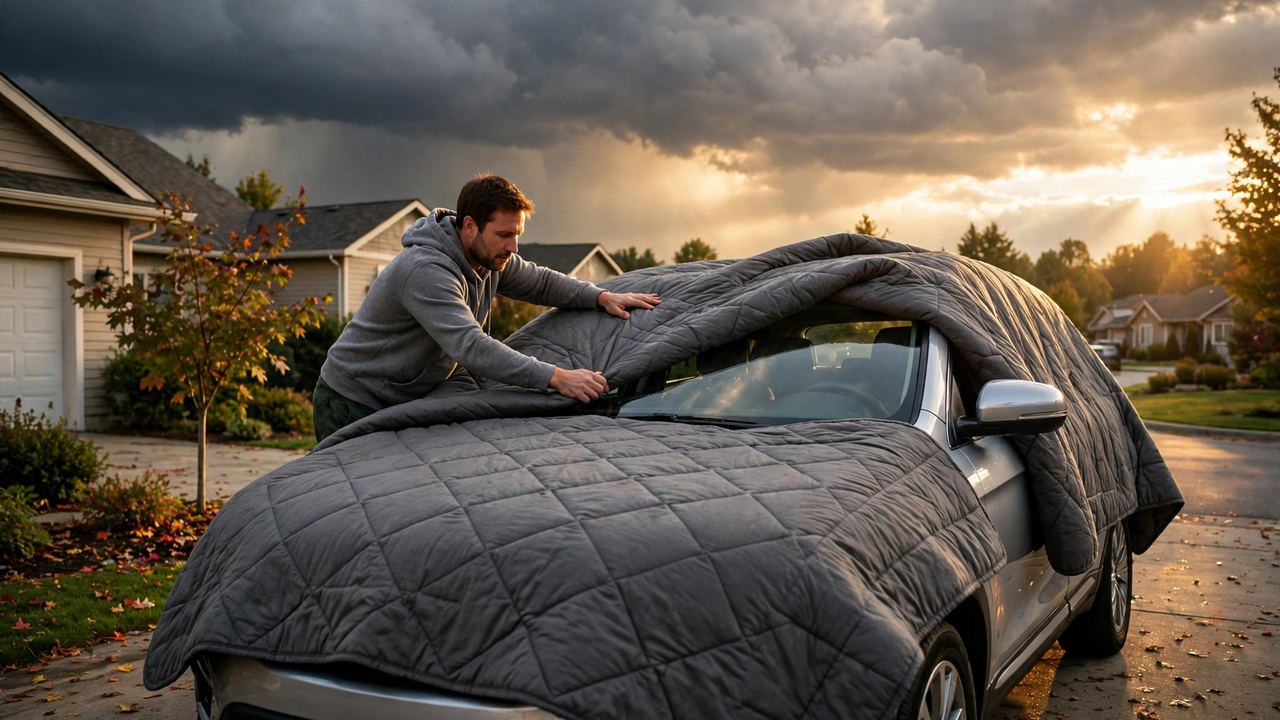
Hail is one of the few kinds of weather that can damage a car in minutes and leave no cheap way back. A single storm can dent a roof and hood, crack a windshield, and turn smooth paint into a surface that needs professional body work. If you park outdoors at home, at work, or on the road, a padded hail cover is the one accessory you can put in place before the storm arrives. This guide to the best hail blankets for cars compares six real products built specifically for hail: padded full covers with thick foam over the roof and glass, a half blanket that concentrates on the top of the vehicle, a rapid-deployment shield, and an inflatable system that surrounds the vehicle with air chambers.
A hail blanket is not the same thing as an ordinary dust cover. A basic cover keeps dirt and light rain off the paint, but it is usually too thin to absorb the impact of falling ice. A hail-specific cover adds a cushioning layer, most often EVA or XPE foam or thick cotton padding, over the horizontal surfaces where hail lands hardest: the roof, hood, trunk, and the glass areas. Some designs pad only the top and carry lighter fabric down the sides, while others wrap the whole vehicle. That difference in approach is the main thing to understand before you buy, because it decides how much of the car is cushioned, how fast the cover goes on, how much trunk space it takes up, and how it behaves in the wind that usually arrives with a hailstorm.
Below you will find a quick verdict, a comparison table, an explanation of how these six picks were selected, and a detailed look at each one. Every specification in this article is phrased the way the maker lists it, and every pick is tied to a specific size range, so measure your vehicle before you order. A hail cover that is too short leaves bumpers and glass exposed, and one that is far too large can flap, shift, and be harder to secure when the wind picks up.
Quick verdict
For most sedan drivers, the Favoto Hail Protector is the balanced starting point: the maker lists 5mm high-density XPE foam over the roof and window areas, Oxford fabric sides, and a long list of windproof straps in a size aimed at sedans measuring 186 to 194 inches long. For SUV drivers who want the same foam-first idea in a larger cut, the JOYTUTUS Hail Protector pairs 5mm EVA padding with five windproof straps for vehicles 192 to 201 inches long. Truck owners are better served by the sportuli Specialized Hail Protector, which is sized for trucks 220 to 235 inches long and pads the top and all window areas with 5mm EVA over a 300D Oxford lower section.
If you want the most complete barrier and you have time to set it up before a storm, the HAIL PROTECTOR SUV2 is the different kind of answer: instead of foam, it inflates air chambers around the vehicle, and the maker lists an inflation time of about 8 to 10 minutes with battery, vehicle, and wall-outlet power options included. If speed matters more than side coverage, the HailOut Texas Hail Cover A is a rigid-feeling shield the maker says can be set up in about two minutes, focused on the fragile roof and glass rather than the sides. And if you mainly worry about the roof and windshield and want something lighter to handle, the padded half hail blanket in this list uses 4mm cotton padding under a reflective silver outer layer and folds down compactly for trunk storage.
The products in this guide
Favoto Hail Protector Car Cover for Sedans up to 194 Inches
It is a full exterior cover, and the maker lists the roof and window areas in 5mm high-density multi-layer XPE impact-absorbing foam, with Oxford
We started with the product class itself: covers and blankets sold specifically for hail protection, rather than general all-weather covers that merely mention hail in passing. Each pick in this guide had to show a real cushioning or barrier system on its product page, such as a stated foam thickness, a stated padding material, an inflatable chamber design, or a rigid shield construction. Covers with no stated impact layer were left out, however good they might be against rain or dust.
Next, we checked fit. Hail covers are sold by vehicle length and type, so each pick here covers a distinct slot: a mid-size sedan size, a large SUV size, a long truck size, a midsize rapid shield, a universal half blanket, and an inflatable system sized for SUVs, trucks, and vans. That spread matters because the right answer for a compact sedan is the wrong answer for a crew-cab truck, and a guide that only lists one size class would not help most readers.
We also looked at how each cover stays in place. Hail rarely falls on a calm day, so straps, elastic hems, and windproof bands are part of the protection, not an accessory. A padded cover that lifts or shifts in a gust exposes exactly the panels it was bought to protect. Finally, we recorded the details each maker lists about storage, reflective strips, vents, and included components, because a cover that lives in the trunk and goes on quickly is far more likely to be in place when a fast-moving storm arrives. Products whose key specifications could not be confirmed on an opened product page were excluded entirely rather than described with guesswork.
The Favoto is the most conventional design in this guide, and for many sedan owners that is exactly the point. It is a full exterior cover, and the maker lists the roof and window areas in 5mm high-density multi-layer XPE impact-absorbing foam, with Oxford fabric side panels. That layout puts the thickest cushioning where hail actually strikes, the horizontal and glass surfaces, while keeping the sides lighter so the cover stays manageable to lift, unfold, and fold away again. The maker lists this size for sedans measuring 186 to 194 inches in length, and it stresses measuring the vehicle before ordering, which is sound advice for any cover in this guide.
Wind security is where this design spends much of its effort. The maker lists a full elastic hem, reinforced front and rear windproof straps, and three additional long windproof straps, plus a storage bag in the box. Large reflective strips on the front, rear, and sides are listed for low-light visibility, and built-in side air vents are listed to promote airflow and reduce heat and moisture buildup under the cover. Reinforced edging is also listed for durability. Taken together, the specification reads like a cover designed to stay on a driveway car through a storm season rather than a blanket that only comes out once.
The trade-offs follow from the full-cover format. A padded full cover is bulkier than a half blanket, takes longer to fit carefully the first few times, and needs to be dried and folded properly if it is going back into its bag after a storm. It is also a sedan-specific size, so SUV and truck owners should look at the JOYTUTUS and sportuli picks instead of stretching this one over a taller vehicle. Within its intended slot, though, it offers the clearest combination of stated foam thickness, stated strap count, and everyday all-weather duties.
Buy it if: you drive a sedan in the listed length range, park outdoors, and want padded roof and glass protection that can also handle rain, snow, dust, and sun between hail events.
Skip it if: your vehicle is an SUV or truck, you need something that deploys in a couple of minutes, or you have very limited storage space for a bulky full cover.
The JOYTUTUS applies the same foam-first logic to a larger vehicle. The maker lists this version for SUVs 192 to 201 inches long, with thick EVA padding reinforcing the roof and window areas. The maker lists the padding at 5mm and describes it as protection against cherry-sized hail, which is a useful way to picture the intended threat level: the everyday hail that dents roofs and chips glass in spring and summer storm belts, handled by a cushion rather than by hope. The construction is described as a multi-layer structure combining EVA cushioning with an outer fabric for shock absorption and all-weather use.
For staying put, the maker lists five reinforced windproof straps and elastic hems, along with reflective strips for nighttime visibility. Those details matter more on an SUV than on a sedan, because a taller vehicle presents more side area to the wind and a larger cover has more material to shift. The maker also lists protection against rain, snow, ultraviolet rays, dust, and debris, so like the Favoto, this is a cover that can earn its keep as a general outdoor cover and not only on hail days.
Size discipline is the main caution. The maker lists several sizes in this family, and this pick is specifically the 192 to 201 inch SUV version, so confirm both your vehicle length and the size you are ordering before you buy. A cover bought a size too small will not pull down properly over the mirrors and bumpers, and one bought too large will be harder to tension with the straps. If your SUV falls outside this range, choose the size the maker lists for your length rather than forcing this one.
Buy it if: you drive an SUV in the listed length range and want 5mm EVA padding over the roof and windows with a strong strap count for windy storms.
Skip it if: your SUV is shorter or longer than the listed range, or you want an inflatable or rigid barrier instead of a foam-padded fabric cover.
Trucks are the hardest vehicles to protect from hail: they are long, tall, and their broad hoods and roofs present a large target. The sportuli Specialized Hail Protector is built for that problem. The maker lists it for trucks 220 to 235 inches in length, including full-size crew-cab trucks with short beds and mid-size trucks, and lists the top and all window areas in 5mm thick high-density EVA cushioning foam pad material. The maker describes that pad as able to withstand egg-size hail impact, the strongest hail-size claim among the fabric covers in this guide, and lists a waterproof fabric layer under the EVA pad to keep the pad from soaking the vehicle after absorbing water.
Below the padded zone, the maker lists the lower perimeter in 300D high-density waterproof Oxford fabric, intended to stand up to long summer sun exposure. The detail list includes windproof bands at the bottom, reflective stripes for night visibility, ventilation holes for airflow, adjustable elastic hems, and reinforced orange serging at the edges. The maker lists the package as the cover and a storage bag, and lists the item weight at 15 pounds, which gives a realistic sense of the heft involved in handling a truck-size padded cover.
That heft is the honest downside. A 15-pound, truck-length padded cover is a two-hand job to fit and fold, and the maker itself frames this as a professional hail cover rather than an everyday rain cover, even noting it is not recommended simply for rainy days. If your truck lives outside in a hail corridor, that specialization is a virtue. If you only face an occasional storm and mostly want light weather protection, one of the smaller, lighter picks will be easier to live with.
Buy it if: you own a truck in the listed length range, park it outdoors, and want the thickest stated foam claim in this guide over the roof, hood, mirrors, and glass.
Skip it if: your vehicle is a car or SUV, you want a light daily cover, or you cannot comfortably handle and store a large, heavy padded cover.
The HAIL PROTECTOR SUV2 takes a completely different approach from every foam cover in this guide. Instead of a cushioning fabric, the maker lists a patented, portable inflatable system: air chambers surround the vehicle and create a barrier that absorbs and disperses hail impact before it reaches the surface. Because the chambers wrap the vehicle, the maker presents it as protection against hail driven from shifting directions, not only hail falling straight down onto the roof. This SUV2 size is listed for SUVs, trucks, and vans, in silver, from the maker Hail Storm Products.
Deployment is the key specification. The maker lists an inflation time of approximately 8 to 10 minutes and lists multiple power options in the system: a rechargeable battery pack, a 12-volt vehicle adapter, and an AC wall outlet adapter. The complete system is listed as including the inflatable cover sized to the vehicle, a blower assembly, the battery pack and adapters, a cinch wand, a storage bag, and a quick-start guide. The maker also lists testing in wind gusts up to 80 miles per hour and a one-year parts and labor warranty. The maker advises practicing the setup once or twice before storm season, which is wise: an inflatable system rewards preparation and punishes first attempts made while a storm is already approaching.
The compromises are time, complexity, and dependence on power. Eight to ten minutes is fast for building an air barrier around a truck, but it is far slower than throwing a blanket over a roof, and the system needs its blower and a power source to work. It also takes more storage room than a fabric cover. In return, it is the only pick here whose barrier is air rather than a few millimetres of foam, and the only one the maker positions against hail of any size. For owners in severe hail regions who watch forecasts and can deploy ahead of a storm, that trade can make sense.
Buy it if: you face severe hail, park an SUV, truck, or van outdoors, and you are willing to practice setup and deploy 8 to 10 minutes ahead of a storm for a full air-chamber barrier.
Skip it if: you need protection you can throw on in two minutes, you have no reliable power source where you park, or you want the smallest possible package in the trunk.
The HailOut Texas Hail Cover A is built around one idea: speed. The maker lists a setup time of about two minutes and describes the product as a compact, ergonomic shield for the fragile parts of the vehicle, comparing its role to a vest for the roof and glass. The maker lists the material as high-density polyethylene and lists the model as HS-SD-SUV, made by Material Protection LLC in Texas, with a one-year warranty description. The maker lists the protection area at about 197 inches long by 77 inches wide and names a 2020 Toyota Camry and RAV4, and comparable-size cars and SUVs, as the best fit.
The hail claim is specific. The maker lists quick protection for the fragile parts against most hailstones up to large golf-ball sizes, and supports the shield concept with an energy comparison between a baseball and a golf-ball-sized hailstone. The design is patented in the United States and internationally, according to the maker. Just as important is what the maker openly leaves out: it states there is no side protection, a deliberate choice to keep the shield fast, lighter, and focused, and lists the weight at about 20 pounds in its notes and 21 pounds in the product details. The maker also recommends two people for installation in strong winds, while noting one person can manage after practice.
That honesty defines who should buy it. If your fear is a fast storm catching your car at work or while traveling, a shield that is up in about two minutes and covers the roof and glass, the panels hail damages most, is a rational trade. If you want the doors, fenders, and side glass cushioned as well, a full padded cover or the inflatable system fits your goal better. Check the stated protection area against your vehicle before ordering, because the maker is explicit that very large or very small vehicles are not the intended fit.
Buy it if: you want the fastest deployment in this guide, your car or SUV matches the stated protection area, and roof and glass protection matter more to you than side coverage.
Skip it if: you need side panel protection, your vehicle is much larger than a midsize SUV, or you prefer a soft cover that folds into a small bag.
This padded half blanket is the lightest concept in the guide. Rather than wrapping the whole vehicle, it concentrates on the top, where hail does its worst work. The maker lists a multi-layer structure with 4mm thick cotton padding, an outer layer of reflective silver insulation with a waterproof membrane, and an inner soft cotton layer intended to protect the finish from scratches and frost. The maker lists the padding as protection against hail, heavy snow, and frost, and lists the fit as universal for hatchbacks, sedans, and SUVs. The listed item weight is 7 pounds, roughly half the sportuli truck cover, which tells you how much easier this one is to lift onto a roof and shake out on your own.
Securing and visibility details are still present despite the simpler format. The maker lists wind buckles, wind strips, and tail elastic straps to hold the blanket in strong winds, and reflective strips at the mirrors and front for nighttime visibility. Installation is described as a quick-attach design, and the blanket folds down to a compact size for storage in the trunk or garage. One practical note comes straight from the maker: the blanket ships vacuum-compressed, which makes it arrive thinner, and the maker recommends airing it in a ventilated, sunny spot so the padding returns to its normal thickness before first use.
The limits are coverage and cushion thickness. A half blanket leaves the lower doors and bumpers outside its padded zone, and 4mm of cotton is a softer, thinner cushion than the 5mm EVA or XPE foam in the full covers above. For moderate hail, snow load, frost, and sun on a car that is otherwise garaged or only occasionally exposed, that may be exactly enough, at a size and weight you will actually use. For repeated severe hail, step up to a foam full cover, the rapid shield, or the inflatable system.
Buy it if: you want light, compact top coverage for a hatchback, sedan, or SUV, mainly against moderate hail, snow, frost, and sun, and you value easy solo handling and trunk storage.
Skip it if: you need full-body coverage, the thickest available padding, or protection aimed at severe, large hail.
Buying guide
Start with the kind of hail you actually get
Hail size drives everything. Small, cherry- or nickel-sized hail is the common threat in many regions, and the foam covers in this guide are described by their makers in exactly those terms. Larger golf-ball or egg-sized hail carries far more energy, which is why the sportuli maker claim reaches to egg-size hail, the HailOut shield is framed around large golf-ball sizes, and the inflatable system is positioned against hail of any size. Match the claim to your local storm history rather than buying the thinnest cover and hoping, or the heaviest system for a risk you never face.
Padding material and thickness
EVA and XPE foams are closed-cell cushioning materials that spread impact over a wider area, and the full covers here list 5mm of one or the other over the roof and windows. Cotton padding, listed at 4mm in the half blanket, is softer and lighter but thinner. A rigid high-density polyethylene shield works differently again, deflecting and absorbing as a shell over the top of the car, while the inflatable system replaces solid padding with air chambers. There is no single best material, only the best match between material, thickness, coverage area, and how quickly you can deploy it.
Coverage: full cover, half blanket, shield, or air
Decide which panels you are protecting. Full covers cushion the roof and glass and carry fabric down the sides, which also helps against sun, rain, snow, and dust between storms. Half blankets and the rapid shield concentrate on the roof, hood, and glass and accept exposed lower panels in exchange for speed and lighter handling. The inflatable system surrounds the vehicle, which addresses wind-driven hail that arrives at an angle. Look at where your car has glass and broad flat metal, and choose the coverage shape that matches.
Measure before you order
Every pick in this guide is sold against a length range or a stated protection area. Measure your vehicle from bumper to bumper, compare it with the range the maker lists, and pick the size that contains your measurement comfortably. Height matters too: an SUV or truck needs a cover cut for its taller body. Ordering by vehicle type alone, without the measurement, is the most common way buyers end up with a cover that will not pull down, will not tension, or leaves glass exposed at one end.
Straps, hems, and wind
Hailstorms bring wind, outflow, and gusts that try to lift any cover like a sail. Count the straps the maker lists, look for elastic hems that pull the cover snug at the bottom, and note windproof bands or buckles. Reflective strips are worth having if the car parks near a street or driveway edge, since a covered car is less recognizable at night. Practice fitting the cover on a calm day, learn where each strap routes, and store it so the straps do not tangle, because the time to learn is not when thunder is already audible.
Storage and deployment time
A hail cover only works if it is with the car and can be fitted in time. Think about where it will live: the half blanket and the fabric covers fold into bags for the trunk, the rapid shield is a larger rigid package, and the inflatable system includes a blower and power gear. Think equally about deployment: about two minutes for the shield, a few minutes to fit and strap a full cover once practiced, and about 8 to 10 minutes to inflate the air system. If your storms arrive with little warning, weight your choice toward speed. If you act on forecasts the night before, coverage can matter more than minutes.
Care after a storm
Let a wet cover dry before folding it away for long, keep foam padding out of prolonged compression where you can, and follow any maker note about airing vacuum-packed padding back to full thickness. Check straps and stitching after a severe storm, since that is when damage shows. A cover that is stored dry, untangled, and ready will be fitted in time for the next storm; one stuffed away wet and knotted may not be.
FAQ
Do hail blankets really prevent dents?
A padded hail blanket is designed to absorb and spread the impact of hailstones before the energy reaches the panel or glass underneath. The makers in this guide describe their padding, shield, or air chambers in terms of specific hail sizes, from cherry-sized up to larger claims. No cover can promise protection against every possible storm, which is why matching the stated claim to the hail size your area actually gets is the sensible way to choose.
What thickness of padding should I look for?
The full fabric covers in this guide list 5mm EVA or XPE foam over the roof and window areas, and the half blanket lists 4mm cotton padding. Thicker, denser foam over the impact zones is the general pattern for stronger claims, but coverage, fit, and how securely the cover is strapped down matter as well. A well-fitted 5mm cover that stays in place protects better than a thicker cover that shifts in the wind.
Can I leave a hail cover on all season?
Several picks here are also listed by their makers for rain, snow, ultraviolet light, dust, and general outdoor use, with features such as vents and waterproof membranes that suit longer outdoor stays. Others are more specialized: the sportuli maker frames its cover as a professional hail cover rather than a rain cover, and the inflatable system is a deploy-before-the-storm product. Read the intended use on the pick you choose and follow the maker guidance on ventilation and drying.
How do I choose the right size?
Measure your vehicle length bumper to bumper and match it to the range the maker lists for that size, such as 186 to 194 inches for the Favoto sedan size or 192 to 201 inches for the JOYTUTUS SUV size in this guide. For the rapid shield, compare your vehicle with the stated protection area instead. If your measurement falls between sizes or outside a range, choose the size the maker assigns to your length rather than guessing.
Is an inflatable hail cover better than a padded blanket?
They solve the problem differently. An inflatable system surrounds the vehicle with air chambers and is positioned by its maker against hail of any size and from shifting directions, but it needs about 8 to 10 minutes and a power source to deploy. A padded blanket is simpler, needs no power, stores smaller, and goes on faster, but its protection is a few millimetres of foam over the areas it covers. The better choice depends on your hail severity, warning time, and storage space.
What should I do when a hailstorm is forecast?
Fit the cover before the storm arrives, route and tighten every strap the maker provides, and check that the padded zones sit over the roof, hood, and glass. If you use the inflatable system, start early enough to complete inflation, and if you use the rapid shield, position it over the fragile top panels first. Practicing the whole routine once on a calm day is the single easiest way to make sure it goes smoothly under pressure.
Conclusion
The right hail blanket is the one that matches your vehicle, your hail risk, and your warning time. Sedan drivers are well served by the Favoto, with its listed 5mm XPE foam and extensive strapping in a clear size range. SUV drivers get the same foam approach scaled up in the JOYTUTUS, and truck owners get the most specialized fabric design in the sportuli, sized and padded for long, tall vehicles. Drivers facing severe hail who can deploy ahead of a storm should look closely at the inflatable HAIL PROTECTOR SUV2, while anyone who needs protection in about two minutes should consider the HailOut rapid shield and its deliberate focus on roof and glass. For lighter, occasional exposure, the padded half blanket keeps things simple, compact, and easy to handle alone.
Whichever you choose, measure first, practice fitting it once in calm weather, and keep it stored dry and ready in or near the vehicle. Hail gives little warning and less forgiveness, and a cover that is the right size, properly strapped, and already in place is the difference between watching a storm pass and pricing body work afterwards.
M
Modern Line Home Editorial Team
We compare specs, materials and verified owner reviews before a product earns a spot. Rankings are never paid.
Affiliate disclosure. As an Amazon Associate we earn from qualifying purchases at no extra cost to you. Prices accurate as of the date shown.
House cold even with the heat on? Walk this ordered checklist: thermostat and filter first, then drafts, insulation, leaky ducts and a failing heating system.
Windows fogging up in winter? Check where the fog sits: on the room side it is indoor humidity, outside it is harmless, and between panes the seal has failed.
Store the main firewood pile about 30 feet from your house, off the ground and covered only on top. Compare racks, woodsheds, garages and indoor spots safely.
Place a portable generator outdoors only, at least 20 feet from windows, doors and vents, exhaust pointed away. Exact distances, setup steps and CO rules here.
Keep houseplants in the right winter spot: match window direction to plant type, stay clear of radiators and cold glass, and fix dry air and low light at home.
Mice enter through pencil-width gaps at foundations, pipes, vents, doors and the roofline. Walk this room-by-room winter checklist to find and seal each one.
A winter outage timeline: what to do in the first hour, first night and multi-day outage, with food safety times, pipe protection, heat and CO safety steps.
Size a space heater by room area: 10 watts per square foot at 8-foot ceilings, adjusted for insulation and ceiling height, with full wattage and BTU tables.
Start dripping at about 20 degrees, sooner for exposed pipes. Set a pencil-lead stream, drip the right faucets on both lines, and know when to stop safely.
A fridge needs 800-1,200 starting watts, not just 150-400 running watts. Use the tables to total your fridge plus freezer, lights, furnace fan and more today.











Write Your Review
No reviews yet. Be the first to share your experience!