We independently review everything we recommend. When you buy through our links, we may earn a commission. As an Amazon Associate we earn from qualifying purchases.
Best Vacuums for Senior Citizens: 6 Light, Easy Picks
Find the best vacuums for senior citizens: six light, simple machines with easy handles, long cords or cordless freedom, and dust cups that empty without fuss.
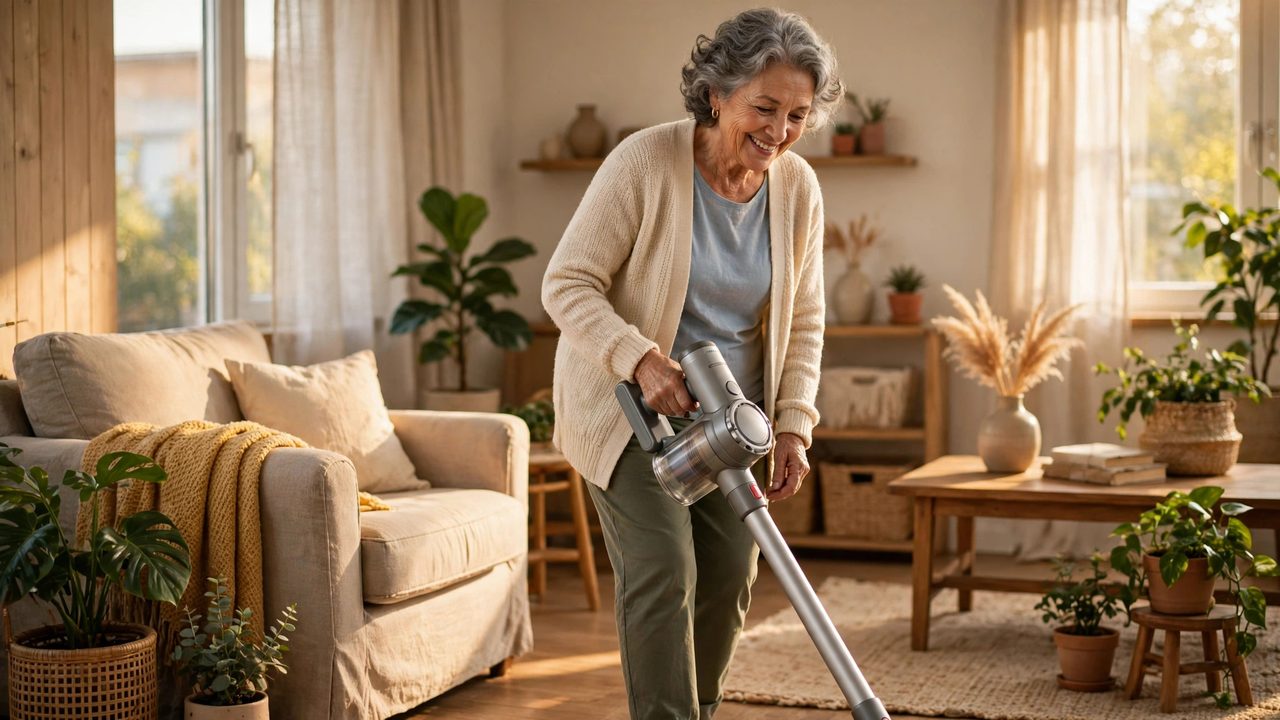
Choosing the best vacuums for senior citizens is less about raw power and more about the weight you push, the handle you grip, and the little jobs — emptying a cup, wrapping a cord, changing a bag — that decide whether a machine gets used or stays in the closet. A vacuum that is easy to start, easy to steer, and easy to put away will keep floors cleaner than a heavy flagship that feels like hard work before it is even switched on. This guide compares six machines chosen for exactly that balance: light bodies, simple controls, forgiving steering, and maintenance that does not demand kneeling, squeezing, or wrestling with parts.
The six picks cover the main shapes an older household might want. There is a featherweight corded stick for quick daily sweeps, a very light bagged upright for anyone who prefers changing a bag a few times a year over emptying a cup after every clean, two cordless sticks for homes where a cord is a trip hazard or a nuisance, a versatile bagless upright with a lift-away pod for stairs, and a simple full-size upright for carpeted homes that want one machine to do everything. None of them needs an app, a smartphone, or a menu of modes to learn.
Every specification below is phrased the way the maker lists it, and where makers publish two different figures for the same machine — which happens more often than it should — the guide says so rather than picking the flattering one. Think about your own home as you read: the number of stairs, the mix of carpet and hard floors, whether there is a pet, and who will empty the machine. Those answers point to one of these six far more reliably than any suction figure.
Quick verdict
For most senior households, the Oreck Commercial XL is the easiest full-size upright to live with: the maker lists it at about nine pounds, it has a single speed, automatic floor adjustment, and a long cord, so there is almost nothing to set, carry, or think about. If weight matters above everything else, the Bissell Featherweight is the lightest machine here by a wide margin and turns into a hand vacuum for stairs and upholstery. If a cord is the problem, the Shark Pet Cordless IX141 gives cordless freedom with a simple on-off switch rather than a trigger you must hold down, while the Dyson V8 is the lightest cordless option but does ask you to hold its trigger while you clean — a real consideration, covered honestly below. The Eureka PowerSpeed is the straightforward bagless upright for carpeted homes, and the Shark Navigator Lift-Away NV360 is the choice when stairs and above-floor cleaning matter, because its pod lifts off the base and comes with you.
The products in this guide
Oreck Commercial XL Upright Vacuum
Maker lists: about 9 lb (some Oreck materials say 8 lb) Type: corded bagged upright, model XL2100RHS Cord: 35 feet Cleaning path: 12 inches Bag
Weight came first. Every machine in this guide is one an older adult can plausibly carry between rooms and, where relevant, up a flight of stairs without help. The lightest pick weighs under three pounds as listed; even the full-size uprights sit at or near ten pounds, well below the heavy deep-clean machines that dominate many roundups. Where a machine is heavier — the Shark Navigator — it earns its place because the part you carry on stairs separates from the part you push.
Controls came second. Each pick starts with a switch or a button, not a touchscreen sequence. Height adjustment, where it exists, is either automatic or a simple dial with a small number of settings. There are no app-paired robots here and no machines that need a phone to unlock their basic functions, because a vacuum should work on the day the internet does not.
Maintenance came third. Bagged and bagless both appear, deliberately: a bag holds far more, needs attention far less often, and keeps dust contained when it is changed, while a bagless cup avoids buying bags but needs emptying often and usually involves shaking loose what sticks. The guide states plainly which is which, how big each cup or bag is as the maker lists it, and how often you should expect to deal with it in a typical home.
Finally, every product had to be a real, current model sold new, with its specifications verifiable on opened maker or retailer pages. Models that could not be verified to that standard were excluded entirely rather than described from rumor, and no specification in this guide is guessed. Runtime figures for the cordless models are the makers’ maximum figures, which apply to their gentlest settings; the sections below say what that means in practice.
Maker lists: about 9 lb (some Oreck materials say 8 lb)
Type: corded bagged upright, model XL2100RHS
Cord: 35 feet
Cleaning path: 12 inches
Bag capacity: 9 quarts, top-fill disposable bag
Motor: 870 watts as listed
Floor adjustment: automatic, with MicroSweep carpet-to-hard-floor transition
Handle: Helping Hand handle design
The Oreck is the machine in this guide that asks the least of its owner. There is one speed. There is no height dial to set, because the maker lists automatic floor adjustment that moves from carpet to bare floor without stopping. There is no cup to empty after every session, because dirt goes into a large top-fill bag that, in a typical home, needs changing only a few times a year — and when it does, the bag lifts out with the dust sealed inside it rather than puffing back into the room. For anyone who dislikes the emptying ritual of bagless machines, that single difference can decide the purchase.
The weight is the other headline. The maker lists the machine at about nine pounds, and some Oreck materials say eight; either figure makes it roughly half the weight of a conventional full-size upright, light enough to carry up stairs one-handed by its handle for most people. The long cord means a whole floor of a modest home can often be cleaned from one or two outlets, which means less bending to plug and unplug. The low-profile head is made to slide under furniture, and non-marring bumpers are fitted to protect walls and chair legs when steering is less precise than it used to be.
The trade-offs are honest ones. This is a floor vacuum: there is no hose-and-wand system for upholstery, curtains, or car interiors, so above-floor jobs need a second, smaller machine — the Bissell below pairs well with it. Bags are an ongoing purchase, and the machine uses its own Oreck bags, so keeping a spare pack in the cupboard is part of ownership. It has a high-speed brush roll and a single setting, so delicate rugs deserve a cautious first pass. None of that changes the central fact: as a push-it-around-the-floors machine for an older household, this is the simplest design here.
Buy it if: you want one light upright for floors, hate emptying dust cups, and want almost nothing to adjust or learn.
Skip it if: you need a hose for stairs and upholstery in the same machine, or you do not want to buy replacement bags.
Maker lists: 2.6 lb in the spec table (some Bissell pages say 2.9 lb or under 4 lb)
Type: corded stick vacuum that converts to a hand vacuum, model 2033
Cord: 15 feet
Dirt cup: 0.67 liters, bagless
Cleaning path: 9.5 inches
Power: 2 amps as listed
Included: crevice tool and floor nozzle
Warranty: 1-year limited as listed
Nothing else in this guide — and very little anywhere — is as easy to pick up as the Featherweight. Bissell’s own pages do not agree perfectly on the number: the spec table lists 2.6 pounds, while other Bissell copy says 2.9 pounds or simply under four. The honest summary is that the assembled stick weighs under three pounds by the maker’s own figures, which means lifting it onto a stair, carrying it to a spill, or hanging it on a hook is a one-handed, no-bracing job. For quick daily cleaning — crumbs under the table, litter by the door, dust along the hallway — that lightness changes the habit: the machine gets used because getting it out is effortless.
The design is equally simple. It is a corded stick, so there is no battery to charge, fade, or replace, and it runs as long as you need it to. The handle releases so the unit becomes a hand vacuum for stairs, upholstery, and the car, and the floor nozzle can fit directly to the hand unit for stair treads. There is one speed and one surface setting. The crevice tool handles the edges the narrow nozzle misses.
Its limits are the flip side of its size. The cord is short at fifteen feet, so expect to change outlets between rooms. The dirt cup is small and needs emptying often, and the single-stage filter needs shaking out regularly to keep suction up. There is no powered brush roll, so this is a surface cleaner for hard floors, area rugs, and low-pile carpet — not a deep cleaner for thick carpet, and not the machine for a shedding pet’s worth of hair across a whole house. Treat it as the always-ready second vacuum, or as the only vacuum in a small hard-floored apartment, and it makes complete sense.
Buy it if: you want the lightest possible vacuum for daily pick-ups, stairs, and small spaces, with no battery to manage.
Skip it if: you need deep carpet cleaning, a long cord, or a cup you can empty once a week instead of after most sessions.
Type: cordless stick with removable handheld, model IX141
Runtime: up to 40 minutes as listed
Dust cup: XL cup, 0.34 quarts as listed in product details
Power: 181 watts as listed
Features: LED headlights on the nozzle
Included: crevice tool and pet multi-tool
Charging time: about 4 hours as listed
For a senior household, the strongest argument for cordless is safety and simplicity: no cord to trip over, trail down stairs, or bend down and move from outlet to outlet. The Shark IX141 is the cordless pick here for one specific reason — it is switched on and left running, rather than depending on a trigger that must be squeezed for the entire clean. Over a whole floor of a home, that difference matters to hands far more than a small difference in suction.
The maker lists up to forty minutes of runtime, which in real homes means the gentler standard mode on mostly hard floors; expect less on carpet settings, but still enough for a typical apartment or the main floor of a house in one go. The stick converts to a handheld for stairs, furniture, and the car, and the pet multi-tool is genuinely useful on upholstery whether or not a pet lives in the house — it lifts crumbs and lint from chair fabric well. LED headlights on the nozzle sound like a gimmick until you vacuum under a sofa or along a dim hallway skirting board and can actually see the dust line you are chasing.
Ownership points to plan around: the battery needs a home on charge, and a full charge takes about four hours as listed, so the routine is to dock it after use rather than before a clean. The dust cup is modest, so pet households will empty it often. At just under seven pounds as listed it is not the lightest here, though the weight sits low and centered in stick mode, which most people find easier than the same weight carried in one hand. As a single cordless machine for a smaller home, it is the most forgiving design in this guide.
Buy it if: you want cordless freedom without holding a trigger, and your home fits inside one charge.
Skip it if: you have large carpeted areas that would drain the battery mid-clean, or you prefer never to think about charging.
Type: cordless stick converting to handheld, model V8 (SV25)
Runtime: up to 40 minutes as listed
Suction: 115 air watts as listed, two power modes
Bin: 0.14 gallons, bagless
Filtration: HEPA filter as listed, washable
Included: Motorbar cleaner head, combination tool, crevice tool, hair screw tool, wall docking station and charger
Control: trigger — runs only while held
The Dyson V8 is the lightest full cordless stick in this guide at 5.6 pounds as the maker lists it, and that weight is carried high, close to the hand, which makes it unusually easy to lift for shelves, picture rails, and cobwebs — jobs that heavier machines turn into a two-handed effort. It converts to a handheld in seconds, the Motorbar head is made to de-tangle hair as it cleans, and the hair screw tool is well suited to stairs and upholstery. The wall dock stores and charges the machine in one place, which suits a utility cupboard or a hallway corner.
Filtration is a strength: the listing specifies a HEPA filter within a sealed system, and the filter is washable rather than a recurring purchase. The bin empties by a push-down mechanism that drives dirt out without reaching inside it, though the bin itself is small at 0.14 gallons, so a pet household will empty it frequently. Two power modes let you trade runtime for suction on rugs, with the forty-minute figure belonging to the gentler mode.
One design point must be stated plainly, because it decides this machine for many older buyers: the V8 runs only while its trigger is held in. For short jobs — a spill, a staircase, one room — many people never notice. For a long whole-home clean, a hand that tires easily may find the constant grip the hardest part of the machine, harder than its weight. If that sounds like you, the Shark IX141 above is the better cordless choice. If your cleaning style is short, frequent bursts, the V8’s lightness and tools are excellent.
Buy it if: you clean in short sessions, want the lightest cordless stick, and value sealed HEPA filtration and strong above-floor tools.
Skip it if: holding a trigger throughout a long clean would tire your hand, or you want a large bin you empty rarely.
Dust cup: 2.6 liters — the largest cup in this guide
Motor: 960 watts as listed
Height settings: 5 manual settings
Filter: washable
Included: pet turbo brush, crevice tool and upholstery tool among its onboard tools
Surfaces: carpet and hard floor as listed
The PowerSpeed is the conventional choice in this guide: a corded, bagless upright that does the whole house, in the format most people already know. At ten pounds as the maker lists it, it is light for a full-size upright, and its standout figure is the dust cup — at 2.6 liters it is several times the size of the cordless bins here, which means fewer trips to the bin mid-clean and fewer emptying sessions per week. For a carpeted home with a pet, that capacity, plus the pet turbo brush for stairs and upholstery, is the practical heart of the machine.
Five height settings let you raise the head for thick carpet and lower it for hard floors; it is a manual dial, so there is a small amount of bending or footwork when floors change, though most homes settle on one setting for most rooms and leave it there. The filter is washable, which keeps running costs to the occasional belt and the electricity it uses. Tools ride onboard, so the crevice tool is there when you reach the skirting boards rather than in a drawer in another room.
Compared with the Oreck, you trade the bag for a cup: no bags to buy, but a cup to empty and a filter to wash and dry. Compared with the cordless pair, you trade freedom for unlimited runtime and a bigger cup — there is no charge to plan and no battery to age. It is the heaviest-feeling push of the lighter picks on thick carpet simply because it is a full upright doing full upright work, but at ten pounds it remains well within what most older households manage comfortably on one floor.
Buy it if: you want one familiar corded upright for a carpeted home, with a big cup, washable filter, and pet tools onboard.
Skip it if: carrying any upright up stairs is difficult, or you strongly prefer bagged dust disposal.
Maker lists: model NV360, upright with detachable lift-away pod
Type: corded bagless upright with Lift-Away canister
Steering: swivel steering
Filtration: HEPA filter with Anti-Allergen Complete Seal as listed
Included: upholstery tool and crevice tool
Surfaces: carpet and hard floors
Use modes: full upright, lift-away pod for stairs and above-floor, handheld-style reach with wand
The Navigator solves the oldest upright problem — stairs — in the simplest way: the canister pod lifts off the base, so the part you carry up the staircase is a fraction of the whole machine, with the wand and hose giving you reach across each tread without balancing a full upright on a step. For a two-story home, that feature alone can justify the machine, and it is why the heaviest product in this guide still belongs in a guide for senior citizens: what matters is the weight in your hand on the stairs, not the weight on the floor.
On the floor, swivel steering does the other half of the ease work. The head turns with a twist of the wrist rather than by hauling the whole body around chair legs, which makes a room with real furniture noticeably less physical to clean. The sealed system with a HEPA filter, listed by the maker as Anti-Allergen Complete Seal, keeps what the vacuum collects inside the machine rather than leaking it back at the exhaust — worth having in any home, and simple to maintain, with filters that rinse rather than needing constant replacement.
The honest costs: as a complete upright it is the heaviest push here, the cord must be managed room to room, and the lift-away mode, while light, still asks you to hold the pod or set it on a step while you work the wand. Assembly out of the box involves clicking several parts together, so having a family member help with the first setup is a sensible plan. For a single-story home with no stairs, the Oreck or Eureka above will feel simpler. For a home with stairs and furniture, this is the most capable design in the guide.
Buy it if: you have stairs, furniture to steer around, and want sealed HEPA filtration in a corded machine.
Skip it if: you live on one level and want the lightest, simplest push possible.
Buying guide
Start with the weight in your hand, not the weight on the page. For a stick or an upright you push, total weight is a fair guide. For anything you carry — a handheld, a lift-away pod, a machine going up stairs — what matters is the weight of the part you actually lift. That is why this guide includes a machine whose pod separates and why the two-pound-class Bissell exists at all. If possible, lift any vacuum in a store before buying; a minute in the hand teaches more than any specification.
Decide about the cord honestly. A cord means unlimited cleaning time, no charging routine, and usually a lighter machine, at the cost of managing the cord and changing outlets. A long cord — the Oreck’s thirty-five feet is the benchmark here — quietly removes most of that cost. Cordless means freedom and no trip hazard from a trailing cable, at the cost of a battery that must be charged, a runtime limit, and a bin that is usually small. Many senior households end up happiest with a corded main machine and a tiny corded or cordless stick for daily pick-ups.
Bagged or bagless is a lifestyle choice. A bag holds more, needs changing far less often, and seals the dust away when it comes out — but bags are a recurring purchase and you must keep spares. A bagless cup costs nothing to run but needs emptying often, and emptying usually means shaking and occasionally reaching in. Neither is better in the abstract; the right answer is the one whose chore you mind least, because the machine that gets maintained is the machine that keeps working.
Look at the controls, not the features. One switch beats five modes. Automatic height adjustment beats a dial you must remember. A trigger that must be held for the whole clean is a genuine drawback for some hands and a non-issue for others — only you know which. Large, clearly marked controls, a handle that fills the hand rather than pinching it, and a power switch you can reach without bending are worth more than any smart feature.
Match the machine to the floors you actually have. Mostly hard floors with a few rugs: the Bissell or either cordless stick is enough. Mostly carpet: the Eureka or the Oreck will do the deeper work. Stairs: the lift-away Shark, the handheld mode of the sticks, or the Oreck carried by its handle. A pet: look for the pet tools and the bigger cups, and expect to empty or change bags more often than the averages suggest.
Plan the storage and the routine. Where will it live, and can you get it out without moving something else first? Where does the cordless dock go? Who empties it, and how often, realistically? A vacuum that lives in an easy place, with its charger or its spare bags already there, gets used. One that lives behind the coats does not — whatever its specifications say.
FAQ
What is the lightest vacuum in this guide?
The Bissell Featherweight 2033. Bissell’s spec table lists it at 2.6 pounds, though other Bissell pages say 2.9 pounds or under four pounds; by any of the maker’s figures it is the lightest machine here by a wide margin. It is a light-duty corded stick for hard floors, rugs, and quick pick-ups rather than a deep carpet cleaner.
Is a bagged or bagless vacuum easier for an older person to maintain?
It depends on the chore you mind least. A bagged machine like the Oreck needs a bag change only a few times a year in most homes, and the dust leaves sealed inside the bag, but you must buy and store spare bags. A bagless machine costs nothing in bags but its cup needs emptying often — sometimes after every session — and that can involve shaking loose dust free. Many people find the rare bag change easier than the frequent cup emptying.
How long do the cordless models really run?
Both cordless picks list up to forty minutes, and that figure applies to their gentlest settings, typically on hard floors. On carpet or higher power modes, expect meaningfully less. For an apartment or the main floor of a house cleaned in one session, that is usually sufficient; for a large carpeted home, a corded machine removes the question entirely.
Do I need HEPA filtration?
A sealed system with a HEPA filter, as listed on the Dyson V8 and the Shark Navigator, keeps fine dust inside the machine instead of blowing it back into the room, which many households simply prefer. It is a filtration specification, not a medical treatment, and this guide makes no health claims for it. If you choose a model without it, a bagged design like the Oreck still contains dust well because the dirt stays inside a closed bag.
Which pick is best for stairs?
The Shark Navigator, because its pod lifts away from the base so you carry only the light canister and wand up the steps. The Bissell Featherweight is the other strong answer — it converts to a hand vacuum light enough to carry in one hand — and the Dyson V8’s handheld mode works well for short stair jobs.
What if holding a trigger is difficult?
Choose a machine with a switch that stays on. The Dyson V8 runs only while its trigger is held, which is fine for short jobs but tiring over a long clean. The Shark IX141 cordless, and every corded machine in this guide, switches on and stays on until you switch it off.
Conclusion
The right vacuum for a senior household is the one that feels easy before, during, and after the clean: easy to get out, easy to push or carry, easy to empty, and easy to put away. Judged that way, the Oreck Commercial XL is the simplest full-size upright here, the Bissell Featherweight is the effortless daily helper, the Shark IX141 is the cordless machine that respects your hands, the Dyson V8 is the light cordless for short sessions, the Eureka PowerSpeed is the familiar big-cup upright for carpet, and the Shark Navigator is the answer when stairs enter the picture. Match one to your floors, your stairs, and the maintenance chore you mind least, and it will still be serving you long after a heavier, cleverer machine has been retired to the back of a closet.
M
Modern Line Home Editorial Team
We compare specs, materials and verified owner reviews before a product earns a spot. Rankings are never paid.
Affiliate disclosure. As an Amazon Associate we earn from qualifying purchases at no extra cost to you. Prices accurate as of the date shown.
House cold even with the heat on? Walk this ordered checklist: thermostat and filter first, then drafts, insulation, leaky ducts and a failing heating system.
Windows fogging up in winter? Check where the fog sits: on the room side it is indoor humidity, outside it is harmless, and between panes the seal has failed.
Store the main firewood pile about 30 feet from your house, off the ground and covered only on top. Compare racks, woodsheds, garages and indoor spots safely.
Place a portable generator outdoors only, at least 20 feet from windows, doors and vents, exhaust pointed away. Exact distances, setup steps and CO rules here.
Keep houseplants in the right winter spot: match window direction to plant type, stay clear of radiators and cold glass, and fix dry air and low light at home.
Mice enter through pencil-width gaps at foundations, pipes, vents, doors and the roofline. Walk this room-by-room winter checklist to find and seal each one.
A winter outage timeline: what to do in the first hour, first night and multi-day outage, with food safety times, pipe protection, heat and CO safety steps.
Size a space heater by room area: 10 watts per square foot at 8-foot ceilings, adjusted for insulation and ceiling height, with full wattage and BTU tables.
Start dripping at about 20 degrees, sooner for exposed pipes. Set a pencil-lead stream, drip the right faucets on both lines, and know when to stop safely.
A fridge needs 800-1,200 starting watts, not just 150-400 running watts. Use the tables to total your fridge plus freezer, lights, furnace fan and more today.












Write Your Review
No reviews yet. Be the first to share your experience!