We independently review everything we recommend. When you buy through our links, we may earn a commission. As an Amazon Associate we earn from qualifying purchases.
Best Rugs for Mid Century Wood Floors: 6 Top Picks
The best rugs for mid century wood floors pair period patterns with low-to-medium pile and floor-safe backing. Six verified picks, plus rug pad guidance below.
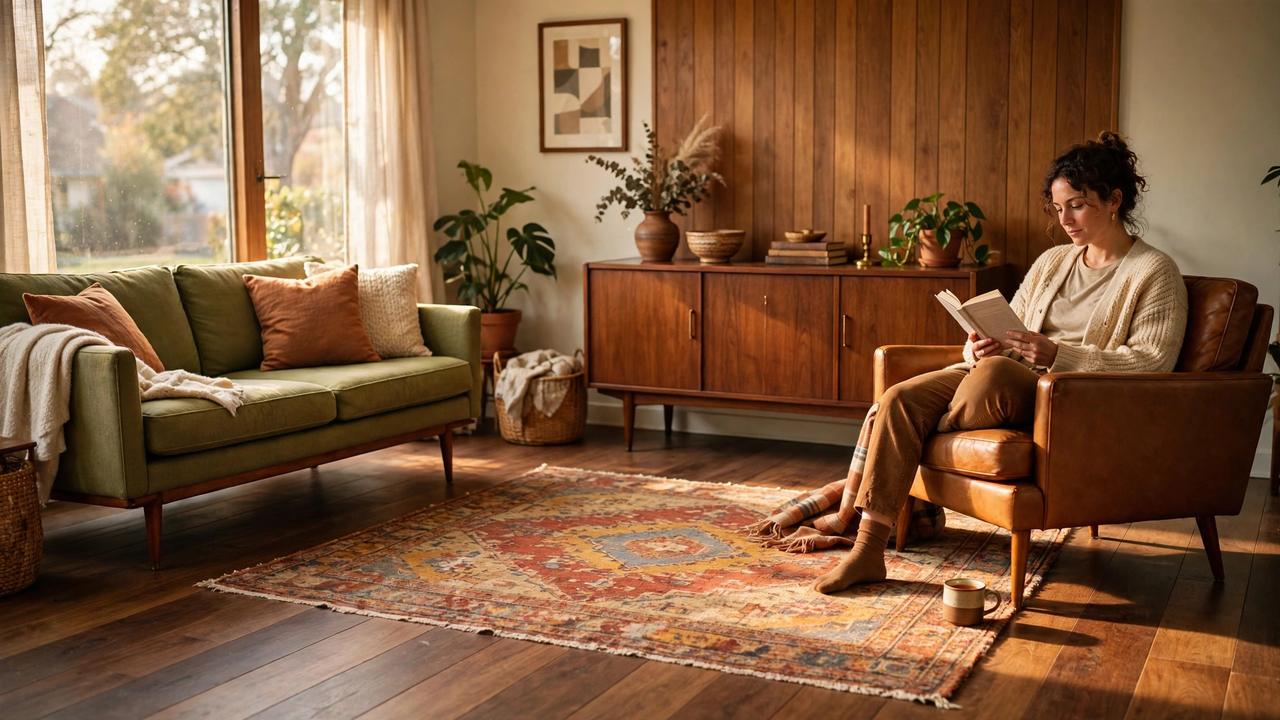
Wood floors are the foundation of almost every mid-century modern interior. The warm oak, walnut, and teak tones that define the period were meant to be seen, which is why the right rug never covers the whole floor. It anchors the seating group, echoes the geometry of the furniture, and leaves a generous border of wood visible on every side. Choosing the best rugs for mid century wood floors means balancing three things at once: a pattern and palette that belong to the era, a pile height that works with low-slung furniture and tapered legs, and a backing strategy that protects the floor finish underneath instead of trapping grit against it.
This guide pulls together six area rugs that meet those tests. Each one carries a design language rooted in the period — stripes, waves, op-art geometry, painterly abstracts — and each one was checked against its maker’s own listing details for fiber, construction, pile, and size before it earned a place here. Just as important, the buying guide explains how to pair any of these rugs with the right pad, because on wood floors the pad matters as much as the rug itself. A rug that slides scratches. A rug with the wrong backing can react with a floor finish. A rug with no pad at all lets dust grind into the boards with every step. Get the rug and the pad right together, and the floor stays as good as the room looks.
Quick verdict
If you want one recommendation, start with the SAFAVIEH Retro Collection rug in Ivory and Gray. Its striped field, medium pile, and durable polypropylene build make it the most versatile period-appropriate anchor for a living room, and it comes in the 8 by 10 size that suits most mid-century seating layouts. If easy care matters more than anything, the RUGGABLE x Jonathan Adler Op Art rug is a two-piece washable system with a genuinely graphic mid-century pattern and a cushioned pad built into the design. Wool lovers should look at the SAFAVIEH Metro Collection rug, a hand-tufted wool piece with a quiet wave pattern and a low 3/8-inch pile. The nuLOOM Kailani is the washable geometric option in a period-friendly green, the SAFAVIEH Hollywood brings the boldest wave pattern of the group in gray and red, and the SAFAVIEH Madison closes the list with a soft abstract in gray and blue that flatters walnut floors particularly well.
The products in this guide
SAFAVIEH Retro Collection Area Rug in Ivory and Gray
The Retro Collection is the most literal answer to the brief in this guide: a striped field in ivory and gray that reads like a textile pulled
Every rug in this guide had to pass four filters. First, the design had to be defensible as mid-century: geometric patterning, stripes, waves, atomic or op-art motifs, or the muted painterly abstracts that filled postwar interiors, in colors the period actually used — olive and harvest greens, teal, rust and red accents, warm neutrals, gray, and ivory. Second, the pile had to sit in the low-to-medium band. Period rooms pair rugs with low furniture, and a deep shag swallows tapered legs and fights with the clean lines of the style; every pick here is low pile or a moderate medium pile. Third, the product had to be a real, currently listed area rug from an identifiable maker, with its fiber, construction, and size confirmed on the maker’s own listing rather than a roundup or a marketplace summary. Fourth, the rug had to make sense on wood: flat enough to lie safely over boards, compatible with a separate rug pad, and free of the rough exposed backings that can abrade a finish when used without one.
Specs in the product sections are phrased as the maker lists them, because rug listings vary by size and colorway and the exact variant you choose can change a dimension or a pile figure slightly. Where a maker gives a range of sizes, we name the reference size we evaluated and note that other sizes exist in the same design. No rug was included on the strength of a photo alone, and no specification appears here that the maker’s listing does not state.
The Retro Collection is the most literal answer to the brief in this guide: a striped field in ivory and gray that reads like a textile pulled straight from a 1950s living room. Stripes were one of the era’s workhorse patterns, used on everything from upholstery to drapery, and on the floor they do something useful — they lengthen a room visually and give low, horizontal furniture a graphic base to sit on. The maker lists this rug as power-loomed from polypropylene in Turkey, with a medium pile of about 0.8 inch that the listing also describes as a 3/4-inch profile. That is the plushest feel in this roundup, yet it stays well short of shag territory, so chair legs and sofa feet still sit level.
On wood floors, the Retro’s virtues are practical as well as visual. The maker lists the fibers as stain resistant and virtually non-shedding, which matters over boards because shed fibers and tracked grit are what grind into a finish underfoot. The listing positions it for high foot traffic and for homes with kids and pets, and the care routine is simple: regular vacuuming and blotting minor stains with a mild detergent or carpet cleaner. The maker notes that rugs may arrive with temporary creases that flatten as the rug settles. Pair it with a felt-and-rubber pad cut an inch smaller on every side and the ivory field will float over honey oak or mid-tone walnut without sliding, while the gray striping picks up the upholstery tones in most period palettes.
Buy it if you want the classic striped mid-century look in a durable, family-proof build, in the 8 by 10 size that anchors a full seating group. Skip it if your room already has a lot of linear pattern in the furniture and drapes — a wave or abstract pick below will rest easier — or if you want a natural fiber.
Jonathan Adler’s Op Art design is the designer statement of this group: a bold geometric pattern in teal that the maker itself files under a mid-century, modern theme. Op art was a genuine 1960s movement, and its crisp repeated geometry is one of the fastest ways to give a wood floor a period charge without touching the furniture. The construction is what separates this rug from everything else here. It is a two-piece system — a chenille rug cover over a separate cushioned pad — and the maker lists the weave as flat woven with a low pile, so the cover lies close to the floor and doors swing freely over it.
For wood floors, the system design solves the pad question by building the answer in. The maker lists the pad as a latex-free non-slip pad that grips hard surface floors to keep the rug in place, and the cushioned version adds 0.6 inches of thickness underfoot. Because the grip layer is part of the system, there is no separate pad to research and no bare rug backing dragging across the boards. Care is the other headline: the cover is machine washable in a standard washer, and the maker lists it as stain and water resistant with a barrier that repels spills — useful insurance over a floor finish that water can damage if a spill sits. The reference size here is the generous 9 by 12, with smaller sizes in the same design for tighter rooms. One caution for purists: the flat woven cover feels thinner underfoot than a tufted rug, even over the cushioned pad, so try it in a seating zone rather than judging it as a plush rug.
Buy it if you want a true designer mid-century pattern, the easiest care in the guide, and a built-in non-slip pad system that is made for hard floors. Skip it if you dislike bold, high-contrast geometry or want the dense feel of a woven wool or medium-pile rug.
Green is the signature accent color of mid-century interiors — olive, avocado, and deep leaf tones ran through the period’s kitchens, upholstery, and ceramics — and the Kailani puts that color underfoot in a crisp geometric pattern. The maker lists the rug as power-loomed and machine made, woven from 100 percent PET polyester, in a 5 by 8 reference size that suits an apartment living room, a bedroom, or the zone in front of a credenza. The geometric repeat is small and orderly, which makes it a good citizen in rooms where the furniture already carries the bolder shapes.
The Kailani’s defining feature is that the whole rug is machine washable. The maker lists it as stain resistant and lightweight, and gives the care routine plainly: machine wash cold on the gentle cycle without bleach, then line dry or tumble without heat. For a wood floor household, that matters twice over. Spills get lifted out of the rug instead of soaking toward the boards, and a washable rug comes back to the floor fully clean rather than carrying embedded grit in its base. Because washable rugs are thin by design, a separate non-slip pad underneath is close to mandatory on wood: it stops the rug from skating, adds the cushion the thin build lacks, and keeps the rug’s underside from micro-scratching the finish as it shifts. Choose a pad made for hard floors, keep it slightly smaller than the rug, and the Kailani becomes the lowest-maintenance way in this guide to run a period green on real wood.
Buy it if you want the era’s green in a geometric pattern and the freedom to machine wash the whole rug after a spill or a muddy week. Skip it if you want a thick, cushioned feel underfoot from the rug itself, or a large 8 by 10 in this exact colorway is a must and you cannot find it listed.
Most mid-century floors were covered, when they were covered at all, in wool — and the Metro Collection is the pick for anyone who wants the authentic fiber. The maker lists it as hand-tufted in India from wool, with a low pile of 3/8 inch, in a 6 by 9 reference size. The pattern is a study in restraint: gently undulating striations flow across an open natural and ivory field, translating wave movement into a quiet textile rather than a loud print. In a room with a starburst clock, a sculptural chair, and a walnut sideboard all competing for attention, that restraint is exactly what the floor needs.
Wool brings functional gifts that suit wood floors. The maker notes that wool recovers from footsteps, resists soil naturally, and quiets a room — a real benefit in mid-century homes, where hard surfaces and open plans can make living spaces echo. The low pile sits close to the floor and lets furniture move freely, and the listing’s care guidance is the classic wool routine: vacuum on a low setting without a beater bar, blot spills at once with a dry cloth and never rub, and use professional cleaning for the whole rug. The maker is candid that a little shedding at first is normal for new wool and fades within weeks; during that period, lift the rug once or twice and sweep beneath it so loose fiber and grit do not sit against the finish. A felt pad is the right partner here — it protects the boards, cushions the tufted backing, and keeps this heavier rug planted.
Buy it if you want genuine wool, a hand-tufted build, and a calm wave pattern that supports statement furniture instead of competing with it. Skip it if you need machine washability or spill-proof synthetics for a dining room with small children.
The Hollywood Collection is the extrovert of the group. The maker lists its theme as mid-century and modern, and the design earns it: bold curving ribbons and dimensional swoops sweep across the field in gray with red, a color pairing that echoes the era’s love of a cool neutral base lit up by one hot accent. Where the Metro whispers, the Hollywood performs — it is the rug for a room whose furniture is simple and whose floor is allowed to be the art. The reference size, 5 feet 3 inches by 7 feet 6 inches, is a classic mid-format that defines a coffee-table zone in front of a sofa or sits at the foot of a bed.
The construction is built for real life on hard floors. The maker lists it as power-loomed in Turkey from polypropylene with a medium pile of 5/8 inch — soft underfoot without the bulk of a shag, so it cushions the step from board to rug without creating a trip edge. The listing states that polypropylene resists stains and will not fade quickly in sun, and that the rug sheds little to none, which keeps loose fiber off the wood. Care is vacuum as usual, blot spills at once, and clean marks with mild soap and water. One quirk the maker flags honestly: the pile leans one way, giving the rug a light side and a dark side, so walk around it before you settle its orientation and choose the read you prefer in your light. Over wood, pair it with a rug pad as the maker suggests — the pad stops the swoops from slowly traveling across the boards and keeps the medium pile from acting like a dust mop against the finish.
Buy it if you want the boldest mid-century wave in the guide and a forgiving synthetic build in a versatile mid-size. Skip it if your room already runs red accents in upholstery or art — the rug’s red needs to be the main event — or if you prefer a pattern that reads the same from every angle.
The Madison takes the painterly route: an expressive, layered abstract in gray and blue that the maker describes as bringing textural interest and dynamic modern energy to open floor plans. Abstract expressionism was the art movement of the mid-century decades, and a rug that behaves like a soft painting under the furniture is a historically honest choice — especially over walnut, where the blue-gray field cools the wood’s warmth and makes the grain read richer by contrast. The maker lists the Madison as power-loomed in Turkey from polypropylene with a low pile of 3/8 inch, in an 8 by 10 reference size.
That low pile is the Madison’s practical signature on wood. It lies flat under furniture and lets chairs slide, which makes it the natural dining-room pick of this guide: dining chairs move constantly, and a low, flat rug over a good pad lets them glide instead of catching, tipping, or dragging the rug across the boards. The maker lists it as built for busy living rooms, hallways, and family rooms, kids and pets included, with little to no shedding. Care is regular vacuuming, prompt blotting, and mild soap and water for marks, and the maker suggests rotating it twice a year so sun and traffic wear evenly — advice worth following on wood, since the floor under a rug ages out of the sun while the exposed border fades, and rotation at least evens the rug’s own wear. The maker also notes the tone shifts with light and that the pile has a light side and a dark side, so live with it a few days before judging the color against your boards.
Buy it if you want a soft abstract over warm wood, a genuinely flat low pile for a dining set or sliding chairs, and an 8 by 10 that seats a sofa and two chairs with their front legs on the rug. Skip it if you want crisp geometric pattern — the Madison’s painterly blur is the opposite of a hard-edged motif.
Buying guide
Patterns and colors that belong to the period
Mid-century pattern falls into a few families, and any of them will sit comfortably on wood. Geometry is the safest: stripes, grids, diamonds, and repeated abstract shapes in the manner of the Retro and Kailani picks. Waves and ribbons are the organic branch of the style, seen in the Metro and Hollywood rugs, echoing the kidney shapes and amoeba curves of period furniture. Op art and hard-edged repeats, like the Jonathan Adler design, bring the 1960s graphic punch. Painterly abstracts, like the Madison, reference the era’s art. For color, build from the wood outward. Warm floors — oak, teak, warm walnut — pair naturally with ivory, gray, olive, teal, and restrained red accents. Cool or gray-washed floors take the same palette but let blues lead. The most common mistake is matching the rug too closely to the floor tone, which makes both disappear; aim for contrast in value, lighter or darker than the boards, so the rug reads as a deliberate layer.
Pile height: why low to medium wins
Period furniture sits low and stands on slim, often tapered legs. A low pile of about 3/8 inch or less keeps those legs level, lets doors and dining chairs move freely, and preserves the horizontal calm of the room. A medium pile up to roughly 5/8 or 3/4 inch adds barefoot comfort in a seating zone while staying clear of shag bulk, as the Hollywood and Retro picks show. Deep pile works against everything the style stands for: it swallows leg lines, rocks furniture, traps more grit against the floor, and creates a raised edge that catches feet and vacuum heads. Whatever pile you choose, vacuum with the setting the maker specifies — beater bars off for wool and delicate constructions — because the wrong vacuum setting wears a rug faster than foot traffic does.
Backing and rug pads: protecting the wood
This is the section that decides whether your floor looks better or worse in five years. Never place a rug directly on wood and walk on it for months without checking underneath. Dust and grit migrate under every rug, and foot traffic turns that grit into an abrasive layer. The defense is a two-part routine: a proper pad, and lifting the rug to sweep beneath it on a regular schedule.
Choose the pad by material. A felt pad with a natural rubber grip layer is the standard recommendation for wood: the felt cushions and protects, the rubber holds the rug still, and neither reacts with common floor finishes. Avoid cheap PVC and vinyl pads, which can react with some finishes and leave marks, and avoid adhesive-backed pads and tapes on finished wood entirely. Latex-free non-slip pads, like the one built into the Ruggable system, are designed for hard surfaces and are a sound choice. Cut or buy the pad about an inch smaller than the rug on every side so it stays hidden and the rug’s edges lie flat on the floor. If a rug has a rough or abrasive backing — some woven and jute-backed constructions do — a pad is not optional; it is the barrier between that texture and your finish. Finally, rotate the rug and pad a half-turn once or twice a year. Sunlight fades exposed wood and covered wood differently, and rotation spreads both the rug’s wear and the light line that can form at its edge.
Sizing over wood floors
Mid-century rooms show their floors, so size the rug to the furniture group, not the room. In a living room, an 8 by 10 usually seats a sofa and chairs with at least their front legs on the rug, leaving a wood border that frames the arrangement. A 5 by 8 or the Hollywood’s mid-format suits a smaller grouping or an apartment layout. Under a dining table, the rug should extend far enough that chairs stay on it when pulled out — and a low pile, like the Madison’s, is close to mandatory there. In a bedroom, a 6 by 9 under the lower two-thirds of a bed gives a warm landing on both sides. When in doubt, tape the outline on the floor and live with it for a day; the right size is the one that leaves the wood visible as a design element rather than an afterthought.
FAQ
What rug pad is safest for wood floors under a mid-century rug?
A felt pad with a natural rubber grip layer, sized about an inch smaller than the rug on every side. It cushions, prevents sliding, and does not react with common finishes. Avoid PVC or vinyl pads and any adhesive product on finished wood. Washable rug systems with built-in non-slip pads, like the Ruggable pick in this guide, are also designed for hard floors.
Will a rug damage my wood floor?
A rug itself does not damage wood; neglect does. Grit trapped underneath abrades the finish, a sliding rug scuffs, and some backing materials or cheap pads can react with finishes. Use a proper pad, lift the rug to sweep beneath it regularly, blot spills promptly so moisture never sits against the boards, and rotate the rug once or twice a year to even out light exposure.
What colors go with walnut floors in a mid-century room?
Walnut’s warm brown takes ivory and natural tones for a calm look, gray and blue for cooling contrast, and teal, olive, or a restrained red as the period accent. The Madison’s gray-blue abstract and the Metro’s natural ivory wave both flatter walnut; keep the rug clearly lighter or darker than the floor so the two layers read separately.
Is wool or polypropylene better on wood floors?
Both work with the right pad. Wool, like the Metro pick, is the period-authentic fiber: it recovers from footprints, resists soil, and quiets a room, but it needs gentler care and sheds a little at first. Polypropylene, used in the Retro, Hollywood, and Madison picks, is stain resistant, low-shedding, and easy to clean, which suits busy households. The fiber matters less to the floor than the pad and your cleaning routine do.
How big should a rug be in a mid-century living room?
Big enough for the front legs of every seat in the group to rest on it, small enough to leave a visible border of wood on all sides. For most rooms that is an 8 by 10; smaller spaces do well with a 5 by 8 or a mid-format around 5 by 7.5 feet. Tape the outline on the floor before you buy if you are unsure.
Can I use a washable rug on wood floors?
Yes — the Kailani and the Ruggable system in this guide are both machine washable, and washing is an advantage on wood because the rug returns to the floor free of embedded grit. Thin washable rugs need a non-slip pad underneath to stop skating and add cushion, and the rug should always go back down fully dry so no moisture is trapped against the finish.
Conclusion
The right rug for a mid-century room on wood floors does three jobs: it speaks the period’s visual language, it respects the low, clean profile of the furniture, and it treats the floor underneath as something worth protecting. The SAFAVIEH Retro is the all-round anchor, the Ruggable x Jonathan Adler Op Art is the washable designer statement with its pad built in, the nuLOOM Kailani brings the era’s green in a machine washable geometric, the SAFAVIEH Metro offers real hand-tufted wool in a quiet wave, the SAFAVIEH Hollywood delivers the boldest pattern of the six, and the SAFAVIEH Madison lays a flat, painterly abstract that dining chairs can glide over. Pick the pattern that fits your room’s temperament, pair it with a felt-and-rubber pad cut just smaller than the rug, and keep the simple rhythm of sweeping beneath it and rotating it through the year. Do that, and the wood that makes the room will still be the best-looking thing in it a decade from now.
M
Modern Line Home Editorial Team
We compare specs, materials and verified owner reviews before a product earns a spot. Rankings are never paid.
Affiliate disclosure. As an Amazon Associate we earn from qualifying purchases at no extra cost to you. Prices accurate as of the date shown.
House cold even with the heat on? Walk this ordered checklist: thermostat and filter first, then drafts, insulation, leaky ducts and a failing heating system.
Windows fogging up in winter? Check where the fog sits: on the room side it is indoor humidity, outside it is harmless, and between panes the seal has failed.
Store the main firewood pile about 30 feet from your house, off the ground and covered only on top. Compare racks, woodsheds, garages and indoor spots safely.
Place a portable generator outdoors only, at least 20 feet from windows, doors and vents, exhaust pointed away. Exact distances, setup steps and CO rules here.
Keep houseplants in the right winter spot: match window direction to plant type, stay clear of radiators and cold glass, and fix dry air and low light at home.
Mice enter through pencil-width gaps at foundations, pipes, vents, doors and the roofline. Walk this room-by-room winter checklist to find and seal each one.
A winter outage timeline: what to do in the first hour, first night and multi-day outage, with food safety times, pipe protection, heat and CO safety steps.
Size a space heater by room area: 10 watts per square foot at 8-foot ceilings, adjusted for insulation and ceiling height, with full wattage and BTU tables.
Start dripping at about 20 degrees, sooner for exposed pipes. Set a pencil-lead stream, drip the right faucets on both lines, and know when to stop safely.
A fridge needs 800-1,200 starting watts, not just 150-400 running watts. Use the tables to total your fridge plus freezer, lights, furnace fan and more today.












Write Your Review
No reviews yet. Be the first to share your experience!