We independently review everything we recommend. When you buy through our links, we may earn a commission. As an Amazon Associate we earn from qualifying purchases.
Best Camping Mattresses for Big Guys: Wide and Strong
Find the best camping mattresses for big guys: wide 30-inch pads and queen air beds with maker-listed capacities, thick foam, and high R-values for cold nights.
Find the best camping mattresses for big guys: wide 30-inch pads and queen air beds with maker-listed capacities, thick foam, and high R-values for cold nights.
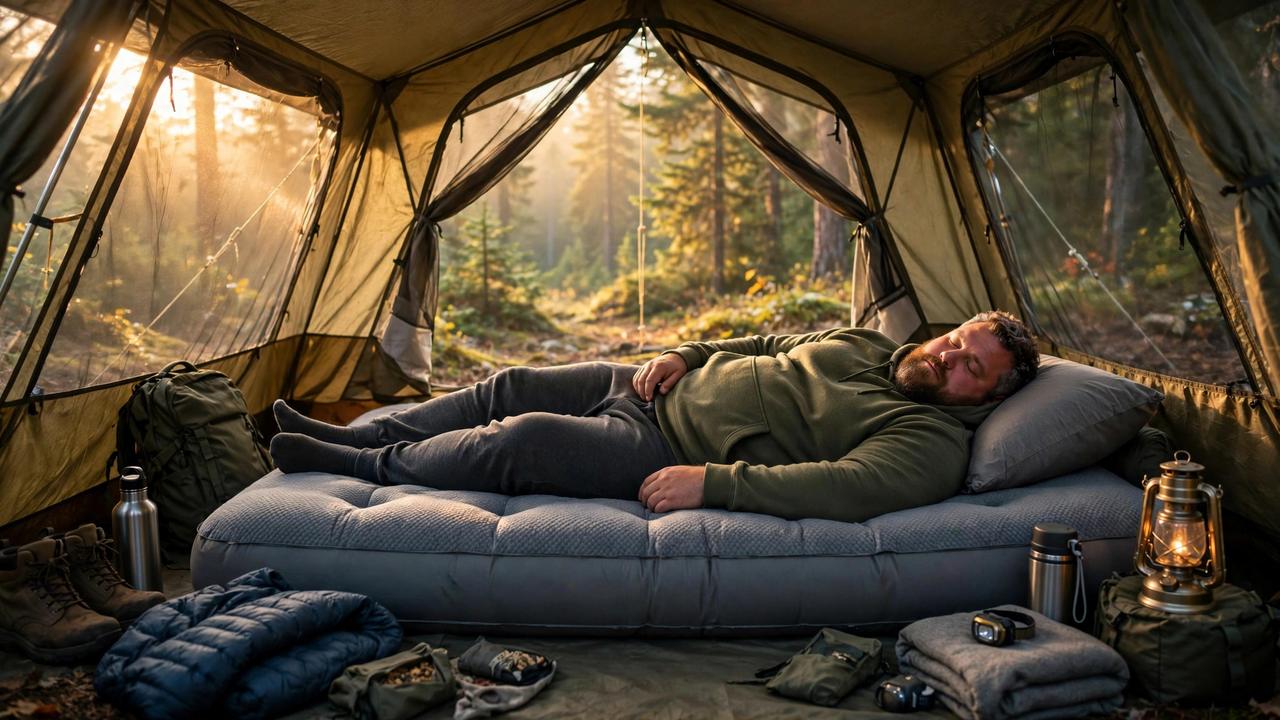
A standard camping pad is built around an average sleeper: roughly 20 to 25 inches wide, 72 inches long, and just thick enough to keep a lighter body off the ground. If you are a bigger guy, that formula fails in predictable ways. Your shoulders hang off the sides, your hips push straight through thin air chambers to the tent floor, and a pad that felt fine in the store sags by two in the morning. Finding the best camping mattresses for big guys is therefore less about chasing a single headline feature and more about matching four things at once: real width, real length, enough thickness to stop you bottoming out, and, where the maker publishes one, a weight capacity with genuine headroom above your own weight.
This guide takes that big-guy angle seriously. Every pick below is at least 30 inches wide in the size named, or a full queen width, and every thickness, dimension, R-value and capacity figure is one the maker lists on its own product page or on the product listing for that exact model. Where a maker publishes a weight capacity, we quote it and treat it as a ceiling to stay comfortably under, not a target to test. Where a maker does not publish a capacity for a foam pad, we say so plainly and judge that pad on its width, thickness and construction instead. The result is a short list that spans tall double-high air beds for drive-up campsites, thick self-inflating foam pads for cold ground, and one genuinely packable wide pad for the big guy who still walks a mile or two to camp.
Quick verdict
If you camp from a car or truck and want the most room and the highest maker-listed capacity in this guide, start with the Coleman SupportRest Double-High in queen size: the maker lists a capacity of 600 pounds, an 18-inch double-high profile, and a 78 by 60 inch sleeping surface. If you want that queen footprint with a foam core and strong insulation instead of a pure air bed, the LOSTHORIZON Air and Foam mattress in queen size pairs an 80 by 60 inch surface with a maker-listed capacity of 440 pounds and a maker-listed R-value of 13. For a solo pad, the EXPED MegaMat in Long X-Wide is the warm benchmark, with a 30.3-inch width and a maker-listed R-value of 8.1, while the Therm-a-Rest MondoKing 3D in XX-Large is the longest solo pad here at 80 inches. The Big Agnes Captain Comfort Deluxe is the thickest solo pad in the guide at five inches, and the Klymit Insulated Static V Luxe is the one pick that still packs small enough for a backpack while giving you a 30-inch width and a maker-listed capacity of 300 pounds.
The products in this guide
Coleman SupportRest Double-High Queen Air Mattress
In queen size the maker lists inflated dimensions of 78 by 60 inches and a double-high profile of 18 inches, so a solo sleeper gets a surface wider
Best if you are a heavy solo sleeper who wants queen width and bed height at
Read the capacity column carefully. A published capacity is a maximum for the whole mattress, so on a queen bed shared by two people it is the combined load that matters, and on any mattress it also has to carry bedding and the extra force of sitting down or rolling over. The foam pads without a published figure are not weaker by default; their makers simply rate them by size and construction rather than by a load number, which is exactly why thickness and width do so much of the work in their sections below.
How we selected
We started with width, because width is the constraint big sleepers feel first. Every solo pad in this guide is 30 inches wide or wider in the size named, a full step up from the 25-inch wide pads that dominate the market, and the two queen models give a solo big guy a 60-inch surface to spread across. Length came next: five of the six picks are 77.6 inches or longer, so a sleeper over six feet is not choosing between a pillow and warm feet.
Thickness was the third filter, and it matters more for heavier sleepers than for anyone else. A thin air pad supports you with pressure alone, and the more you weigh, the more pressure it takes, which is why hips and shoulders bottom out. Foam-core pads and deep air beds spread that load across more material. The solo pads here run from three to five inches thick, and the Coleman stands 18 inches tall, which also makes getting up from the mattress a very different job than rising from floor level.
Fourth, we checked capacities wherever a maker publishes one and refused to invent one where it does not. Three picks carry a maker-listed capacity on their listings: 600 pounds for the Coleman queen, 440 pounds for the LOSTHORIZON queen, and 300 pounds for the Klymit pad. For the three premium foam pads whose makers publish dimensions, thickness and R-values but no load figure, we report exactly that, and we recommend them on the strength of their size and depth rather than on a number nobody stated.
Finally, every product had to be a real, current model sold new on Amazon US in the size named, with its specifications confirmed on an opened maker page or an opened listing for that exact model. Size variants matter enormously in this category, a wide pad and its regular sibling can share a name and almost nothing else, so each pick is pinned to the specific size discussed, and the linked listings are the listings for those sizes.
The Coleman SupportRest Double-High is the pick that solves the big-guy problem with sheer scale. In queen size the maker lists inflated dimensions of 78 by 60 inches and a double-high profile of 18 inches, so a solo sleeper gets a surface wider than most tent doors and a bed height closer to the mattress at home than to the ground. Most importantly for this guide, the maker lists a weight capacity of 600 pounds for the queen size, the highest published figure among these picks, which gives a heavy solo sleeper real headroom and gives two campers a combined ceiling they can actually plan around.
Support comes from coil construction rather than a single open air chamber. The maker describes its ComfortStrong coil system as contouring to the body for better support, and that internal structure is what keeps a tall air bed from feeling like a raft when a heavier sleeper sits on the edge to pull boots on. The top is a velvet-like plush surface, the bed fits standard queen sheets, and a built-in pump inflates it in minutes, with the maker quoting under four minutes for the rechargeable version of this bed. A dual-sealed valve is designed to hold that air overnight instead of slowly handing it back.
The trade-offs are the ones you would expect from an 18-inch queen air bed. It is a car-camping and guest-room mattress, full stop: it is bulky rolled, it needs its pump charged or powered, and an uninsulated air bed is not the warmest choice on frozen ground, since the maker does not list an R-value for it. Pair it with a blanket or pad on top in cold weather. In a big tent, a truck-adjacent camp or a cabin, though, nothing else in this guide gives you this much width, this much height and a published 600-pound ceiling in one product.
Buy it if: you are a heavy solo sleeper who wants queen width and bed height at a drive-up site, or two campers whose combined weight needs a maker-listed 600-pound capacity.
Skip it if: you camp in serious cold without adding insulation on top, you need to carry your mattress any distance, or your tent is too small for a 60-inch-wide, 18-inch-tall bed.
The LOSTHORIZON queen takes the opposite approach to the Coleman: instead of height, it combines air with a solid foam core. The maker lists the queen at 80 by 60 inches and 4.5 inches thick, with a weight capacity of 440 pounds, a maker-listed R-value of 13, and a total weight of 17.6 pounds. That makes it the longest surface in this guide, tied for the widest, and the only queen here whose insulation figure is published, which matters for big guys who camp in shoulder season and find that a plain air bed turns cold underneath them.
The foam-and-air build is the real story. The maker describes the mattress as self-inflating, with firmness you adjust by adding or releasing air, so a heavier sleeper can run it firmer for support while a lighter partner on the other side still gets some give from the foam. The maker also highlights quiet, stable support, because the foam core damps the squeak and bounce of a pure air chamber when you roll over. A pump is included in the box, the cover uses a 30D stretch fabric, and the queen is model 2112402-Q0-BR in the maker’s range, alongside smaller sizes with lower capacities, so check you are ordering the queen if the 440-pound figure is part of your decision.
Be clear about what it is not. At 17.6 pounds rolled into a substantial bundle, this is a basecamp, rooftop-tent and vehicle mattress, not a backpacking pad, and the maker says as much. Its R-value is a maker-listed figure rather than one presented as an ASTM-tested score, so treat it as the brand’s own insulation claim. Within those limits, it is a compelling middle path: queen room, a published capacity with headroom for most solo big guys, foam support that does not depend entirely on air pressure, and warmth claims no plain air bed in this guide attempts.
Buy it if: you want queen width with foam support and a maker-listed capacity of 440 pounds, and you camp in cool or cold weather where an uninsulated air bed feels chilly.
Skip it if: you need a mattress you can carry into camp, you want the sit-on-the-edge height of a double-high bed, or a smaller size’s lower capacity would be the one that actually arrives, so double-check the size before ordering.
The EXPED MegaMat in Long X-Wide, the LXW size, is the solo pad that big car campers have treated as a benchmark for years. The maker lists it at 77.6 by 30.3 inches, 3.9 inches thick, with an R-value of 8.1, a weight of 5 pounds 11.5 ounces, and a packed size of 31.1 by 9.8 inches. That width is the widest solo footprint in this guide, and the 3D construction with vertical sidewalls means the usable surface runs close to the full stated width instead of doming away at the edges, which is where wider sleepers usually lose room first.
Inside is an open-cell polyurethane foam core with horizontal air channels cored through it to cut weight and packed volume. The pad self-inflates when you open the valve, and the included Top-Up Pump lets you set the final firmness precisely, a feature heavier sleepers should use: a foam-core pad run slightly firmer carries a hip far better than the same pad left soft. The maker lists a recycled 50-denier tricot polyester top and a recycled 75-denier polyester bottom, separate inflate and deflate valves, and a repair kit in the box. EXPED does not publish a weight capacity for this pad, so we do not quote one; the case for it rests on its width, its foam depth and an R-value that makes it a genuine four-season option.
Its limits are packed size and patience. A 31-inch roll claims real trunk space, a brand-new pad can take a while to reach full loft the first few times, and deflating all that foam on a cold morning is a job you do with your knees and some commitment. None of that matters much at a drive-up site, which is the use it was designed for. For a big guy who camps solo in all seasons and wants one pad that behaves like a mattress rather than a mat, this is the warmest and widest solo option here.
Buy it if: you are a broad solo sleeper who camps in cold weather, wants the full 30.3-inch width usable to the edges, and values a maker-listed R-value of 8.1.
Skip it if: trunk space is tight, you want a published weight capacity to shop by, or you regularly share the mattress, since this is a one-person pad.
The MondoKing 3D in XX-Large is built for the tall end of big. The maker, Therm-a-Rest, lists the XX-Large at 80 by 30 inches and 4.25 inches thick, with an R-value of 7.0, a weight of 5 pounds 8 ounces, and a packed size of 31 by 10.3 inches. Eighty inches is the longest solo sleeping surface in this guide, so a sleeper who is both tall and broad is not trading width for length, and the 3D shape with vertical sidewalls keeps that whole rectangle available instead of sloping off at the borders.
The support system is the maker’s StrataCore construction, a continuous layer of thermal foam set between alternating ridges of air and foam, which gives the pad a firmer, more even feel than a soft foam slab. Heavier and stomach sleepers in particular tend to prefer that firmer platform, because it resists the hammock sag that a very plush pad can allow under a heavy midsection. The TwinLock valve system uses two one-way valves, one dedicated to inflation and one to deflation, and the included stuff sack doubles as a pump sack. The maker lists a 50-denier polyester knit top, a 75-denier polyester bottom, and urethane foam. Like EXPED, Therm-a-Rest does not publish a weight capacity for this pad, so judge it on its dimensions and depth, which are both at the top of the solo class.
Downsides mirror its rival: it packs into a long, fat roll, it is firmly a vehicle-based pad at five and a half pounds, and the pump sack connection can take a little practice. It is also worth storing unrolled with the valves open, as makers of foam pads generally recommend, so the core keeps its loft. If your height is the first problem and your weight the second, the MondoKing XXL answers both with the longest bed here and more than four inches of structured foam under you.
Buy it if: you are tall as well as big, want an 80-inch solo pad with a firmer foam platform, and camp in cold weather that suits a maker-listed R-value of 7.0.
Skip it if: you prefer a very plush, sink-in feel, you need a published weight capacity, or packed bulk is already a problem in your vehicle.
Big Agnes Captain Comfort Deluxe Camp Pad, Extra Wide Long
The Captain Comfort Deluxe in Extra Wide Long is the thickness leader among the solo pads. Big Agnes lists this size at 78 by 30 inches and a full five inches thick, with an R-value of 8.3 for this size, a weight of about 6 pounds 6 ounces, and a packed size of 11 by 17 inches. Five inches of foam-and-air loft is a meaningful margin for a heavy side sleeper, because it is the distance between your hip bone and the ground that decides whether you feel the tent floor at three in the morning, and this pad simply has more of that distance than anything else here.
The construction follows the same premium pattern as its rivals: a self-inflating foam core with horizontal coring to trim bulk, vertical sidewalls for a flat, mattress-like top, a soft stretch fabric surface, and two valves so you can inflate, deflate and micro-adjust without fighting a single fitting. The maker offers the model in wider double sizes as well, but the Extra Wide Long is the solo size that fits this guide: a full 30 inches for one sleeper, with the highest maker-listed R-value of the solo pads here. As with the other two premium foam pads, Big Agnes does not publish a weight capacity for it, so the recommendation rests on depth, width and warmth rather than a load figure.
That depth cuts both ways. Extracting the air from five inches of foam takes repeated rolling and some patience, the pad is the heaviest solo option in this guide, and its short, thick packed roll is an awkward shape even if its length is handy. It is also a considered purchase rather than an impulse one. For the big guy whose main complaint is bottoming out, though, the logic is hard to argue with: the thickest pad, at full width, with four-season insulation, made by a maker that sells it specifically as its deluxe camp pad.
Buy it if: bottoming out is your main problem, you sleep on your side, and you want the deepest solo pad here at five inches with a maker-listed R-value of 8.3.
Skip it if: you hate a slow pack-up routine, you are shopping strictly by a published weight capacity, or you need a pad that disappears into a small car.
Every other pick in this guide assumes a vehicle does the carrying. The Klymit Insulated Static V Luxe is the exception, and it earns its place by giving a big guy a real wide pad he can actually walk in with. The maker lists it at 76 by 30 inches and three inches thick, weighing 32 ounces and packing to about 10 by 5 inches, and the listing for this exact model states a maximum weight capacity of 300 pounds. A 30-inch-wide pad that disappears into a backpack side pocket is a genuinely different proposition from a 31-inch foam roll.
The design is an air pad with the maker’s V-Chamber baffles, which limit air movement and are shaped to distribute weight across the surface, plus side rails intended to keep you centred on the pad. The insulated version adds Klymalite synthetic insulation; note the figures carefully, because the maker lists an ASTM R-value of 2.4 for this pad, a three-season number, whatever larger historical figures older listings showed. The fabric is 75-denier polyester. Three inches of air is also less forgiving than four or five inches of foam for a very heavy side sleeper, and the 300-pound maker-listed capacity is the lowest published figure in this guide, so it suits the big guy under that ceiling rather than the heaviest sleepers, who should take one of the queen or foam options instead.
Used within its limits, it solves a real problem: the tall, broad hiker who is tired of 23-inch pads. It inflates by breath or pump sack in a couple of dozen breaths, the wide rectangle fits three-person tents better than two-person ones if a partner is along, and at two pounds it leaves pack weight for everything else. Think of it as the mobility pick: less depth, less warmth and a lower published ceiling than the car-camping pads, in exchange for being the only mattress here that goes where you go on foot.
Buy it if: you backpack or hike in to camp, stay under the maker-listed capacity of 300 pounds, and want a 30-inch width in a two-pound, packable pad for three-season trips.
Skip it if: you weigh near or above that published ceiling, you sleep cold and need a high R-value, or you are a heavy side sleeper who bottoms out on three inches of air.
Buying guide
Start with the capacity, but read it properly. Where a maker publishes a weight capacity, treat it as the maximum total load, not a comfort rating. A solo sleeper should look for clear headroom above his own weight plus bedding, because sitting up, kneeling and rolling all load a mattress harder than lying still. On a shared queen, add both sleepers together. And where a maker publishes no capacity at all, which is common for premium foam pads, do not fill the gap with guesses from forums; shop those pads on width, thickness and construction instead.
Width is the big-guy specification. Twenty-five inches is sold as wide across the industry, and for a broad-shouldered sleeper it still leaves elbows negotiating with the tent floor. Thirty inches changes the night: you can sleep on your back without arranging your arms, and turn without a conscious plan. Measure your tent floor before buying, though, because two 30-inch pads side by side need a genuinely wide tent, and a 60-inch queen needs a family-size shelter or a vehicle.
Thickness prevents bottoming out. The heavier you are, the more you compress whatever is under you. As a working rule from the sizes in this guide, look for at least three inches of air, four inches of foam-and-air for car camping, and more if you sleep on your side, where your whole load concentrates on a shoulder and a hip. Foam cores forgive under-inflation; pure air pads punish it, so keep them topped up.
Match the R-value to your season. R-value measures insulation from the ground. The maker-listed figures here range from 2.4 on the packable Klymit, a three-season pad, through 7.0 and 8.1 and 8.3 on the big foam pads, which are four-season tools, to a maker-listed 13 on the foam-cored queen. Uninsulated double-high air beds publish no R-value and sleep cold in winter unless you add insulation above them. Ground cold is not a comfort detail for big guys; a compressed pad insulates less under a heavier load, so err on the warm side.
Decide who carries it. This guide splits cleanly in two. The queens and the big foam pads weigh between five and a half and seventeen and a half pounds and pack into rolls or bundles meant for a trunk, a truck bed or a rooftop tent. The Klymit weighs two pounds and packs to the size of a large water bottle, and it is the only pick that belongs in a backpack. Neither group is better; they are answers to different trips, and many big campers end up owning one of each.
Plan the details. Check the valve and pump story before a trip, charge a built-in pump if your bed has one, carry the repair kit the foam-pad makers include, and store self-inflating pads unrolled with valves open so the foam keeps its loft. Finally, confirm the exact size at checkout: in this category the difference between a regular and an extra-wide variant is the entire point of the purchase, and model names alone do not tell you which one is in the cart.
Frequently asked questions
What weight capacity should a big guy look for in a camping mattress?
Look for a maker-listed capacity with clear headroom above your weight plus bedding, rather than a figure you have to sit exactly on. In this guide the published figures run from 300 pounds on the packable Klymit pad to 440 pounds on the LOSTHORIZON queen and 600 pounds on the Coleman queen. Remember that a shared mattress is rated for the combined load, and that some premium foam pads publish no capacity at all, in which case width and thickness are the honest basis for choosing.
How wide should a camping mattress be for a big guy?
Thirty inches is the width that changes the experience for most broad sleepers, and it is the minimum solo width in this guide. The standard wide size across the industry is 25 inches, which still crowds wide shoulders and elbows. If you camp solo from a vehicle and your shelter allows it, a 60-inch queen gives you room no solo pad matches; just measure your tent floor first, because queens need large tents.
Are foam pads or air mattresses better for heavier campers?
Foam-and-air self-inflating pads are generally the safer bet for heavier campers at a drive-up site, because the foam core still supports you if the air is a little soft, and four to five inches of loft resists bottoming out. Pure air beds can work very well, especially double-high models with internal coil structure and a high published capacity, but they depend entirely on staying fully inflated. Thin backpacking air pads are the most demanding of the three and suit big guys only within their published capacity.
What R-value does a big guy need for cold-weather camping?
The same ranges apply to everyone, with one adjustment: a heavier sleeper compresses a pad more, and a compressed pad insulates less, so choose toward the top of the range for your season. For three-season use, a maker-listed R-value around 2.5 to 4.5 is a common target; for winter and frozen ground, look at 6 and above. The big foam pads in this guide list 7.0 to 8.3, and the foam-cored queen lists 13, while a packable pad listing 2.4 is a three-season tool.
Can a big guy backpack with any of these mattresses?
Only one pick here is built for it: the Klymit Insulated Static V Luxe, which the maker lists at 32 ounces with a packed size of about 10 by 5 inches and a capacity of 300 pounds. The foam pads weigh five and a half to six and a half pounds and roll to around 31 inches, and the queens are heavier still, so they belong to car camping, basecamps and vehicle sleeping. If you hike in and exceed the packable pad’s published capacity, the realistic answer is a drive-up site and a foam pad, not a lighter pad used past its limit.
Conclusion
The right camping mattress for a big guy is the one whose published numbers actually fit his body: wide enough for his shoulders, long enough for his height, thick enough that his hip never meets the ground, and, where the maker states one, rated with headroom to spare. For maximum room and the highest maker-listed capacity here, that is the Coleman SupportRest Double-High queen at 600 pounds. For queen space with foam support and cold-weather insulation, it is the LOSTHORIZON queen at 440 pounds. Among solo pads, the EXPED MegaMat Long X-Wide brings the widest usable surface and the warmth to match, the MondoKing 3D XX-Large brings the length, the Big Agnes Captain Comfort Deluxe brings the deepest five-inch cushion, and the Klymit Insulated Static V Luxe brings a 30-inch width to the trail within its 300-pound published limit. Match the pick to how you actually camp, vehicle or on foot, summer or frozen ground, and the mattress stops being the thing that limits the trip.
M
Modern Line Home Editorial Team
We compare specs, materials and verified owner reviews before a product earns a spot. Rankings are never paid.
Affiliate disclosure. As an Amazon Associate we earn from qualifying purchases at no extra cost to you. Prices accurate as of the date shown.
House cold even with the heat on? Walk this ordered checklist: thermostat and filter first, then drafts, insulation, leaky ducts and a failing heating system.
Windows fogging up in winter? Check where the fog sits: on the room side it is indoor humidity, outside it is harmless, and between panes the seal has failed.
Store the main firewood pile about 30 feet from your house, off the ground and covered only on top. Compare racks, woodsheds, garages and indoor spots safely.
Place a portable generator outdoors only, at least 20 feet from windows, doors and vents, exhaust pointed away. Exact distances, setup steps and CO rules here.
Keep houseplants in the right winter spot: match window direction to plant type, stay clear of radiators and cold glass, and fix dry air and low light at home.
Mice enter through pencil-width gaps at foundations, pipes, vents, doors and the roofline. Walk this room-by-room winter checklist to find and seal each one.
A winter outage timeline: what to do in the first hour, first night and multi-day outage, with food safety times, pipe protection, heat and CO safety steps.
Size a space heater by room area: 10 watts per square foot at 8-foot ceilings, adjusted for insulation and ceiling height, with full wattage and BTU tables.
Start dripping at about 20 degrees, sooner for exposed pipes. Set a pencil-lead stream, drip the right faucets on both lines, and know when to stop safely.
A fridge needs 800-1,200 starting watts, not just 150-400 running watts. Use the tables to total your fridge plus freezer, lights, furnace fan and more today.












Write Your Review
No reviews yet. Be the first to share your experience!