We independently review everything we recommend. When you buy through our links, we may earn a commission. As an Amazon Associate we earn from qualifying purchases.
Best Office Chairs for Leg Circulation: 6 Top Picks
Compare six office chairs with waterfall seat edges, adjustable seat depth and recline, chosen for seated leg comfort on long desk days at home or work today.
Compare six office chairs with waterfall seat edges, adjustable seat depth and recline, chosen for seated leg comfort on long desk days at home or work today.
If your legs feel restless, heavy or simply uncomfortable after a few hours at a desk, the seat you are sitting on is worth a close look. A seat that is too deep presses its front edge into the back of your thighs. A seat set too high leaves your feet dangling and loads that same edge. A rigid front lip gives your legs nowhere to soften the contact. None of those are medical problems a chair can solve, and this guide does not pretend otherwise. What a well-chosen chair can do is give you the adjustments that let the seat fit your legs properly: a front edge that curves or flexes away, a seat depth you can shorten or lengthen, a height range that lets your feet rest flat, and a recline that lets you change position through the day. This guide to the best office chairs for leg circulation is really a guide to those features, applied to six real chairs from established makers.
One plain note before the picks. A chair is furniture, not a medical treatment. Nothing in this article claims that any chair changes circulation, affects swelling, prevents clots or helps any medical condition, because chairs are not sold or tested as medical devices. If you have ongoing leg discomfort, swelling, numbness or any circulation concern, talk to a clinician rather than shopping for a cure in a furniture catalogue. What follows is about seated comfort and fit: the maker-listed ergonomic features that determine how a seat meets the back of your legs, and how to set them up once the chair is in front of your desk.
Quick verdict
The Steelcase Leap is the strongest all-round pick for leg comfort at a desk, because it combines the two features that matter most in one chair: the maker lists a flexible seat edge that reduces pressure on the back of your legs, and a seat depth that adjusts across a wide range so the edge can stop short of your knees. The Haworth Fern is the closest rival, with a maker-listed waterfall seat edge and a long seat-depth adjustment, in a softer, more relaxed design. The Steelcase Gesture suits people who shift between keyboard, phone and tablet postures and still want a proper seat-depth slider. The Herman Miller Embody is the pick for sitters who move constantly, with a seat depth that adjusts in locking positions and a seat built from independent support elements. The Herman Miller Aeron, in size B here, is the choice for people who run warm and want a sized mesh seat with no foam at all. The Steelcase Series 1 is the most accessible route to a genuine adjustable seat depth from a major maker, in a lighter, simpler chair.
The products in this guide
Steelcase Leap Office Chair
Combined with the Leap’s seat-depth adjustment, it becomes a proper fit system: the maker lists seat depth adjusting from 15.75 to 18.75 inches, so
Best if you want the strongest combination of a flexible seat edge and a wide seat-depth
Every chair in this guide had to pass the same checks. First, the product had to be a real, current model from an identifiable maker, sold new on Amazon US, with its existence and specification confirmed on opened pages rather than search snippets. Second, it had to offer at least one maker-listed feature that directly affects how the seat meets your legs: a waterfall or flexible front edge, an adjustable seat depth, a forward tilt, or a seat construction designed to spread load rather than concentrate it at the front lip. Chairs whose only claim was a thick cushion were left out, because extra foam under the thighs does nothing about an edge that sits in the wrong place.
Third, the numbers had to be published. Seat depth ranges, seat height ranges and weight capacities in this guide are the figures the maker lists, and they are phrased that way throughout. Where a maker lists a range, the range is quoted; where a chair is sized rather than adjustable, like the Aeron, that limitation is stated plainly instead of being smoothed over. Fourth, adjustability had to be usable by one person at a normal desk: levers and knobs reachable from the seated position, and adjustments that stay where they are set.
Finally, we deliberately excluded chairs that lean on medical language to sell themselves. Compression claims, therapeutic claims and recovery claims have no place in a furniture listing, and any model marketed that way was skipped in favour of established task chairs whose makers describe them in ordinary ergonomic terms: fit, support, movement and comfort. The result is a short list of six chairs that differ in price level, materials and feel, but share the mechanical features that decide whether a seat is kind to the back of your legs over a long day.
The Leap earns the top spot because Steelcase designed its seat around exactly the contact point this guide is about. The maker lists a flexible seat edge that reduces pressure on the back of your legs, and the front of the seat gives under load instead of holding a hard line against your thighs. On its own that would be a nice detail. Combined with the Leap’s seat-depth adjustment, it becomes a proper fit system: the maker lists seat depth adjusting from 15.75 to 18.75 inches, so you can slide the seat until a small gap remains between its front edge and the back of your knees, and the flexible edge softens whatever contact remains when you shift forward.
The rest of the chair supports that brief well. The maker lists the Natural Glide System, which lets the seat glide as you recline so your posture stays in check and you stay close to your work surface instead of sliding away from it. The 3D LiveBack technology is designed to mimic the natural shape of your spine, and there is a lower back firmness dial so you can set how assertively the lumbar area pushes back. The maker lists a seat height range of 15.5 to 20.5 inches on the standard cylinder, which covers most desk heights and lets most sitters get their feet flat on the floor, a basic but essential part of keeping weight off the seat edge. The listed weight capacity is 400 pounds, the highest in this guide alongside the Gesture.
In daily use, the Leap is the chair for someone who wants to set things once and then stop thinking about them. The controls are mechanical and direct, the seat is a supportive foam rather than a hammock, and the recline works through a set of back-stop positions up to a relaxed lean. If your current chair leaves a line of discomfort across the back of your thighs by mid-afternoon, the combination of a shorter seat setting and a flexing front edge is the most direct furniture answer available, stated strictly as a matter of fit and comfort.
Buy it if: you want the strongest combination of a flexible seat edge and a wide seat-depth range, you sit for long stretches, and you prefer a firm, supportive foam seat with a high listed capacity.
Skip it if: you want a mesh seat for airflow, you need a headrest built in from the factory, or your legs are long enough that even an 18.75-inch seat depth leaves you wanting more seat under your thighs.
The Fern is the other chair in this guide whose maker uses the exact words this topic calls for. Haworth lists a waterfall seat edge, which means the front of the seat curves down and away instead of ending in a squared-off lip. Haworth also lists 88 mm of seat depth adjustment, a generous amount of travel that lets the seat sit at roughly 395 to 483 mm deep, so shorter and longer legs can both find a setting where the waterfall edge falls clear of the back of the knee. For a chair chosen around leg comfort, that pairing of a shaped edge and real depth travel is the whole argument, and the Fern makes it cleanly.
Around that seat, Haworth lists a seat height adjustment from 420 to 540 mm, a five-position back stop that limits how far you recline, a forward tilt that lets you adjust your posture toward the desk, and tilt tension control for supportive reclining. The back uses the maker’s patented Wave Suspension system, a flexible structure of cradles that responds as you move rather than a rigid shell with a lumbar pad stuck on it. The maker lists 4D arms, and a weight capacity of up to 150 kg on its store specification. The overall feel is less mechanical than the Leap: fewer dials, a back that moves with you, and a seat that aims to disappear rather than to hold you in a set shape.
The Fern suits a sitter who changes position often and dislikes being locked into one posture. Lean back and the back stop catches you where you set it; perch forward and the forward tilt keeps the seat under you; slide the seat shallower for a morning of focused typing, then deeper for a relaxed afternoon of reading. The waterfall edge matters most in that forward, feet-flat working position, where the front of the seat would otherwise do most of the pressing. If your taste runs to a softer, more residential look, the Fern’s knit and mesh options also sit more easily in a home office than the Leap’s corporate styling.
Buy it if: you want a maker-listed waterfall seat edge with long seat-depth travel, a flexible movement-friendly back, and a chair that looks at home in a home office.
Skip it if: you want a firmness dial for the lumbar area, a very firm seat, or the reassurance of a long published track record at the very top of the market.
The Gesture was designed from a global posture study, and it shows in how it handles the in-between positions: leaning sideways on one elbow, perching with a tablet, swivelling to a second screen. For leg comfort, the relevant hardware is under the seat. The maker lists an adjustable seat depth running from 15.75 to 18.5 inches, set by a knob you turn from the seated position, and its own guidance for that adjustment is to leave two to three inches between the front edge of the seat and the back of your knees. That is exactly the clearance this guide recommends, printed in the maker’s own instructions. The seat itself is a high-density foam cushion, and the maker describes a wider-than-average seat with adaptive bolstering shaped to fit the sitter.
The Gesture’s signature feature is its arms. Steelcase calls them 360-degree arms, and the maker lists them adjusting in height, width, pivot and depth to support the postures people actually adopt with phones and tablets. The back uses the 3D LiveBack system, the maker lists a Core Equalizer that changes lumbar firmness automatically as the recline angle changes, and an optional height-adjustable lumbar support with four inches of travel. Seat height adjusts from 16 to 21 inches, and the listed weight capacity is 400 pounds. Recline runs through a variable back stop with an upright lock, so you can work bolt upright, lean mid-way, or open the chair up for a call.
Choose the Gesture if your workday is a mixture of devices and postures and your legs complain most when you have been sitting in one twisted position for too long. The seat-depth knob makes small corrections easy, which encourages the habit that matters: nudging the seat a little shallower when you perch, a little deeper when you recline. It is a substantial, heavy chair, and its price level matches the Leap’s, so the decision between them is about arms and posture range rather than about the seat, where both are strong.
Buy it if: you move between keyboard, phone and tablet all day, you want seat-depth adjustment you can fine-tune by knob, and you value arms that follow your postures.
Skip it if: you sit in one classic typing posture all day and would not use the arm range, or you want a mesh seat rather than foam.
The Embody approaches the seat differently from every other chair here. Instead of a single slab of foam, the maker lists a four-layer seat with elastic suspension and support coils that move independently, part of a system Herman Miller calls Pixelated Support, which it says conforms to your micro-movements and distributes weight across the seat. For the back of your thighs, the practical point is that load is spread by many small elements rather than carried on one firm front bar of foam. The maker lists the seat depth adjusting from 15 to 18 inches in six locking positions, the shallowest starting point in this guide, which makes the Embody a genuinely good fit for shorter legs that most chairs leave pressed against the seat edge.
The back is a central spine with flexible ribs, set by the maker’s BackFit adjustment, which Herman Miller describes as letting you fine-tune the chair to your spine and then adapt to your movement. The maker lists a seat height range of 16 to 20.5 inches, a tilt limiter so you can cap the recline, and fully adjustable arms as an option, adjusting in height and width. The listed weight capacity is 300 pounds, the joint lowest here, and there is no separate lumbar pad adjustment; the back’s shape is set through BackFit instead. The chair is one size only, so all of the fitting work is done by the seat slider, the height cylinder and the back adjustment.
The Embody is the pick for the fidgeter: the person who crosses and uncrosses their legs, shifts weight from side to side, leans, straightens and never sits the same way for ten minutes together. A seat built from independent elements rewards that movement instead of punishing it, and the six locking depth positions make it easy to return to a setting that works after someone else has used the chair. If you instead want a chair that holds one firm, unchanging shape, the Leap will feel more disciplined. If you want a chair that keeps up with you, this is it.
Buy it if: you have shorter legs and need a seat that adjusts down to 15 inches deep, you move constantly while seated, and you like the idea of a seat made of independent support elements.
Skip it if: you are over the 300-pound listed capacity, you want a separate lumbar adjustment, or you prefer the simple, firm feel of a conventional foam seat.
The Aeron takes the opposite route to fit from the adjustable chairs above: instead of a sliding seat, it comes in three sizes, and you choose the size whose fixed seat depth matches your legs. The listing for this size B chair states it provides optimal ergonomic support for people between 5 feet 3 inches and 6 feet 6 inches in height, and the maker lists the size B seat depth at 17 inches, between 16 inches on size A and 18.5 inches on size C. Get the size right and the front of the seat lands where it should, short of the back of your knees, with nothing to adjust and nothing to drift out of setting. Get it wrong and there is no slider to rescue you, which is why the sizing decision matters more on this chair than on any other in the guide.
What you sit on is not foam at all. The maker lists the 8Z Pellicle suspension seat and back, divided into eight zones of varying tension that cradle and support the body, with air passing through the mesh instead of heat building up under your thighs. The listing describes the Pellicle as providing targeted pressure distribution, and the suspended seat has a giving quality that some sitters find kinder across the back of the legs than a padded edge. The maker lists the Harmonic 2 tilt for natural, balanced motion through posture changes, a tilt limiter, a seat angle adjustment that can tip the seat toward an engaged forward posture, and PostureFit SL support with two pads that flex independently. Fully adjustable arms are listed as adjusting in height, sliding forward and back, and pivoting in and out.
Choose the Aeron if you run warm, dislike foam, and are confident in your size. The size B is the middle and most commonly fitted of the three, and its wide seat height range makes it easy to set your feet flat. Be honest about the sizing, though: if you fall between sizes, the maker’s own guidance leans toward size B, but a chair with a sliding seat, like the Embody or the Leap, removes the gamble entirely. For a shared or hot-desking space, that adjustability usually wins. For a single owner who has sat in an Aeron and knows their size, the mesh seat remains a distinctive and durable answer.
Buy it if: you want a breathable mesh seat with no foam, you know your Aeron size, and you prefer a sized fit that never needs re-adjusting.
Skip it if: you are between sizes, you share the chair with someone of a different build, or you want to fine-tune seat depth after purchase, because this seat does not slide.
The Series 1 is the reminder that the key feature in this guide, an adjustable seat depth, is not reserved for flagship chairs. The listing for this model states that it includes an adjustable seat depth, fully adjustable arms that raise and lower, pivot, and shift forward, back and side to side, adjustable lumbar support, and pneumatic seat height adjustment. That is the full fitting kit for leg comfort in a simpler, lighter chair: set the height so your feet are flat, slide the seat so its edge clears the back of your knees, and let the lumbar support keep you sitting back in the seat rather than perched on its front half.
The maker describes the Series 1’s recline as weight-activated, with an adjustment and a lock, so the backrest tension responds to your body weight instead of relying on a stiffness dial you set once and forget. The back is a flexing mesh-upholstered design over an upholstered foam seat, and the listed weight capacity is 300 pounds. It is a smaller, lighter chair than the Leap or Gesture, which makes it easier to move around a home office and easier to live with in a tight space, and its controls are deliberately simple: Steelcase aimed this chair at people who will not read a manual, and the adjustments are the ones that matter, presented without ceremony.
As a leg-comfort pick, the Series 1 makes one honest trade. Its seat is a conventional upholstered cushion without the Leap’s flexing edge or the Fern’s waterfall shaping, so the fit depends more heavily on getting the depth and height right. Do that, and it delivers the core benefit at a friendlier price level. Skip the setup, and no edge design would save it anyway. For a first ergonomic chair, a second chair for a partner’s desk, or a home office on a budget, it is the sensible entry point into this category.
Buy it if: you want genuine seat-depth adjustment and the full basic fitting kit from a major maker, in a lighter chair at a more accessible price level.
Skip it if: you want a shaped or flexing seat edge as well as depth adjustment, a higher listed capacity, or the heavier build of a flagship chair.
Buying guide
Start with seat depth, because it decides where the edge lands. Sit in your current chair and feel behind your knees. The fit you want, and the fit the makers themselves describe, is a small gap, roughly two to three inches or a few fingers’ width, between the front edge of the seat and the back of your knees when your back is against the backrest. If the edge touches or presses, the seat is too deep for your legs, whatever its other virtues. An adjustable seat depth, listed on five of the six chairs here, lets you dial that gap in. A sized chair like the Aeron builds it in at purchase, which works only if the size is right.
Then look at the edge itself. A waterfall edge curves the front of the seat down and away, as Haworth lists on the Fern. A flexible edge, as Steelcase lists on the Leap, gives under the weight of your thighs. Both designs reduce how sharply the seat’s front line meets your legs compared with a squared, rigid lip. Neither design is a treatment for anything; they are shapes, and shapes are what furniture can honestly offer. If you try chairs in person, sit forward in your normal typing posture and pay attention to the front three inches of the seat. That is where your decision lives.
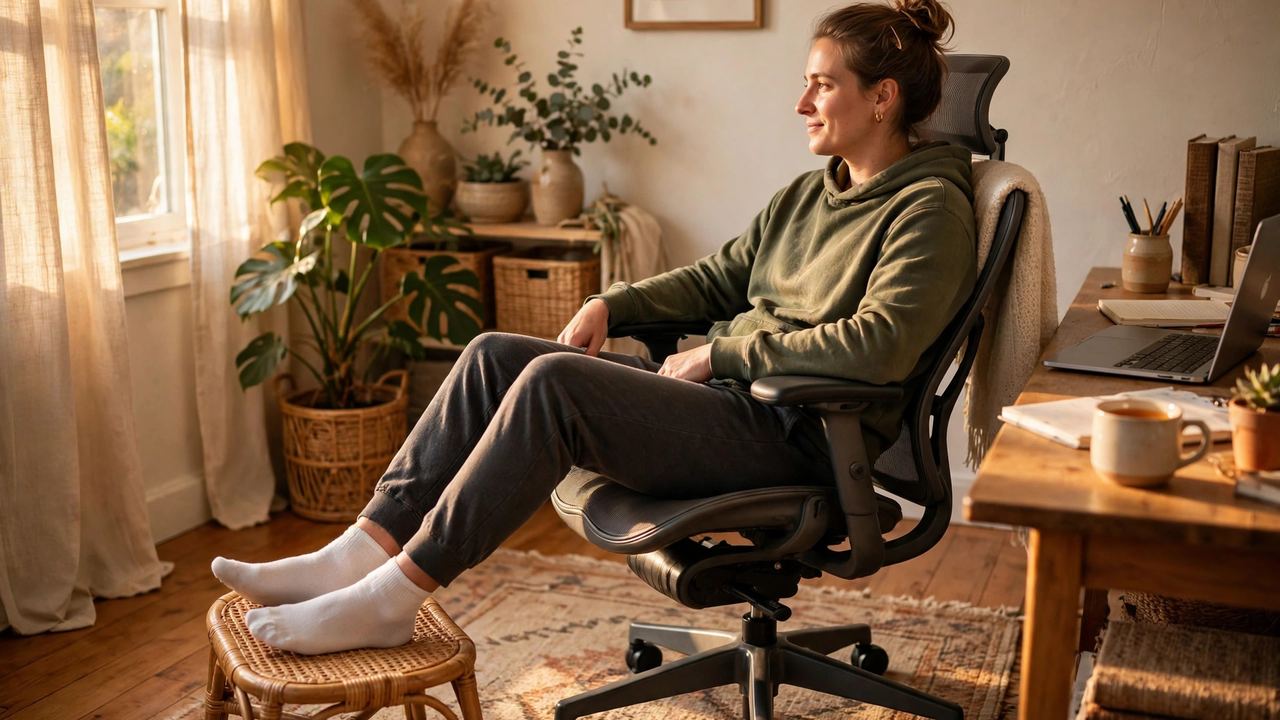
Set the height so your feet are flat. A seat cranked too high leaves your feet dangling and transfers your weight onto the seat edge; too low and your knees rise and your posture collapses backward. Every chair here has a pneumatic height adjustment with a range wide enough for standard desks, and the correct setting is the one where your feet rest flat on the floor with your weight spread across the whole seat. If your desk is high and your feet cannot reach, a footrest is a legitimate furniture accessory: it supports your feet so the seat edge does not have to carry them. What it is not is a medical device, and it should not be sold to you as one.
Use the recline. Sitting bolt upright in one position for eight hours is a posture problem no seat edge can fix. A recline with a back stop or tilt limiter, listed on every chair in this guide, lets you open your hip angle, shift the load on the seat, and change the angle at which the seat meets your legs. Forward tilt, listed on the Fern and available through the Aeron’s seat angle adjustment, suits perching and leaning-in work. The healthiest pattern furniture can support is variety: upright for typing, slightly reclined for calls, forward for close work, and regular stands and walks in between, which no chair replaces.
Check the capacity and the warranty. Listed capacities here run from 300 to 400 pounds, and a chair used near its limit will feel less supportive at the seat than the same chair used well within it. Buy with headroom. These are also long-life products from makers with established parts and service networks, which matters more over a decade of daily use than any single feature. Finally, keep the medical boundary clear in your own mind as you shop: if a listing promises to fix a health condition, that is a reason to distrust the listing, not a reason to buy the chair. Buy fit, shape and adjustability. For symptoms, see a clinician.
FAQ
What chair feature matters most for the back of my legs?
Seat depth fit. If the seat is too deep, its front edge presses into the back of your knees no matter how it is shaped. Choose a chair with an adjustable seat depth, or a correctly sized fixed seat, and set it so a small gap remains behind your knees. A waterfall or flexible edge then softens whatever light contact remains.
Is a waterfall seat edge the same as a flexible seat edge?
Not quite. A waterfall edge is a shape: the front of the seat curves downward, as on the Haworth Fern. A flexible edge is a behaviour: the front of the seat gives under load, as on the Steelcase Leap. Both aim to avoid a hard, straight line against your thighs, and both work best combined with correct seat depth and height settings.
A chair is furniture, not a medical treatment, and this guide makes no such claim for any model in it. Chairs can offer fit and comfort features, such as an edge that does not press and a depth that suits your legs. If you have circulation concerns, swelling or persistent leg discomfort, the right step is to talk to a clinician, not to rely on a furniture purchase.
How high should I set my chair?
Set it so your feet rest flat on the floor and your weight is spread across the seat rather than concentrated at its front edge. If your desk height forces the chair higher than your legs comfortably allow, use a footrest to support your feet. Recheck the setting after adjusting seat depth, because the two interact.
Mesh seat or foam seat: which is kinder to legs?
It depends on fit more than material. A suspended mesh seat like the Aeron’s spreads load and stays cool, but its depth is fixed by size. A foam seat like the Leap’s can add a flexing edge and a sliding depth adjustment. Either can be comfortable when the depth and height are right, and either can annoy when they are wrong.
How often should I change position?
As often as your work allows. Use the chair’s recline and back stop to vary your posture through the day, and stand and walk regularly. Adjustability is only useful if you use it; a small seat-depth or recline change every so often keeps one posture from becoming an all-day posture.
Conclusion
Leg comfort at a desk is mostly a fitting problem, and fitting problems have furniture solutions: a seat depth that leaves a gap behind your knees, an edge shaped or built to give rather than press, a height that lets your feet rest flat, and a recline that keeps you moving between postures. The Steelcase Leap combines those answers most completely, with its flexible seat edge and wide depth range. The Haworth Fern matches it on edge design with its waterfall front and long depth travel. The Steelcase Gesture adds posture-chasing arms, the Herman Miller Embody adds the shallowest seat setting and a seat of independent elements, the Herman Miller Aeron offers a sized mesh alternative for those who know their fit, and the Steelcase Series 1 brings real seat-depth adjustment to a simpler, lighter chair. Choose by your leg length, your desk and your habits, set the chair up carefully when it arrives, and keep the boundary in mind: these are comfort features on furniture, and anything beyond comfort belongs in a conversation with a clinician.
M
Modern Line Home Editorial Team
We compare specs, materials and verified owner reviews before a product earns a spot. Rankings are never paid.
Affiliate disclosure. As an Amazon Associate we earn from qualifying purchases at no extra cost to you. Prices accurate as of the date shown.
House cold even with the heat on? Walk this ordered checklist: thermostat and filter first, then drafts, insulation, leaky ducts and a failing heating system.
Windows fogging up in winter? Check where the fog sits: on the room side it is indoor humidity, outside it is harmless, and between panes the seal has failed.
Store the main firewood pile about 30 feet from your house, off the ground and covered only on top. Compare racks, woodsheds, garages and indoor spots safely.
Place a portable generator outdoors only, at least 20 feet from windows, doors and vents, exhaust pointed away. Exact distances, setup steps and CO rules here.
Keep houseplants in the right winter spot: match window direction to plant type, stay clear of radiators and cold glass, and fix dry air and low light at home.
Mice enter through pencil-width gaps at foundations, pipes, vents, doors and the roofline. Walk this room-by-room winter checklist to find and seal each one.
A winter outage timeline: what to do in the first hour, first night and multi-day outage, with food safety times, pipe protection, heat and CO safety steps.
Size a space heater by room area: 10 watts per square foot at 8-foot ceilings, adjusted for insulation and ceiling height, with full wattage and BTU tables.
Start dripping at about 20 degrees, sooner for exposed pipes. Set a pencil-lead stream, drip the right faucets on both lines, and know when to stop safely.
A fridge needs 800-1,200 starting watts, not just 150-400 running watts. Use the tables to total your fridge plus freezer, lights, furnace fan and more today.












Write Your Review
No reviews yet. Be the first to share your experience!