We independently review everything we recommend. When you buy through our links, we may earn a commission. As an Amazon Associate we earn from qualifying purchases.
Best Baby Chairs for Sitting Up: 6 Supportive Picks
Find the best baby chairs for sitting up with six maker-verified floor seats and boosters compared by age range, weight limit, tray, harness and easy cleaning.
Find the best baby chairs for sitting up with six maker-verified floor seats and boosters compared by age range, weight limit, tray, harness and easy cleaning.
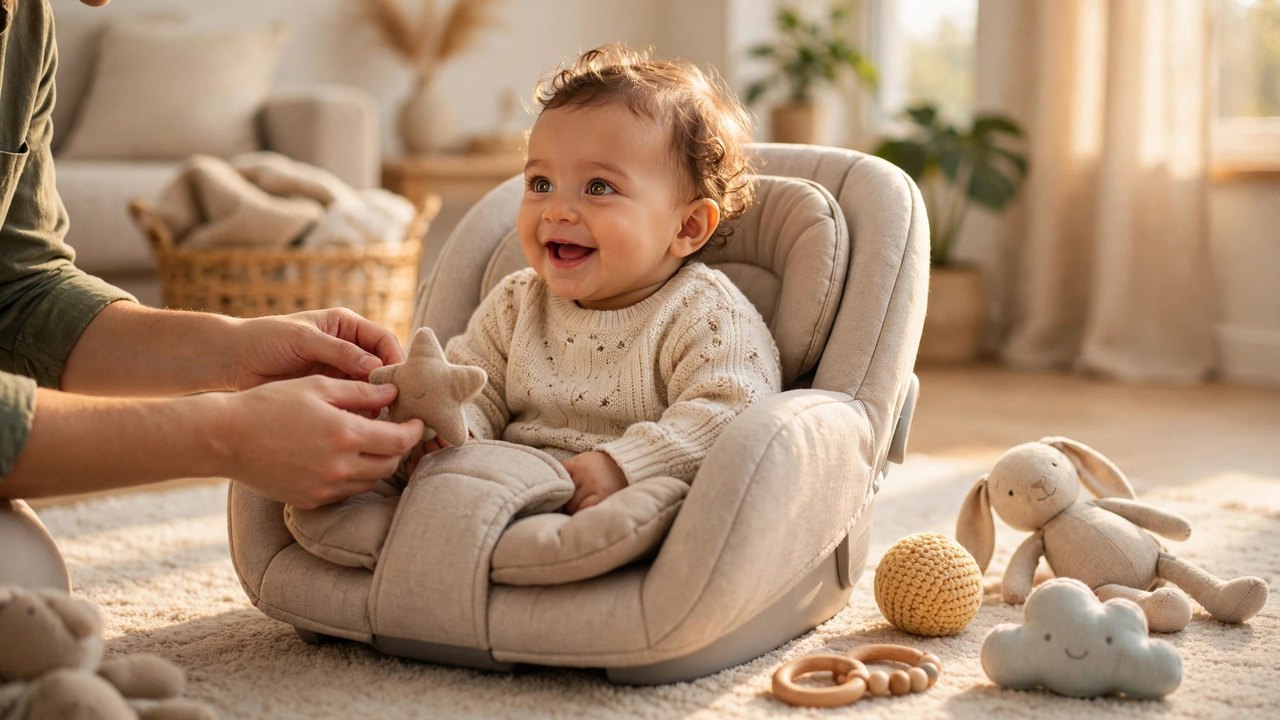
Learning to sit up changes the whole room for a baby. Faces come into view, toys stay within reach, and feeding and play start to happen at eye level instead of from a reclined angle. The best baby chairs for sitting up support that stage without rushing it, and the right design depends on where the seat will live, how long it needs to last, and whether it also has to work at a dining table or on the road. This guide compares six real seats from Bumbo, Fisher-Price, Ingenuity, Infantino, hiccapop and Bright Starts, using only the specifications each maker lists for its own model.
Every seat below is a floor seat, a booster, or a design that does both jobs. Some are soft foam shells for the earliest sitters, some are fabric seats on sturdy frames, and some fold flat for travel. What they share is a clear maker-stated starting point, a stated weight limit, and a defined way of keeping a baby contained while sitting. Age and weight guidance for baby products is not interchangeable between brands, so each pick is described with its own maker limits rather than a blended average.
Quick verdict
For the earliest supported sitting in a single-purpose floor seat, the Bumbo Floor Seat is the classic choice: the maker lists it for babies from 3 to 12 months who can hold their head up, in a wipe-clean foam shell with a 3-point harness. For a soft fabric seat with a wide, sturdy base and a machine-washable pad, the Fisher-Price Sit-Me-Up Floor Seat fits babies who can hold their head up unassisted, up to the maker-listed limit of 25 lb. For the longest table-side life, the Ingenuity Baby Base 2-in-1 Seat covers 6 to 36 months and up to 33 lb, works on the floor or strapped to a dining chair, and converts to a toddler seat when the foam insert comes out. For play built into the seat itself, the Infantino Music & Lights 3-in-1 Discovery Seat & Booster adds a light-up piano and six activities for the maker-listed range of 4 months to 4 years, up to 33 lb. For travel, the hiccapop OmniBoost folds like a small camping chair and straps to an adult chair, while the Bright Starts Pop ‘N Sit Portable Booster Seat folds to a compact bundle and covers floor, feeding and booster modes for 6 months to 3 years, up to 37 lb.
The products in this guide
Fisher-Price Sit-Me-Up Floor Seat
The Fisher-Price Sit-Me-Up Floor Seat takes the opposite approach to the Bumbo: a soft fabric seat pad suspended in a frame with a wide, sturdy base
Best for a soft, washable fabric seat with a wide base and a flat fold sounds
The table below puts the maker-listed basics side by side. Always check the current listing and the manual for the exact colour or pattern being bought, because makers revise patterns and bundle contents over time.
Selection started with the job in the keyword: a chair that helps a baby sit up. That ruled out reclined bouncers, swings, walkers and full high chairs that happen to hold a baby upright as a side effect. Each seat in this guide is sold as a floor seat, a sit-up seat, or a booster that also works on the floor, so sitting is the main event rather than an accessory position.
Next, every candidate had to be verified on opened pages. The maker’s own product page, catalogue or manual had to confirm the product exists, name its model or style number where the maker publishes one, and state its age or developmental starting point and its weight limit. For baby products this bar matters more than usual: a seat that starts too early or carries past its limit is not a bargain, it is a mismatch. Products whose maker specifications could not be opened and read were excluded entirely rather than described from snippets or guesswork.
Variety was the third filter. Babies learn to sit over a window of months, and households use these seats very differently. The final six cover a soft foam floor seat for the earliest stage, a fabric sit-up seat with a wide base, a rigid booster that grows into a toddler seat, an activity seat with built-in play, and two folding travel seats that strap to adult chairs. If a household only needs one of those jobs, the matching pick is easy to spot; if it needs two, the convertible designs earn their place.
Finally, Amazon availability was checked model by model. Where an ASIN could be pinned to the exact model from an opened Amazon product page or an unambiguous search result showing that model’s listing, the product name and the price-check line in its section link to that listing. Where the exact variant could not be pinned to that standard, the section is left unlinked rather than pointing at a sibling colour or a different bundle. No prices are quoted anywhere in this guide, because prices move and the maker specifications are what decide whether a seat fits a particular baby.
Top picks
Bumbo Floor Seat
The Bumbo Floor Seat is the original foam floor seat, and its shape is the whole idea. The maker lists a deep seating surface and elevated leg openings that gently recline the baby toward the centre of the rounded backrest, easing the baby into an upright position. The seat is made from what the maker lists as a luxurious, high-quality polyurethane foam, with a leather-like outer skin that wipes clean with a damp cloth. It is a single moulded piece, so there is no frame to assemble, no fabric to launder, and no tray hardware unless the optional tray is added.
On timing, the maker lists the floor seat for babies from 3 to 12 months who cannot sit up unaided, and the catalogue repeats the 3 to 12 month range with the condition that the baby can hold their head and neck independently. That head-control condition is the real gate, not the birthday. The maker lists a 3-point safety harness fitted to the seat to help keep a wriggly baby from falling out, while still describing the seat as not totally restrictive. The catalogue lists the seat at 38 cm across with a weight of 1.45 kg for the seat itself, which explains why it gets carried from room to room so easily.
In daily use this is the simplest seat in the guide. It sits on the floor for supervised play and early feeding, wipes down after both, and stores on a shelf without folding or collapsing. The trade-offs follow from the same simplicity: the tray is sold separately, the foam opening is fixed so chunkier legs fill it sooner, and it is a floor-only product. The maker is explicit that a floor seat belongs on the floor or a level ground surface, never on tables, benches, chairs or beds, and that an adult should always stay with the baby during use. Families who want the next size up in the same family will find the maker also lists a Max version with wider leg openings, but that is a different model from the one covered here.
Buy it if the baby can already hold their head up steadily and the household wants one wipe-clean, no-assembly floor seat for short supervised sitting sessions.
Skip it if a tray must be included in the box, the seat needs to strap to a dining chair, or the baby’s legs already fill a snug foam opening.
The Fisher-Price Sit-Me-Up Floor Seat takes the opposite approach to the Bumbo: a soft fabric seat pad suspended in a frame with a wide, sturdy base. Mattel lists the seat as helping young babies take in their environment from a new view, with the soft fabric pad supporting unsteady sitters so they can sit up and play. The maker lists two linkable toys on the standard version, and tray versions add a removable snack tray in front of the baby.
The maker’s stated stage is developmental rather than a month count. Mattel lists the seat for use only with a child who is able to hold their head up unassisted and who is not able to climb out or walk, with a maximum weight of 25 lb (11.3 kg). Those two exit conditions matter as much as the entry one: once a baby can climb out or is walking, the maker-listed use window has closed even if the weight limit has not been reached. The seat pad is removable and machine washable in the maker’s description, which suits a fabric seat that will meet first foods, and the frame folds flat for storage or travel.
Compared with a foam shell, the fabric design gives a softer, more hammock-like sit and wider leg openings, and the flat fold makes it the easier of the two early floor seats to slide behind a sofa or into a car boot. The compromises are laundry and lifespan: fabric needs washing rather than a wipe, and the 25 lb ceiling plus the climb-out rule give it a shorter listed life than the boosters below. It is also floor-only in the maker’s guidance, despite the frame looking chair-like. For the months between head control and confident independent sitting, though, it is the most forgiving seat in this guide.
Buy it if a soft, washable fabric seat with a wide base and a flat fold sounds better than a moulded foam shell for the first sitting months.
Skip it if the baby is close to climbing out or walking, is near the maker-listed 25 lb limit, or the household wants a seat that continues to the table.
The Ingenuity Baby Base 2-in-1 Seat is the workhorse of this list: a rigid booster that works as a floor seat for play and straps to a dining chair for meals. The maker lists it for babies sitting up, with a harness in the infant configuration, adjustable straps that attach the booster to most dining chairs, and a removable tray. The maker’s catalogue lists the bottom straps at 22 inches and the back strap at 36 inches, useful numbers for checking against the dining chairs already in the house before buying.
The maker lists the user age range as 6 to 36 months and the seat as supporting up to 33 lb. Assembled dimensions are listed as 17.25 x 15.25 x 11.75 inches, and the seat itself is listed at about 4.53 lb. The 2-in-1 name comes from the foam insert: with the insert in, it is a smaller infant seat; take the insert out and the same base converts into a toddler seat with more room. The maker lists the materials as a mix of EVA foam and plastic, the base and foam insert as wipe-clean with a damp cloth and mild soap, and the tray as dishwasher safe. When the meal ends, the tray stores underneath the seat, and the seat back stores under the base before first assembly, so the whole unit keeps a compact footprint.
The tray size is worth noting: the maker lists it as holding plates up to 11 x 5 inches, which fits toddler plates rather than full dinnerware. As a floor seat it is firmer and more upright than the fabric or foam options above, which some babies prefer once they are sitting with less support, and the chair straps make it the first pick in this guide that genuinely joins family meals at the table. It does not fold, so it travels by being carried rather than packed, and the dining chair it straps to still needs a suitable size and shape, which the strap lengths above help judge.
Buy it if one seat needs to cover floor play now and strapped-to-the-chair meals for the next couple of years, with a tray that stores inside the seat.
Skip it if the baby is under the maker-listed 6-month starting range, or a folding seat is needed for regular travel.
The Infantino Music & Lights 3-in-1 Discovery Seat & Booster is the play-first entry. In its first mode it is an interactive activity seat: the maker describes six engaging activities, including a light-up piano that plays 20 songs and sounds, arranged on toy pods in front of the baby. Those pods slide apart to reveal the second mode, a snack tray with a cup holder underneath, and with the tray in use and the chair straps attached it becomes the third mode, a booster seat for the dining table. Few seats in this category hide their feeding tray inside their play tray, and it makes the switch from playtime to snack time a slide rather than a rebuild.
The maker-listed range is the widest in this guide: 4 months to 4 years, up to 33 lb. Retail specification listings for the model list a 3-point safety harness, chair attachment straps, a wipeable and removable seat cushion, and two AA batteries required for the lights and sounds, not included. The seat is listed at about 6.6 lb in its overall retail specifications, heavier than the plain boosters because of the activity tray, and its footprint is a play seat first and a travel seat second.
That play value is the reason to choose it, and also the reason to pass. A baby who sits happily with a piano, spinners and textures at hand can stay engaged through a supervised floor session, and the same seat then handles snacks and table time without a second product. Households short on space, or who prefer a quiet seat with no batteries and no sounds, will find the simpler boosters above and below easier to live with. The 4-year upper age is the maker’s stated range for the booster mode; the 33 lb weight limit is the figure that will end use for most children first.
Buy it if built-in activities would genuinely extend sitting play sessions, and one seat covering play, snacks and the table appeals more than separate products.
Skip it if battery-powered sounds are unwelcome, storage space is tight, or a light folding seat is needed for frequent trips.
The hiccapop OmniBoost is built like a miniature camping chair: a fabric seat slung over a folding metal frame, with a removable swivel tray in front. The maker lists it for babies and toddlers from 6 months to 3 years who can sit up, and it works two ways, standing on the floor or ground as a small chair of its own, or strapped onto an adult dining chair as a booster. The maker lists a 3-point harness, removable feet discs intended to keep the frame steady on soft ground such as sand and grass, and a rear storage pocket for small essentials.
Travel is the design brief. The frame folds down into the included shoulder carry bag, and the seat is listed at about 4 lb, so it goes over a shoulder on the way into a restaurant, a relative’s house or a picnic without a second thought. The maker lists the tray as dishwasher safe and the fabric seat cover as removable and machine washable, a practical pairing for a seat that will eat outdoors. One caution on numbers: headline frame-strength figures circulate for this style of folding chair, but the figure that governs use is the maker’s own child guidance, the 6 months to 3 years range for a child who can sit up. Treat the seat as a toddler travel booster within that range, and check the current listing for the maker’s stated child weight guidance for the exact version being bought.
Against the rigid Baby Base, the OmniBoost trades structure for portability. The fabric seat gives less postural support than a moulded booster, so it suits babies who already sit fairly steadily rather than brand-new sitters, and the adult chair it straps to needs the maker’s stated minimum dimensions to hold it securely. For families who eat away from home often, that trade is usually worth it: this is the seat that actually comes along.
Buy it if meals and play happen at other people’s houses, restaurants or outdoors, and a folding seat with its own carry bag would get used weekly.
Skip it if the baby still needs firm moulded support to stay upright, or the seat will almost always stay in one kitchen.
The Bright Starts Pop ‘N Sit Portable Booster Seat is the other folding design, from Kids2, and the maker lists three modes of use: floor seat, feeding seat with the removable tray, and toddler booster strapped to an adult chair. The maker lists it for indoor and outdoor use, with a carrying bag with a shoulder strap included, a rear storage pocket, and a compact fold to 5 x 15 inches. At that folded size it tucks into a car boot corner or a pushchair basket in a way no rigid booster can match.
The maker lists the rating as 6 months to 3 years, or up to 37 lb, the highest child weight limit among the boosters in this guide. Safety fittings listed by the maker include a 3-point harness and safety straps for attaching the seat to an adult chair. Cleaning is split the sensible way: the maker lists the tray as dishwasher safe and the seat pad as machine washable. The maker’s catalogue lists the seat’s material mix as metal, plastic and fabric, reflecting the folding frame under the fabric seat.
Choosing between the Pop ‘N Sit and the OmniBoost comes down to details rather than concept. Both fold, both strap to chairs, both carry a tray and a bag. The Pop ‘N Sit carries the maker-listed 37 lb limit and the backing of the Kids2 catalogue, with themed and canopy versions in the same family for households who want sun cover outdoors; the version covered here is the standard portable booster. As with the OmniBoost, the fabric seat suits a baby who sits with reasonable steadiness, and the booster mode depends on a suitable adult chair. For a second seat kept at grandparents’ houses or in the car, it is hard to beat a chair that folds to the size of a small umbrella.
Buy it if a compact folding booster with the highest maker-listed weight limit in this guide is the priority for home, car and grandparents’ houses.
Skip it if the baby needs a rigid, high-support seat for early sitting practice, or a non-folding booster will simply live at the table full time.
Buying guide
Start with head control, not the calendar. Every maker in this guide gates its seat on development as well as age. Bumbo and Fisher-Price both state the baby must hold their head up unassisted; the boosters start at a listed 6 months. A seat bought a month early does not get used a month early, it gets stored. Match the purchase to the stage the baby is actually at, and note the exit rules too: Fisher-Price ends use when the child can climb out or walk, whatever the scales say.
Respect the weight limit as a hard line. The maker-listed limits here run from 25 lb for the Fisher-Price floor seat to 33 lb for the Ingenuity and Infantino seats and 37 lb for the Pop ‘N Sit. Weight, not age, is usually what ends a seat’s life, so a heavier baby benefits from starting with a higher-limit booster rather than a floor seat that will be outgrown mid-stage. Where a maker markets a frame-strength figure, read the child-specific age and weight guidance instead; that is the number written for the passenger.
Decide the seat’s main location. Floor-only seats (Bumbo, Fisher-Price) are for supervised play and early sitting on the ground, and their makers state plainly that they never go on raised surfaces. Boosters (Ingenuity, Infantino, hiccapop, Bright Starts) add straps for an adult dining chair, which brings the baby to the table but makes the adult chair part of the safety equation: check strap lengths and the chair’s size against the maker’s stated requirements before relying on that mode.
Match support to sitting skill. Moulded foam and rigid shells hold a newer sitter more firmly; fabric sling seats on folding frames assume a baby who already sits fairly steadily. If the baby still topples sideways within a minute or two, the firmer seats in this guide are the safer match, and the folding travel seats become the second seat for later.
Count the cleaning jobs. First foods guarantee mess. Wipe-clean foam (Bumbo) is the fastest reset; dishwasher-safe trays (Ingenuity, hiccapop, Bright Starts) and machine-washable pads or covers (Fisher-Price, hiccapop, Bright Starts) split the work between sink, dishwasher and laundry. A seat that is annoying to clean gets used less, whatever its other merits.
Think about the second year. Floor seats are single-stage products with a defined end. The Ingenuity converts to a toddler seat by removing its insert, and the Infantino and the folding boosters keep working as table boosters long after floor sitting is mastered. If the budget allows one purchase, a convertible usually outlasts a specialist; if the early months are the priority, a specialist floor seat plus a later booster is a perfectly sensible two-step plan.
FAQ
When can a baby start using a chair for sitting up?
When the maker of that specific seat says so, which in this guide means the baby can hold their head up unassisted for the floor seats, and from the listed 6 months for the boosters. Head control is the condition the makers themselves state, so a baby who cannot yet hold their head steady is not ready for any seat here, whatever their age in months.
Can a floor seat be used on a chair or table to save space?
No. The makers of the floor seats in this guide state that the seat is for the floor or a level ground surface only, never on raised surfaces such as tables, benches, chairs or beds. If table height is needed, choose a booster with chair straps and follow that maker’s attachment instructions for a suitable adult chair.
How long can a baby stay in a sitting chair at one time?
Makers of floor seats advise using them for short periods and always with an adult present and watching. Treat these seats as a place for a supervised play or feeding session, not as a container for long stretches, and take the baby out when the session ends or the baby tires of sitting.
What ends a seat’s useful life: age or weight?
Whichever maker limit arrives first. The seats here carry limits from 25 lb to 37 lb alongside their age ranges, and Fisher-Price adds a behavioural limit, stopping use when the child can climb out or walk. Check both figures for the model being bought and retire the seat when either is reached.
Is a tray included with these seats?
It varies by model, which is why the comparison table calls it out. The Ingenuity, Infantino, hiccapop and Bright Starts seats in this guide include a tray in their maker descriptions; the Bumbo tray is sold separately, and Fisher-Price sells the Sit-Me-Up in versions with and without a snack tray, so check the exact listing before ordering.
Do these seats help a baby learn to sit?
They support a baby who is already developing the skill, giving a contained, upright place to practise during supervised sessions. They are not training devices with a promised timeline, and no seat here replaces floor time, which is where babies build the strength and balance that sitting up requires.
Conclusion
The best baby chair for sitting up is the one whose maker-stated stage, weight limit and location match the baby and the household in front of it. The Bumbo Floor Seat remains the simplest wipe-clean start for a baby with steady head control; the Fisher-Price Sit-Me-Up offers the softest fabric alternative with a washable pad and a flat fold; the Ingenuity Baby Base 2-in-1 covers the longest span from floor to family table; the Infantino Discovery Seat builds the play into the chair itself; and the hiccapop OmniBoost and Bright Starts Pop ‘N Sit fold away for families whose sitting happens in more than one place. Check the maker’s current specifications for the exact version being bought, honour the stated limits, keep floor seats on the floor, and any of these six will do its job well through the sitting-up stage and, for the boosters, well beyond it.
M
Modern Line Home Editorial Team
We compare specs, materials and verified owner reviews before a product earns a spot. Rankings are never paid.
Affiliate disclosure. As an Amazon Associate we earn from qualifying purchases at no extra cost to you. Prices accurate as of the date shown.
House cold even with the heat on? Walk this ordered checklist: thermostat and filter first, then drafts, insulation, leaky ducts and a failing heating system.
Windows fogging up in winter? Check where the fog sits: on the room side it is indoor humidity, outside it is harmless, and between panes the seal has failed.
Store the main firewood pile about 30 feet from your house, off the ground and covered only on top. Compare racks, woodsheds, garages and indoor spots safely.
Place a portable generator outdoors only, at least 20 feet from windows, doors and vents, exhaust pointed away. Exact distances, setup steps and CO rules here.
Keep houseplants in the right winter spot: match window direction to plant type, stay clear of radiators and cold glass, and fix dry air and low light at home.
Mice enter through pencil-width gaps at foundations, pipes, vents, doors and the roofline. Walk this room-by-room winter checklist to find and seal each one.
A winter outage timeline: what to do in the first hour, first night and multi-day outage, with food safety times, pipe protection, heat and CO safety steps.
Size a space heater by room area: 10 watts per square foot at 8-foot ceilings, adjusted for insulation and ceiling height, with full wattage and BTU tables.
Start dripping at about 20 degrees, sooner for exposed pipes. Set a pencil-lead stream, drip the right faucets on both lines, and know when to stop safely.
A fridge needs 800-1,200 starting watts, not just 150-400 running watts. Use the tables to total your fridge plus freezer, lights, furnace fan and more today.












Write Your Review
No reviews yet. Be the first to share your experience!