We independently review everything we recommend. When you buy through our links, we may earn a commission. As an Amazon Associate we earn from qualifying purchases.
Best Vacuums for Removing Mold From Furniture: 6 Picks
Compare the best vacuums for removing mold from furniture surfaces, with sealed HEPA filtration, upholstery tools, and honest limits on what vacuuming can do.
Finding the best vacuums for removing mold from furniture starts with an honest limit that shapes every pick in this guide. A household vacuum does not remediate mold. It cannot treat growth inside cushion foam, padding, or fabric backing, it cannot address the moisture problem that allowed growth to start, and it does not make a contaminated piece of furniture safe. What a well-chosen vacuum can do, as the makers of the machines below describe their tools, is pick up loose, dry surface debris from upholstery — dust, crumbs, lint, hair, and loose particles sitting on the fabric — while a sealed filtration system keeps fine particles from blowing straight back into the room through the exhaust.
That narrower job is still worth doing carefully. Loose debris on a sofa or armchair is easier to lift away with a dedicated upholstery nozzle than with a floor head, and a machine whose air path is sealed around a HEPA filter, as the maker lists it, is a better tool for fine surface dust than an open, leaky design. If a piece of furniture has extensive visible growth, a persistent musty problem throughout the padding, or water damage underneath the fabric, vacuuming the surface is not the answer for that piece, and this guide will say so plainly in the buying guide below. For routine surface cleaning of furniture — and for picking up loose debris from upholstery as part of regular housekeeping — the six machines below combine the two features that matter most: filtration the maker describes as sealed or HEPA-grade, and a real upholstery tool in the box.
Quick verdict
For most households, the Shark Stratos Upright Vacuum AZ3002 is the most complete furniture-cleaning package here: the maker lists a HEPA filter with a sealed system, a dedicated upholstery tool, and a powered pet brush for working loose debris out of fabric, all on a Lift-Away body that detaches for above-floor work. The Shark PowerDetect Upright Vacuum AZ4002 is the heavier-duty sibling, with a HEPA filter and a pet multi-tool for upholstery. The Miele Blizzard CX1 Cat & Dog is the premium canister choice, with a HEPA lifetime filter as the maker lists it, a mini turbobrush, and an upholstery nozzle. The Atrix Ergo Pro Backpack Vacuum VACBPAI is the specialist: an 8-quart HEPA-filtered backpack with a full tool set including an upholstery tool, built for moving from piece to piece without dragging a body behind you. The Kenmore Intuition Bagged Upright BU4050 is the bagged option, pairing a completely sealed HEPA system, as the maker lists it, with sealed disposal bags and both an upholstery tool and a powered Pet Handi-Mate. The Dyson Ball Animal 3 rounds out the list with whole-machine filtration the maker lists as trapping 99.97% of particles as small as 0.3 microns, plus a stair tool and combination tool that suit fabric surfaces.
The products in this guide
Shark Stratos Upright Vacuum AZ3002
The Shark Stratos AZ3002 earns the top spot because it covers the furniture job from both ends: the tools that touch the fabric and the filtration
Best for Most households wanting one complete package
The table below summarizes the six picks side by side. Filtration wording follows each maker’s own listing, because the exact phrasing — sealed HEPA system, HEPA lifetime filter, whole-machine filtration — describes different constructions, and the differences matter for this use.
Long hose reach and strong floor-to-furniture range
How we selected
Every product in this guide had to pass the same checks on opened maker and retailer pages, and several well-known models were excluded along the way. The first check was filtration, described exactly as the maker lists it. For a vacuum that will be run slowly over upholstery to lift loose fine debris, the exhaust side matters as much as the suction side: a machine that pulls particles off fabric and then leaks them around an unsealed filter housing has moved the dust rather than collected it. We therefore required either a sealed system built around a HEPA filter, a HEPA filter the maker rates for fine particles, or whole-machine filtration with a stated particle capture figure — and we quote each maker’s own wording rather than applying one label to all six.
The second check was a genuine furniture tool. A floor head dragged across a sofa cushion is the wrong implement: it is too wide for seams, too aggressive for some fabrics, and unable to follow the curves of arms and backs. Each pick below includes at least one attachment designed for upholstery or for the small fabric surfaces of furniture — a flat upholstery nozzle, a mini turbo brush, a powered hand tool, or a stair tool with a fabric-friendly face. The third check was reach and format. Cleaning furniture means working around, behind, and sometimes under pieces, so a detachable pod, a long hose, a canister body that stays on the floor, or a backpack layout all counted in a machine’s favor.
Two further rules governed the writing itself. First, no remediation claims: nothing in this article states or implies that vacuuming treats, kills, or removes mold growth from inside furniture, because the makers of these machines do not claim that either — they describe surface debris pickup and filtration, and so do we. Second, no invented specifications. Every figure below — wattage, capacity, weight, cord length, filtration wording — comes from a page opened during research for this guide, and where a maker and a retailer describe a feature differently, the maker’s own phrasing governs and is flagged with the words the maker lists.
The Shark Stratos AZ3002 earns the top spot because it covers the furniture job from both ends: the tools that touch the fabric and the filtration that handles what comes off it. On the tool side, the listing includes a dedicated upholstery tool for flat passes over cushions and backs, a self-cleaning pet power brush that works loose hair and debris out of fabric with a small powered head, and a crevice tool for the seams where cushions meet arms — exactly the places loose debris collects. On the filtration side, the maker lists a HEPA filter paired with a sealed system, which Shark describes as trapping fine dust inside the machine rather than leaking it around the filter, and the listing’s filter type is given as a HEPA filter.
The format helps as much as the tools. The Stratos is a corded upright, but its Powered Lift-Away pod detaches from the floor head, so for furniture work you carry the lighter pod and hose rather than maneuvering the whole upright around a sofa. The maker lists DuoClean PowerFins HairPro floor heads for the floor side of the machine, an odor neutralizer cartridge in the floor head, and LED headlights, though for the purposes of this guide the relevant numbers are the ones on the listing’s specification table: the machine is listed at 16.7 pounds in full upright form, with upholstery named among its recommended surfaces. In pod mode the weight in your hand is a fraction of that figure, which matters when you are working slowly across a three-seat sofa and a pair of armchairs.
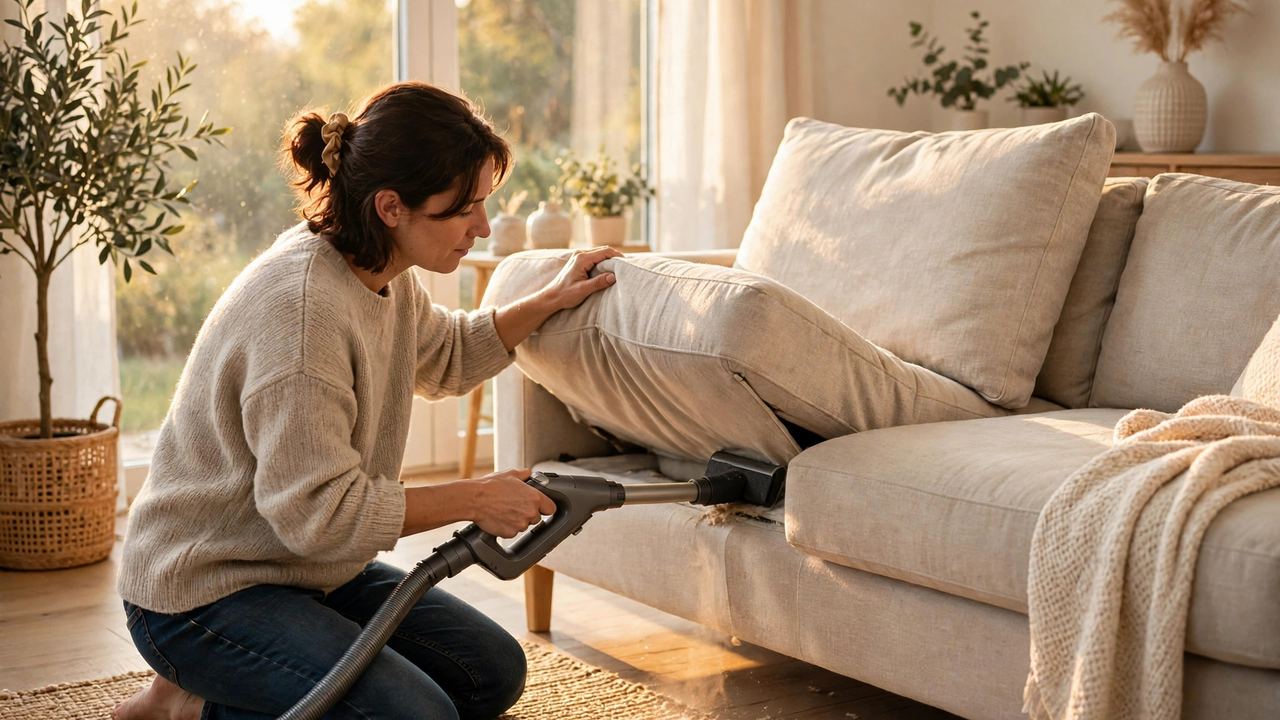
Used on furniture, the sensible routine with the Stratos is the upholstery tool first, in slow overlapping passes, then the pet power brush on any section where hair and fibrous debris are visibly worked into the fabric, then the crevice tool along seams and buttons. The sealed HEPA system, as the maker lists it, is doing the quiet part of the job the whole time: keeping the fine fraction of what you lift from becoming airborne again at the exhaust. The dust cup empties into a bin, which is the one compromise against the bagged machines below — emptying a cup of fine debris calls for a slow, careful tip rather than a shake.
Buy it if: you want one mainstream upright that pairs a sealed HEPA system, as the maker lists it, with a proper upholstery tool and a powered fabric brush, and you prefer a detachable pod over a canister. Skip it if: you want sealed bag disposal rather than a bagless cup, or your furniture work is mostly stairs and tight rooms where a backpack or canister moves more easily.
The PowerDetect AZ4002 is Shark’s heavier, sensor-driven upright, and its furniture case rests on the same two pillars: the listing gives its filter type as a HEPA filter, and the box includes a pet multi-tool and a HairPro self-cleaning pet power brush alongside a duster crevice tool. The pet multi-tool is the piece that matters most here — it is the hand tool intended for upholstery and stairs, sized for cushions and arms rather than floors — while the powered brush handles fabric where loose debris and hair are pressed in and a plain nozzle skates over them.
Where the PowerDetect differs from the Stratos is in its floor-head intelligence and its size. The maker lists DuoClean Detect with sensors that respond to dirt, edges, floor type, and direction, plus an odor neutralizer, and the whole machine is listed at 17.6 pounds — the heaviest upright in this guide. Like the Stratos, it offers a Lift-Away configuration for above-floor work, and that feature is what makes a machine of this weight practical on furniture at all: the pod comes off, the hose and hand tool do the upholstery work, and the floor head stays parked. If you never use the detachable mode, a smaller machine will serve you better; if you do, the PowerDetect brings the strongest floor-cleaning feature set here along with its furniture tools.
For loose surface debris on upholstery, the PowerDetect’s powered hand brush is its standout. Fine dry particles sitting on top of fabric yield to a plain nozzle, but the mix that actually accumulates on household furniture — hair, lint, crumbs ground into the weave by use — responds better to gentle powered agitation followed immediately by suction, which is the combination a motorized mini brush provides. Paired with the HEPA filter the maker lists, the machine collects that material without the leaky exhaust path of a budget upright. It is a lot of vacuum for a single armchair, but for a house where the same machine must also handle floors, stairs, and several upholstered pieces in one session, the capacity makes sense.
Buy it if: you want Shark’s most feature-heavy upright, a HEPA filter as the maker lists it, and a powered brush plus multi-tool for upholstery, and you will actually use the Lift-Away pod for furniture. Skip it if: weight matters — at the listed 17.6 pounds it is the heaviest pick here — or you only need a furniture and stairs machine rather than a full-size floor vacuum.
The Miele Blizzard CX1 Cat & Dog is the canister pick, and canisters have a natural advantage over furniture: the body stays on the floor, the hose and wand do the traveling, and you work across a sofa with a light tool in your hand instead of a machine in your arms. The listing gives the model number as 41KCE043USA, the filter type as a HEPA AirClean lifetime filter, and upholstery among the recommended surfaces. The maker lists Vortex Technology for the machine’s cyclonic separation, a 1,200-watt PowerLine motor, and ComfortClean self-cleaning for the fine dust filter, with a dust container listed at 2.0 liters on the maker’s data for the range.
The tool set is the most furniture-complete in this guide. The listing’s included components name a crevice tool, a dusting brush, the Electro Plus floor head, and a handheld turbo brush; the maker’s data for this model adds the upholstery nozzle and the Parquet Twister floor brush for delicate hard floors. For upholstery work that gives you three relevant implements: the flat upholstery nozzle for broad cushion faces, the mini turbo brush for fabric where hair and debris are worked in, and the dusting brush for the tops of backs, arms, and the frames and legs around the fabric. Suction is adjustable through the maker’s four-stage control, which matters on furniture — lighter fabrics and loose cushions call for reduced suction so the material is not pulled into the nozzle.
The HEPA lifetime filter, as the maker lists it, is the other half of the case. Miele describes the Blizzard’s filtration as separating coarse debris and fine dust into different parts of the container and finishing with the HEPA lifetime exhaust filter, a design intended to keep fine particles in the machine through long use without a disposable filter to replace. The canister is listed at 19 pounds, but that weight rolls behind you on the floor; the working weight at the end of the hose is the wand and tool alone. The operating radius the maker lists for the range, 32 feet, means a whole living room’s worth of furniture can usually be worked from one outlet.
Buy it if: you prefer a canister for furniture, want a HEPA lifetime filter as the maker lists it, and value the fullest upholstery tool set here, including a mini turbo brush. Skip it if: you dislike bagless emptying of fine debris, or your budget points to an upright — this is the premium-priced format in the guide, and its floor head is aimed at homes that also have serious carpet to clean.
The Atrix Ergo Pro is the outlier in format and, for certain rooms, the most practical machine here. It is a corded backpack vacuum: the listing gives the model number as VACBPAI, the filter type as a HEPA filter, and the machine’s headline figures as an 8-quart capacity, a 1,400-watt motor, and 106 CFM of suction in the listing title, with a noise level of 72 dB also stated there. The included components on the listing name a crevice tool, the HEPA filter, an upholstery tool, a carpet tool, an oval brush, and a hard floor tool — a commercial-style kit that treats upholstery as a standard job rather than an afterthought.
Why a backpack for furniture? Because furniture cleaning is mobile work. You move from sofa to armchair to dining chairs to a mattress edge, around side tables and lamps, often in rooms where dragging an upright or a canister between pieces is the slowest part of the job. With the machine on your back, the hose and tool are simply in your hand wherever you stand, and the 8-quart bagged capacity means a long session across several rooms does not pause for emptying. The bagged design matters for this guide’s subject, too: debris leaves the house inside a sealed bag rather than being tipped out of an open cup, and the HEPA filtration the maker lists keeps the exhaust side of the machine filtered while you work at close quarters with the furniture.
The trade-offs are real. A backpack is a working posture you either accept or you do not, the cord still trails behind you, and the Ergo Pro’s tool set is functional rather than refined — the upholstery tool is a standard nozzle, not a powered brush, so fabric with debris worked deep into the weave takes more passes than with the Shark or Kenmore powered hand tools. Atrix positions this machine for professional and residential use alike, and that shows in its priorities: capacity, filtration, and mobility first. For a large home, a furnished rental, or any space with a lot of upholstered pieces spread across rooms, those priorities align unusually well with the furniture-cleaning job.
Buy it if: you clean a lot of furniture across several rooms, want 8-quart bagged capacity with HEPA filtration as the maker lists it, and like the backpack format for stairs and tight spaces. Skip it if: you want a powered upholstery brush, a machine that stands in a closet corner as an ordinary upright, or you only ever clean one or two pieces at a time.
The Kenmore Intuition BU4050 makes the bagged-upright case, and for handling fine debris picked up off furniture, bags have a genuine argument: what you collect stays sealed inside the bag from the moment it leaves the fabric until the moment the bag goes out with the trash. The maker lists a completely sealed system with HEPA filtration, describing it as trapping 99.97% of dust inside the vacuum, and lists HEPA dust bags among the included items. The listing gives the filter type as a HEPA filter, the capacity as 3 liters, and upholstery among the recommended surfaces, with the machine’s weight given as 6.4 kilograms on the listing — under 15 pounds in the maker’s own description of the range.
The furniture tools are strong. The included components name a crevice tool, an upholstery tool, a dusting brush, and the Pet Handi-Mate — Kenmore’s powered hand tool, described by the maker for removing hair from upholstery and stairs. That gives the BU4050 both halves of upholstery work: a flat nozzle for broad, gentle passes over cushion faces, and a motorized mini tool for the sections where hair and fibrous debris are pressed into the fabric. The Hair Eliminator brushroll handles the floor side, keeping the main head from accumulating wrapped hair, and the Lift-Up design lets the pod detach for above-floor cleaning, so the hose and hand tools can work across a sofa while the floor head stays parked at the side.
The maker also lists PowerFlow bag technology, described as maintaining suction as the bag fills, and a two-motor system with swivel steering and an LED headlight. For furniture sessions, the practical points are the sealed bag changes — Kenmore describes its No Touch bag technology as a button-press release that keeps your hands off the full bag — and the adjustable reach of the detachable wand for the backs of tall pieces. Ongoing bag cost is the standing compromise of every bagged machine, and this one is no exception; the counterweight is that fine debris never has to be shaken out of a cup or a washable filter at the sink.
Buy it if: you want bagged, sealed disposal with a completely sealed HEPA system as the maker lists it, plus both an upholstery tool and a powered hand tool for fabric. Skip it if: you refuse ongoing bag purchases on principle, or you prefer a canister’s hose handling for large furniture pieces.
The Dyson Ball Animal 3, listed with model number UP30, takes a different filtration route from the sealed-HEPA uprights above. Dyson lists whole-machine filtration for this model, and describes its washable post-motor filter as trapping 99.97% of particles as small as 0.3 microns. That wording is the maker’s own, and it is quoted here exactly because it is not the same claim as a sealed HEPA system — it is a whole-machine filtration figure for a bagless cyclone machine, and readers comparing filtration approaches should weigh it as such. The listing gives the bin capacity as 0.55 gallons, the suction figure in its feature list as 290 air watts, and the weight at 17.3 pounds.
For furniture, the Ball Animal 3’s strengths are reach and its two included hand tools. The listing names a combination tool — a brush and wide nozzle in one, per the maker — and a stair tool, which the maker describes as lifting carpet pile without sticking and capturing hairs with velour strips; on upholstery, that same flat, fabric-friendly face is the tool for cushion tops and arms. Dyson lists a total reach of 50 feet for the model, made up of a 35-foot cord and a hose that stretches 15 feet, and that hose length is the quiet advantage here: tall bookcases of furniture, the far side of a sectional, and the backs of pieces against a wall all fall within range without moving the machine or changing outlets. The ball format steers the floor head tightly around furniture legs on the way to those pieces.
The floor side is built around the maker’s de-tangling Motorbar cleaner head, with three suction modes on the listing, and the washable filter keeps running costs down to rinsing and drying rather than replacements. The compromises for this guide’s purpose are the bagless bin — fine debris is tipped out rather than sealed away — and the absence of a powered mini brush for fabric; the stair and combination tools are suction tools, effective on loose surface debris, which is the honest scope of this entire guide, but slower on hair worked into a weave than the powered hand tools on the Shark and Kenmore picks.
Buy it if: you value the longest hose-and-cord reach here, whole-machine filtration as the maker lists it, and a washable filter with no bags or filters to buy. Skip it if: sealed bag disposal matters to you, or you want a powered upholstery brush for fabric with heavily worked-in hair and debris.
Buying guide
Start with the limit stated at the top of this article, because it decides whether a vacuum is even the right purchase. Vacuuming addresses loose, dry debris sitting on furniture surfaces. It does not treat growth within cushions, foam, or padding, it does not dry out a damp piece, and it does not resolve the moisture source — a leak, condensation, or a chronically humid room — that allowed a problem to develop. A piece with growth that extends beyond a small surface area, that smells musty from inside the padding, or that was soaked in a flood or a long leak is a piece to discuss with a qualified professional, and in many such cases replacement is the realistic outcome. No vacuum in this guide, at any price, changes that. What follows assumes the legitimate job: routine removal of loose surface debris from upholstery, done with filtration that keeps fine particles contained.
Filtration wording is the first specification to read closely, and to read literally. A sealed system with a HEPA filter, as several makers here list it, means the air path is gasketed so air exits through the filter rather than around it — the seal is what makes the filter’s rating meaningful on a real machine. A HEPA lifetime filter, as Miele lists it, adds the promise of a filter that is maintained rather than periodically replaced. Whole-machine filtration, as Dyson lists it, is a system-level figure with a stated particle size. These are different constructions with different maintenance, and the honest comparison is between the makers’ own descriptions, not between marketing labels. Whichever you choose, keep the filter on its maintenance schedule: a clogged filter strangles suction and stresses every seal in the machine.
Next, match the tool to the fabric. A flat upholstery nozzle with no brush is the safe default for most woven fabrics, leather-look surfaces, and anything delicate — it lifts loose debris without agitating the material. A powered mini brush, like the pet tools on the Shark and Kenmore picks or the turbo brush on the Miele, earns its place on sturdy fabrics where hair and fibrous debris are worked into the weave. A crevice tool is not optional for furniture: seams, button tufts, and the junction between cushions and arms are where debris concentrates. Adjustable suction, offered on the canister here, protects lightweight fabrics and loose cushion covers from being pulled into the nozzle. Whatever the tool, work slowly. Suction needs dwell time to lift fine particles out of a weave, and fast passes mostly move the coarse fraction.
Bagged or bagless is a real decision for this use. Bagged machines — the Kenmore and the Atrix here — seal collected debris inside the bag for disposal, which keeps the emptying step contained and simple. Bagless machines — the Sharks, the Miele, and the Dyson — avoid bag costs but ask you to tip fine debris out of a cup or bin, a step best done slowly, outdoors or into a lined bin, without shaking. Neither is wrong; choose based on whether you prioritize contained disposal or zero consumables, and remember that washable filters still need full drying time before they go back in.
Finally, consider format against your furniture. Detachable pods (both Sharks, the Kenmore) suit homes where one machine does floors and furniture. A canister (the Miele) gives the lightest tool in the hand and the easiest work around large pieces. A backpack (the Atrix) suits many pieces across many rooms. A long-reach upright (the Dyson) suits big rooms and sectionals. Empty or change bags and bins before they are packed full, clean hair from brushrolls so hand tools keep their suction, and store the machine dry — a vacuum put away damp after cleaning a damp room helps nobody.
FAQ
Can a vacuum remove mold from furniture?
A vacuum can pick up loose, dry surface debris from upholstery, which is the job the tools and filtration in this guide are built for. It does not remediate mold: it cannot treat growth inside cushions, foam, or fabric backing, and it does not fix the moisture that caused a problem. Furniture with extensive growth, growth inside the padding, or water damage needs a qualified professional’s assessment, and replacement is sometimes the right answer. No claim in this article goes beyond loose surface debris pickup, because the makers of these machines do not claim more than that either.
Why does sealed HEPA filtration matter for cleaning furniture surfaces?
When a nozzle lifts fine dry particles off fabric, those particles travel through the machine and out with the exhaust air unless the filtration contains them. A sealed system, as the makers here list it, gaskets the air path so exhaust passes through the HEPA filter instead of leaking around it, and the filter is rated by its maker to trap fine particles. The result the makers describe is that fine dust collected from the surface stays in the machine — in the bag, bin, or filter — rather than being blown back into the room at face height while you work.
Which attachment should be used on upholstery?
Start with the flat upholstery nozzle included with most picks here, worked in slow overlapping passes. Use a powered mini brush or turbo brush — included with the Shark, Kenmore, and Miele picks — on sturdy fabrics where hair and debris are worked into the weave. Finish with the crevice tool along seams, buttons, and cushion junctions. Reduce suction on lightweight or delicate fabrics where the machine allows it, and avoid stiff bristle brushes on materials that mark easily.
Is a bagged or bagless vacuum better for this job?
Bagged models, like the Kenmore BU4050 and the Atrix VACBPAI here, keep collected debris sealed inside the bag through disposal, which many people prefer when the debris is fine and dusty. Bagless models avoid ongoing bag costs but require tipping debris out of a cup or bin, which should be done slowly and without shaking. Filtration quality, as the maker lists it, and the included upholstery tools matter more than the bag question itself.
How often should furniture be vacuumed?
For routine housekeeping, upholstered pieces benefit from a pass with the upholstery tool whenever floors in the same room are vacuumed, and more often in homes with pets, since hair and the debris it carries accumulate in seams first. Cushions should be lifted periodically so the base beneath them can be vacuumed too. This is ordinary surface cleaning; it is not a treatment schedule for a mold problem, which a vacuum cannot provide.
What should be done before vacuuming a piece with visible surface growth?
Stop and assess the piece first. If the affected area is more than a small, isolated surface patch, if the padding underneath is damp or smells musty from within, or if the piece was soaked, vacuuming is not the appropriate response — consult a qualified professional about the piece, and consider that porous furniture with growth inside it is often not salvageable. For ordinary loose dust and debris on sound furniture, the machines and method in this guide apply as described.
Conclusion
The right vacuum for furniture surface cleaning is the one that pairs filtration the maker describes as sealed, HEPA, or whole-machine with a genuine upholstery tool — and it is a cleaning tool, not a remediation device. The Shark Stratos AZ3002 is the most complete all-round package, the Shark PowerDetect AZ4002 its heavier sibling, the Miele Blizzard CX1 Cat & Dog the premium canister with the fullest tool set, the Atrix Ergo Pro VACBPAI the high-capacity backpack for many pieces and rooms, the Kenmore Intuition BU4050 the sealed bagged upright with a powered hand tool, and the Dyson Ball Animal 3 the long-reach option with whole-machine filtration as the maker lists it. Choose by format and disposal preference, work slowly with the right nozzle, keep filters maintained — and leave any furniture with a genuine mold problem in the padding or from water damage to professional assessment rather than a vacuum, however good its filtration is.
M
Modern Line Home Editorial Team
We compare specs, materials and verified owner reviews before a product earns a spot. Rankings are never paid.
Affiliate disclosure. As an Amazon Associate we earn from qualifying purchases at no extra cost to you. Prices accurate as of the date shown.
House cold even with the heat on? Walk this ordered checklist: thermostat and filter first, then drafts, insulation, leaky ducts and a failing heating system.
Windows fogging up in winter? Check where the fog sits: on the room side it is indoor humidity, outside it is harmless, and between panes the seal has failed.
Store the main firewood pile about 30 feet from your house, off the ground and covered only on top. Compare racks, woodsheds, garages and indoor spots safely.
Place a portable generator outdoors only, at least 20 feet from windows, doors and vents, exhaust pointed away. Exact distances, setup steps and CO rules here.
Keep houseplants in the right winter spot: match window direction to plant type, stay clear of radiators and cold glass, and fix dry air and low light at home.
Mice enter through pencil-width gaps at foundations, pipes, vents, doors and the roofline. Walk this room-by-room winter checklist to find and seal each one.
A winter outage timeline: what to do in the first hour, first night and multi-day outage, with food safety times, pipe protection, heat and CO safety steps.
Size a space heater by room area: 10 watts per square foot at 8-foot ceilings, adjusted for insulation and ceiling height, with full wattage and BTU tables.
Start dripping at about 20 degrees, sooner for exposed pipes. Set a pencil-lead stream, drip the right faucets on both lines, and know when to stop safely.
A fridge needs 800-1,200 starting watts, not just 150-400 running watts. Use the tables to total your fridge plus freezer, lights, furnace fan and more today.












Write Your Review
No reviews yet. Be the first to share your experience!