We independently review everything we recommend. When you buy through our links, we may earn a commission. As an Amazon Associate we earn from qualifying purchases.
Best Microfiber Towels for Tesla Model 3 Paint Finish
Compare the best microfiber towels for Tesla Model 3 paint care, from twist-loop drying towels to edgeless buffing towels, with GSM, blend and edge specs too.
Compare the best microfiber towels for Tesla Model 3 paint care, from twist-loop drying towels to edgeless buffing towels, with GSM, blend and edge specs too.
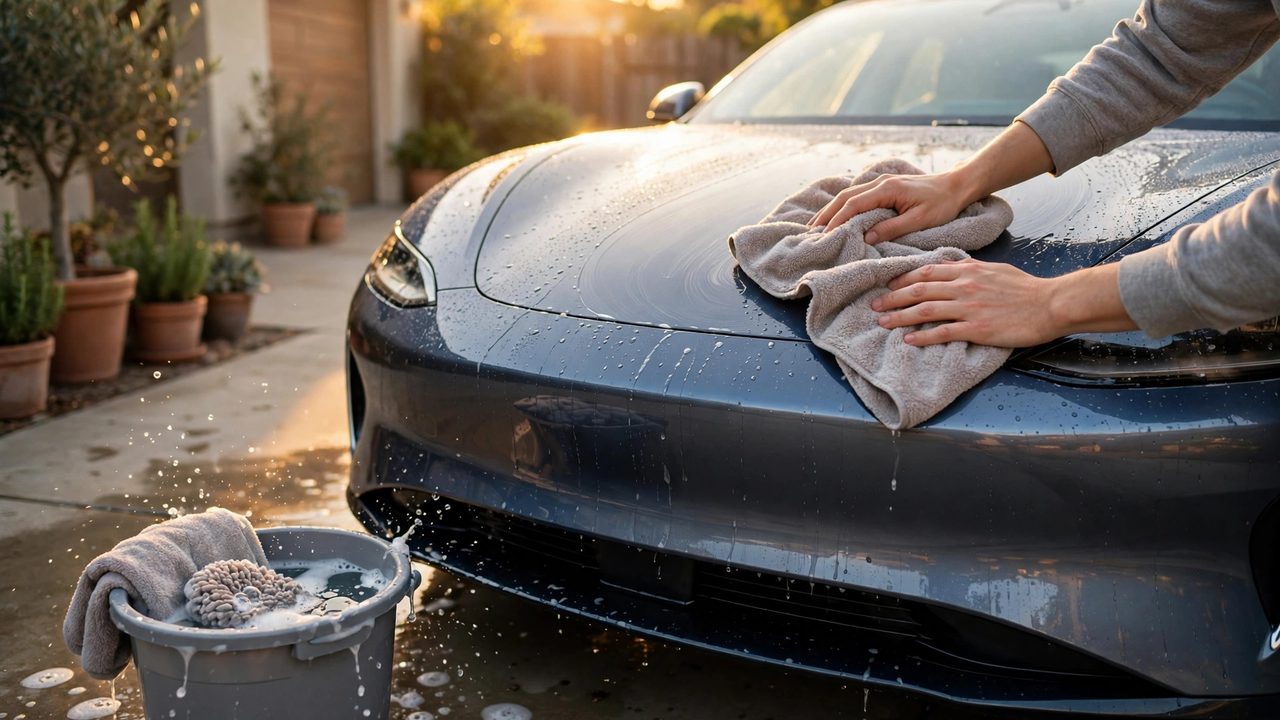
Tesla Model 3 owners tend to notice wash marks early. The car’s broad, flat panels, frameless glass and smooth trunk lid show fine swirls and drying streaks clearly, especially on darker colours, and the paint is widely treated by detailers as a finish that rewards a gentle touch. None of the towels in this guide is sold as a Tesla-approved accessory, and no maker here claims a Model 3 endorsement. The Model 3 angle is simpler than that: soft automotive paint care, done with towels whose fibres, edges and construction are listed clearly enough to judge before anything touches the car. Choosing the best microfiber towels for tesla model 3 paint finish care comes down to matching the towel to the job, because the cloth that dries a soaked roof panel should not be the same cloth that levels a coating or buffs off wax.
A sensible Model 3 towel kit has three layers. First, a large twist-loop drying towel that lifts water off the roof, bonnet, doors and trunk in long, low-pressure passes. Second, a plush edgeless towel for detail sprays, rinseless washes and final wipes, where nothing stitched or banded ever crosses the paint. Third, a dual-pile or mid-weight towel for polish and sealant removal, where a shorter face can bite into residue while the plush face finishes. The six towels below cover those three jobs, and every specification quoted comes from the maker’s own listing material, phrased throughout as the maker lists it.
Quick verdict
For most Model 3 owners, the balanced starting point is The Rag Company Gauntlet Drying Towel in the 20 by 30 inch size for drying, paired with The Rag Company Eagle Edgeless 500 Towel for final wipes. The Gauntlet’s hybrid twist-loop and plush build pulls water quickly without the bulk of the very heaviest drying towels, and its suede border keeps the perimeter soft. The Eagle Edgeless 500 is the classic buffing towel: circular knit, fully edgeless, and plush enough for wax, sealant and detail spray work on clean paint.
Owners who wash a Model 3 outdoors and want the fewest drying passes should look at The Rag Company Liquid8r Drying Towel, the largest and densest dryer here. Owners who polish or apply sealants by hand should add The Rag Company Creature Edgeless Towel, whose dual pile was designed for exactly that residue work. Chemical Guys Professional Grade Premium Microfiber Towels are the high-count workhorse set for households that want a fresh towel for every panel and every step. The Rag Company Eagle Edgeless 600 Towel is the softest finishing option, reserved for the last buff on paint that is already clean.
The products in this guide
The Rag Company Gauntlet Drying Towel
The Gauntlet is the drying towel most Model 3 owners should start with
Best if you want one proven drying towel sized for a mid-size sedan
The table below summarises the maker-listed figures that matter for paint work: fabric weight, blend, size and edge. Read the edge column as carefully as the weight column, because on soft paint the border of a towel is often the riskiest part of it.
Selection started with the jobs a Model 3 wash actually involves: sheeting water off large flat panels, drying mirrors, handles and the charge-port area, wiping detail spray without streaks, removing polish and sealant residue, and finishing coated or waxed paint without dragging anything hard across it. A towel had to be a current, named model from a known car-care maker, sold new through Amazon US, with its core specifications published in maker material that could be opened and read: fabric weight where the maker publishes it, blend ratio, size and edge type.
Blend mattered because the ratio of polyester to polyamide shapes both softness and absorbency. Every towel in this guide uses the 70/30 blend that The Rag Company lists across its paint towels and that Chemical Guys lists for its premium towel, a mix the makers present as the softer, more absorbent option compared with firmer 80/20 cloths. Edge design mattered just as much. Edgeless, suede-bordered, silk-banded and hidden-hem constructions all keep a soft material at the perimeter, while exposed overlock stitching was treated as a reason to keep a towel off delicate paint and out of this list.
Weave was the third filter. Twist-loop weaves dominate the drying picks because the looped pile holds a large volume of water and keeps working as the towel loads up. Circular-knit plush weaves fill the buffing slots because their deep, soft pile suits product removal on clean paint. Dual-pile construction earned the Creature Edgeless its place because polish removal genuinely needs two faces: one with bite, one for finishing. Towels whose makers published no verifiable specifications, and towels that could not be tied to a real current listing, were excluded rather than described from guesswork. Where a maker does not publish a figure at all, as with the Chemical Guys towel’s fabric weight, the guide says so plainly instead of filling the gap.
The Gauntlet is the drying towel most Model 3 owners should start with. The maker lists it at 900 GSM in a 70/30 blend of Korean split microfiber, with a hybrid weave that combines twist loop on one working face with plush pile, and a ButterSoft suede border running around the edge. The version linked here is the 20 by 30 inch towel, sold as a single pack in Ice Grey, and the maker lists the same design in smaller and larger sizes for owners who prefer a different footprint. For a sedan the size of the Model 3, the 20 by 30 inch format hits a useful middle ground: large enough to lay across the roof or bonnet and pull toward you in one motion, small enough to fold into quarters and control around the mirrors, window frames and rear spoiler lip.
Twist-loop pile is the right tool for the first minutes after a rinse. The loops stand up from the backing, trap water inside the pile and keep the wettest part of the towel cushioned away from the clear coat, so a laid-flat drag or a gentle pat-and-lift removes water without the scrubbing motion that leaves marks. The plush hybrid character helps at the end of the dry, when only a thin film remains on the doors and rear quarters and a purely looped towel can start to feel grabby. The suede border deserves attention on a Tesla, because the border is what slides around panel edges, the trunk rim and the door tops; a soft suede perimeter is far kinder there than a stitched seam.
Used well, one Gauntlet in this size can handle the bulk of a Model 3 dry, with a smaller towel following for the glasshouse and jambs. Fold it, work panel by panel, and flip to a dry face as each section loads with water. When the towel feels heavy and starts leaving a trail, that is the signal to swap rather than press harder. Pressure is the enemy on soft paint; the pile is supposed to do the work.
Buy it if: you want one proven drying towel sized for a mid-size sedan, with a soft suede border and a hybrid pile that finishes as well as it dries.
Skip it if: you want the absolute largest drying footprint for the fewest possible passes, or you prefer a waffle weave that wrings out more easily between panels.
The Liquid8r is the heavy lifter of the group. The maker lists it at 1100 GSM in a 70/30 blend, with a long twist-loop weave and a hemmed hidden edge, and the version linked here measures 25 by 36 inches in Aqua Blue. That combination of density and footprint is aimed at one thing: removing a lot of water in very few passes. On a Model 3, the big flat roof panel, the bonnet and the trunk lid are where this towel earns its keep, because a single laid-flat pull can clear most of the standing water from each surface before the towel needs attention.
The hidden hem is a thoughtful detail for paint work. Instead of an exposed stitched border, the edge is hemmed in a way that keeps the seam tucked away from the contact surface, so the perimeter that wraps around panel edges stays soft. Long twist loops hold water deep in the pile, which matters on a car with frameless windows and a glass roof, where rinse water keeps escaping from seals and trim for minutes after the main dry. A towel that still has capacity when those late drips arrive saves the second round of wiping that often causes streaks.
The trade-off is handling. A 25 by 36 inch towel at this density becomes genuinely heavy when saturated, and it needs care around the lower doors and sills so a loaded corner never drags near the ground and picks up grit. Many owners will use it as the first-pass towel only: clear the roof, bonnet, trunk and upper doors, then hand over to a smaller, plusher towel for the final wipe. Used that way, the Liquid8r shortens the wettest, riskiest part of the wash, when the most water and the most remaining contamination are moving across the paint.
Buy it if: you wash outdoors, dry in the open air where water spots form quickly, and want maximum pickup per pass on the Model 3’s large flat panels.
Skip it if: you find large towels awkward, wash in a tight garage bay, or prefer to work with several smaller towels you can swap and wring frequently.
If the drying towels handle the water, the Eagle Edgeless 500 handles everything that comes after. The maker lists it at 500 GSM in a 70/30 blend, with a circular-knit weave and a fully edgeless construction, made in South Korea. The version linked here is the 16 by 16 inch towel in Red, sold as a four-pack. There is no border, no banding and no tag to remove: the pile simply runs to the edge of the towel, which is exactly what a final-wipe towel should do on soft clear coat.
Circular-knit plush pile behaves differently from twist loop. It is softer and loftier, designed to cushion contact while you spread and remove detail spray, spray wax, sealant or a rinseless wash solution. On a Model 3, this is the towel for the weekly maintenance wipe, for drying aids sprayed onto still-damp panels, and for the last pass over the doors and rear quarters before the car goes back on the road. The 16 by 16 inch size folds into a thick pad with eight clean faces, so a four-pack gives a careful owner a fresh face for nearly every panel.
Colour choice is practical, not cosmetic. Picking one colour for paint towels and a different colour for wheels, jambs and interior work is the simplest defence against cross-contamination, and the Eagle line’s colour range makes that system easy to keep. Keep these towels for clean paint only. The moment an Eagle is used on a dirty sill or a wheel, it should leave the paint rotation permanently, because the plush pile that makes it gentle also holds onto anything it picks up.
Buy it if: you want the benchmark edgeless buffing towel for detail sprays, spray sealants, rinseless washes and final wipes on clean Model 3 paint.
Skip it if: your main need is bulk drying capacity, or you want one towel type to cover dirty jobs as well as finishing work.
The Creature Edgeless solves a specific problem: removing product that does not want to come off. The maker lists it at 420 GSM in a 70/30 blend, with a dual-pile design and an ultrasonic cut edge, in a 16 by 16 inch size. The version linked here is the Lime Green ten-pack. One face carries a plush pile for gentle buffing, while the other face is shorter and tighter, giving it the bite to break down polish residue, stubborn sealant haze and wax that has dried harder than intended.
That two-face layout maps neatly onto hand polishing and sealant work on a Model 3. Use the shorter face to work across a panel and lift the residue, then flip to the plush face for the finishing pass that clears the last haze. The ultrasonic cut edge keeps the perimeter free of stitching, so the towel can be used right up to badges, panel gaps and the edges of the trunk and bonnet without a hard seam crossing the paint. At 420 GSM it sits deliberately below the Eagle towels in plushness; that is a feature for this job, because an overly lofty towel tends to skate over dried residue instead of gripping it.
The ten-pack format matters more than it first appears. Polish and sealant removal loads a towel with product quickly, and a loaded towel starts smearing rather than removing. Having a stack of identical towels means you can retire each one as soon as it loads up and keep working with a fresh face, which is both faster and safer on soft paint. Retired Creature towels also make a sensible second life as jamb and trim towels, clearly separated by their colour from the finishing set.
Buy it if: you remove polish, wax or sealant by hand and want a dual-pile, edgeless towel bought in a pack sized for frequent swapping.
Skip it if: you never apply products that need removing and only need drying and detail-spray towels, where plusher options serve better.
Chemical Guys takes the opposite approach to the specialist towels above: one versatile design, bought in quantity. The maker lists the Professional Grade Premium towel in a 70/30 microfiber blend with silk-banded edges and a dual pile, a shorter face for general wiping and a higher pile face for buffing. The version linked here is the Gold towel measuring 16 by 16 inches, sold as a pack of twelve under the maker’s model MIC_506_12. The maker does not publish a GSM figure for this towel, so its density cannot be compared on paper with the numbered towels in this guide; judge it by its blend, its pile and its edges instead.
Silk banding is the defining detail. All four edges are wrapped in a soft silk band, which protects the perimeter stitching and gives the towel a finished edge that glides rather than catches. It is not the same as a truly edgeless towel, and on the very softest finishes an edgeless design remains the more cautious choice for the final buff. But for the dozens of other touches in a wash routine, removing quick detailer, wiping glass, cleaning door jambs, drying wheels after the paint is done, a banded towel in a large pack is the practical answer.
Quantity changes behaviour for the better. With twelve matching towels, there is no temptation to keep using a towel that should have been retired mid-wash, and colour-coding by pack becomes easy: one colour for paint, another for everything else. The bright Gold pile also shows trapped dirt clearly, which makes it simple to see when a face is spent and the towel needs flipping or replacing. For a Model 3 household that washes frequently and wants a deep bench of towels rather than a few precious ones, this set covers the everyday workload and leaves the specialist towels fresh for finishing.
Buy it if: you want a large matching set of dual-pile, silk-banded towels for the general workload of frequent washing, with a fresh towel always within reach.
Skip it if: published fabric weight matters to you when comparing towels, or you want a fully edgeless design for every towel that touches the paint.
The Eagle Edgeless 600 is the indulgent end of the Eagle family. The maker lists it at 600 GSM in a 70/30 blend, with the same circular-knit weave and edgeless construction as the 500, in a 16 by 16 inch size made in South Korea, and describes it as its softest towel. The version linked here is the Dark Grey towel sold as a three-pack. That extra density over the 500 is not about absorbency for drying; it is about pile depth and cushioning during the very last contact the paint receives.
Reserve this towel for clean, finished paint: the final buff after a sealant has been levelled with a work towel, the gentle wipe that removes the last detail-spray haze, or the finishing pass on a coated car after a maintenance wash. On a dark Model 3, where every faint drag mark shows under garage lighting, that deep pile and complete absence of edging make a real difference to how confidently you can finish a panel. The Dark Grey colour also suits owners who prefer towels that do not show every trace of removed product.
Because it is the softest and most specialised towel here, it should also be the most protected. Keep the three-pack separate from general towels, wash it only with other premium microfiber, and retire a towel from this duty the first time it is dropped on the ground or used on anything dirty. Used with that discipline, the Eagle Edgeless 600 is a small, focused upgrade: not a towel for the whole wash, but the right last touch for owners who finish their car carefully and inspect the result closely.
Buy it if: you want the maker’s softest edgeless towel for final buffing on clean, dark or freshly protected Model 3 paint.
Skip it if: you need towels that can rotate through dirty jobs, or the Eagle Edgeless 500 already covers your finishing work and you would rather spend on drying capacity.
Buying guide
Match the weave to the job first. Twist loop is the drying weave: its looped pile stores water and keeps working as it loads, which is why both drying picks here use it. Circular-knit plush is the finishing weave, soft and lofty for sprays and final wipes. Dual pile is the removal weave, pairing a shorter working face with a plush finishing face. Waffle weave, used by some drying towels outside this guide, wrings out easily and suits glass, but holds less water per pass than a comparable twist loop. Buying by job rather than by headline softness prevents the common mistake of drying with a buffing towel and buffing with a drying towel.
Read GSM in context. GSM is grams per square metre, a measure of fabric density. Within one weave family, higher GSM generally means a plusher, more absorbent towel, which is why the drying picks sit at 900 and 1100 while the buffing picks sit between 420 and 600. Across different weaves the number compares less cleanly, and a maker that publishes no GSM, as Chemical Guys does not for its premium towel, is not automatically offering a thin towel; it simply means density cannot be part of your comparison for that product.
Check the blend. The 70/30 polyester-to-polyamide blend used by every towel here is the ratio the makers present as the softer, more absorbent choice for paint. Firmer 80/20 towels have their place on interiors, wheels and dirty work, but for the towels that touch Model 3 paint during drying and finishing, 70/30 is the specification to look for on the label.
Treat the edge as a safety feature. Edgeless towels remove the border question entirely. Suede borders, silk banding and hidden hems all keep a soft material at the perimeter. Exposed overlock stitching is the construction to keep away from delicate finishes; towels built that way belong on jambs, interiors and wheels. Whatever the edge, remove or avoid tags before first use, since a tag is a hard foreign object sewn to an otherwise soft towel.
Size the kit to the car. A Model 3 is a mid-size sedan with large flat panels and a glass roof. One large drying towel in the 20 by 30 to 25 by 36 inch range, a four-pack or more of 16 by 16 inch finishing towels, and a multi-pack of removal or general towels covers a careful wash with spares. Folding a 16 by 16 inch towel into quarters gives eight working faces, so pack counts translate into more clean contact area than they first suggest.
Wash towels like equipment, not laundry. Wash microfiber separately from cotton, which sheds lint into the pile. Use warm or cool water and a detergent without fabric softener, since softeners coat the fibres and destroy absorbency. Dry on low heat or air dry, and never use dryer sheets. Wash new towels before first use, store them in a closed container away from garage dust, and inspect each towel before it touches paint. A towel dropped on the ground should be washed before it returns to paint duty, and any towel that feels stiff, grabby or contaminated should be demoted to dirty work.
Use technique that protects the finish. Dry with the towel laid flat and pulled slowly, or pat and lift panel by panel, rather than scrubbing in circles. Work from the roof down so water and any remaining grit move away from finished panels. Use a drying aid or detail spray as lubrication on the final wipe when the maker of your protection product allows it. And keep paint towels, glass towels and wheel towels in separate colours or separate bins, because the most expensive towel in this guide cannot protect paint once it has been used on a brake-dust-covered wheel.
FAQ
Are any of these towels officially approved for Tesla paint?
No maker here lists a Tesla approval for these towels, and this guide does not claim one. The picks were chosen because their maker-listed blends, weaves and edge designs suit soft automotive paint care generally, which is the approach Model 3 owners can verify from the specifications themselves.
How many towels does a Model 3 wash actually need?
A practical minimum is one large drying towel, two to four plush 16 by 16 inch towels for finishing, and a small stack of general or removal towels for jambs, glass and product work. Multi-packs help because a fresh, clean face matters more than any single specification once the wash is under way.
Is a higher GSM always better for paint?
Not on its own. Higher GSM helps a drying towel hold more water and gives a finishing towel more cushion, but weave, blend and edge design matter just as much. A 420 GSM dual-pile towel removes polish residue better than a 600 GSM plush towel, because the job needs bite as well as softness.
Can one towel do everything?
A mid-weight edgeless towel can cover light drying and finishing in a pinch, but a single towel type forces compromises: drying wants capacity, removal wants bite, and finishing wants maximum plushness with no edge. A small kit split by job is safer for the paint and faster in practice.
How should microfiber towels be washed?
Wash them separately from cotton, in warm or cool water, with a detergent that contains no fabric softener, and dry on low heat or air dry without dryer sheets. Softeners and heat damage the split fibres that make microfiber absorbent and gentle.
When should a paint towel be retired?
Retire a towel from paint duty when it feels stiff or scratchy, when it leaves lint, when it has been used on wheels or heavy contamination, or when debris stays embedded in the pile after washing. Demoted towels remain useful for jambs, interiors and wheels, clearly separated from the paint set.
Conclusion
A Model 3 does not need a cupboard full of exotic towels. It needs the right construction for each contact with the paint: a twist-loop dryer with a soft border for the water, an edgeless plush towel for sprays and final wipes, a dual-pile towel for product removal, and, for owners who finish carefully, the softest edgeless towel reserved for the last buff. The Gauntlet and Eagle Edgeless 500 cover the core of that system, the Liquid8r adds maximum drying capacity, the Creature Edgeless handles residue, the Chemical Guys set supplies depth in numbers, and the Eagle Edgeless 600 finishes the job. Choose by the maker-listed GSM, blend, size and edge, keep the sets separate, wash them properly, and the towels will treat the Model 3’s finish as gently as the specifications promise.
M
Modern Line Home Editorial Team
We compare specs, materials and verified owner reviews before a product earns a spot. Rankings are never paid.
Affiliate disclosure. As an Amazon Associate we earn from qualifying purchases at no extra cost to you. Prices accurate as of the date shown.
House cold even with the heat on? Walk this ordered checklist: thermostat and filter first, then drafts, insulation, leaky ducts and a failing heating system.
Windows fogging up in winter? Check where the fog sits: on the room side it is indoor humidity, outside it is harmless, and between panes the seal has failed.
Store the main firewood pile about 30 feet from your house, off the ground and covered only on top. Compare racks, woodsheds, garages and indoor spots safely.
Place a portable generator outdoors only, at least 20 feet from windows, doors and vents, exhaust pointed away. Exact distances, setup steps and CO rules here.
Keep houseplants in the right winter spot: match window direction to plant type, stay clear of radiators and cold glass, and fix dry air and low light at home.
Mice enter through pencil-width gaps at foundations, pipes, vents, doors and the roofline. Walk this room-by-room winter checklist to find and seal each one.
A winter outage timeline: what to do in the first hour, first night and multi-day outage, with food safety times, pipe protection, heat and CO safety steps.
Size a space heater by room area: 10 watts per square foot at 8-foot ceilings, adjusted for insulation and ceiling height, with full wattage and BTU tables.
Start dripping at about 20 degrees, sooner for exposed pipes. Set a pencil-lead stream, drip the right faucets on both lines, and know when to stop safely.
A fridge needs 800-1,200 starting watts, not just 150-400 running watts. Use the tables to total your fridge plus freezer, lights, furnace fan and more today.












Write Your Review
No reviews yet. Be the first to share your experience!