We independently review everything we recommend. When you buy through our links, we may earn a commission. As an Amazon Associate we earn from qualifying purchases.
Best Cold Weather Slippers for Backpacking and Camp
Find the best cold weather slippers for backpacking: insulated down and synthetic camp booties compared by fill, weight, sole and pack size for cold camps.
Find the best cold weather slippers for backpacking: insulated down and synthetic camp booties compared by fill, weight, sole and pack size for cold camps.
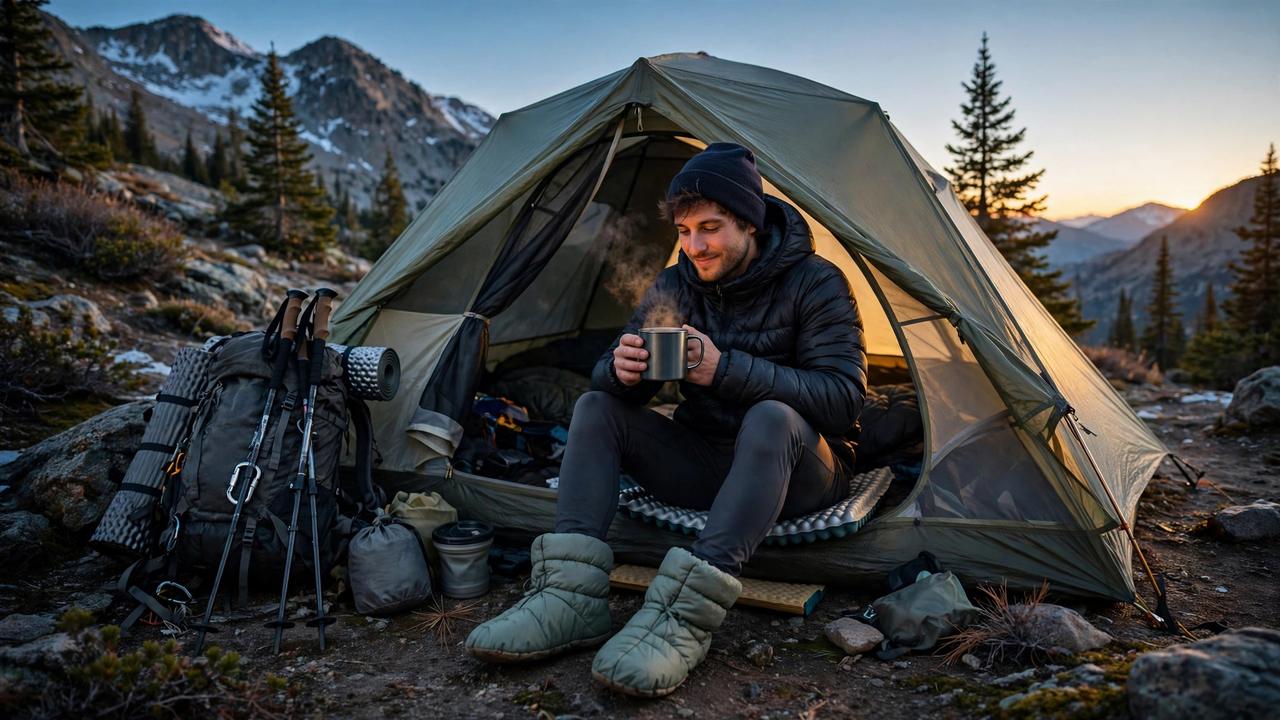
Cold camp changes the maths of a backpacking day. You can walk well, eat well and pitch carefully, and still lose the evening to cold feet inside a tent that never quite warms up. Trail shoes come off, socks alone meet cold ground through a thin tent floor, and every trip outside for water or a stove check becomes a small negotiation. That is the gap camp booties fill. The best cold weather slippers for backpacking are not house slippers carried outdoors by accident. They are insulated, packable footwear built for camp: lofty fill over the toes and ankle, a sole that can handle a tent porch, frozen grass and a short walk to a water source, and a shape that compresses into a pack corner instead of demanding its own compartment.
This guide compares six real models from established outdoor makers, spanning the main choices a cold-weather backpacker actually faces. There is a structured, treaded bootie for camps where you will be moving around outside a lot, plush synthetic booties that tolerate damp tent life, a high-loft down bootie for dry cold, a lighter synthetic boot for hut and tent use, and a heavier, grippier model for winter camps where the ground itself is the problem. Every specification below is drawn from an opened maker or retailer page for that exact model, and the phrasing follows the maker lists convention used throughout: if a fill, weight, sole or size range appears here, the maker lists it for that product.
One honest starting point matters. Camp slippers are camp footwear, not hiking footwear. None of the six below is made for miles on a trail, for kicking steps in hard snow, or for standing water and deep mud. Their job starts when the walking stops. Judged on that job — warmth while you are still, protection from cold ground, packability on the way in, and a sole suited to camp wear — the differences between them are clear and worth understanding before you choose.
Quick verdict
For most backpackers who want one pair that works inside the tent and for repeated trips outside it, the ThermoBall Traction Booties are the easiest recommendation in this set, because the maker lists a recycled rubber outsole with real traction alongside synthetic insulation that keeps working when it gets damp. For pure tent and sleeping-bag warmth on a tight pack, the Baffin Cush Booty and the Rab Cirrus Hut Boot are the lighter, softer answers, with the Rab design adding a more structured footbed and a reinforced lower edge. For dry, cold nights where loft is the priority, the Sierra Designs Down Booties bring treated down in a mid-calf cut. The Exped Camp Booties sit in a useful middle place: fully recycled materials as the maker lists them, a thin insulated sole, and a high, flexible shape that packs small. The Outdoor Research Tundra Trax Booties are the heavy-duty end of the group, with the thickest synthetic fill listing here and a rubber traction sole, suited to winter base camps rather than fast, light travel.
If your camps are mostly dry and cold, choose down or a high-loft synthetic and save weight. If your camps are damp, coastal, thawing or shared with melting snow, choose synthetic fill and a sole you can wipe clean. If you will be in and out of the tent all evening, prioritise the sole and the cuff over a small weight saving. Those three decisions explain almost every difference in the table that follows.
The products in this guide
The North Face ThermoBall Traction Booties
The ThermoBall Traction Booties with ThermoBall Eco insulation made from 100% recycled polyester, in small round synthetic clusters designed to trap
Best if you want one camp pair for tent, hut and trailhead use
PrimaLoft Gold with Cross Core technology, 200 g per square metre
456 g per pair
Rubber traction sole
XS to XL
Read the table as a set of trade-offs, not a ranking. The lightest pair here is not the warmest for standing on frozen ground, because ground cold arrives through the sole, not through the upper. The heaviest pair earns its weight with fill thickness and a rubber sole, which is either exactly what a winter base camp needs or exactly what a long-distance pack does not. Fill type matters in a different way: down compresses smallest and lofts highest for its weight in dry cold, while synthetic fills keep more of their structure when tent condensation, damp socks or melting snow get into the picture.
How we selected
Selection started with the use case in the keyword itself: cold weather, backpacking, and camp. A model had to be an insulated camp slipper or bootie in its own right, not a casual house slipper, not a winter boot, and not an uninsulated camp shoe. It had to be packable in principle, with insulation over the foot and, for most models, coverage at or above the ankle, because ankles are where tent drafts and cold air pooling on a groundsheet do their work overnight.
Each product was then checked on opened pages. The maker page, or a retailer page carrying the full maker specification for that exact model, had to confirm the product name, the insulation, the sole construction and the size range. Products whose specifications could not be confirmed that way were excluded entirely rather than described from memory or from round-up snippets. Where sources disagreed on a figure — down booties in particular have older and newer versions in circulation — the current maker-aligned specification was used and the older figure left out.
Amazon availability and ASINs were handled separately and conservatively. An ASIN is recorded in the accompanying products file only when it was pinned to the exact model by an opened Amazon product page, a search result unambiguously showing that product page link, or a third-party page binding the code to that model. Where that standard was not met, the product appears with a plain heading and no shopping link, and the file records it as not found. That is deliberate: a wrong link to a sibling variant helps nobody, and several of these booties are sold in men, women and unisex versions that look nearly identical.
Finally, the set was balanced on purpose. A guide that listed six near-identical soft down socks would not help a backpacker choose. This set spans structured and soft soles, down and synthetic fills, low and high cuts, and a weight range from just over two hundred grams to just under five hundred, so the buying guide at the end can map each design to the kind of camp it actually suits.
The maker lists the ThermoBall Traction Booties with ThermoBall Eco insulation made from 100% recycled polyester, in small round synthetic clusters designed to trap heat in air pockets in the way down does, while continuing to insulate when wet. The upper is 100% recycled PET ripstop with a non-PFC durable water-repellent finish, and the outsole is recycled rubber — listed at 20% recycled content on the Amazon product details for the men’s version — with traction as its stated purpose. A fleece collar lining and a collapsible heel with elastic side panels complete a design that is closer to a soft shoe than to a sock with a sole attached.
That structure is the point. Of the six models here, this is the one to choose when camp involves repeated outdoor movement: fetching water after dark, standing on a frozen hut porch, crossing a snowy car park at a trailhead, or managing a dog outside the tent at midnight. The rubber outsole gives purchase on icy paths and wet decks where silicone-print soles can skate, and the ripstop upper shrugs off the scuffs that come with that kind of use. The trade-off is equally clear in the maker-listed weight of 482 g for the pair and in the packed bulk: these do not compress like a down sock, and they take a real corner of a winter pack.
Sizing needs care. The maker lists whole sizes only, so anyone between sizes has to make a judgement call, and the insulation can pack out slightly with wear, changing the feel over a season. The low profile also leaves more of the ankle exposed than a high bootie does, which matters in deep cold or when snow reaches the cuff. Worn with a proper winter sock, though, the fit is secure enough for camp movement without the heel slop that plagues softer designs.
Buy it if: you want one camp pair for tent, hut and trailhead use, you expect to walk outside on cold, slick ground every evening, and you prefer synthetic insulation that tolerates damp conditions.
Skip it if: pack weight and compressed size are your first priorities, you mainly need warmth inside a sleeping bag, or you want high coverage over the ankle for deep winter camps.
Baffin describes the Cush Booty as a sleeping bag for your feet, and the maker lists the construction to match that idea: a fixed-fit multi-layer inner boot system, a PolyWool polyester wool blend footbed for breathable warmth, and a mid-height Hex-Flex reinforced hexagonal nylon upper intended to improve durability and rip resistance. The maker lists B-Tek Dry water resistance rather than waterproofing, a slip-on shape, and an elasticised lockable tie with a drawstring toggle at the top to protect against the elements. The base is a durable nylon bottom with added silicone for slip resistance.
The maker lists the pair weight at 0.69 lb based on a unisex medium, with a height of 6 inches, and the size range is unusually wide, running from small through to 3XL in unisex sizing, which makes this one of the easier models in the set for very small or very large feet, or for wearing over thick expedition socks. In camp terms, this is a tent, hut and cabin bootie first. The soft sole is made for tent floors, hostel bunks, sleeping bags and short, careful steps outside on a porch or a packed path, not for frozen rubble or icy slopes.
That softness is also its comfort. There is no rigid structure to break in and no firm footbed edge, so the bootie wraps the foot rather than holding it, which many people prefer for sleeping in on the coldest nights. The drawstring matters more than it looks: cinched, it keeps the loft around the ankle and stops the bootie rotating or slipping off inside a bag; left loose, the same pair is easy to kick on for a midnight exit. Care follows the soft construction, with the maker advising hand washing and air drying rather than machine cycles.
Buy it if: you want plush, packable warmth mainly for inside the tent, hut or sleeping bag, you value a very wide unisex size range, or you plan to sleep in your booties on cold nights.
Skip it if: you need a treaded sole for icy ground, you expect prolonged wet conditions around camp, or you want firm underfoot structure for standing and working outside.
Exped Camp Booties
The maker lists the Exped Camp Booties as a high, flexible and soft bootie made from 100% recycled materials, with synthetic insulation, an elastic ankle strap and a top cuff intended to give a close fit, and a non-slip, comfortable 4 mm sole that also insulates from the ground. Retailer specifications for the model list the pair at 232 g in a medium, which places it at the light end of the soled booties in this guide, and the sizes run from small to extra large. Two elastic straps are supplied for packing the pair down, a small detail that suits how backpackers actually carry soft footwear: bound tight, in a side pocket or strapped under a lid.
The design logic is recovery and simplicity. After a day in stiff boots, a soft, high bootie with light insulation lets feet rest without the pressure points of a structured shoe, and the synthetic fill is a sensible match for tent life, where condensation drips, damp groundsheets and wet socks are normal rather than exceptional. The 4 mm sole is enough for tent porches, grass, pine needles and short walks on packed camp ground, and the anti-slip surface helps on smooth hut floors. It is not a sole for ice, sharp gravel or long standing on frozen earth, and the thin insole is the first place cold will be felt in deep winter.
Fit reports on retailer pages suggest the shape can feel roomy, which is worth knowing if you are between the listed sizes or plan to wear the booties over a single thin sock. With a thicker camp sock the roominess becomes an advantage, adding still air around the foot. For backpackers who count grams but still want a real sole between foot and groundsheet, this is one of the most balanced specifications in the set.
Buy it if: you want a light, packable, fully recycled camp bootie with a thin insulated sole for tent and hut use, and your camps are cold but not expedition-grade.
Skip it if: you stand for long periods on frozen ground, you need aggressive traction, or you want the maximum loft of a down-filled high bootie for the coldest nights.
Sierra Designs Down Booties
The current Sierra Designs Down Booties are listed with 550-fill DriDown insulation — down treated with a hydrophobic finish intended to resist wetting out and dry faster than untreated down — inside a 50% recycled nylon ripstop shell with a PFC-free durable water-repellent treatment. The maker-aligned specification lists a 100% polyester tricot liner, a smooth silicone grip sole, a mid-calf height with an adjustable closure, and a weight of 269 g for a size medium, in unisex sizes from XS to XL. Earlier versions of this long-running model were listed with different fill figures, so checking the current product page before ordering is sensible.
This is the down option in the guide, and its strengths follow from that. Down gives the highest loft for its weight here, wraps the foot and ankle in a continuous layer of still air, and compresses smaller than a synthetic bootie of similar warmth, which is why designs like this have been a winter backpacking staple for decades. The mid-calf cut extends that warmth further up the leg than any other model in this set, sealing the gap that opens between a sleeping bag footbox, a sock top and a trouser hem when you sit up to cook or read in the tent.
The limits are down’s limits. The DWR shell and treated fill handle tent condensation, frost and a damp porch, but prolonged wet, slush or mud will defeat the insulation, and the flat silicone sole is a grip aid for tent floors and dry camp ground, not a tread for ice. The broad unisex size bands can also feel generous, so the adjustable cuff closure is not decoration: use it. Kept dry in a waterproof stuff sack during the day, this pair rewards the care with the warmest-feeling loft in the set for its packed size.
Buy it if: your winter camps are dry and cold, you prioritise loft and compressibility, and you want insulation that continues to mid-calf inside the tent and sleeping bag.
Skip it if: your camps are regularly wet or thawing, you need a treaded rubber sole, or you do not want to manage down’s need to stay dry in the pack.
The maker lists the Cirrus Hut Boot with PrimaLoft Silver Insulation Luxe made from 100% recycled fibres, a recycled 30D Pertex Quantum shell with a fluorocarbon-free water-repellent finish, and a 600D nylon reinforced lower edge where booties scuff against floors, stoves and each other. Underfoot there is a padded EVA footbed over a flexible PU outsole. The listed weight is 206 g per pair in a size medium — the lightest soled boot in this guide — and the unisex sizes run from XS to XL. An ankle cuff with drawcord and a heel loop finish the boot version; the lower Cirrus Hut Slipper from the same family is a different product and should not be confused with it when ordering.
The boot cut is the reason to choose this model over its slipper sibling. It covers the ankle, cinches against drafts, and keeps the insulation in place when you move around a hut or cross a cold tent vestibule, while the synthetic fill keeps working when the boot picks up damp from tent walls or melted snow brought in on socks. Pertex Quantum is a tightly woven, wind-resistant shell fabric, so the boot sheds the moving air that makes thin tent walls feel colder than the thermometer suggests.
Underfoot insulation is the honest weakness of any bootie this light, and the Cirrus Hut Boot is no exception: on a frozen floor or snow-covered ground, cold will arrive through the sole sooner than it will through the upper, so standing on a foam pad or your sleeping mat edge in camp is a practical habit, not a workaround. The flexible sole is made for floors and gentle camp ground rather than ice. Within those limits, the specification is exceptionally efficient: real ankle coverage, recycled synthetic warmth and a reinforced lower, at a listed weight many backpackers will accept even on longer routes.
Buy it if: you want the lightest high-cut synthetic bootie here for tents, huts and bothies, especially where damp is likely and down is a risk.
Skip it if: you need deep-winter underfoot insulation for standing on snow, strong grip on ice, or the plush sleeping-bag feel of a soft, sole-less design.
The maker lists the Tundra Trax Booties with PrimaLoft Gold insulation with Cross Core technology at 200 g per square metre, a 100% recycled Pertex Quantum Eco shell that is water-resistant, wind-resistant and breathable, and a rubber traction sole intended for icy surfaces. The specification also lists a drawcord-adjustable cuff, a memory foam insole with EVA foam, and a PU mudguard, at a listed weight of 456 g per pair, in sizes from XS to XL. This is, by a clear margin, the most built-up specification in the guide.
That build suits a particular kind of camp: a winter base camp, a ski hut, a snow-covered trailhead or a long static evening where you are cooking, organising gear and moving in and out of shelter on ground that is frozen, slick or both. The thick synthetic fill keeps insulating when it picks up moisture, the rubber sole grips where printed soles give up, and the mudguard protects the lower upper from slush and grit. For a backpacker walking a short distance into a winter camp and staying put, the weight buys genuine function.
For a backpacker walking a long distance, the same specification is the argument against. At 456 g listed, plus the packed bulk of a structured bootie, this pair competes with food and fuel in a winter pack, and it is more footwear than a tent-and-sleeping-bag routine requires. The drawcord cuff also needs occasional re-tightening in use, a minor point that matters on a midnight walk. Choose this model for the camp you will actually have, not the lightest camp you can imagine.
Buy it if: your cold-weather camps are static and wintry, you will be moving around outside on frozen or icy ground, and you want maximum synthetic fill and a rubber sole.
Skip it if: you are travelling fast and light over distance, your camp routine is mostly inside the tent, or packed size matters as much as warmth.
Buying guide
Start with fill type, because it decides how you must treat the booties. Down, represented here by the Sierra Designs model, lofts highest and packs smallest for its warmth, and it feels the warmest in dry cold. It also needs discipline: store the booties in a dry sack, air them when the sun appears, and do not expect full warmth after a wet night in a leaking tent. Synthetic fills — ThermoBall Eco, PolyWool, PrimaLoft Silver and PrimaLoft Gold in this set — give up some loft per gram but keep insulating when damp, dry faster, and suit the reality of condensation-heavy winter tents. For most backpackers in mixed conditions, synthetic is the safer default; for disciplined winter campers in dry cold, down remains the connoisseur choice.
Then judge the sole against your actual camp routine. There are three sole families here. Soft nylon or fabric soles with silicone grip, as on the Baffin model, are for floors, tent groundsheets and sleeping bags. Thin foam or PU soles, as on the Exped and Rab models, add ground insulation and durability for porches, grass and packed earth. Rubber traction soles, as on The North Face and Outdoor Research models, are for ice, wet decks, frozen paths and repeated outdoor movement. Buying a rubber sole for a sleeping-bag routine wastes weight; buying a fabric sole for an icy base camp wastes the whole purchase.
Weight only makes sense alongside warmth. The listed pair weights in this guide run from 206 g to 482 g. That spread is the difference between a luxury you forget you packed and a deliberate piece of winter equipment. A useful test is to ask what the booties replace. If they replace a pair of heavy camp shoes and a pair of thick sleep socks, even the heaviest model here may save weight overall. If they are purely additional, the lightest model that still matches your sole and fill needs is the right one.
Height and cuff design control drafts. Cold air pools at ground level, and a low slipper leaves the ankle — with little insulation of its own — right in that pool. High and mid-calf cuts, drawcords, toggles and elastic ankle straps all exist to seal that gap. If you sleep cold, or your camps involve sitting outside the bag for cooking and sorting gear, prioritise coverage and a cuff you can cinch one-handed with gloves off and cold fingers.
Fit with the sock you will actually wear. Camp booties are usually worn over socks, sometimes over two pairs, and unisex letter sizes and whole shoe sizes both leave room for error. Check the maker’s size chart for the exact model, measure against the sock combination you plan to use, and remember that a slightly roomy bootie with a good cuff is warmer than a tight one, because compressed insulation loses loft. A bootie that slips at the heel on every step, though, will wear its sole unevenly and let cold air pump in and out as you walk.
Plan the carrying system before the trip. Soft booties compress best in a small dry sack clipped inside the pack, away from stove fuel, crampon points and wet outer layers. Structured booties travel better in a side pocket or under the lid where their shape is an asset rather than a problem. At camp, keep booties inside the tent or vestibule, off bare snow, and never leave them where stove heat or sparks can reach synthetic shells, which can be damaged by direct heat.
Finally, match the bootie to the shelter. In a heated hut with wooden floors, almost any model here is comfortable and the lightest is best. In a single-skin tent in thawing conditions, synthetic fill and a wipe-clean sole matter most. In a dry, deep-winter camp, loft and coverage dominate. In a base camp with a cook tent and constant outdoor chores, sole and durability dominate. The right answer changes with the shelter, which is why this guide keeps six genuinely different designs rather than six versions of the same one.
FAQ
Can camp booties be worn inside a sleeping bag?
Yes, and for soft-soled models that is one of their main uses. The Baffin Cush Booty and the Sierra Designs Down Booties are particularly suited to it because their soles are soft and their insulation wraps the whole foot. Keep the soles clean before getting into the bag, cinch or settle the cuff so the bootie stays in place overnight, and make sure the extra foot volume does not compress your bag’s own footbox insulation from the inside.
Are down or synthetic booties warmer for backpacking?
Per gram, down usually lofts higher and feels warmer in dry cold, which is why the down model here is competitive at a moderate listed weight. In damp conditions the comparison reverses in practice, because synthetic fills retain more of their structure and warmth when wet and dry faster in a tent. The honest answer is conditional: down for dry cold and careful packing, synthetic for wet, thawing or condensation-heavy camps.
Can you walk outside in camp slippers?
Short camp walks are exactly what the soled models are made for: tent to porch, vestibule to water source, hut door to woodpile. Rubber-soled models handle icy and slick ground best, thin-soled models suit grass and packed earth, and soft-soled models should stay on floors and groundsheets. None of them is a hiking shoe, and distance, sharp rock, deep mud or steep ice will damage the bootie and risk a fall.
How should insulated booties be washed and stored?
Follow the maker’s care label for the exact model. As a general pattern across this set, hand washing with mild detergent and air drying away from direct heat is the safe route, and the Baffin maker page advises exactly that for its nylon booties. Store booties uncompressed when you can, so the fill keeps its loft, and never store them damp in a sealed sack after a trip.
What size should a backpacker choose?
Use the maker’s chart for that model rather than your trail shoe size alone, and decide while wearing the sock or sock combination you will use in camp. Between sizes, a little extra room usually serves warmth better than a tight fit, provided the cuff or ankle strap keeps the bootie secure. Whole-size models need the most care here, since there is no half size to split the difference.
Do camp booties replace camp shoes in winter?
For most winter backpacking routines, yes: an insulated bootie with a camp-appropriate sole does the job of a camp shoe and a sleep sock in one item, which is the weight case for carrying one. The exception is a camp routine involving long outdoor chores, deep slush or genuinely icy working ground, where a structured bootie helps but a proper insulated boot may still be the safer tool.
Conclusion
Cold feet end more winter evenings early than cold air ever does, and the fix is a small, specific piece of equipment rather than a bigger sleeping bag or a heavier tent. Choose the fill for your conditions — down for dry cold, synthetic for damp camp life — choose the sole for your routine — soft for the sleeping bag, thin for the tent porch, rubber for frozen ground — and choose the weight you will genuinely carry without resentment. On those terms, the ThermoBall Traction Booties are the most versatile pair here for mixed camp use, the Rab Cirrus Hut Boot is the lightest high-cut synthetic answer, the Sierra Designs Down Booties are the loft choice for dry winter nights, the Baffin Cush Booty is the plush tent and hut favourite with the widest size range, the Exped Camp Booties balance recycled construction and low weight with a real sole, and the Tundra Trax Booties are the heavy-duty option for static winter camps. Any of the six, matched honestly to the trip, will change what a cold camp feels like from the moment your trail shoes come off.
M
Modern Line Home Editorial Team
We compare specs, materials and verified owner reviews before a product earns a spot. Rankings are never paid.
Affiliate disclosure. As an Amazon Associate we earn from qualifying purchases at no extra cost to you. Prices accurate as of the date shown.
House cold even with the heat on? Walk this ordered checklist: thermostat and filter first, then drafts, insulation, leaky ducts and a failing heating system.
Windows fogging up in winter? Check where the fog sits: on the room side it is indoor humidity, outside it is harmless, and between panes the seal has failed.
Store the main firewood pile about 30 feet from your house, off the ground and covered only on top. Compare racks, woodsheds, garages and indoor spots safely.
Place a portable generator outdoors only, at least 20 feet from windows, doors and vents, exhaust pointed away. Exact distances, setup steps and CO rules here.
Keep houseplants in the right winter spot: match window direction to plant type, stay clear of radiators and cold glass, and fix dry air and low light at home.
Mice enter through pencil-width gaps at foundations, pipes, vents, doors and the roofline. Walk this room-by-room winter checklist to find and seal each one.
A winter outage timeline: what to do in the first hour, first night and multi-day outage, with food safety times, pipe protection, heat and CO safety steps.
Size a space heater by room area: 10 watts per square foot at 8-foot ceilings, adjusted for insulation and ceiling height, with full wattage and BTU tables.
Start dripping at about 20 degrees, sooner for exposed pipes. Set a pencil-lead stream, drip the right faucets on both lines, and know when to stop safely.
A fridge needs 800-1,200 starting watts, not just 150-400 running watts. Use the tables to total your fridge plus freezer, lights, furnace fan and more today.












Write Your Review
No reviews yet. Be the first to share your experience!